

When seeking telecom system support near me, there's a good chance something is already going wrong. Calls are dropping. A front desk phone won't register. Your VoIP platform works in one office suite but not another. Or you're halfway through an upgrade and suddenly realize nobody has a plan for the old PBX cabinet, the unused PRI handoff, or the stack of phones in the storage room.
That situation is common in Metro Atlanta. A business in Roswell, Sandy Springs, Norcross, or Marietta usually doesn't need "telecom" in the abstract. It needs a local provider who can keep live systems working, help with moves and migrations, and cleanly close out retired equipment so the project is finished.
Why Your Atlanta Business Needs Professional Telecom Support
A Roswell office can go from normal to chaotic fast. Reception can't transfer calls. Sales reps can't reach clients. The conference room phone shows registration errors. The internet circuit is up, but voice quality is bad enough that nobody wants to use it. At that point, the problem isn't "the phones." The problem is that your business communications chain has broken somewhere between carrier service, network hardware, cabling, endpoints, and system configuration.
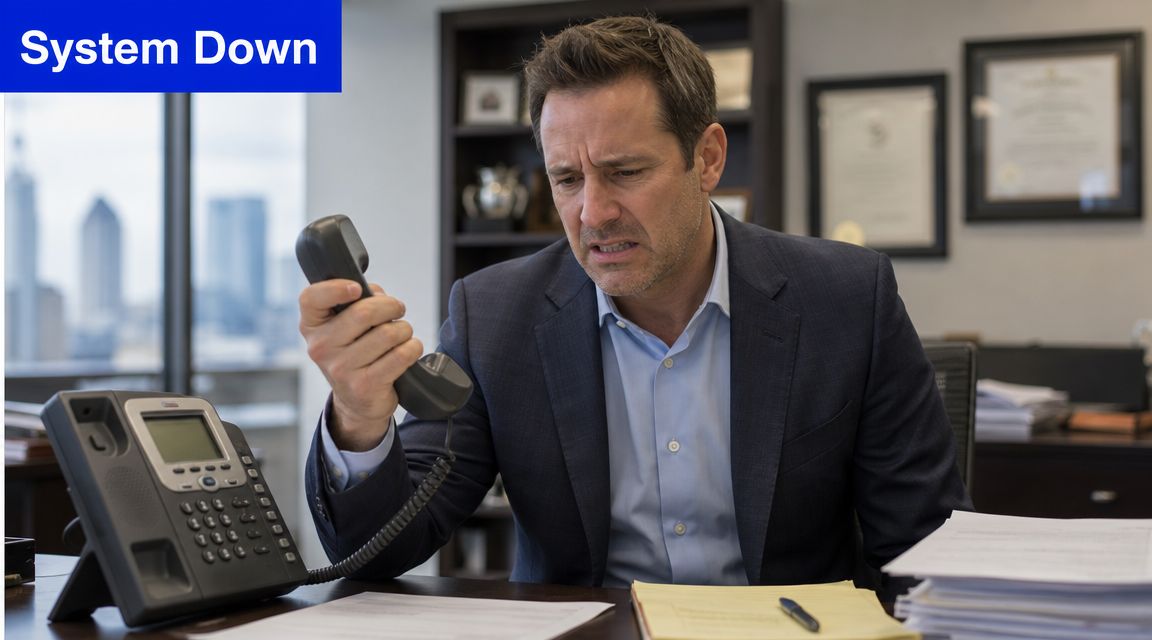
Atlanta businesses feel this more sharply because many operate across multiple sites, hybrid teams, mobile devices, and cloud platforms at the same time. A law office in Sandy Springs might rely on desk phones, softphones, conference bridges, mobile forwarding, and a network closet that also supports access control and internet failover. When one layer slips, users only see the symptom. A qualified telecom support team has to find the cause.
The scale of the broader industry explains why this work isn't simple break-fix labor. The U.S. telecom industry serves around 335 million people and is valued at at least $118 billion, with nearly 400 million smartphone users and mobile penetration above 100%, according to telecommunications industry statistics summarized by Tridens. For a local business, that means your office phone system sits inside a much larger and more complex communications environment than most owners realize.
Support is part of continuity, not a side expense
Treating telecom support as something you buy only after an outage usually costs more in disruption, staff time, and customer frustration. The better approach is to treat it like electrical work for your communications stack. You want someone who understands handsets, switches, VLAN behavior, SIP registration issues, paging, cabling, and the practical realities of field service in Metro Atlanta office buildings.
Practical rule: If calls are tied to revenue, scheduling, dispatch, or compliance, telecom support belongs in your continuity plan.
A strong local partner should also understand how your business uses telecom, not just what model phone sits on the desk. A medical office uses call flow differently than a logistics company. A property management group has different needs than a professional services firm. That's why broad directories alone aren't enough. A more focused starting point is to compare providers that already work in this market, such as business telecom services in Atlanta, then narrow the list based on your environment and urgency.
What usually fails first
In practice, these are the trouble spots that trigger urgent support calls:
- Endpoint confusion: Phones are powered but not provisioned correctly, or users moved desks without reconfiguration.
- Network mismatch: Voice traffic is competing with data traffic, or switch settings don't align with the phone deployment.
- Carrier handoff issues: The office blames the phone system, but the actual fault sits upstream with the provider or circuit path.
- Legacy leftovers: Old PBX gear, analog adapters, fax lines, and partial migrations create hidden points of failure.
Businesses that understand those failure points usually stop asking, "Who can fix this one issue?" and start asking, "Who can own this problem end to end?"
Defining Your Specific Telecom Support Requirements
Before you call vendors in Marietta, Norcross, or Alpharetta, write down what you need. Most bad telecom engagements start with a fuzzy request like "we need phone support." That tells a provider almost nothing. It doesn't clarify whether you're dealing with a cloud calling issue, an on-prem PBX, cabling work, mobile device support, a carrier dispute, or an office move.
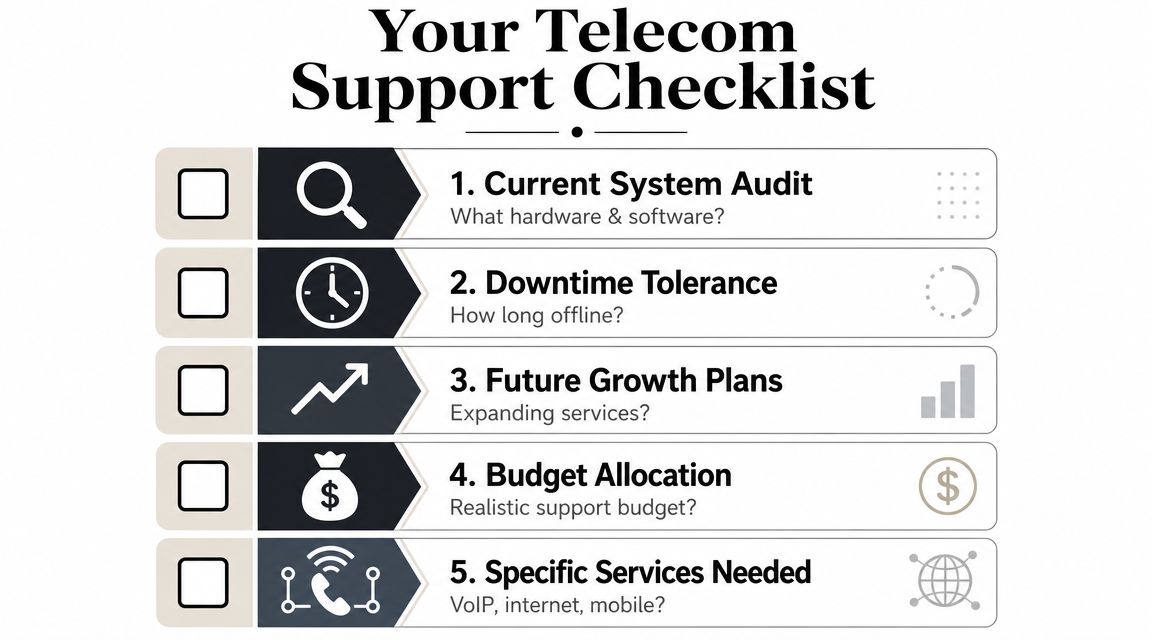
Start with a short internal audit. It doesn't need to be fancy. It does need to be accurate.
Build a real scope of work
A useful requirements list should answer five practical questions.
- What system do you have today: List the phone platform, handsets, conference phones, switches, firewalls, analog lines, fax devices, intercoms, and any carrier-managed equipment.
- What kind of help do you need right now: Emergency repair, routine maintenance, expansion, relocation, cabling, new installation, carrier coordination, or full migration.
- What can't go down: Identify the users and functions that need priority restoration, such as reception, call queues, alarm lines, paging, or executive lines.
- Where is everything located: Include suites, branch offices, warehouse spaces, remote users, and any offsite telecom rooms.
- What happens next year: If you're adding staff, moving floors, consolidating offices, or shifting from PBX to VoIP, support needs will change.
That document will save you time because weak-fit providers eliminate themselves quickly.
Separate live support from project work
A lot of Atlanta businesses lump all telecom needs into one bucket, but they usually belong in two categories.
Live system support covers outages, poor call quality, phone registration failures, extension changes, cabling faults, patching, and routine maintenance.
Project work covers office expansions, cloud migrations, carrier transitions, hardware refreshes, telecom room cleanup, and de-installation of old equipment.
If you don't separate those categories, the vendor conversation gets messy. A provider that's good at dispatching a technician for a dead handset may not be the right firm to handle a staged migration off an aging PBX.
Don't let a vendor define your scope for you. If you don't document your environment first, the proposal will usually reflect their comfort zone, not your actual needs.
Inventory the assets people forget
The most common blind spot isn't the phones on desks. It's the gear behind the scenes. Businesses often forget to count:
- Network closet equipment: Switches, patch panels, UPS units, edge devices, and old rack-mounted telecom hardware.
- Analog dependencies: Fax lines, elevator phones, alarm dialers, postage meters, or door systems that still need legacy connectivity.
- Shared spaces: Conference rooms, warehouse paging, break-room phones, lobby handsets, and cordless devices.
- Old but active circuits: PRI, copper, or transitional services that someone assumed had already been retired.
If you need a reference point for the range of services local firms may handle, review a provider overview such as telecom services in Atlanta. Use it as a checklist, not as a substitute for your own inventory.
Decide your tolerance for downtime
This answer changes everything. A small office that can tolerate a half day of disruption buys support differently than a medical practice, customer service operation, or dispatch-driven business.
Write down the practical answer, not the optimistic one. Which users need same-day help? Which systems can wait? Can calls fail over to mobile devices? Can reception function manually if the main platform is down?
Once you know the business impact, you'll stop shopping for vague "support" and start buying the right response model.
How to Find and Vet Telecom Providers in Metro Atlanta
A search for telecom system support near me will give you a mix of telecom resellers, managed IT firms, cabling contractors, internet brokers, and national call-center operations pretending to be local. Some are useful. Some are middle layers that subcontract everything. You need to know which is which before an outage forces the decision.
The fastest shortcut is local relevance. Favor providers that can clearly explain where they work in Metro Atlanta, what kinds of systems they support, and how they handle onsite service. A vendor that knows Roswell office parks, Buckhead high-rises, warehouse sites near Kennesaw, and branch-office layouts in Cobb or Gwinnett will usually troubleshoot faster than a remote team reading from a script.
Read beyond the homepage
A polished website doesn't tell you much. Vendor pages are written to sound broad and reassuring. What matters is whether the company can describe actual operating process.
The strongest clue is how they talk about incidents. Professional support teams track time-to-first-contact, time-to-escalation, and time-to-resolution, and they don't confuse fast acknowledgment with actual repair quality, as discussed in this HPE community post on support performance metrics. If a provider can only promise a quick callback but can't explain escalation and closure discipline, that's a warning sign.
Ask questions that expose process
Use interviews to find out how a provider works under pressure, not how well they pitch.
| Category | Question |
|---|---|
| Local coverage | Do you dispatch your own technicians in Metro Atlanta, or do you subcontract onsite work? |
| System familiarity | Which phone platforms, VoIP environments, and legacy systems do you support most often? |
| Incident handling | How do you measure first contact, escalation, and final resolution? |
| Carrier coordination | Will you open and manage tickets with the carrier, or do we handle that? |
| Site work | Do you support cabling, patching, switch changes, and telecom closet cleanup? |
| After-hours support | What happens if the outage starts after business hours or on a weekend? |
| Documentation | Will you provide asset inventories, diagrams, configuration notes, and closure records? |
| Migrations | Can you support cutovers from legacy PBX or mixed analog environments? |
| End-of-life planning | Who removes retired gear, and how is equipment tracked after de-installation? |
That last question matters more than most buyers realize. Plenty of firms will install a new system and walk away from the pile they just replaced.
Check whether the provider understands edge cases
Not every business sits in a standard office with perfect connectivity. Some Atlanta-area operations have field teams, temporary sites, rural service areas, or mobile workforces that need different connectivity assumptions. If your business has those requirements, a practical reference on internet for rural and RV businesses can help you think through alternate access scenarios before you speak with a telecom vendor.
A serious provider won't treat every environment the same. They should ask where users work, how voice traffic reaches them, and what fallback options exist when the main connection behaves badly.
Slow resolution usually isn't a technical mystery. It's a process problem. Tickets bounce between help desk, network staff, carrier support, and onsite techs because nobody owns the handoff.
Look for signs of a real local operation
Some good indicators are simple.
- Specific service geography: They name the cities and types of facilities they support.
- Clear escalation path: You can tell who answers, who triages, and who gets involved when the issue is deeper than basic support.
- Field capability: They can handle closet checks, patching, rack work, and hardware replacement onsite.
- Migration fluency: They can talk about old PBX environments, analog dependencies, and post-cutover cleanup without sounding surprised.
If you want a local comparison point while building your shortlist, review telecom providers near Atlanta businesses. Then push every candidate through the same interview questions. Consistency matters. It keeps the loudest salesperson from becoming the default choice.
Understanding the Full Scope of Telecom Services
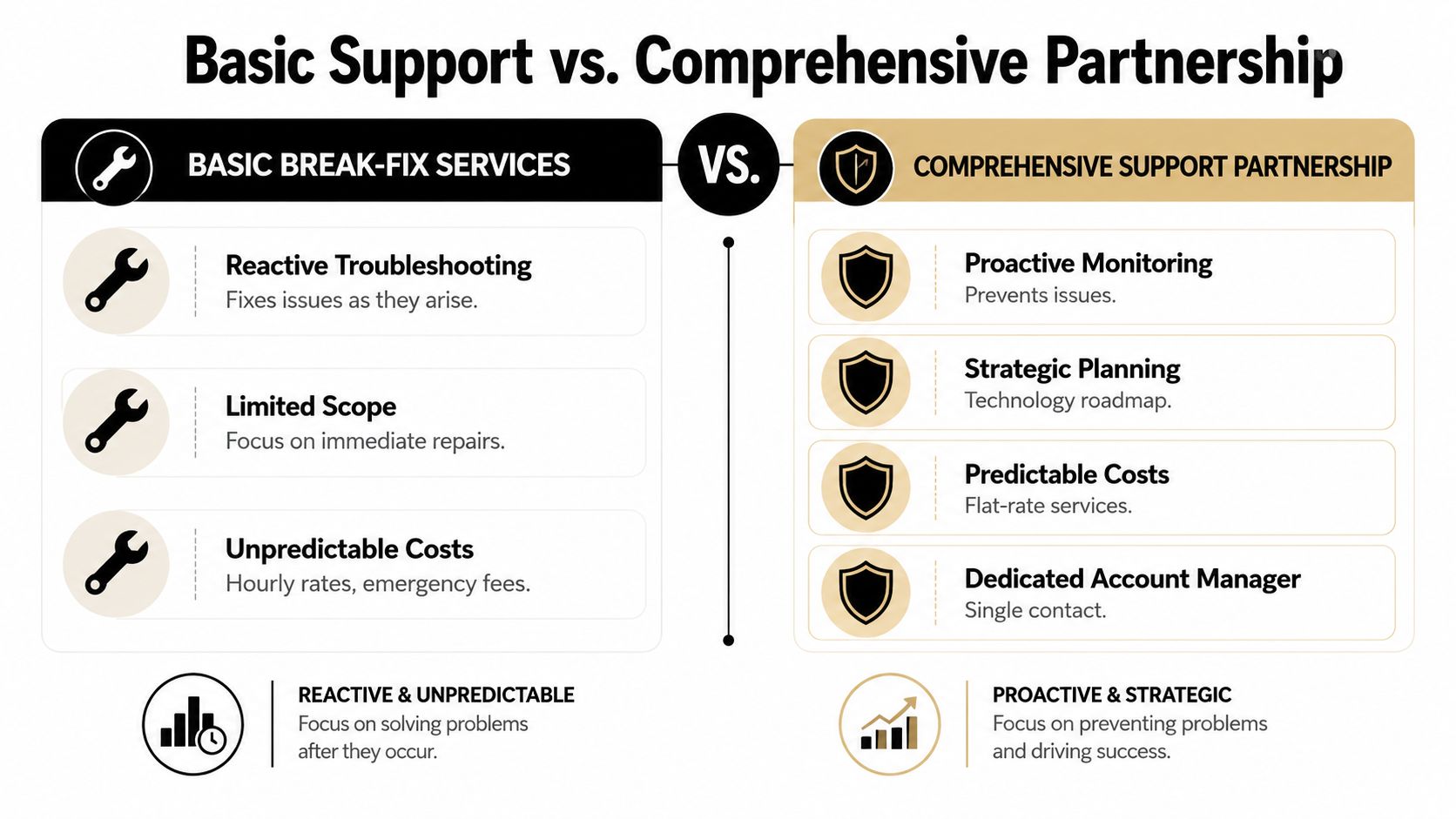
A lot of businesses think telecom support means one thing: someone shows up when phones stop working. That's only the narrowest version of the service. In practice, providers fall into two camps. One handles immediate faults. The other manages communications infrastructure as an ongoing operating function.
Basic break-fix versus comprehensive support
The difference shows up in behavior.
Basic break-fix service is reactive. Something fails, you call, they troubleshoot, and the invoice follows. That model can work for a very small office with a simple setup and a high tolerance for downtime.
Extensive support is broader. The provider monitors patterns, maintains documentation, helps plan changes, manages upgrades, and reduces the chance of preventable outages. It usually fits businesses with multiple sites, customer-facing phone traffic, call routing complexity, or systems that blend voice and network infrastructure.
Here's the practical comparison:
- Reactive support: Good for isolated issues, one-off repairs, and low-complexity environments.
- Managed partnership: Better for recurring tickets, growth, office moves, platform transitions, and businesses that can't afford voice instability.
- Project-led support: Useful when you're deploying new systems, re-cabling a space, or migrating from an old platform to cloud calling.
What stronger providers actually do
A deeper provider should be comfortable with more than handsets and user moves. They should handle or coordinate:
- New system installation: Phones, provisioning, cutover planning, testing, and user rollout.
- Network-side telecom work: Switch configuration alignment, patching, closet organization, and voice path troubleshooting.
- Legacy-to-modern migration: PBX to VoIP, analog line rationalization, and transitional support while old and new systems coexist.
- Facility integration: Paging, conference rooms, door entry, and sometimes adjacent systems such as commercial intercom systems when communication infrastructure overlaps with building access and internal coordination.
That last point matters in mixed-use offices, schools, warehouses, and medical facilities where telecom isn't confined to desk phones.
Technical depth separates real telecom expertise
One of the clearest signs of advanced capability is whether a provider talks about Call Setup Success Rate, or CSSR, as a meaningful KPI. In the cited 4G analysis, CSSR measures successful call setups divided by attempted call setups and is used to assess call connection reliability in relation to network conditions, with improvement methods that include failed-access log review, drive tests, site surveys, and RF tuning such as antenna tilt and transmit power adjustment, according to this CSSR-focused telecom performance study.
You don't need every local office support firm to be an RF engineering shop. But if a provider can discuss call reliability, interference, capacity, and user experience beyond "reboot the phone," you're dealing with a team that understands communications performance at a deeper level.
Better telecom support doesn't just restore service. It reduces repeat failures by connecting user complaints to network behavior, hardware condition, and site-specific patterns.
For businesses evaluating long-term support options, a reference page on telecom maintenance services in Atlanta can help frame what a broader partnership may include. The right level depends on how central voice and connectivity are to daily operations.
The Overlooked Final Step Decommissioning and Recycling
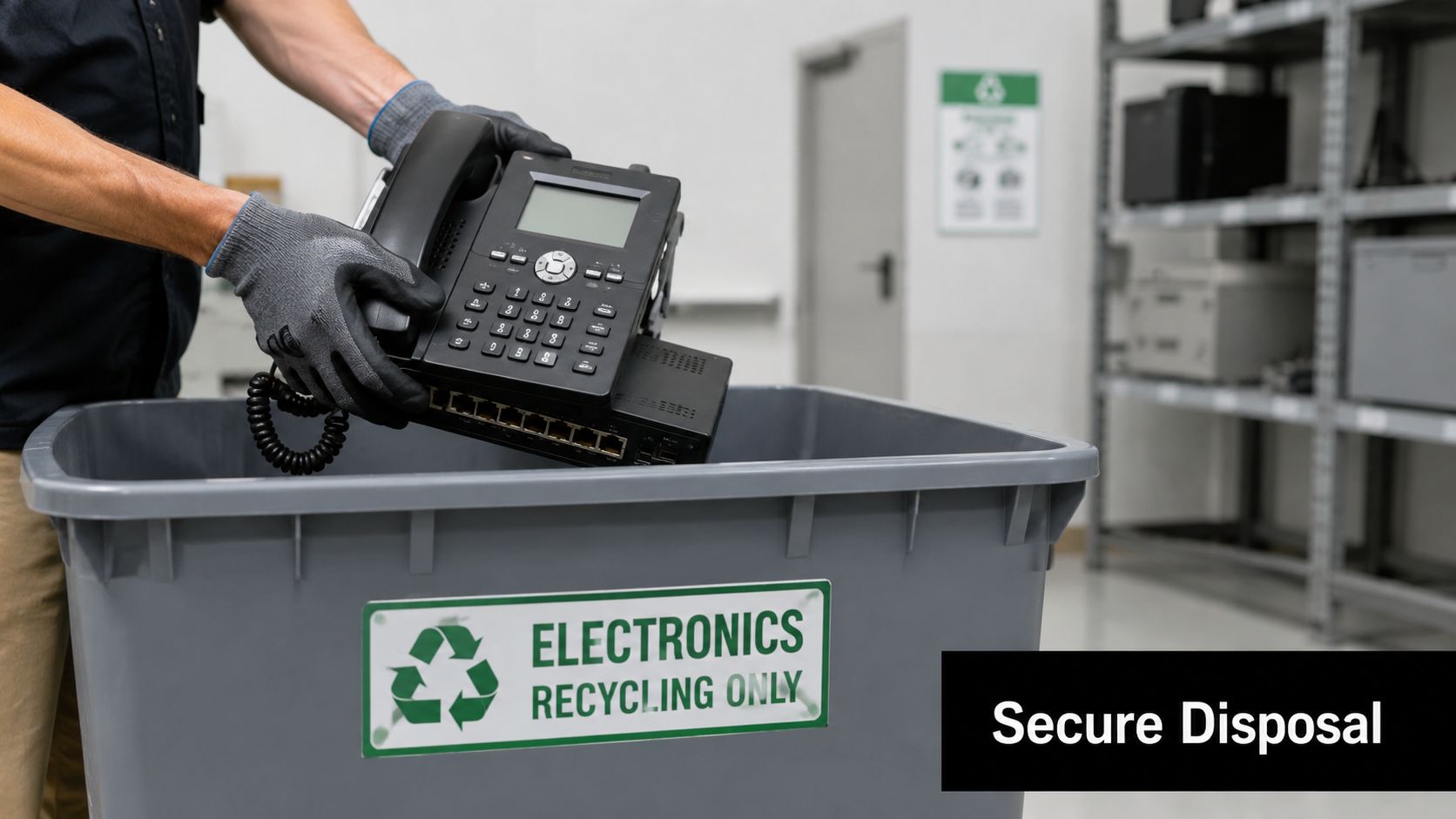
A telecom project isn't finished when the new phones come online. It's finished when the old equipment is disconnected, removed, documented, and sent through a secure disposition process.
That step gets missed constantly. A business upgrades from PBX to VoIP, celebrates a smooth cutover, then leaves retired desk phones, gateway devices, patch hardware, and rack components sitting in a back room for months. Nobody owns the cleanup, so the storage shelf becomes the default disposal plan.
Migration isn't the end of the lifecycle
Many businesses searching for support are already in the middle of a legacy transition, and the primary need isn't just repair. It's migration support plus de-installation and responsible disposition of retired hardware, as discussed in this broadband and transition-focused resource. That's especially true when old PBX shelves, fax infrastructure, PRI-connected gear, and telecom racks are still physically present after cutover.
The risk isn't only clutter. Retired telecom gear can hold configuration details, call history context, storage media, labels, and network information that shouldn't be left unmanaged.
What good decommissioning looks like
A proper closeout process should include several pieces:
- Asset identification: Match what was removed to a site list so nothing disappears into a pile of unlabeled hardware.
- Physical de-installation: Remove phones, rack gear, power accessories, cabling remnants, and ancillary telecom devices cleanly.
- Data handling: Treat storage-bearing equipment and attached media as information-bearing assets until proven otherwise.
- Disposition records: Keep a chain of custody and final outcome for equipment that is recycled, resold, or destroyed.
- Environmental compliance: Make sure the material goes through a legitimate electronics recycling path rather than general waste disposal.
A lot of IT teams are good at the cutover and weak at the cleanup. That's not because the final step is unimportant. It's because no one assigned it.
Why businesses should plan this before the upgrade
If you wait until after the migration, old hardware becomes someone else's problem. Facilities doesn't want it. IT doesn't have time. The telecom installer has already moved on. Then weeks later you're paying again for removal you could have built into the original plan.
For Atlanta businesses, the simplest fix is to treat retirement as part of the project scope from day one. Ask who removes the old phones. Ask who inventories the retired rack gear. Ask how data-bearing devices are handled. Ask where the equipment goes next.
If you need a benchmark for what certified end-of-life handling looks like, review R2-certified telecom recycling in Atlanta. Use that standard to judge whether your telecom project covers the full lifecycle.
Building a Long-Term Telecom Partnership in Atlanta
The best outcome isn't finding a technician who can rescue one bad day. It's building a relationship with a local partner who understands your sites, your users, your critical lines, and your equipment history.
That starts with clarity. Know your system, your pain points, your downtime tolerance, and the difference between support work and project work. Then vet providers based on process, not presentation. Ask how they escalate. Ask how they document. Ask how they handle migrations, legacy dependencies, and final equipment removal.
The bigger reason to take telecom seriously is that this industry sits inside national infrastructure, not on the sidelines. The National Telecommunications and Information Administration is the executive branch agency principally responsible by law for advising the President on telecommunications and information policy issues, as outlined by the NTIA. For a business owner, the takeaway is straightforward. Telecom support isn't a trivial office expense. It's part of how your company stays reachable, coordinated, and operational.
A good Atlanta telecom partner should feel like an extension of your IT and facilities teams. They should know when to troubleshoot, when to escalate, when to recommend replacement, and when to push for a cleaner long-term design. They should also recognize that every system eventually reaches end of life. The strongest support strategy covers that final stage with the same discipline as the initial install.
If your business is replacing phones, clearing out rack gear, or closing the loop on a telecom migration, Montclair Crew Recycling provides an Atlanta-area path for secure IT and telecom equipment disposition, including removal, asset handling, data destruction support, and responsible electronics recycling.
