
A Chicago office can tolerate a slow printer for a day. It can't tolerate phones dropping, fiber alarms piling up, or a cutover that looked clean on paper but leaves half the floor unable to reach cloud apps by noon.
That's usually when telecom maintenance becomes real. Not during procurement. Not during the sales demo. It becomes real when the circuit is technically up, users are still calling the help desk, and your team has to figure out whether the fault sits in the carrier handoff, the building cabling, the edge device, power, optics, or an old voice system nobody wanted to replace this quarter.
Chicago buyers feel that pressure more than most because the environment is unforgiving. Dense buildings, mixed legacy infrastructure, hard access windows, and weather that exposes weak physical plant all turn a simple outage into an operations problem fast. Good telecom maintenance services in Chicago aren't just about fixing what broke. They're about preserving business continuity, controlling lifecycle cost, and knowing when repair has stopped being the smart answer.
Why Your Chicago Business Can't Afford Telecom Downtime
A common failure day starts. Users report choppy calls. A conference room codec won't register. Then a floor loses connectivity to the applications everyone assumed were “in the cloud” and therefore somebody else's problem. The carrier says the service looks normal from its side. Facilities says there was no planned power work. Your IT lead starts juggling vendor calls while department heads ask for an ETA.
That's not an IT inconvenience. That's a business interruption.
Chicago's operating environment makes this worse because communications systems rarely live in neat, modern conditions. They live in mixed-use buildings, older risers, tenant spaces with inherited cabling, and equipment rooms that have seen too many moves without enough documentation. Local repair demand reflects that reality. One Chicago provider openly markets repair for homes, businesses, and buildings across the city and suburbs, which shows how maintenance work often spans from simple phone issues to building-wide communications systems. It also points to the kind of specialized labor involved. The same market depends on technicians who typically need at least a high school diploma, often additional technical education, and on-the-job training, according to Chicago telecom repair market context.
Break-fix feels cheaper until the outage starts
A lot of organizations still treat telecom support as an occasional dispatch. That works right up until it doesn't. If the only plan is “call someone when it fails,” you're accepting several risks at once:
- Longer diagnosis cycles: The first hour often goes to basic discovery because nobody has current diagrams, config backups, or circuit ownership notes.
- Finger-pointing between vendors: Carrier, MSP, voice vendor, and facilities all stay inside their own scope.
- Higher business disruption: Revenue teams, front desks, branch staff, and remote users all feel the outage differently, but all of them feel it.
Practical rule: If your communications stack supports customer contact, access control, cloud apps, or interoffice operations, maintenance is part of business continuity. It isn't optional overhead.
A proactive model acts like insurance, but it's more useful than insurance because it can prevent the claim. Scheduled inspections, change control, spare planning, and carrier escalation paths reduce the number of ugly surprises. Even when they don't stop the failure, they shorten the path to restoration.
For teams comparing regional support models, this outside look at telecom maintenance services in Atlanta is useful because it shows the same operational pattern seen in Chicago. Dense commercial environments punish reactive support.
Downtime also accelerates asset decline
There's another cost people miss. Every unstable router, aging PBX shelf, dirty fiber connector, or neglected UPS increases the load on your staff. Repeated emergency work makes teams delay modernization decisions they should have made earlier. That's how temporary fixes become permanent risk.
The smart buyer asks a different question. Not “Who do I call when the phones die?” Ask “What maintenance model keeps my business running and my infrastructure from aging into a liability?”
Preventive Corrective or Managed What Service Do You Need
The right maintenance model depends on one question. What does one hour of telecom disruption cost your Chicago operation in lost calls, delayed work, tenant complaints, missed patient intake, or stalled transactions?
That answer usually separates preventive, corrective, predictive, and managed service pretty quickly. These are not interchangeable labels. They shift cost, risk, staffing load, and control in very different ways.
Chicago buyers also get distracted by the install phase. Fast turn-up matters, but the harder decision comes after cutover. Day-two support determines whether your system stays stable, whether carrier issues get pushed to resolution, and whether aging gear gets replaced before it starts causing repeat incidents. That trade-off between deployment speed and long-term service reliability shows up in this Chicago telecom service analysis focused on deployment and reliability.
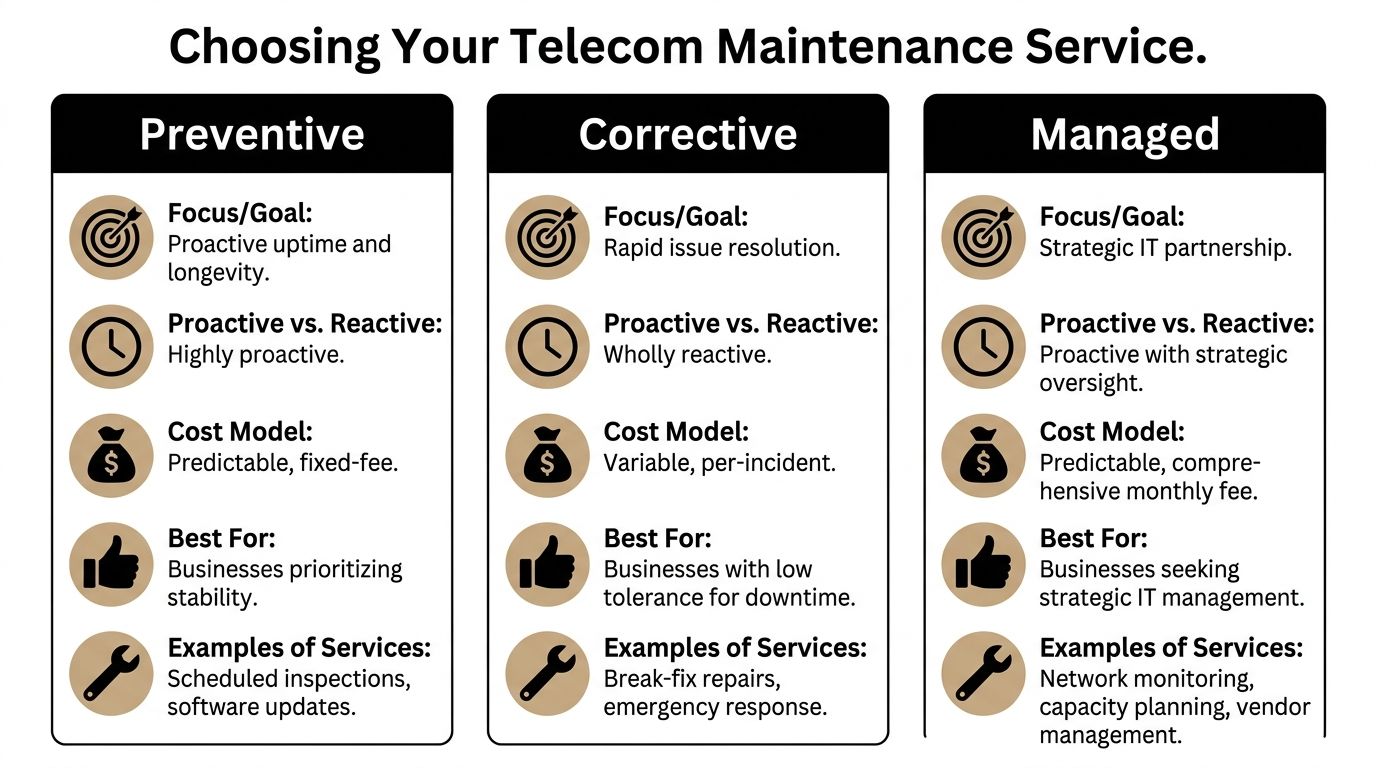
Preventive maintenance fits environments that need stability
Preventive support is scheduled, documented, and routine. The goal is to catch the common failure points before they turn into tickets.
This model works well for offices, clinics, schools, and mid-size commercial sites with a known set of circuits, switches, firewalls, voice hardware, and wiring closets. The environment may still be important to the business, but it is predictable enough to maintain on a schedule.
Typical work includes:
- Scheduled inspections: Checks on patching, optics, UPS status, environmental conditions, alarms, and physical wear.
- Software hygiene: Firmware review, patch planning, backup validation, and rollback preparation.
- Configuration review: Finding drift, bad documentation, weak failover settings, and informal changes made during past incidents.
Preventive support usually costs more than pure break-fix over the course of a year. It also reduces the number of surprise outages and the amount of after-hours labor. For many facilities, that is a better financial trade than paying less upfront and absorbing repeated disruption later.
Corrective support is break-fix by design
Corrective maintenance starts after something fails. The provider responds, troubleshoots, replaces a part, or escalates the carrier.
That can be acceptable in a small office, a low-priority site, or an environment already scheduled for retirement. It is a weak fit for operations where telecom supports patient flow, property access, dispatch, customer service, or revenue collection.
The budget case for corrective support looks good until the second or third incident. Then the hidden costs show up. Overtime. User downtime. Emergency parts sourcing. Repeated truck rolls. Leadership asking why a known issue was left in place.
If you choose corrective support, do it deliberately. Set it aside for locations where the business can tolerate delay and where replacement is already in the capital plan.
Predictive maintenance helps when failure patterns are hard to catch
Preventive work follows a schedule. Predictive work looks for condition changes that suggest failure is coming.
That matters in mixed environments. Legacy voice platforms, aging power systems, unstable optics, and intermittent transport issues often pass a basic inspection and still fail under load. Predictive maintenance uses monitoring data, event correlation, and trend analysis to flag risk earlier. IBM describes predictive maintenance as using asset and operational data to anticipate equipment problems before failure occurs in its overview of predictive maintenance.
In practice, predictive support makes sense when:
- The same issue keeps returning without a clear root cause.
- One outage carries more cost than expanded monitoring and analysis.
- You need better timing for refresh decisions, not just faster repair.
- You have equipment nearing end of support and need a cleaner exit plan.
That last point matters more than many buyers expect. Better maintenance data helps you decide when to keep an asset in service, when to move it into a managed support tier, and when to decommission it. For regulated Chicago organizations, that decision also connects directly to secure retirement, data handling, and disposal controls. Maintenance is part of lifecycle management, not just uptime.
Managed telecom service shifts operations from your team to a partner
A managed model covers daily ownership tasks. Monitoring. Ticket handling. Carrier coordination. Change control. Asset records. Vendor follow-up. Capacity review. Lifecycle planning.
This is usually the right fit for multi-site companies, busy internal IT teams, and organizations where telecom issues spill into executive visibility fast. I have seen strong IT departments still choose managed telecom support because they do not need another system to babysit. They need someone accountable for keeping it stable and documenting what happens when it is not.
Managed service also helps when telecom touches adjacent responsibilities such as security, cloud connectivity, and support coordination. Teams comparing those broader operational models may also find useful context in this article on cybersecurity and cloud solutions for SMBs.
Here's the practical comparison:
| Service Model | Primary Goal | Example Activities | Best For |
|---|---|---|---|
| Preventive | Reduce avoidable failures | Scheduled inspections, firmware review, config backup checks | Businesses that want predictable upkeep |
| Corrective | Restore service after failure | Break-fix dispatch, emergency repairs, carrier ticket escalation | Small or low-risk environments |
| Predictive | Catch failure patterns early | Condition monitoring, trend review, fault correlation | Mixed legacy environments and higher uptime needs |
| Managed | Run telecom operations day to day | Monitoring, vendor management, planning, ongoing support | Multi-site or business-critical environments |
Hybrid models are common, and often smart. A company may use preventive support at headquarters, corrective support at a low-priority branch, and managed oversight for carrier relationships across all sites. The model works if ownership is clear, documentation stays current, and nobody assumes the other party is handling end-of-life decisions.
If your team is weighing that broader operating model, this guide to managed telecom support for multi-site business environments gives a useful view of how outsourced telecom ownership works in practice.
What's Included in a Telecom Maintenance Agreement
A maintenance agreement sounds simple until you read the scope. “Hardware support” can mean anything from remote ticket handling to on-site parts replacement, fiber testing, and power diagnostics. If you don't pin that down, you're buying a label, not a service.
The most useful agreements define support by layer. Physical plant. Transport. Edge hardware. Voice platform. Monitoring. Escalation. Reporting. End-of-life planning. That's what separates telecom maintenance from generic IT help desk work.

Physical and transport layer support
Often, the weakest points of many contracts are where real outages begin.
Chicago telecom technicians routinely work across more than voice cabling. Job requirements in the market commonly include SONET, TDM, DWDM, IP, and Ethernet equipment, plus OTDR testing, DC power troubleshooting, and circuit testing. Those roles also involve correlating optical-layer diagnostics with service-level symptoms on circuits running up to 1G, 10G, 100G, and 400G, according to Chicago telecom technician job requirements.
What that means for a buyer is straightforward. If your provider can only reboot a device and open a carrier ticket, that isn't full telecom maintenance.
A serious agreement should address:
- Fiber diagnostics: Connector inspection, light-level checks, and OTDR work when fiber faults are suspected.
- Power chain issues: DC plant review, rectifier alarms, and grounding concerns where applicable.
- Circuit verification: Hand-off testing, patch path validation, and service restoration checks after changes.
Platform and device support
This is the part most buyers expect, but even here scope matters. Ask exactly which systems are covered.
That usually includes routers, switches, firewalls, session border controllers, PBX or VoIP systems, gateways, and sometimes wireless backhaul gear. It should also include what happens when the issue spans systems. A voice fault may stem from a QoS problem. A dropped session may trace back to optics, not software.
A practical agreement often includes this core set:
| Agreement Component | What it should mean in practice |
|---|---|
| On-site and remote support | Remote triage plus field dispatch when physical work is required |
| Hardware spares and replacements | Defined process for replacement parts and compatible inventory |
| Software updates and patches | Controlled maintenance windows, rollback plans, and validation |
| Monitoring | Alerting tied to business impact, not just device status |
The right contract tells you who owns diagnosis when the fault crosses layers. That's where weak support models usually fail.
Reporting and accountability
Support without reporting turns into recurring surprise. You want incident notes, trend visibility, open risk items, and recommendations tied to business impact.
That's also where adjacent disciplines matter. If your telecom provider touches cloud voice, remote access, edge security, and branch connectivity, it helps to understand broader maintenance practices around cybersecurity and cloud solutions for SMBs. Not because telecom maintenance becomes general IT support, but because the fault domains increasingly overlap.
At minimum, ask for:
- Incident summaries: What failed, what was done, and what still needs correction.
- Change records: What was modified, by whom, and whether configs were backed up.
- Risk flags: Unsupported gear, repeated alarms, or single points of failure.
A contract that can't produce that information will keep you reactive. You'll restore service, but you won't improve the environment.
Evaluating SLAs and Telecom Maintenance Pricing in Chicago
Most buyers skim the SLA, jump to response times, and assume they understand the contract. They usually don't. An SLA only helps if it tells you what happens when a business-critical service fails, who takes ownership, how fast action starts, and how progress gets communicated.
The first distinction to make is between response time and resolution time. Response time is acknowledgment. Resolution time is restoration. A vendor can meet the first and still leave you in a long outage if the language around escalation, parts, site access, and carrier coordination is weak.
Read the SLA in business terms
For a Chicago facility or IT director, the practical questions are simple:
- Who answers first: Is it a dispatcher, a help desk, or a telecom engineer?
- What counts as critical: Full-site outage, voice degradation, intermittent packet loss, or only complete failure?
- Who owns third-party coordination: Will the provider stay engaged with the carrier and landlord, or stop at opening a ticket?
- What are the support hours: Business hours only, extended coverage, or true emergency availability?
If your contract says “best effort” around dispatch, after-hours work, or parts logistics, assume you'll feel that vagueness during the next outage.
What usually drives price
Telecom maintenance pricing in Chicago varies less because of vendor branding and more because of operational reality. The same support model costs more when the environment is harder to support.
Common pricing factors include:
Site complexity
A single office with modern cabling is cheaper to support than a high-rise floor with inherited pathways, mixed handoffs, and strict access windows.Technology mix
Legacy voice, optical transport, mixed vendor estates, and aging edge devices raise support burden.Coverage model
Remote-only support costs less than contracts that include field response, spares, and after-hours work.Documentation quality
Environments with current diagrams, labeling, and configuration discipline are faster to maintain.
The cheapest quote often hides the most risk
A low monthly fee can still be expensive if it excludes the work you need. Watch for contracts that omit carrier escalation, site visits, patching, config backup validation, or project-level change support. Those exclusions convert routine maintenance into a chain of extra invoices.
When you review a quote, ask one question for every line item: “What outage scenario does this prevent, shorten, or leave uncovered?”
If you manage several providers or want cleaner accountability between internal IT and outside vendors, these IT vendor management best practices are worth reviewing before you negotiate terms. The main benefit is forcing clear ownership before there's a live incident.
A strong SLA doesn't need legal poetry. It needs operational clarity. During an outage, that's what keeps your team from paying premium rates for basic coordination nobody agreed to in writing.
A Vendor Selection Checklist for Chicago Organizations
Choosing a telecom maintenance vendor in Chicago is a risk decision, not a shopping exercise. Too many teams compare logos, monthly fees, and broad service menus, then discover the difference during the first cross-vendor outage.
Local execution matters. Building access matters. Spare logistics matter. Technician depth matters. The cheapest vendor can become the most expensive one if they can't operate cleanly in your environment.
Start with labor reality, not marketing claims
Telecom maintenance isn't commodity labor. The U.S. Bureau of Labor Statistics reports that telecommunications technicians earned a median annual wage of $64,310 in May 2024, with employment projected to decline 3% from 2024 to 2034, while still producing about 23,200 openings per year on average due to replacement demand, according to BLS data on telecommunications equipment installers and repairers.
That matters because buyers should set realistic expectations. Skilled field support costs money. Availability can tighten. A quote that looks unusually low may be relying on thinner staffing, subcontracted dispatch, or a narrow support scope.
The questions that expose weak vendors
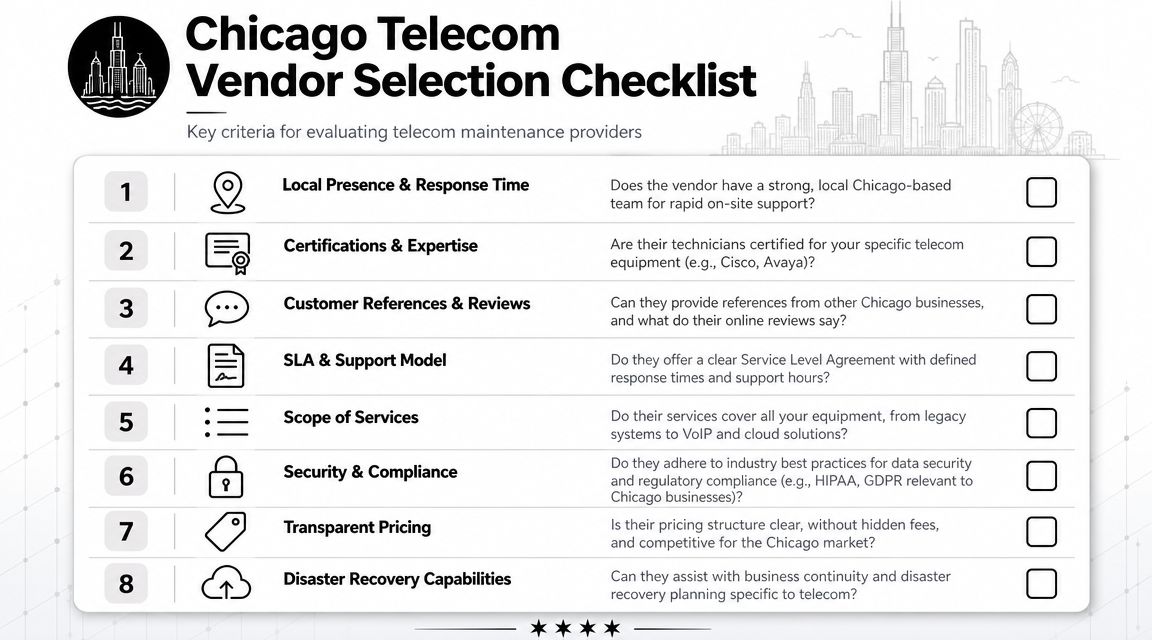
Use this checklist in interviews and proposal reviews:
Local team depth
Ask whether they have field technicians who routinely work in Chicago buildings, not just a regional call center.Actual equipment familiarity
Don't ask if they support “all major platforms.” Ask which routers, PBX systems, optical gear, and edge devices they support directly.Carrier and landlord coordination
Chicago outages often involve more than one party. Require a plain answer on who owns escalation.Spares and logistics
Ask where replacement parts are staged and how emergency dispatch works when access windows are tight.Documentation discipline
Require examples of incident reporting, change notes, and post-repair recommendations.
Here's the simplest truth. Vendors that answer in specifics usually operate better in the field.
Don't ignore relocation and transition experience
Maintenance vendors also get pulled into office moves, floor consolidations, and staged cutovers. That's when telecom support intersects with logistics. For teams planning relocations, it helps to review adjacent operational guidance like TLC Moving's Boston IT relocation help. The geography is different, but the lesson holds. Moves expose weak documentation and poor handoff planning fast.
A practical scorecard
| Selection Area | What a strong answer looks like |
|---|---|
| Local presence | Named Chicago coverage model and realistic dispatch process |
| Technical scope | Specific platforms, versions, and support boundaries |
| SLA clarity | Defined severity levels, ownership, and communication standards |
| Security handling | Controlled access, credential process, and documented changes |
| Lifecycle support | Willingness to flag aging assets and support retirement planning |
Buy the vendor that reduces uncertainty, not the one that makes the proposal sound the easiest.
If you're building a local shortlist, this overview of telecommunications services in Chicago is a useful reference point for how provider types differ in the market.
A good selection process doesn't eliminate outages. It eliminates preventable confusion during outages. That's worth more than a discount.
Securely Managing Retired and Decommissioned Telecom Gear
A lot of Chicago teams run maintenance well right up to the point gear leaves production. Then the process gets loose. An old firewall goes on a shelf after a cutover. A voice gateway gets boxed during a floor re-stack. Six months later, nobody can say whether configs were wiped, drives were removed, or the asset was disposed of through an auditable path.
That gap creates avoidable risk. Retired routers, switches, PBX appliances, firewalls, and edge devices often still contain saved credentials, call routing details, management IP history, certificates, and configuration backups. In regulated environments, that is not scrap. It is a controlled asset until it is sanitized, documented, and dispositioned properly.
That final stage belongs in the same lifecycle plan as break-fix support, spares, and refresh planning.
Maintenance history should drive retirement timing
The retirement decision usually shows up before the replacement quote does. You see it in repeat tickets, rising time spent on workaround fixes, parts that are harder to source, and platforms that stay stable only if nobody touches them. A maintenance program should surface those patterns early so operations and finance can decide whether another year of support still makes sense.
That matters because a device can be technically repairable and still be a poor business asset.
Common signs an asset should move to the retirement list:
- Recurring incidents keep consuming labor without improving reliability
- The platform is supported only through used parts, niche expertise, or temporary workarounds
- Configuration risk is increasing because the system is old, poorly documented, or tied to one person
- The gear no longer fits security policy, compliance needs, or current network design
In practice, decommission planning starts before removal day. It starts when the maintenance record shows the asset is costing more to carry than to replace.
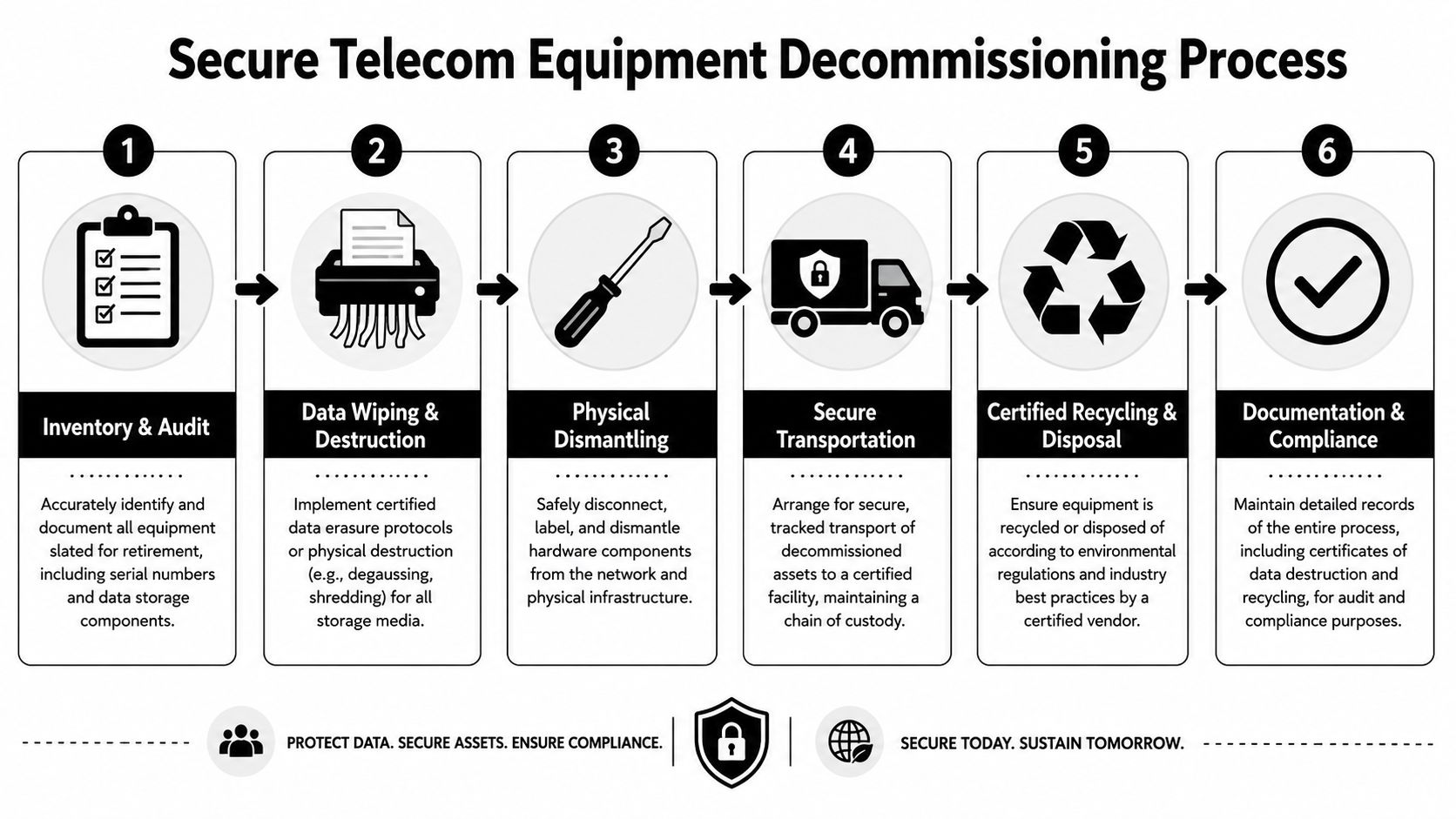
What a secure decommissioning workflow looks like
A controlled process is straightforward, but it has to be explicit.
Inventory the asset before disconnecting it
Record model, serial number, site, rack or closet location, assigned role, and whether the device contains removable or embedded storage.Capture what needs to be retained
Save approved configs, license records, and network documentation your team will need for audits, rollback questions, or replacement builds.Sanitize data based on the device type
Remove credentials, wipe storage, clear call history and saved configs, and destroy media when policy requires physical destruction rather than logical wiping.Maintain chain of custody
Tag the asset, document who handled it, and control transport from the site to storage, reuse, recycling, or destruction.Separate redeployable gear from disposal candidates
Some equipment still has value as lab stock, emergency spares, or limited redeployment. Other hardware should go straight to certified recycling because the support risk is too high.Keep final records
Retain disposition receipts, destruction certificates, and internal approvals. Those records matter during audits, incident reviews, insurance questions, and lease returns.
Assign ownership before the refresh starts
The biggest failure point is ownership. Facilities may control access to closets. IT may own the configs. Security may own the sanitization standard. Procurement may own the lease return. If nobody is named to run the full chain, retired gear sits in limbo.
I advise clients to assign one owner for decommission coordination before the first device is swapped. That person does not have to do every task. They do need authority to confirm inventory, sanitization, transport, and final documentation across teams and vendors.
If your project includes broader IT asset disposition work, guidance on how to decommission a server is useful because the same controls apply to telecom hardware with stored data and embedded configurations.
For organizations that need an ITAD option, Montclair Crew Recycling is one provider that handles business IT equipment removal, audit support, data destruction, and compliant disposition. In a telecom refresh, that service should be planned at the start of the project, not after old hardware has been sitting in a storage room with unknown data on it.
Retired telecom gear remains a security and compliance responsibility until it is inventoried, sanitized, documented, and removed through a controlled process.
Handled well, decommissioning protects more than data. It closes the lifecycle cleanly, reduces audit exposure, and keeps aging equipment from turning into a delayed incident or an unplanned cleanup cost later.
Frequently Asked Questions About Chicago Telecom Services
Do I still need a maintenance contract if my phones are cloud-based
Usually, yes. A cloud voice platform removes some on-premises burden, but it doesn't remove your dependence on local network health. Call quality still depends on switching, routing, handoffs, power, cabling, and wireless conditions inside the building. If those layers are unstable, a hosted phone system won't save you.
Isn't this my ISP's job
Only partly. Your ISP is responsible for its service scope. That often stops at the demarc or managed device boundary. If the problem sits in your firewall, switch path, patching, voice configuration, power, or a mixed-vendor handoff, the ISP may confirm the circuit is up and stop there. A telecom maintenance provider handles the messy middle where business outages usually live.
What should I ask for in an emergency response clause
Ask who answers first, who can work the problem remotely, when field dispatch starts, and who owns third-party escalation. Also ask how stakeholder updates happen during the incident. If that isn't written clearly, your team will spend the outage managing communication gaps.
Can one vendor support multiple Chicago-area locations
Yes, but only if the contract defines site coverage properly. Multi-site support needs more than a citywide promise. It needs clear boundaries for downtown offices, suburban branches, after-hours access, spare logistics, and severity-based response. The weak point is often not technical skill. It's inconsistent operating process between locations.
How do I know whether to repair or replace aging telecom gear
Look at the pattern, not the single event. If the same asset keeps generating urgent tickets, depends on hard-to-source parts, or creates change risk every time someone touches it, replacement is usually the better business decision. Maintenance should buy stability. If it only buys time, plan the retirement.
What's commonly missing from vendor proposals
Three things. Real ownership across vendors, honest limits around field capability, and a documented end-of-life process for replaced equipment. A proposal can look complete and still leave you holding old firewalls, phones, and switches with no secure disposition plan.
Should facilities be involved or is this just an IT issue
Facilities should absolutely be involved when telecom touches power, risers, roof access, IDF conditions, cooling, or landlord coordination. In many Chicago buildings, those factors determine how fast a repair happens. The best outcomes come when IT, facilities, and the maintenance vendor all know who owns which tasks before there's a fault.
If your Chicago telecom project includes retiring routers, switches, PBX hardware, servers, or other network assets, Montclair Crew Recycling can support the disposal side with business IT equipment removal, data destruction, and compliant recycling workflows. That's especially useful when a maintenance or upgrade project leaves older gear that still needs to be tracked, sanitized, and taken out of service properly.
