

Most companies shopping for telecommunications services Chicago start with provider brand names. That's backwards. Your address, your building's riser situation, and whether you need true path diversity matter more than the logo on the quote. A flashy enterprise package means very little if your suite is off-net, your install requires construction, or your backup circuit rides the same physical route as your primary.
Chicago is a serious telecom market. The city sits in a broader U.S. telecom services market valued at USD 451.7 billion in 2025, with a projection to USD 601.2 billion by 2030. Locally, that scale shows up in dense provider overlap, enterprise buildings with multiple carrier options, and constant infrastructure refresh cycles. If you're also planning around voice transitions, it's worth getting expert advice on the upcoming PSTN change before you lock in a long contract.
Chicago also isn't a one-size-fits-all market. A Loop office, a Fulton Market creative shop, a medical practice on the North Side, and a suburban warehouse all face different realities. The right provider depends on whether you need cheap broadband, clean DIA, multi-site Ethernet, temporary failover, or a carrier that already serves your building.
Here's the short list decision-makers should use.
1. AT&T Business
Need one carrier that can cover a Chicago office today and still fit a larger network plan a year from now? AT&T Business is usually on the shortlist for that reason. It fits buyers who want internet, wireless failover, Ethernet, and managed options under one provider instead of piecing together separate contracts.
For decision-makers, the key question is fit by site type. AT&T tends to work best for companies that expect their connectivity needs to change. A small office can start with business fiber. A larger operation can move to DIA, multi-site networking, or mobility-backed continuity if downtime starts carrying a higher cost.
Best fit in Chicago
AT&T is a strong match for:
- SMBs in standard office buildings: Good for firms that need reliable business internet now, with the option to add voice, managed Wi-Fi, or wireless backup later.
- Mid-market and enterprise teams with multiple locations: Useful when some sites need basic access and others need dedicated connectivity or private networking.
- Businesses using cellular failover as a practical backup: A solid option for locations where a second wired carrier is hard to get quickly or affordably.
Chicago remains a serious carrier market, and AT&T has a visible local enterprise presence through its downtown office at AT&T Corporate Center, 227 W Monroe St. That matters because providers with established metro operations are usually better positioned for multi-building support, account coverage, and upgrade paths across the city.
What works and what doesn't
AT&T usually performs best in on-net or near-net buildings. If your property already has AT&T fiber in the riser, the buying process is much simpler. If not, install intervals and construction costs can change the math fast.
The portfolio depth is the main advantage. A business can keep internet, mobility, and some managed services with one vendor, which reduces vendor sprawl and can make support escalation cleaner during an outage.
The trade-off is simple. Broad product coverage does not mean every Chicago address gets the same value. In some Loop and River North buildings, AT&T may be an easy fit. In smaller neighborhood offices or older properties, another carrier may quote faster or cheaper service.
Practical rule: Ask AT&T to price both business fiber and DIA for the exact address. That comparison usually shows whether the premium buys better SLA terms and cleaner performance, or just a more expensive version of standard access.
You can review local service options on AT&T Business Chicago. If you're comparing how provider fit changes in another major metro, this telecommunications services Dallas guide is a useful reference point. If you're also planning to retire older network hardware during an upgrade, this kind of telecommunications company support overview helps frame the full lifecycle, not just the circuit order.
2. Comcast Business
Comcast Business is often the fastest realistic option when a Chicago company needs serviceability across many addresses, especially for SMB and mid-market deployments. It covers a lot of ground, and that matters more than people admit. If you operate in mixed-quality buildings, broad reach is a competitive advantage.
For business leaders, the key question isn't whether Comcast can sell to enterprises. It can. The question is whether your location lands in its sweet spot for fast deployment versus a slower custom build.
Ideal customer profile
Comcast Business tends to fit three scenarios especially well:
- SMBs that need dependable mainstream connectivity: Good for offices, clinics, retail, and professional firms that don't need niche carrier engineering.
- Multi-site organizations: Useful when some sites need standard broadband and others need Ethernet or dedicated services.
- Teams that need a secondary carrier: Comcast is frequently shortlisted as a backup to another incumbent because it's often available where others aren't.
In practice, Comcast works best when you need speed of procurement and a sane upgrade ladder. A lot of Chicago businesses start with standard business internet, then move selected locations onto Metro Ethernet or dedicated internet as workloads mature.
Local trade-offs that matter
Comcast's biggest strength in telecommunications services Chicago is last-mile reach. Its biggest weakness is that quote quality can vary a lot by building status. An on-net building can be straightforward. An off-net or partially served property can turn into a construction conversation.
If a sales rep says service is available, ask whether that means existing lit service, near-net construction, or a fully custom build. Those aren't the same purchase.
Comcast is usually a good fit for buyers who want one provider that can handle smaller locations and still support more formal enterprise services when needed. It isn't always the cheapest once you move into dedicated designs, and install timelines can stretch when fiber work is involved.
For companies comparing provider models across markets, this broader view of business telecom options in Dallas is useful because the same on-net versus off-net logic applies in Chicago. Direct product details live on Comcast Business.
3. Astound Business
Astound Business is the provider I tell buyers to check when they want a real alternative to the largest national incumbents without going all the way into carrier-only territory. In Chicago, that's useful. Plenty of companies want competitive pressure in the quoting process, but they still need a provider that understands business internet, voice, and Ethernet.
Astound's local value is strongest in neighborhoods and buildings where its cable and fiber footprint gives you a true second path from the usual names. That's the main reason to include it early in a bid list.
Where Astound makes sense
Astound is a smart choice for:
- SMBs watching recurring cost closely: Especially those that don't need a highly customized enterprise design.
- Multi-tenant office and mixed-use properties: Good where property owners want practical business service options for tenants.
- Teams seeking route diversity: Astound can be valuable when your primary provider is a national incumbent and you want a different last-mile profile.
Chicago's concentration of telecom vendors and network specialists means businesses regularly cycle communications equipment during upgrades. The local market includes firms such as TDS, UScellular, and SAC Wireless, which illustrates how concentrated and active the regional telecom environment is (Chicago telecom vendor concentration).
The buying angle
Astound is often strongest when your requirement is straightforward. Business internet, voice, Ethernet, and building-level practicality. It gets weaker if you're expecting a giant enterprise procurement machine with every edge case already templated.
That isn't a criticism. It's a fit issue. For many Chicago firms, especially in smaller offices and MDU-style properties, straightforward is exactly what you want.
- Good move: Use Astound as either a primary quote or a competitive benchmark against Comcast and AT&T.
- Bad move: Assume neighborhood coverage means your exact suite is serviceable without a building check.
- Best question to ask: Is the service already in my building, or will the order require new construction or landlord coordination?
If your business is also evaluating telecom expansion patterns in other dense metros, this look at telecom services in Atlanta provides a useful comparison point. For current offerings, see Astound Business.
4. Zentro
Zentro is one of the few providers on this list where local focus is the main selling point, not a side detail. If your business sits in a commercial, mixed-use, or multifamily property where the building relationship matters as much as the raw circuit, Zentro deserves serious attention.
This is not the carrier I'd lead with for a suburban industrial site that needs a sprawling enterprise network strategy. It is the carrier I'd look at quickly for downtown and neighborhood buildings where property-centric deployment and fast turn-up can beat larger competitors on execution.
Who should shortlist it
Zentro is a strong fit for:
- Offices in on-net commercial properties: Especially where the landlord already has a relationship with the provider.
- Multifamily and mixed-use operators: Amenity internet, shared property models, and managed in-building setups are its natural lane.
- Condo and HOA environments with business needs: Bulk-style arrangements can make procurement simpler for property leadership.
Why local support can matter more than raw brand size
A Chicago-focused provider often handles building coordination better than a national sales organization juggling a huge regional queue. That doesn't automatically mean better service. It does mean faster practical answers about risers, access, activation, and who owns the in-building gear.
Smaller local providers often win on the boring parts of deployment. Those boring parts decide whether your project goes live on schedule.
Zentro's limitations are clear too. If the property isn't in its footprint, the conversation ends quickly. And if your company needs a globally standardized enterprise contract structure, you'll probably pair it with another provider or look elsewhere.
This one is best viewed as a high-fit option, not a universal option. If your building is on-net, it can be an excellent answer. If it isn't, move on fast.
For businesses thinking beyond bandwidth and into property-level telecom planning, these telecom solutions near me considerations are often part of the same decision. Zentro's current services are listed on Zentro Internet.
5. Zayo
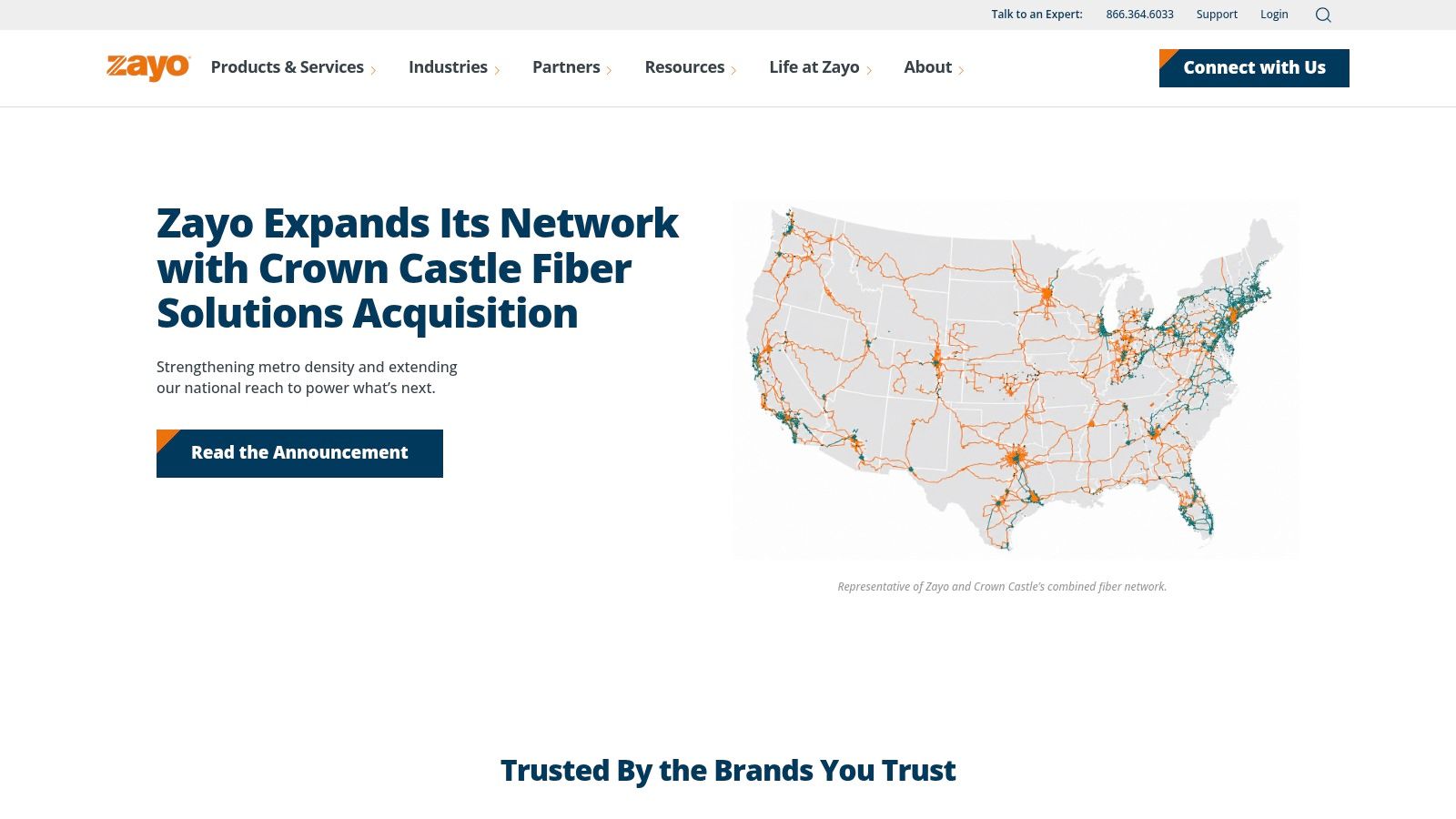
Zayo is what you shortlist when your business isn't really buying "internet" in the casual sense. You're buying network design. That usually means DIA, dark fiber, wavelengths, private connectivity, data center interconnects, or a high-capacity path where carrier diversity and route engineering matter.
For Chicago, that's a meaningful distinction. The city has enough enterprise density, carrier hotels, and interconnect demand that infrastructure-first providers can be the right answer, not an overbuilt answer.
Enterprise-first use cases
Zayo fits best when the buying team includes IT leadership, network engineering, or infrastructure operations, not just office administration. Good examples include:
- Data-heavy enterprises: Firms moving large volumes between sites, clouds, and data centers.
- Content and platform businesses: Organizations that care about backbone quality and interconnection options.
- Companies needing diverse routing: Especially where the backup path must be physically distinct, not just contractually separate.
Chicago's importance as a telecom market is tied to broader carrier concentration and infrastructure activity. That matters because providers like Zayo are strongest where there is dense enterprise demand and regular network modernization.
The practical trade-off
Zayo can be excellent, but it's not built for everyone. Smaller buyers sometimes get pulled toward infrastructure-grade providers when they really need a simpler managed business service. That's usually a mistake. If your office mostly needs stable internet, voice, and predictable support, Zayo may be more complexity than value.
If your team needs custom network architecture, though, the opposite is true. A mainstream SMB service can become the wrong tool very quickly.
- Use Zayo for: Carrier-grade DIA, fiber, interconnects, and serious redundancy planning.
- Don't use Zayo for: A casual office internet purchase where nobody wants to manage network design decisions.
- Ask early: Is my building on-net, near-net, or dependent on construction for the service I want?
This broader guide to telecom providers near me is useful if you're comparing infrastructure-led providers against more conventional business telecom vendors. Product details are on Zayo.
6. Cogent Communications
Need dedicated internet in Chicago without paying incumbent pricing?
Cogent usually enters the conversation for one reason. Price per Mbps. For Chicago buyers, that makes it most relevant in multi-tenant office towers, carrier-neutral facilities, and other buildings where fiber is already present and the install path is straightforward. If your team is comparing providers for a clean DIA handoff, or for a lower-cost secondary circuit, Cogent deserves a serious look.
This is not a fit for every buyer. Cogent tends to work best for IT-led organizations that know how they want the circuit delivered and do not need a heavily managed service layer wrapped around it.
Decision-maker snapshot
Shortlist Cogent if your buying profile looks like this:
- Ideal customer: Mid-market and enterprise teams. Especially companies with internal IT staff, data center presence, or a clear failover plan.
- Primary use case: Budget-conscious DIA, internet for a network-heavy site, or a secondary provider to reduce carrier concentration risk.
- Chicago availability note: The best outcomes usually come in on-net buildings or properties already served by multiple carriers. In those locations, pricing and turn-up timelines are often much better than at off-net suburban sites that require construction.
The practical trade-off is simple. Cogent often gives businesses attractive bandwidth economics, but the operating model can feel more bare-bones than what some buyers expect from a large incumbent or a managed network provider. That does not make it worse. It makes it better for a specific type of customer.
I usually tell clients to evaluate Cogent in two passes. First, confirm building status and install interval. Then compare the quote against your actual support expectations, not just your target monthly rate. A low-cost circuit stops being a bargain if your team really wanted white-glove support, bundled voice, or broad branch-office handholding.
Buy Cogent for straightforward DIA and secondary circuit value. Buy something else if your priority is a polished managed-service experience.
One more local point matters in Chicago. Cogent is strongest where building access is already established. If your office is in a downtown high-rise, a carrier hotel, or a property with existing fiber entrances, the fit can be very good. If your location is off-net, the conversation changes quickly because construction cost and lead time start driving the decision.
For current service information, visit Cogent Communications.
7. Lumen
Lumen sits in the middle of this list in an interesting way. It has enough enterprise heritage to handle serious networking demands, but it can still be relevant for companies that aren't buying dark fiber or giant custom builds. If your Chicago location needs more than standard business broadband but less than a full infrastructure engineering project, Lumen can land in the sweet spot.
The old Level 3 lineage still matters here. Buyers looking for cloud connectivity, dedicated internet, wavelength services, or flexible provisioning usually understand why.
Where Lumen tends to win
Lumen is worth shortlisting for:
- Enterprises with cloud-heavy traffic: Especially where direct connectivity and more formal SLA expectations matter.
- Data-heavy business sites: Teams that have outgrown basic broadband but don't want to overcomplicate the design.
- Organizations interested in flexible consumption: On-demand style provisioning can be attractive where eligible.
Chicago's modernization cycle also affects the decision environment around providers like Lumen. Public broadband expansion efforts in the city include a USD 14.6 million NTIA Middle Mile Grant tied to 400 miles of new fiber across 24 underserved communities. For business buyers, that doesn't automatically change your address-level options today, but it does signal continued infrastructure turnover and service evolution in the metro.
Where buyers get tripped up
Lumen can look ideal on paper and still be wrong for your exact building. That's not unusual in telecommunications services Chicago. Product eligibility often depends on whether the site is already served in a way that supports the specific service model you want.
Some companies also overestimate how self-service the buying experience will be. In reality, most serious Lumen deals still require a proper design and quote process.
If your shortlist includes AT&T, Zayo, and Lumen, the cleanest way to separate them is simple. Ask each one for the same exact address, same handoff, same term, same install assumptions, and same diversity requirement. Then compare what they commit to, not what the brand implies.
See current options on Lumen internet services.
Chicago Telecom Services, 7-Provider Comparison
| Provider | Implementation complexity 🔄 | Resource requirements ⚡ | Expected outcomes 📊⭐ | Ideal use cases 💡 | Key advantages ⭐ |
|---|---|---|---|---|---|
| AT&T Business (Chicago) | Moderate, address/building qualification; DIA custom quoting | Moderate‑High, fiber provisioning, CPE, managed Wi‑Fi options | Reliable symmetric speeds up to 5 Gbps; SLA options for DIA | SMBs → large enterprises, branch sites, locations needing 5G failover | Broad metro coverage; clear upgrade path; integrated 5G backup |
| Comcast Business | Moderate, on‑net fast, off‑net fiber builds can take longer | Moderate, HFC or fiber, multi‑site coordination | Scalable DIA/Ethernet with nationwide backbone and enterprise support | Multi‑site SMBs and enterprises, on‑net building deployments | Wide serviceability; large nationwide fiber backbone; MEF‑certified |
| Astound Business | Low‑Moderate, availability varies by neighborhood/building | Moderate, cable/fiber CPE; channel/partner support for scaling | Competitive local performance; flexible SMB and MDU packages | SMBs, MDUs/MDOs, properties seeking an incumbent alternative | Strong local presence post‑WOW acquisition; flexible offerings |
| Zentro (formerly Everywhere Wireless) | Low, rapid activations in on‑net properties; quote‑based tiers | Low, property‑centric deployments, managed gear and Wi‑Fi | Fast turn‑ups and symmetric tiers tailored for properties | Multifamily, condos/HOAs, office buildings needing bulk amenity Internet | Local concierge support; InstantOn activation; property focus |
| Zayo | High, complex enterprise designs, dark fiber and wavelengths custom | High, long‑haul/metro fiber, high‑capacity optics and engineering | Carrier‑grade low‑latency connectivity; very high capacity (100G+) | Enterprises, data centers, content providers, private networks | Tier‑1 backbone; diverse routing; rich data center interconnects |
| Cogent Communications (Chicago) | Moderate, quick when on‑net; off‑net adds lead time | Moderate, facilities‑based IP backbone, data center ports | Cost‑competitive DIA/IP transit; good for diverse/backup circuits | Cost‑sensitive enterprises and secondary/diverse circuits | Aggressive pricing; strong presence in Chicago data centers |
| Lumen (formerly CenturyLink/Level 3) | High, enterprise solution designs; on‑net eligibility varies | High, fiber+, NaaS/on‑demand ports, wavelengths and dark fiber | Enterprise SLAs, cloud interconnects, on‑demand scaling where eligible | Large enterprises, cloud‑centric sites, data‑heavy deployments | Global reach; Level‑3 heritage; flexible consumption and cloud connects |
Your Next Move A Provider Checklist
Choosing among telecommunications services Chicago isn't about finding a universal winner. It's about finding the provider that fits your exact building, your risk tolerance, and the way your team uses connectivity. A great carrier in one tower can be a mediocre option three blocks away if the building isn't on-net or the install path is messy.
The biggest mistake I see is treating proposals like they are interchangeable. They aren't. One quote may assume existing fiber, another may hide construction behind vague language, and a third may look cheap until you ask about restoration terms, router responsibility, and expedited install options. Chicago gives buyers more choice than many markets, but that only helps if you force the providers to answer the same operational questions.
Use this checklist in every conversation:
- Confirm on-net status: Is your building directly on the provider's network, or are they proposing a near-net or construction-based delivery?
- Clarify the SLA: What uptime commitment applies to the exact service being quoted, and what service credits are available if the provider misses it?
- Ask about install timing: What is the normal interval for your address, and what can they do if you need the site live faster?
- Check path diversity: If this is a backup circuit, can they provide a route that's physically separate from your primary, not just a different invoice?
- Pin down support ownership: Who manages the demarc, the router, and the first-response troubleshooting process when your team calls in?
- Review future fit: Can the provider move you from standard broadband to DIA, Ethernet, or multi-site service without forcing a full rip-and-replace?
Chicago's telecom market is active and still evolving. Public broadband expansion has also exposed a practical blind spot. As legacy infrastructure gets replaced, organizations need a clean plan for decommissioned routers, telecom gear, and storage-bearing network equipment. Public discussion around expansion often focuses on deployment, while disposal, data handling, and old equipment retirement get far less attention. That's one reason lifecycle planning should sit next to network planning, not behind it.
If you want a second opinion while narrowing the field, this outside perspective on finding reliable business internet options is a useful reminder that the buying questions are often more important than the marketing claims. Get your exact address, define your primary and backup use cases, and make every provider answer the same shortlist of questions. That's how you avoid overbuying, underbuying, and getting trapped in a contract that looked better than it performs.
When your telecom upgrade leaves you with retired switches, phones, servers, routers, or other network hardware, Montclair Crew Recycling gives businesses a practical way to handle the disposal side correctly. They help organizations decommission and recycle IT and telecom equipment, protect data with DoD 5220.22-M three-pass drive wiping and optional on-site shredding, and document the process for compliance and asset recovery needs.
