

Your Atlanta business adds a second location, signs a downtown lease, or moves a critical workload into colocation. The telecom decision stops being a simple bandwidth purchase and turns into an operations project with real consequences for uptime, install timing, and risk.
Atlanta gives buyers options, but that does not make the decision easy. Provider strength changes by building, by corridor, and by how much support you need after install. A law firm in Midtown, a healthcare clinic in Marietta, and a distribution site near the airport can all need very different mixes of fiber, voice, wireless backup, and support. Businesses comparing Atlanta-area telecom providers for business locations should start with serviceability, failover design, contract terms, and handoff requirements, not headline speeds.
The wrong choice usually shows up later. It appears in delayed quotes, unexpected construction charges, weak performance at off-net sites, or a migration plan that ignores the equipment being pulled out. That last issue gets missed too often. Old phones, firewalls, switches, and circuit hardware can sit in storage long after cutover, even though they may still hold configuration data or need documented disposition. A practical telecom plan covers the full lifecycle, from provider selection to retirement of replaced gear.
That is also why network planning and onsite WiFi design need to line up. For teams reviewing office coverage, guest access, and reliability expectations, this comprehensive guide for business WiFi is a useful reference point. For businesses investing in new buildouts, relocations, or campus connectivity, fiber optic infrastructure deployment remains part of the conversation as service needs expand across offices, warehouses, and data environments.
This guide takes that full view seriously. It covers major Atlanta telecom providers, compares where each one fits, and closes with the final step many articles skip: responsible decommissioning. When old telecom hardware comes out, Montclair Crew is the partner to call for secure, documented end-of-life handling.
1. AT&T Business
A Midtown headquarters signs with AT&T for primary fiber, adds wireless failover for field staff, and keeps voice under the same umbrella. That kind of consolidated setup is why AT&T stays in the conversation for Atlanta businesses with multiple sites, compliance requirements, or a mix of office, remote, and mobility needs.
AT&T is usually strongest when the business wants one provider to cover dedicated internet, transport, voice, wireless continuity, and managed security. In Atlanta, that matters most for firms that do not want separate vendors arguing over a cutover problem at 2 a.m. or passing tickets between the carrier, firewall team, and voice provider.
Where AT&T fits best
AT&T makes sense for companies that value operating consistency more than chasing the lowest monthly rate. A legal office with strict uptime expectations, a healthcare group adding clinics, or a regional company standardizing service across several addresses can often justify the premium if procurement gets clearer accountability and fewer handoff points.
The trade-off is straightforward. Pricing is usually custom, and off-net locations can bring longer install intervals, added construction charges, or both. Atlanta buyers with offices in outer suburban corridors should verify serviceability early instead of assuming every metro address gets the same answer.
Ask two questions before you spend time comparing proposals. Is the building on-net, and what is the actual failover plan at the demarcation point if the primary circuit drops?
That second question matters more than many teams expect. I have seen buyers approve a strong core network design, then learn too late that local loop diversity was weak or the backup path still depended on the same building entry. AT&T can solve those issues, but only if they are defined during design and contracting.
For businesses reviewing local carrier options, this Atlanta telecommunications company near me resource is a useful way to compare where large incumbents fit against more specialized providers. For offices upgrading both connectivity and internal coverage, pair carrier review with a comprehensive guide for business WiFi. A stronger circuit does not fix poor access point placement, guest segmentation problems, or weak conference room coverage.
- Best for headquarters and core sites: Strong choice when SLA-backed primary connectivity and escalation depth matter.
- Best for multi-site standardization: Useful if you want voice, transport, wireless backup, and support under one contract family.
- Less attractive for price-driven branch deals: Off-net quotes can shift the business case fast.
Direct site: AT&T Business
2. Comcast Business

A growing Atlanta branch needs service in weeks, not after a long construction cycle. That is where Comcast Business usually enters the conversation.
Comcast is often the practical pick for locations that need business internet fast, especially retail sites, sales offices, and smaller operational branches. In Atlanta, that matters because many companies are not standardizing one site. They are juggling a mix of urban offices, suburban branches, and locations with very different access options. Comcast can cover that mix with cable at one address and fiber-based services at another.
The buying decision comes down to workload, timeline, and tolerance for variability.
Where Comcast fits best
For a branch office that mainly runs cloud apps, video meetings, VoIP, and normal business traffic, Comcast Business can be a cost-conscious way to get online without waiting for a custom fiber build. That shorter install cycle is a real advantage when a lease is signed late or an expansion team is trying to hit an opening date. For larger sites, Comcast also offers fiber DIA, Ethernet, and related enterprise services, which gives IT teams room to keep the provider while upgrading the circuit type.
That said, access method matters more than logo.
HFC service can work well for general office use, but it is still a shared cable platform with upload limitations that show up quickly under the wrong traffic pattern. I would not use it as the primary connection for a site that pushes large backups all day, syncs heavy design files, aggregates surveillance footage, or functions like a small data hub. Those locations usually need dedicated fiber, clearer SLAs, and a design that treats upstream performance as a requirement instead of an afterthought.
Address validation also matters in metro Atlanta. Service quality and install options can change by building, business park, and suburb, so teams should verify what is serviceable before they compare pricing sheets. A low quote is not very useful if the location ends up needing construction, temporary workarounds, or a different class of circuit after the contract discussion starts.
Comcast also makes sense in a portfolio strategy. Some Atlanta businesses use it for smaller branches and secondary circuits while reserving premium fiber providers for headquarters, warehouses, or sites with stricter uptime and performance targets. That approach is often more rational than forcing every property into the same service model.
Upgrades create a second operational task that buyers often ignore. Replacing legacy Comcast gear can leave behind modems, voice equipment, firewalls, switches, and rack hardware that still contain configuration data or take up space until someone deals with them. If your refresh project includes cleanup, plan for business electronics recycling for retired telecom and network gear at the same time you plan the cutover. Teams dealing with broader telecom asset removal can also use this Atlanta telecommunications company recycling resource when old telecom assets need compliant disposition instead of closet storage.
- Best for branch offices: Good fit when install speed and budget matter more than premium circuit design.
- Best for mixed site portfolios: Useful when some locations need cable now and others may move to fiber later.
- Less ideal for heavy upload use: Shared cable service becomes a poor fit for backup-heavy, surveillance-heavy, or file-intensive sites.
Direct site: Comcast Business
3. Lumen

A common Atlanta scenario looks like this. The office internet is fine, but traffic also has to move cleanly between a data center, cloud environment, backup site, and a few regional locations. At that point, the buying decision shifts from basic access to transport design, interconnection, and operational control. Lumen belongs on that shortlist.
Lumen fits organizations that care about metro Ethernet, private connectivity, backbone reach, and predictable paths between sites. That usually includes companies tying offices to colocation facilities, separating internet traffic from internal transport, or building around hybrid cloud requirements. For those buyers, the provider question is less about who can light up the address and more about who can support the network model without forcing awkward workarounds.
The trade-off is straightforward. Lumen can be a strong choice for enterprises with real WAN complexity, but it can feel slow and process-heavy for a single office with ordinary SaaS traffic. If the requirement is simple and the timeline is tight, a smaller-scope service often makes more sense.
Atlanta supports the kind of architecture Lumen is built for. The market has deep carrier presence, dense interconnection activity, and meaningful data center demand, which is one reason enterprises often evaluate Lumen here alongside other fiber and transport-focused providers. Lumen is usually at its best when the project includes cloud on-ramps, multi-site routing decisions, or a need to keep public internet and private transport on separate tracks.
There is also an end-of-life issue that procurement teams routinely leave for later. Lumen projects often retire routers, optics, switches, line cards, and other rack gear that still carry configuration data or occupy valuable space after cutover. If the migration includes cleanup, plan electronics recycling for retired telecom and network hardware as part of the same project, not as a separate task someone inherits after go-live.
- Best for cloud and interconnect strategy: Strong fit when traffic moves between offices, data centers, and cloud platforms.
- Best for larger WAN environments: Useful for organizations that need transport options beyond standard business internet.
- Less ideal for small standalone offices: The buying process can be heavier than the use case justifies.
Direct site: Lumen
4. Zayo
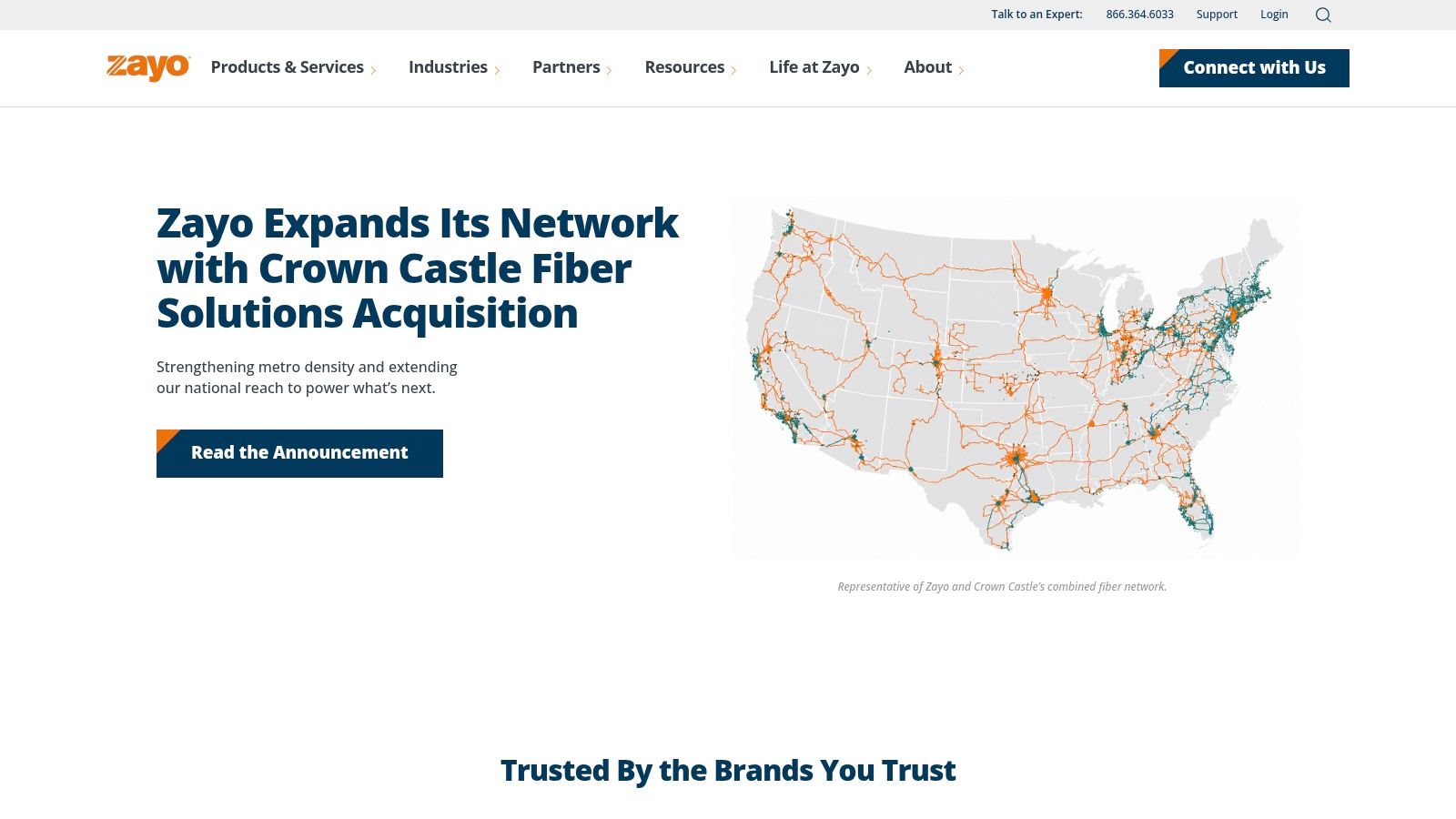
A common Atlanta telecom mistake looks like this: a company buys premium transport because the spec sheet sounds impressive, then realizes six months later that it needed fast deployment and predictable monthly cost more than dark fiber options. Zayo belongs on the shortlist when the network design itself is the priority.
Zayo is strongest in projects where path diversity, wavelength services, dark fiber, or custom metro connectivity directly support the business. That usually means data replication, media transport, large campus connectivity, carrier-neutral facility strategies, or multi-site environments where route control affects uptime and performance. If the requirement is basic office internet, Zayo is often more carrier than the use case justifies.
Where Zayo stands out
Atlanta is a good market for a provider like Zayo because many businesses here operate across data centers, production sites, and distributed offices. In those environments, transport design is not a procurement detail. It shapes failover options, latency, expansion plans, and how much flexibility you keep when one facility or provider has an issue.
The trade-off is straightforward. Zayo can give enterprises far more control than a standard business broadband product, but that control often comes with longer sales cycles, engineering review, construction variables, and higher one-time costs. Building proximity matters. If your site is not near existing fiber, the business case can change quickly.
I usually advise clients to write the technical reason for choosing Zayo in one sentence before asking for quotes. If the answer is “we need diverse physical paths between two sites” or “we need high-capacity transport into a specific facility,” the evaluation is probably justified. If the answer is “we want better internet,” start with a simpler provider or compare local telecom services in Atlanta for business connectivity before committing to a fiber-heavy design.
Zayo also fits the lifecycle view procurement teams often miss. Projects at this level can retire optics, routers, transport gear, cross-connect hardware, and older edge equipment after cutover. If Zayo is part of a network redesign, the cleanup plan should be part of the scope from day one so the old hardware does not sit in a closet with configs and asset tags still attached.
Direct site: Zayo
5. GFiber Business
A growing Atlanta firm signs a lease, opens cloud apps on day one, and wants internet that works without a long carrier negotiation. GFiber Business fits that scenario better than many enterprise-first providers. If the building is serviceable, buyers usually get a cleaner quoting process, simpler packaging, and pricing that is easier to defend internally.
That simplicity matters for small and midsize offices. A design agency, accounting firm, clinic, or satellite team often needs stable symmetrical fiber more than custom contract terms or a heavily engineered network design. GFiber is strongest when the requirement is clear and the site does not need unusual routing, multi-site transport, or strict enterprise SLA language.
The upside is operational clarity. Lean IT teams can stand up service faster, support cloud backups and video meetings without fighting asymmetric speeds, and avoid paying for complexity they will never use.
The limit is also clear. GFiber remains highly address-dependent in Atlanta, and serviceability can change block by block or building by building. Buyers should also separate "good business fiber" from "enterprise-grade internet architecture." If the site needs diverse paths, custom failover, or formal performance commitments tied to a larger WAN plan, another provider may be a better fit.
GFiber also belongs in the full lifecycle conversation. Simple internet replacements often trigger a quiet pileup of retired firewalls, old Wi-Fi gear, desk phones, and edge devices after cutover. Teams that plan the swap but ignore disposal usually end up storing obsolete hardware with labels, configs, and asset tags still attached. For that cleanup step, use a scheduled electronics recycling pickup in Atlanta so the project closes cleanly instead of leaving old equipment behind.
- Best for SMB offices: Straightforward buying process and predictable budgeting.
- Best for cloud-based work: Symmetrical service supports file sync, video calls, and shared apps.
- Less ideal for complex enterprise environments: Coverage, path diversity, and contract structure can be limiting.
Direct site: GFiber Business
6. Verizon Business

A common Atlanta telecom problem looks like this: the lease is signed, the buildout is behind schedule, the opening date is fixed, and the wired circuit still has weeks to go. Verizon Business belongs on the shortlist when speed to service matters more than perfect wireline performance on day one.
That is the core trade-off. Verizon’s business internet options can get a site online quickly for temporary offices, project locations, pop-ups, and branches that need a backup path before fiber is ready. For many teams, that timing advantage matters more than squeezing out the last bit of consistency from a primary circuit.
Best as a fast primary or backup path
Verizon is usually strongest in two situations. First, as an interim primary connection for sites that cannot wait on construction. Second, as a secondary connection for continuity planning when the main carrier goes down. I regularly advise clients to consider wireless here because it avoids tying both primary and backup service to the same construction delays, conduit issues, or building access problems.
Performance still needs realistic expectations. Signal conditions, equipment placement, and local congestion affect results. A well-installed fixed wireless connection can perform well for cloud apps, voice, and day-to-day office traffic, but it does not behave like a dedicated fiber circuit with tighter predictability and stronger contractual controls.
That distinction matters in procurement. If the business case depends on low-latency consistency for large file movement, site-to-site traffic, or a tightly managed WAN, Verizon is usually the support circuit or temporary bridge, not the long-term design center.
I also look at Verizon through the full lifecycle lens. Fast cutovers often leave behind retired routers, old failover appliances, POTS replacement devices, and legacy voice hardware sitting in closets long after the network upgrade is done. A scheduled electronics recycling pickup in Atlanta for retired telecom hardware closes that last step cleanly, especially after a backup refresh or wireless migration.
Direct site: Verizon Business 5G internet
7. Cogent Communications
A company signs a lease in a downtown Atlanta building, assumes every serious carrier option is on the table, and then learns the economics depend almost entirely on whether the site is already on-net. That is the right way to assess Cogent.
Cogent usually makes the most sense in carrier hotels, colocation facilities, and enterprise buildings where its network is already present. In those settings, it can be a cost-efficient choice for high-capacity internet and transport. The buying process is often simpler because the hard part, physical network reach, is already solved.
I do not treat Cogent as a default recommendation for a typical office move. I look at it closely when the business operates in a building with strong interconnection options, expects substantial bandwidth demand, and wants to control recurring circuit cost without paying for a custom build.
The trade-off is straightforward. Cogent pricing can look very attractive on-net. If your site needs third-party local loops, building access work, or special construction, that advantage can shrink fast. At that point, the cheaper monthly rate may not offset the slower path to installation, the added vendors, or the reduced design flexibility.
That distinction matters in Atlanta because the market has enough data center and carrier-dense properties to make provider selection highly location-specific. As noted earlier, infrastructure concentration changes what is realistic and cost-effective. For Cogent, address qualification is not a paperwork step. It is the main filter.
The lifecycle question matters here too. Cogent often enters the discussion during data center migrations, bandwidth upgrades, and colo consolidations. Those projects usually leave behind retired routers, optics, patch panels, cabling, and older telecom gear that still contains asset tags, configuration data, or disposal obligations. Teams that choose a lower-cost transport option but ignore end-of-life handling leave the job unfinished. That is one reason I frame telecom planning as a full lifecycle decision, from provider fit at turn-up to responsible hardware removal at decommissioning.
A third-party review of Atlanta telecom content also points out that local provider comparisons often stop at procurement and skip disposal planning during upgrades and migrations, according to telecom upgrade and disposal gap analysis. That gap shows up most often in data-center-heavy environments, which is exactly where Cogent is strongest.
- Best for on-net data center environments: Strong fit when the building already supports a clean handoff.
- Best for budget-sensitive high-capacity DIA: Often a good financial choice if construction is not part of the deal.
- Less ideal for standard office sites: Off-net requirements can erase the pricing benefit and complicate delivery.
Direct site: Cogent Communications
Atlanta Telecom Providers, Top 7 Comparison
| Provider | Implementation Complexity 🔄 | Resource Requirements ⚡ | Expected Outcomes ⭐📊 | Ideal Use Cases 💡 | Key Advantages ⭐ |
|---|---|---|---|---|---|
| AT&T Business | Medium, address‑dependent builds; fiber‑ready sites turn up faster | High, fiber loops, onsite CPE, possible construction fees | High reliability and capacity with strong SLAs and integrated security | Enterprise offices, multi‑site connectivity, data‑center links | Deep metro fiber presence; strong SLAs; integrated security |
| Comcast Business | Low–Medium, HFC quick; fiber/DIA may require provisioning/build | Moderate, leverages HFC coax for fast installs; fiber needs CPE/build | Fast branch connectivity; enterprise performance where fiber is on‑net | Branch offices, SMBs, multi‑site with mixed needs | Large local footprint; rapid HFC provisioning; single‑vendor options |
| Lumen | Medium–High, enterprise provisioning and interconnect configuration | High, backbone/peering, CPE, extensions for off‑net reach | Low‑latency, robust inter‑DC and multi‑cloud connectivity | Multi‑cloud enterprises, data‑center interconnects | Extensive peering and interconnect footprint; flexible extensions |
| Zayo | High, custom routes, dark fiber builds, longer lead times | Very High, NREs, engineering, proximity to on‑net routes required | Deterministic, very high‑capacity transport with route diversity | Large campuses, wholesale, high‑bandwidth inter‑DC links | Dense metro fiber, dark fiber options, high‑capacity wavelengths |
| GFiber (Google Fiber) Business | Low, simple provisioning where available; address‑limited | Low, included equipment, minimal setup, simple contracts | Consistent symmetrical speeds for SMBs; limited enterprise SLA | Small/medium offices, retail sites, satellite locations | Transparent flat pricing; included equipment; easy procurement |
| Verizon Business | Low, rapid FWA deployment; optional professional install | Low, wireless CPE; signal‑dependent performance and coverage | Quick connectivity and portability; variable throughput by signal | Temporary sites, pop‑ups, fast backup/continuity circuits | Fast turn‑up; portable service; published plans and price guarantees |
| Cogent Communications | Medium, straightforward on‑net; off‑net needs third‑party loops | Moderate, colocation adjacency preferred; economical on‑net DIA | Cost‑effective high‑capacity DIA with strong upstream capacity | Colocated tenants, data‑center centric operations | Tier‑1 backbone; aggressive pricing and low jitter on‑net |
From Connection to Decommission
A common Atlanta upgrade looks like this. The new circuit is ordered, the cutover date is set, and the team focuses on uptime. Then the old firewall, switches, handsets, access points, carrier demarc gear, and storage media get stacked in a closet because nobody defined the retirement plan.
That gap creates real operational risk. Old telecom and network hardware can hold configuration data, credentials, call records, and local storage. It also creates a facilities problem, especially during office moves, MDF and IDF cleanouts, and multi-site refresh projects.
Provider selection should account for that full lifecycle from day one. AT&T and Comcast often fit distributed business locations that need broad local availability and familiar support channels. Lumen and Zayo fit designs built around transport, interconnection, route diversity, or custom fiber paths. GFiber works well in the right footprint when the goal is straightforward symmetric service without much procurement friction. Verizon makes sense when a site needs fast activation or a backup circuit. Cogent can be a smart choice for on-net, data-center-adjacent bandwidth where cost per megabit matters.
The trade-off is simple. The more specialized the service design, the more disciplined the retirement process needs to be.
A branch office converting from legacy voice to IP may retire phones, gateways, UPS units, and edge networking gear at the same time. A data center migration may leave behind optics, routers, cross-connect hardware, cabinets, and spare parts with asset value. A wireless backup rollout may be easy to deploy, but it still leaves replaced equipment that has to be tracked, wiped where applicable, and removed through a documented chain of custody.
That is why decommissioning belongs in the telecom plan, not in the cleanup phase after the project closes. Strong teams define asset audit procedures, pickup logistics, data destruction standards, resale criteria, and recycling requirements before the first circuit goes live. That approach reduces storage clutter, limits security exposure, and gives finance and compliance teams a cleaner record of what left the business and how it was handled.
Montclair Crew Recycling is one local option for that end-of-life work in Metro Atlanta. The company handles IT and telecom equipment disposition, asset auditing, logistics, recycling, resale support when appropriate, and free DoD 5220.22-M three-pass hard drive wiping, with on-site shredding available for organizations that need it. For companies replacing telecom gear during relocations, carrier changes, or infrastructure refreshes, that kind of documented handoff closes the project properly.
If your team is upgrading circuits, replacing voice systems, or clearing out retired network hardware, Montclair Crew Recycling can help you handle the decommissioning side with pickup, data destruction, compliant recycling, and asset disposition support across Metro Atlanta.
