

Monday at 9:07 a.m., the phones start clipping, Microsoft 365 drags, and the POS terminals lag just long enough for staff to notice. By 9:20, someone is tethering a laptop to a hotspot, the office manager is calling the provider, and IT is trying to figure out whether the problem is the circuit, the firewall, or the building. That is how a lot of Atlanta businesses find out their connectivity plan no longer matches the way they operate.
Choosing among local telecom companies in Atlanta is a business continuity decision. Speed matters, but so do install timelines, building serviceability, support quality, failover design, and the limits of each address. A law office, warehouse, clinic, retail chain, and multi-site professional firm can all buy "fast internet" and still get very different results in day-to-day operations.
Start with the operating reality of the site. Does the business need shared broadband or dedicated internet? How much pain does even a short outage cause? Will voice, cloud apps, cameras, guest Wi-Fi, and VPN traffic all ride the same connection? Those answers narrow the field faster than any provider map.
The part many teams miss is the full lifecycle. Buying the new circuit is only one step. A clean upgrade also means planning cutover windows, deciding whether fixed wireless should sit in the failover role, confirming what old handsets, switches, routers, and carrier equipment need to come out, and making sure retired telecom hardware is decommissioned through a certified local partner instead of getting left in a closet or tossed into general waste.
This guide looks at seven providers and access options Atlanta businesses regularly consider, with the selection framed around operations, resilience, and what it takes to run a reliable site.
1. AT&T Business Fiber
A common Atlanta rollout goes like this. The business signs a new lease, expects fiber because the building is in a strong office corridor, then learns the exact suite is not ready for the product they wanted. With AT&T, that address-level check matters more than the ZIP code or the broker's marketing sheet.
AT&T Business Fiber stays on a lot of shortlists because it covers a wide range of business needs under one provider. Internet, voice, wireless, and related services can sit on the same account, which is useful for companies trying to reduce vendor sprawl across several sites. For a small office, that can simplify support. For a larger business, it can simplify procurement and standardization.
The practical value is in the fit, not the logo.
Where AT&T fits best
AT&T tends to work well for businesses that need symmetrical fiber for daily operations, not just headline download speed. If the site runs VoIP, cloud backups, remote desktops, large file sync, or constant VPN traffic, balanced upload and download capacity matters. That is often the difference between a connection that looks fine on paper and one that performs reliably during a busy workday.
A few strengths usually stand out:
- Symmetrical business fiber tiers: Better suited for cloud-heavy offices than cable plans with tighter upload limits.
- Single-provider buying path: Useful for businesses that want internet, voice, mobility, and security options from one carrier.
- Wireless backup options on some services: Worth considering for sites where even a short outage disrupts phones, payments, or access to line-of-business systems.
- National account support: Helpful for companies standardizing service across Atlanta and other markets.
Ask two questions early. Is the exact suite serviceable for the product you want, and what does failover look like at that address? Those answers save time because AT&T can be a strong primary circuit, but the install path varies widely by building, conduit access, landlord approval, and whether existing fiber is already in place.
There is also a cost and process trade-off. Standard business fiber is often easier to buy than custom enterprise designs, but dedicated internet, construction-heavy installs, and complex multi-site quotes can still move slowly. Teams opening on a lease deadline should confirm install intervals before treating AT&T as the safe default.
One more operational point gets missed during upgrades. Replacing a carrier often means retiring old gateways, phones, switches, or provider-owned handoff equipment left behind from earlier contracts. If you are comparing business telecommunications companies near you, build decommissioning into the project plan from the start so obsolete telecom hardware gets removed and processed properly instead of sitting in a rack room for another year.
If AT&T can light the address cleanly, it is a credible primary connection for Atlanta businesses that want stable fiber and fewer vendors to manage. If the building is difficult to serve, the decision gets less about brand preference and more about construction risk, failover design, and how much delay the business can absorb.
2. Comcast Business
Comcast Business is often the most pragmatic answer when a business needs serviceability first. In Metro Atlanta, plenty of offices can get Comcast faster than they can get a custom fiber build from a traditional telco. That matters when you're opening a location on a lease deadline, replacing a failed incumbent, or trying to stand up a branch without construction drama.
Comcast often beats prettier slide decks. It gives you a credible last-mile alternative, especially for retail, medical offices, restaurants, and branch-heavy organizations that need broad coverage more than bespoke transport engineering.
What works and what doesn't
Comcast Business works well when the business requirement is "get us online reliably and quickly." It works less well when buyers assume every Comcast option behaves like dedicated fiber. That's where some teams get burned.
The practical trade-offs look like this:
- Broad serviceability: Useful across mixed Atlanta building stock where pure fiber availability can be uneven.
- Multiple access types: Good if you need basic broadband at one site and Ethernet or DIA at another.
- Bundling: Convenient for businesses that want internet, voice, Wi‑Fi, and security under one contract.
- Upload limitations on some coax products: A real issue for heavy cloud sync, large file transfer, and camera-heavy environments.
Comcast is a strong second carrier for failover design because it usually follows a different last-mile path than the incumbent telco.
Comcast also has serious network depth behind the business product line. The company highlights more than 350,000 route-miles of fiber and MEF-certified Ethernet services, which is why it shows up so often in enterprise branch and multi-location discussions. For a lot of Atlanta businesses, the smarter move isn't choosing Comcast instead of fiber. It's pairing Comcast with another provider so one outage doesn't take down both circuits.
If you're reviewing carriers and replacement hardware at the same time, this local page on finding a telecommunications company near me helps frame both sides of the decision.
The weakness is simple. Once you move into DIA, Ethernet, or construction-dependent service, Comcast stops being the "easy" option and starts looking like every other carrier sale. Custom pricing, feasibility checks, and install lead times all come back into play.
3. Verizon 5G Business Internet Fixed Wireless Access

A new office opens on Monday. The fiber install slips three weeks because the landlord still has not approved riser access. Staff still need VoIP, card processing, Microsoft 365, and VPN on day one. That is the kind of problem Verizon 5G Business Internet solves well.
In Atlanta, Verizon fixed wireless makes the most sense as an operations tool. It buys time, adds path diversity, and gives IT teams a practical fallback when wired service is delayed or unstable. For small branches and lower-demand sites, it can carry the primary load. For larger offices, I usually treat it as the backup circuit that keeps core business functions running during a carrier outage.
The best fit is not "anywhere with 5G coverage." The best fit is a site with decent signal conditions, moderate bandwidth needs, and a real business reason to avoid waiting on construction. Medical suites in older buildings, retail stores opening on tight timelines, project offices, and temporary locations are common examples.
What Verizon 5G usually does well:
- Fast deployment: Useful when permits, building access, or local construction delays would stall a wired order.
- True failover separation: Helpful when you want a backup connection that does not depend on the same last-mile cable plant as your primary carrier.
- Short-term flexibility: A good option for temporary sites, phased rollouts, and offices still waiting on permanent connectivity.
- Continuity for core apps: Often good enough to keep phones, payments, cloud apps, and remote access available during an outage.
There is a catch. Fixed wireless has to be tested at the exact suite, with the gateway placed where it will live. Signal can change by floor, window line, wall material, and time of day. A coverage map is only a starting point.
For teams comparing wireless backup with wired alternatives, this guide to local telecom service options for business connectivity helps frame the decision around uptime, serviceability, and support.
The trade-off is straightforward. Performance can swing with congestion, signal quality, and building conditions, so fixed wireless is a harder sell for high-volume uploads, latency-sensitive traffic, or sites that cannot tolerate variation. It also changes your hardware plan. If Verizon is part of your failover design, budget for proper firewall configuration, testing, and, once the permanent circuit is in place, responsible retirement of any replaced telecom gear through a certified local e-waste partner. That final step gets missed too often.
4. T-Mobile Business Internet Fixed Wireless Access
A five-person office signs a lease on Monday, needs phones, card processing, and cloud access by Friday, and the fiber install date is still a moving target. That is the kind of job T-Mobile Business Internet can solve.
For Atlanta businesses opening a small branch, launching a temporary site, or bridging the gap before a wired circuit goes live, T-Mobile is often the practical option. The appeal is simple. Fast deployment, predictable pricing, and less installation friction than a custom wired build. For many SMBs, that is enough to keep operations running while the long-term network plan catches up.
It fits best where the business requirement is continuity, not perfect consistency.
The honest trade-off
T-Mobile works well for offices with ordinary business traffic and limited network complexity. A small accounting office, retail location, field trailer, or satellite clinic can usually get workable service faster than they can get fiber or DIA approved, engineered, and installed. That speed matters when revenue depends on opening on time.
Where it tends to make sense:
- New sites waiting on wired service: Useful as an interim connection while construction, landlord approvals, or carrier scheduling play out.
- Smaller offices with standard cloud usage: A reasonable fit for email, SaaS platforms, web apps, VoIP, and payment systems.
- Secondary connectivity for continuity planning: Helpful when the primary circuit is wired and you want a separate access path.
- Short-lifecycle locations: Strong fit for project offices, event spaces, seasonal operations, and temporary clinics.
The trade-off is operational. Performance can vary more than wired service, especially inside older buildings, multi-tenant properties, and suites with poor signal penetration. Before relying on it as a primary connection, test it in the exact room where the gateway will sit and during the hours your staff is working. That is where many deployments succeed or fail.
T-Mobile also changes the way I advise clients on rollout planning. Instead of treating connectivity as a one-time carrier decision, treat it as part of the full site lifecycle. Use fixed wireless to get the location open, move critical traffic to fiber once serviceability improves, then retire the replaced gateways, handsets, and edge gear through a certified IT asset disposal process for old telecom hardware. Atlanta teams handle the install phase all the time. They forget the cleanup phase just as often.
For offices with heavy uploads, persistent video traffic, large file sync, or latency-sensitive applications, T-Mobile is usually better as a stopgap or backup than the long-term primary. Used that way, it can be a smart operational tool instead of a compromise.
5. Zayo
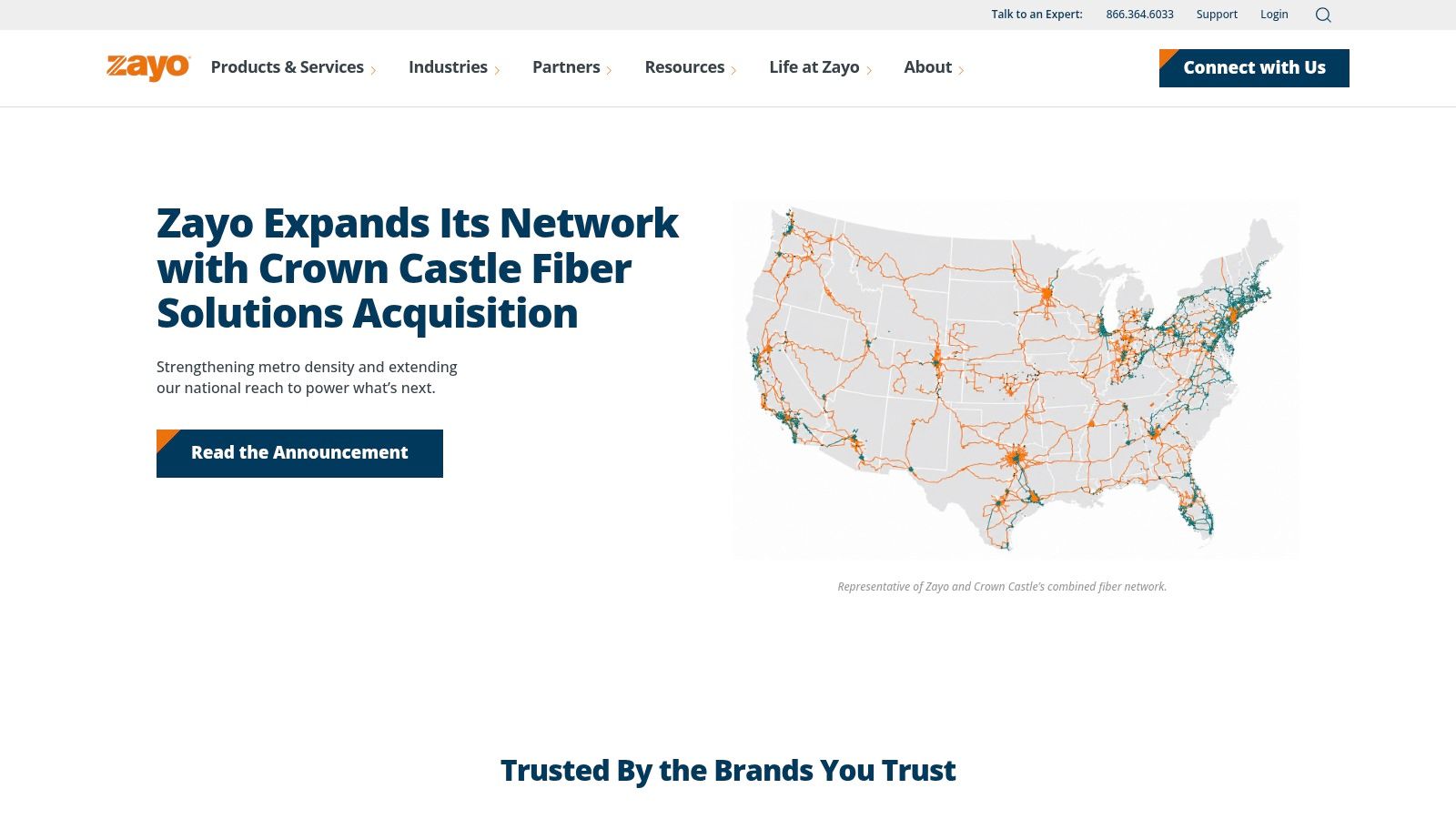
Zayo is a different kind of conversation. This isn't the provider most small offices call first, and that's fine. Zayo is built for enterprises, data centers, content-heavy environments, and organizations that care about route diversity, dark fiber, wavelengths, transport design, and serious capacity planning.
If your Atlanta business lives in colocation, cloud interconnects, multi-site data movement, or high-availability infrastructure, Zayo belongs on the shortlist. If you just need internet for a fifteen-person office, it's probably too much carrier for the job.
When Zayo is worth the complexity
Zayo makes sense when the network itself is strategic infrastructure. That includes headquarters with large east-west traffic, healthcare and finance environments with major inter-site movement, and MSPs or platforms that need custom transport rather than generic business broadband.
Its strengths are clear:
- Dark fiber and wavelength options: Better fit for organizations with serious internal networking capability.
- Metro and long-haul reach: Useful when Atlanta is one node in a broader regional or national design.
- Protection and diversity design: Important for uptime-conscious environments.
- Scalability: Strong option for businesses that expect traffic growth and topology changes.
The market backdrop supports that positioning. Cloud-based telecom analytics platforms are projected to grow, with the market forecast to reach USD 29.46 billion by 2034 at a 15.11% CAGR, according to Fortune Business Insights. As operators and enterprises modernize around those data-heavy environments, more edge hardware, routers, and transport gear eventually get retired too.
That's the part buyers often ignore. Upgrading to a more capable network usually leaves you with racks of old hardware that still contain configs, logs, and operational data. If you're planning a carrier migration or transport refresh, build decommissioning into the project from day one with a provider focused on IT asset disposal.
Carrier-grade upgrades create carrier-grade disposal problems. Someone still has to remove, audit, wipe, and process the gear you replace.
The trade-off is simple. Zayo engagements are custom, enterprise-heavy, and rarely the fastest path to "good enough" internet.
6. Cogent Communications
A common Atlanta scenario goes like this. The business finds an aggressive DIA quote, signs quickly, then learns the building is not on net and the install timeline just turned into a construction project. With Cogent, that risk is real. The provider often makes excellent financial sense in the right building and much less sense in the wrong one.
Cogent works best for buyers who already know their operating model. If the priority is dedicated internet or IP transit at a site with existing Cogent service, it deserves a serious look. If the priority is bundled voice, branch support, managed security, and white-glove coordination across mixed locations, the fit usually weakens.
Building serviceability decides the deal
For Cogent, serviceability is not a footnote. It is usually the first screening question. An on-net office, carrier hotel, or data center can mean cleaner pricing, faster turn-up, and fewer surprises. An off-net location can mean added loop costs, longer lead times, and more moving parts for your IT team to manage.
That operational difference matters more than the headline rate.
Cogent usually fits these cases well:
- On-net commercial properties and data centers: Best starting point for a serious evaluation.
- DIA and IP transit: Better suited to businesses with in-house network staff or a trusted advisor.
- Straightforward internet buying: Useful when the goal is bandwidth and uptime, not a bundled carrier relationship.
- Primary plus backup designs: A practical option when paired with fiber or fixed wireless from another provider for failover resilience.
Cogent also forces a useful discipline in the buying process. Verify the exact service address, ask about local loop requirements, confirm install assumptions in writing, and map out failover before signing. Teams that skip those steps often end up comparing quoted price instead of total operating impact. For businesses that want outside perspective on vendor fit and sourcing decisions, Southern Tier Resources expertise can help frame the trade-offs.
The weak spot is support breadth. Cogent is usually more attractive as a focused connectivity provider than as a full communications stack. That is not a flaw if your business wants a clean internet circuit and has the staff to run the rest. It becomes a problem when operations depend on one vendor to handle every site issue, every escalated trouble ticket, and every add-on service.
One more practical point gets missed during carrier changes. Replacing a circuit often means retiring firewalls, edge routers, handoff gear, or small racks of telecom equipment with stored configs and network logs. Before the cutover, assign ownership for removal and disposition. This guide on how to choose the right computer disposal company is a good filter for finding a certified local partner that can document chain of custody instead of just hauling equipment away.
7. Lumen CenturyLink Level 3
Lumen is still relevant in Atlanta because backbone heritage matters. The CenturyLink and Level 3 lineage means this provider remains a practical choice for headquarters, campuses, larger branch networks, and organizations that need more than commodity broadband. If your team is thinking in terms of DIA, Ethernet, SD-WAN, cloud on-ramps, and multi-site consistency, Lumen fits that conversation better than providers focused on simple SMB internet.
One useful thing about Lumen is range. It can support enterprise designs without forcing every site into the exact same product. That's valuable when the HQ needs carrier-grade access but smaller offices need something lighter.
Strong for structured WAN environments
Lumen is best when the network has to be managed as a system, not a collection of local internet circuits. Businesses with multiple offices, hybrid cloud traffic, compliance pressure, or central IT control usually get more value from that model.
A few reasons buyers still consider it:
- DIA and Ethernet depth: Better for predictable performance and SLA-driven environments.
- National backbone: Helpful for businesses with locations beyond Atlanta.
- SD-WAN and related services: Useful when branch policy and traffic steering matter.
- Smaller-site options: Gives some room to standardize under one umbrella.
Lumen states that its Dedicated Internet Access includes a 99.99% availability SLA. For the right buyer, that matters more than a promo rate. It doesn't remove all outage risk, but it signals the product is aimed at businesses that treat downtime as a cost center, not a minor annoyance.
The challenge is fit and buying motion. Smaller accounts may end up working through channel partners, on-net status still matters, and quote-based sales can take longer than SMB buyers would like. For broad business and infrastructure context around these kinds of enterprise environments, some Atlanta teams also lean on outside regional advisors such as Southern Tier Resources expertise when evaluating larger operational changes.
7-Provider Local Telecom Comparison
| Provider | Implementation Complexity 🔄 | Resource Requirements ⚡ | Expected Outcomes 📊 | Ideal Use Cases 💡 | Key Advantages ⭐ |
|---|---|---|---|---|---|
| AT&T Business Fiber | Medium, standard fiber install; high‑tier builds are address‑dependent | Requires fiber availability; Wi‑Fi gateway & ActiveArmor included; DIA may need custom quote | High reliability; symmetrical up to 5 Gbps; built‑in 5G failover on select tiers ⭐⭐⭐ | SMBs to multi‑site enterprises needing reliable primary + automatic backup | Published SMB pricing, end‑to‑end services, large Atlanta footprint |
| Comcast Business | Medium, widely serviceable; DIA/Ethernet may require construction/quotes | Coax or fiber access; enterprise SLAs; potential construction charges | Broad coverage; good branch/retail performance; coax can be asymmetrical ⭐⭐ | Multi‑location retail, hospitality and branch networks | Extensive metro fiber, MEF‑certified Ethernet, broad portfolio |
| Verizon 5G Business Internet (FWA) | Low, rapid turn‑up and self‑install options | Dependent on 5G Ultra Wideband coverage; static IP available; minimal build work | Fast deployment and portability; performance varies with signal quality ⭐⭐ | Rapid site turn‑up, pop‑ups, or resilient wireless failover | Quick deployment, portability, price guarantee on eligible plans |
| T‑Mobile Business Internet (FWA) | Low, quick activation and simple installs | 5G/LTE coverage dependent; transparent starting prices; portal management | Immediate connectivity; speeds/latency vary with radio conditions; not ideal for latency‑sensitive apps ⭐⭐ | Pop‑ups, temporary sites, SMBs needing inexpensive failover or fast connectivity | Transparent pricing, nationwide reach, promotional price locks |
| Zayo | High, enterprise engagements, custom quotes and build cycles | Dark fiber/wavelength leases; significant engineering and data‑center integration | Dedicated, low‑latency, high‑capacity transport scalable to carrier needs ⭐⭐⭐ | Data centers, carriers, content networks, high‑capacity enterprise interconnects | Deep DC connectivity, scalable metro and long‑haul capacity |
| Cogent Communications | Low–Medium, simple when on‑net; off‑net requires loops and extra work | Best when on‑net in carrier‑neutral buildings; flat‑rate DIA where available | Competitive DIA and IP transit pricing on‑net; strong peering for data‑center workloads ⭐⭐ | On‑net data‑center tenants and enterprises seeking cost‑effective DIA | Attractive on‑net pricing, well‑peered backbone |
| Lumen (CenturyLink/Level 3) | Medium, enterprise installs with SLA setup; off‑net quote‑based | National fiber backbone; SD‑WAN and managed options; channel engagement for small accounts | Consistent SLA-backed performance for HQs/campuses and cloud on‑ramps ⭐⭐⭐ | Headquarters, campuses, multi‑site interconnects and data‑center links | Level‑3 heritage, broad service portfolio (DIA, SD‑WAN, wavelengths) |
From Upgrade to E-Waste The Full Telecom Lifecycle
Monday morning after a carrier cutover, the new circuit is up, users are back online, and the project looks done. Then someone notices the old firewall, switches, access points, VoIP handsets, and edge appliances are still sitting in the rack or stacked in a closet. That is still part of the telecom job.
A provider change creates two operational tracks. One is activation. The other is retirement of the gear that just got displaced. Businesses that plan for the first and ignore the second usually end up with avoidable security risk, messy asset records, and equipment that sits untouched for months.
Old telecom hardware can hold far more than basic settings. It may contain saved credentials, VPN details, call logs, configuration backups, internal IP schemes, and management data. If that equipment leaves the building without being documented and wiped correctly, the migration is not really complete.
Atlanta companies run into this constantly because network refreshes are tied to office moves, fiber upgrades, SD WAN rollouts, wireless failover deployments, and provider consolidation. The broadband buildout happening across the country only adds to that turnover. Federal investment in new connectivity, including the BEAD program discussed by Fifth Third, means more replacement cycles, more retired gear, and more end of life handling that someone has to own.
For Atlanta companies, a local certified partner solves the last-mile problem of decommissioning. Montclair Crew helps businesses remove telecom and IT equipment with secure handling, free DoD 5220.22-M three-pass hard drive wiping, optional on-site shredding, asset audit support, compliant recycling, and resale recovery when equipment still has value. That matters during site closures, MDF and IDF cleanouts, and multi-location upgrades where internal IT teams do not have time to manage chain of custody themselves.
Teams that need a clearer technical baseline before planning a migration can also review the CompTIA Network+ study guide. It is a useful refresher on core networking concepts that affect provider selection, failover design, and hardware replacement decisions.
Old telecom gear remains a security and compliance issue until it is wiped, documented, and removed properly.
There is also a time and cost angle that gets missed. If disposal is built into the migration plan from the start, rack space gets cleared faster, audit trails stay cleaner, and operations does not inherit a pile of unlabeled equipment after the install team leaves. If disposal is treated as an afterthought, somebody is chasing serial numbers, hunting for drives, and figuring out removal weeks later.
The right Atlanta telecom partner is not just the carrier with the best rate card or the fastest quoted speed. It is the provider mix and support plan that fits how the business runs, including failover, serviceability, install constraints, and the cleanup work after the cutover. Closing that loop is part of doing the job properly.
If your Atlanta business is upgrading providers, consolidating sites, or clearing out retired network gear, Montclair Crew Recycling can handle the cleanup properly. Their team helps businesses remove, audit, wipe, shred, recycle, and resell telecom and IT equipment so you don't trade one infrastructure problem for a data security problem.
