
Your office probably has one of these piles right now. Old laptops from the last refresh. A few dead monitors. Network gear nobody wants to touch. Maybe a retired server sitting in a closet because nobody wants to be the person who throws out a device that might still hold company data.
That’s when a quick search for staples electronics recycling looks appealing. It’s familiar. It’s convenient. It feels responsible.
For some situations, it is.
For many Atlanta businesses, it isn’t the smartest move.
The mistake I see most often is treating consumer electronics recycling and business IT asset disposition like they’re the same service with different branding. They’re not. One is built for convenience. The other is built for security, documentation, chain of custody, and operational control.
If you’re clearing out a drawer with one old keyboard and a dead personal printer, a retail drop-off program can be fine. If you’re handling company laptops, office desktops, servers, storage devices, or anything that may contain regulated or sensitive data, the standard should be much higher.
The main question isn’t, “Where can I recycle this?” It’s, “What risk am I accepting if I recycle this the wrong way?”
Your Atlanta Business Has Old Tech What Is the Smartest Move
A business owner in Metro Atlanta usually starts in the same place. There’s equipment taking up space, employees want it gone, and nobody wants to overcomplicate disposal.
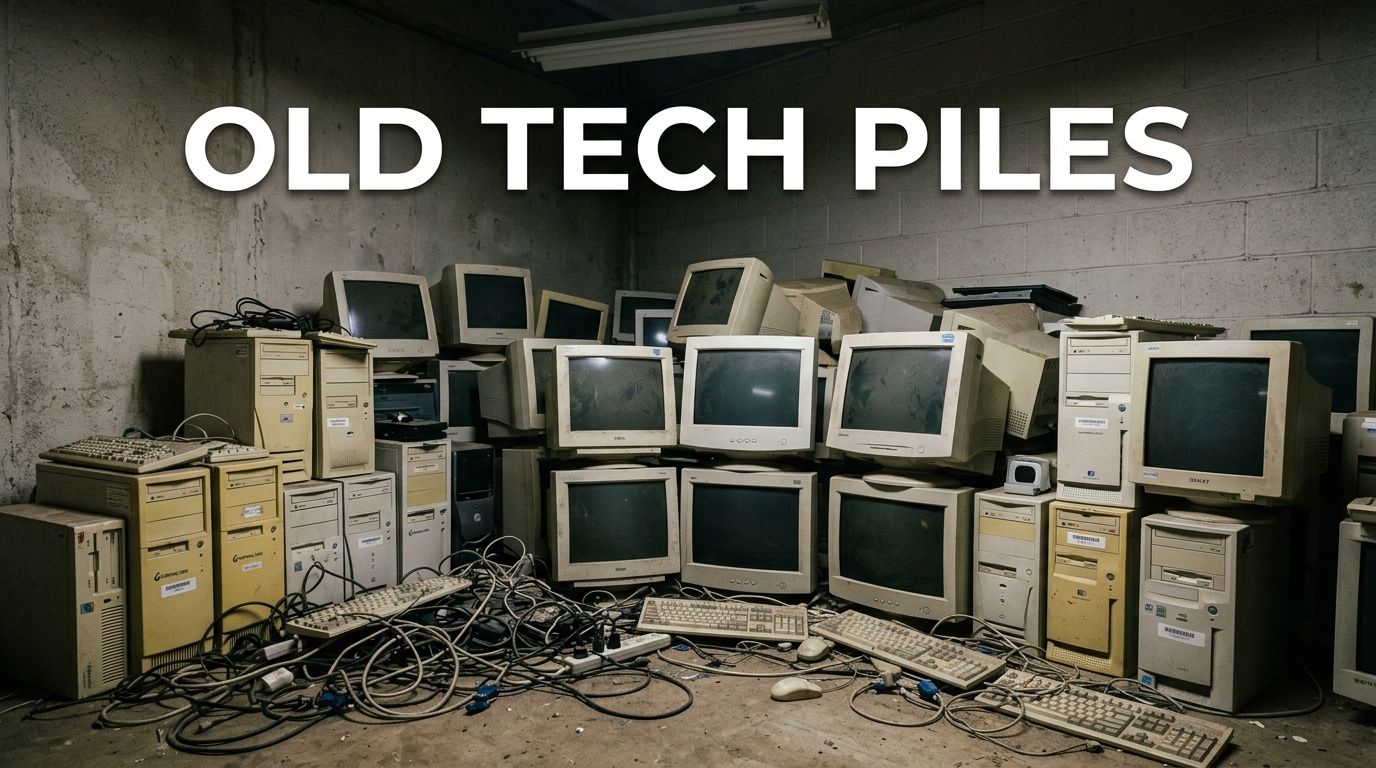
Maybe it’s a small office in Sandy Springs with a dozen retired laptops. Maybe it’s a warehouse in Norcross with old handhelds, printers, and access points. Maybe your team just migrated systems and now the leftovers are stacked in a back room beside boxes of cables and a few mystery hard drives.
The easy option is obvious. Load it into a car. Drive to a store. Drop it off. Move on.
That simplicity is exactly why Staples has become such a visible name in this space. Staples earned the EPA’s Gold Tier Award for the seventh time in 2020 in the Sustainable Materials Management Electronics Challenge, and the winners collectively helped recycle 176,494 tons of electronics, according to Waste Dive’s reporting on the EPA recognition.
That’s real scale. It matters. It also doesn’t answer the business question.
The business problem isn’t just removal
When a company disposes of tech, it isn’t just trying to get rid of clutter. It’s trying to solve several problems at once:
- Data risk: Old devices may still hold client files, employee records, saved credentials, emails, or backups.
- Compliance exposure: Healthcare, legal, finance, education, and government organizations need more than a verbal assurance that equipment was handled properly.
- Operational burden: Someone has to inventory assets, move them, transport them, and prove what happened to them.
- Value recovery: Some assets shouldn’t be scrapped at all. They may still have resale or reuse value.
A retail drop-off program handles the first problem well enough for consumers. It does far less for the other three.
Two paths, very different outcomes
Most Atlanta businesses are really choosing between two models.
One is the consumer drop-off route, where convenience comes first.
The other is the professional B2B ITAD route, where control comes first.
If you need a deeper overview of how Georgia companies usually approach this decision, this guide to Georgia ITAD services is a useful reference point.
If your equipment came from a company balance sheet and ever touched company data, you shouldn’t treat disposal like a weekend errand.
That’s the dividing line for this entire topic. Staples can be a solid environmental recycling option. It is not automatically the right operational or legal choice for a business.
Retail Drop-Off vs Professional ITAD A Fundamental Difference
Before comparing features, get the model right.
A retail recycling program and a professional ITAD service may both keep electronics out of landfill streams. That’s where the similarity ends.
What retail drop-off is designed to do
Retail drop-off exists to make recycling easy for the public.
It’s built for high volume, low touch intake. People bring items in. The retailer accepts a broad category of electronics. The system prioritizes accessibility, throughput, and responsible downstream recycling.
That’s a good fit when the main goal is simple disposal.
It’s a weak fit when the asset itself carries business obligations.
A consumer-friendly program doesn’t usually start with questions like these:
- Who logged the serial numbers?
- Who maintained possession from office to final processing?
- What proof do you have that each storage device was sanitized or destroyed?
- What documentation will you keep for audits, legal review, or internal controls?
Those are business questions. Consumer programs aren’t built around them.
What professional ITAD is built to do
IT asset disposition is a business service, not just a recycling service.
It treats end-of-life equipment as a managed process. That process usually includes pickup, inventory, audit support, data destruction, downstream handling, disposition reporting, and when appropriate, resale or remarketing.
If you want a plain-English definition, this explanation of what IT asset disposition means gets to the point.
A real ITAD workflow starts earlier than recycling. It starts when your company decides an asset is leaving service.
Why the philosophy matters
The philosophy behind the service determines the risk you absorb.
A retail program asks, “How do we help people recycle this responsibly?”
A B2B ITAD process asks, “How do we move this asset out of service without creating a security, compliance, or documentation failure?”
That difference affects everything:
| Decision area | Retail drop-off model | Professional ITAD model |
|---|---|---|
| Primary goal | Consumer convenience and material recovery | Controlled business disposition |
| Intake method | Self-transport and handoff | Managed pickup and removal |
| Data handling focus | Limited public detail | Formal destruction process |
| Documentation | Minimal consumer-style confirmation | Asset-level records and certificates |
| Best fit | Personal devices, small household loads | Business fleets, servers, regulated environments |
The practical rule
A company shouldn’t choose an electronics recycling option based only on whether a store accepts the item.
It should choose based on whether the service matches the asset’s risk profile.
Practical rule: If the device once held company email, customer data, HR files, medical information, financial records, or internal credentials, convenience should not be the deciding factor.
That’s why the phrases “electronics recycling” and “ITAD” should never be used interchangeably inside a business. One describes disposal access. The other describes risk-managed disposition.
Head-to-Head Staples vs Montclair Crew for Business Needs
An Atlanta office manager loads retired laptops into an SUV, drives them to a retail store, gets a basic receipt, and heads back to work. A week later, legal asks for proof of serial numbers, drive destruction, and chain of custody. That is the moment the difference becomes expensive.
For a business, the comparison is simple. Staples offers a consumer-oriented recycling channel. A professional ITAD provider manages business risk.
| Business criterion | Staples program | Professional B2B ITAD |
|---|---|---|
| Intended user | Consumers and light office drop-off | Organizations disposing of managed IT assets |
| Data security visibility | Public materials focus on recycling and accepted items | Service centers on documented data destruction and asset control |
| Logistics | Your staff transports equipment or uses mail-back options | Provider handles pickup, removal, and scheduling |
| Audit trail | Limited public detail on asset-level reporting | Asset tracking, disposition records, and certificates |
| Scale fit | Better for a few low-risk items | Better for office refreshes, cleanouts, and infrastructure projects |
| Value recovery | Recycling is the visible focus | Recycling plus evaluation for reuse and resale |
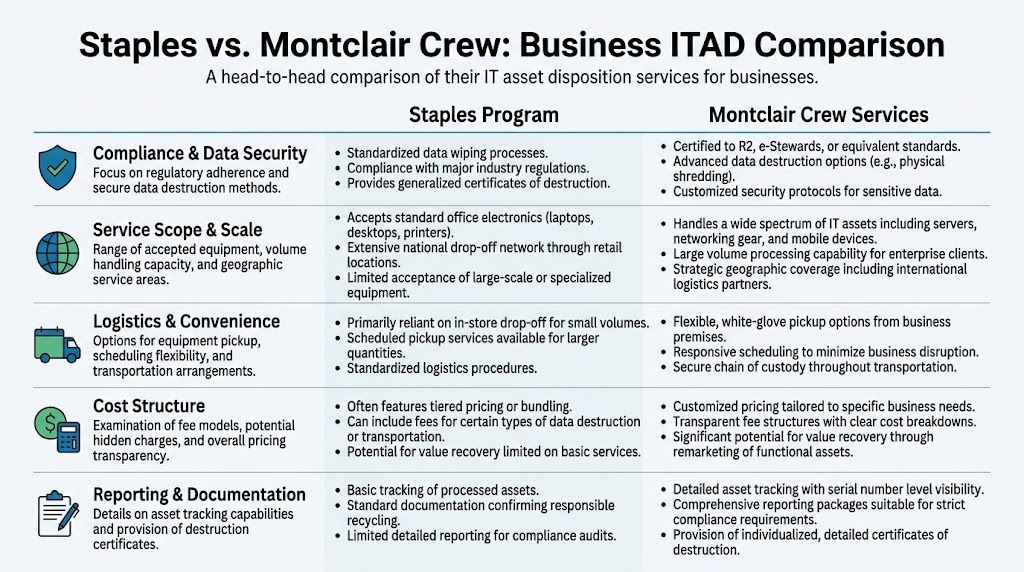
Staples solves a recycling problem, not a business disposition problem
Staples has a legitimate place in electronics recycling. Its public program is built for convenience and environmental handling.
That still leaves a major business gap.
A company retiring employee laptops, desktop towers, monitors, docks, and servers does not just need a place that accepts devices. It needs documented control over what left the building, who handled it, what happened to the storage media, and what records exist if an auditor, client, insurer, or regulator asks questions later.
Retail recycling does not usually market itself around that level of control because household users do not need it. Businesses do.
Data liability is the deciding factor
The biggest risk is not whether the material gets recycled. The biggest risk is whether data-bearing assets leave your office without a defensible chain of custody.
Staples' public-facing program information emphasizes environmental disposal. Public details do not give a business owner much clarity on asset-level tracking, formal sanitization records, or the documentation standard many companies need, as discussed in Recycling Today’s coverage of the program.
That uncertainty is a problem by itself.
If your retired devices held email, payroll files, customer records, contracts, saved passwords, browser sessions, or internal documents, you need proof. Guessing is not a control. A drop-off receipt is not an audit trail.
If a device once stored company data, your disposal method needs evidence attached to it.
A professional ITAD provider should be able to answer direct questions about sanitization methods, physical destruction options, serial number tracking, and final disposition records. If the answer is vague, the process is weak.
The logistics expose the design of the service
Look at the labor burden.
Someone on your team has to collect the devices, verify what is being removed, pack them, load them, transport them, and hand them off. If anything is missed, swapped, or lost in transit, your company owns that failure.
That process may be acceptable for one old printer or a dead keyboard.
It is a poor fit for branch closures, employee equipment refreshes, storage-room cleanouts, and server retirements. Professional ITAD exists for those jobs because businesses need pickup, controlled removal, inventory handling, and scheduled service that does not depend on an employee making store runs with company assets in a personal vehicle.
Reporting separates convenience from accountability
Business owners usually do not need vague confirmation that electronics were dropped off somewhere. They need records they can keep.
They need to know which assets were collected, which were destroyed, which were recycled, and whether any resale value was recovered. They also need documentation that stands up under scrutiny.
That is why a side-by-side review such as this guide to Staples recycling electronics for business disposal decisions matters. The question is not whether a retailer accepts electronics. The question is whether the service gives your company the paperwork and control a business environment requires.
Cost looks different when risk is included
Retail drop-off often looks cheaper because the visible fee is low or zero.
The missing costs show up elsewhere. Staff time. Transport time. Weak documentation. No pickup. No asset-level reporting. No clear recovery process for equipment that still has resale value. More internal effort, less control.
A professional provider may charge for work a store does not perform. That is the point. You are paying for controlled removal, documented handling, and lower exposure.
Bottom line for Atlanta businesses
Use Staples for a few low-risk items if no meaningful data, compliance, or reporting requirement is involved.
Use a professional ITAD provider for employee computers, storage media, office cleanouts, regulated data, multi-site pickups, or any project where you may need to prove what happened after the equipment left your possession.
For business assets, the smart choice is the option that reduces liability, not the one that feels most convenient.
Which Service Is Right for Your Business Scenario
The right answer depends on what you’re disposing of, who used it, and what was stored on it.

A solo freelancer with one old desktop
A freelance designer in Midtown replacing a personal workstation has a simple problem. One machine. Limited volume. No internal compliance department. No fleet. No server rack. No offboarding event.
In that case, a retail program can be perfectly reasonable if the device is properly reset first and the person understands they’re using a consumer disposal channel.
The key point is that this is a personal-device workflow. The risk sits mostly with the individual, and the logistics are easy.
A law firm replacing office computers
A law firm in Marietta disposing of office laptops and desktops has a very different problem.
Client records, emails, document caches, local file copies, saved credentials, and browser data may all remain on retired devices. The firm doesn’t just need recycling. It needs controlled disposition with clear proof that data-bearing assets were handled correctly.
A consumer drop-off option is the wrong fit here.
The firm should want:
- documented inventory
- controlled removal
- verified data destruction
- final reporting suitable for internal records
That’s the difference between “we dropped them off” and “we can demonstrate what happened to each asset.”
A healthcare office decommissioning workstations
A medical practice near Emory has even less room for ambiguity.
Protected health information changes the stakes. Even if a workstation looks wiped at the user level, that doesn’t answer what standard was used, who performed it, how the asset was tracked, or what record the practice kept after disposal.
For healthcare, a retail handoff is too loose.
If patient information may have touched the device, the disposal process should be documented like any other controlled business process.
That means pickup, custody, destruction standards, and a retained paper trail.
A data center clearing out servers
An Alpharetta data center retiring racks of servers, storage hardware, and network equipment should never default to a consumer-style recycling channel.
The scale alone makes that impractical. The bigger issue is that infrastructure hardware often has residual value, removable media, configuration data, and business continuity implications.
The smarter path is a business ITAD workflow that can separate:
- hardware that should be destroyed
- hardware that can be remarketed
- components needing special handling
- assets requiring detailed inventory reporting
Quick decision guide
| Scenario | Better fit | Why |
|---|---|---|
| One personal or very low-risk device | Retail drop-off | Convenience outweighs process overhead |
| Office laptop refresh | B2B ITAD | Business data and records matter |
| Healthcare or legal environment | B2B ITAD | Compliance and auditability matter |
| Server or bulk infrastructure retirement | B2B ITAD | Scale, logistics, and value recovery matter |
The simplest rule to follow
Don’t choose based on the item alone. Choose based on the business consequences if something goes wrong.
A monitor with no storage is one thing. A laptop that belonged to HR is another. A rack server from a production environment is another level entirely.
That’s why businesses get into trouble when they ask only, “Will Staples take it?” The better question is, “What standard of control does this asset require?”
The Hidden Costs of 'Free' Recycling for Your Business
Your office manager loads six retired laptops into an SUV, drops them at a retail counter, and heads back to the office thinking the job is done.
For a business, that is often where the actual risk starts.

Free at the counter still costs your business
“Free” only means there is no disposal fee at the counter. It says nothing about labor, chain of custody, documentation, or data liability.
Your team still has to collect devices, confirm what may contain data, transport assets off-site, and answer questions later if finance, legal, IT, or an auditor asks what happened. If that process lives in email threads and a spreadsheet someone built after the fact, you do not have a disposal program. You have a gap.
That gap gets expensive fast.
Environmental recycling is not the same as business protection
A consumer recycling program can be perfectly legitimate from an environmental standpoint and still be the wrong fit for corporate assets.
Business owners in Atlanta often miss this distinction. They hear “recycling” and assume the job is handled. It is not handled until you can show what assets left your control, whether any stored data, how they were processed, and who can verify the outcome.
Environmental responsibility matters. Audit trail matters more when company data is involved.
Where the hidden cost usually shows up
Staff time you did not budget for
Retail drop-off shifts the work to your employees.
Someone has to sort the equipment, pull serials if you want any record at all, move the load, wait at the store, and clean up the documentation afterward. For a business with more than a few devices, that is wasted skilled labor.
Weak documentation
This is the biggest problem with consumer-style recycling for business equipment.
If a laptop from HR, finance, or sales disappears from your records, you need more than “we dropped it off.” You need an inventory, a processing record, and a documented data disposition path. Without that, you are exposed in audits, client security reviews, insurance questionnaires, and internal investigations.
Missed value recovery
Not every retired device is scrap.
Some equipment can be remarketed, some should be destroyed, and some only needs component-level handling. A retail drop-off process does not exist to help your company sort those decisions in a way that protects value and records.
Data security uncertainty
This is the cost that hurts the most because it can turn into a legal and reputational problem.
If your company cannot prove how data-bearing devices were sanitized or destroyed, you keep the liability. The device may be gone, but the responsibility is not.
A free recycling option only makes sense when the asset has low business consequence and low data risk.
Compare price the right way
Do not compare retail recycling to professional ITAD like you are buying printer paper.
You are choosing a level of control. Businesses pay for secure pickup, serialized inventory, data destruction records, audit support, and a documented chain of custody because those controls reduce expensive uncertainty later.
If you want a clearer picture of downstream processing, read this explanation of what happens to recycled electronics.
The smartest question is not “How much does drop-off cost?” It is “What will it cost my business if I cannot prove what happened to these assets?”
Your Next Steps for Secure IT Disposal in Metro Atlanta
A staff member loads retired laptops into a personal car, drops them at a retail counter, and heads back to the office. Two months later, a client asks for proof of data destruction and a list of serialized assets removed from service. If your team used a consumer recycling channel, that paper trail may not exist.
That is the decision in front of your business.
Use a retail drop-off option only for a very small batch of low-risk items with no meaningful data exposure. For company computers, servers, drives, and anything tied to client, employee, or financial information, use a professional ITAD process.
Start with an asset list
Do not start by asking where to drop things off. Start by identifying what you have and which items can create liability.
List laptops, desktops, servers, network equipment, loose drives, phones, tablets, printers, and monitors. Note quantity, location, and whether each item may store data. A simple spreadsheet is enough if it is accurate.
Classify risk before you schedule anything
Business disposal decisions should be driven by exposure, not convenience.
Ask these questions:
- Did the device ever hold company files, customer data, employee records, passwords, or regulated information?
- Does your company need proof of sanitization, destruction, pickup, or final disposition?
- Would a missing asset create a client issue, legal issue, insurance issue, or internal investigation?
If any answer is yes, route that equipment into a documented business process.
Use pickup and chain-of-custody controls for business assets
Driving equipment across Metro Atlanta for a retail handoff is not efficient, and it is not a strong control. Your team loses time. Your company also takes on avoidable custody risk the moment those devices leave the office without a business-grade intake process.
A better next step is to schedule a business electronics recycling pickup in Atlanta so the assets are removed, tracked, and processed through a service built for company equipment.
Make the decision based on consequence. If the assets are low-risk and disposable, keep it simple. If they hold data or could surface in an audit, use a provider that gives you documentation your business can stand behind.
Frequently Asked Questions About Business E-Waste
Can a very small business still use a retail recycling option
Yes, sometimes.
If you’re a one-person business with a single low-risk device and no real compliance exposure, a retail option can be acceptable. The important part is honesty about the risk. Once the device contains client files, financial records, employee data, or anything sensitive, the standard should change.
Small business doesn’t mean low liability.
Is Staples bad for electronics recycling
No. That’s not the point.
Staples has a meaningful recycling program and a serious environmental track record. The issue is fit. A consumer-focused program can be a solid choice for consumer disposal and still be the wrong choice for company-owned data-bearing assets.
What should a business demand before handing over old computers
At minimum, ask for clarity on these items:
- Data destruction method: How are drives wiped or destroyed?
- Chain of custody: Who controls the assets from pickup to final processing?
- Reporting: Will you receive itemized records or certificates?
- Logistics: Who removes and transports the equipment?
- Disposition path: What gets recycled, destroyed, or resold?
If the answers are vague, keep looking.
Are mail-back programs enough for office equipment
Usually not for anything substantial.
Mail-back can work for a limited, low-risk batch. It’s weaker for bulk assets, fragile equipment, time-sensitive cleanouts, or devices that need close custody and formal reporting.
Business IT disposal gets messy fast once boxes start moving through general shipping channels.
What happens after a professional ITAD pickup
A proper B2B process usually includes intake, inventory review, data destruction, downstream disposition, and final documentation.
The exact workflow varies by provider, but the key advantage is control. The business isn’t left wondering what happened after drop-off day. It gets a managed chain from removal through final disposition.
Is on-site service really necessary
Not always. Often, yes.
If you have servers, multiple departments, a storage room full of retired equipment, or any category of sensitive data, on-site service is the cleanest way to reduce internal labor and tighten control.
For business equipment, convenience should mean your team doesn’t have to become the recycling logistics department.
If your Atlanta organization needs a secure, documented way to retire laptops, servers, drives, and other IT equipment, Montclair Crew Recycling offers the kind of B2B process businesses need: pickup, asset auditing, certified data destruction, compliant recycling, and support for value recovery when appropriate.
