
When your business recycles old electronics, they don't just vanish into a black hole. Far from it. They actually start a highly secure, documented journey. Every single device gets logged, all your sensitive data is permanently destroyed, and the components are either prepped for a second life or carefully broken down to recover valuable materials like copper, aluminum, and gold. It's a process that flips potential liabilities into secure, sustainable assets.
The Lifecycle of Your Recycled Business Electronics
When a Metro-Atlanta business decides it's time to retire old IT equipment, two things are always top of mind: data security and environmental compliance. If you don't know what happens to recycled electronics after they leave your office, you're leaving your business exposed. This is way more than just a drop-off service; it's a multi-stage operation designed from the ground up to protect your information and get the most out of every last component.
This journey transforms what could be e-waste into a valuable stream of commodities and reusable goods. To give you a bird's-eye view, this infographic maps out the core stages of the process.
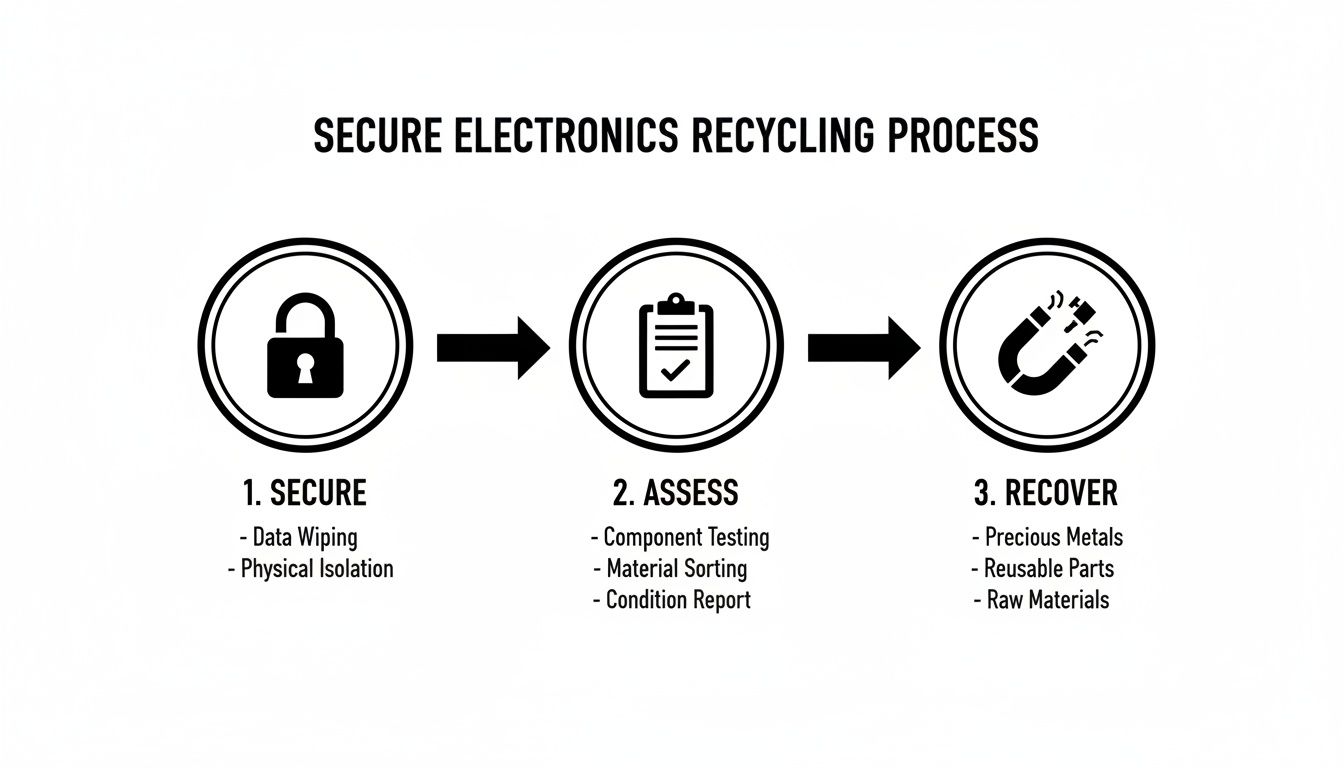
As you can see, every step revolves around security and sustainability, from the moment we pick it up to the final material recovery. Each stage is built to solve a specific business problem, whether it's protecting data or satisfying regulations.
A Roadmap for Your Retired Assets
To give you an even clearer picture, let's break down the typical lifecycle of your retired business devices. Think of this as a roadmap for your assets, with critical checkpoints along the way to guarantee security and compliance. Partnering with one of the best IT asset disposition companies ensures each of these steps is handled by certified pros who know exactly what they're doing.
The table below really lays it all out, connecting each stage to what's actually happening and, more importantly, the business concern it solves.
Lifecycle Stages of a Recycled Business Device
| Stage | Primary Activity | Key Business Concern | Certified Process |
|---|---|---|---|
| Secure Logistics | On-site pickup and locked transport of all assets. | Preventing theft or loss of devices during transit. | Sealed trucks and GPS tracking. |
| Asset Audit | Scanning and logging every device by serial number. | Maintaining a perfect inventory and accountability. | Creating an unbroken chain of custody. |
| Data Destruction | Wiping or shredding hard drives and other media. | Eliminating the risk of a catastrophic data breach. | Issuing Certificates of Data Destruction. |
| Sorting & Triage | Testing assets for functionality and cosmetic condition. | Maximizing financial returns on reusable equipment. | Grading devices for reuse, parts, or recycling. |
| Material Recovery | Shredding and separating materials into commodities. | Ensuring environmental compliance and sustainability. | R2v3/RIOS certified de-manufacturing. |
This end-to-end process isn't just about getting rid of old gear. It's about providing your business with a documented, defensible, and responsible way to manage the entire lifecycle of your IT assets.
Secure Intake and Chain of Custody
The journey for your old electronics really kicks off the moment they leave your building. This first step, what we call secure intake, is hands-down the most important for protecting your business from data leaks and compliance headaches. It’s the official handoff, where the responsibility for your retired assets transfers from your team to ours.
Think of it like an armored car service, but for your data. When our crew shows up at your Metro-Atlanta facility, every single device is handled with care and loaded into locked, secure vehicles. This isn't just a casual pickup; it’s a planned operation designed to make sure nothing goes missing along the way.
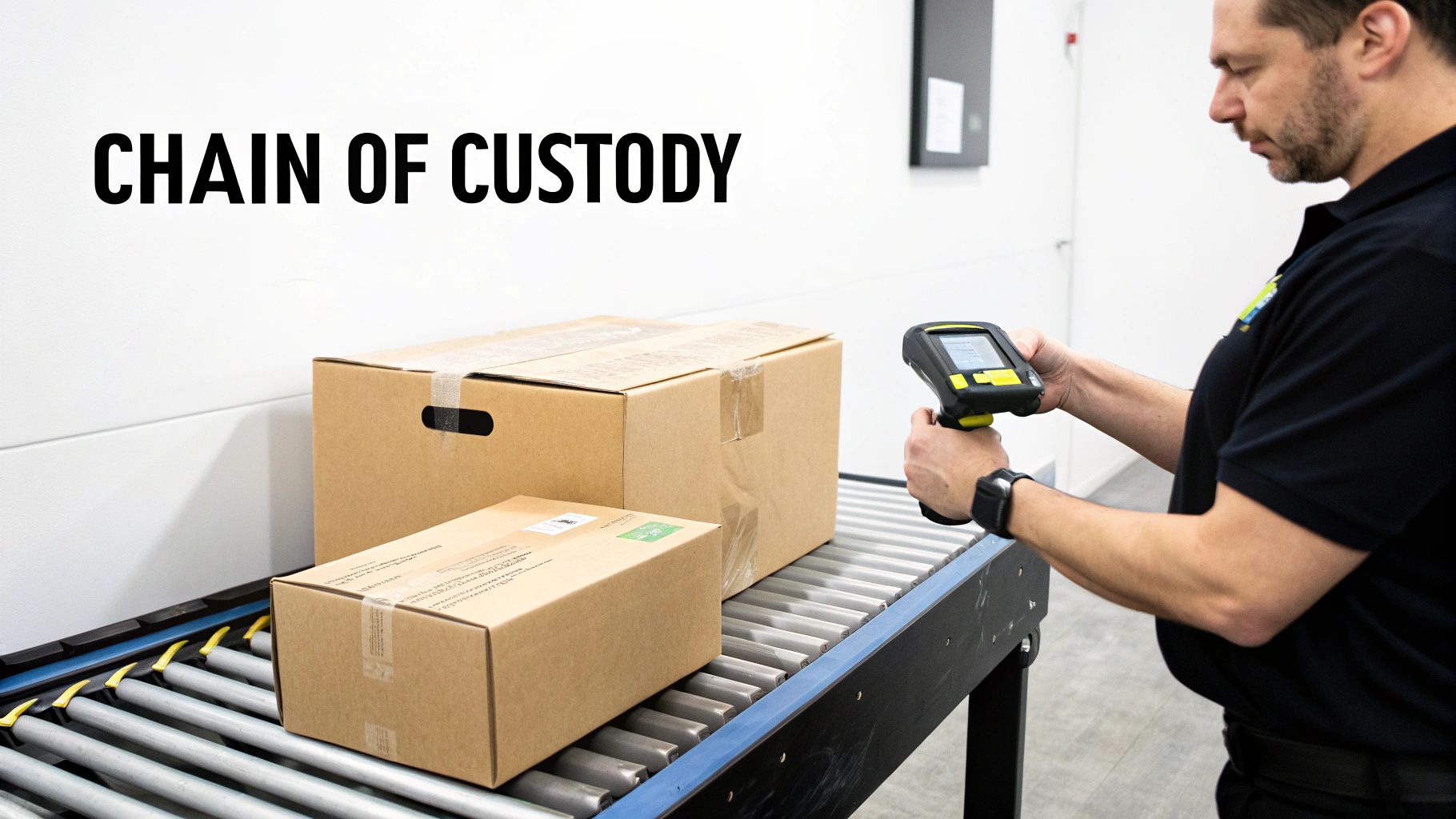
Once everything arrives safely at our certified facility, the asset audit starts immediately. This is where we lay the groundwork for your compliance and peace of mind. Each piece of equipment gets logged to create an unbreakable chain of custody.
Establishing an Unbroken Chain of Custody
The idea of a chain of custody is simple but incredibly powerful. It's a chronological paper trail that documents the seizure, custody, control, and final disposition of every single asset you hand over. It’s the verifiable proof that shows nothing was lost or misplaced between your office and our secure facility. This documentation is your first line of defense if an auditor ever comes knocking.
Every device—from servers and laptops down to individual hard drives—is scanned by its unique serial number. This creates a detailed inventory report that acts as your receipt, confirming we’ve taken possession of your specific equipment. This isn't just about counting boxes; it's about establishing total accountability from the very beginning. For businesses new to this, learning the details of a secure IT asset removal service is the best place to start.
A documented chain of custody is non-negotiable in the world of IT asset disposition. It transforms the recycling process from a simple disposal task into a managed, auditable security protocol that protects your organization's sensitive information.
This rigorous tracking is more important than ever. The electronics recycling market, valued at USD 43.2 billion in 2025, is expected to skyrocket to USD 147.9 billion by 2035. A huge chunk of that growth comes from businesses needing to securely manage old PCs and laptops, which make up 45% of the market. Secure, documented processes are becoming the industry standard, not the exception.
Why Meticulous Auditing Matters
Let's be blunt: without a detailed asset audit, you have no way to prove what happened to your retired electronics. Imagine trying to explain to an auditor where a server that held confidential customer data went. The consequences could be brutal, from massive fines to a damaged reputation you can't easily fix.
A comprehensive inventory report gives you the hard evidence to satisfy everyone from your internal stakeholders to outside auditors and regulatory bodies. This report will typically include:
- Asset Tag Number: Your company's internal ID for the device.
- Serial Number: The unique number from the manufacturer.
- Device Type: Laptop, server, monitor, etc.
- Manufacturer and Model: For example, a Dell Latitude 7420.
- Date of Receipt: The exact date the asset entered our custody.
This level of detail leaves no room for error or ambiguity. You get the peace of mind knowing every last device is accounted for, which sets the stage for the next critical step: guaranteed data destruction. This initial paperwork is the cornerstone of a truly secure and compliant recycling program.
Guaranteed Data Destruction and Sanitization
Once your old IT gear is logged and accounted for, we get to the most important part of the entire process: dealing with the sensitive data left on those devices. Hitting 'delete' on a file doesn't actually erase it. Think of it like tearing the table of contents out of a book—the chapters are still there, and someone determined enough can find them. This is where professional data destruction stops being optional and becomes absolutely essential.
For any Metro-Atlanta business, a single hard drive discarded improperly can turn into a nightmare. A data breach can mean devastating fines, a ruined reputation, and the permanent loss of customer trust. Guaranteed data destruction is the only way to be certain your company’s private information, client lists, and internal records are gone for good.
This isn't just about wiping a drive; it's about complete data sanitization. That means using a verifiable process to make every bit of information totally unrecoverable. You can learn more about the specifics in our guide on what is data sanitization and why it’s so critical for business compliance. It’s a meticulous, fully documented step that is non-negotiable for protecting your organization.
Choosing the Right Method of Destruction
When it comes to permanently wiping data, there are two main industry-standard methods: software-based wiping and good old-fashioned physical destruction. The right one for you depends on the device, your security needs, and whether the hardware has any resale value.
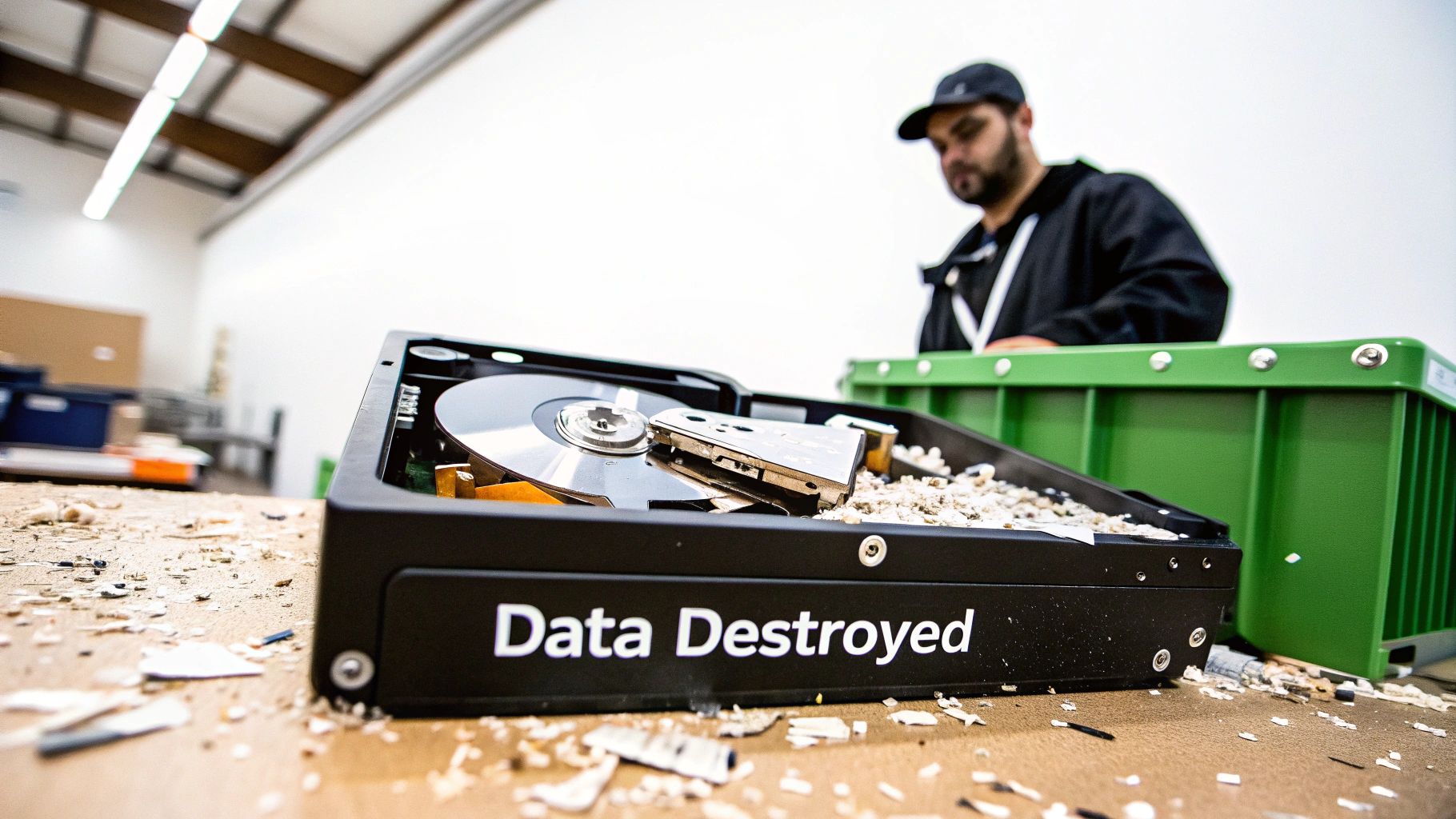
A simple way to think about it: software wiping is like digitally bleaching a drive, scrubbing every sector clean so it can be safely reused. Physical shredding is like feeding that same drive into an industrial woodchipper, leaving nothing but tiny, unreadable pieces behind.
Let's look at how these two powerful approaches stack up.
Data Destruction Methods Compared
Choosing between wiping and shredding comes down to balancing security needs with asset value. A software wipe preserves the hardware for potential resale, while shredding offers the ultimate, visible proof of destruction. Here’s a quick comparison to help you understand the options.
| Method | Process Description | Best For | Key Benefit |
|---|---|---|---|
| DoD 5220.22-M Wipe | A software-based method that overwrites the entire hard drive with patterns of ones and zeros in multiple passes. | Functional hard drives (HDDs and SSDs) that may be reused or resold. | Allows for asset value recovery while ensuring data is completely irretrievable. |
| Physical Shredding | The hard drive or storage media is fed into an industrial shredder that grinds it into small metal fragments. | Damaged, obsolete, or highly sensitive drives; solid-state media; tapes and optical discs. | Provides irrefutable visual confirmation of destruction and is the most secure method. |
Understanding when to use each is key. If you're retiring a fleet of newer laptops that still have market value, a Department of Defense (DoD) compliant wipe is the perfect fit. It secures your data while preserving the hardware's value. But for that box of old, failed server drives that's been sitting in a closet? Physical shredding is the obvious and safest choice.
When a company goes through a major IT overhaul like a data center move, managing the old hardware correctly is a huge deal. As detailed in A Modern Playbook for the Migration of Data Center Operations, ensuring rock-solid data security on retired assets is a critical piece of a successful project.
The Certificate of Data Destruction Your Proof of Compliance
No matter which method is used, the job isn't done until you have a Certificate of Data Destruction in your hands. This document is your official, auditable proof that your data was permanently destroyed in line with privacy laws like HIPAA, PCI DSS, or GDPR.
This certificate is way more than just a piece of paper—it's your legal evidence of due diligence. It will always include:
- Unique serial numbers of every drive that was destroyed.
- The method of destruction used (e.g., DoD wipe, shredding).
- The date and location where the destruction took place.
- A statement of compliance from us, your certified recycler.
This paperwork officially closes the loop on your chain of custody. It gives you verifiable proof that protects your business from future liability and confirms your sensitive data was handled the right way. It’s the final step that lets you move forward with total peace of mind.
Sorting for Reuse, Refurbishment, or Recovery
Once your electronics are inventoried and the data is wiped clean, they head to the next stop: our triage center. This is a crucial step that decides the next chapter for every single asset. Not everything is destined for the shredder—in fact, a lot of retired equipment still has plenty of life and value left in it.
Think of it like an organ donation system, but for technology. Just because a server is no longer needed in your data center doesn't mean its components—like its valuable RAM, CPUs, or power supplies—are useless. Our technicians get hands-on, meticulously testing and grading each device to figure out its best possible path forward.
This whole process is the heart of a circular economy. Instead of the old straight line from "buy" to "landfill," we create loops that keep electronics and their parts in use for as long as possible. It’s a simple concept that dramatically cuts down on e-waste and helps you get more out of your original investment.
The Triage Process Unpacked
The sorting stage is a detailed, hands-on evaluation. Our goal is to steer as much material as we can away from being melted down into basic commodities and toward higher-value options. This is where having deep expertise in the secondary IT market really pays off.
Technicians run a series of diagnostic tests to see if a device is fully working, partially working, or completely dead. The assessment looks at a few key things:
- Functionality: Does it power on? Does it still do what it's supposed to do?
- Cosmetic Condition: Are there any dents, cracked screens, or major scratches that would tank its resale value?
- Age and Specs: Does the device still meet what the market wants? A three-year-old laptop has a much better shot at a second life than one from a decade ago.
- Component Value: Even if the whole unit is a bust, can we pull out valuable parts like memory sticks, processors, or graphics cards to be used elsewhere?
This thorough grading makes sure that whatever happens next is the smartest choice, both financially and for the environment.
From Potential Waste to Revenue Stream
After an asset gets its grade, it's sent down one of three main tracks. Each path is set up to squeeze out the most value possible while sticking to strict environmental rules. This is a core part of any solid IT asset recycling program.
- Reuse and Resale: Devices that are in good shape, both functionally and cosmetically, get cleaned up, refurbished, and prepped for the secondary market. This includes things like newer laptops, monitors, servers, and networking gear. It’s the greenest option because it extends the entire product's lifespan.
- Component Harvesting: For equipment that doesn't quite work but is full of good parts, our team carefully takes it apart. High-demand components like RAM, CPUs, and hard drives are tested and sold on their own, giving them a second chance in other machines.
- Material Recovery: Anything with no resale value—either as a whole unit or for its parts—is slated for de-manufacturing. These assets move on to be broken down into their raw materials like steel, plastic, and precious metals.
By focusing on reuse and refurbishment first, your business can often flip a disposal cost into a revenue-sharing opportunity. A certified partner will give you transparent reports on the value recovered from your assets, putting money directly back into your budget.
This sorting and triage stage is where the hidden potential in your old IT gear is truly unlocked. It turns a simple disposal task from a liability into a strategic move that helps your bottom line and your company's green initiatives.
Responsible Material Recovery and Recycling
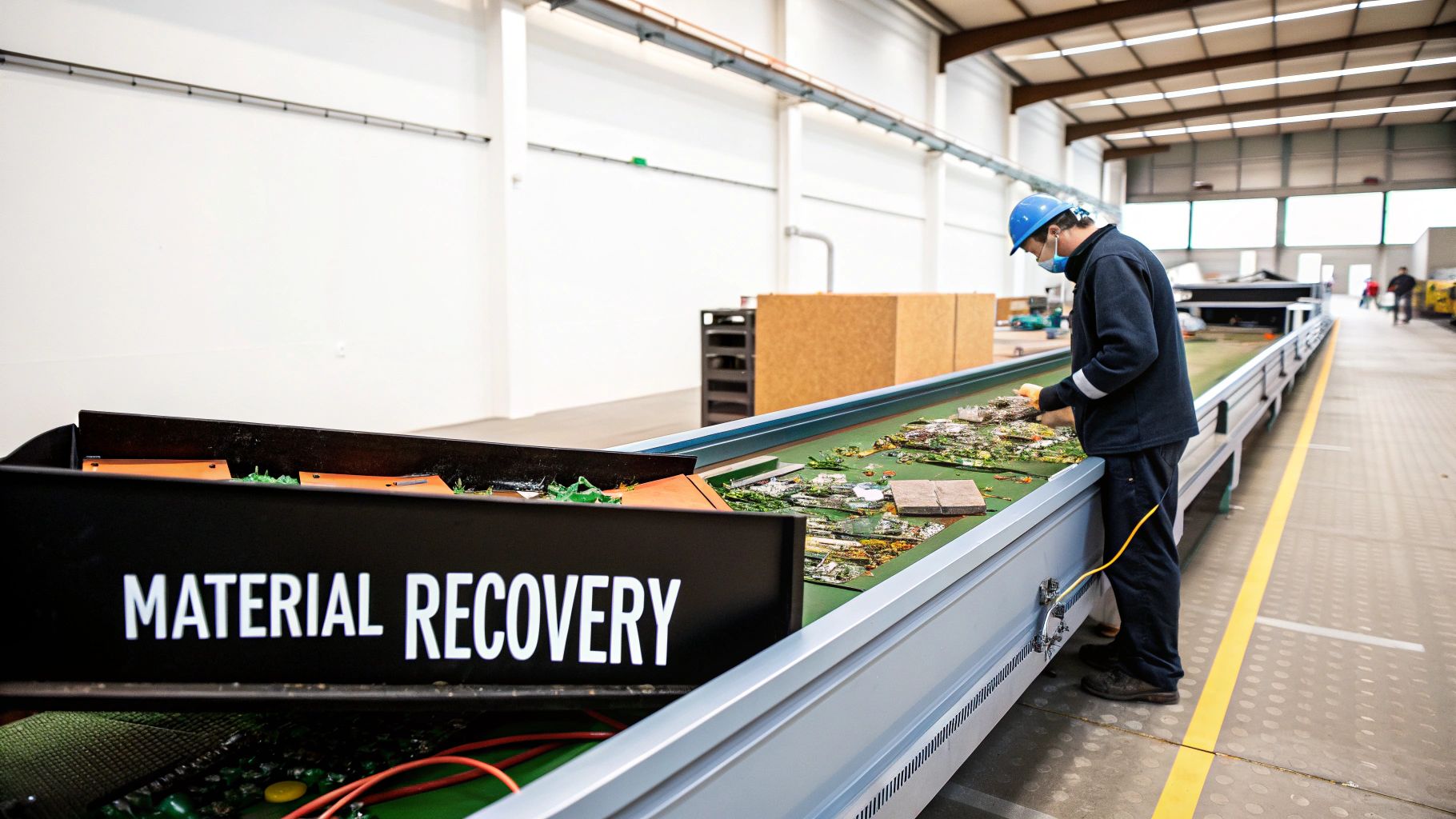
When a device can’t be reused or its parts harvested, it moves into the final stage of its lifecycle. This is what most people picture when they think of e-recycling: a highly sophisticated process of de-manufacturing and material recovery. It’s where old laptops, servers, and phones are carefully broken down into their raw ingredients.
This isn't just a demolition job. Think of it as urban mining. Instead of digging into the earth, we're mining the rich resources locked inside your old equipment. The end goal is to separate the jumble of materials into clean, pure commodities that manufacturers can use to build brand-new products.
The De-Manufacturing and Shredding Process
The journey starts with hands-on de-manufacturing. Our technicians strategically dismantle devices to pull out any hazardous components before they hit the shredder. It’s a crucial first step for safety and environmental compliance.
Here’s what they’re looking for:
- Batteries: Lithium-ion and other batteries are carefully removed to prevent fires. They have their own specialized recycling channels.
- Mercury-containing components: Things like fluorescent backlights in older monitors have to come out to stop mercury contamination.
- Leaded glass: Those old, heavy Cathode Ray Tube (CRT) monitors are full of lead and need special handling.
Once the hazardous stuff is safely set aside, the remaining electronic skeletons are fed into massive industrial shredders. These machines are incredibly powerful, tearing devices into uniform chunks just a few inches in size. This step is key because it liberates all the different materials from each other, getting them ready for the high-tech sorting process that comes next. This is a core part of our certified electronic waste recycling services, making sure every last bit is put to good use.
Advanced Sorting for Pure Commodities
With the electronics now reduced to a mixed stream of small fragments, the real magic happens. A series of automated technologies goes to work, separating this complex jumble into pure commodity streams with incredible accuracy.
First, powerful overhead magnets snatch up all the ferrous metals, like the steel from casings and frames. What's left moves on to an eddy current separator. This machine creates a magnetic field that literally repels non-ferrous metals like aluminum and copper, kicking them off the conveyor belt into their own collection bin.
The final sort is handled by advanced optical sorters. As the remaining bits of plastic and circuit board fly by under high-speed cameras, targeted jets of compressed air precisely separate different types of plastics and materials containing precious metals.
The result of all this isn't a pile of trash. It's a collection of clean, valuable commodities—bales of steel, aluminum, copper, and sorted plastics. These raw materials are then sold to smelters and manufacturers, which means less need for new mining and a huge savings in energy.
This kind of responsible recovery is more critical than ever. Globally, only 22.3% of e-waste is officially collected and recycled, meaning over 77% is unaccounted for. That's an estimated $62 billion in recoverable resources like gold and copper just being lost. In the US, we only recycle about 15% of our e-waste. You can see the full story in the Global E-waste Monitor 2024. Working with a certified recycler ensures your old assets become part of the solution, not the problem.
Compliance Reporting and Proving Due Diligence
The journey of your old electronics isn't really over until the paperwork is signed, sealed, and delivered. For any Metro-Atlanta business, this last step is just as important as the data destruction itself. This isn't just about getting a receipt; it's about getting the documentation that shields you from liability and proves you did the right thing.
Think of it like the deed to a house. This paperwork officially transfers the responsibility for those assets from your company to your certified recycling partner. Without it, you're leaving your organization wide open to compliance headaches down the road. These reports are your official record, perfect for satisfying internal audits, reassuring stakeholders, and showcasing your commitment to corporate social responsibility.
Your Essential Documentation Checklist
Once all the physical work is done, a trusted partner like Montclair Crew will provide a full reporting package. This is more than just a simple invoice. It's a collection of documents that, together, create a bulletproof audit trail.
You should always expect to get these three key items:
- A Detailed Asset Inventory: This isn't a vague summary. It's a line-by-line list of every single device we received from you, identified by serial number, your asset tag, and model number. It's your proof that everything you handed over has been accounted for.
- Certificate of Data Destruction: This is your legal guarantee that every hard drive, SSD, and data-bearing device was sanitized according to strict industry standards. It will even specify which destruction method was used for each serial number.
- Certificate of Recycling: This document confirms that any equipment that couldn't be reused was broken down and processed in an environmentally responsible way, following every rule in the book, including R2v3/RIOS standards.
This suite of documents gives you a completely transparent, end-to-end record of what happened to your equipment, closing any potential gaps in your compliance strategy.
Turning Compliance into a Sustainability Story
This paperwork does more than just check a box for the compliance department—it's also a goldmine of data for your sustainability reporting. These reports quantify your positive environmental impact, giving you solid numbers that resonate with customers, employees, and investors.
You can use the total weight and type of materials recycled to report on the exact amount of e-waste your company diverted from local landfills. Suddenly, a routine IT cleanout becomes a powerful data point for your annual ESG (Environmental, Social, and Governance) report.
This kind of certified reporting is critical. Shockingly, only about 17-22.3% of all e-waste ever makes it to a proper recycling facility. The rest of it ends up contributing to 70% of the world's toxic waste. Transparent, certified documentation is the only real way to fight illegal dumping and show that your company is part of the solution, not the problem.
Want to see the bigger picture? You can learn more about how certified recycling makes a global impact and recovers billions in valuable resources by checking out this detailed e-waste statistics overview.
Ultimately, these final reports provide the definitive answer to the question, "What happened to our old computers?" They give you verifiable proof of security, compliance, and environmental stewardship, protecting your business and building your reputation at the same time.
Common Questions About Business Electronics Recycling
Even after you decide to recycle your company’s old electronics, you’re bound to have some questions. It’s only natural. You're dealing with sensitive company data, company assets, and logistical details. Getting straight answers is the first step to building a solid, secure IT asset disposition plan.
Let's tackle some of the most common questions we hear from Metro-Atlanta businesses to clear things up and help you move forward with confidence.
How Can I Be Certain My Company Data Is Destroyed?
This is probably the most critical question, and the answer is simple: you need a Certificate of Data Destruction. Think of this as the official, legally-binding receipt for your peace of mind. A certified recycler provides this document as a guarantee that all your information is gone for good, completely irretrievable.
This certificate isn't just a piece of paper; it's your proof of due diligence. It will specify exactly how the data was destroyed—whether through a DoD 5220.22-M wipe or physical shredding—and list the serial numbers of every single device that was sanitized. Always, always insist on getting one for every data-bearing asset you hand over. It’s what protects your business from liability and confirms you’re compliant with privacy laws like HIPAA or PCI DSS.
Can My Business Get Money Back for Old Electronics?
Yes, absolutely. This is done through a service called IT Asset Value Recovery (ITAVR). If your retired gear—think servers, laptops, or networking equipment—is still functional and has some life left in it, we can refurbish it and find it a new home on the secondary market. When it sells, you get a cut of the profit.
Of course, the potential return depends on a few things:
- Age and Condition: Newer equipment in good shape will always be worth more.
- Specifications: A laptop with a powerful processor and lots of RAM has more value than a basic model.
- Market Demand: The tech world moves fast. The current demand for specific models is a huge factor in what they’ll sell for.
A good partner will be upfront about this, giving you a clear assessment of your assets and an honest estimate of their potential resale value before any work begins.
What paperwork should I expect to receive from my recycling partner? You should always get a full documentation package that creates a clear and complete audit trail. This means a detailed inventory list of every asset, a Certificate of Data Destruction for anything that held data, and a Certificate of Recycling to confirm everything was processed responsibly and in an environmentally sound way.
How Long Does the Electronics Recycling Process Take?
The timeline really depends on the size of the job. For a standard business pickup here in the Atlanta area, the whole process—from the moment we arrive at your door to you receiving the final reports—usually takes anywhere from a few days to a couple of weeks.
Getting the equipment out of your facility and back to ours is quick, often done in a day or two. The real work happens back at our facility: detailed auditing, certified data destruction, and sorting everything for remarketing or recycling. A professional recycler should give you a clear project timeline based on your specific inventory so you know exactly what to expect.
Ready to put a secure, compliant, and maybe even profitable electronics recycling program in place for your Metro-Atlanta business? Montclair Crew handles the entire IT asset disposition process, from secure pickups and certified data destruction to getting you cash back for your old gear. We keep it simple and transparent. Contact us today to schedule your pickup at https://www.montclaircrew.com.
