
In today's complex IT landscape, managing vendor relationships has evolved from a simple procurement task to a critical strategic function. Effective vendor management is the bedrock of operational efficiency, robust cybersecurity, and sustained innovation. Yet, many organizations struggle with disjointed processes, leading to significant cost overruns, security vulnerabilities, and missed strategic opportunities. This guide moves beyond theory to provide a definitive list of IT vendor management best practices designed to transform your vendor relationships into powerful, value-driven partnerships.
We'll provide actionable steps, specific implementation details, and practical examples to help you build a resilient and high-performing vendor ecosystem. The insights are tailored to be particularly useful for businesses navigating the dynamic Metro Atlanta market, addressing local considerations alongside universal principles. For a deeper dive into modern, effective strategies for managing IT vendors, explore these future-proof vendor management best practices.
This article will cover the entire vendor lifecycle, from initial selection and rigorous due diligence to performance monitoring and secure asset disposition. You will learn how to:
- Establish ironclad Service Level Agreements (SLAs) and contracts.
- Implement comprehensive risk management and compliance frameworks.
- Develop robust systems for performance monitoring and relationship management.
- Execute effective cost optimization and strategic exit planning.
By mastering these ten essential practices, you can mitigate risk, optimize spending, and unlock the full strategic value of your IT partners, ensuring long-term success and a significant competitive advantage.
1. Vendor Selection and Due Diligence
Effective IT vendor management best practices begin long before a contract is signed. The foundation is a rigorous vendor selection and due diligence process, which involves a comprehensive evaluation of potential partners to ensure they align with your organization’s technical, financial, and security requirements. This proactive approach prevents costly mismatches and ensures the vendor can deliver on its promises reliably over the long term.

This process goes beyond comparing price lists. It involves a deep dive into the vendor’s operational health, security posture, and past performance. For example, a healthcare provider must verify a cloud vendor’s HIPAA compliance, while a financial firm in Atlanta would scrutinize a software provider’s disaster recovery capabilities to ensure business continuity. Similarly, when choosing among IT asset disposition companies, you must assess their data destruction certifications and environmental compliance.
How to Implement a Robust Vetting Process
To standardize your evaluation, create a detailed scorecard that grades vendors on key criteria. When evaluating potential IT vendors, a thorough due diligence process should include a comprehensive third-party risk assessment to identify and mitigate potential vulnerabilities before they impact your operations.
Follow these actionable steps to ensure a thorough vetting:
- Standardize Evaluation: Develop a vendor evaluation scorecard with weighted criteria covering technical skills, financial stability, security certifications (like SOC 2 or ISO 27001), and cultural fit.
- Verify Credentials: Don’t just take a vendor's claims at face value. Request and meticulously check client references, asking specific questions about performance, responsiveness, and problem resolution.
- Assess Security Posture: Scrutinize the vendor’s security policies, business continuity plans, and data handling procedures. This is critical for protecting your organization from supply chain attacks.
- Conduct On-Site Visits: When feasible, particularly for critical hardware or disposition vendors in the Metro Atlanta area, conduct a site visit to observe their operations firsthand.
2. Service Level Agreements (SLAs) and KPI Definition
Once a vendor is selected, the next critical step in IT vendor management best practices is to establish clear, measurable, and enforceable expectations through a comprehensive Service Level Agreement (SLA). An SLA is a formal contract that defines the level of service you expect from a vendor, laying out the specific metrics and Key Performance Indicators (KPIs) by which that service will be measured. This document transforms ambiguous promises into concrete commitments, creating a framework for accountability and objective performance evaluation.
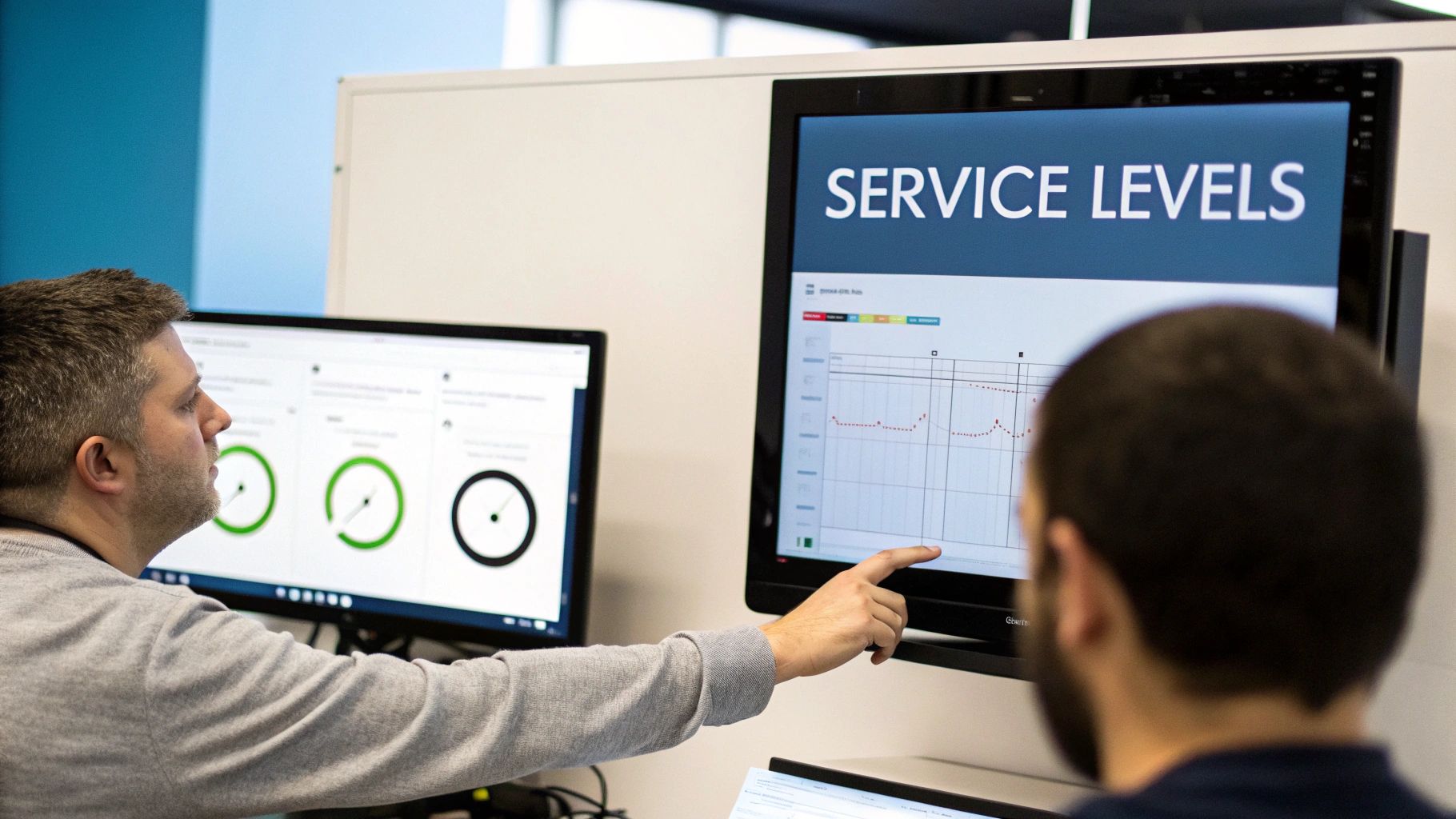
SLAs are essential for managing expectations and ensuring that vendor services align with business objectives. For instance, a cloud provider like AWS might guarantee 99.99% uptime, while a managed service provider (MSP) could commit to a four-hour response time for critical incidents. Similarly, a software vendor might define specific timelines for resolving high-priority bugs. These documented agreements provide a legal and operational basis for managing the vendor relationship and ensuring continuous service quality.
How to Implement Effective SLAs and KPIs
A strong SLA goes beyond just technical metrics; it should also include clear procedures for reporting, communication, and remediation. The goal is to create a transparent partnership where both parties understand the definition of success and the consequences of failure.
Follow these actionable steps to build a robust SLA:
- Define Clear Metrics: Establish specific, measurable, achievable, relevant, and time-bound (SMART) KPIs. Include both technical metrics (e.g., uptime, latency) and business-level metrics (e.g., end-user satisfaction, project milestone delivery).
- Include Penalties and Credits: Outline clear consequences for SLA breaches, such as service credits, fee reductions, or termination clauses. This incentivizes the vendor to consistently meet performance targets.
- Establish Escalation Procedures: Document a detailed escalation path with defined timelines and contact points for different issue severities. This ensures problems are addressed by the right people promptly.
- Schedule Regular Reviews: Implement mandatory monthly or quarterly performance review meetings. Use these sessions to discuss KPI reports, address any shortcomings, and plan for future improvements.
3. Risk Management and Compliance Framework
A robust risk management and compliance framework is a non-negotiable component of modern IT vendor management best practices. It provides a structured approach to identifying, assessing, and mitigating risks posed by third-party partners. This framework moves beyond initial due diligence, establishing an ongoing process for managing security threats, regulatory non-compliance, financial instability, and operational disruptions.
This systematic approach is critical for protecting your organization from the cascading effects of a vendor-related incident. For example, a healthcare organization must continuously assess a software vendor’s HIPAA compliance, not just at signing. Similarly, a financial firm in Atlanta needs a framework to monitor a cloud provider’s financial health and operational resilience to prevent service disruptions that could impact customers.
How to Implement a Vendor Risk Framework
Developing a formal risk management framework ensures consistency and allows you to prioritize mitigation efforts based on a vendor’s criticality to your business operations. A documented process is essential for demonstrating compliance to auditors and regulators.
Follow these actionable steps to build your framework:
- Establish a Vendor Risk Register: Create a centralized register that lists all vendors, their associated risks, risk ratings (e.g., high, medium, low), and documented mitigation plans.
- Conduct Regular Audits: Implement a schedule for annual security and compliance assessments. For critical vendors, exercise contractual audit rights to perform deeper inspections of their controls and processes.
- Mandate Cyber Liability Insurance: Require vendors who handle sensitive data or provide critical services to carry adequate cyber liability insurance. This provides a financial backstop in the event of a breach originating from their environment.
- Monitor Vendor Financial Health: Use financial monitoring services or request quarterly reports from key vendors to ensure they remain financially stable and can continue to deliver services without interruption.
4. Contract Management and Lifecycle Oversight
Once a vendor is selected, the focus shifts to creating and managing a comprehensive contract that governs the entire relationship. Effective contract management and lifecycle oversight involve the meticulous handling of agreements from negotiation and creation through to execution, renewal, or termination. This structured approach ensures that contracts are not just static documents but living agreements that evolve with your business needs and protect your organization from risk.
This discipline is crucial for maintaining clarity and accountability. For instance, a tech company in Atlanta must have clearly defined terms for software licensing, data ownership, and service level agreements (SLAs) in its SaaS contracts. Without diligent oversight, an organization might miss a critical auto-renewal date for an underperforming service or fail to enforce penalties for non-compliance, leading to unnecessary costs and operational disruptions. This aligns with the broader principles of asset management, where every stage of an asset's journey, much like a contract's, requires careful governance.
How to Implement Proactive Contract Management
A centralized and proactive approach is key to transforming contract management from a reactive, administrative task into a strategic function. This involves using tools and processes to track key milestones, ensure compliance, and manage changes effectively. For a deeper understanding of how structured oversight applies to physical assets, you can explore the principles of asset lifecycle management on montclaircrew.com.
Follow these actionable steps for robust contract governance:
- Centralize Your Contracts: Implement a contract lifecycle management (CLM) system or a simple centralized repository to store all vendor agreements. This ensures easy access and prevents lost documents.
- Use Standardized Templates: Work with your legal team to create master vendor agreement frameworks and standardized templates. This speeds up negotiations and ensures key protective clauses are always included.
- Track Key Dates: Set up automated alerts for critical dates, such as contract expiration and auto-renewal deadlines, at least 60-90 days in advance to allow time for review and negotiation.
- Define Clear Termination Clauses: Ensure every contract includes explicit termination and transition clauses that detail the process for offboarding a vendor and migrating data or services smoothly.
5. Vendor Performance Monitoring and Scorecard System
Once a vendor is onboarded, the management process shifts from selection to continuous oversight. A structured performance monitoring and scorecard system is one of the most effective IT vendor management best practices for ensuring partners consistently meet expectations. This systematic approach involves tracking, measuring, and evaluating vendor performance against predefined Key Performance Indicators (KPIs) to drive accountability and informed decision-making.
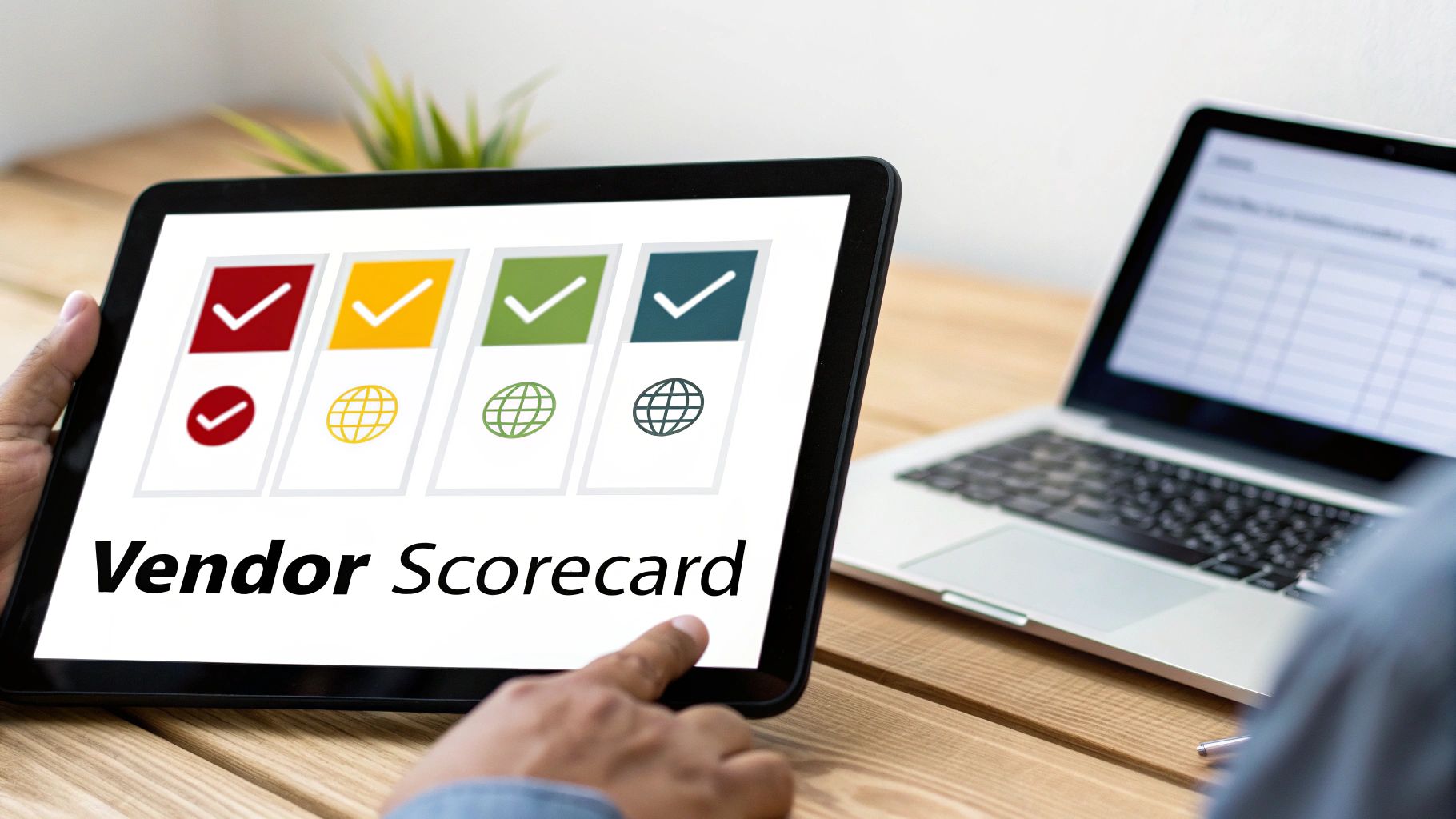
This ongoing evaluation moves beyond gut feelings and provides objective, data-driven insights into the vendor relationship. For example, a managed service provider might use a scorecard to track system uptime, ticket response times, and resolution rates, while a data center in Metro Atlanta would monitor an IT asset disposition vendor’s chain-of-custody accuracy and data destruction success rates. By visualizing performance via dashboards in tools like Power BI or Tableau, organizations can spot negative trends before they escalate into major service disruptions.
How to Implement a Vendor Scorecard System
A successful scorecard system is a collaborative tool, not a punitive one. It should foster transparent communication and a shared commitment to excellence. Sharing results directly with vendors during quarterly business reviews (QBRs) allows for open dialogue about strengths and areas needing improvement.
Follow these actionable steps to build an effective monitoring framework:
- Balance Your Metrics: Combine quantitative KPIs (e.g., uptime percentage, cost savings) with qualitative metrics (e.g., communication effectiveness, innovation, stakeholder satisfaction) for a holistic view.
- Weight Metrics by Impact: Assign a higher weight to metrics that have the greatest impact on your business objectives. A security vendor’s incident response time is more critical than their invoicing accuracy.
- Track Trends Over Time: Focus on performance trends rather than isolated data points. A single missed SLA might be an anomaly, but a consistent decline over three months signals a systemic problem.
- Link Scores to Outcomes: Make the scorecard meaningful by tying performance scores to contract renewals, incentive bonuses, or potential penalties. This ensures vendors are motivated to maintain high standards.
6. Relationship Management and Communication Framework
Beyond contracts and performance metrics, successful IT vendor management best practices hinge on building strong, collaborative relationships. A structured communication framework transforms a transactional vendor arrangement into a strategic partnership. This approach ensures that both parties are aligned, issues are resolved efficiently, and opportunities for innovation and improvement are consistently identified.
This framework is not about informal check-ins; it is a deliberate governance model that fosters trust and transparency. For instance, an enterprise might establish quarterly business reviews with its primary cloud provider to discuss performance, security, and future technology roadmaps. Similarly, a Metro Atlanta school district could hold bi-weekly operational meetings with its managed service provider to address immediate support tickets and plan for upcoming system upgrades.
How to Implement a Strong Communication Framework
To avoid misunderstandings and ensure mutual accountability, establish a formal governance structure with defined roles and scheduled interactions. This proactive communication prevents minor issues from escalating and keeps strategic goals at the forefront of the partnership.
Follow these actionable steps to build a robust framework:
- Establish a Governance Structure: Define clear roles and responsibilities for both your team and the vendor’s. Document a formal escalation matrix so everyone knows who to contact when issues arise.
- Schedule Regular Touchpoints: Implement a cadence of meetings tailored to different organizational levels, such as weekly operational calls, monthly performance reviews, and quarterly strategic sessions with executive leadership.
- Document and Track Outcomes: Meticulously record meeting minutes, decisions, and action items. Use a shared tracking system to monitor progress and ensure accountability for all follow-up tasks.
- Foster Strategic Alignment: Involve key vendors in your annual business planning and forecasting. Sharing your long-term goals helps them proactively suggest solutions and align their service delivery with your future needs.
7. Cost Optimization and Negotiation Strategy
A core component of IT vendor management best practices is implementing a systematic approach to cost optimization and strategic negotiation. This extends beyond simply choosing the cheapest option; it involves a continuous process of managing expenses while ensuring service quality and performance meet organizational needs. A well-executed strategy balances cost reduction with the long-term value and reliability of your vendor partnerships, preventing a "race to the bottom" that sacrifices quality for savings.
This practice requires a deep understanding of market rates, service value, and your own organization’s needs. For instance, a large enterprise can consolidate its cloud services under a single provider to leverage volume discounts, while a healthcare system in Metro Atlanta might benchmark its hardware maintenance contract costs against industry data to identify negotiation opportunities. The goal is to maximize the value derived from every dollar spent with IT vendors.
How to Implement Cost and Negotiation Strategies
Effective cost management is a proactive, data-driven discipline. By analyzing total cost of ownership (TCO) instead of just the sticker price, you gain a holistic view of all direct and indirect expenses, including support, maintenance, and integration. This comprehensive approach is a cornerstone of successful IT procurement best practices and provides a solid foundation for negotiation.
Follow these actionable steps to refine your cost optimization efforts:
- Develop a TCO Model: Create a comprehensive Total Cost of Ownership model that includes all associated costs, such as software licensing, implementation, training, support, and potential decommissioning expenses.
- Benchmark Market Rates: Before entering negotiations, conduct thorough market research to benchmark current rates for similar services. This data provides crucial leverage and ensures you are receiving a competitive price.
- Consolidate and Leverage Volume: Whenever possible, consolidate services with fewer, high-performing vendors. This not only simplifies management but also increases your purchasing power for negotiating volume discounts.
- Negotiate Performance-Based Pricing: Tie vendor compensation to specific performance metrics and KPIs. Include clauses for price adjustments or service credits if the vendor fails to meet agreed-upon service levels.
- Conduct Regular Invoice Audits: Meticulously review vendor invoices each month to verify accuracy, check for billing errors, and ensure charges align with contractual terms and actual usage.
8. Vendor Consolidation and Strategic Sourcing
As your IT ecosystem grows, so does the number of vendors you manage, leading to administrative bloat, inconsistent service levels, and diluted purchasing power. Vendor consolidation is a strategic practice of reducing the number of suppliers to simplify management, increase negotiating leverage, and improve operational efficiency. This approach involves carefully assessing service categories and identifying core partners who can provide multiple high-quality services.
This best practice shifts the focus from transactional relationships to strategic partnerships. For instance, a growing Atlanta-based tech company might consolidate its cloud infrastructure, cybersecurity software, and managed IT services under a single, highly capable Managed Service Provider (MSP). This not only reduces administrative overhead but also fosters a deeper, more integrated partnership, leading to better-aligned technology strategies and streamlined support.
How to Implement Vendor Consolidation Strategically
Effective consolidation isn't about cutting vendors arbitrarily; it's about optimizing your vendor landscape. The goal is to build stronger relationships with fewer, more capable partners who deliver greater value. A key part of these it vendor management best practices is ensuring that consolidation enhances, rather than compromises, service quality and resilience.
Follow these actionable steps for a successful consolidation initiative:
- Map the Vendor Landscape: Begin by auditing all current IT vendors. Categorize them by service (e.g., hardware, software, cloud, security) and spend to identify areas with overlapping providers and clear consolidation opportunities.
- Evaluate Multi-Service Capabilities: Assess which of your top-performing vendors have the proven capability and expertise to expand their service offerings to cover the needs of vendors being phased out.
- Negotiate Master Service Agreements: Leverage your increased spend with a single vendor to negotiate more favorable terms, including volume discounts, dedicated support channels, and improved SLAs.
- Plan a Phased Transition: Create a detailed transition plan to migrate services with minimal disruption. Ensure contracts include clauses for knowledge transfer and data migration support from the outgoing vendor.
- Maintain Strategic Alternatives: While consolidating, always maintain a qualified secondary vendor for mission-critical services to mitigate the risk of over-reliance on a single partner and ensure business continuity.
9. Security and Data Protection Governance
Strong IT vendor management best practices hinge on establishing a comprehensive framework for security and data protection. This governance model ensures that every third-party partner handling your data adheres to stringent security, privacy, and compliance standards. It involves continuous assessment, monitoring, and enforcement to protect sensitive organizational and customer information from unauthorized access, breaches, and misuse, which is non-negotiable in today's threat landscape.
This proactive governance protects your organization from the significant financial and reputational damage of a third-party data breach. For example, a financial services firm in Atlanta must mandate that its payment processor is PCI-DSS compliant. Similarly, a healthcare provider is obligated to conduct thorough HIPAA security assessments of any vendor accessing patient data. For vendors managing end-of-life assets, understanding and verifying their secure data handling is critical. You can learn more about how this is achieved by reading about what data sanitization is and why it's a vital part of the process.
How to Implement Strong Security Governance
To effectively manage vendor security, you must embed data protection requirements into every stage of the vendor lifecycle, from selection to offboarding. This creates a culture of security that extends beyond your own network perimeter.
Follow these actionable steps to build a robust governance program:
- Mandate Certifications: Require vendors to provide proof of relevant security certifications, such as SOC 2 Type II reports or ISO 27001 compliance, as a baseline for partnership.
- Enforce Contractual Clauses: Embed specific data protection standards directly into vendor contracts. This should include data handling protocols, encryption requirements, and clear incident response notification timelines.
- Conduct Regular Audits: Don't rely solely on initial assessments. Perform periodic security audits and vulnerability scans to ensure ongoing compliance and identify emerging risks.
- Control and Monitor Access: Implement strict access controls for all vendor personnel. Utilize logging and monitoring tools to track all vendor activity within your systems and ensure accountability.
10. Exit Planning and Transition Management
Superior IT vendor management best practices address the entire vendor lifecycle, including its conclusion. Exit planning and transition management involve proactively preparing for the end of a vendor relationship, whether due to contract expiration, non-renewal, or termination. This strategic foresight ensures business continuity, protects data integrity, and minimizes operational disruptions during the critical handover period.
A well-executed exit strategy is not an afterthought; it is a core component of risk mitigation. For example, a business switching its managed service provider must ensure a seamless knowledge transfer of all system configurations and operational procedures to prevent service gaps. Similarly, transitioning from one cloud provider to another requires a meticulous data migration plan to avoid data loss and downtime, a process with its own set of challenges.
How to Implement a Smooth Vendor Transition
The key to a successful vendor offboarding is to begin planning long before the relationship ends. This process should be formally documented and treated with the same seriousness as onboarding. For complex transitions like moving physical infrastructure, leveraging established frameworks is essential. For further guidance, you can explore detailed data center migration best practices to inform your strategy.
Follow these actionable steps for effective exit management:
- Define Exit Clauses Upfront: Embed detailed exit and deconversion clauses into the initial contract. Specify vendor cooperation requirements, data return formats, and any associated fees for the transition period.
- Create a Transition Plan: Develop a comprehensive project plan at least 6-12 months before the contract end date. This plan should outline key milestones, responsibilities, communication protocols, and a detailed timeline for knowledge transfer and data migration.
- Secure Critical Assets: For custom software solutions, utilize a source code escrow agreement from the start. This ensures you can access and maintain the application's source code if the vendor ceases operations or fails to meet its obligations.
- Validate the New Vendor: Before fully decommissioning the old vendor, conduct a parallel run period where both the old and new systems operate simultaneously. This allows you to validate the new vendor’s performance and ensure all data has been migrated accurately.
10-Point IT Vendor Management Comparison
| Practice | Implementation Complexity 🔄 | Resource Requirements ⚡ | Expected Outcomes 📊 | Ideal Use Cases 💡 | Key Advantages ⭐ |
|---|---|---|---|---|---|
| Vendor Selection and Due Diligence | High — multi-step evaluations and checks 🔄 | High — cross-functional team, time, documentation ⚡ | Lower vendor failure risk; improved vendor fit 📊 | New vendor onboarding; high-impact procurements 💡 | Reduces selection risk; long-term relationship foundation ⭐ |
| Service Level Agreements (SLAs) and KPI Definition | Medium — requires clear metric design and legal input 🔄 | Medium — monitoring tools and legal/ops effort ⚡ | Clear accountability and measurable performance baselines 📊 | Outsourced services with measurable delivery (cloud, MSPs) 💡 | Establishes expectations; enables data-driven remediation ⭐ |
| Risk Management and Compliance Framework | High — continuous assessment and controls integration 🔄 | High — specialist expertise, audits, monitoring tools ⚡ | Reduced regulatory and security risk; faster incident response 📊 | Regulated industries; vendors handling sensitive data 💡 | Proactive risk reduction; regulatory assurance ⭐ |
| Contract Management and Lifecycle Oversight | Medium — process and version control needs 🔄 | Medium — CLM system, legal review, governance ⚡ | Fewer missed renewals; clearer obligations and auditability 📊 | Large/vendor-heavy organizations; long-term contracts 💡 | Consistency, legal protection, renewal visibility ⭐ |
| Vendor Performance Monitoring and Scorecard System | Medium — metric selection and automation setup 🔄 | Medium — dashboards, data pipelines, stakeholder reviews ⚡ | Early issue detection; continuous improvement and benchmarking 📊 | Ongoing managed services and multi-vendor environments 💡 | Objective performance insights; trend-based decisions ⭐ |
| Relationship Management and Communication Framework | Medium — governance cadence and escalation paths 🔄 | Medium — dedicated relationship managers, meeting cadence ⚡ | Improved responsiveness, collaboration, and innovation 📊 | Strategic partners; innovation-focused engagements 💡 | Stronger vendor commitment; smoother issue resolution ⭐ |
| Cost Optimization and Negotiation Strategy | Medium — requires analysis and market intelligence 🔄 | Medium — finance/procurement resources, benchmarking tools ⚡ | Lower TCO; better pricing and contract terms 📊 | High-spend categories; renewals and consolidation opportunities 💡 | Cost savings and transparent TCO; negotiation leverage ⭐ |
| Vendor Consolidation and Strategic Sourcing | High — planning and transition complexity 🔄 | High — migration resources, integration effort ⚡ | Reduced supplier count, improved leverage and consistency 📊 | Organizations seeking simplification and scale benefits 💡 | Lower overhead; stronger strategic partnerships ⭐ |
| Security and Data Protection Governance | High — technical controls and ongoing audits 🔄 | High — security assessments, certifications, monitoring ⚡ | Stronger data protection and regulatory compliance 📊 | Any vendor handling sensitive or regulated data 💡 | Reduces breach risk; compliance assurance and trust ⭐ |
| Exit Planning and Transition Management | High — detailed transition planning and validation 🔄 | High — project management, parallel runs, testing ⚡ | Minimized service disruption and validated knowledge transfer 📊 | Contract terminations, migrations, provider replacements 💡 | Ensures continuity; preserves data and operational integrity ⭐ |
From Process to Partnership: Your Next Steps in Vendor Management
Navigating the complex landscape of IT vendor relationships requires more than just signing contracts and hoping for the best. As we've explored, mastering this discipline is a strategic imperative that transforms your vendor ecosystem from a simple transactional arrangement into a powerful engine for innovation, security, and growth. The journey from a reactive, process-driven approach to a proactive, partnership-based model is built on the foundation of consistent, actionable it vendor management best practices.
Recapping the essential pillars we've covered, true vendor management excellence is about creating a holistic, end-to-end governance framework. It begins with meticulous vendor selection and due diligence, ensuring every new partner aligns with your organization's technical, financial, and cultural standards. This rigor extends into crafting ironclad Service Level Agreements (SLAs) and defining meaningful Key Performance Indicators (KPIs), which serve as the objective bedrock for measuring success and holding partners accountable.
From Theory to Actionable Strategy
Moving beyond the initial setup, the real work lies in continuous oversight and optimization. Implementing a robust risk management and compliance framework isn't a one-time task; it's an ongoing commitment to identifying, assessing, and mitigating potential threats. Likewise, diligent contract management and lifecycle oversight ensures that agreements remain relevant and deliver value from procurement to termination. This active management is what separates a thriving vendor ecosystem from a neglected one.
The most successful programs are data-driven and relationship-focused. By establishing a formal vendor performance monitoring and scorecard system, you replace subjective assessments with objective data, enabling productive conversations and informed decisions. These conversations are facilitated by a structured relationship management and communication framework, ensuring that key stakeholders on both sides are aligned, informed, and working collaboratively toward shared goals. This symbiotic relationship fosters an environment where you can pursue advanced strategies like cost optimization and vendor consolidation, maximizing value and efficiency across your entire portfolio.
Securing the Lifecycle and Planning for the Future
Ultimately, the integrity of your vendor management program rests on its ability to protect your most critical assets: your data and your reputation. A stringent security and data protection governance model is non-negotiable, demanding that every vendor adheres to your security protocols. This vigilance must extend to the very end of the vendor or asset lifecycle. A well-defined exit planning and transition management strategy is crucial for ensuring business continuity and a smooth handover, whether you are offboarding a software provider or decommissioning hardware.
For organizations in Metro Atlanta, this final step carries significant weight. When a server, laptop, or data-bearing device reaches its end-of-life, the responsibility for securing the data it contains does not disappear. In fact, this final stage is often where the most critical vulnerabilities lie. Neglecting certified data destruction and responsible asset disposition can unravel all the hard work put into securing your vendor partnerships. Embracing these it vendor management best practices is not about adding bureaucracy; it's about building resilience, fostering innovation, and creating a competitive advantage. It is a continuous cycle of improvement that empowers your organization to leverage external expertise confidently and securely, turning vendor relationships into true strategic partnerships.
When your IT asset lifecycle concludes, ensure your data security and compliance don't end with it. As a key part of your it vendor management best practices, partner with a certified expert for secure IT asset disposition. For businesses in Metro Atlanta, Montclair Crew Recycling provides certified data destruction and environmentally responsible electronics recycling, giving you a secure and documented final step in your asset governance. To learn more about securing your end-of-life assets, visit Montclair Crew Recycling.
