
Asset Lifecycle Management (ALM) is really just a formal way of thinking about the entire journey of your company's physical equipment. From the moment you think about buying it, all the way to its final retirement, ALM is the strategic process that covers it all. This approach ensures you squeeze every bit of value from your gear—laptops, servers, machinery, you name it—while keeping costs and risks in check.
Understanding Asset Lifecycle Management
Think about it like managing a fleet of delivery trucks for your business. You wouldn't just buy a bunch of trucks and cross your fingers. You’d have a clear plan: research the best models, get them on the road with your drivers, schedule regular maintenance, figure out the right time to upgrade, and eventually, sell or scrap them.
Asset Lifecycle Management applies that same exact logic to every business asset you own. It’s a framework that forces you to see your equipment not as a one-and-done expense, but as a long-term investment that needs a game plan. Instead of reacting when things go wrong—like a server dying unexpectedly—ALM helps you proactively manage the whole process from start to finish.
Why ALM is a Business Imperative
A formal ALM strategy gives you a clear, documented process for everything. This structure helps you sidestep common mistakes, like blowing the budget on gear you don't need, clinging to old tech that's a security nightmare, or missing out on cash from retired hardware. When you track an asset from day one to its final day, you get a full picture of its performance, costs, and how it’s helping (or hurting) your business.
The benefits are huge, and it's why the market is growing so fast. The global Asset Management System market, which was valued at USD 16.97 billion, is expected to hit USD 26.41 billion by 2030. That growth is all about businesses needing to automate and control costs.
At its core, Asset Lifecycle Management is about making smart, data-driven decisions at every single stage. It’s the difference between guessing when a laptop needs replacing and knowing the exact moment it costs more to maintain than to upgrade.
A well-run ALM program creates an environment that's predictable, efficient, and secure. It means every asset is accounted for, properly maintained, and retired the right way. That last part is critical, and you can learn more about how to handle it responsibly in our guide to IT asset disposition. Getting this final step right closes the loop, protects your data, and safeguards your company's reputation.
The Six Stages Of An Asset's Journey
Every piece of equipment your business owns—from a server humming away in the data center to a remote employee's laptop—follows a predictable path. Grasping this journey is the absolute foundation of effective asset lifecycle management. It's not a single event but a continuous cycle with six distinct stages, and each one is an opportunity to maximize value, tighten cost controls, and slash risks.
When you start looking at an asset's life this way, it stops being just a purchase and becomes a strategic piece of your entire operation. Each stage demands specific actions and smart decisions. Let's walk through this journey, step by step, using real-world IT examples to see how it works from initial planning to its final, responsible retirement.
This visual breaks down the core phases, simplifying the journey into three main buckets: acquiring, managing, and retiring assets.
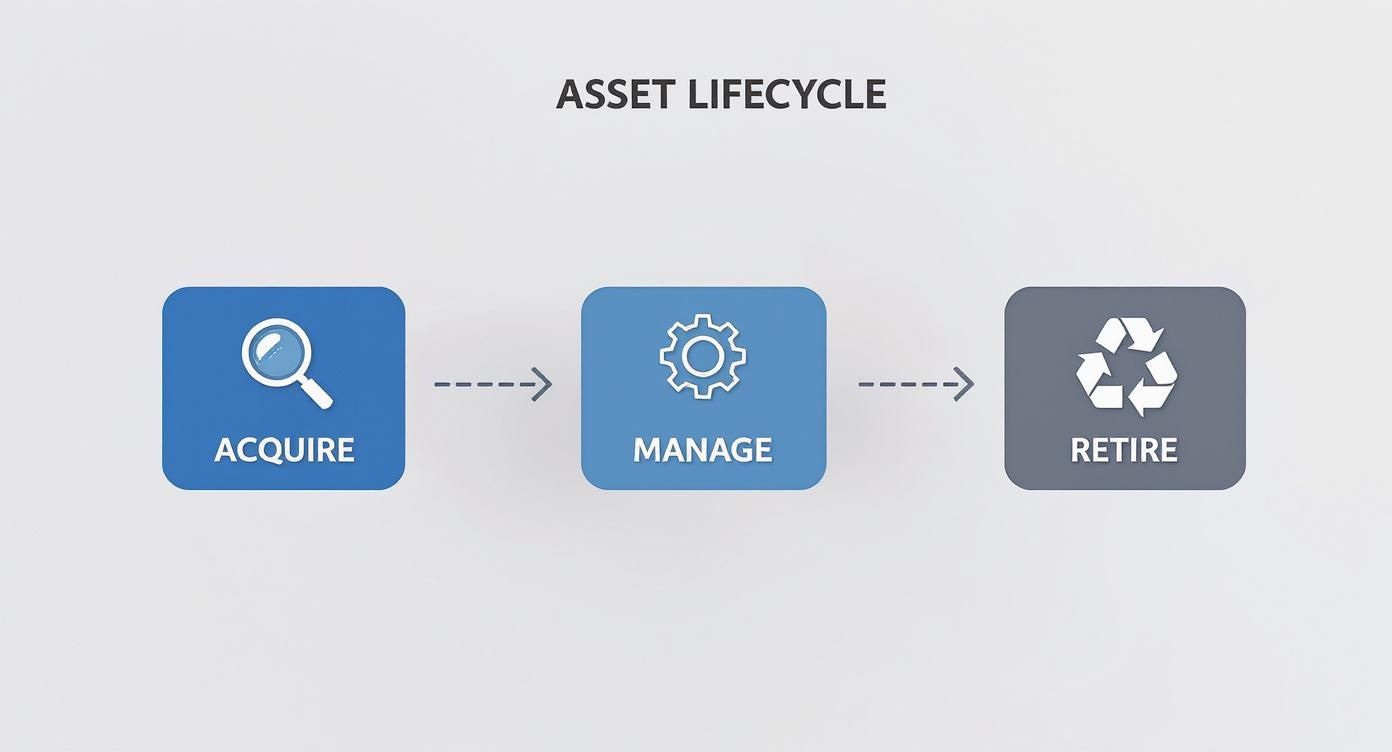
The key takeaway here is that ALM is a structured process, not just a series of disconnected tasks. A proper system ensures nothing ever falls through the cracks.
1. Procurement And Acquisition
The journey kicks off long before a box ever arrives at your door. The procurement stage is all about strategic thinking and smart buying. This is where you identify a real business need, research the solutions, and look at the total cost of ownership—not just the price tag.
This means asking the tough questions:
- Need vs. Want: Does this new server truly fill a performance gap, or are we just overspending on specs we'll never use?
- Standardization: Can we stick to a standard model? Doing so makes maintenance and support a whole lot easier down the line.
- Vendor Relationships: Are we negotiating the best possible terms, including solid warranties and support agreements?
Skipping this stage is how you end up with "shadow IT"—employees buying unapproved software or hardware, opening up massive security and compliance holes. A solid procurement process ensures every asset is necessary, secure, and a sound financial decision.
2. Deployment And Integration
Once you've bought an asset, it needs to be officially welcomed into the company's ecosystem. The deployment stage is so much more than just plugging it in. It’s a methodical process to make sure the equipment is functional, secure, and ready to go.
Key steps here typically include:
- Asset Tagging: Giving it a unique ID and logging it into a central tracking system.
- Configuration: Installing the right software, applying security policies, and getting it on the network.
- User Assignment: Handing it off to the right person or department and providing any training they need.
A smooth deployment is critical. A poorly configured laptop, for example, can become a security liability from day one. Proper integration means the new gear works perfectly with everything else you already have.
3. Utilization And Maintenance
This is where an asset spends most of its life. During the utilization and maintenance stage, the goal is simple: squeeze every ounce of performance out of it and make it last as long as possible. This is where proactive management really pays off.
This phase is all about ongoing activities:
- Performance Monitoring: Keeping an eye on metrics like uptime, CPU usage, and network lag to make sure everything is running as it should.
- Scheduled Maintenance: Applying patches, running diagnostics, and even doing physical cleanings to head off failures before they happen.
- Help Desk Support: Being there for users to fix issues and keep downtime to an absolute minimum.
An asset that isn't properly maintained is an asset that is depreciating faster than it should. Regular upkeep prevents minor issues from snowballing into costly, business-halting disasters.
Good maintenance drives down the total cost of ownership by helping you dodge expensive emergency repairs and pushing back the date when you need to buy a replacement.
4. Upgrade Or Refresh
Technology moves fast, and business needs are always changing. The upgrade stage is a critical fork in the road where you decide if an existing asset can be beefed up or if it’s time to replace it. This decision isn't just about age; it's about performance, security, and whether it makes financial sense.
For instance, adding more RAM to a developer's sluggish computer is an upgrade. Swapping out an entire department's five-year-old laptops with newer, more secure models is a refresh. This decision has to be driven by data—maintenance costs, performance metrics, and security risks. Making the right call here stops you from wasting money on new gear while also preventing the productivity drain that comes with outdated tech.
5. Decommissioning
When an asset finally reaches the end of its useful life, you can't just unplug it and shove it in a closet. The decommissioning stage is about formally and securely taking that asset offline. The main goal is to pull it from your live environment without causing disruptions or leaving a security hole wide open.
This process involves a few key steps:
- Data Backup: Making sure every bit of critical information is safely moved to a new system or archived.
- Software License Removal: Revoking software licenses tied to the device so they can be used elsewhere.
- Network Disconnection: Killing the asset's access credentials and taking it completely off the network.
Proper decommissioning is a non-negotiable security step. It ensures that a retired server, for example, doesn't become a forgotten backdoor into your network. For a deeper dive into this, check out these essential IT asset management best practices.
6. Disposition
Finally, the disposition stage answers the question: what happens to the physical asset itself? This is the last stop in the journey, and it comes with huge environmental and data security responsibilities. The goal is to get rid of the asset in a way that's secure, compliant, and sustainable.
Your options usually include:
- Resale: Selling equipment that still has value to recoup some of the initial cost.
- Recycling: Working with a certified e-waste recycler to responsibly handle components.
- Secure Destruction: Physically destroying hard drives and other storage media to make sure data is gone for good.
Choosing the right disposition path is absolutely crucial for protecting sensitive company and customer data. It also reinforces corporate sustainability goals by keeping hazardous electronic junk out of landfills.
Unlocking The Business Value Of ALM
Effective asset lifecycle management is so much more than an IT checklist. Think of it as a powerful business strategy that hits your bottom line directly. When you start connecting each stage of an asset's journey to real-world financial and operational results, ALM stops being a chore and becomes a serious competitive advantage. It's the engine that drives cost savings, beefs up security, and cuts through complex compliance red tape.
This structured approach pays off immediately by giving you a clear, bird's-eye view of every single asset your organization owns. You'll shift from just reacting to equipment problems to proactively optimizing every dollar you invest.
Let's break down the tangible business benefits you can actually expect.
Achieving Significant Cost Control
One of the first things you'll notice with ALM is a much tighter grip on your finances. Without a system, it's shockingly easy to lose track of assets, leading to what we call 'ghost assets'—equipment that's on your books but is physically missing, stolen, or broken. These ghost assets are quietly draining your budget on taxes, insurance, and licensing fees.
A solid ALM program wipes out this waste by keeping an accurate, real-time inventory. This clarity also helps you buy smarter. Instead of purchasing new laptops on a whim, you can look at maintenance histories and performance data to pinpoint the exact moment it's cheaper to replace a device than to keep fixing it.
By optimizing purchasing and eliminating waste, a mature ALM program can reduce asset-related costs by up to 30% over the asset's lifetime. It turns guesswork into a data-backed financial strategy.
This kind of financial insight is only becoming more critical. The global Asset Lifecycle Management market was valued at around USD 5.06 billion and is expected to hit USD 8.50 billion by 2034. This explosion shows just how many businesses are using ALM, along with tools like IoT and AI, to squeeze more efficiency out of their assets.
Enhancing Security And Mitigating Risk
In an age of non-stop cyber threats, every unmanaged device on your network is a back door waiting to be opened. ALM provides a crucial layer of defense by making sure every single asset is tracked, patched, and accounted for from day one to retirement. That means no server is left unpatched and no laptop is forgotten in a closet, still holding sensitive company data.
The security payoff is crystal clear at the end of an asset's life. A structured disposition process ensures every device is securely wiped of all data before it's resold, recycled, or destroyed. This one practice dramatically cuts the risk of a data breach, which can bring devastating financial and reputational damage. ALM creates a clean chain of custody, proving data was handled securely from deployment all the way to disposal.
Simplifying Regulatory Compliance
Trying to keep up with standards like GDPR, HIPAA, or Sarbanes-Oxley can be a nightmare. These regulations demand that you prove exactly where your data is and how you're protecting it. ALM creates a transparent, auditable trail for every asset that holds or processes sensitive information.
- Audit-Ready Records: With ALM, you can quickly pull a detailed history for any asset, showing its location, user, maintenance records, and final disposition.
- Proof of Data Destruction: Certified data destruction records give you undeniable proof that you've met your data privacy obligations.
- Policy Enforcement: ALM systems help you enforce corporate security and usage policies across all devices, ensuring everyone stays compliant.
This detailed documentation makes audits less painful and demonstrates due diligence, protecting your organization from the hefty fines and legal trouble that come with non-compliance.
Bolstering Sustainability And Corporate Reputation
Finally, responsible asset management shows your company is serious about sustainability. A well-defined disposition strategy prioritizes remarketing and responsible recycling, which keeps hazardous e-waste out of landfills. This doesn't just check an environmental box; it boosts your corporate social responsibility (CSR) profile.
To really tap into the business value of ALM, it's vital to know what your assets are worth through dedicated asset valuation services. When you understand the value of your retired equipment, you can make smarter financial and environmental decisions. This responsible approach resonates with customers, partners, and employees, turning a simple operational task into a strategic advantage that builds a positive brand.
How To Measure Your ALM Program's Success
You can’t manage what you don’t measure. A strategy without real numbers to back it up is just a guess, and in the world of IT, guesses can get expensive. To really see the impact of your asset lifecycle management (ALM) program, you’ve got to track the right metrics.
This is what turns ALM from a theoretical exercise into a data-driven powerhouse. Good metrics show you exactly where you’re winning, where you’re overspending, and which assets are actually pulling their weight. Without them, you’re flying blind.
Key Financial Metrics To Track
The fastest way to prove your ALM program’s worth is to show how it affects the bottom line. Two metrics are absolutely essential here: Total Cost of Ownership (TCO) and Return on Assets (ROA). Together, they paint the complete financial picture of an asset from cradle to grave.
Total Cost of Ownership (TCO) goes way beyond the initial sticker price. It forces you to calculate every single cost tied to an asset from the moment you buy it to the day you retire it. This isn't just one number; it's the sum of several parts:
- Acquisition Costs: The purchase price, shipping, and any installation fees.
- Operational Costs: Think energy bills, software licenses, and user training.
- Maintenance Costs: Scheduled repairs, emergency fixes, and replacement parts all add up.
- Disposition Costs: Secure data wiping, recycling fees, or resale services.
Grasping the true TCO lets you compare different assets accurately. It shifts the conversation from short-term savings to long-term value.
Measuring Performance And Reliability
Beyond the money, you need to know how well your assets are actually doing their job. Performance metrics tell you if your equipment is a reliable workhorse or a constant drain on productivity. Tracking these helps you get ahead of maintenance and plan for replacements before a critical failure shuts you down.
An effective ALM program isn't just about saving money; it's about maximizing uptime and ensuring your assets reliably support business operations when you need them most.
Three core metrics will give you a clear view:
- Asset Utilization Rate: This shows how much an asset is actually being used compared to its potential. A low rate might mean you’ve over-invested in equipment you don't need.
- Mean Time Between Failures (MTBF): This measures the average time an asset operates before it breaks down. A high MTBF is a sign of a reliable, well-maintained piece of equipment.
- Mean Time to Repair (MTTR): This tracks how long it takes to get a broken asset back online. A low MTTR reflects an efficient maintenance team and a solid parts inventory.
Here is a quick breakdown of some of the most important metrics to keep an eye on.
Essential ALM Metrics To Track
| Metric (KPI) | What It Measures | Why It Matters |
|---|---|---|
| Total Cost of Ownership (TCO) | The full cost of an asset from acquisition to disposition. | Reveals the true, long-term cost, enabling smarter purchasing decisions beyond the initial price tag. |
| Asset Utilization Rate | The percentage of time an asset is actively used versus its available time. | Helps identify underused assets, preventing over-purchasing and optimizing resource allocation. |
| Mean Time Between Failures (MTBF) | The average operational time between one failure and the next. | A key indicator of asset reliability and health. A higher MTBF means less unexpected downtime. |
| Mean Time to Repair (MTTR) | The average time it takes to repair a failed asset and return it to service. | Measures the efficiency of your maintenance team and processes. A lower MTTR minimizes productivity loss. |
| Scheduled Maintenance Compliance | The percentage of planned maintenance tasks completed on time. | Shows how well you are sticking to your proactive maintenance plan, which is crucial for preventing failures. |
| Asset ROI | The net profit generated by an asset compared to its overall cost. | Directly links asset performance to financial returns, justifying investments and proving value. |
Tracking these KPIs consistently provides the data you need to fine-tune your strategy and demonstrate its positive impact on the entire organization.
Governance And Establishing Clear Policies
Metrics are useless if you don’t have a solid framework to act on the insights they provide. This is where governance comes in. It means creating clear, documented policies for every single stage of the asset lifecycle. It also means creating a dedicated team or role responsible for overseeing the entire program. Good governance ensures consistency, accountability, and security across the board.
A critical piece of this puzzle is your asset disposition policy. When an asset hits the end of its life, your policy must dictate exactly how its data is sanitized and how the hardware is disposed of. A verifiable process is non-negotiable for compliance, and it's vital to understand what a certificate of destruction provides as tangible proof that you’ve eliminated all sensitive data securely.
This structured approach is gaining serious traction. The Enterprise Asset Management (EAM) market, a key component of ALM, was valued at USD 5.66 billion and is projected to nearly triple to USD 13.84 billion by 2034. This growth is fueled by organizations that recognize the urgent need for efficiency and digital transformation. You can see more about the drivers of this trend on Precedence Research. By tracking the right KPIs and building solid governance, your organization can confidently ride this wave instead of getting caught in the undertow.
Putting ALM Into Practice With Proven Methods
Knowing the theory behind asset lifecycle management is one thing, but actually turning that knowledge into a real-world program is where you start seeing the benefits. The right way to go about it really depends on the size and complexity of your business. A five-person startup has completely different needs than a huge corporation with multiple data centers.
But one thing is universal. Every single successful ALM strategy, no matter the scale, is built on one non-negotiable step: a complete and accurate asset inventory. Think of it as the foundation of a house. Everything else—from buying new gear to maintaining and eventually getting rid of it—is built right on top of that foundation.
Getting Started For Small Businesses
For a small or medium-sized business, you don't need to break the bank on a massive software suite to get started. The first goal is simply to get control and visibility using straightforward, effective tools. You're trying to build good habits that will grow with your company.
Your main objective is to create a single source of truth for all your company’s assets. A detailed asset register, which often starts as a well-organized spreadsheet, is the perfect place to begin.
Here are the first steps you should take:
- Create a Central Asset Register: Log every piece of equipment you own. Make sure to include the important details like the serial number, purchase date, who it’s assigned to, warranty expiration, and its physical location.
- Establish Clear Procurement Rules: Draft a simple policy that outlines who is allowed to buy new assets and what the approval process looks like. This is huge for preventing out-of-control spending and stopping unsecure devices from getting on your network.
- Develop a Basic Maintenance Schedule: For your most important assets, like servers or critical machinery, set up calendar reminders for routine check-ups and software updates. It’s simple, but it works.
- Define a Retirement Process: Decide ahead of time what happens when a laptop or server reaches the end of its life. Having a clear process for wiping data and disposing of the hardware is a critical security measure you need from day one.
These initial steps create a framework for accountability and control, helping you avoid the chaos that often hits when a business starts growing quickly.
Scaling ALM For Enterprises And Data Centers
Larger organizations and data centers are playing a different ballgame. With thousands of assets, often spread across multiple locations, trying to track everything by hand is a recipe for disaster. Here, the focus has to shift to automation, integration, and rock-solid governance to manage all that complexity and risk.
For an enterprise, ALM isn't just an IT task; it has to be woven into the larger tech ecosystem. This means integrating your ALM software with other systems to create a smooth flow of information and automate the tedious, repetitive tasks. For example, having robust ERP systems in manufacturing is crucial, as they can provide the financial backbone for your asset data.
For large-scale operations, ALM is not just an IT function but a core business process that directly impacts financial planning, operational security, and regulatory compliance.
Here are some of the advanced strategies larger organizations use:
- Integrate ALM and ERP Systems: Connect your asset management platform with your Enterprise Resource Planning (ERP) system. This directly links your asset data to your financial records, automating things like depreciation tracking and making budget forecasting far more accurate.
- Leverage Automation for Asset Discovery: Use network scanning tools that automatically find and identify any new hardware plugged into your network. This ensures new assets are logged immediately, closing security gaps that manual entry always leaves open.
- Implement Certified Data Destruction Policies: Create and strictly enforce data destruction policies for every retired asset. This is absolutely critical for data centers, where even one mishandled server can lead to a catastrophic data breach. Understanding the formal process for the decommission of a server is a key part of this, ensuring you stay compliant and secure.
- Adopt a Role-Based Access Control Model: Inside your ALM software, set up permissions that limit who can see, change, or retire assets. This ensures that only authorized people can make critical changes, adding a vital layer of internal security and accountability to your whole program.
Common Questions About Asset Lifecycle Management
As businesses start to realize how important their physical assets are, a few common questions always pop up. Getting straight answers is the first step to building an asset lifecycle management (ALM) program that actually works.
Let's cut through the jargon and get to the heart of what this process means for your operations, security, and bottom line.
What Is The Difference Between ALM And ITAM?
This is easily one of the most common points of confusion. While Asset Lifecycle Management (ALM) and IT Asset Management (ITAM) are closely related and definitely overlap, they aren't the same thing. They operate on different levels.
Think of ALM as the big-picture, long-term game plan for an asset. It covers the entire journey, from the first thought of buying it all the way to its final, secure disposal. ALM is all about the total cost of ownership, its overall value to the business, and its strategic role from cradle to grave.
ITAM, on the other hand, is much more tactical. It's focused on managing your IT gear while it's actively being used. ITAM handles the day-to-day stuff: inventory, tracking software licenses, monitoring usage, and making sure the IT infrastructure is running smoothly. In short, ITAM is a critical piece that happens within the bigger ALM framework.
ALM is the entire roadmap for an asset's journey, while ITAM is the detailed navigation system you use during the longest part of that trip.
How Can A Small Business Start ALM On A Tight Budget?
You don't need a massive budget or complicated software to get the benefits of ALM. For a small business, the trick is to start with simple, smart steps that give you immediate visibility and control. The idea is to build good habits that can grow with your business.
Here are a few practical first steps:
- Create a Detailed Asset Spreadsheet: Your first move is to build a central asset list. This can be a simple but well-organized spreadsheet tracking the essentials for every asset: serial number, purchase date, who has it, its location, and warranty info.
- Establish Basic Procurement Rules: Draft a clear, simple policy on who can buy assets and what the approval process looks like. This one step can stop wasteful spending and prevent unapproved, insecure devices from getting onto your network.
- Partner with a Certified ITAD Vendor: You don't have to handle asset disposal on your own. Working with a certified IT Asset Disposition (ITAD) vendor ensures that when equipment is retired, its data is securely wiped and the hardware is recycled the right way.
What Are The Biggest Security Risks ALM Prevents?
A formal ALM program is one of your best defenses against some pretty scary security holes. Without it, you’re leaving several dangerous backdoors wide open.
One of the biggest risks ALM shuts down is data breaches from improperly discarded hardware. When a computer or server is retired without a secure process, it might still have sensitive customer data, financial records, or company secrets on it. Proper ALM enforces strict rules for disposal, including certified data destruction. To see how that works, you can learn more about what is data sanitization and why it's a non-negotiable part of the process.
ALM also helps you get rid of 'ghost assets'—those undocumented devices plugged into your network. These untracked machines often miss critical security patches and updates, making them easy pickings for cyberattacks. By keeping an accurate inventory, ALM makes sure every single device is known, managed, and locked down.
Ready to take control of your asset disposition process? Montclair Crew Recycling provides secure, compliant, and responsible IT equipment disposal for businesses and organizations across Metro Atlanta. We ensure your data is destroyed and your hardware is handled correctly. Contact us today to simplify your ITAD program.
