

You search telecom solutions near me because something has to change now. Maybe your circuit costs are too high. Maybe your team is moving to VoIP, adding backup connectivity, or replacing aging network gear at multiple sites across Metro Atlanta.
Then you open the storage room.
There they are. Old desk phones, failed access points, discontinued firewalls, retired routers, a stack of handsets nobody wants to claim, and maybe a few carrier devices still wearing asset tags from three refresh cycles ago. That pile is where a lot of telecom projects go sideways. Companies focus on buying the new service and forget that the old hardware still carries risk, cost, and compliance obligations.
A practical telecom plan has to cover both ends of the lifecycle. You need the right provider for connectivity and the right process for removing what’s no longer in service, without losing track of data-bearing devices, lease-return obligations, or resale value on reusable equipment.
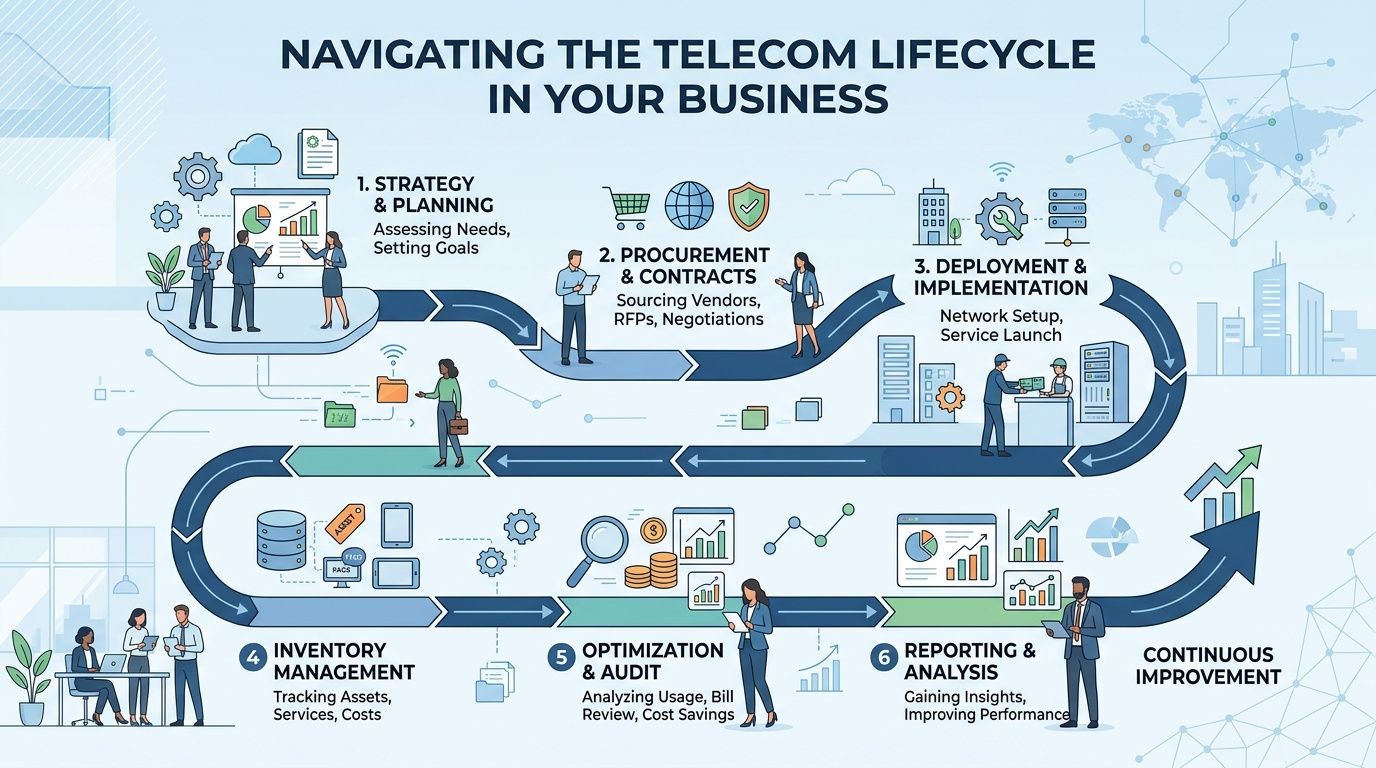
Navigating the Telecom Lifecycle in Your Business
Most businesses don’t have a telecom strategy problem. They have a lifecycle problem.
A regional office upgrades to hosted voice. A warehouse swaps legacy networking gear for newer hardware. A data room gets cleaned out after a carrier transition. The new service goes live, but the retired equipment stays behind because nobody owns the last step. It sits in a closet, then in a cage, then on a pallet.
That’s not harmless overflow. It’s unmanaged equipment.
The broader market makes this issue more urgent. The global telecom services market reached USD 2,095.72 billion in 2025 and is projected to expand to USD 3,584.32 billion by 2033, according to Grand View Research’s telecom services market analysis. More upgrades mean more displaced hardware. If your business keeps modernizing, your disposal workload keeps growing too.
The overlooked half of a telecom upgrade
Facilities directors usually see the physical problem first. IT directors usually see the security problem first. Procurement sees lingering costs. Finance sees assets that were bought, depreciated, and then abandoned without a clean closeout.
All of them are right.
A proper lifecycle approach means you don’t treat decommissioning as janitorial cleanup. You treat it as controlled asset retirement. That includes inventory, segregation of reusable versus scrap equipment, data handling for anything with storage, and documented downstream disposition.
Practical rule: If you can’t say what the device is, where it came from, whether it stores data, and who removed it, it isn’t ready to leave your building.
That’s why asset lifecycle discipline matters long before pickup day. If you need a broader operating model, this overview of asset lifecycle management practices is useful because it frames retirement as part of the same system as procurement and deployment.
What works and what fails
The teams that handle telecom transitions cleanly do a few things consistently:
- They create a retirement list early. Every router, switch, handset, modem, UPS, and accessory gets accounted for before the new rollout is complete.
- They separate by disposition path. Reuse, resale, manufacturer return, certified destruction, and recycling are not the same workflow.
- They document custody. Someone signs off at the site, during transport, and at final processing.
What fails is the informal approach.
A common mistake is letting local staff “set aside” equipment until someone has time to deal with it. Another is mixing telecom hardware with general office e-waste. The worst one is assuming old telecom gear has no data risk. Many devices do. Configuration files, call records, credentials, and stored network information don’t stop mattering because the device is unplugged.
How to Find the Right Local Telecom Partners
A search for telecom solutions near me usually returns three different categories mixed together: carriers, telecom agents, and disposal companies. If you don’t separate them, you’ll waste time talking to vendors that solve the wrong problem.
Start with two lists, not one
Build one list for service acquisition and another for asset retirement.
For service acquisition, include providers that can handle your current priorities. Fiber, business internet, failover connectivity, voice, mobility, or managed circuits. If you’re comparing access types and availability, Premier Broadband's fiber internet guide is a helpful primer because it clarifies how local provider searches usually map to actual service options.
For asset retirement, look for companies that specifically mention telecom gear, secure data destruction, on-site removal, chain-of-custody handling, and business-only processing. That’s a very different capability set from a generic recycler.
Qualify websites fast
You can eliminate weak candidates in a few minutes if you know what to scan for.
Use this quick screen:
| What to check | Why it matters |
|---|---|
| Accepted asset types | If the site only mentions laptops and monitors, they may not understand telecom equipment. |
| Pickup and logistics language | Multi-site removals, packing, and scheduling matter in Atlanta. |
| Data destruction details | Vague claims are a red flag. Look for actual process descriptions. |
| Business service focus | B2B workflows are different from public drop-off recycling. |
| Documentation language | You want audit trails, certificates, and disposition records. |
A provider can have a polished website and still be operationally weak. The opposite is also true. Some local firms won’t win design awards, but they know how to pull old gear out of a live facility without disrupting operations.
One local reference point for comparing firms in the area is this roundup of telecom companies serving Atlanta businesses. It’s useful for identifying the difference between broad telecom vendors and specialized local support options.
Use local business signals
Metro Atlanta gives you a practical advantage. Ask neighboring facilities managers, property managers, and IT leads who they’ve used for removals, not just who sold them service. The best feedback usually comes from someone who had to coordinate loading dock access, after-hours pickup, and signoff documentation on a real project.
A vendor’s real quality shows up on pickup day, not in the sales call.
Also pay attention to geography. A provider may say they cover Atlanta, but that can mean very different things in practice. If you have sites in Alpharetta, Norcross, Marietta, Kennesaw, and inside the Perimeter, you need to know whether they can support that footprint without turning every removal into a custom exception.
Keep your shortlist tight
You don’t need ten candidates. You need a small shortlist of vendors you can vet thoroughly.
A good shortlist usually includes:
- A carrier or telecom advisor for the new service side
- A secure ITAD or electronics recycling partner for the old hardware side
- An internal project owner who can coordinate site contacts, inventory, and timing
One option in the Atlanta area is Montclair Crew Recycling, which handles business IT and telecom equipment disposition, including pickup, audit support, data destruction, and compliant recycling for organizations retiring old gear. That’s relevant when your telecom project includes closets, racks, or storage areas full of equipment that has to be removed responsibly, not just disconnected.
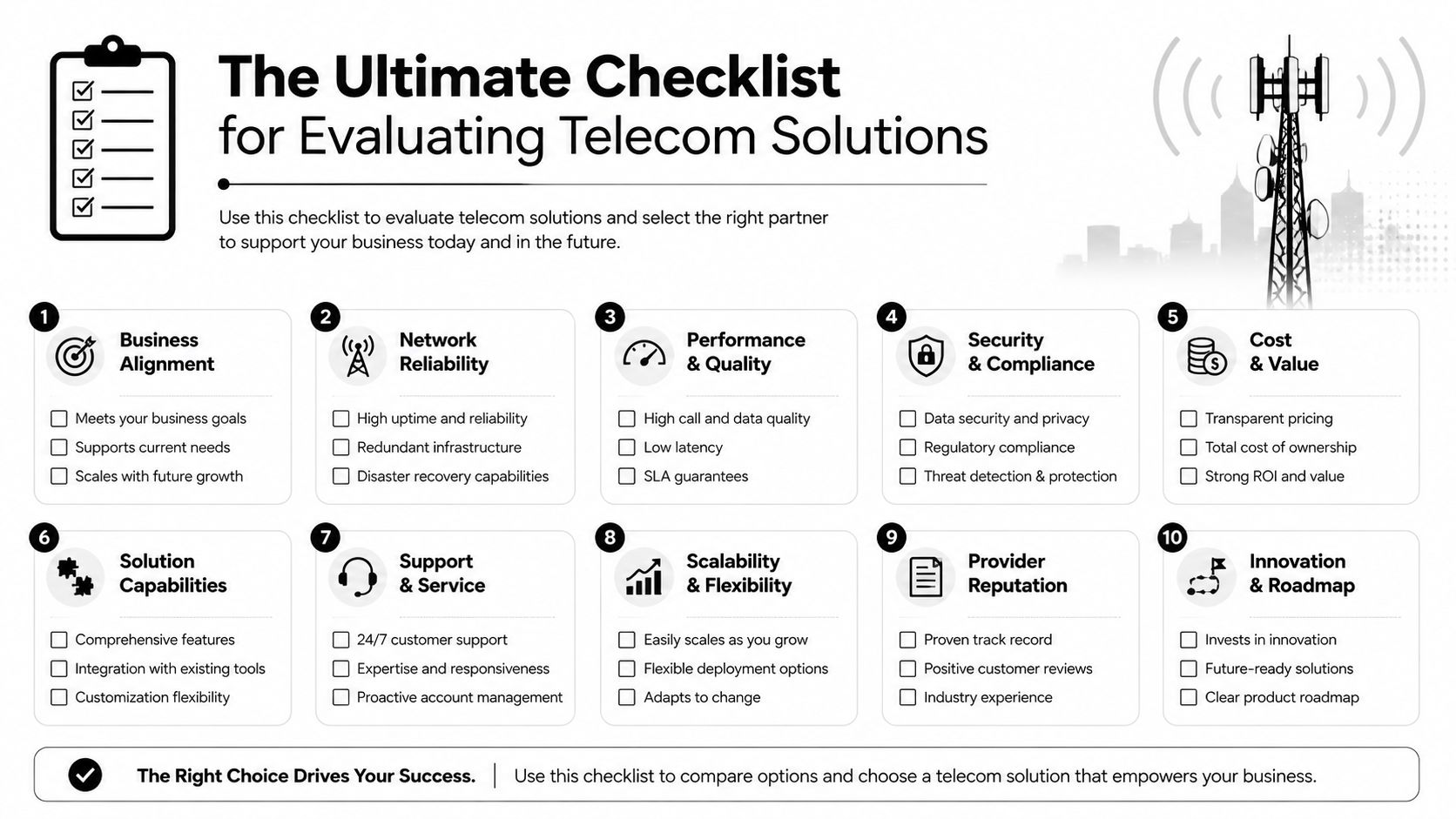
The Ultimate Checklist for Evaluating Telecom Solutions
Finding candidates is easy. Rejecting the wrong ones is where the significant work is.
If you’re vetting a telecom disposal partner, don’t evaluate them like a commodity hauler. Evaluate them like a risk transfer decision. Once your equipment leaves the site, you’re relying on their process, their staff, and their documentation.
Data destruction has to be explicit
Don’t accept “we wipe everything” as an answer.
Ask what they wipe, what standard they use, what they physically shred, and what documentation you receive afterward. A business telecom environment can include storage in more places than people realize. Appliances, voice systems, security devices, wireless controllers, and some network gear may all require deliberate handling.
Non-negotiable: If the provider can’t explain the difference between sanitizing reusable equipment and destroying non-reusable media, keep looking.
A serious partner should define the conditions that trigger wiping versus physical destruction. They should also explain how they identify data-bearing devices during audit and intake.
TEM thinking improves disposal decisions
There’s also a cost-control angle here that many teams miss. Effective Telecom Expense Management requires auditing all mobile, voice, and data services to identify redundant or obsolete equipment, and integrating that work with disposition helps track depreciation and end-of-life costs, according to CTPros’ guide to telecom expense management.
That matters because disposal isn’t just risk reduction. It’s financial cleanup. If you don’t know what you retired, you can’t recover value properly, close service loops, or match disposal records to your asset ledger.
Environmental compliance is not a brochure line
Ask what standards the provider follows, where material goes downstream, and how they separate reusable equipment from scrap. If they can’t describe their process clearly, assume the back end is messy.
Use this screening list during vendor calls:
Downstream accountability
Ask where equipment goes after pickup. Reuse, remarketing, parts harvesting, and recycling should follow defined paths.Material segregation
Mixed gaylords full of telecom gear, cables, batteries, and general electronics create errors fast. Good operators sort early.Certificate package
You should know exactly what records you’ll receive after the job closes.
Logistics capability tells you how mature they are
A disposal partner can sound strong on compliance and still fail operationally.
Look for practical capabilities such as site-by-site pickup planning, on-site packing, palletization, rack equipment removal, liftgate coordination, and chain-of-custody handoff. These details matter more than marketing language because they determine whether a multi-location decommissioning runs smoothly or turns into a week of rescheduling.
A useful benchmark is whether the provider thinks in standardized workflows. The firms that handle telecom projects well tend to use repeatable methods for documentation, handoff, and site readiness. If you want to compare that mindset to a broader service framework, this page on telecom services in Atlanta is a practical reference point.
Value recovery policy should be clear before pickup
Some retired telecom hardware has resale value. Some doesn’t. The problem starts when a vendor won’t define how they make that call.
Ask for a plain explanation of:
| Evaluation point | What you need to hear |
|---|---|
| Reusable equipment | How they identify items fit for resale or refurbishment |
| Pricing method | How they determine fair market value |
| Revenue sharing | Whether and how proceeds are returned to your business |
| Non-viable assets | What gets recycled outright and why |
If value recovery is real, the partner should be able to explain it without hand-waving.
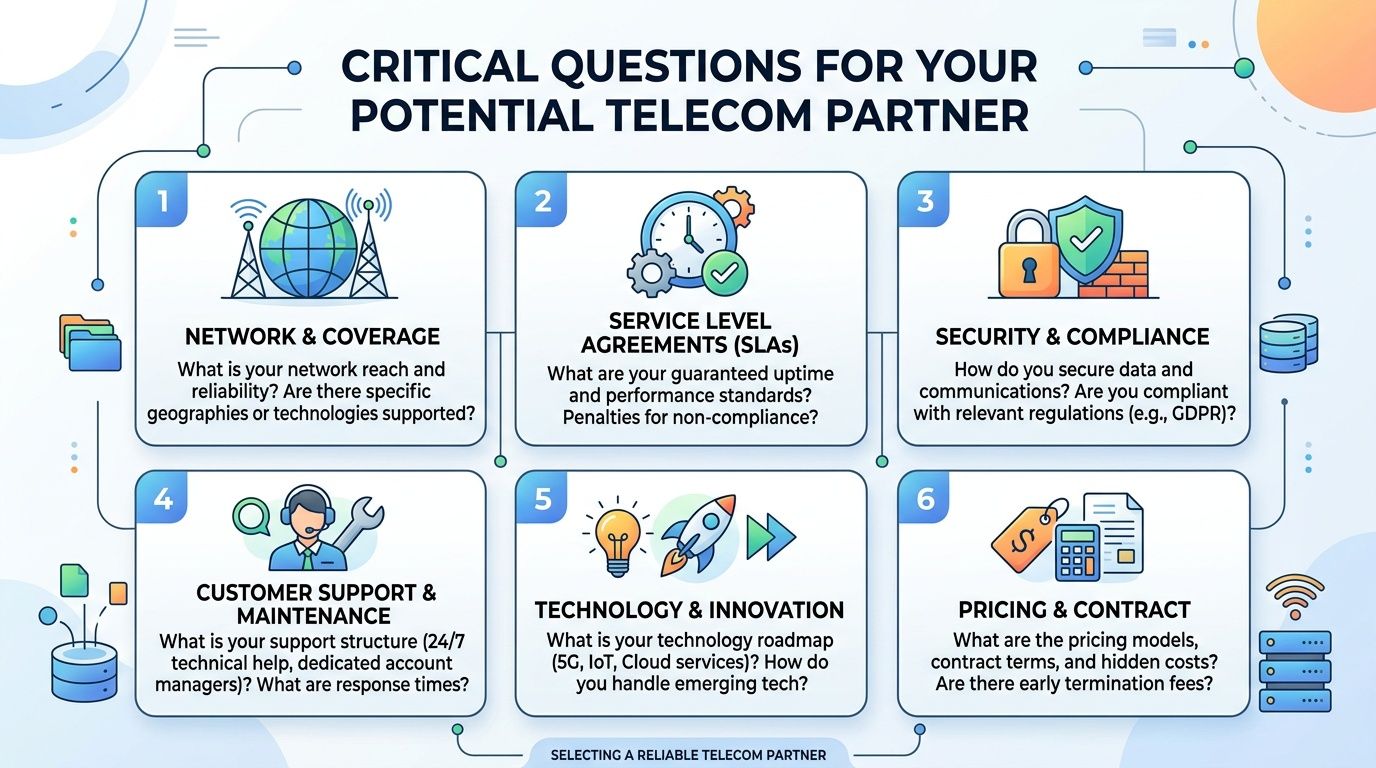
Critical Questions for Your Potential Telecom Partner
Most vendor interviews are too soft. Buyers ask broad questions, vendors answer with polished language, and nobody learns much.
A better approach is to ask questions that force process-level answers. If the provider is real, they’ll answer directly. If they dodge, generalize, or redirect, that tells you enough.
Ask questions that expose their operating model
Use these in your call or site walk:
What happens from the moment your crew arrives on-site to the moment the last pallet leaves?
This exposes whether they have a real handoff process or are improvising.How do you tag, count, and reconcile assets during pickup?
You want to hear about itemization, audit support, and exceptions handling.Which devices do you treat as data-bearing by default?
This reveals whether they understand telecom hardware or only think in terms of PCs and servers.What paperwork do I receive after completion?
You’re looking for certificates, inventory records, and disposition documentation.How do you handle reusable gear versus scrap?
This shows whether they understand value recovery or just bulk recycling.
Ask about telecom-specific equipment, not generic e-waste
Under these conditions, weak vendors get exposed quickly.
The Fixed Wireless Access market expanded sharply after major carrier entry in late 2020, with T-Mobile reaching 5.2 million subscribers and Verizon reaching 3.1 million, while the sector had previously sat at about 2 million total customers before their entrance, according to S&P Global Market Intelligence’s fixed wireless subscribers research. That kind of growth drives equipment turnover. Older antennas, base station components, customer premises gear, and supporting hardware all enter retirement cycles.
So ask directly:
- Have you handled retired FWA antennas or base station equipment before?
- How do you pack and transport oversized or fragile wireless components?
- What do you do when equipment arrives with missing labels or uncertain ownership?
The right question isn’t “Do you recycle telecom gear?” It’s “What telecom gear have you actually processed, and what did you do with it?”
Watch how they answer, not just what they say
Strong providers sound operational. They talk about sequence, documentation, exceptions, and accountability. Weak ones sound generic. They say things like “end-to-end solutions,” “full compliance,” or “smooth process” without describing any actual steps.
Here’s a quick read on answer quality:
| If they say | What it usually means |
|---|---|
| “We customize every job completely.” | They may not have a standard process. |
| “We handle all electronics.” | They may lack telecom-specific experience. |
| “We provide documentation.” | Ask which documents, when, and in what format. |
| “We maximize value.” | Ask how value is calculated and reported. |
If a provider can’t stay precise under basic questioning, don’t trust them with retired network hardware, carrier equipment, or anything that once touched your production environment.
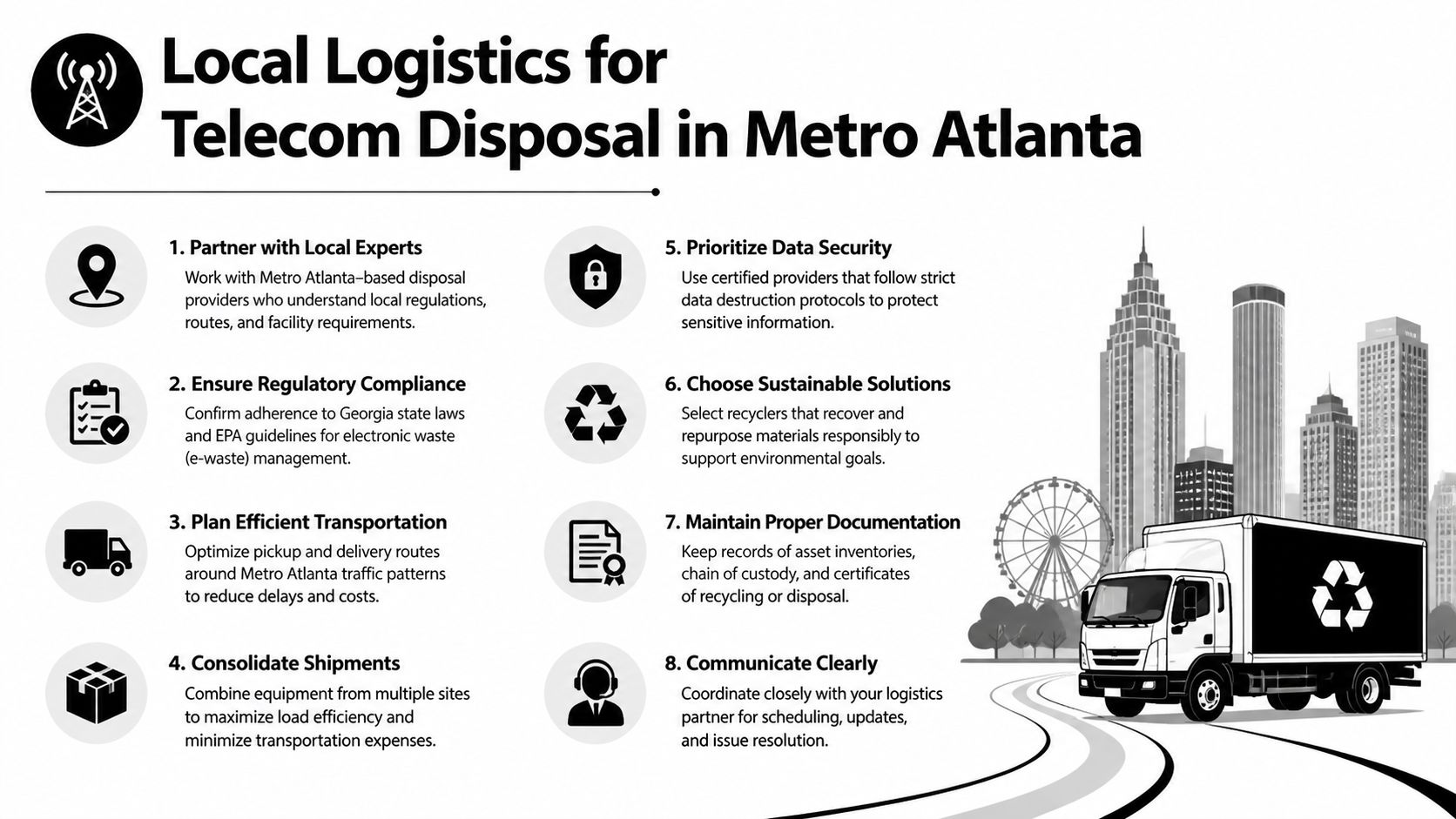
Local Logistics for Telecom Disposal in Metro Atlanta
Atlanta logistics can wreck a clean plan if you treat pickup like an afterthought.
A decommissioning job in Alpharetta isn’t the same as one in Midtown. A warehouse in Kennesaw behaves differently from a medical office in Sandy Springs. Loading dock rules, freight elevator access, parking limits, building management approvals, and traffic windows all affect how fast retired telecom equipment leaves the site.
Plan the site before you schedule the truck
A little prep prevents most pickup-day problems.
Confirm access conditions
Ask whether the crew will need COIs, loading dock reservations, elevator windows, or after-hours approval.Stage equipment by type
Keep handsets, rack gear, loose cabling, batteries, and peripherals separated. Faster loading starts with cleaner staging.Assign one site contact
One person should control access, approve counts, and handle last-minute questions.
If you’re coordinating multi-site removals, basic routing discipline matters more than people think. This explanation of route optimization in field operations is worth a look because it shows why sequencing stops, time windows, and travel paths affect reliability.
Use local coverage to your advantage
Metro Atlanta businesses should ask simple questions: Where is the provider based, where can equipment be dropped off, and how far do they routinely serve without making your job “special handling”?
For companies that want pickup support, this page on electronics recycling pickup across Atlanta helps clarify what a local service footprint should look like.
A practical local setup matters. An Alpharetta headquarters is useful for North Fulton and nearby business corridors. A Smyrna drop-off point helps for Cobb and west-side traffic patterns. If your sites stretch across Marietta, Norcross, Roswell, and inside the city, local proximity usually means easier scheduling and fewer handoff errors.
Schedule around building access first, traffic second, and internal availability third. Most teams do that in the opposite order.
Don’t let pickup day become sorting day
If the crew arrives and your team is still deciding what stays, what goes, and what needs wiping, you’ve already lost time.
Label what’s in scope. Pull out anything under lease. Separate suspect data-bearing equipment for special handling. Make sure abandoned accessories don’t hide valuable hardware. In Atlanta, the easiest jobs are the ones that are already operationally decided before the truck starts moving.
Taking the Final Step to Hire Your Telecom Partner
By the time you hire a partner, the hard part should already be done. You should know your asset scope, your site conditions, your documentation requirements, and your tolerance for risk.
Execution is where disciplined teams pull ahead. They don’t send a vague “please pick this stuff up” email. They issue a defined scope, identify site contacts, confirm access rules, and require a clean closeout package at the end.
Lock the job before equipment moves
Your handoff should include a short but exact package of information:
Scope of work
Which sites, which equipment categories, and whether removal includes rack extraction, loose storage cleanup, or palletized loads.Handling instructions
Call out anything that may contain data, anything leased, and anything excluded from pickup.Completion documents
Specify the records you expect after processing, not after you chase the vendor for two weeks.
Standardized thinking is paramount. Top Telecom Managed Services providers use a standardized deployment methodology to ensure consistency and eliminate delays, and that same logic applies to disposition work when you standardize documentation and coordinate removal schedules, as described in this telecom managed services methodology overview.
Prepare your team for closeout, not just removal
A clean project doesn’t end when the truck leaves.
Your finance, IT, facilities, and compliance teams may all need different outputs from the same event. Finance may need asset retirement support. IT may need proof of destruction. Facilities may need cleared space and building signoff. Compliance may need records stored for audit purposes.
One useful internal discipline is aligning retirement with procurement policy. This guide to IT procurement best practices is relevant because it helps tie buying, deployment, and retirement into one controlled process instead of three disconnected tasks.
The simplest rule is this: don’t close the project until the paperwork matches the physical reality. If the room is empty but the records are incomplete, the job isn’t finished. If the records are complete but your team still has untagged devices under desks or in branch closets, the job isn’t finished either.
A good telecom partner makes the final step boring. That’s what you want. No surprises, no vague reporting, no orphaned equipment left behind.
If your Atlanta business is replacing telecom equipment, closing sites, cleaning out network rooms, or retiring old voice and data hardware, Montclair Crew Recycling provides B2B pickup, asset audit support, secure data destruction, and compliant recycling for retired IT and telecom gear across Metro Atlanta.
