

A phone outage rarely starts as a full failure. In Atlanta offices, it usually begins with small faults that get waved off for days. One department hears clipped audio. The receptionist's phone unregisters once or twice. A remote employee can place calls but cannot receive transfers. Then traffic picks up, the weak point gives way, and customer communication starts backing up fast.
Telecom maintenance services in Atlanta turn those warning signs into scheduled work instead of emergency repair. That covers more than the phone system itself. It includes PBX platforms, SIP trunks, fiber handoffs, structured cabling, carrier circuits, DAS, paging, voice gateways, and the patching and power behind them. Companies planning telecom network installation in Atlanta usually get better long-term results when maintenance is built in from the start, not added after the first outage.
Atlanta gives businesses access to a deep bench of telecom labor and infrastructure experience. That helps with response times and specialization, but local market depth does not remove the need for a clear service plan. Buildings still age. Cabling still gets repurposed badly. Firmware still falls behind. Spare parts still disappear right when an old gateway finally fails.
Good maintenance also has to cover the full equipment lifecycle. Keeping gear online is only part of the job. The other part is knowing when a switch, gateway, handset fleet, or UPS has reached the point where repair no longer makes financial or operational sense. At that stage, replacement and retirement need the same level of control as installation and support.
That last step gets missed all the time. Old telecom gear can hold configs, call routing details, credentials, labels, and other business data that should not leave the site in a junk pile or an open resale stream. A solid maintenance program in Atlanta should end with secure, documented IT asset disposition when equipment comes out of service.
Keeping Your Atlanta Business Connected
Monday at 8:15 a.m., the phones start breaking in ways that waste time. Front desk calls sound choppy. A few desk sets never register. The carrier says their side is clean, so internal IT restarts the phone server and waits. The fault is often found somewhere less obvious: a failing patch lead, a voice gateway with unstable ports, a closet UPS that is dipping under load, or cabling that got disturbed during another project.
That is why telecom maintenance has to cover the whole path, not just the call server. In Atlanta buildings, voice trouble often shows up at the handset first, but the root cause can sit in patching, power, fiber handoff, switching, grounding, or the carrier demarc. A break-fix approach turns a small fault into a long outage because every team starts by proving the problem belongs to someone else.
Why Atlanta businesses feel telecom outages fast
In this market, a phone issue rarely stays small. Medical offices miss confirmations. Property managers lose tenant calls. Service companies miss dispatch updates. Retail sites run into payment verification delays, and internal teams fall back to personal cell phones and side conversations that never get documented.
Atlanta does have a strong bench of telecom labor and infrastructure experience, which helps with response time and specialization. That only matters if the technician arriving on site can trace the full service path and work from current records.
Practical rule: Dispatch speed matters less than accurate fault isolation.
Good maintenance starts with knowing what is in the building. That means current inventories, labeled patching, clean rack layouts, documented carrier handoffs, and a record of what has already failed once. Companies planning telecom network installation in Atlanta usually avoid future service pain when those standards are built into the original design instead of patched in later.
What working maintenance looks like on the ground
Field-ready maintenance is boring in the right way. It relies on repeatable checks, clean documentation, and scheduled replacement before old gear starts creating intermittent faults that no one can reproduce on demand.
A workable program usually includes a few habits:
- Keep records usable: Model numbers, firmware versions, carrier circuit IDs, patch locations, and voice VLAN details should be easy to find during an outage.
- Inspect the physical layer: A surprising number of voice tickets trace back to loose terminations, bad jumpers, dirty fiber ends, overloaded power strips, or heat in a neglected closet.
- Watch for age-out signals: Fan noise, random re-registration, battery weakness, port flaps, and recurring gateway lockups usually show up before a hard failure.
- Control site changes: Moves, adds, and cabling rework need signoff and documentation, especially in multi-tenant buildings where telecom rooms get touched by several vendors.
- Plan the end of life: Once repair costs and risk stop making sense, replacement should include secure removal of the retired gear, because old telecom equipment can still hold configs, credentials, call routing data, and labels tied to your business.
That last point gets missed too often. Keeping systems online is only half the job. The other half is retiring failed or obsolete equipment in a way that protects business data, meets disposal requirements, and leaves a clear chain of custody when handsets, gateways, switches, and UPS units come out of service.
Atlanta businesses need uptime, but they also need a controlled lifecycle. Maintenance should reduce outages now and make the next replacement cleaner, safer, and easier to document.
Decoding the Four Types of Telecom Maintenance Services
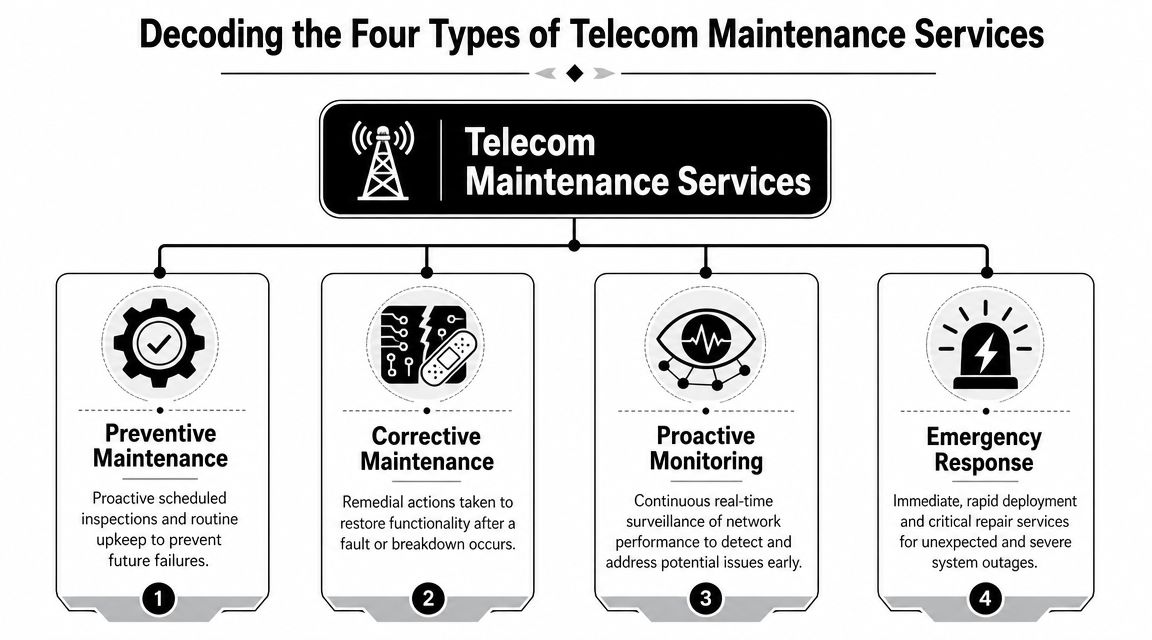
Most companies buy the wrong maintenance package because vendors use the same words for very different scopes. The easiest way to think about it is car care. Preventive maintenance is your oil change and scheduled inspection. Corrective maintenance is the brake repair after a failure shows up. Proactive monitoring is the dashboard that catches a problem early. Emergency response is the tow truck and immediate repair when the vehicle dies in traffic.
Preventive maintenance
This is the work that keeps small defects from turning into service tickets. In telecom, that usually means scheduled inspection of cabling, patch fields, power supplies, battery backups, grounding, active gear condition, firmware alignment, rack airflow, and physical security of closets and telecom rooms.
Good preventive work is repetitive by design. A technician checks the same fault-prone points every cycle and documents what changed. That's how you catch loose patching, dirty fiber interfaces, failing fans, weak batteries, unsupported software, and overloaded small switches before users notice.
What doesn't work is “preventive maintenance” that is really just a visual walk-through with no testing, no notes, and no remediation schedule.
Corrective maintenance
Corrective work starts after a fault, but the best teams don't troubleshoot by guessing. They isolate the failure in order.
The most effective corrective maintenance separates physical-layer defects from configuration-induced outages. A structured workflow that verifies optical power, checks copper continuity, and validates switchport error counters before testing software configuration can shorten repair time and reduce repeat service calls, as described in this telecommunications support overview from Xtreme Solutions.
That matters in mixed environments. A business may have legacy PBX equipment, newer IP phones, fiber uplinks, and a carrier handoff all tied together. If the technician starts by changing software settings before checking the physical path, the site can lose hours.
Don't let anyone reboot their way through a telecom outage. Good corrective maintenance narrows the fault domain first.
Proactive monitoring
This service sits between preventive and corrective work. The provider watches the environment for signs of trouble, such as interface errors, registration instability, abnormal device behavior, environmental alarms, or repeated flaps that suggest something is degrading.
Proactive monitoring is useful when your business can't wait for employees to become the monitoring system. It's especially helpful in multi-site operations, medical offices, schools, and organizations with small internal IT teams.
For many Atlanta firms, this type of support is part of broader enterprise telecom solutions in Atlanta, where the voice platform, cabling, switching, and carrier coordination all need to be handled as one operating system rather than separate silos.
Emergency response
Emergency response is what you call when service is already down or when the risk of downtime is immediate. This includes storm damage, fiber cuts, failed gateways, power events, water exposure, accidental disconnects, and major voice outages.
You're not buying elegance here. You're buying speed, escalation discipline, access to replacement parts, and the ability to stabilize service under pressure.
A solid emergency scope should answer these questions clearly:
- Who picks up after hours: If your site fails on a weekend, does a live engineer respond or just a call center?
- What parts can they source: A rapid response promise means little if no one can get the needed power supply, transceiver, or gateway.
- How do they escalate: You need named paths for carrier issues, on-site dispatch, and decision authority when a workaround is required.
- What's the restoration target: Even when full repair takes time, the provider should state how they'll restore minimal communications first.
Not every business needs all four service types at the same level. A small office may need preventive work and emergency response. A distributed organization usually needs all four.
Negotiating Your Service Level Agreement and Contract
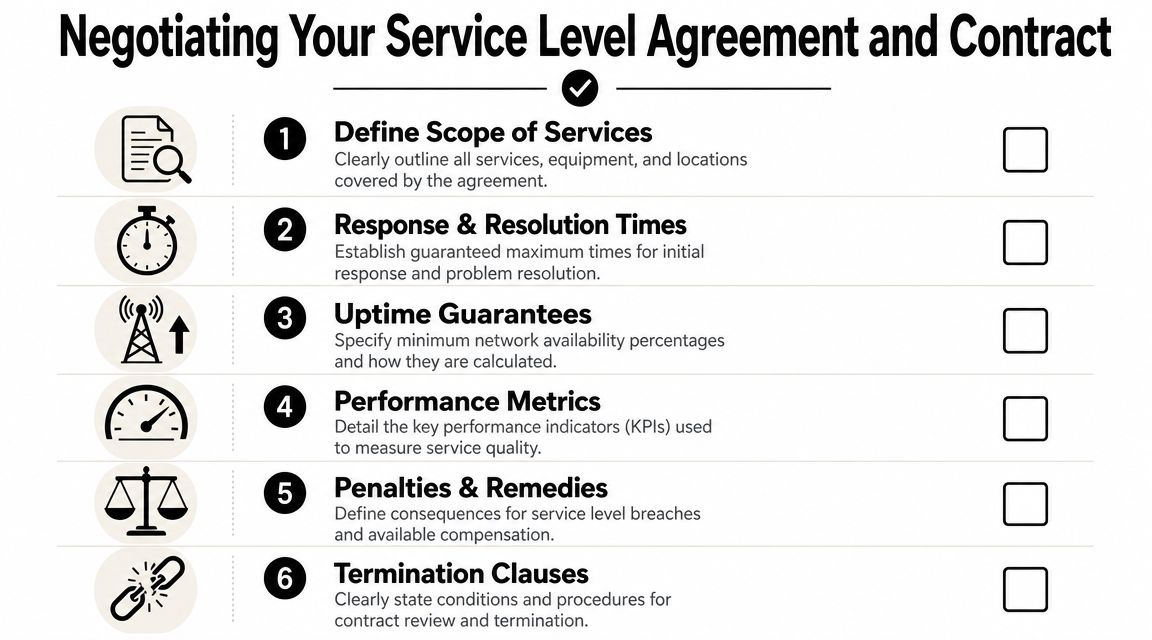
A telecom maintenance contract is only useful if the service level agreement matches how your business operates. Plenty of contracts look detailed and still leave gaps around after-hours coverage, parts, escalation, and what “response” really means. If you don't pin those down before signing, you'll discover the missing language during an outage.
Response time is not repair time
This is the first contract trap. A provider may promise a fast response, but “response” can mean a ticket acknowledgment, not a technician doing useful work. For a voice outage, those are not the same thing.
Ask for both of these in writing:
- Initial response definition: Is it a phone callback, remote login, dispatch confirmation, or active diagnosis?
- Resolution path: What happens if the issue needs onsite work, a replacement part, or carrier coordination?
You should also ask whether the clock runs during nights, weekends, and holidays. If your phones support patients, tenants, logistics, or customer scheduling, a business-hours-only SLA won't protect you.
Scope has to be precise
A maintenance agreement should name the equipment, sites, and service boundaries it covers. If the contract says “telecom equipment” but doesn't list systems, that's a problem. If the provider supports handsets but excludes switching, gateways, and cabling, that's another problem.
Look for clear wording around:
- Covered assets: PBX, voice gateways, switches, fiber patching, cabling, DAS, paging, carrier demarc extensions.
- Excluded work: MACs, cabling changes, software upgrades, after-hours labor, replacement hardware.
- Site list: Which Atlanta locations are included, especially if your business spans multiple buildings or suburbs.
- Escalation boundaries: When the vendor owns the issue and when they only “assist” while someone else is responsible.
A lot of buyers also benefit from outside guidance when they understand IT support agreements in plain language, especially where support scope and accountability overlap between IT and telecom.
The contract should reflect how failures happen
Telecom contracts often focus on support hours and labor rates, but real failure points sit elsewhere. Parts availability matters. Legacy support matters. Carrier coordination matters. Documentation matters.
Field advice: If the provider can't explain the first four steps they take during a voice outage, the SLA probably won't save you.
Use this short contract review table before signing:
| Contract Element | What good looks like | What usually causes trouble |
|---|---|---|
| Response language | Defines acknowledgment, diagnosis, and dispatch | “Response” means only ticket receipt |
| Coverage scope | Lists systems, locations, and dependencies | Broad wording with hidden exclusions |
| After-hours support | States who responds and how | “Best effort” language |
| Parts handling | Explains sourcing and replacement responsibility | Assumes parts are someone else's issue |
| Escalation | Names internal and carrier escalation paths | No ownership once issue crosses vendors |
| Documentation | Requires service notes and remediation records | Verbal updates only |
Atlanta buyers comparing local options often start with a broader list of firms and then narrow it down to those with a visible field presence. That search usually begins with a provider directory or a local telecommunications company near me page, but the contract language should do the primary selection work.
Your Vendor Selection Checklist for the Atlanta Area
Choosing a telecom maintenance vendor in Atlanta isn't just about who can show up. It's about who can work cleanly across old and new infrastructure without turning every issue into a guessing exercise. In this market, plenty of companies can install or repair something. Fewer can document what they did, explain why the issue happened, and build a maintenance rhythm that lowers future risk.
One issue stands out in older office parks, schools, medical sites, and long-running businesses. Many Atlanta-area organizations still operate mixed-generation environments. Industry listings show support for legacy platforms from Avaya, AT&T, Lucent, and Nortel, which means vendor selection should include documented preventive testing, remediation intervals, and escalation paths for both legacy telephony and modern IP systems, as reflected in this Atlanta telecom provider listing.
What to verify before you sign
Start with local fit. Metro Atlanta is not one operating environment. Service in Midtown, Alpharetta, Norcross, Marietta, and distributed suburban offices can involve different dispatch times, building access issues, carrier coordination patterns, and legacy infrastructure conditions.
Then get practical. Ask the vendor to walk you through an actual fault workflow, not just a sales overview.
- Local dispatch capability: Can they serve your actual footprint, not just claim “Atlanta coverage”?
- Legacy platform knowledge: Can they support old PBX cabinets and gateways without treating them like unsupported museum pieces?
- Modern telecom skills: Do they handle fiber, IP telephony, switching, and DAS as part of one support model?
- Documentation discipline: Will they produce usable notes on inventory, firmware, changes, and recurring faults?
- Escalation ownership: When a carrier, ISP, or third party is involved, do they stay on the issue or hand it back to you?
Atlanta Telecom Vendor Evaluation Checklist
| Evaluation Criterion | Why It Matters for Atlanta Businesses | Verification Method |
|---|---|---|
| Local field presence | Faster onsite support depends on actual regional coverage and dispatch discipline | Ask for service area details by city and suburb |
| Legacy system experience | Older voice estates still exist in many Atlanta buildings | Request examples of supported legacy platforms |
| Mixed-environment troubleshooting | Most outages involve more than one layer | Ask for their standard fault isolation workflow |
| Documentation quality | Good records reduce repeat failures and shorten future repairs | Review sample service notes or maintenance reports |
| Preventive maintenance process | Scheduled testing is different from ad hoc repair | Ask for inspection checklists and remediation intervals |
| Parts and replacement planning | Aging systems fail harder when parts are unavailable | Ask how they source and stage common components |
| Carrier coordination | Many outages cross provider boundaries | Ask who owns carrier ticketing and escalation |
| Decommissioning support | Replacements create removed gear that must be handled securely | Ask what happens to retired equipment |
Questions that reveal weak vendors quickly
Some questions cut through sales language fast:
- What do you check first when intermittent call failures affect only part of the office?
- How do you distinguish a cabling issue from a registration or configuration issue?
- What's your process for unsupported equipment that is still business-critical?
- What records do you update after each service event?
- What do you do with removed phones, switches, gateways, batteries, and rack hardware?
If the answers stay vague, the support will probably be vague too.
Businesses that want a steadier operating model often compare ad hoc repair with broader managed telecom services near me options. That comparison is useful because some vendors are built for break-fix only, while others can manage lifecycle planning, recurring maintenance, and replacement coordination.
A vendor is a good fit when they can explain your environment back to you clearly after the site walk.
The Link Between Maintenance and Secure Equipment Disposal
Most telecom maintenance conversations stop at restoration. The phones are back. The gateway is replaced. The old switch is out of the rack. Job done. In reality, that last step creates a second operational problem. Now you have retired telecom equipment sitting in a closet, on a cart, or in the back of an office waiting for someone to decide what to do with it.
That gap is where maintenance and IT asset disposition meet. Maintenance events and upgrades create a short decision window for removed gear. With millions of tons of e-waste generated annually in the U.S. and low formal recycling rates, secure and compliant planning for retired switches, phones, and servers becomes a real part of the maintenance lifecycle, as noted by Southern Telecom's discussion of telecom services and operations.
Why removed telecom gear is riskier than it looks
Retired telecom equipment isn't just metal and plastic. It may contain stored credentials, call routing data, configuration backups, user directories, site labeling, asset tags, or removable media. Even if the device seems dead, the information in it may still matter.
The biggest mistakes usually look harmless:
- Storage in place: Old gear stays in a telecom closet for months with no inventory control.
- Informal disposal: Someone drops phones, switches, or gateways into a general recycling stream.
- No chain of custody: The business can't document what left the site, when, or who handled it.
- No value review: Reusable equipment gets discarded with scrap because nobody assessed resale or redeployment potential.
A clean end-of-life process
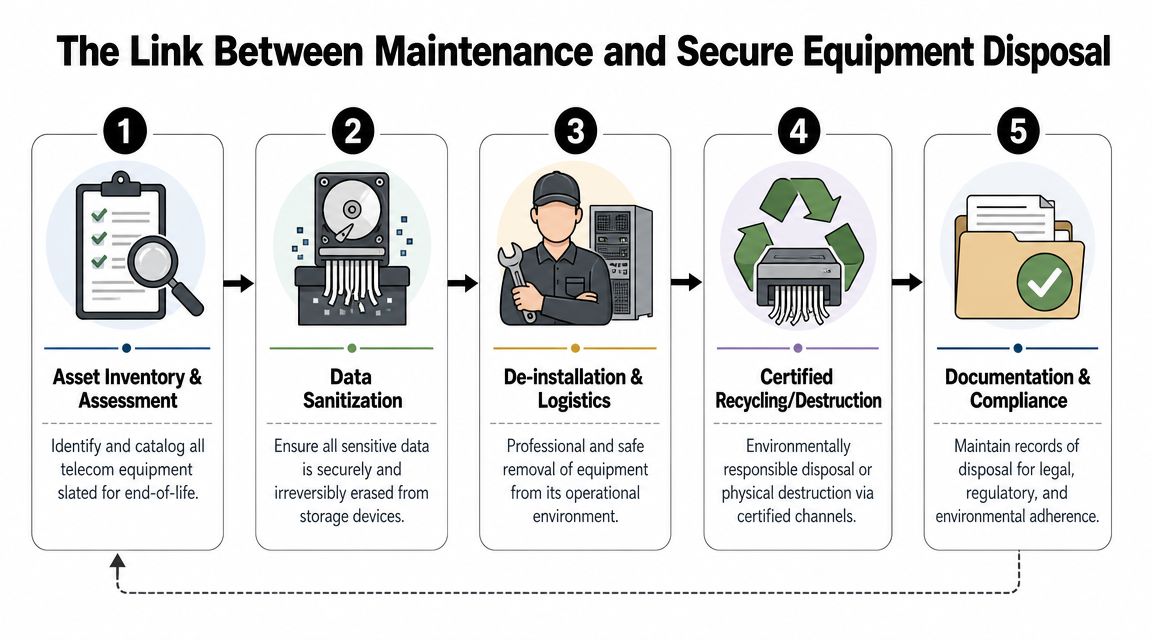
A solid decommissioning workflow should be tied to the maintenance ticket from the beginning, not added later. The process is simple in concept but has to be executed carefully.
- Inventory what is being removed. Record model, serial, location, and whether the asset contains storage or saved configuration.
- Separate reusable from dead-on-arrival equipment. Some assets belong in resale or redeployment channels. Others belong in destruction or certified recycling.
- Sanitize data before the equipment disappears. If a device stores sensitive information, don't let it leave without a controlled wipe or destruction step.
- Document chain of custody. The organization should be able to show what happened to each retired asset.
- Keep final disposition records. That matters for compliance, internal audit, and environmental reporting.
For Atlanta organizations replacing telecom hardware during moves, consolidations, or system upgrades, providers such as R2-certified telecom recycling in Atlanta can handle the removal side of the lifecycle. Montclair Crew Recycling is one example of a local company that works on telecom and IT equipment disposition, including asset audit, logistics, data destruction, and environmentally compliant recycling.
If the old gear leaves the rack without paperwork, you've created a second problem while solving the first one.
Advanced Maintenance for Atlanta's Unique Environment
Atlanta telecom maintenance has changed because the physical environment has changed. Telecom rooms now look more like compact infrastructure spaces than old-school phone closets. They hold denser electronics, more heat-producing equipment, tighter rack layouts, and more dependencies on stable power. Maintenance that used to focus on punchdowns and handset swaps now also involves thermal management, power quality, and room conditions.
Industry reporting on telecom data centers describes a wider shift toward renewable energy sources, advanced cooling systems, liquid cooling, and AI-driven energy management as operators work to reduce power usage and support heavier infrastructure loads, according to DataBank's review of data center evolution in the telecom sector. Atlanta businesses don't need to run a hyperscale facility for that trend to matter. The practical takeaway is that maintenance now extends beyond cabling and voice gear into cooling, airflow, and power resilience.

Weather changes the maintenance plan
In the Southeast, weather isn't an occasional disruption. It has to be part of the maintenance model. The U.S. experienced 27 separate billion-dollar weather and climate disasters in 2024, and power loss plus weather-related fiber cuts remain major causes of service interruption, based on this telecom preventative maintenance discussion citing NOAA and FCC-related outage concerns.
For Atlanta-area businesses, that shifts maintenance priorities in practical ways:
- Backup power checks matter more: UPS units and batteries need real inspection, not a glance at a front panel.
- Surge protection needs review: Summer storms can expose weak protection and poor grounding.
- Vegetation management matters: Overgrowth around exterior runs, cabinets, and aerial exposure points creates avoidable failure risk.
- Recovery logistics count: After a storm, access, replacement parts, carrier coordination, and removal of damaged gear all become part of service restoration.
What stronger local maintenance includes
A generic national maintenance checklist won't fully match Atlanta conditions. A stronger local plan usually includes:
- Telecom room environmental review: Heat, airflow obstruction, dust load, and power layout.
- Storm-season readiness: Battery health, backup runtime expectations, and contact paths for emergency dispatch.
- Physical route review: Exterior entries, roof penetrations, grounding, and vulnerable pathway segments.
- Post-event procedures: Inspection after lightning, flooding, water intrusion, or extended utility loss.
The businesses that hold up better in bad conditions aren't always the ones with the newest gear. They're the ones with cleaner maintenance discipline around power, environment, and recovery.
Frequently Asked Questions About Telecom Maintenance
What's the difference between an IT provider and a telecom maintenance specialist
An IT provider usually covers user devices, core networking, software platforms, and general help desk support. A telecom maintenance specialist goes deeper on voice systems, carrier handoffs, structured cabling, PBX environments, gateways, paging, DAS, and the physical path that supports communications.
There can be overlap, especially with VoIP. But when outages involve call quality, registration, analog devices, old gateways, or physical telecom plant, a specialist usually finds the issue faster because they work those fault domains every day.
Can a small business handle its own telecom maintenance
A small business can handle basic operational tasks if it has disciplined staff and good records. That includes labeling, simple handset swaps, checking obvious patching errors, and keeping inventory current.
What usually breaks down is fault isolation. Without the right testing workflow and field experience, teams spend too long guessing. That gets expensive fast when front desk phones, scheduling lines, or customer service queues are involved.
How are telecom maintenance contracts usually structured
Most contracts fall into a few patterns. Some are break-fix only. Some include scheduled preventive visits. Others bundle monitoring, recurring maintenance, and emergency response under a managed service model.
The right structure depends on how costly downtime is for your business, how old the equipment is, whether you have multiple sites, and whether you need after-hours coverage. The key is making sure the scope, escalation path, and handling of retired equipment are spelled out.
When should aging telecom equipment be replaced instead of repaired
Replace it when maintenance becomes reactive and unpredictable. If the platform is unsupported, parts are difficult to source, firmware is drifting, or outages keep reappearing in different forms, repair starts to become a delay tactic rather than a strategy.
Aging gear also creates operational drag. Each outage takes longer because fewer people know the platform, replacement options narrow, and interoperability issues get harder to solve cleanly.
What should be documented after every maintenance visit
You want more than “issue resolved.” A useful service record includes the affected assets, symptoms, tests performed, findings, parts replaced, config changes, firmware state if relevant, unresolved risks, and next actions.
That record becomes the baseline for the next event. Without it, every future call starts from zero.
What happens to equipment removed during an upgrade
That depends on whether someone planned for decommissioning before the work started. Removed phones, gateways, switches, batteries, and cabling components should be inventoried, assessed for reuse or resale, sanitized if they store data, and then sent through a documented disposition process.
If that doesn't happen, old hardware tends to pile up in closets and storage rooms. That creates security, compliance, and housekeeping problems that linger long after the upgrade is finished.
Is emergency response enough by itself
Usually not. Emergency response is important, but if that's all you buy, you're paying to recover from preventable failures. Most businesses need some combination of preventive work, structured corrective support, and clear emergency escalation.
Emergency-only service often works until equipment ages, sites multiply, or one bad outage exposes all the missing documentation.
If your Atlanta business is replacing telecom hardware, cleaning out a telecom room, or retiring old voice and network equipment after a maintenance project, Montclair Crew Recycling provides a local path for inventory, secure handling, data destruction, and compliant disposition of telecom and IT assets so the job doesn't end with a pile of unmanaged gear.
