

You're probably dealing with one of two situations right now. Your company is moving offices, or your IT team just approved a telecom refresh and now there's a back room full of retired switches, desk phones, PBX gear, rack hardware, cables, and battery backups that nobody wants to touch. Operations wants it gone. Security wants proof the data is gone first. Finance wants to know whether any of it still has value. Legal wants to know what California expects you to do with it.
That's where sustainable telecom recycling in Los Angeles stops being a vague sustainability goal and becomes an execution problem. You need a process that protects data, handles batteries and mixed materials correctly, documents chain of custody, and gives you records that will stand up if someone asks questions later.
The stakes are bigger than one office cleanout. The Global E-waste Monitor 2024 reports that the world generated 62 million tonnes of e-waste in 2022, yet only 22.3% was properly collected and recycled. For Los Angeles organizations, that matters because retired telecom equipment sits at the intersection of two risks at once: material waste and information exposure. If you want a useful background on downstream handling, this explainer on what happens to recycled electronics is a good companion read before you schedule any pickup.
The Challenge of Retiring Telecom Gear in Los Angeles
Telecom gear rarely retires in neat, clean batches. Most Los Angeles businesses accumulate it over years. One closet holds VoIP phones from a previous rollout. Another rack still has an old firewall, a few unmanaged switches, a legacy UPS, patch panels, and unlabeled cables from a tenant improvement project nobody documented properly. By the time a move, merger, or refresh forces action, the equipment isn't just old. It's mixed, partially undocumented, and tied to different departments.
That creates three practical problems at once.
Why telecom disposal gets messy fast
First, telecom gear is often data-adjacent even when it doesn't look like it. A router, firewall, PBX appliance, call recording system, or unified communications server can hold credentials, network maps, call logs, user data, or configuration files. Treating all telecom hardware like low-risk scrap is a common mistake.
Second, telecom removals usually include multiple material classes in one event. You're not just removing phones or switches. You may also be dealing with lithium batteries, lead-acid batteries, metal enclosures, circuit boards, optics, cables, and non-data-bearing rack components. Each category can require a different downstream path.
Third, Los Angeles projects tend to run under tight building and scheduling constraints. Property management may want a floor cleared in a narrow window. Your recycler still needs time to reconcile assets, segregate streams, and document what happened. If you skip that discipline, the project moves faster on day one and becomes riskier on day thirty.
Practical rule: If the pickup plan fits on a sticky note, it's probably too loose for a compliant telecom decommissioning project.
What works and what doesn't
What works is a formal workflow that starts before any pallet is wrapped. Someone needs to inventory assets, separate reusable equipment from clear scrap, identify anything with storage or configuration memory, and isolate batteries before the truck arrives.
What doesn't work is the “load it all and sort it later” approach. That method causes chain-of-custody gaps, weakens final reporting, and makes it harder to prove whether a given asset was reused, sanitized, dismantled, or shredded.
A sustainable telecom recycling Los Angeles program isn't just about keeping gear out of landfill channels. It's about making each retired asset traceable from the server room or closet to its final disposition. When businesses handle that well, the process becomes more than disposal. It becomes a controlled closeout of infrastructure, with security, environmental, and operational boxes all checked at the same time.
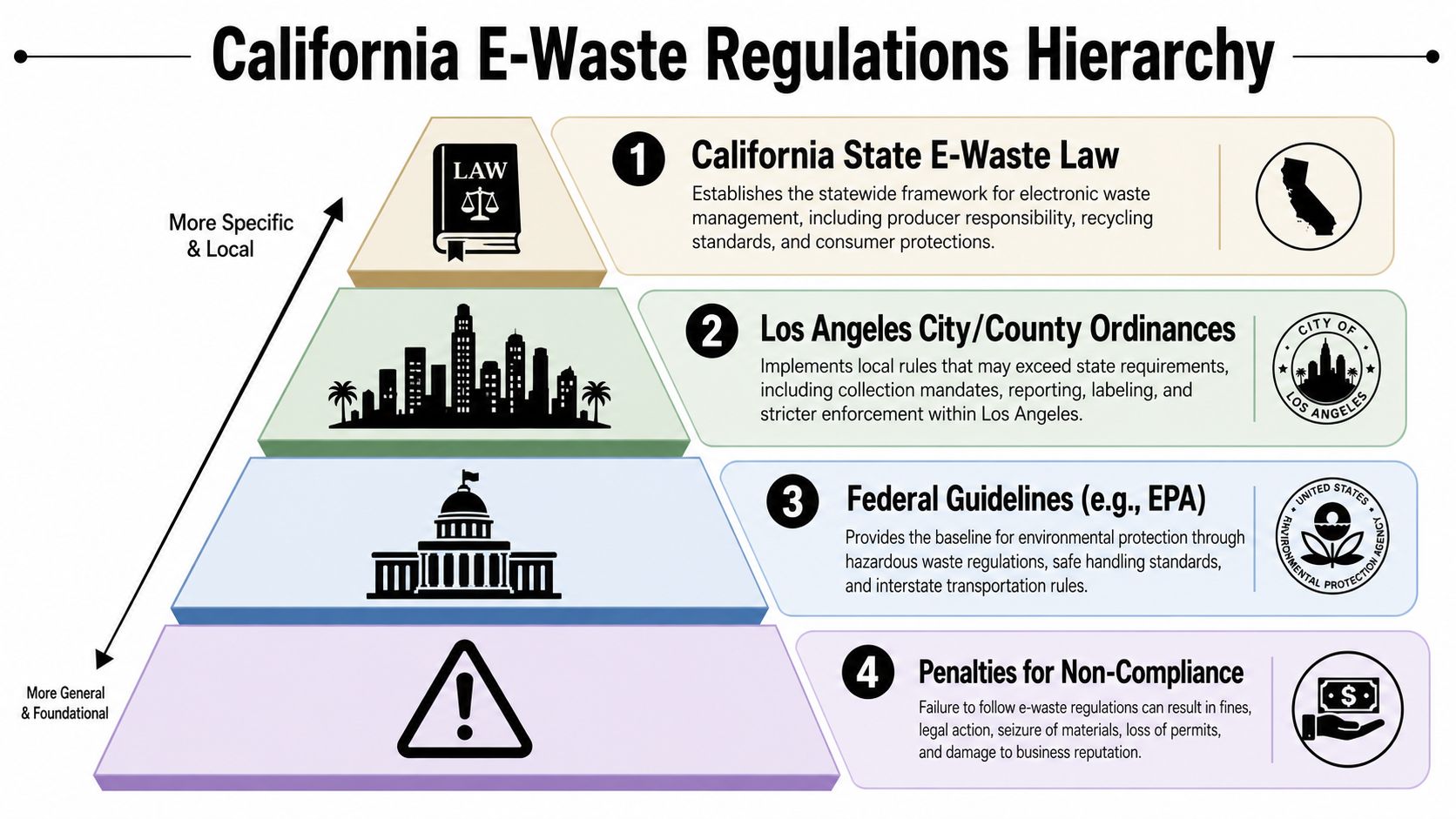
Navigating California's E-Waste and Disposal Regulations
California disposal rules can feel like driving Los Angeles freeways for the first time. The broad route looks simple until you realize every lane behaves differently. Telecom recycling works the same way. One removal event can include standard electronics, universal-waste batteries, data-bearing devices, and plain metal scrap, but they don't all belong in the same stream.
That's why companies get into trouble when they think “electronics recycling” is a single category.
Separate streams matter more than the pickup itself
A lot of business teams focus on collection because pickup is the visible part of the project. Compliance depends more on what happened before pickup and what records exist after it. A mixed telecom rack may contain low-risk metal rails, boards that belong in electronics recycling, and batteries that require separate handling under California rules. If those items leave your site as one undifferentiated load, your paperwork will usually be weaker than you think.
Nationally, collection systems already show uneven performance. The Recycling Partnership reported in January 2024 that only 21% of U.S. residential recyclables are captured, despite broad access to recycling services, which shows how easily materials miss the intended stream even in mature systems. That same article is a useful reminder for businesses planning disposition projects because telecom loads are more complex than household recycling and need stronger controls, especially when batteries and mixed racks are involved, as outlined in this report on residential recyclable capture and infrastructure gaps.
For vendor vetting, it also helps to compare providers that specialize in structured programs rather than basic hauling. A shortlist of e-waste disposal companies can help you see what service models are built for compliant business pickups.
The compliance questions to answer before pickup
Before you approve a telecom recycler, ask these operational questions, not just pricing questions:
- Which assets are data-bearing: Routers, firewalls, PBX appliances, call systems, and some networked peripherals may require sanitization or destruction records.
- Which items are battery-containing: UPS units, battery backups, and some telecom cabinets can introduce separate handling requirements.
- Which parts are reusable: Functional network gear may be eligible for refurbishment or resale rather than immediate dismantling.
- Which items are plain commodity scrap: Empty steel racks and non-electronic metal can move through a different channel than boards and devices.
Those distinctions sound small, but they drive the legal and documentation outcome of the project.
Where businesses make avoidable mistakes
The most common error is treating the recycler as the first point of control. The first point of control is your site. If your team hands over mixed pallets with no serialized inventory, no battery segregation, and no device-state classification, the vendor is reconstructing your audit trail after the fact. That's backward.
Another frequent mistake is relying on a generic statement like “recycled responsibly” without asking what happened to each category of material. In telecom decommissioning, vague language is a risk marker. You want to know whether the asset was tested for reuse, sanitized, dismantled for parts, or processed for commodity recovery.
A compliant project isn't defined by whether a truck showed up. It's defined by whether you can reconstruct the disposition of each asset later.
Los Angeles businesses don't need to become waste-law experts. They do need to manage telecom decommissioning like a controlled compliance event. That means identifying regulated material types early, routing them correctly, and requiring records detailed enough to survive an audit.
Essential Certifications for Compliant Telecom Recycling
Certifications matter because most companies never see the full downstream chain. You may watch your own gear leave the office, but you usually won't see the sorting line, refurbishment area, downstream processors, or final material recovery partners. A certification doesn't eliminate vendor risk, but it gives you a structured way to evaluate whether a recycler's claims are backed by audited systems.
The mistake is treating every certification acronym as interchangeable.
Think of certifications as different kinds of risk coverage
If you're hiring a telecom recycler in Los Angeles, certifications work like layered insurance.
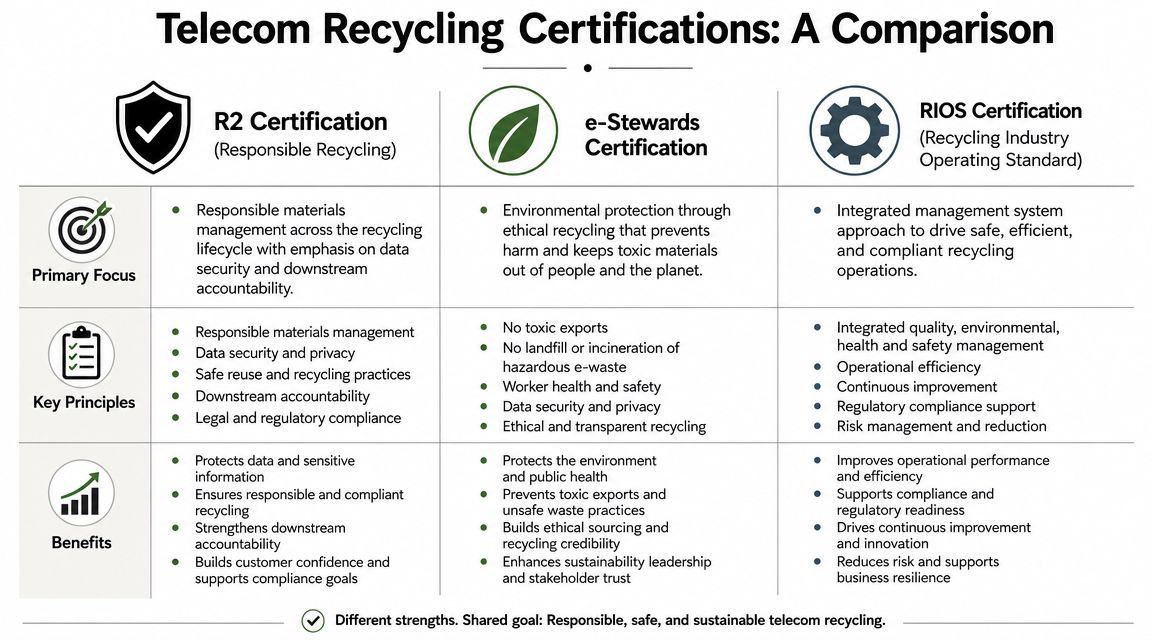
R2 is often the certification businesses look for when they care about responsible materials management and data security controls across the asset lifecycle. In practical terms, it signals that the vendor should have structured processes around intake, tracking, sanitization, reuse, and downstream accountability.
e-Stewards tends to matter most to organizations with strict environmental and downstream handling expectations. Businesses that want a tighter position on hazardous exports and worker protections often prioritize it.
RIOS is different. It says less about one narrow issue and more about whether the recycler runs disciplined operating systems across quality, environmental, and health and safety management. That's useful when you're evaluating whether a facility can execute repeatably, not just promise the right outcome.
What each certification tells you operationally
A simple way to interpret them is this:
| Certification | What it helps you evaluate | Why it matters in telecom recycling |
|---|---|---|
| R2 | Lifecycle controls and data handling discipline | Useful when assets include network gear, storage, and devices that may be reused or sanitized |
| e-Stewards | Downstream environmental strictness | Useful when your organization has strong environmental policy requirements |
| RIOS | Management system maturity | Useful when you want confidence that safety, process control, and documentation aren't improvised |
If you want a practical overview of one certification path, this page on R2 certified telecom recycling gives a straightforward example of how those standards are framed in business ITAD work.
Certifications are necessary, but not sufficient
A certified vendor can still be a poor fit if their service model doesn't match your project. Certification doesn't tell you whether the vendor can handle after-hours building access, on-site serial reconciliation, witness destruction, mixed battery loads, or phased decommissions across multiple locations.
Ask for the operating details behind the badge:
- How do they track serialized assets
- How do they separate reusable gear from scrap
- How do they document sanitization by device type
- How do they identify downstream processors
- What records do they return at closeout
Those answers usually tell you more than the logo page on a website.
What I look for first: not the certificate itself, but whether the vendor can explain how that certification shows up in day-to-day intake, testing, data destruction, and reporting.
A good telecom recycler should be able to translate certifications into plain operational language. If they can't, you're probably hearing sales vocabulary instead of process vocabulary.
Data Destruction A Non-Negotiable Step in Telecom Disposal
Most telecom disposal failures aren't environmental failures first. They're information security failures first.
That catches business teams off guard because many retired telecom assets don't look like traditional data devices. A phone system appliance looks like infrastructure. A firewall looks like a networking tool. A switch may seem harmless once it's unplugged. But retired telecom hardware can retain credentials, configuration backups, IP schemas, call routing details, access logs, voicemail data, and administrative settings. In the wrong hands, that information can map your environment faster than a spear-phishing email ever could.
Not every device needs the same sanitization method
The right destruction method depends on the media type and the intended disposition path.
If the device can be reused, software wiping may make sense for supported storage media. If the device contains magnetic media and reuse isn't part of the plan, degaussing can be appropriate in some cases. If the asset is damaged, unsupported, highly sensitive, or slated for end-of-life destruction, physical shredding is often the cleaner answer from a risk standpoint.
For teams that want a plain-language example of device wiping logic, this guide to secure iPhone data erasure by Trade.com.au is useful because it reinforces a core principle that applies far beyond phones: deleting user data isn't the same thing as documented sanitization.
If you need the magnetic-media side explained clearly, this primer on what a degausser does helps separate where degaussing fits from where it doesn't.
The paperwork is part of the security control
For enterprise telecom decommissioning, documentation is what turns a security promise into an auditable event. An auditable process requires serial-level tracking, a specified sanitization method for each device, and a final disposition record, as described in this overview of Los Angeles electronics recycling documentation and reporting. That same source notes that global e-waste is projected to reach 82 million tonnes by 2030, while documented collection and recycling rates are expected to fall to 20% by 2030, which is why traceability matters so much when you need to prove what happened to your assets.
A certificate without supporting detail isn't enough. If the recycler can't tie the serial number to the sanitization method and final outcome, you don't have a strong record. You have a summary.
What secure telecom data destruction should include
Look for a process with these features:
- Asset identification before removal: The vendor should know what they're taking, not just how many pallets left the site.
- Method matched to media type: Wiping, degaussing, and shredding serve different purposes.
- Witness or documented custody options: Some organizations need on-site visibility. Others need sealed transport and controlled off-site processing.
- Final records tied to the asset list: Your closeout package should reconcile what was picked up with what was sanitized or destroyed.
If the recycler talks about “bulk destruction” but can't explain how each serial-numbered device is accounted for, slow the project down and ask harder questions.
The organizations that handle sustainable telecom recycling Los Angeles projects well treat data destruction as a defined workstream, not a line item buried inside haul-away service. That mindset prevents the most expensive kind of disposal mistake. One that looks cheap and easy until someone asks for proof.
A Practical Workflow for Sustainable Telecom Recycling
Friday afternoon in Los Angeles. Facilities needs a telecom room cleared before a lease handoff. IT wants usable gear preserved, data-bearing devices controlled, and dead batteries kept out of the general load. If those decisions happen at the dock instead of before pickup, the project usually costs more and produces weaker records.
A practical workflow starts before anything leaves the room.
Step 1 inventory and classify before pickup
Start with a room-by-room inventory. Do not let the truck crew determine what you own.
Build a working list that separates assets into disposal paths early:
- Reusable network gear: switches, routers, handsets, optics, supported appliances
- Data-bearing devices: firewalls, PBX systems, servers, storage, security appliances
- Battery-containing equipment: UPS units, battery backups, devices with internal batteries
- Non-data scrap: empty racks, rails, brackets, faceplates, non-electronic metal
This step determines whether a project is efficient or expensive. Source segregation prevents reusable gear from being treated as scrap, keeps battery items out of the wrong stream, and gives you cleaner chain-of-custody records from the start. As noted earlier, separating material before pickup also supports better accountability.
If your team needs a broader planning template, a server decommissioning checklist for asset review and project prep can help structure the work even when the job includes more than servers.

Step 2 separate the streams physically
After the list is built, separate materials on site. Labels in a spreadsheet are not enough. Use distinct floor zones, pallets, cages, or gaylords so the pickup team can move each stream without guessing.
A workable field layout looks like this:
| Zone | What goes there | Main control goal |
|---|---|---|
| Reuse hold | Functional gear pending test or resale review | Protect value |
| Data destruction hold | Devices requiring wipe, degauss, or shred | Protect information |
| Battery hold | UPS batteries and any separated battery units | Prevent handling errors |
| Scrap hold | Non-reusable metal and electronics scrap | Simplify downstream processing |
Physical separation does two things. It reduces loading mistakes, and it makes exceptions obvious. If a firewall shows up in the scrap area or a swollen battery lands on a mixed pallet, staff can catch it before the asset leaves the building.
Step 3 lock down logistics and chain of custody
Schedule pickup only after the inventory is approved and any equipment still needed for continuity is clearly excluded. In live offices, that often means confirming with IT, facilities, and the site contact on the same day. A missed exclusion can create an outage. A rushed pickup can break custody records.
Set the logistics plan in writing. Confirm access windows, dock requirements, packaging method, pallet count, seal or tamper controls if used, and who signs at each handoff. For Los Angeles buildings with tight freight schedules or shared loading docks, this level of detail prevents delays that turn a two-hour pickup into an all-day problem.
Step 4 review downstream outcomes before project closeout
Do not close the project because the room looks empty. Close it when the records reconcile.
Review the final package against the original scope and confirm:
- Pickup reconciliation matches the asset list or approved variance
- Data-bearing devices show sanitization or destruction method
- Reusable assets show test, resale, or refurbishment disposition if applicable
- Battery streams are documented separately from standard scrap
- Final reporting identifies what was recycled, dismantled, or remarketed
A clean telecom room is only the visible result. The actual finish line is documentation that stands up to a security review, an internal audit, or a compliance question months later.
A sustainable telecom recycling Los Angeles workflow works best when the process is controlled and predictable. No mixed pallets. No vague exceptions. No uncertainty about where batteries went or whether resale gear was separated early enough to keep its value.
Selecting Your Los Angeles Recycling Vendor Checklist and Costs
Most vendor decisions fall apart because companies ask broad questions and get broad answers. “Are you certified?” “Do you do data destruction?” “Can you recycle telecom equipment?” Almost every vendor will say yes. Those questions don't tell you how the project will run.
A better approach is to compare vendors based on execution detail, reporting quality, and how they handle the trade-off between value recovery and final recycling.
The vendor checklist that matters
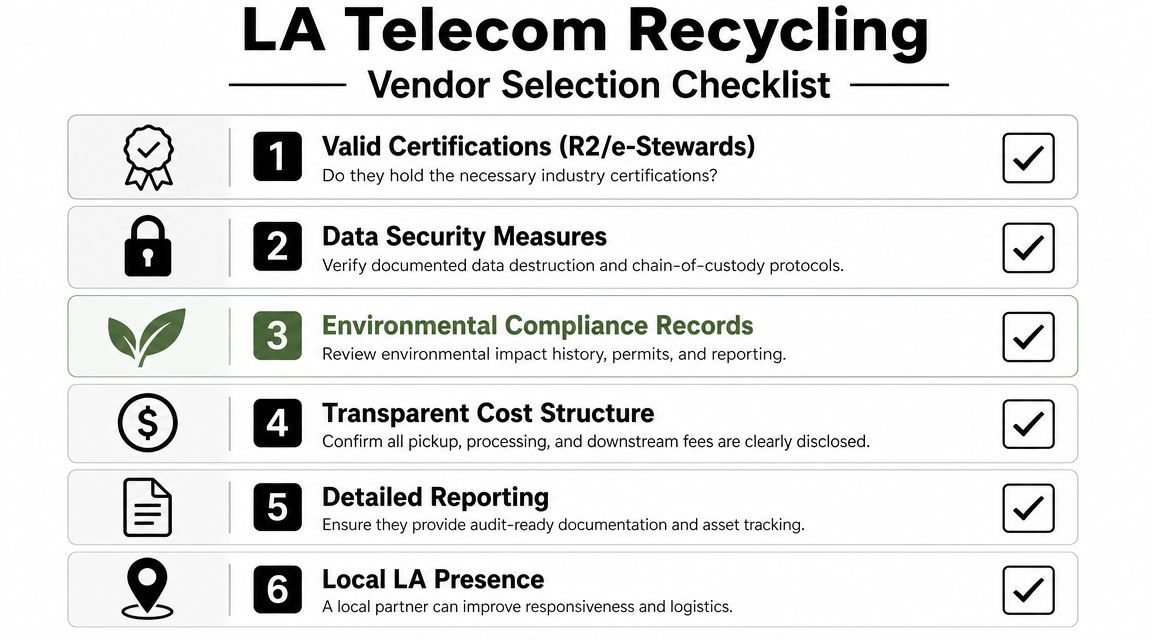
Use this list when screening Los Angeles telecom recyclers.
- Certification fit: Ask which certifications they hold and how those standards show up in intake, data handling, and downstream controls.
- Serial tracking discipline: Ask whether they track assets at serial level or only by pallet and weight.
- Sanitization options: Ask which methods they offer for different device types and whether they can document the method used per asset class.
- Battery handling process: Ask how they separate and route lithium and lead-acid battery streams.
- Downstream transparency: Ask whether they disclose final processors and disposition categories.
- Closeout reporting: Ask to see a sample certificate of recycling or destruction package with identifying details redacted.
If a vendor struggles to answer those questions without switching to general marketing language, keep looking.
Resale versus recycling is a real decision
This is where practical ITAD experience matters. Not every retired telecom asset should be reused, and not every old piece of gear should be shredded immediately.
When choosing a partner, businesses should ask directly about the trade-off between resale and recycling. While reuse is often promoted, older telecom hardware can be more valuable as recycled metal than as resale stock, and a good vendor should be able to evaluate a specific batch of legacy equipment and recommend whether refurbishment, resale, or certified recycling offers the best blend of sustainability and value recovery, as noted in this RCR Wireless discussion of network decommissioning and circular options.
That matters in Los Angeles because many businesses want two things at once. They want environmental reporting, and they want to recover value where it's realistic. A serious vendor won't promise that every asset has remarketing value. They'll sort the batch and tell you which assets justify testing and which ones belong in commodity recovery.
How to think about cost without guessing
Costs vary by project scope, building access, asset mix, data destruction requirements, and whether there is any resale offset. Since the right number depends on the batch, the useful way to compare quotes is by structure, not just headline price.
Use this side-by-side lens:
| Option | Upside | Trade-off |
|---|---|---|
| Reuse or resale focused | May recover value on functional assets | Usually requires more testing, grading, and handling time |
| Recycling focused | Faster closeout for obsolete or damaged gear | Lower chance of value recovery on older equipment |
| Destruction heavy | Strong security posture for sensitive assets | Can eliminate reuse options and any associated recovery |
The cheapest quote often strips out the controls you need. The highest quote isn't automatically better either. What you want is alignment. If the vendor's process matches your security, compliance, and timing needs, the quote will make sense on its own terms.
Ask for two things in writing: what documentation you'll receive, and how the vendor decides whether an asset is reused, recycled, or destroyed.
That single request often reveals whether the recycler is running a disciplined disposition program or shuffling material.
Conclusion Your Next Steps for Responsible Recycling in LA
A strong telecom recycling program in Los Angeles rests on three pillars. Compliance, so mixed electronics and batteries are handled through the right channels. Security, so data-bearing telecom assets are sanitized or destroyed with traceable records. Verifiable sustainability, so your organization can show what was reused, what was recycled, and how the project was controlled from pickup through final disposition.
The businesses that get this right don't start by asking who can haul the gear away fastest. They start by identifying what they have, separating streams on site, and choosing a recycler that can document every important decision. That's what turns a rushed office cleanout into a defensible ITAD process.
If you're planning a telecom room cleanout, an office move, or a phased network refresh in Los Angeles, the next step is simple. Build the asset list before you request quotes. Flag data-bearing devices. Isolate batteries. Then ask prospective vendors for sample reporting, sanitization options, certification details, and a clear explanation of how they determine reuse versus recycling.
For local research, it's worth checking Los Angeles County Public Works guidance on electronics disposal and reviewing CalRecycle resources on approved recycling options before you finalize a project plan. Those references can help your internal team align facilities, IT, and procurement around the same disposal standard.
A good telecom recycling process doesn't feel dramatic. It feels controlled. The room gets cleared, the records are complete, and nobody has to guess what happened after the truck left.
If you're comparing vendors or building a repeatable ITAD process for telecom and other retired electronics, Montclair Crew Recycling is one option to review. The company provides B2B electronics recycling and IT asset disposition services, including asset audit support, data destruction, environmentally compliant disposition, and resale handling where applicable.
