

Picking the right e waste disposal companies is about so much more than just offloading old equipment. It’s a serious business decision that directly impacts your data security, legal standing, and even your brand’s reputation. One wrong move here can lead to crippling fines or a data breach, quickly turning those outdated assets into massive liabilities.
This guide isn't about the basics. We're digging into the real-world business risks and strategic upsides of choosing a partner you can actually trust.
Why Your Choice of E Waste Partner Matters So Much
Let me paint a picture for you. Imagine a mid-sized marketing firm right here in Atlanta decides to upgrade fifty laptops. To save a few bucks, they go with the cheapest disposal company they can find, no questions asked. A few months down the road, sensitive client data from those old hard drives starts popping up on the dark web. The result? A catastrophic data breach, shattered client trust, and a mountain of legal fees.
This isn’t just some scary story; it’s a preventable disaster that happens more often than you’d think. Your legal responsibility for those electronics follows a "cradle-to-grave" model. That means even after the devices are long gone from your office, you're still on the hook if they're dumped illegally or if the data gets compromised.
The Stakes Are Only Getting Higher
The sheer volume of e-waste makes this a problem that businesses can no longer afford to ignore. The global e-waste management market was valued at a staggering USD 80.0 billion and is on track to hit USD 206.0 billion by 2033. This explosion is fueled by constant tech upgrades and tougher regulations.
This growth shines a spotlight on a few critical points for any organization:
- Data Security is Non-Negotiable: Every retired server, laptop, and smartphone is a potential data bomb waiting to go off. A legitimate partner guarantees complete, verifiable data destruction.
- Compliance is Mandatory: Laws like HIPAA and GDPR come with heavy penalties for improper disposal. Ignorance isn't an excuse.
- Environmental Responsibility Matters: Proper recycling keeps toxic materials out of our soil and water. The environmental impact of electronic waste is a huge concern for customers and stakeholders—they want to see you’re doing the right thing.
Think of choosing an e-waste partner as a risk management decision. The right company isn't just a vendor; they're an extension of your security and compliance team, protecting your business long after your old equipment has been hauled away.
Shifting from a Cost to a Strategic Move
It’s time to stop looking at e-waste disposal as just another line item on the expense report. It's a strategic process. A truly competent partner doesn’t just pick up your junk. They provide a secure, documented, and compliant service that acts as a shield for your organization.
What you're really getting is peace of mind, backed by certified processes and transparent reporting.
This guide will walk you through how to properly vet e-waste disposal companies, covering everything from the must-have certifications and data destruction methods to logistics and cost. By the time we're done, you'll know exactly how to turn a potential liability into a secure, well-managed part of your IT asset lifecycle.
Understanding Key Certifications and Compliance
Trying to make sense of e-waste disposal companies can feel like drowning in alphabet soup. You'll see acronyms like R2, e-Stewards, and NAID AAA tossed around, but what do they actually mean for your company's security and legal standing? These aren't just fancy badges for a website; they are critical proof of a vendor's commitment to doing things the right way.
Think of it this way: hiring an uncertified recycler is like letting an unlicensed contractor rewire your office. Sure, they might be cheap, but the risk of a catastrophic failure is massive. Certifications are your guarantee that an independent third party has audited the company's entire process and confirmed they meet strict industry standards.
The Big Two for Environmental Stewardship
When it comes to responsible recycling, two certifications stand out as the undisputed gold standard. They're your assurance that a vendor won't just take your old equipment and dump it in a landfill overseas—a mess that you, the original owner, would still be legally on the hook for.
- R2 (Responsible Recycling): The latest version, R2v3, is a comprehensive framework covering everything from environmental protection and worker safety to data security. It provides a solid, verifiable process for managing e-waste through its entire lifecycle.
- e-Stewards: Many consider this the most rigorous environmental certification out there. It has a strict no-export policy, which means a certified company is forbidden from shipping hazardous e-waste to developing countries.
Partnering with a vendor holding at least one of these is non-negotiable. It's the first and most important step to protect your business from the legal and reputational fallout of improper disposal.
NAID AAA: The Gold Standard for Data Destruction
While R2 and e-Stewards have data security components, there's another certification that is laser-focused on it. NAID AAA Certification is the recognized industry standard for secure data destruction. It verifies everything from a company’s hiring practices and operational security to their actual destruction processes, all validated through surprise, unannounced audits.
A company can be R2 certified for its recycling process but not NAID AAA certified for data destruction. If protecting sensitive information is your top priority—which it should be—verifying a vendor's NAID AAA status is absolutely essential.
This is a critical distinction. It’s the difference between a company saying they destroy your data and a company proving it through a tough, ongoing verification process. The lifecycle of your retired assets involves way more than just recycling, which is why understanding what IT asset disposition entails gives you a much fuller picture of the entire security and compliance chain.
To make this easier, here's a quick breakdown of what these key certifications mean for you.
Key E-Waste Certifications at a Glance
| Certification | Primary Focus | What It Guarantees for Your Business |
|---|---|---|
| R2v3 | Comprehensive E-Waste Management | Ensures responsible handling of electronics, worker safety, and has baseline data security protocols. A solid, all-around standard. |
| e-Stewards | Strict Environmental Protection | Guarantees your e-waste won't be exported to developing nations. The highest bar for environmental responsibility. |
| NAID AAA | Secure Data Destruction | Verifies a secure chain of custody and destruction process for your sensitive data, confirmed by surprise audits. The ultimate proof of data security. |
These certifications work together to provide a complete shield of compliance for your organization. R2 or e-Stewards covers the "where does it go?" and NAID AAA covers the "what happens to my data?"—both are equally important.
Beyond the Certificate: What You Need to Ask
Don't just take a company's word that they're certified. Ask for a copy of their certificates and, just as importantly, check the expiration dates. An expired certification is a massive red flag.
Compliance also goes beyond these industry standards and into specific legal regulations. You have to ask direct questions about their experience with rules that matter to your industry. For instance, if you're in healthcare, a great question is, "Can you walk me through how your process ensures HIPAA compliance?" If you handle customer financial data, ask about their protocols for GDPR, CCPA, or GLBA.
A trustworthy partner will have clear, confident answers and be ready to show you documentation to back up their claims. This isn't just about ticking a box; it's about building a partnership that shields your company from potentially devastating legal and financial penalties.
Ensuring Your Data Is Actually Destroyed
Think dragging your files to the trash bin is enough? It’s not. When you hand over old equipment to an e-waste disposal company, you need ironclad proof that your sensitive information is gone for good, not just hidden from view.
This isn't just about best practices—it's about survival. Imagine a healthcare organization retiring a server rack. If just one patient record is recoverable from a supposedly wiped drive, the consequences are catastrophic. We're talking crippling HIPAA fines and a complete loss of patient trust that could sink the entire organization. The method used to destroy that data is every bit as critical as the recycling process itself.
So, how do you make sure you're covered? This quick guide will help you zero in on what to look for.
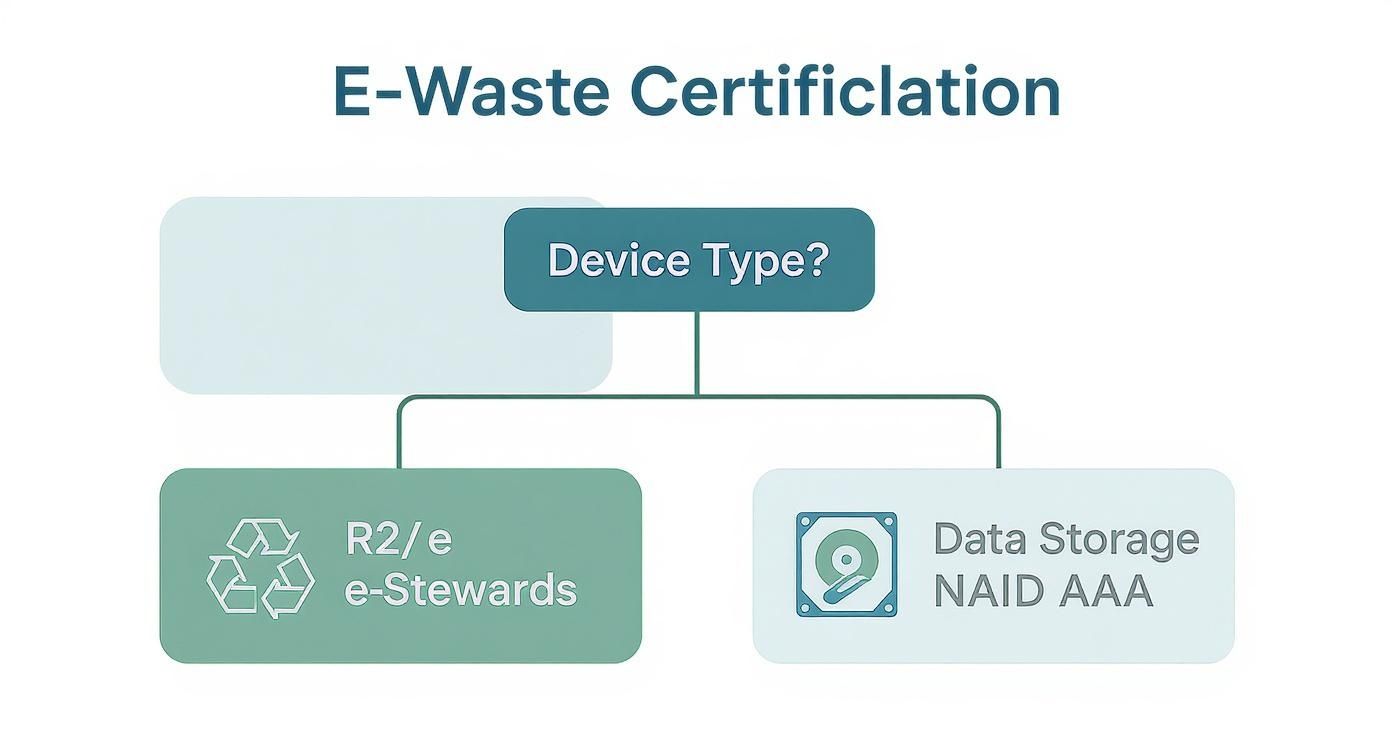
As you can see, if your gear holds sensitive data, a vendor with NAID AAA certification is your best bet. It's the industry's gold standard for secure data destruction.
Comparing Data Destruction Methods
Not all data destruction methods are created equal. The right approach depends entirely on the device you're getting rid of and your company's security policies. Any professional partner worth their salt should offer—and be able to clearly explain—these options.
-
Physical Shredding: This is the most direct and satisfyingly final method. The hard drive is literally fed into an industrial shredder that pulverizes it into tiny, mangled pieces of metal and plastic. There is zero chance of data recovery from a physically shredded drive. It’s brute force, and it’s effective.
-
Degaussing: This technique is for traditional hard disk drives (HDDs). It uses an incredibly powerful magnet to scramble the magnetic fields on the drive's platters, wiping the data clean and rendering the drive useless. One big catch: degaussing is completely ineffective on modern Solid-State Drives (SSDs) because they don't use magnetic storage.
-
Cryptographic Erasure: For SSDs, this is the go-to method. Instead of "wiping" the data, this process deletes the encryption key that makes the data readable. It’s like locking the data in an unbreakable vault and then vaporizing the only key. The encrypted information is left as meaningless digital noise.
If you want to get into the nitty-gritty of these techniques, our complete guide on what data sanitization involves breaks it all down even further.
Demanding Proof and Transparency
Trusting a vendor’s sales pitch is one thing; verifying their process is what protects your business. You absolutely must demand documentation that proves the job was done, and done right.
A reputable e-waste partner will always provide a serialized Certificate of Destruction (CoD). This isn't just a simple receipt. It's a legal document listing the unique serial numbers of every single data-bearing device they destroyed, detailing the method used, and noting the exact date of destruction. This certificate is your proof of due diligence.
But don't stop there. Ask about their chain-of-custody protocol. How do they track your assets from the second they leave your office to the moment they're destroyed? A transparent process ensures nothing gets "lost" along the way.
Finally, always take a look at the partner's internal documentation and their privacy policy to see how they handle data security. This end-to-end approach—from pickup to final certification—is the only way to get real peace of mind that your company's sensitive information has been wiped from existence.
Evaluating Logistics and Chain of Custody
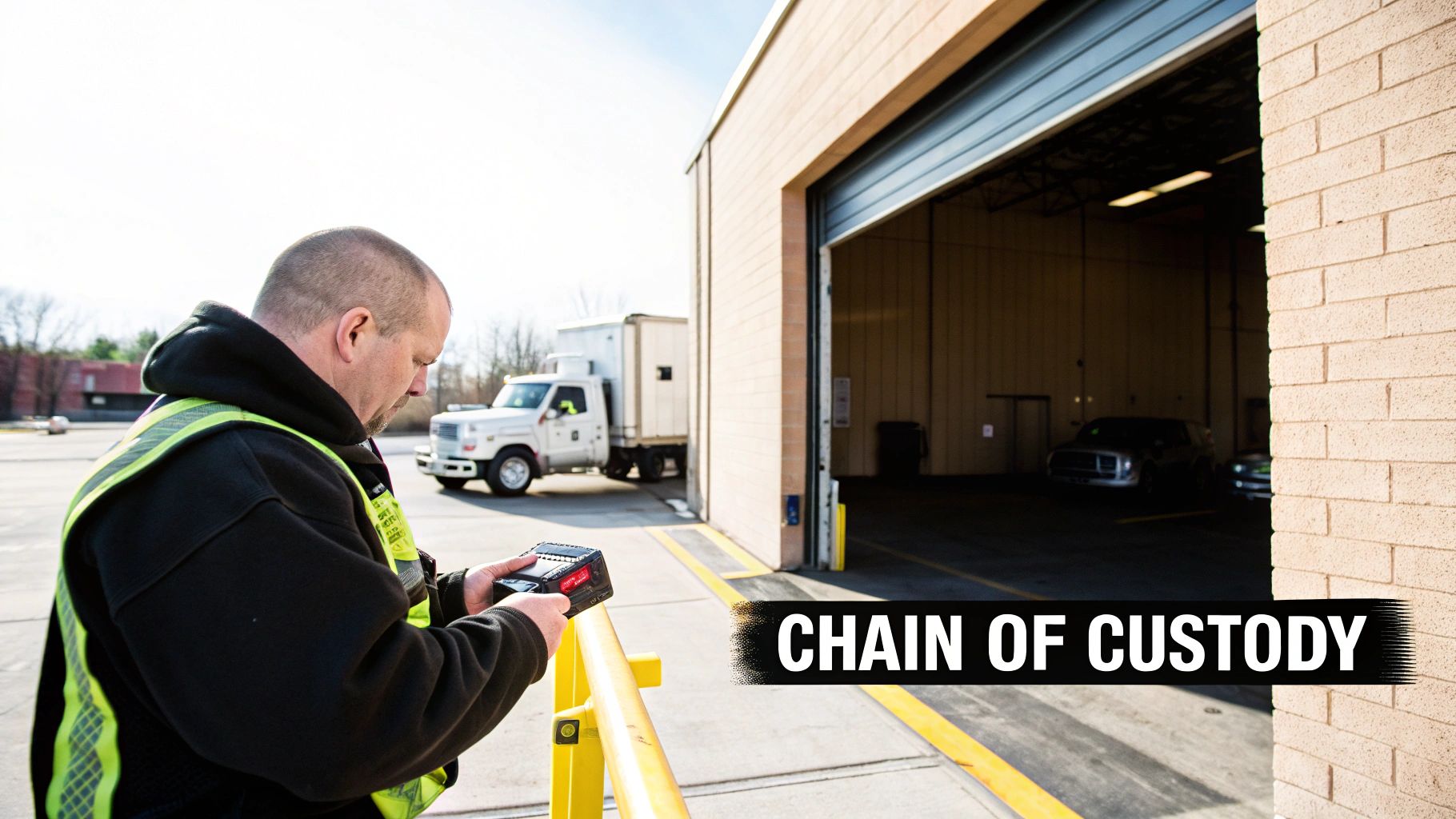
Let's be blunt: the moment your old electronics are loaded onto a truck is one of the riskiest parts of the entire disposal process. Without a rock-solid, documented plan, those assets could easily disappear, leaving your company with a massive liability nightmare. This is why digging into a vendor's logistics and chain of custody isn't just a box to check—it's absolutely critical.
A documented chain of custody is your proof. It’s the unbroken, chronological paper trail that tracks your assets from the second they leave your server room to the moment you get that final Certificate of Destruction. Think of it as your primary defense if an auditor comes knocking or a security incident occurs.
From Your Door to Theirs
Top-tier e-waste disposal companies know that security begins the second they arrive for pickup. Their whole logistics process should scream "secure," giving you total confidence that your assets are protected on the road. Anything less is a gamble you can't afford to take.
So, what does a truly secure logistics operation look like?
- Secure, GPS-Tracked Vehicles: The trucks shouldn't be random subcontracted vehicles. They must be company-owned and fitted with GPS tracking. This gives you a real-time view of the route and ensures no unscheduled stops.
- Vetted Employees: The drivers and technicians handling your sensitive gear need to have passed thorough background checks. You need to trust the people touching your data.
- Locked and Sealed Transport: Your assets shouldn't just be tossed in the back of a truck. They should be moved in sealed, locked containers that can't be opened until they reach the secure processing facility.
This level of detail is non-negotiable. For bigger jobs, like full-scale data center decommissioning services, the plan needs to be even tighter, often involving on-site supervision and serialized packing before anything even gets loaded.
Don't be shy about asking a potential provider to walk you through their entire transportation security protocol. If their answers are vague or they brush off your questions, that’s a huge red flag. The physical security of your data is just as important as its digital security.
Why Serialized Reporting Is a Non-Negotiable
Once the truck drives away, the documentation you receive becomes your proof of compliance. A common mistake is settling for a simple weight receipt. All that proves is that a certain poundage of "stuff" was picked up—which is practically useless from a security standpoint.
A proper report has to be serialized.
This means it lists the unique serial number, asset tag, make, and model for every single device that was collected. This detailed inventory ties directly to the final Certificate of Destruction, creating a closed-loop system where every single asset is accounted for.
Without that granular detail, you have zero proof that a specific laptop containing sensitive client files was actually destroyed. A serialized report removes all the guesswork and gives you the concrete evidence you need to satisfy auditors, stakeholders, and legal teams. It changes the game from a generic "recycling pickup" to a verifiable security procedure.
Breaking Down Costs and Uncovering Value
Trying to compare quotes from e-waste disposal companies can feel like comparing apples and oranges. One vendor charges by the pound, another by the pallet, and a third comes in with a price that seems almost too good to be true. To make a smart financial call, you have to look past that initial number and see the whole picture—costs, potential returns, and everything in between.
Your final bill is almost always a mix of services. You'll have standard fees for the basics, like transportation from your office and the labor to pick up and sort everything. Then you get into the specialized services, particularly secure data destruction. The costs here can swing wildly depending on the method. Physical shredding, for instance, is priced very differently from cryptographic erasure.
Look Beyond Simple Disposal Fees
Too many businesses see e-waste disposal as just another line item expense to shrink. That mindset misses a huge opportunity to actually get money back from your old equipment. The trick is to stop thinking about "disposal" and start thinking about IT Asset Disposition (ITAD). It’s a much more strategic approach that focuses on finding a new home for gear that still has life in it.
Think about it this way: a law firm upgrading its fleet of three-year-old laptops is sitting on a pile of valuable assets. Instead of just paying to have them recycled, a real ITAD partner can securely wipe the data, test the hardware, and resell the laptops on the secondary market. The money they make is then shared with you, which can seriously lower—or even completely offset—your net disposal costs. In some cases, it can even turn into a surprise revenue stream.
The goal isn't just to get rid of old tech; it's to maximize its end-of-life value. A small upfront investment in a reputable partner can yield a much larger financial return than simply choosing the cheapest disposal-only option.
Questions to Uncover the True Cost
To really compare proposals and dodge any nasty surprises on the final invoice, you need to ask the right questions. Any transparent, reputable vendor will be happy to give you straight answers.
Use this checklist to dig below the surface and find the best value, not just the lowest price:
- How do you price your services? Is it based on weight, the number of items, or a flat project fee?
- What’s included in the quote? Does it cover transportation, labor, and all the data destruction fees?
- Are there any potential surcharges? What about extra charges for things like old CRT monitors, batteries, or other hazardous materials?
- Do you offer value recovery? Ask if they provide ITAD and profit-sharing for equipment they can resell. What’s their typical revenue share percentage?
- Are there fees for reporting? Will you be charged extra for a serialized asset list or a Certificate of Destruction?
Asking these pointed questions forces vendors to be transparent. It helps you uncover hidden fees and truly compare what you're getting from different e-waste companies. This turns a simple price check into a strategic financial decision, ensuring you pick a partner who protects your data and your bottom line.
How to Select Your E Waste Disposal Partner
Alright, you’ve done the research and have a few solid contenders. Now it's time to go from just looking at proposals to picking a true partner. This last part is all about making sure what they say on paper matches what they do in practice.
One of the best ways to get a real feel for a company is to see their operation up close. Ask for a site visit. Whether you go in person or do a virtual tour, seeing their facility gives you a gut check on their security, how they organize everything, and their overall professionalism. It’s the easiest way to confirm they are one of the e waste disposal companies that actually backs up its certifications with action.
Final Vetting and Agreement
Next up, talk to their current customers. Ask for references—specifically from companies that are similar to yours in size or industry. Getting that honest, unfiltered feedback on their reliability and service quality is priceless. When you do get them on the phone, it’s vital to ask the right crucial questions to ask potential partners to ensure there won't be any surprises down the road.
The final step before you sign anything is to get a detailed Statement of Work (SOW). Don't settle for a vague agreement. This document should spell out everything: pickup logistics, how they'll track your assets, the exact data destruction methods they'll use, and when you can expect reports. Think of it as your contract and your ultimate source of peace of mind.
Going through these steps might seem like a lot, but it’s absolutely necessary. Consider this: globally, a staggering 17.4% of e-waste is actually recycled the right way, and that number is shrinking. For a deeper dive, check out some of the latest e-waste statistics on dtpgroup.co.uk.
And if you're looking for local options, our guide on finding dependable computer disposal near me can give you some extra pointers.
Got questions? We've got answers. When you're dealing with e-waste disposal, a few key questions always seem to pop up. Let's tackle them head-on so you know exactly what to expect.
What Exactly Is a Certificate of Destruction?
Think of a Certificate of Destruction (CoD) as your official, legally-binding receipt that proves your data-bearing devices were wiped clean and physically destroyed. This isn't just a simple confirmation—it's your key piece of evidence for your audit trail, showing you've met compliance standards like HIPAA or GDPR.
A legitimate CoD must be serialized. This means it lists the unique serial number of every single hard drive, server, or device that was destroyed. It will also spell out the destruction method (like shredding or degaussing) and the exact date the job was done. If a vendor just offers a generic receipt, walk away. A serialized CoD is your only real protection against future liability.
Can We Actually Get Money Back for Our Old Tech?
You absolutely can. This is what the industry calls IT Asset Disposition (ITAD), or value recovery. If your old equipment still has some life left in it—think recent-model laptops, servers, or networking gear—a good partner can refurbish it and find it a new home on the secondary market.
The best part? Your business gets a cut of the resale profits. This can seriously offset your recycling costs and, in some cases, even turn a disposal project into a revenue stream. Always ask a potential partner about their ITAD process and profit-sharing models before you sign anything.
Who's on the Hook if Our E-Waste Is Dumped Illegally?
The short, and slightly scary, answer is: you are. There's a legal concept called "cradle-to-grave" liability. It means that as the original owner of the equipment, you are responsible for it forever, even long after it's left your building.
If the vendor you hired cuts corners and illegally dumps your assets, you could be facing hefty fines and the legal responsibility for the cleanup. This is precisely why doing your homework and partnering with a fully certified, insured, and reputable e-waste company isn't just a smart move—it's essential for protecting your business from some serious downstream risk.
Ready to work with an e-waste disposal partner who gets it right every time? Contact Montclair Crew Recycling today. Let's schedule a pickup or talk more about our certified ITAD services at https://www.montclaircrew.com.
