
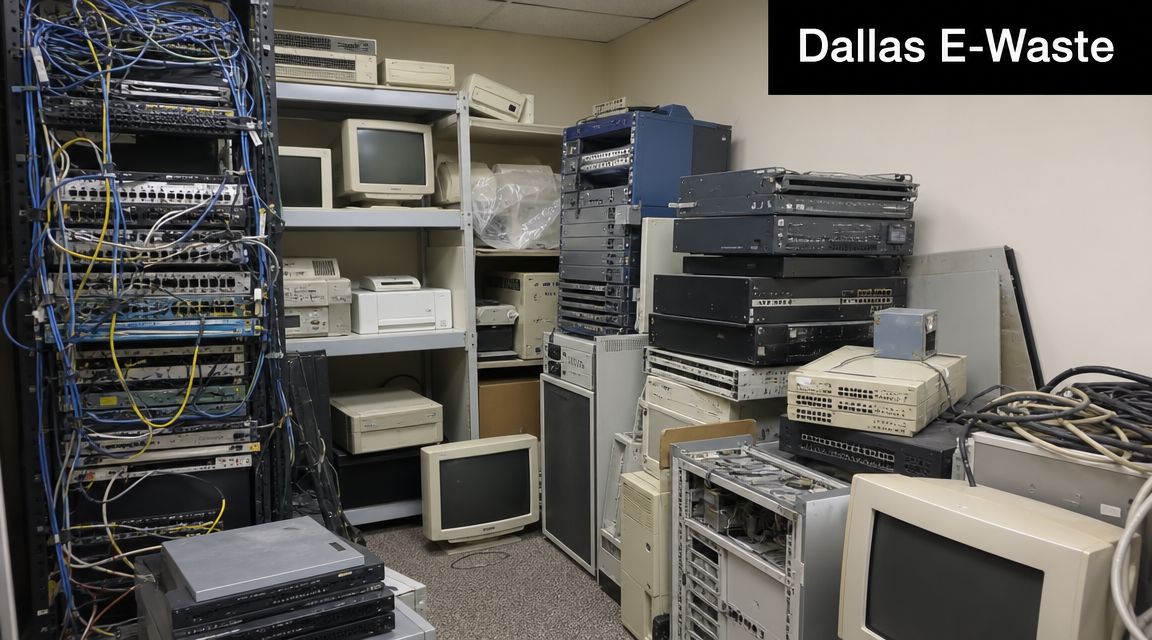
If you're managing a Dallas office, warehouse, clinic, or multi-site business, you probably have a telecom graveyard somewhere already. Old VoIP phones in boxes. Retired switches on a shelf. Access points, cabling, UPS units, broadband gateways, maybe a few servers from the last migration, all sitting in a room no one wants to own.
That backlog isn't just a storage problem. It's a data security issue, a compliance issue, an environmental issue, and often a value recovery issue. Sustainable telecom recycling Dallas programs work best when companies stop treating decommissioned gear like trash and start treating it like a controlled asset stream.
Why Your Dallas Business Needs a Telecom Recycling Strategy
A formal telecom recycling plan usually starts after something goes wrong. Facilities needs the room back. Internal audit asks where retired devices went. IT discovers that gear pulled during a refresh was never documented. Finance realizes equipment with resale potential was scrapped with dead inventory.
That reactive approach creates avoidable risk. A stronger approach starts before decommissioning begins, especially if your team is already planning infrastructure changes with a Dallas telecom consulting partner.
Why this matters beyond the storage room
This isn't a niche cleanup problem. It's part of a much larger waste stream. The Global E-waste Monitor benchmark summarized here estimates that the world generated 62 million metric tonnes of e-waste in 2022 and projects that figure could reach 82 million tonnes by 2030. The same summary notes that in 2019, global e-waste generation was 53.6 million metric tons, but only 17.4% was formally recycled.
For Dallas businesses, that matters because telecom and IT gear turns over constantly. Phones age out. Routers lose support. Switches get replaced during bandwidth upgrades. Firewalls, wireless controllers, fiber gear, servers, and backup batteries all have a retirement date. If you don't have a process, you end up with unmanaged hardware leaving service without the controls you'd apply to production equipment.
Practical rule: The minute equipment is approved for removal, it should enter a documented disposition workflow, not a closet.
The four business drivers you can't ignore
A solid sustainable telecom recycling Dallas plan protects four things at once:
- Security first: Telecom devices often store more than people expect. Configuration files, logs, call data, saved credentials, customer information, and local admin access can remain on retired hardware.
- Compliance posture: Regulated organizations need evidence, not vendor promises. If a recycler says "secure" but can't show how assets are tracked and destroyed, that won't help during an audit.
- Environmental responsibility: Reuse, refurbishment, and certified recycling reduce landfill disposal and keep recoverable materials in circulation.
- Financial recovery: Some retired equipment still has market value. Treating all outgoing assets as scrap can destroy recoverable value before anyone evaluates it.
What a strategy changes in practice
Without a plan, teams improvise. One person labels a pallet. Another sends a truck. No one reconciles serial numbers. Drives leave the building without a destruction record. Working devices get mixed in with broken ones.
With a plan, every asset follows a controlled path. It gets identified, classified, secured, and directed to the right outcome. That's what separates a cleanup event from a mature disposal program.
Auditing Your Retired Telecom Assets for Value
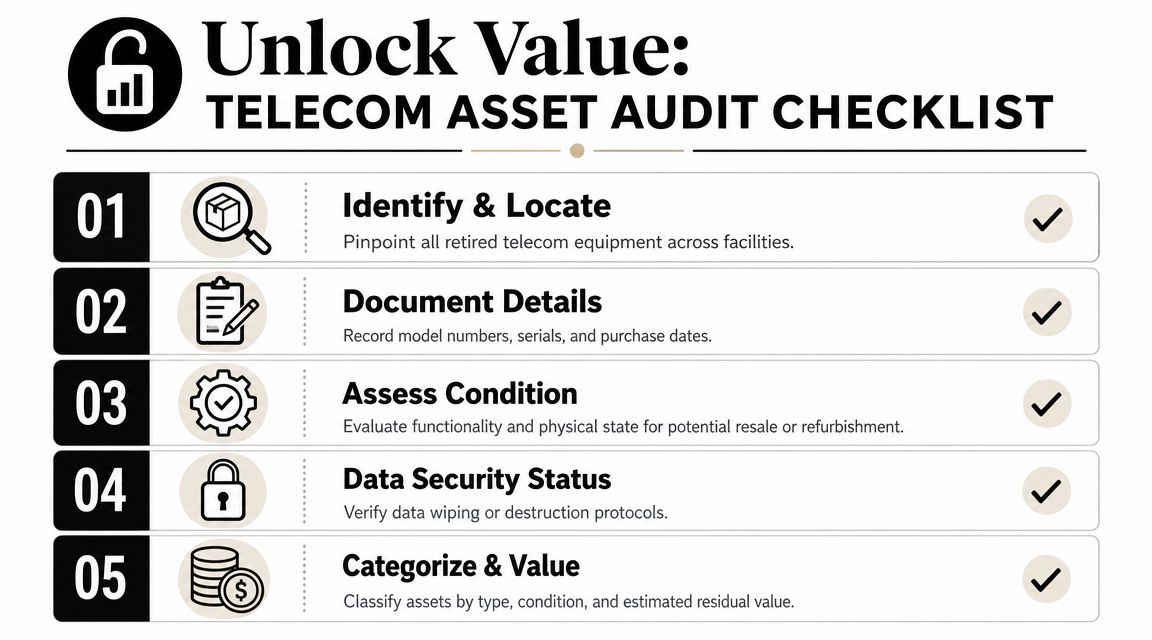
The audit is where most companies either save money or lose it. If your team skips this step, you'll almost always over-recycle good equipment, under-document risky equipment, or both.
A proper audit isn't just an inventory exercise. It's a value discovery process. The point is to determine what can be repaired, refurbished, reused, harvested for parts, or sent to end-of-life recycling.
Start with the four Rs
Industry guidance summarized in this telecom equipment recycling workflow reference puts recycling at the end of the hierarchy: Repair, Refurbishment, Reuse, Recycling. The same guidance says a practical workflow starts with a strict asset audit and then separates equipment into reuse/refurbishment, parts recovery, and end-of-life recycling. It also warns against the common mistake of treating all decommissioned equipment as waste, because that increases landfill volume and forfeits resale value.
That order matters. If you recycle first, you destroy options.
What to capture in the audit
Most Dallas teams do better when they manage this through an enterprise IT asset management process instead of a one-off spreadsheet built the day before pickup.
At minimum, capture:
Asset type and function
Identify whether the item is a VoIP phone, switch, router, firewall, server, access point, modem, power supply, patch panel, UPS, battery unit, or cabling lot.Manufacturer and model
Model family often tells you whether there may be a reuse market or if the item is already at end of support and only useful for parts or commodity recycling.Serial number and quantity
This becomes part of chain-of-custody and downstream destruction reporting.Physical condition
Note cracked housings, missing modules, bent ports, corrosion, battery swelling, or cut cables.Functional status
Don't guess. Mark assets as tested working, powers on untested, non-functional, or incomplete.Data-bearing status
Separate equipment with storage, removable media, or retained configuration memory from passive hardware.
Sort assets into workable streams
A simple sort table keeps teams from blending high-risk and low-value items together.
| Asset stream | Typical items | Main decision |
|---|---|---|
| Reuse or refurbishment | Working switches, phones, servers, newer network gear | Can this be tested, cleaned, and redeployed or sold |
| Parts recovery | Incomplete units, obsolete but repairable gear, spare modules | Are components still useful even if the full unit isn't |
| End-of-life recycling | Damaged boards, unusable cabling, failed batteries, broken housings | Does this belong in certified material recovery only |
Common audit mistakes
Teams get into trouble when they move too fast at the wrong points.
- Mixing everything together: Phones, switches, batteries, and drives shouldn't share the same gaylord or pallet without segregation.
- Labeling by room, not by asset: "Closet A cleanup" isn't an inventory method.
- Skipping accessories: Power bricks, optics, rack ears, and handsets affect reuse value.
- Treating cabling as simple scrap: Copper, fiber, and mixed cable should be separated based on what your recycler can process responsibly.
Gear that's ugly isn't always worthless. Gear that's clean isn't always safe to release.
The audit should answer one basic question for every item: what is the highest responsible use left in this asset?
Secure Data Destruction and Dallas Compliance Requirements
"Certified recycling" is not enough. For Dallas businesses in healthcare, finance, legal, education, and public sector work, the issue isn't whether a vendor uses the word secure. The issue is whether the vendor can prove exactly what happened to each data-bearing asset.
That's where many recycling programs fail. The marketing page sounds fine. The pickup goes smoothly. Then someone asks for serial-level destruction records, wiping details, transport logs, or auditor-ready documentation, and the paperwork isn't there.
The questions that actually matter
Guidance focused on telecom e-recycling in regulated environments stresses that compliance granularity is critical. It says organizations are expected to manage privacy and recycling risk through documented vendor controls, and that buyers should ask which wiping standard is used, whether hard drives are shredded on-site or off-site, how serial numbers are tracked, and what documentation auditors receive, because telecom devices can still contain customer-saved data. That's the practical benchmark described in this telecommunications infrastructure recycling compliance reference.
Those are the right questions because they force operational detail.
Wiping versus physical destruction
For many organizations, the decision comes down to two paths. Either the device is sanitized for reuse, or the media is physically destroyed.
Software wiping makes sense when the business wants remarketing, redeployment, or documented sanitization without destroying the equipment. Physical destruction makes sense when policy, risk tolerance, asset condition, or data sensitivity rules out reuse.
If a recycler offers both, ask when each method is used and who approves the choice. If the answer is vague, keep looking.
A practical checklist for any secure data destruction program should include:
- Documented standard: The vendor should tell you the wiping method or destruction protocol in writing.
- Serialized tracking: Each drive, appliance, or data-bearing unit should tie back to a serial number or equivalent identifier when available.
- Custody logs: You need to know when the asset left your site, who handled it, and where it was processed.
- Certificates and reports: Ask what you receive after completion. A blanket "certificate of recycling" is not the same as detailed destruction support.
- Exception handling: Find out what happens when a drive fails wiping, a serial number can't be read, or a device arrives damaged.
If your recycler can't explain their chain of custody in plain language, they probably can't defend it under audit.
What regulated Dallas sectors should verify
Different sectors care about different exposures, but the vendor controls should still be concrete.
| Sector | Main concern | What to ask for |
|---|---|---|
| Healthcare | Patient and device data | Serialized destruction records, custody logs, documented handling of failed media |
| Finance | Customer data and auditability | Wiping or shredding method, approval workflow, final reporting package |
| Public sector | Records handling and defensibility | Chain-of-custody detail, transport controls, proof of final disposition |
Weak controls that create real risk
These are the red flags I see most often in disposition programs:
- Off-site processing with no custody detail
- Generic certificates with no serial references
- No distinction between reusable equipment and destroyed media
- Pickup teams that can't explain packaging or sealed transport
- Promises of compliance without written procedures
A secure recycling process should survive scrutiny from legal, compliance, internal audit, and IT operations. If it only survives a sales conversation, it isn't enough.
How to Select a Certified Telecom Recycler in Dallas
Once you've classified assets and defined security requirements, vendor selection becomes much easier. The mistake most companies make is choosing based on pickup convenience alone. Convenient doesn't equal controlled.
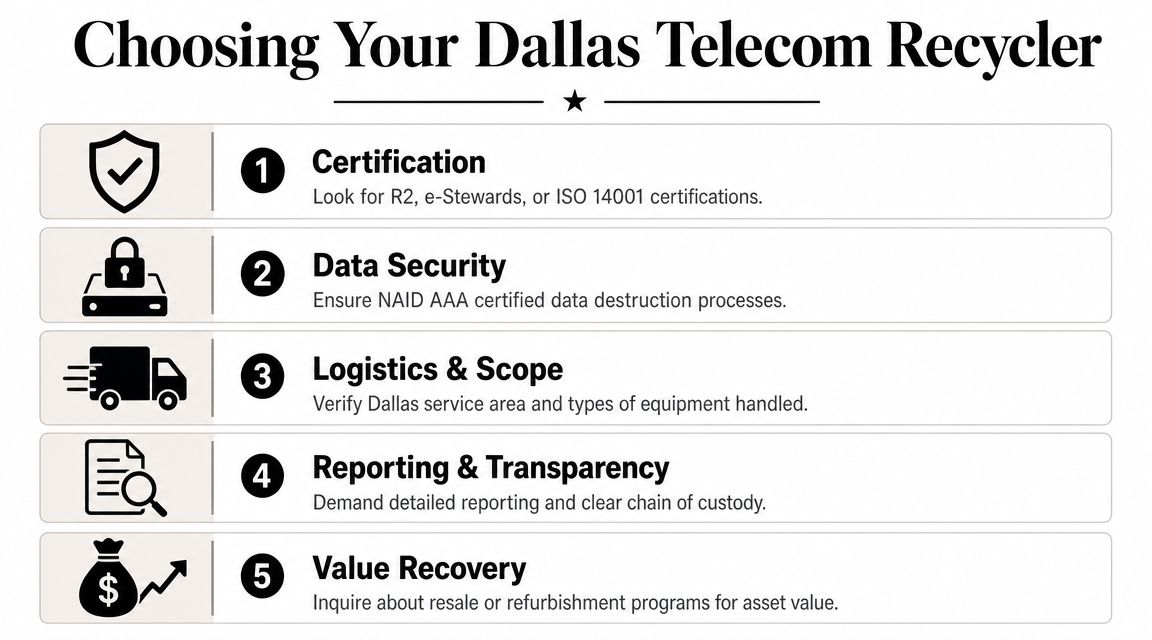
You need a recycler that can support environmental handling, data security, reporting, and downstream accountability without hand-waving. In sustainable telecom recycling Dallas projects, certifications matter because they give you a baseline for how the vendor operates. They don't replace due diligence, but they do narrow the field.
What certifications help you verify
The most common credentials you'll hear are R2, e-Stewards, and ISO 14001. You should ask what a vendor currently holds, for which facility, and whether the certified location is the one that will process your material.
The operational point is simple. Certification should map to the site and process handling your assets, not to a logo on a website.
Here is a simple comparison to structure the conversation.
Comparing E-Waste Recycling Certifications
| Feature | R2 (Responsible Recycling) | e-Stewards |
|---|---|---|
| Focus | Responsible electronics reuse and recycling controls | Responsible electronics recycling with strict downstream expectations |
| Buyer takeaway | Useful when you want process discipline, reuse support, and documented handling | Useful when you want a strong environmental and chain-of-vendor posture |
| What to verify | Which facility is certified and what services are covered | Which facility is certified and what downstream controls apply |
Questions that separate good vendors from polished marketers
If you're reviewing IT asset disposition companies, don't ask "Are you certified?" and stop there. Ask questions that reveal process depth.
- Which certifications apply to the exact facility handling our telecom assets?
- Do you process network gear, batteries, optics, copper cabling, and servers in-house or through downstream partners?
- How do you track serial numbers from pickup through final disposition?
- What reports do we receive after processing?
- How do you separate reusable equipment from material recycling?
- Can you support on-site pickup, palletization guidance, and staged removals for active facilities?
- What happens to assets that fail testing or can't be wiped?
What a serious recycler should be able to describe
The best vendors can walk you through the lifecycle without getting vague:
- Intake and reconciliation
- Secure storage or staged processing
- Testing and triage
- Data destruction where required
- Refurbishment, parts harvesting, or recycling
- Final reporting
Ask who their downstream processors are for items they don't handle directly. If they won't disclose that chain, you're being asked to trust a black box.
Warning signs during vetting
A recycler may still be the wrong fit even if they're responsive.
- They answer process questions with sales language
- They can't distinguish telecom gear from general office electronics
- They don't discuss chain of custody until you bring it up
- They promise value recovery before seeing the asset list
- They avoid specifics on hard drive handling
Selection should feel boring in the best possible way. Clear scope, clear controls, clear documentation.
Recovering Value from Your Used Telecom Equipment
Most disposal conversations focus on cost avoidance and risk reduction. That's important, but it leaves money on the table if nobody looks seriously at reuse and refurbishment.
A lot of retired telecom hardware isn't dead. It's just surplus to your environment. That's a major difference. Working VoIP phones, recent switches, network modules, server components, and some broadband devices can still fit secondary use cases even after they've aged out of your own standard.
What scale looks like when recovery is built in
AT&T's circularity reporting is useful here as a benchmark for what's possible when recovery is operationalized instead of improvised. In 2025, AT&T said it recovered nearly 14 million customer devices, including more than 11.4 million mobility devices and nearly 3.5 million broadband devices. It also said more than 7.6 million devices were returned through its trade-in program. AT&T estimated that refurbishment and recycling of those devices avoided about 907,000 metric tons of CO2e versus manufacturing new devices. On the operations side, AT&T reported diverting 98% of wireline operations waste from landfill, handling 78,800 tons of domestic U.S. operational waste and keeping 77,267 tons out of landfills, according to its circularity reporting.
Those figures don't mean your Dallas business should expect the same scale. They do show that disciplined recovery programs can produce meaningful environmental and operational results when the process is built into normal asset turnover.
Where value usually hides
The best candidates for recovery tend to fall into a few buckets:
- Standardized phone fleets: If handsets are clean, complete, and from supported platforms, they may have reuse demand.
- Enterprise network gear: Switches, routers, optics, and modules often hold more value than mixed peripheral electronics.
- Server-adjacent assets: Rails, memory, processors, and power supplies can matter if systems are dismantled correctly.
- Spare inventory from canceled projects: New-in-box or lightly used telecom hardware often gets overlooked during office and MDF cleanouts.
For Dallas companies that don't want to build a secondary market process internally, working with telecom equipment buyers in Dallas can be a practical route, provided the valuation follows testing and secure data handling, not assumptions.
Recovery options that work
Not every asset needs to be sold the same way.
| Recovery path | Best fit | Main caution |
|---|---|---|
| Resale through a qualified buyer | Tested working equipment with known demand | Don't release data-bearing gear without documented sanitization |
| Refurbishment for internal reuse | Standardized gear still compatible with your environment | Avoid redeploying unsupported equipment just to delay replacement |
| Donation | Usable equipment with community value but limited resale interest | Document transfer and confirm data handling before release |
The companies that do this well don't ask, "How fast can we clear the room?" They ask, "What's the highest responsible return from each asset?"
Building a Sustainable and Profitable Disposal Program
The strongest telecom disposal programs are repeatable. They don't depend on one project manager remembering the steps, and they don't start from scratch every time a closet gets cleaned out.
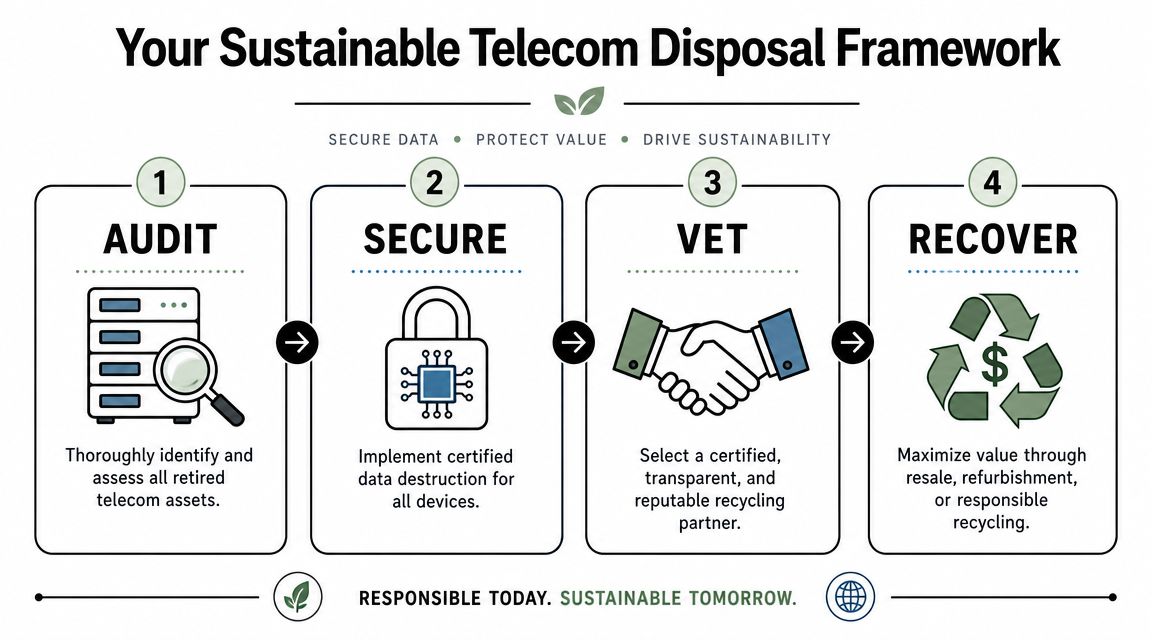
I usually think of the operating model in four actions: audit, secure, vet, recover. If one is missing, the program gets expensive fast. Skip the audit and you lose value. Skip security controls and you create exposure. Skip vendor vetting and your documentation falls apart. Skip recovery and everything turns into low-value scrap.
Turn one-time cleanouts into policy
A workable program should define:
- Who owns disposition approval: IT, facilities, security, and finance should know where decision rights sit.
- How assets are staged: Retired telecom gear needs a controlled holding area, not random storage.
- When data review happens: Data-bearing status should be identified before pickup, not after transport.
- What vendors must provide: Reporting, custody logs, and destruction support should be written into the process.
- How recovery is evaluated: Reuse and resale should be considered before end-of-life recycling is approved.
What works and what doesn't
Programs work when teams treat retired telecom assets like controlled business property until final disposition is documented.
Programs fail when they rely on assumptions such as:
- "It probably doesn't store data."
- "The recycler handles that."
- "We'll sort it later."
- "It's too old to be worth anything."
The cheapest way to dispose of telecom equipment is often the most expensive way to explain it later.
Sustainable telecom recycling Dallas efforts don't need to be complicated. They need to be disciplined. Start with a real asset list. Separate data-bearing gear. Ask better vendor questions. Document final outcomes. Then repeat the process every time equipment leaves service.
If your team needs a practical partner for secure, compliant IT and telecom disposition, Montclair Crew Recycling can help with asset audits, data destruction, equipment removal, responsible recycling, and value recovery workflows that are easier to defend to operations, compliance, and finance.
