
A lot of Atlanta businesses are in the same spot right now. A network refresh is finished, the old phones are off desks, the switches came out of the rack, and now retired telecom gear is sitting in a closet, on a pallet, or in a server room corner waiting for someone to “handle it.”
That pile isn't just clutter. It can hold saved configurations, credentials, logs, and other sensitive information. It also falls into the category of electronic waste, which means disposal decisions affect security, compliance, and environmental responsibility at the same time.
That's why R2 certified telecom recycling Atlanta searches usually start as a cleanup task and turn into a risk-management project. If you choose the right recycler, you get documented handling, secure data destruction, and a clear downstream process. If you choose the wrong one, you may never know where the equipment went, who touched it, or whether the data was destroyed.
Your Office Has Old Telecom Gear What Now
If your office has old routers, switches, firewalls, VoIP phones, or network appliances stacked in storage, the first move isn't calling a junk hauler. The first move is recognizing that these items are retired assets, not trash.
Telecom gear confuses a lot of business owners because it doesn't look like a laptop with customer files on it. But a router can still hold sensitive settings. A firewall can still reflect how your network is structured. A switch may seem harmless until you remember it once sat inside your production environment.
Treat the pile like a records problem
A simple way to think about it is this. Old telecom hardware is like a filing cabinet after an office move. Even if the cabinet looks empty, you don't send it away until someone confirms what's inside and where it's going.
Start with three questions:
- What do we have
- Does any of it store data or configuration information
- Who will document pickup, destruction, and final disposition
If you can't answer those three questions, you don't have a disposal plan yet.
Practical rule: If a device touched your business network, handle it as sensitive until a qualified recycler documents how it was sanitized or destroyed.
Why Atlanta businesses need a tighter process
Metro Atlanta businesses often have equipment spread across offices, network closets, branch locations, and shared storage rooms. That creates two common mistakes. Staff either leave retired gear sitting for months, or they rush to remove it without asking for audit-ready documentation.
A better path is to use a telecom-focused ITAD process with secure pickup and tracking. If you're comparing local service models, this overview of ITAD telecom services near me helps frame what a business pickup should include.
The key mindset shift is simple. You're not paying someone to “take stuff away.” You're assigning custody of sensitive business equipment.
What R2 Certification Actually Guarantees
R2 certification answers a practical business question. If your company hands retired telecom equipment to a recycler, what controls should already be in place before that gear leaves your building?
The answer is process discipline that has been independently audited. For an Atlanta business retiring switches, routers, firewalls, PBX systems, or rack equipment, that matters because risk follows the asset through pickup, storage, data sanitization, downstream processing, and final disposition.
It sets a verified operating standard
R2 is often reduced to a simple environmental label. That misses its full value for business owners.
What you are getting is evidence that the recycler operates under documented controls for how equipment is received, tracked, secured, processed, and sent downstream. In plain terms, the standard is designed to reduce the odds of informal handling, vague paperwork, and inconsistent data destruction practices.
That distinction matters with telecom gear because these assets often move through several hands. Pickup crews, warehouse staff, sanitization teams, shredding partners, and downstream processors may all touch the same load. If those handoffs are not governed by a formal standard, accountability gets blurry fast.
The guarantee is broader than recycling alone
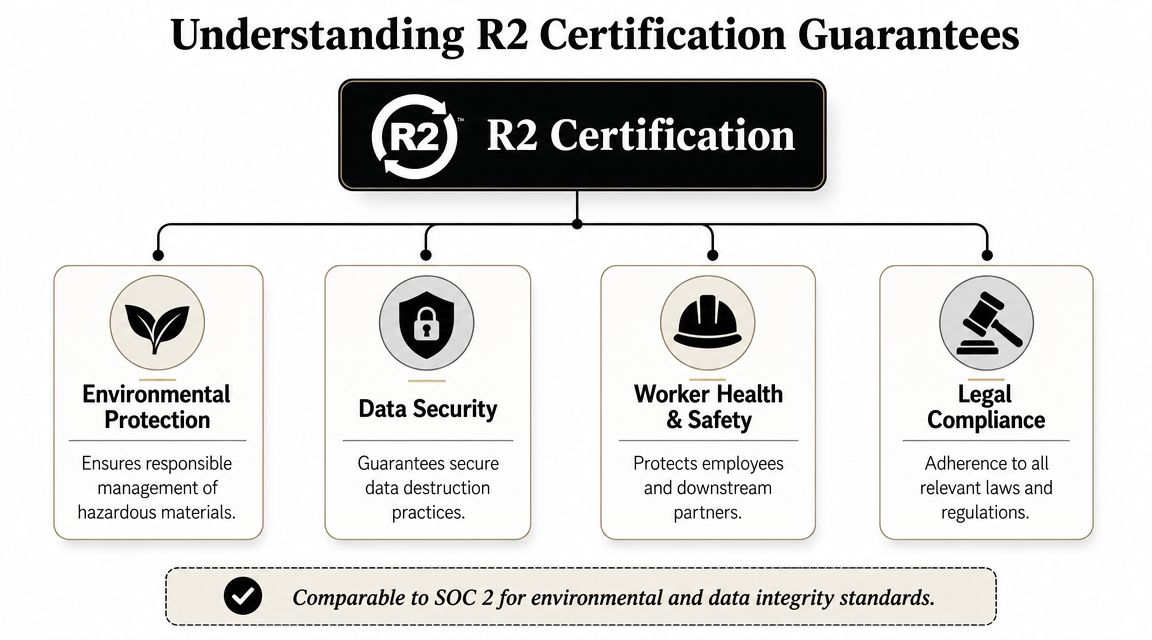
For business disposal, R2 speaks to four areas that owners and IT managers should care about:
| Guarantee area | What it means for your business |
|---|---|
| Environmental protection | Equipment is directed into controlled recycling and recovery channels instead of informal disposal streams |
| Data security | Data-bearing devices are handled under documented sanitization or destruction procedures |
| Worker safety | Facilities follow defined health and safety practices during dismantling and materials handling |
| Legal compliance | The recycler maintains documented controls to support lawful processing and recordkeeping |
A useful way to read that table is this. R2 does not promise that every device will be reused, shredded, or recycled in the exact same way. It promises that those decisions should happen inside a documented system with verification points, not as ad hoc choices made on the warehouse floor.
Why that matters more for telecom equipment in Atlanta
Telecom recycling has a different risk profile than general office cleanouts. A decommissioned desk phone may be simple. A retired firewall, switch, or VoIP appliance is not. Those devices can retain configurations, credentials, network maps, or administrative settings even after they are no longer useful to your team.
Atlanta adds another layer. Many metro businesses have equipment spread across headquarters, branch offices, colocation space, storage rooms, and network closets. That creates more pickups, more handoffs, and more chances for a device to fall outside the paper trail. An R2-certified recycler is not just processing scrap. The recycler is expected to control that chain with documented procedures.
That is why R2 certified telecom recycling Atlanta searches should lead you to questions about controls, records, and downstream accountability, not just price per pound.
What a recycler is really saying when it claims R2
When a vendor says it is R2 certified, you should hear a specific message behind the label.
The company should be able to show that it works under an audited management system. It should have defined procedures for tracking assets, securing material, managing data-bearing devices, and documenting final disposition. It should also be able to explain who handles each stage of processing and how those downstream vendors are controlled.
R2 turns telecom disposal into an auditable business process with documented controls.
For a business owner, that is a solid guarantee. The certification does not remove your duty to vet the vendor, but it gives you a stronger framework for choosing one and a clearer basis for asking the right questions.
The Hidden Risks of Uncertified Telecom Recycling
The biggest telecom recycling mistake is assuming old network equipment is low-risk because it isn't user-facing. That assumption causes businesses to lower their guard at exactly the wrong moment.
A retired firewall may still reflect VPN settings, rules, and network structure. A PBX or VoIP device may retain call-related information or administrative settings. A switch or router may still hold startup configurations or credentials. Even when the gear is obsolete, the information inside it can still be useful to the wrong person.
The problem with “we recycle electronics”
A non-certified recycler may still be honest. The issue is that you often have no way to test the process before your equipment leaves your building.
Ask yourself what happens if a vendor says:
- they “wipe everything,” but won't explain how
- they provide no chain-of-custody paperwork
- they can't tell you where non-reusable components go
- they issue vague receipts instead of asset-level records
Those gaps create exposure long before anyone proves a breach. They weaken internal controls, make audits harder, and leave your business relying on trust instead of documentation.
If you're comparing what formal recycling programs look like versus generic drop-off options, this page on Staples electronics recycling helps clarify why business-grade handling is a separate category.
R2 certified vs non-certified telecom recycling
| Factor | R2 Certified Recycler | Non-Certified Recycler |
|---|---|---|
| Data handling | Documented process for sanitization or destruction | Process may be unclear or inconsistent |
| Chain of custody | Tracked handoffs and records are expected | Handoffs may be informal |
| Downstream vendors | Controlled through documented requirements | Often opaque to the client |
| Audit support | Better suited for compliance review | Often limited to a basic receipt |
| Risk posture | Built around documented controls | Built around vendor assurances |
Why the cost question can mislead buyers
Some businesses focus on one issue first. “Will this cost me money?” That's understandable, but it's the wrong opening question.
The first question should be whether the recycler can prove control over the equipment from pickup through final disposition. Cost matters. Convenience matters. Neither one fixes a bad chain of custody.
When a recycler can't explain its process in plain language, the problem usually isn't your understanding. It's the process.
Uncertified recycling can look fine on pickup day. The risk shows up later, when a missing asset, incomplete certificate, or downstream question lands on your desk.
Securing Your Data Through Chain of Custody
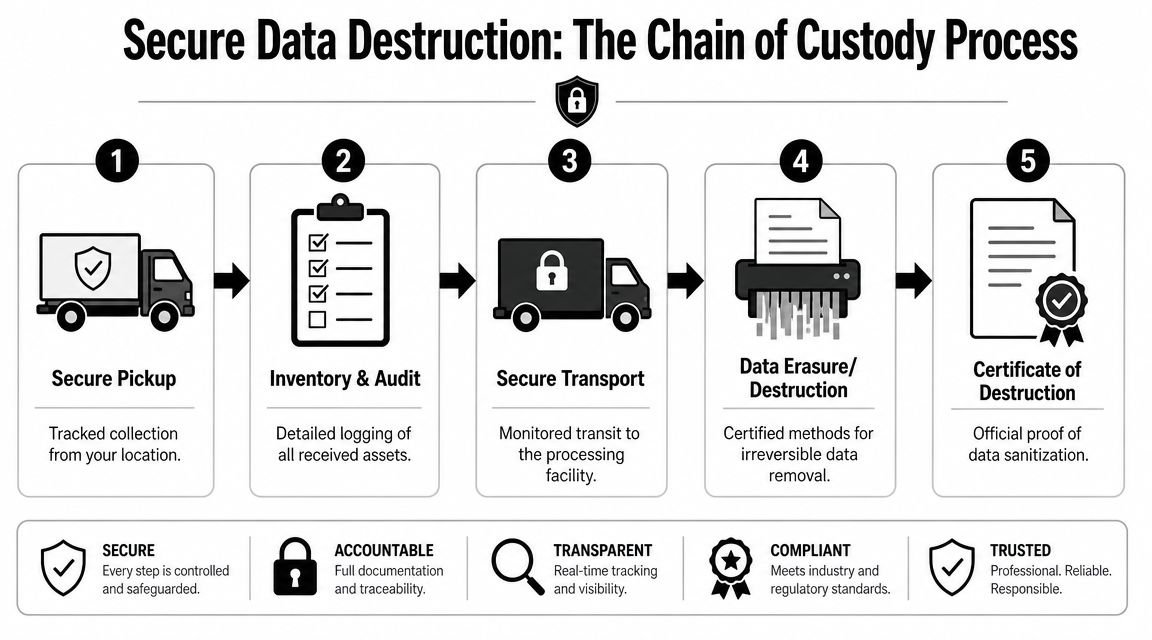
Chain of custody sounds technical, but the idea is simple. It's the documented journey of your equipment from your location to final processing.
Imagine it as package tracking for sensitive business assets. You want to know what left your office, who received it, where it went next, and what happened at the end. If any link in that chain is missing, your proof is missing too.
What an R2 chain of custody is supposed to do
The EPA's explanation of certified electronics recyclers and R2 process controls makes this clear. R2 is a process-control framework that requires certified facilities to manage the full electronics chain, including legal and regulatory compliance, environmental management systems, worker health and safety, data security, and documented downstream vendor controls. The EPA also notes that certified recyclers must demonstrate these standards to an accredited third-party auditor, and the program is designed to maximize reuse and recycling, minimize human and environmental exposure, ensure safe downstream handling, and require destruction of all data on used electronics.
For telecom assets, that means a router or PBX shouldn't be tossed into a gaylord and sent away. It should move through a controlled process where reusable equipment is triaged separately and non-reusable items are routed to dismantling and recovery under documented controls.
Wiping versus shredding
Readers often misunderstand this concept. They hear “data destruction” and assume there's only one acceptable method. There isn't.
In practice, the right method depends on the asset, its condition, and your policy.
- Software wiping makes sense when storage media is functional and the organization wants the option of reuse or resale.
- Physical shredding makes sense when the asset is damaged, policy requires destruction, or the business wants the storage media rendered unusable.
- Logical destruction is aimed at securely removing data through software-based sanitization procedures.
- Physical destruction destroys the media itself.
A factory reset is not the same as documented sanitization. That's the confusion that causes trouble in telecom disposal.
For readers comparing destruction methods, this primer on what a degausser is is useful background, especially when evaluating how different media types are handled.
What to ask for before pickup
A secure process should produce paperwork you can use. Ask for:
- An asset list or manifest tied to pickup
- Chain-of-custody documentation showing release and receipt
- A description of the sanitization or destruction method
- A certificate of destruction or equivalent final record
Audit mindset: If a regulator, client, or internal auditor asked for proof six months from now, would your current recycler give you a clear file or a vague email?
That question cuts through jargon quickly. If the answer is unclear, the process isn't strong enough yet.
How to Quickly Verify a Recycler's R2 Status
You don't need to rely on a sales rep's wording. You can verify R2 status yourself, and you should.
A lot of confusion comes from phrases like “R2 compliant,” “R2 standards followed,” or “our downstream partner is certified.” Those phrases might describe part of a process, but they are not the same as the company itself holding an active certification.
A simple due diligence routine
Use this checklist before scheduling a pickup:
- Check the exact company name. Make sure the legal entity on the quote matches the entity claiming certification.
- Look for active status in the official SERI directory, not just a logo on a website.
- Review the scope. Confirm the certification applies to the facility and services relevant to your project.
- Ask about downstream handling if part of the process is subcontracted.
- Save a copy of the listing or certificate for your procurement file.
Red flags that should slow you down
Some warning signs are easy to miss when you're trying to clear space quickly.
| Red flag | Why it matters |
|---|---|
| “R2 compliant” with no active certificate shown | May indicate marketing language rather than current certification |
| Expired badge or outdated version references | Certification status may no longer be valid |
| Certification applies to another location only | Your assets may not be processed under the claimed controls |
| Vague answers about downstream vendors | Risk may be moving outside the documented chain |
If you want a local comparison point while vetting providers, this list of certified electronics recycling companies in Georgia can help you build a shortlist.
The process only takes a few minutes, and it's one of the highest-value checks in the whole vendor review.
Atlanta Logistics What to Expect from a Local Partner
Your team approves a telecom cleanout for the Atlanta office. Then the practical questions start. Who disconnects the old switches? How does the recycler get gear out of a locked server room without disrupting staff? What happens if part of the load is boxed, part is loose on shelves, and part is still mounted in a rack?
That is why this stage is not only about finding a recycler with the right paperwork. It is also about finding a local operator who can run a controlled pickup in a busy business environment. For Atlanta companies, the essential test is whether the vendor can handle traffic, building access, timing, and documentation without turning your disposal project into an internal fire drill.
What a capable local partner should handle
Telecom recycling works like a small move combined with a compliance handoff. The equipment has to leave the site safely, in the right order, with enough tracking to show what was removed and when. In Metro Atlanta, that often means working around loading dock schedules, downtown building rules, suburban office parks, and multi-site pickups spread across the region.
A prepared partner should ask operational questions early, not after the truck arrives. They should want to know whether your assets are in a closet, a data room, a warehouse corner, or on multiple floors. They should ask about elevators, security sign-in procedures, parking constraints, pallet jacks, and whether your staff needs the vendor to do all physical removal.
That level of detail is not red tape. It is how mistakes get prevented.
What you should expect during planning
A local recycler with real experience usually sounds more like a project coordinator than a scrap buyer. The conversation should be concrete.
- Clear scheduling. You should get a defined pickup window and a straightforward explanation of what needs to be ready before arrival.
- Site-specific planning. The vendor should ask how the crew will enter, where equipment is located, and whether the building has access limits.
- Packing and removal guidance. They should tell you whether to leave gear in racks, box small items, or stage pallets in advance.
- Mixed-load handling. Many Atlanta businesses retire telecom hardware with servers, PCs, battery backups, and cabling in the same project. The vendor should be prepared for that.
- Post-pickup documentation. You should know what records will be issued after the equipment leaves the premises and after processing is complete.
Atlanta-specific logistics issues that affect risk
Atlanta adds its own layer of complexity. A pickup from a single-story suburban office is one job. A removal from a downtown high-rise with freight elevator reservations, loading dock time limits, and security checkpoints is another. Multi-location projects add another issue: keeping records straight when assets leave from different addresses on different days.
This is where local familiarity matters in a practical sense. A vendor that regularly serves the metro area is more likely to plan for traffic delays, access windows, and route efficiency. That lowers the chance of missed pickups, rushed loading, or informal workarounds by your staff.
For a business owner, the analogy is simple. You are not hiring someone to haul away scrap metal. You are hiring a vendor to execute a controlled transfer of business assets under time, access, and documentation constraints.
Questions to ask before approving the pickup
Use questions that reveal how the vendor operates on the ground.
| Question | What a strong answer includes |
|---|---|
| How will you handle removal from our specific site? | Steps for access, loading, staging, and coordination with your building or IT team |
| What does your crew need from us before pickup day? | A short, practical prep list, not vague instructions |
| Can you manage equipment from more than one Atlanta-area location? | A defined process for scheduling and documenting each site separately |
| How do you deal with mixed telecom and IT loads? | A clear explanation of sorting, packing, and transport procedures |
| What paperwork should we expect after pickup? | Specific records, delivery timing, and who on your team will receive them |
For R2 certified telecom recycling Atlanta, the strongest local partner combines compliance controls with disciplined field logistics. Both matter. One protects your records. The other protects the project from going sideways on pickup day.
Partner with Montclair Crew for Compliant Atlanta Recycling
If your business wants one local option to evaluate, telecom recycling near you through Montclair Crew aligns with the operating model discussed throughout this guide. The company is based in Alpharetta, has a drop-off center in Smyrna, and handles telecom gear, computers, servers, and related IT assets for organizations across Metro Atlanta.
From a risk-management perspective, the practical fit is straightforward. Their service model includes on-site removal, asset audit and logistics, certified data destruction, environmentally compliant disposition, and free DoD 5220.22-M three-pass hard drive wiping, with optional on-site shredding according to the publisher information provided for this article.
That matters for businesses that need one vendor to manage pickup, documentation, and end-of-life handling without turning the job into an internal project. It also fits organizations retiring mixed loads, where telecom hardware is leaving the site alongside laptops, servers, and other electronics.
Before choosing any recycler, ask for the same things you'd ask anyone else: current certification details, documentation samples, pickup procedures, and a clear explanation of how data-bearing devices are handled. The right partner should be able to answer those questions directly and without sales language.
Frequently Asked Questions About Telecom Recycling
Business owners usually ask the same practical questions once the compliance issues are clear. Here are the short answers.
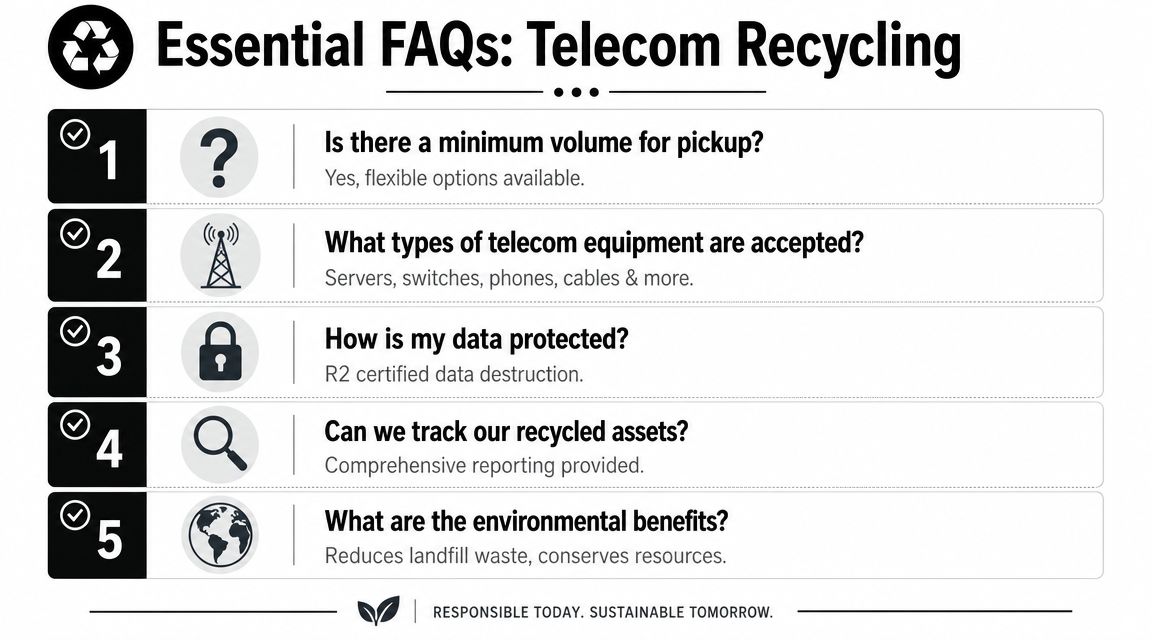
Is there a cost for pickup or recycling
It depends on the equipment, volume, service level, and whether any assets have resale value. Some providers offer free pickup for qualifying business loads, while others charge based on labor, transport, or special handling. The important thing is to ask for the pricing logic in writing before the equipment leaves your site.
What if we only have a small amount of telecom gear
Small loads can still deserve secure handling. A few switches, phones, or firewalls may contain enough sensitive information to require the same documented process as a larger batch. If the volume is limited, ask whether the recycler offers scheduled pickup, drop-off, or a minimum service threshold.
Do recyclers only take phones and network gear
Usually not. Many business recyclers handle broader ITAD loads that include laptops, desktops, servers, storage, cables, accessories, and related electronics. That can simplify a project when your telecom refresh overlaps with a larger office or infrastructure cleanup.
How do we protect data on old telecom equipment
Start by assuming the equipment is sensitive. Then require the recycler to explain the sanitization or destruction method, chain of custody, and final documentation. “We reset it” is not enough.
How do we get started
A smooth process usually starts with a simple asset list and a pickup discussion. You don't need a perfect spreadsheet to begin, but you should be able to describe what equipment you have, where it sits, and whether any of it is data-bearing.
The easiest telecom recycling projects are the ones scoped before pickup day, not on the loading dock.
If your organization needs a compliant path for retiring telecom gear, servers, computers, or other electronics in Metro Atlanta, Montclair Crew Recycling offers local pickup, data destruction support, and IT asset disposition services designed for business environments. Call or submit a request through the website to schedule a pickup and start with a documented plan.
