

You're probably dealing with one of two situations right now. Either a back room is filling up with old VoIP phones, failed switches, dead laptops, and a few servers nobody wants to touch, or your team is in the middle of an upgrade and the retired gear is stacking up faster than anyone expected.
That's usually when the search starts for e-waste telecom recycling near me. The problem is that most search results are built for consumers dropping off a single printer or an old TV. Businesses in Atlanta need something else entirely. You need secure handling, documented data destruction, workable logistics, and a clear answer on whether any of that equipment still has value.
Why Your Business Needs a Telecom Recycling Playbook
That overflowing storage closet isn't just ugly. It's a weak process made visible.
Old PBX hardware, rack switches, wireless access points, desk phones, UPS units, and retired servers often sit in place because nobody wants to make the wrong call on disposal. The facilities team doesn't want data risk. IT doesn't want to lose track of serial numbers. Finance doesn't want to pay for hauling equipment that might still be worth something. So the pile grows.
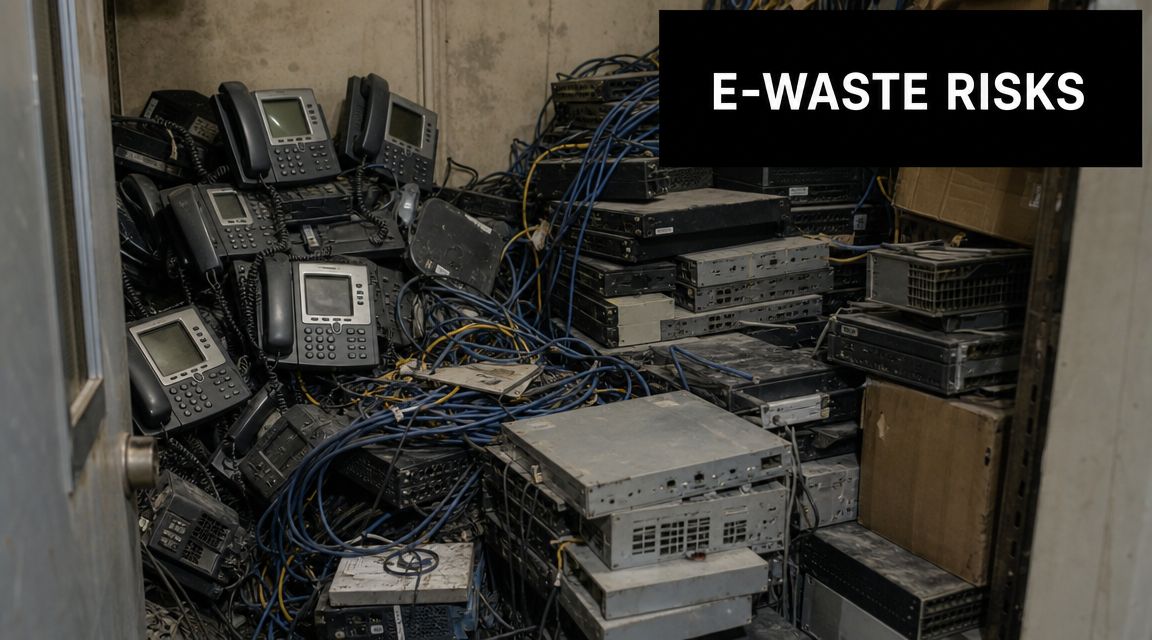
Most local pages don't solve that. As this business-focused electronics recycling discussion points out, local e-waste content usually centers on consumer drop-off rules, not on how businesses should handle PBX systems, routers, servers, secure transport, or data destruction. That's the core gap behind many “near me” searches.
Generic drop-off advice doesn't fit business telecom waste
A business telecom disposal plan has to answer questions that consumer pages skip:
- Who tracks the assets before they leave your site?
- How is data handled on drives, appliances, and storage media?
- What gets reused instead of destroyed?
- What proof do you get after pickup, wiping, shredding, or recycling?
- How do you remove bulky gear without tying up your staff for half a day?
If those questions aren't answered, you don't have a disposal plan. You have a hope-and-haul plan.
Practical rule: If a recycler talks mainly about drop-off bins and accepted household items, they're probably not built for telecom and IT asset disposition.
What works in Metro Atlanta
For Atlanta businesses, the workable approach is simple. Build a repeatable playbook, then use it every time you refresh equipment, close a branch, clean a server room, or decommission telecom hardware.
That playbook usually includes asset review, data handling, logistics, documentation, and a decision on reuse versus scrap. If you need a broader framework for ongoing program design, this guide to managing electronic waste is a practical starting point.
A good process removes friction. Your staff knows what to separate, what to tag, what to hold for wiping, and what can leave immediately. That's how e-waste stops being a recurring mess and becomes a controlled business function.
Inventory and Prepare Your Retiring IT Assets
The first job is to stop thinking in terms of “junk.” Start thinking in terms of asset classes.
A practical recycling workflow starts with an asset audit that separates equipment for reuse, parts harvesting, or end-of-life recycling. The same UN-linked analysis notes that logistics can consume roughly one-third of total recycling costs, and that palletizing equipment and consolidating small lots materially improve the economics. It also warns that mixing reusable IT assets with shred-only material destroys resale value, as noted in this e-waste logistics and recycling analysis.
What to gather before pickup or drop-off
Walk the office, MDF and IDF closets, storage room, front desk cabinets, and any offsite storage. Pull together telecom and IT equipment in one controlled staging area.
Focus on equipment like:
- Telecom systems such as PBX units, VoIP phones, conference phones, headsets, handsets, and paging hardware
- Network hardware including routers, switches, firewalls, modems, wireless access points, and network cards
- Server room equipment such as rack servers, tower servers, rails, racks, KVM gear, and patch panels
- User devices including desktops, laptops, thin clients, docks, monitors, keyboards, and mice
- Accessories and mixed items such as cables, power supplies, adapters, and external drives
Then divide it into three physical groups. Reuse candidates. Data-bearing items. Scrap-only material.
Telecom and IT asset recycling guide
| Asset Category | Examples | Accepted by Montclair Crew? |
|---|---|---|
| Telecom handsets | VoIP phones, IP phones, conference phones | Yes |
| PBX and voice systems | PBX cabinets, voicemail hardware, call processors | Yes |
| Network equipment | Routers, switches, firewalls, access points | Yes |
| Servers and storage | Rack servers, tower servers, storage arrays | Yes |
| End-user devices | Laptops, desktops, monitors | Yes |
| Cabling and accessories | Patch cables, power cords, adapters | Yes |
| Racks and larger infrastructure | Server racks, cabinets, rails | Usually, but confirm handling needs first |
| Battery-backed equipment | UPS units and similar devices | Special handling may be required |
| Specialized nonstandard equipment | Certain medical or lab electronics | Usually requires review before acceptance |
Sort for value before you sort for scrap
The biggest avoidable mistake is combining everything into gaylords or loose carts and sending it all out as one load. That's how good hardware gets treated like low-grade scrap.
High-value candidates usually include enterprise servers, switches, routers, and network cards that still have intact boards and limited physical damage. Low-value material often includes broken plastic-heavy peripherals, damaged handsets, and mixed accessories. Keep them apart.
If your team can't tell what's reusable, don't guess on the loading dock. Tag it, stage it, and let it be evaluated before it gets lumped into shred-only material.
If your internal process needs work before the equipment leaves the building, these IT asset management best practices are useful for tightening inventory discipline and handoff procedures. For organizations with repeat refresh cycles, a more structured internal program around enterprise IT asset management helps keep disposal from becoming a last-minute scramble.
Choose the Right Data Destruction Method
Most disposal mistakes don't start with recycling. They start with uncertainty about the data.
A retired phone system may hold configuration data. A firewall may retain credentials. A server or storage device can hold customer files, internal documents, or years of system history. Before anything leaves your control, decide whether the right method is data erasure or physical destruction.
When software wiping makes sense
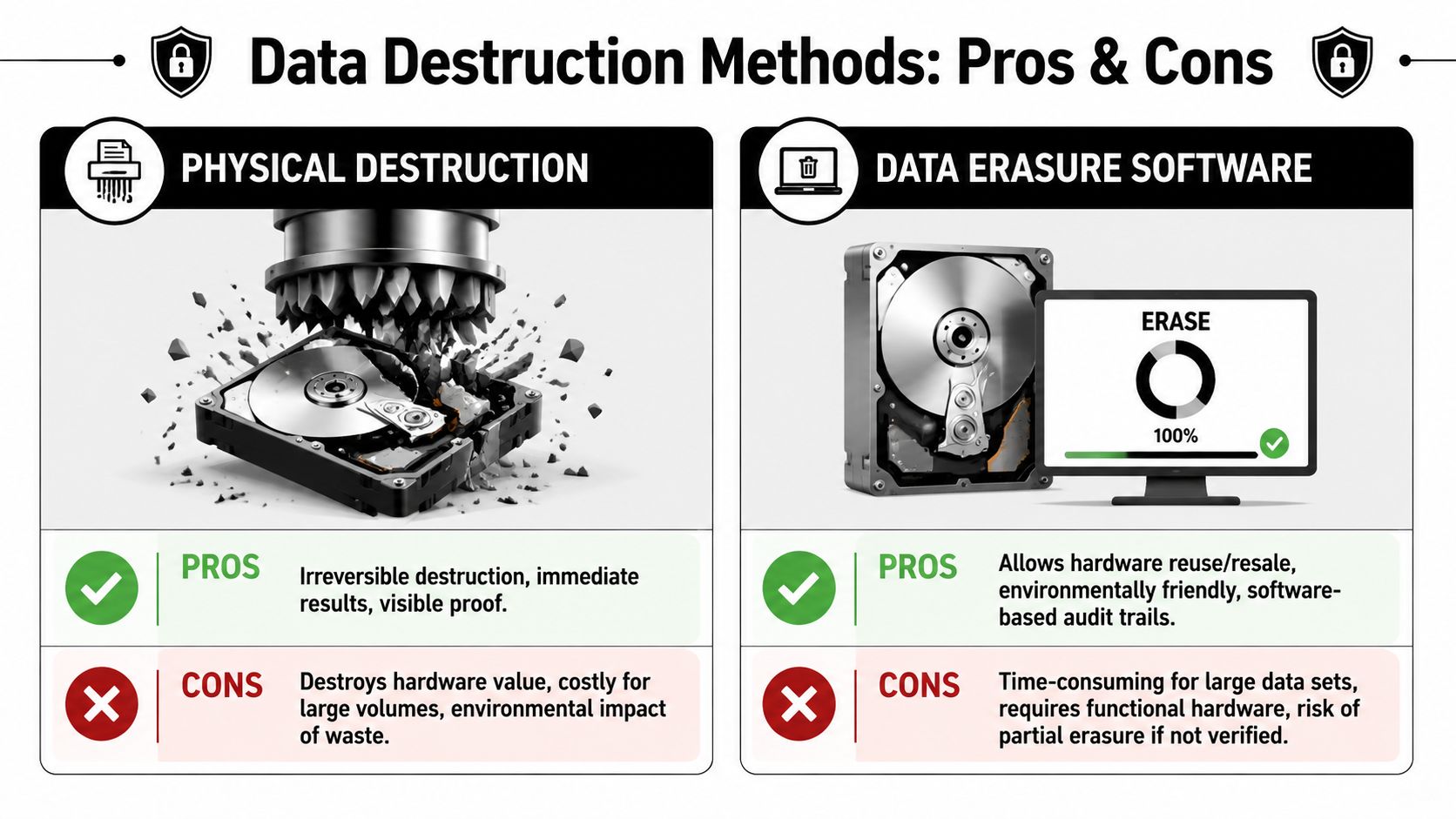
Software wiping is the right fit when the hardware is still functional and you want the option of reuse, remarketing, or internal redeployment. It's also the more sustainable route because the device can stay in circulation instead of going straight to destruction.
Montclair Crew offers free DoD 5220.22-M three-pass hard drive wiping for qualifying assets, which makes software-based sanitization a practical option for many business retirements. If your process needs a documented destruction path for broader device categories, IT asset destruction services are one route to formalize that handoff.
When shredding is the better call
Physical shredding fits a different situation. Use it when policy requires irreversible destruction, when the media is damaged, or when your organization needs witnessed disposal for internal controls or industry obligations.
Shredding gives immediate certainty. You don't preserve device value, but you do remove any question about whether the media can be reused or audited later.
Here's the practical comparison:
- Choose wiping when hardware still works, asset value matters, and you want an audit trail tied to serials or devices.
- Choose shredding when the media is damaged, policy is strict, or stakeholders need visible destruction.
- Don't mix methods casually across a batch. Decide by asset type and policy before pickup day.
A simple decision filter
If the drive works and the equipment may have resale or redeployment value, wipe it.
If the drive is failed, highly sensitive, or subject to stricter handling requirements, shred it.
Data destruction should be decided before loading, not argued over while equipment is already on a truck.
That one change prevents a lot of rushed decisions and a lot of unnecessary hardware loss.
Streamline Your E-Waste Logistics in Metro Atlanta
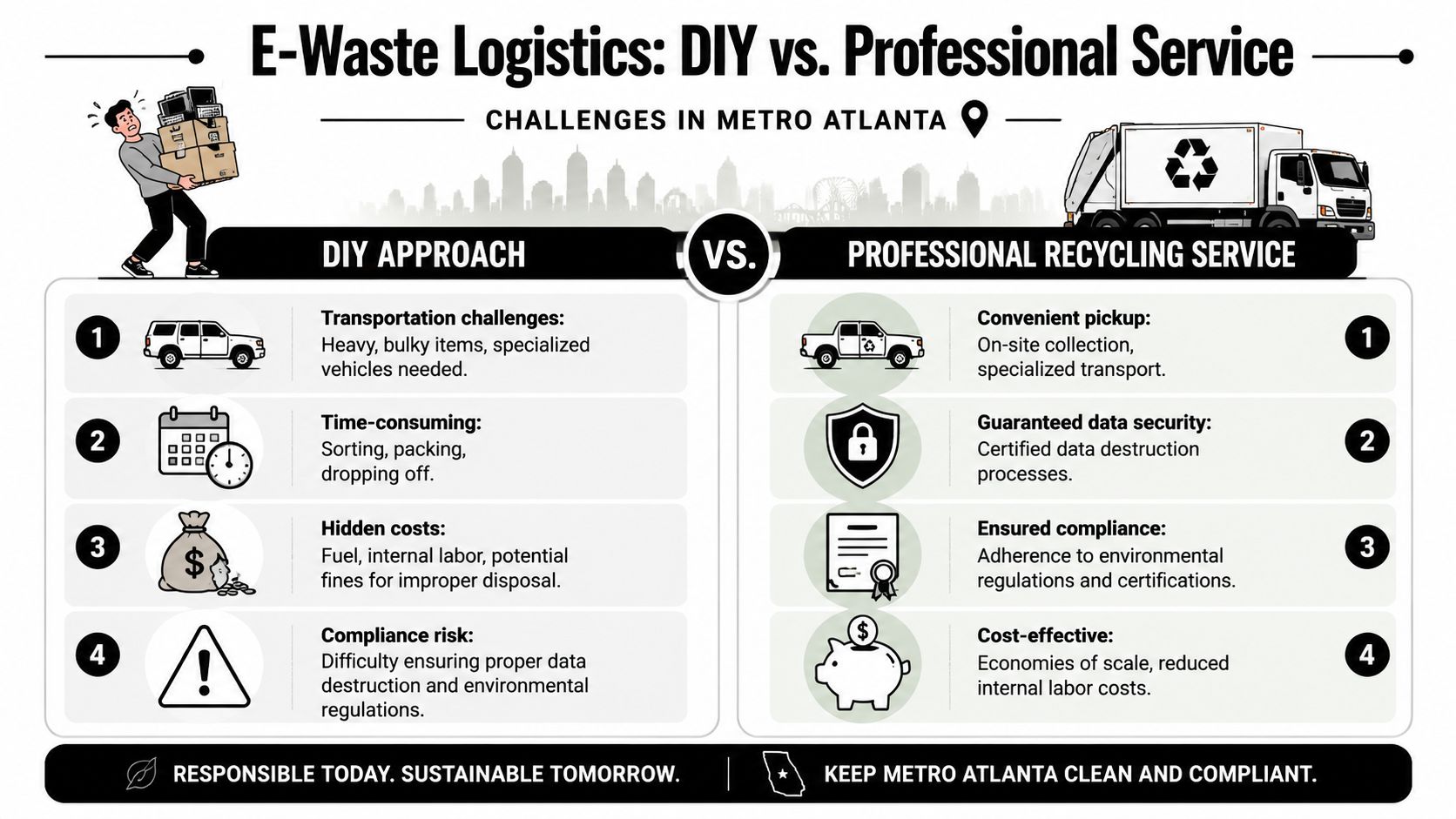
Logistics is where good intentions usually break down. A business may know what should happen to old telecom gear, but the actual removal gets delayed because nobody wants to box phones, move racks, or make repeated trips across town.
That's why the underlying question behind e-waste telecom recycling near me usually isn't location alone. It's whether the recycler can remove equipment from your site without disrupting your workday.
As this local program discussion of business e-waste limitations notes, public drop-off programs often have item limits and residency restrictions. For business telecom surplus, the better fit is often a B2B recycler that can provide on-site logistics, audit support, and data wiping.
When drop-off works
Drop-off is fine when you have a controlled, low-volume batch and your team can transport it safely. Think a handful of switches, a few desktops, some phones, or compact network gear from a small office cleanup.
Drop-off is usually the better option when:
- Your load is small and already boxed or palletized
- No de-install work is needed
- Your staff can transport it without risk
- You don't need on-site labor
For Metro Atlanta companies near Smyrna, that can be the fastest route for lighter loads.
When on-site removal is the smarter move
On-site pickup is the better operational choice when you're clearing a server room, replacing phones across a floor, decommissioning a branch, or dealing with racks and heavy mixed loads. It also helps when your staff shouldn't be spending paid hours sorting and hauling scrap.
Good pickup service solves the parts that internal teams often underestimate:
- Heavy lifting for servers, UPS units, and racks
- Controlled staging so reusable assets don't get damaged
- Faster clear-outs for offices, schools, clinics, and data rooms
- Better chain-of-custody discipline from removal through transport
If your organization needs scheduled removal rather than ad hoc hauling, electronics recycling pickup in Atlanta is the kind of service model that usually fits better than trying to repurpose internal labor for disposal days.
Businesses don't usually have a recycling problem. They have a labor, transport, and accountability problem.
That's why the best local option often isn't the closest place on the map. It's the one that can move the equipment cleanly and document what happened.
Meet Regulatory and Environmental Compliance
A rushed office cleanout creates compliance problems fast. A few phones go into desk drawers, a switch gets handed to a facilities runner, and a pallet leaves without a clean asset record. Weeks later, legal, IT, or procurement asks what happened to the gear and whether any data-bearing equipment left the site unchecked. If you cannot answer that clearly, the disposal job was not under control.
For Atlanta businesses, compliance is not just about recycling the material. It is about keeping retired telecom and IT equipment inside a documented process from pickup through final disposition. That matters most with devices that may store call logs, credentials, configuration files, voicemails, contact data, or network settings.
What compliance looks like on a real job
On business telecom loads, we look for four things:
- A clear record of what left your site
- Documented handling for any data-bearing equipment
- A traceable downstream path for reuse, recycling, or destruction
- Paperwork your compliance, legal, or facilities team can pull later without guessing
If a vendor cannot provide that, your company keeps the risk.
The legal exposure is not theoretical. Disposal rules vary by market, and some jurisdictions take electronics handling seriously. New York City, for example, prohibits disposal of certain electronic devices with trash or regular recycling, and larger businesses must use an electronic waste recycler, as stated in the NYC electronics disposal guidance. Atlanta businesses should read that as a practical warning. Waiting until a dispute, audit, or landlord turnover to ask for records is too late.

The documents you should ask for before pickup day
Good documentation starts before the truck arrives. If your team is retiring handsets, switches, servers, UPS units, or mixed telecom closets, ask what records you will receive and when.
The standard file should include:
- Asset inventory records with serials, counts, or other unit-level identifiers where practical
- Data destruction confirmation matched to the agreed method
- Disposition records showing whether assets were reused, recycled, or destroyed
- Chain-of-custody documentation for pickup, transfer, and processing
That is the baseline for corporate electronic asset recycling services, especially when multiple departments share responsibility for IT, facilities, and purchasing.
Why downstream handling deserves scrutiny
A clean pickup does not prove compliant handling. The key question is where the material goes after it leaves your building.
If a vendor is vague about downstream processors, resale channels, exports, or reporting, stop there. Some equipment should be dismantled and recycled. Some may still have resale value. Some belongs in controlled destruction because the data risk outweighs recovery value. Those decisions need to be documented, not improvised. If your finance team is comparing recovery options, outside guidance on valuation and selling strategies can help frame the resale side, but it should sit alongside security and disposition controls, not replace them.
Cheap disposal gets expensive when records are missing. The cost shows up later in internal investigations, vendor disputes, and unanswered questions about where business equipment ended up.
The safer path is straightforward. Use a recycler that can document inventory, data handling, transport, and final outcome in a way your team can use.
Unlock Hidden Value in Your Retired Telecom Gear
A common Atlanta scenario looks like this. The office is clearing a telecom closet, facilities wants the space back, and old switches, handsets, and servers get treated like low-grade scrap. That decision is fast, but it often leaves money on the table and mixes reusable equipment into a load that should have been sorted first.
For businesses, value recovery is not the main goal. Security and compliance still come first. But once those controls are set, you should know which assets deserve resale review, which belong in parts harvesting, and which should go straight to material recycling. Generic "near me" results rarely help with that decision.
Some retired telecom gear still has market value, especially if it came out of service recently, stayed in climate-controlled rooms, and is still complete. Age matters. Model demand matters. Condition matters even more.
Which telecom assets are worth evaluating
The assets that usually justify inspection and grading include:
- Enterprise servers with usable processor generations, RAM, drive caddies, and power supplies
- Managed switches and routers from active commercial product families
- Network modules, optics, and interface cards with steady secondary-market demand
- VoIP phones and conference units that still match live business deployments
- Complete units with faceplates, rails, adapters, and limited cosmetic damage
A box of mixed scrap usually gets scrap pricing. A labeled batch of complete, testable equipment gets a very different review.
That is why staging matters. If your team stacks reusable gear under broken monitors, loose cables, and metal scrap, you lower resale potential before the truck arrives. We see this often in office moves and post-upgrade cleanouts across Metro Atlanta. Equipment that could have been remarketed ends up damaged, incomplete, or too time-consuming to process.
Recovery only works with the right order of operations
Start with asset identification. Then confirm data handling requirements. After that, test, grade, and assign the right disposition path.
Skipping those steps creates predictable losses. A server may have resale value, but not if drives are missing and no one documented the configuration. A switch may still sell, but not if it was palletized with shred-only material and bent in transit. The trade-off is simple. More sorting and documentation takes more effort up front, but it improves recovery and reduces avoidable destruction.
General liquidation advice can still help on the finance side. These valuation and selling strategies are useful for framing how condition, completeness, and demand affect pricing. For telecom and IT assets, that review needs to sit inside a controlled disposition process, not beside it.
If you want one workflow for resale review, recycling, and documented disposition, use a provider that handles corporate electronic asset recycling with asset-level sorting instead of treating every load as bulk scrap.
What reduces recovery value fastest
Three issues cause the biggest drop in returns:
- Rough internal handling that cracks housings, bends rack ears, or separates parts from the main unit
- Mixed pallets where reusable gear is packed with obvious end-of-life material
- Delayed decisions on wiping, testing, and final disposition
Protect the upside while the equipment is still in your building. Keep complete systems together. Bag small accessories and label them. Separate likely resale units from destruction candidates before pickup day. If a device has any chance of reuse, handle it like inventory, not junk.
Your Atlanta E-Waste Recycling Questions Answered
Businesses around Atlanta usually ask the same practical questions once they've decided to move forward. The details matter because telecom and IT disposal only works when the handoff is clear.
Can you recycle VoIP phones, PBX systems, switches, and servers together
Yes, in many business recycling programs you can combine telecom and IT assets in one project, provided the load is reviewed properly first. The important part is separation by disposition. Data-bearing devices, reusable network gear, and obvious scrap shouldn't all be packed the same way.
Do old phones and network gear really need data handling
Sometimes yes, and it's a mistake to assume otherwise. Servers and storage are the obvious concern, but telecom and network equipment can also retain credentials, configurations, call data, or other business information. If there's any uncertainty, treat the device as data-bearing until someone qualified reviews it.
Is pickup better than searching for the nearest drop-off
For most businesses, yes. A nearby public site may still be the wrong fit if it's built around consumer rules, limited quantities, or self-haul only workflows. Commercial loads usually go smoother when removal, inventory, and data handling are coordinated together.
What should my team do before the recycler arrives
Keep it simple:
- Stop adding to the pile once the batch is identified
- Group similar devices together by type and condition
- Pull out anything leased or still assigned to staff
- Flag storage media and data-bearing equipment for review
- Clear access paths to closets, server rooms, docks, and elevators
Should we donate, recycle, or resell old mobile devices
That depends on age, condition, lock status, and whether the devices still fit a useful secondary market. For example, the market for refurbished Apple iPhones shows why some mobile hardware deserves evaluation before scrap decisions are made. The same principle applies to business phones and tablets. Working units often need a value review before they go into a recycling stream.
What proof should I ask for after disposal
Ask for the records your business would need if someone questioned the disposal later. That usually means asset-level reporting where available, destruction confirmation for data-bearing items, and final recycling or disposition documentation.
What's the fastest way to make this manageable going forward
Set one internal rule. No retired telecom or IT device gets stored without a tag, owner, or disposition status. Once that rule is in place, pickups and clear-outs become routine instead of reactive.
If you need a local B2B option for telecom and IT disposal in Metro Atlanta, Montclair Crew Recycling handles on-site removal, business electronics recycling, secure data wiping, optional shredding, and disposition support for organizations retiring phones, servers, network gear, and other IT assets.
