
You're probably here because your phones work just well enough to be dangerous. Calls drop at the worst time. Wi-Fi slows down when the office gets busy. Your internet carrier blames the firewall, the firewall vendor blames the carrier, and nobody owns the problem. That's usually the moment an Atlanta business owner searches for managed telecom services near me.
A first telecom upgrade feels bigger than it should. It touches voice, internet, Wi-Fi, mobile devices, conferencing, remote work, billing, support, and eventually the pile of old gear sitting in a closet. The right provider brings those moving parts under one operating model. The wrong one gives you a new contract and the same headaches.
Why Your Business Needs More Than Just a Phone Line
A modern telecom setup isn't just about dial tone. It's the system your team relies on to answer customers, move files, run cloud apps, support hybrid staff, and keep operations moving when one carrier or device fails. When that system is patched together over time, small issues become business issues.
A lot of owners still frame telecom as a utility purchase. That's a mistake. If your office in Atlanta, Alpharetta, or Marietta depends on cloud software, remote access, or customer response times, telecom is now part of your operating backbone.
The broader shift confirms that. The global managed telecom services market is projected to grow from USD 28.38 billion in 2025 to USD 66.34 billion by 2032, at a CAGR of 12.9%, according to Grand View Research's telecom managed services market report. That kind of growth doesn't happen because companies want another vendor. It happens because networks, voice platforms, and carrier relationships have become too complex to manage casually, especially for small and medium businesses.
Practical rule: If your staff loses time chasing outages, billing errors, or finger-pointing between vendors, you already have a telecom management problem.
Many companies start with phones and end up discovering they need a broader communications strategy. Voice quality may be the symptom, but the root issue is often bandwidth contention, poor Wi-Fi design, weak failover planning, or fragmented support. If you need a baseline before talking to providers, this VoIP telephone service guide is a useful primer on the voice side of the stack.
The goal isn't to buy more technology. The goal is to make communications reliable enough that your team stops thinking about it.
Defining Your Business Telecom Needs for Today and Tomorrow
Before you compare providers, write down how your business works. Most bad telecom decisions start with a vague request like “we need better internet and phones.” That's too broad to price correctly and too vague to implement well.

Audit what hurts right now
Start with the pain your staff feels every week, not the features vendors advertise.
- Call quality issues: Note when calls fail, which teams are affected, and whether the problem shows up only during busy hours.
- Wi-Fi complaints: Separate dead zones from capacity problems. Those are different design issues.
- Remote work friction: If your team works from home or between sites, write down where access, conferencing, or mobile connectivity breaks down.
- Vendor confusion: If you have one provider for circuits, another for VoIP, another for Wi-Fi, and no clear escalation path, list that as an operational risk.
- Billing confusion: Save invoices and flag anything your team can't easily explain.
Then map those pain points to business processes. A dropped sales call matters differently than a flaky guest Wi-Fi network. A clinic, law office, warehouse, and professional services firm won't prioritize the same outcomes.
Turn business plans into telecom requirements
Owners often under-scope the project. Don't design for the office you had last year. Design for the one you expect to run next.
If you plan to add staff, open another site, support more home users, or move more systems into the cloud, your provider needs to support that roadmap. For many businesses, that means discussing UCaaS, SD-WAN, managed Wi-Fi, mobile fleet oversight, and failover connectivity before the contract is signed.
One trend is worth putting on the table early. 5G-enabled SD-WAN is becoming a practical option for hybrid work and branch resiliency. According to MazeCreator Broadband's summary of this trend, 5G fixed wireless deployments surged 45% in underserved U.S. states, and enterprises reported 25% latency reductions after SD-WAN adoption. Even if your first phase is basic, ask every provider how they'd handle a future move toward wireless failover, pop-up sites, or branch connectivity.
Don't ask a provider, “Can you support growth?” Ask, “What changes if we add a second office, more remote staff, or a temporary location next year?”
A useful way to organize this is by timeline:
| Timeframe | Questions to answer |
|---|---|
| Now | What is breaking today, and who feels it first? |
| Next 12 months | Will you add staff, devices, or cloud apps? |
| Longer term | Will you open another location, merge systems, or need stronger failover? |
Once you've written that down, you can speak to providers in concrete terms. If you want a local benchmark for the types of solutions businesses evaluate, this page on telecom solutions near me gives a practical view of the service categories involved.
Building Your Vendor Evaluation Checklist
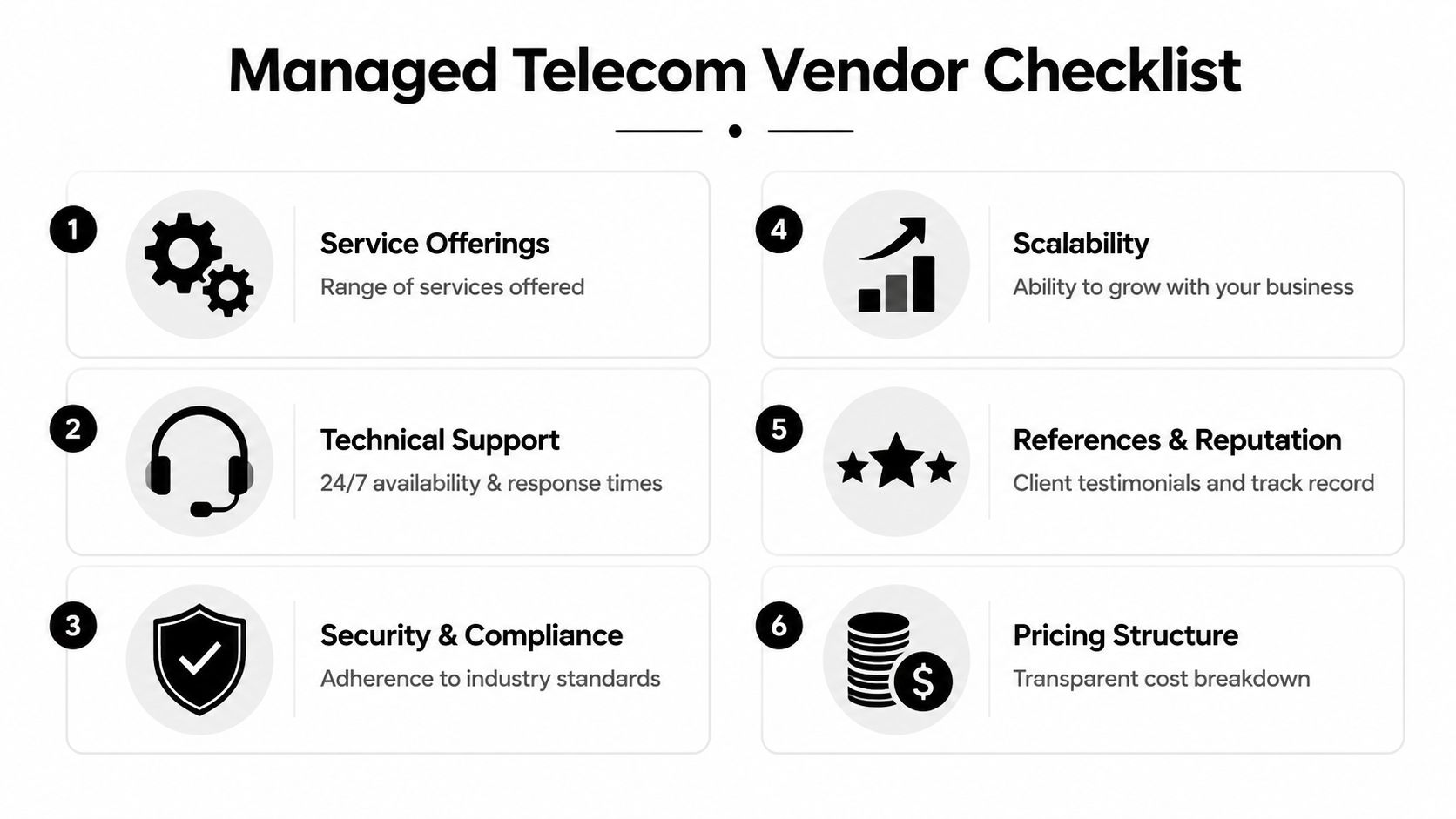
A bad telecom vendor usually looks fine during the sales call. The problems show up at 8:15 a.m. on a Monday, when calls are dropping, Wi-Fi is unstable, and your office manager is stuck between the ISP, the phone provider, and an MSP that says the issue sits with someone else. A useful checklist screens for that outcome before you sign.
Start with operational ownership
Ask each provider to define the exact boundary of their responsibility. Small businesses in Atlanta often assume “managed” means one company owns the whole stack. In practice, some firms only monitor alerts and tell you to call the carrier yourself. Others take full responsibility for ticketing, escalation, circuit coordination, device lifecycle tracking, and post-incident review.
Get specific answers to these questions:
- What do you actively monitor? Circuits, call quality, firewall events, Wi-Fi access points, switches, mobile devices, or only the internet handoff?
- Who owns carrier escalation? Your staff, the provider, or a shared process that becomes blurry during an outage?
- How are changes handled? Adds, moves, firmware updates, number porting, and replacement hardware should follow a documented process.
- What documentation do we receive? You should get diagrams, inventory, admin access records, and current service notes.
- Who tracks equipment from install to retirement? That answer matters later when old phones, firewalls, and switches need to be removed and disposed of properly.
That last point gets missed often. A provider that cannot tell you how they track assets usually will not have a clean process for wiping, removing, and retiring old telecom gear either.
Read the SLA like someone who has to live with it
Sales language does not fix an outage. The SLA tells you how the provider performs when service degrades, how fast they respond, and what happens if they miss the mark.
Ask them to walk you through these items in plain English:
- Response and resolution targets: How quickly do they acknowledge a voice outage, internet issue, or degraded Wi-Fi complaint?
- After-hours support: Is 24/7 support real, or does it mean an answering service opens a ticket?
- On-site support: If a location in Midtown, Alpharetta, or Marietta needs hands-on work, who shows up and how fast?
- Change approval and rollback: What happens if a configuration update causes problems?
- Root cause review: Do they document what failed, what was fixed, and how they will prevent a repeat?
A provider that can explain its outage process clearly usually runs a tighter shop.
Test security, compliance, and asset handling together
Telecom decisions affect more than phones. Admin credentials, call recordings, mobile devices, network switches, and cloud communications all carry security and compliance risk. Ask direct questions and listen for process, not buzzwords.
Use a checklist like this:
- How is privileged access controlled and reviewed?
- How are config changes logged and approved?
- How are backups stored and tested?
- What happens to replaced handsets, firewalls, and switches?
- Do you support secure wipe, chain of custody, and documented disposal when equipment reaches end of life?
- Have you worked with businesses that handle payment data, legal files, medical information, or other regulated records?
For technical leadership teams balancing outsourced support with internal hiring, this TekRecruiter guide on scaling engineering teams is a useful companion read. It helps clarify when to use a managed model versus adding more capability in-house.
Local presence changes the service experience
Metro Atlanta coverage on a map does not guarantee good field support. Ask where technicians are based, which suburbs they already serve, and whether they use employees or subcontractors for installs and break-fix work. That matters if your office in Buckhead needs a pre-8 a.m. cutover or your warehouse south of the city loses connectivity and someone has to trace cabling on site.
National firms can be a fit. A regional provider often has an edge when timing, local carrier relationships, and same-day dispatch matter.
If you want a practical framework for holding providers accountable after selection, review these IT vendor management best practices while you build your checklist.
Looking Beyond Price to Analyze True Value
The cheapest telecom proposal usually wins on paper and loses in operation. Monthly price is only one line in the decision. The bigger question is what your business pays over the life of the agreement in fees, downtime, internal labor, and avoidable waste.

What a low quote can hide
A low recurring number may exclude project work, site visits, hardware replacement terms, after-hours support, circuit management, or contract negotiation help. Some providers also separate voice, internet, and mobile oversight into different scopes. That creates a cheap entry point and an expensive operating model.
Review every quote for these items:
- Installation and onboarding: Is implementation included, or billed separately?
- Hardware terms: Are you buying, renting, or effectively financing equipment through the service?
- Carrier coordination: Does the provider own renewals, disputes, and troubleshooting with carriers?
- Support boundaries: Which issues are included in managed support, and which trigger extra charges?
- Exit terms: What happens if service quality slips and you need out?
TEM is where strong providers often prove their value
One of the fastest ways a managed provider pays for itself is through Telecom Expense Management, or TEM. This is the discipline of auditing bills, consolidating vendors, flagging errors, and tightening contracts before costs drift.
According to this telecom managed services analysis from Telco Solutions, businesses without TEM typically overspend by 15-20%. A capable managed provider can reduce this by an average of 25%, often producing positive ROI in under six months, and billing errors appear on 5-7% of telecom invoices industry-wide. Those numbers matter because telecom waste usually hides in plain sight. Old lines stay active. Add-on features linger. Carrier bills keep rolling after equipment changes.
Good providers don't just keep circuits alive. They challenge the bill, clean up contracts, and remove services you no longer need.
If you're evaluating providers on risk as well as cost, it helps to use a formal framework. This guide on how to implement risk assessment for providers is useful for pressure-testing financial, security, and operational exposure before you sign.
Compare total cost, not just monthly spend
A simple way to compare proposals is to split value into three buckets:
| Value area | What to examine |
|---|---|
| Direct cost | Monthly charges, implementation fees, hardware terms |
| Operational impact | Internal time saved, outage handling, vendor coordination |
| Financial control | Billing cleanup, contract optimization, service right-sizing |
That's also the lens to use when reviewing enterprise telecom solutions in Atlanta. A provider should be able to explain not only what you'll buy, but what they'll actively manage so your costs don't creep upward after month three.
How to Interview Providers and Compare Your Finalists
A shortlist of two or three providers feels manageable until the interviews start sounding the same. Every firm says it offers strong support, modern tools, and local service. The difference shows up when you ask them to explain how they work under pressure, how much effort they expect from your team, and what happens to your old equipment when the upgrade is done.
Ask for operating detail, not sales language
The strongest interviews feel specific. Weak ones stay abstract.
Ask providers to walk through a real outage, a real office move, or a real cutover from older phone systems to newer cloud or hybrid service. In Atlanta, that matters more than many owners expect. A provider that serves Midtown high-rises, suburban offices in Cobb, and warehouse space near the airport should already understand building access delays, after-hours scheduling, and how to stage work so your staff can keep operating.
Use questions like these:
- Walk me through your process after a service outage. Who contacts us first, who opens carrier tickets, and who stays accountable until service is restored?
- What does onboarding require from our team? I want a clear list of tasks, approvals, training time, and decision points.
- How do you handle mixed environments? If we keep some legacy handsets, add new circuits, or run more than one carrier, how do you document and support that setup?
- What changes when we grow, move, or add a site? Explain the operational steps, likely delays, and the parts you control versus the carrier.
- How do you offboard a client? Describe how you return admin access, export records, document configurations, and close out services.
- What is your process for retiring replaced telecom equipment? I want to know whether you remove it, inventory it, store it, recycle it, or leave that problem with us.
That last question gets skipped too often. It should not. Old PBX hardware, handsets, switches, and cabling often sit in closets for months after a migration because nobody assigned ownership.
Probe for technical maturity in plain English
You do not need to ask buzzword-heavy questions to get good answers. Ask how they keep configurations consistent across sites. Ask how they spot trouble before users call. Ask how they manage firmware updates, failed devices, and carrier handoffs.
A capable provider can explain its methods clearly. If the answer turns into jargon, keep pressing. Ask what they automate, what still requires manual work, and where mistakes usually happen during deployments. Providers that know their operation well can explain trade-offs without hiding behind terms.
One practical test works well. Ask, “If we open a second Atlanta location six months from now, what parts of the deployment can you repeat quickly, and what parts would need to be redesigned?” That question exposes whether their process is documented or whether they rebuild every environment from scratch.
If you want a local reference point while narrowing options, review service categories on this page about managed telecom services near you in Atlanta, then use your interviews to confirm how each finalist delivers them.
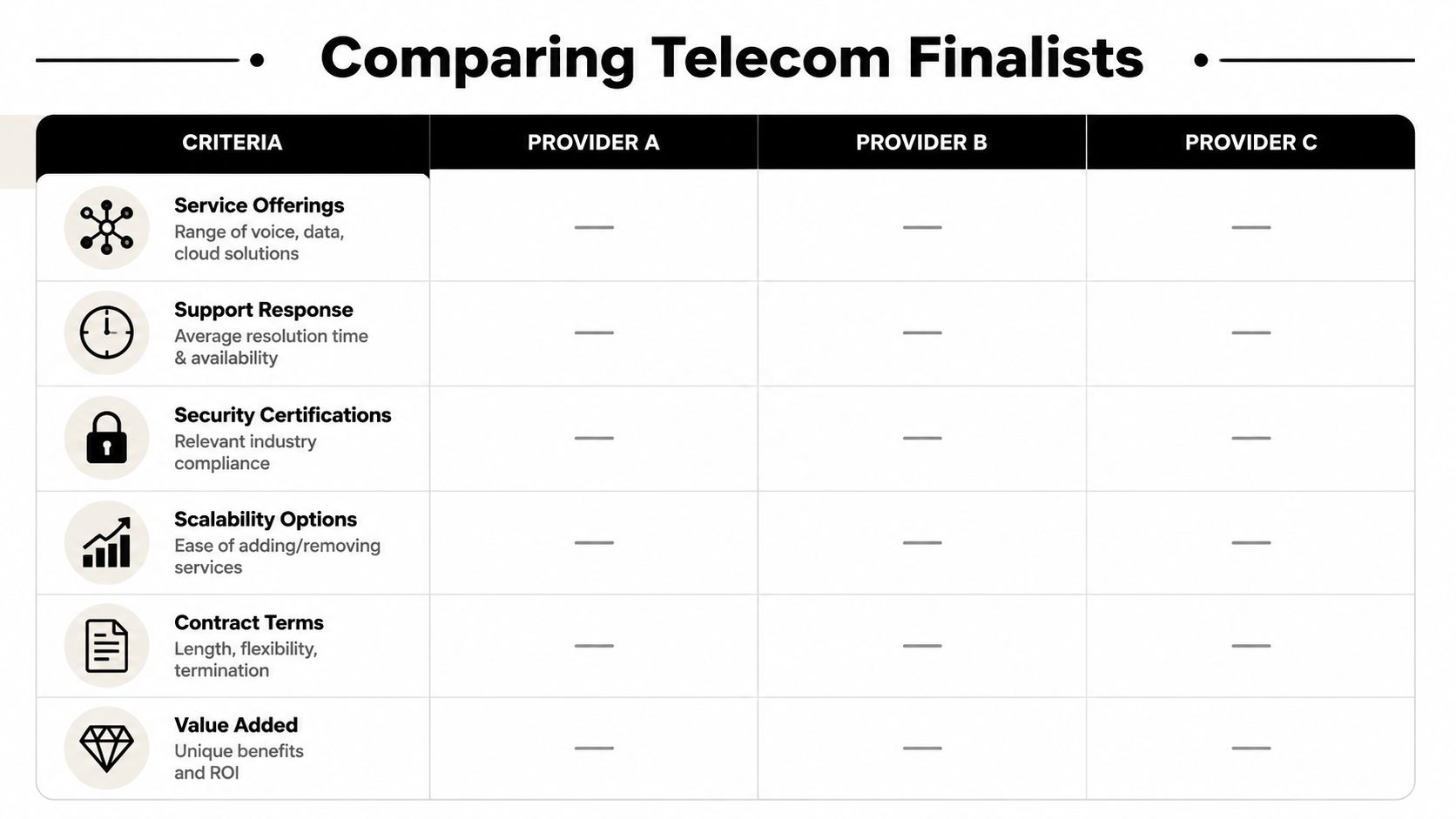
Score finalists side by side
Good interviews produce a lot of impressions. Put them into a simple scoring sheet before memory smooths over the weak spots.
Vendor Comparison Template
| Criteria | Provider A | Provider B | Provider C |
|---|---|---|---|
| Service offerings | |||
| Support response | |||
| Security certifications | |||
| Scalability options | |||
| Contract terms | |||
| Value added |
Add a few notes under the table after each call. Write down how clearly they answered, where they seemed vague, and what risks they admitted. A provider that openly says, “Fiber is better at this site, but the install interval may push your timeline, so we would stage a temporary backup connection,” is usually giving you more useful information than one that promises everything will go smoothly.
What strong finalists usually do differently
Strong providers tend to share a few habits:
- They answer with ownership. You hear who does what, not generic statements about support.
- They discuss limits transparently. They explain where wireless failover fits, where it does not, and what it costs you in performance.
- They keep documentation current. Inventory, credentials, carrier contacts, porting details, and cutover plans are part of the discussion.
- They treat telecom as a lifecycle. Planning, deployment, support, refresh, and end-of-life disposal are handled as connected responsibilities.
That lifecycle view matters for small businesses making a first major upgrade. Installation day gets attention. Cleanup day often does not. Ask each finalist who removes retired equipment, how assets are tracked, and whether they support secure, responsible disposition once the new system is stable. If a provider has no answer, the burden usually lands back on your office manager or internal IT lead.
Test whether “local” means operationally local
A local logo on a website is easy. Real local coverage is measurable.
Ask where technicians are based, what their standard onsite window looks like, and who handles after-hours work in Metro Atlanta. Ask whether field work is done by employees, subcontractors, or a mix of both. If your office is in Buckhead, Decatur, Alpharetta, or near Hartsfield-Jackson, response logistics are different, and the provider should speak to that without hesitation.
Interviewing finalists this way gives you something better than a polished proposal. It gives you a clearer picture of who will keep your phones, internet, locations, and retired hardware under control after the contract is signed.
Contracts, Compliance, and Retiring Old Equipment Responsibly
By the time you reach the contract stage, most owners are tired and ready to sign. That's exactly when expensive mistakes happen. A telecom agreement isn't finished when pricing looks good. It's finished when the operating terms, exit terms, and equipment responsibilities are clear.

Read the clauses that cause pain later
You don't need to be a telecom lawyer to catch the big issues. You do need to slow down and look for the terms that affect control.
Review these carefully:
- Term length: Does the contract lock you in longer than your business can predict comfortably?
- Auto-renewal language: What notice is required if you don't want the agreement to renew?
- Termination rights: What happens if service quality fails, your office moves, or your business changes size?
- Hardware ownership: At the end of the agreement, what equipment is yours and what must be returned?
- Data and admin access: Who controls the portals, credentials, and configuration records?
If a provider resists clarifying these items in writing, treat that as useful information.
Compliance doesn't stop at the network edge
A lot of businesses think compliance ends with encryption and access control. It doesn't. It extends to old phones, routers, firewalls, switches, and storage devices that leave your office after the upgrade.
That's the part most hiring guides skip. Yet it matters because retired telecom gear often contains configuration files, call logs, credentials, cached data, and organization-specific information. Leaving old equipment in a storage room for months is sloppy. Handing it to a general junk hauler is worse.
Old telecom hardware is still part of your security perimeter until it has been properly wiped, documented, and dispositioned.
Treat retirement as part of the project plan
Build equipment retirement into the implementation checklist before cutover begins. Decide who will disconnect old gear, who will inventory it, how data-bearing components will be sanitized, and where chain-of-custody records will live.
A clean retirement workflow usually includes:
- Asset identification so nothing leaves without being logged
- Segregation of reusable and obsolete gear
- Certified data destruction for anything that may store sensitive information
- Environmentally compliant recycling for non-reusable equipment
- Audit documentation for internal records and compliance needs
If your upgrade includes a significant volume of retired network or communications equipment, work with a specialist in IT asset disposal rather than treating the pile as an afterthought. That protects data, keeps disposal compliant, and closes the project properly.
The businesses that handle this well do one simple thing. They treat telecom as a lifecycle, not a purchase.
Conclusion Your Telecom Partner as a Strategic Asset
A first telecom overhaul can feel technical, but the decision is operational. You're choosing who will help your business stay reachable, productive, and resilient when systems get busy or fail. That's why a smart process matters more than a fast quote.
Define what your business needs now. Pressure-test what you'll need next. Compare providers with a real checklist. Interview finalists on how they work, not just what they sell. Then finish the job by reviewing contract terms carefully and planning for the secure retirement of the equipment you're replacing.
The best result isn't just better phones or faster internet. It's a telecom environment your team can rely on without babysitting it. For Atlanta businesses, “near me” should mean more than geography. It should mean responsive support, practical accountability, and a partner who understands the realities of serving local offices, multi-site operations, and growing teams.
If your telecom upgrade is leaving you with old phones, routers, switches, or other retired IT equipment, Montclair Crew Recycling gives Metro Atlanta businesses a practical end-of-life path. Their team helps organizations decommission equipment securely, handle data destruction responsibly, and recycle or recover value from retired assets without turning the final step of the project into another risk.
