

Most searches for business internet providers near me assume the job is simple: enter an address, compare speeds, pick the cheapest plan. That's usually where buyers get into trouble. In Metro Atlanta, the actual question isn't just who serves your ZIP code. It's who can serve your exact suite, how that circuit is delivered, what happens during an outage, and whether the provider can scale with you when you add a second office in Alpharetta, a warehouse in Austell, or a retail site in Sandy Springs.
For Atlanta businesses, internet is core infrastructure. It carries VoIP, cloud backups, SaaS apps, cameras, VPN traffic, payment systems, guest Wi-Fi, and remote collaboration. If the connection is unstable, your team feels it immediately. Productivity drops, calls get choppy, uploads crawl, and IT ends up spending time on workarounds instead of planned projects.
The local market also has more variation than many owners expect. In one dense business market, Broadband Map shows business plans ranging from 25 Mbps DSL to 5,000 Mbps fiber, which shows how dramatically service can change by access type and exact location. That's why a provider that looks strong on paper can still be the wrong fit for your building.
If you're also tightening up the rest of your local infrastructure stack, this guide to finding reliable local hosting is a useful companion read.
1. AT&T Business (Fiber and Dedicated Internet)
What does AT&T buy an Atlanta business: a standard fiber connection for day-to-day office traffic, or a more controlled circuit with stronger support commitments when downtime has a real cost?
AT&T Business stays near the top of the shortlist because it covers both ends of that decision. A smaller office in Midtown or Dunwoody may only need business fiber with static IPs and predictable upload performance. A multi-site company with voice, VPN, cloud backups, and tighter uptime requirements may need Dedicated Internet instead. Having both under one provider can simplify procurement, billing, and long-term network planning.
The key is not to treat every AT&T internet quote as the same product.
Where AT&T makes sense
AT&T publicly separates products such as Business Fiber and Dedicated Internet. That matters in Metro Atlanta, where two suites in the same building can have different service options, install timelines, and support terms. For buyers comparing providers near me, this is one of the first real filters: shared broadband and dedicated access solve different operational problems.
Practical rule: If your team relies on VoIP, cloud apps, large file transfers, or site-to-site VPN traffic all day, ask AT&T to confirm whether the quote is for Business Fiber or Dedicated Internet, and ask what service levels apply to each.
AT&T is often a strong fit for companies that expect to grow. An office can start with fiber at a reasonable monthly cost, then move to DIA later if the site becomes more business-critical. That path is useful for firms opening a second location in Alpharetta, supporting a warehouse in South Fulton, or standardizing service across offices with different building infrastructure.
There is also a last-mile consideration. In some Atlanta buildings, AT&T can be attractive because the carrier already has facilities in place, which can reduce construction delays. In others, serviceability looks good at the address level but becomes more complicated at the suite level, especially in older multi-tenant properties. IT managers should verify the exact handoff, install interval, and whether any build costs apply before treating an AT&T quote as deployment-ready.
- Best fit for SMB offices: Business Fiber from AT&T Business works well for offices that want symmetrical speeds, business support, and room to add static IPs or managed services.
- Best fit for higher-dependency sites: Dedicated Internet is the better option when SLA terms, cleaner performance under sustained load, and tighter escalation paths matter more than lowest monthly price.
- Best fit for staged growth: Companies that want one carrier relationship now, with the option to formalize WAN design later, often find AT&T easier to scale than switching providers midstream.
The trade-off is buying complexity. AT&T can cover a wide range of business requirements, but quote quality varies by building, and DIA usually requires a more consultative sales process than off-the-shelf broadband. Buyers who need fast turn-up for a temporary office or urgent failover may find fixed wireless or cable easier to deploy, even if AT&T is the better primary connection long term.
For a broader view of how providers package business connectivity in different metro markets, this overview of small business telecom providers in Houston is a useful comparison point.
2. Comcast Business (Cable, Ethernet/Dedicated Internet)
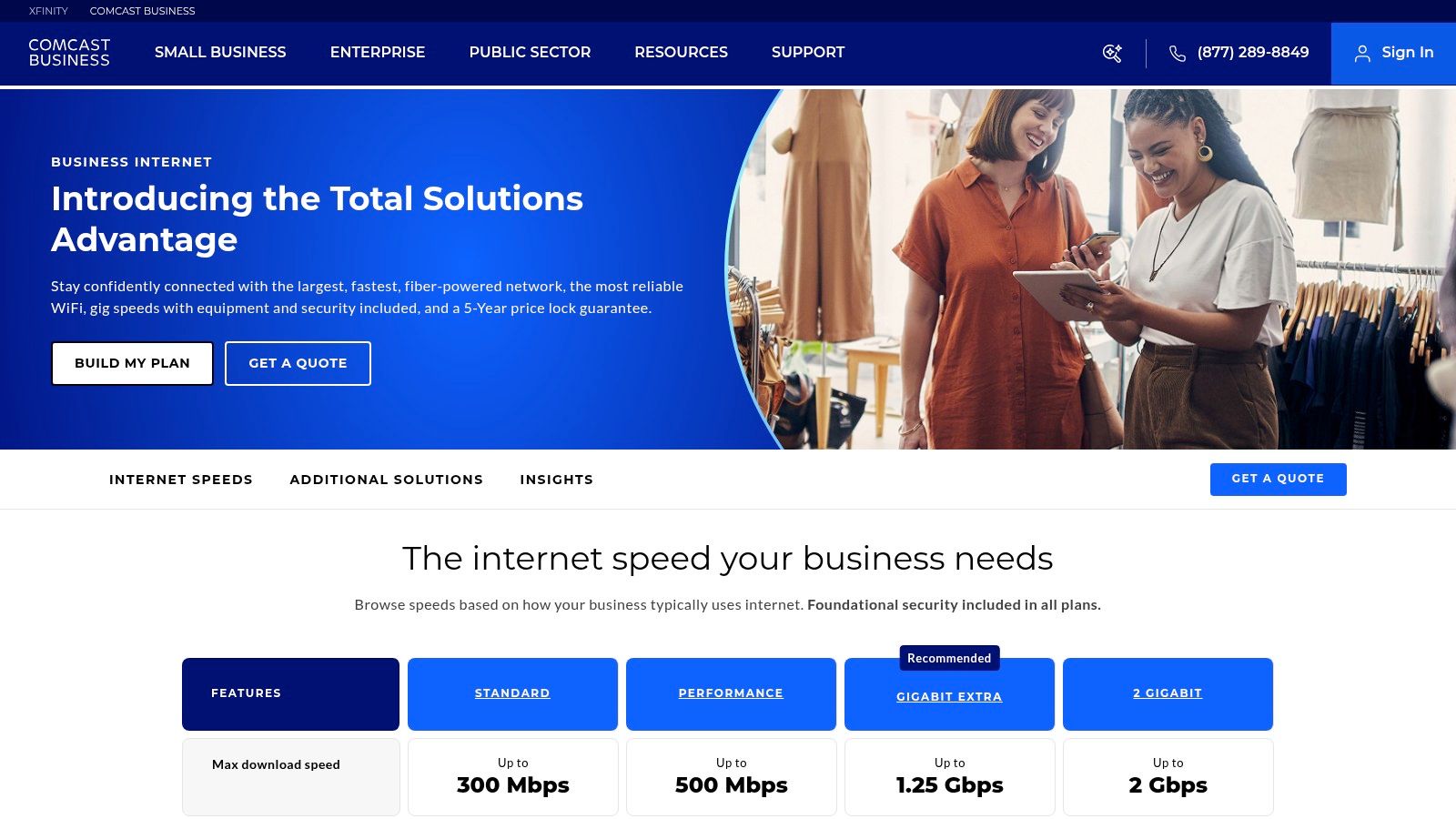
Comcast Business is often the practical choice when you need broad Atlanta-area availability and a faster install than a new fiber build can deliver. In business parks, mixed-use corridors, and retail-heavy areas, Comcast tends to show up early in the shortlist because the footprint is broad and the quoting process is familiar.
That doesn't mean every Comcast option is the same. Many Atlanta companies buy cable business internet for convenience, then discover later that they needed Ethernet Dedicated Internet for tighter support expectations or cleaner performance under load.
The real trade-off
Comcast works well when speed-to-install matters. If you're opening a branch office, moving into a suite with existing coax, or replacing an underperforming incumbent quickly, Comcast is often easier to turn up than a fresh construction fiber order.
The challenge is knowing when cable is good enough and when it isn't. For a standard office running email, browser-based systems, point-of-sale, and moderate cloud usage, Comcast Business cable can be completely adequate. For heavier voice, backup, or multi-site traffic, Ethernet Dedicated Internet is usually the better conversation.
A lot of Atlanta businesses don't outgrow Comcast because of download speed. They outgrow it because the network role changed.
Comcast Business also appeals to buyers who want bundled business services under one umbrella. Backup connectivity and security add-ons can be convenient for lean IT teams that don't want to stitch together separate vendors from day one.
- Strong point: Comcast Business internet plans are widely available and usually easier to deploy than custom enterprise circuits.
- Best use case: Retail, branch offices, medical practices, and professional offices that want business support and a mainstream provider.
- Watch item: Advertised pricing is often tied to terms, bundles, or account conditions, so compare the recurring rate and install assumptions carefully.
Comcast becomes less attractive when your network design needs strict circuit diversity, highly customized support, or architecture built around enterprise routing policies. In those cases, it's often better as one component of the WAN than the entire answer.
3. GFiber (Google Fiber) Business
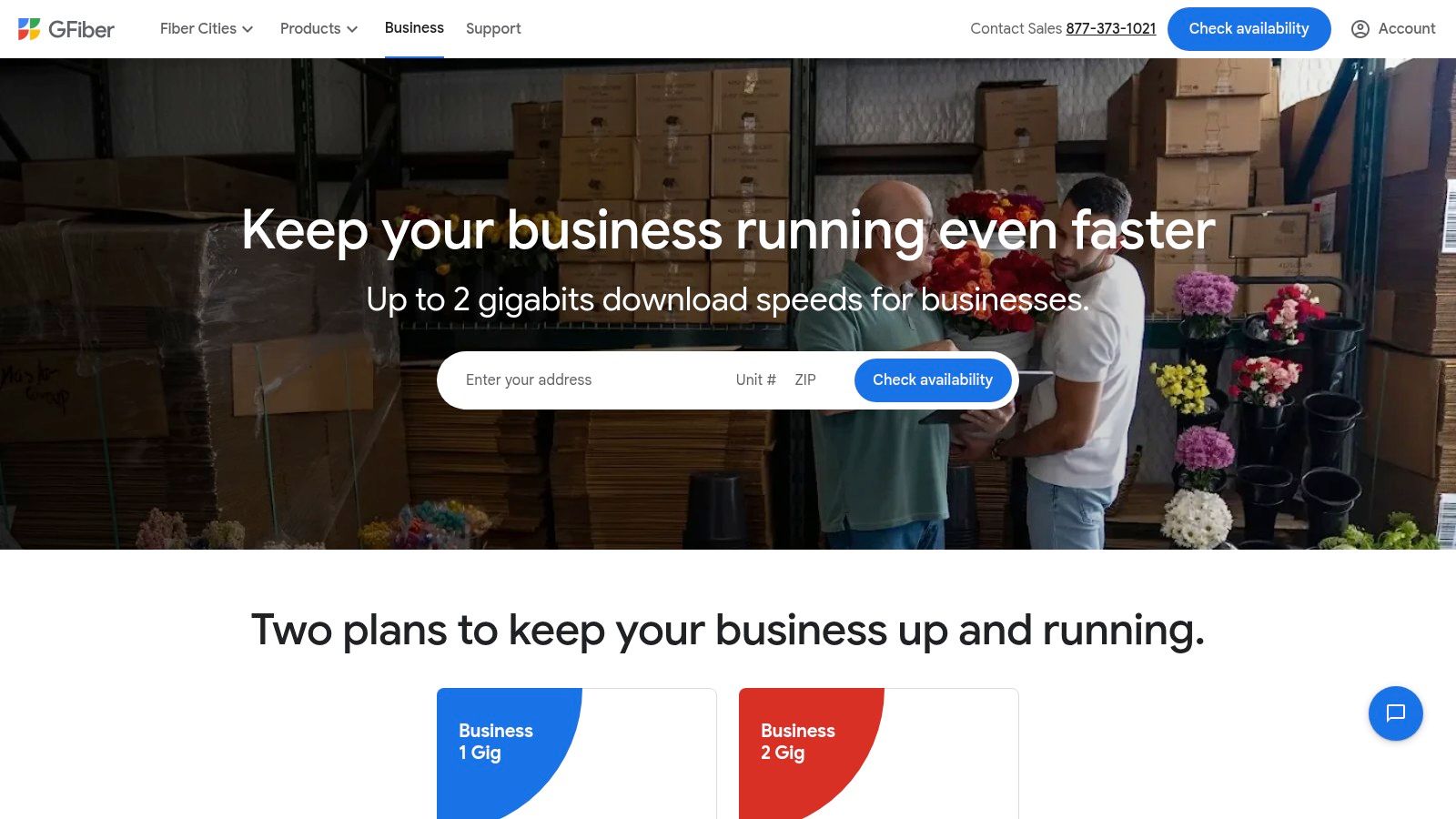
GFiber Business stands out for one reason buyers appreciate immediately. It tends to be straightforward. If your Atlanta address is eligible, the offer is usually easy to understand, the plans are clean, and the symmetry is attractive for teams that upload as much as they download.
That simplicity is valuable. A lot of business internet shopping gets bogged down by confusing bundles, quote-only pricing, and vague language around equipment or install. GFiber has generally positioned itself closer to a transparent business utility than a heavily negotiated carrier sale.
Why small offices like it
For creative teams, agencies, software shops, and professional offices that live in cloud platforms all day, symmetrical business fiber is often the right baseline. Upload performance matters for backups, shared files, hosted calls, and video collaboration. In another business market snapshot, Broadband Map lists San Diego-area fiber options reaching up to 5,000 Mbps down and 5,000 Mbps up, which illustrates why symmetry has become a practical buying standard for business workloads.
GFiber Business leans into that expectation. Where available, it's a strong fit for offices that want fast upstream performance without moving into a full enterprise carrier engagement.
- Simple buying experience: GFiber Business is appealing when you want published business plans instead of a long sales cycle.
- Good office fit: High-collaboration teams, design and media firms, and cloud-native SMBs usually benefit from the symmetrical model.
- Potential limitation: Coverage is still very address-specific, so one building may qualify while another nearby may not.
GFiber isn't the first option I'd pick for a complex multi-site WAN or a heavily customized enterprise environment. It is, however, one of the cleaner choices for a single location that wants fast, modern business fiber with fewer purchasing headaches.
If you're comparing local telecom service expectations more broadly, this resource on telecom services in Atlanta gives helpful context.
4. Verizon 5G Business Internet (Fixed Wireless)

Verizon 5G Business Internet is the option many Atlanta companies overlook until they need it fast. If your wired install is delayed, your suite isn't lit yet, or your landlord process is dragging, fixed wireless can get a site operating without waiting for trenching or internal cabling work.
That makes Verizon useful both as a primary connection in the right setting and as a backup path when you want to reduce last-mile risk. Those are different use cases, and it's worth treating them differently in planning.
Best use for Verizon 5G
As a primary circuit, Verizon makes sense for lighter offices, temporary spaces, pop-ups, project sites, and businesses that need service now. As a backup circuit, it's often even more compelling. A wireless handoff that doesn't depend on the same physical path as your wired carrier can help keep critical systems online during a local access issue.
Field advice: If your primary carrier and backup carrier both enter the building through the same conduit path, you don't have real resilience. Fixed wireless can solve that.
The appeal is speed of deployment. You can often stand up service faster than with wired construction, and the handoff can integrate into your existing firewall or router setup. That's especially useful for IT teams building basic failover without overengineering a branch.
- Main advantage: Verizon 5G Business Internet is one of the fastest ways to get a business site connected when wired timelines slip.
- Strong secondary role: Backup WAN for offices that already have cable or fiber and want a diverse path.
- Big caution: Performance depends heavily on local signal conditions, building materials, and cell capacity, so test before assuming it can replace fiber.
For highly latency-sensitive environments, fixed wireless still isn't my first recommendation as the sole circuit. But for continuity, temporary occupancy, and fast turn-up, it solves problems that wired carriers often can't solve quickly.
This primer on telecom infrastructure services is useful if you're thinking beyond the circuit and into the physical path and handoff design.
5. T-Mobile Business Internet (Fixed Wireless)
Need to get a new Atlanta office online without waiting on a fiber build or a long carrier install cycle? T-Mobile Business Internet is often one of the fastest ways to cover that gap, especially for smaller sites that need workable business connectivity more than formal network engineering.
T-Mobile stands out for operational simplicity. The service is easy to order, easy to relocate, and easier to hand off to a small internal IT team than a custom wired circuit. In Metro Atlanta, that makes it a practical fit for pop-up locations, medical or legal satellite offices, field teams, and companies testing a new address before they commit to a longer-term circuit design.
The trade-off is consistency. Fixed wireless performance can vary by block, by building construction, and by local tower load. A site in Midtown with clean signal conditions may have a very different experience from a suite in an older building with interior walls, coated glass, or difficult equipment placement. For Atlanta buyers, that means a coverage check is only the starting point. An on-site test matters more.
If the location may later move to fiber, it helps to plan the physical build path early. Teams that expect to upgrade from wireless to wired service should review local fiber optic installation options for business sites before the temporary connection becomes permanent by default.
- Best fit: T-Mobile Business Internet works well for small offices, temporary space, and low-complexity backup connectivity.
- Why buyers choose it: Fast activation, straightforward billing, and less carrier coordination than a traditional wired install.
- Primary limitation: Throughput and latency are less predictable than fiber or dedicated internet, so it is a weaker choice for heavy cloud usage, voice-sensitive workflows, or sites with steady all-day demand.
For Atlanta businesses, the practical question is not whether T-Mobile can replace every wired service. It usually cannot. The better question is whether it solves the immediate problem at this location. When the answer is fast turn-up, moderate usage, and low deployment friction, T-Mobile deserves a place on the shortlist.
6. Lumen (Fiber+ Internet and Dedicated Internet Access)
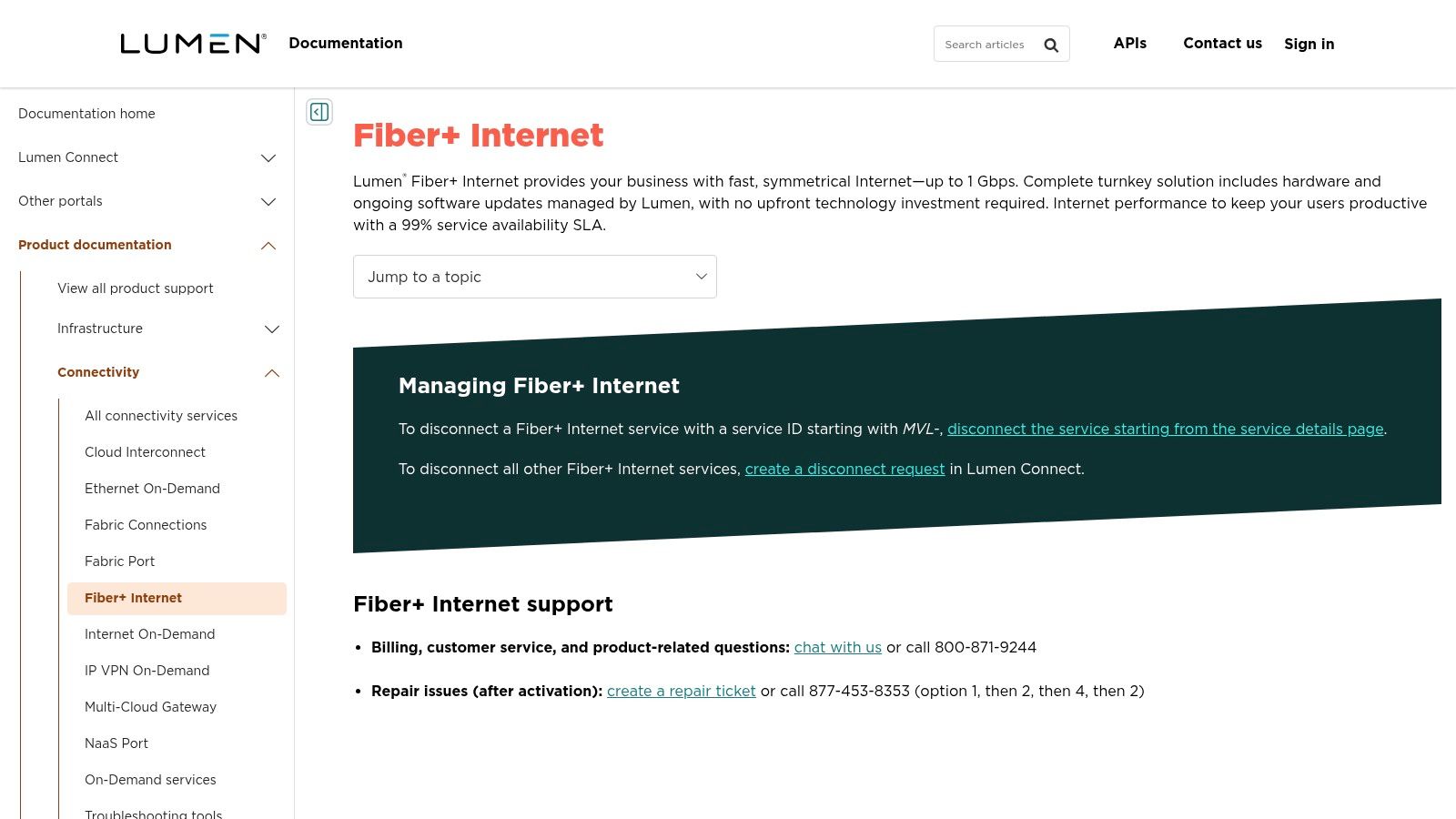
Lumen belongs on the shortlist when your Atlanta business internet decision is tied to broader network architecture. If you're thinking about multi-site connectivity, data-center adjacency, enterprise support structures, or managed network services, Lumen is more relevant than many SMB buyers initially assume.
This isn't usually the simplest provider to buy from. It is often one of the more suitable providers when the circuit needs to fit into something larger than a single-office internet bill.
Enterprise fit over convenience
Lumen's value is less about flashy plan shopping and more about backbone depth, custom quoting, and enterprise-oriented services. For a growing company with a headquarters site, branch traffic, cloud connectivity, and formal IT oversight, that can be the right trade.
Its Fiber+ Internet product is a logical entry point for businesses that want symmetrical business fiber without immediately moving to a fully bespoke enterprise arrangement. Dedicated Internet Access becomes more relevant when service-level commitments, routing control, and business continuity planning matter more than a lower monthly price.
Lumen is usually overkill for a basic office. It's often exactly right for a business that knows internet access is only one piece of the network.
A major practical issue is procurement time. Quote-based providers can require more back-and-forth, and if construction is needed, the schedule may stretch longer than cable or fixed wireless alternatives. That doesn't make Lumen weak. It just means buyers should match the provider to the business requirement.
- Best use case: Multi-site businesses, enterprises, and locations near data-center or carrier-dense environments.
- Strength: Lumen Fiber+ Internet fits organizations that care about enterprise support models and future network expansion.
- Trade-off: Availability and pricing are highly location dependent, and build intervals may not suit urgent office openings.
If your location may need new physical path work or a cleaner internal handoff, this overview of fiber optic installation near me is worth reviewing alongside the carrier quote.
7. One Ring Networks (Atlanta-based Fixed Wireless and Fiber)
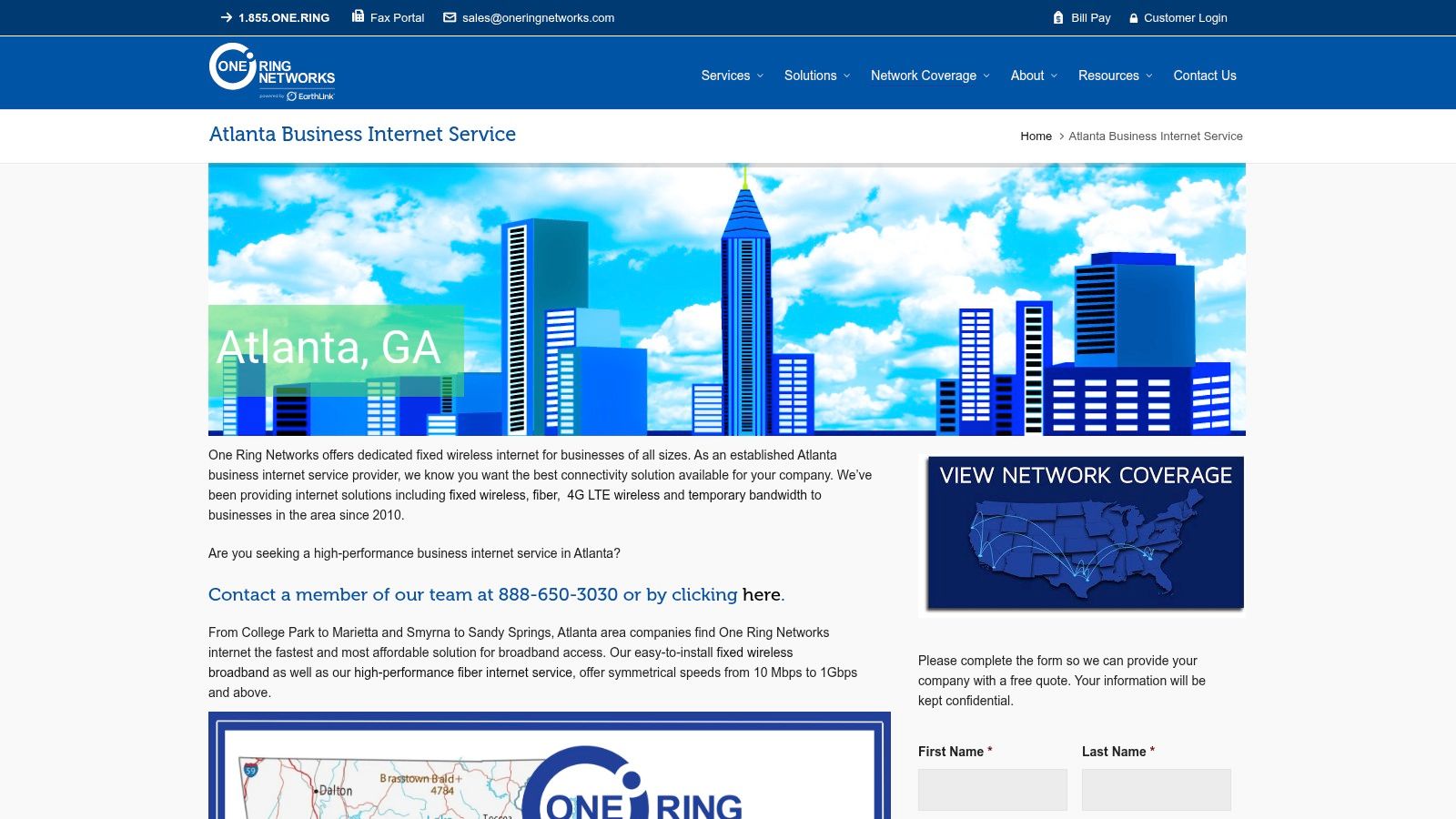
If the phrase business internet providers near me should mean anything useful, it should include local specialists that solve local deployment problems. In Metro Atlanta, One Ring Networks is the most interesting name on this list for that reason. It isn't trying to be a generic national ISP. It's often brought in when conventional options are too slow, too rigid, or too dependent on one physical path.
That local angle matters more than buyers expect. National providers can still be excellent, but when a site has rooftop constraints, difficult serviceability, or an urgent opening date, a local specialist can sometimes move with more precision.
The continuity and diversity play
One Ring Networks is especially valuable when you want a diverse backup path, need service before a fiber build is ready, or have a building that larger providers don't serve well. Dedicated fixed wireless can solve real continuity problems in Atlanta, especially where line of sight is available and time matters.
This also ties into one of the biggest gaps in typical business internet shopping. Much of the market reduces selection to plan browsing, speed, and price, but actual business issues are often whether a provider supports multiple sites, static IPs, dedicated versus best-effort service, and service guarantees, as discussed in this business internet overview from Allconnect. One Ring tends to show up precisely where those operational distinctions matter.
- Best use case: Rapid deployment, construction bypass, hard-to-serve buildings, and wireless backup with genuine path diversity.
- Why local helps: One Ring Networks Atlanta business internet is designed for a market where building conditions and last-mile realities vary sharply block by block.
- Main limitation: Fixed wireless still depends on site survey results, rooftop or mounting access, and line-of-sight feasibility.
For Atlanta businesses that already have one carrier and want a second path that isn't just more of the same, One Ring is often the smartest addition to the shortlist. It's less about replacing every major carrier and more about fixing the gaps they leave.
If you're mapping local options beyond the big names, this guide to telecom providers near me is a useful reference point.
Top 7 Business Internet Providers: Quick Comparison
| Provider | Implementation Complexity 🔄 | Resource Requirements ⚡ | Expected Outcomes ⭐📊 | Ideal Use Cases 💡 | Key Advantages |
|---|---|---|---|---|---|
| AT&T Business (Fiber and Dedicated Internet) | Moderate, GPON simple, DIA requires quoting and provisioning | Fiber availability or DIA quote; CPE and optional security add‑ons | High reliability and symmetrical speeds; strong for VoIP/SaaS ⭐⭐⭐⭐ | Single‑site SMBs to multi‑site enterprises needing SLAs | Deep metro coverage, multiple access types, published terms |
| Comcast Business (Cable, Ethernet/Dedicated Internet) | Low–Moderate, cable quick; DIA custom-quoted | HFC or fiber access; bundling options and backup hardware | Fast turn‑up and broad speed choices; performance varies by medium ⭐⭐⭐ | Retail/business parks requiring quick installs and bundles | Wide availability, fast installs, 24/7 business support |
| GFiber (Google Fiber) Business | Low, posted plans with straightforward provisioning where available | FTTP required at address; includes Wi‑Fi 6E CPE for listed plans | Consistent multi‑gig symmetrical performance and transparent bills ⭐⭐⭐⭐ | Small offices needing predictable pricing and high upstream | True FTTP, clear published pricing, no data caps |
| Verizon 5G Business Internet (Fixed Wireless) | Very low, quick deployment; minimal construction | Strong local 5G signal and outdoor receiver; power/roof access | Rapid service activation; variable real‑world speeds; good failover ⭐⭐⭐ | Temporary sites, rapid stand‑up, primary where wired is slow or as backup | Fast deployment, LTE fallback, price‑lock options on plans |
| T‑Mobile Business Internet (Fixed Wireless) | Very low, self‑install or pro install available | 5G/LTE coverage; simple CPE; low provisioning overhead | Quick turn‑up and predictable monthly cost; throughput varies ⭐⭐ | Single‑site SMBs, easy failover, cost‑sensitive deployments | Simple pricing, very fast to deploy and relocate |
| Lumen (Fiber+ Internet and DIA) | Moderate–High, quote‑based provisioning, possible construction | Access to Tier‑1 backbone; managed services and security options | Enterprise-grade performance, QoS and SLAs for multi‑site needs ⭐⭐⭐⭐ | Enterprises, multi‑site WANs, data‑center adjacent deployments | Tier‑1 backbone, strong peering, managed/security portfolio |
| One Ring Networks (Fixed Wireless and Fiber) | Moderate, site survey and rooftop/LOS checks; local field work | Dedicated fixed wireless or last‑mile fiber; on‑site teams | Fast last‑mile turn‑ups and diverse backup paths; site‑specific results ⭐⭐⭐ | Hard‑to‑serve buildings, diversity/backups, Atlanta local needs | Responsive local deployment, true last‑mile diversity |
Making the Connection: Your Next Steps
The right Atlanta business internet choice usually becomes clear once you stop treating internet like a commodity. Start with the operational question, not the advertised speed. Do you need a primary circuit for a single office, a temporary connection while construction catches up, a backup path for continuity, or a multi-site design with cleaner support and more accountability? The answer changes the provider shortlist immediately.
For many small and midsize businesses, the most practical path is a tiered approach. Use a mainstream wired provider such as AT&T, Comcast, or GFiber for the primary office connection when address availability and budget line up. Add fixed wireless from Verizon, T-Mobile, or a specialist like One Ring Networks when you want fast deployment or a backup path that doesn't ride the same physical infrastructure. If your environment is more complex, Lumen or AT&T Dedicated Internet may fit better because they can support a larger network plan instead of only one office handoff.
It also helps to evaluate providers by building reality, not city branding. A provider may claim service in Atlanta, but your actual suite could still face long construction intervals, limited access types, or a different class of service than the building next door. Ask every vendor to confirm exact address serviceability, install assumptions, handoff type, static IP availability, and whether the quoted product is best-effort broadband or dedicated internet. Those details affect how the circuit behaves once your business depends on it every day.
When IT teams get this right, they usually focus on a short list of practical questions:
- Primary role: Is this line meant to be your main business circuit, a failover path, or a temporary service?
- Traffic pattern: Do your users rely heavily on uploads, cloud backups, VoIP, video meetings, or off-site data movement?
- Support model: Will you need stronger service-level commitments, or is standard business broadband enough?
- Growth path: Can the provider support new offices or a more advanced WAN design later?
Your internet upgrade is also a good time to review the rest of your physical infrastructure. New service often means replacing old firewalls, switches, access points, desktop hardware, phones, and decommissioned servers. If you're modernizing a site, handling a move, or retiring equipment after a network refresh, work with a provider that can dispose of those assets responsibly and securely.
Montclair Crew helps Atlanta-area organizations recycle and decommission IT equipment without turning the process into another operations problem. If your internet transition is part of a broader infrastructure cleanup, that support matters. And if you're reviewing routing design as part of a multi-site refresh, this primer to compare BGP and OSPF protocols is a useful technical companion.
The best provider isn't the one with the loudest speed claim. It's the one that fits your building, your traffic, your uptime expectations, and your next move.
If your Atlanta business is upgrading connectivity, relocating offices, or retiring network hardware during a telecom refresh, Montclair Crew Recycling can help you securely decommission and recycle old computers, servers, telecom gear, and related IT assets. Their local team supports Metro Atlanta organizations with pickup, data destruction, compliant disposal, and practical logistics, so your internet upgrade doesn't leave you with a pile of obsolete equipment and a security risk.
