
A lot of Los Angeles businesses reach the same point at roughly the same time. The internet connection worked when the office was smaller, the team was mostly on email, and large files stayed local. Then operations changed. A production team started moving huge media files between floors. A warehouse added more connected devices. A medical office layered in cloud systems, cameras, access control, and Wi-Fi for staff and guests. Suddenly the network isn't just slow. It becomes a daily bottleneck.
Generic connectivity fixes usually fail in LA. A patchwork of consumer-grade gear, unmanaged cabling, and one-off carrier installs might hold together in a simple office. It won't hold up well across older buildings, multi-tenant properties, high-rise spaces, studios, industrial sites, or campuses spread across neighborhoods with very different infrastructure conditions.
That's where telecom infrastructure services Los Angeles becomes a business decision, not just a technical one. This work covers how data enters your building, how it moves across your space, how wireless coverage performs in difficult environments, how permits get handled, and what happens to old telecom hardware when the upgrade is complete.
The installation is only half the job. In Los Angeles, the projects that stay on schedule and avoid ugly surprises are the ones planned as a full lifecycle effort from design and permitting through cutover, documentation, and secure decommissioning.
Your Business Connectivity in the Heart of Los Angeles
Los Angeles forces companies to think differently about connectivity. A creative firm in Burbank doesn't use its network the same way a logistics operator near the port does. A law office in Century City has different uptime concerns than a manufacturer in Vernon. But they all run into one shared problem. If the underlying telecom design is weak, every cloud app, transfer, call, and camera system feels the strain.
That's why telecom infrastructure services should be treated like electrical planning or HVAC engineering. It's part of the building's operating system. If the backbone is undersized, poorly routed, or hard to service, your team pays for it in delays, dropped connections, and reactive maintenance.
The scale of investment behind this sector shows why businesses can't treat it casually. The United States Telecom Infrastructure Services market was valued at USD 91.5 billion in 2025 and is projected to grow at a CAGR of 8.1% through 2033, while the telecom towers segment held a 45.3% market share in 2025, according to U.S. telecom infrastructure market data from MetaStat Insight. In practical terms, Los Angeles businesses are operating inside a market where network capacity, edge demand, and infrastructure refresh cycles are all moving quickly.
What businesses usually get wrong
Many owners and facility teams buy bandwidth before they fix infrastructure. More speed from the carrier won't solve bad pathways, congested switching, weak IDF planning, or poor in-building wireless coverage.
The other common mistake is hiring for a narrow scope. One contractor handles cabling. Another mounts wireless equipment. Someone else configures the network. Nobody owns the handoff points.
Practical rule: If no one owns the full path from carrier entry to final device performance, problems linger at the seams.
What a strategic telecom partner actually does
A capable provider helps you answer a few blunt questions early:
- Identifying the bottleneck: Carrier handoff, backbone, horizontal cabling, wireless coverage, or switching.
- What has to stay live during the upgrade: Phones, security, production systems, guest access, point-of-sale, or remote links.
- What legacy equipment creates risk: Old switches, firewalls, racks, UPS units, wireless controllers, and storage devices that still hold data.
Businesses that approach telecom this way usually make better long-term decisions. They design for growth, document what's installed, and avoid leaving a pile of retired hardware in a closet after the project closes.
The Core Components of Modern Telecom Infrastructure
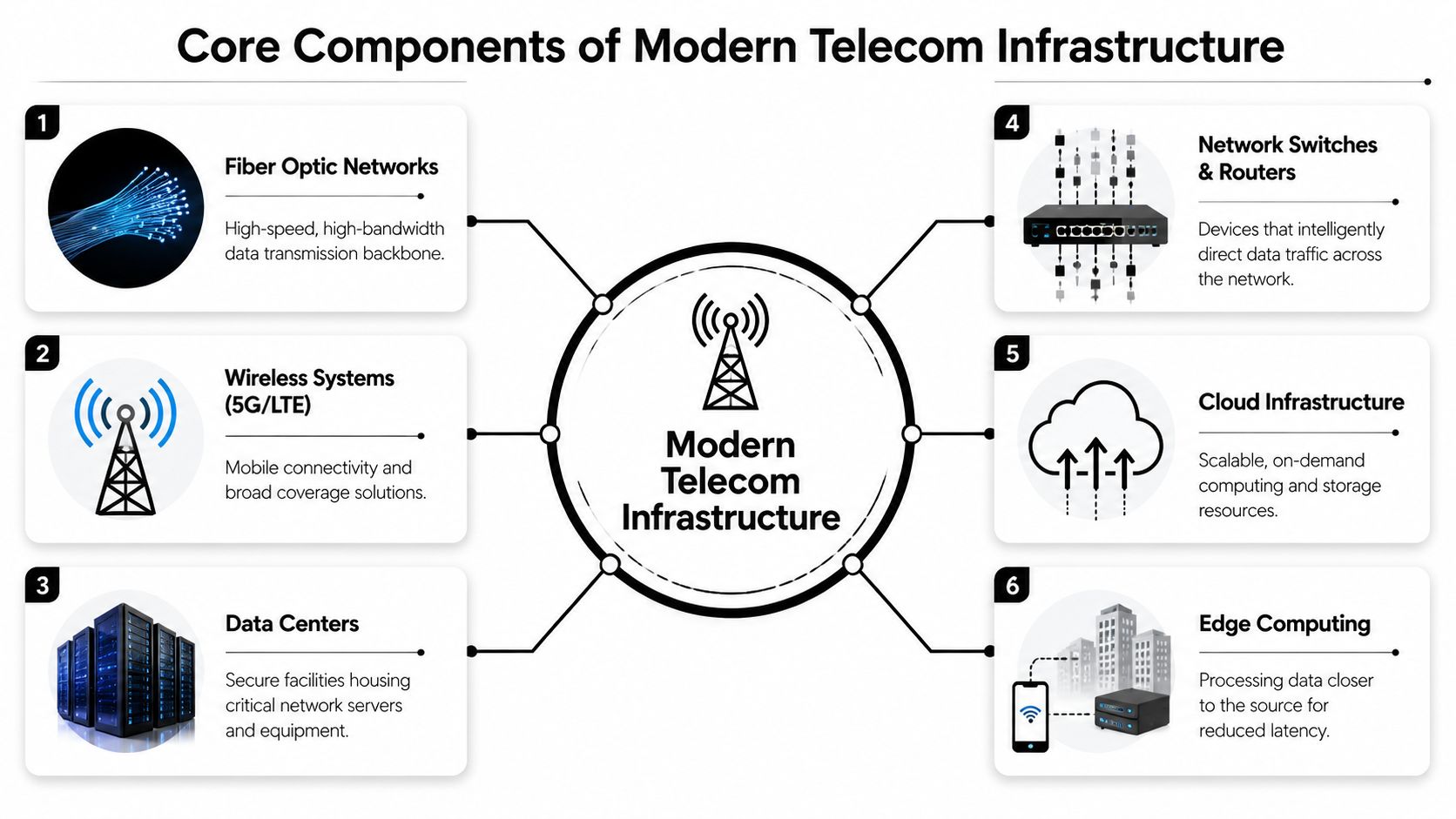
Think of your telecom system like a building's utility network. Fiber is the main service feed. Structured cabling is the distribution inside the property. Wireless fills the spaces where people and devices move. Routers and switches act like traffic control, deciding where each data flow goes and how quickly it gets there. Data centers, cloud platforms, and edge systems support the applications your staff relies on every day.
Fiber and structured cabling
For most serious business environments, fiber optic cabling is the backbone. It handles high-capacity transport between carrier demarcation points, main distribution frames, intermediate closets, and critical rooms. In larger properties, fiber gives you room to scale without rebuilding the network every time demand rises.
Inside the office or facility, structured cabling does the day-to-day work. In Los Angeles projects, solid installations commonly follow TIA/EIA-568-B and use Cat6A UTP to support 500MHz bandwidth for 10GBASE-T over 100 meters, according to Los Angeles structured cabling guidance from LA Low Voltage Techs. That same guidance notes that compliant installations have reduced network downtime by up to 40% annually by preventing problems such as excessive insertion loss.
That matters more than people think. Bad cable management doesn't just look sloppy. Tight bends, poor terminations, mislabeled runs, and overloaded pathways create faults that are miserable to troubleshoot later.
If your site needs new backbone or repair work, it helps to review the requirements with a team experienced in business fiber optic installation services before you commit to pathways, closet locations, and cutover sequencing.
Wireless systems and in-building coverage
Wireless in LA is rarely a simple matter of putting up a few access points and calling it done. Dense interiors, concrete, steel, glass, studio walls, underground areas, and elevator cores all change performance.
The usual options include:
- Small cells: Good when you need targeted cellular coverage support in a limited area.
- DAS: Better for larger buildings, campuses, venues, and places where consistent in-building cellular service matters.
- Wi-Fi overlays: Critical for office mobility, device density, and internal application access, but they don't replace carrier-grade cellular design.
A lot of frustration comes from using the wrong tool. DAS is heavier to plan and coordinate, but it's often the right answer where coverage has to stay consistent across many spaces. Small cells can be effective, but they aren't a universal fix.
When wireless complaints come from stairwells, conference rooms, loading areas, and interior corners all at once, the issue usually isn't the internet circuit. It's the coverage design.
Switching, routing, cloud, and edge
Switches connect devices and move traffic inside the local network. Routers direct traffic between networks, carriers, branch sites, and cloud resources. If these are undersized or badly configured, expensive cabling and strong carrier service won't save the user experience.
Then there's the compute side. Many LA businesses now rely on a mix of cloud infrastructure and edge computing. Cloud platforms give flexibility. Edge systems keep some processing close to users, devices, or production workflows where latency and local resilience matter.
A practical design asks where each application should live, how traffic should flow, and what must keep running if a provider issue or local outage hits. The best telecom infrastructure projects answer those questions before hardware gets mounted.
Navigating LA's Complex Permitting and Compliance Maze
A telecom project can be technically sound and still fail on execution if permitting and compliance are treated as afterthoughts. In Los Angeles, project delays often come from paperwork gaps, incomplete site documentation, unclear jurisdiction, or field conditions that weren't identified before work was scheduled.

Permitting issues that slow real projects
The details vary by site, but the recurring trouble spots are familiar. Exterior penetrations can trigger additional review. Rooftop equipment may require structural signoff. Street-facing work, trenching, conduit changes, and pathway modifications can pull in more stakeholders than the original budget assumed.
Historic properties and mixed-use buildings add another layer. So do landlord approvals in multi-tenant sites. A business may be ready to move, but the building owner, property manager, and carrier all have to line up around access, riser rights, and construction windows.
This is why experienced teams front-load site walks and document review. They identify dependencies early instead of finding them during mobilization.
Compliance doesn't stop at installation
Many companies think “compliance” means permits, inspections, and code. That's only part of the picture. The other half begins when legacy gear comes out.
Recent county broadband expansion adds pressure to that issue. LA County's partnership to bring high-speed internet to 275,000 households and businesses in East and South LA is accelerating equipment turnover, which creates a guidance gap for SMBs on compliant disposal and protection of sensitive data, according to Los Angeles County's broadband partnership announcement.
That matters because old telecom gear often isn't “dead” in any meaningful sense. Switches may still hold configuration data. Firewalls can retain logs. Controllers, servers, and storage devices can contain credentials, user data, and network maps. Removing equipment without a secure disposition plan is a security mistake disguised as a facilities task.
For businesses comparing practices in other markets, a review of telecom network installation approaches in major metro projects can be useful because the pattern is similar. Good teams plan both the new build and the old asset exit path from the start.
Risk check: If your statement of work describes installation in detail but says almost nothing about retired hardware, the project scope is incomplete.
What to require before work begins
Ask for these items before any significant build starts:
- Permit responsibility matrix: Who files what, who tracks approvals, and who owns revisions.
- Cutover and outage plan: Especially if phones, cameras, access control, or production systems must stay live.
- Decommissioning workflow: What gets removed, what stays temporarily, what gets wiped, and what gets recycled or remarketed.
- Closeout documents: As-builts, labeling records, test results, and chain-of-custody records for retired equipment.
The companies that avoid cleanup problems don't treat decommissioning as the final day's task. They treat it as part of project design.
How to Select the Right Telecom Vendor in Los Angeles
Price matters, but it shouldn't lead the decision. In Los Angeles, the best telecom vendor is rarely the cheapest installer. The right partner understands local construction friction, coordinates with building stakeholders, and takes responsibility for what happens after the new system goes live.
That last point gets overlooked constantly. Across the country, the wireless network keeps expanding. The U.S. wireless infrastructure footprint includes more than 158,500 cell towers and 254,850 macrocell sites, according to Wireless Infrastructure Association 2025 key statistics. In a market like LA, that pace of upgrade means legacy hardware is always coming out somewhere. A vendor that ignores the e-waste stream is only solving part of the problem.
The short list should get harder, not easier
When you talk to telecom providers, push past the glossy capability deck. Ask who pulls permits. Ask who certifies the cabling. Ask who owns testing. Ask what they do with removed hardware. Ask what happens when a landlord changes access rules midstream.
A strong vendor can answer without hedging. A weak one usually pivots back to bandwidth, equipment brands, or general experience.
If you're evaluating firms beyond your immediate region, it can help to compare what a mature telecom consulting services partner includes in discovery, scope development, risk review, and lifecycle planning. The specifics differ by city, but disciplined vendor selection doesn't.
Vendor Selection Checklist for LA Businesses
| Evaluation Criterion | What to Look For | Why It Matters |
|---|---|---|
| Local project familiarity | Experience with LA buildings, access constraints, and multi-stakeholder coordination | Reduces surprises during scheduling and field execution |
| Technical scope depth | Ability to handle fiber, structured cabling, wireless, switching, and cutover planning | Prevents handoff gaps between subcontractors |
| Permitting discipline | Clear ownership of filings, revisions, inspections, and site documentation | Keeps projects from stalling in approval cycles |
| Testing and documentation | OTDR results where relevant, cable certification, labeling standards, as-builts | Makes future troubleshooting and expansion much easier |
| Decommissioning process | Secure removal, documented chain of custody, and compliant disposition of retired equipment | Lowers security and environmental risk |
| Value recovery options | Assessment of whether usable retired equipment can be remarketed | Can offset part of project cost instead of sending everything to scrap |
| Ongoing support model | Defined maintenance path, escalation contacts, and post-cutover support | Protects operations after installation crews leave |
Questions that separate serious vendors from installers
Use questions that force operational answers:
- What happens if the carrier handoff date slips but cabling is complete?
- Who coordinates after-hours access with the building and your team?
- How do you document removed devices that may contain data?
- Will you certify the final installation and provide usable closeout records?
The vendor you want is the one who talks comfortably about risk, sequence, and accountability. Not just hardware.
A reliable telecom partner manages complexity without making the client chase every dependency. That's the significant difference between a contractor and an advisor.
Budgeting for Telecom Projects and Calculating ROI
Most telecom budgets go wrong for one of two reasons. Either the scope was too shallow at the start, or the business treated the project like a utility bill instead of an operational investment.

What actually drives cost
Telecom infrastructure pricing changes fast when any of these conditions show up:
- Building complexity: Older sites, occupied spaces, rooftop routing, limited risers, and after-hours work all push labor and coordination higher.
- Technology choice: Fiber backbone work, in-building wireless, and redundant pathways cost more than a basic office refresh, but they often prevent expensive rework later.
- Operational constraints: If the business can't tolerate downtime, crews need more planning, temporary workarounds, and cleaner cutovers.
Inside the building, design choices can create real savings. Using PoE++ to power devices like Wi-Fi 6 access points can yield 30% cost savings over separate power infrastructure, based on inside-plant telecom construction guidance. That's a practical example of spending smarter, not just spending less.
ROI isn't just speed
The return on a telecom upgrade should include several categories, not just internet performance.
- Productivity: Staff lose less time waiting on transfers, reconnecting calls, or working around weak wireless zones.
- Resilience: Better pathways, cleaner switching, and more thoughtful design reduce outage exposure.
- Security: Retiring old hardware through a certified process lowers the chance that forgotten devices leave with recoverable data.
- Future readiness: A solid backbone lets you add cameras, access control, cloud tools, or new production systems without ripping out the core again.
One more place to look for return is the old equipment itself. The same telecom construction guidance notes that asset recovery from decommissioned gear via a certified partner can recoup 20% to 50% of the old equipment's value. That can materially change the economics of a refresh if the removed switches, servers, or telecom hardware still have secondary market value.
Businesses scoping upgrades often start by comparing telecom providers and project options near their facility so they can separate true infrastructure costs from carrier packaging and avoid under-budgeting the construction side.
Budget for the project you need two years from now, not just the outage you're trying to fix this month.
Imagining Your Business Future Ready for Los Angeles
A well-built network changes the feel of a business. The team stops talking about the internet because the system fades into the background and works reliably.

A media company in the Arts District can move large project files without building workflows around delay. A healthcare office can support staff devices, phones, cameras, and patient-facing systems without dead zones and mystery outages. A distribution business can keep scanners, tablets, and office operations connected across a busy site without treating every slowdown like a separate incident.
The biggest improvement usually isn't one dramatic moment. It's the removal of friction. Fewer support tickets. Fewer emergency vendor calls. Cleaner expansions. Better visibility into what's installed and what needs replacement next.
That future starts with a practical assessment. Not just a quote for cabling or a new circuit. A real review of pathways, closets, wireless coverage, carrier entry, resilience needs, and the legacy equipment that has to be removed securely when the upgrade is done.
Frequently Asked Questions About LA Telecom Services
How long does a small office telecom upgrade take in Los Angeles
It depends on building access, permitting, carrier coordination, and whether the work touches existing pathways or rooftop space. A straightforward interior cabling refresh can move quickly. A project involving fiber entry, landlord approvals, or exterior work will take longer. The safest approach is to ask for a schedule that separates design, approvals, installation, testing, and cutover instead of giving you one broad date range.
What's the difference between a small cell and a DAS
A small cell supports targeted cellular coverage in a limited area. A DAS distributes signal across a larger building or campus where coverage has to stay consistent in many spaces. If your problem is isolated, a small cell may be enough. If complaints come from multiple floors or many interior zones, DAS is often the better fit.
Should old telecom equipment be wiped before recycling
Yes. Old switches, servers, firewalls, controllers, and storage devices can retain sensitive information. Decommissioning should include documented data destruction where appropriate, chain of custody, and environmentally compliant disposition. For businesses reviewing secure end-of-life options, it helps to understand how IT asset destruction services fit into a broader telecom refresh plan.
Can a telecom upgrade be phased to reduce disruption
Usually, yes. Good teams phase by closet, floor, department, or service group. They stage equipment, pre-label runs, and cut over during low-impact windows where possible. The key is mapping dependencies early so phones, security systems, and core applications don't get caught in the middle of an avoidable outage.
What should I ask for at project closeout
Ask for test results, labeling records, as-built documentation, warranty details, and records showing how removed equipment was handled. If a vendor can't produce clean closeout documentation, maintenance gets harder from day one.
If your business is upgrading networks, retiring telecom gear, or trying to handle the cleanup that most installers leave behind, Montclair Crew Recycling can help with the end-of-life side of the project. They provide B2B IT asset disposition, certified data destruction, equipment removal, audit support, environmentally compliant recycling, and resale or profit-sharing options when retired hardware still has value. For organizations that need a secure path to decommission servers, networking gear, and telecom equipment without exposing data or sending reusable assets straight to landfill, they're worth contacting for a full lifecycle plan.
