
You're probably looking at a pile of old gear right now. A few VoIP phones in a cabinet, a retired PBX on a shelf, maybe a stack of switches from the last office refresh, and a network rack that nobody wants to touch because it still might be live somewhere.
That's where “telecom equipment disposal near me” usually starts for a business. Not with one broken phone, but with mixed equipment, unknown data exposure, missing asset records, and a pickup job that has to happen without disrupting the office.
Most generic e-waste advice doesn't help much here. Consumer drop-off guidance is built for loose cords, monitors, and a couple of laptops. Business telecom disposal is different. You may need deinstallation, chain-of-custody documentation, hard drive wiping, on-site shredding, serialized tracking, and a recycler that can handle both network hardware and compliance paperwork.
Your Guide to Telecom Equipment Disposal in Metro Atlanta
A common Atlanta scenario looks like this. An office relocates, a school upgrades phones, or a medical practice replaces older network gear. The old equipment doesn't disappear. It gets boxed, stacked, and pushed into a back room until someone has time to deal with it properly.
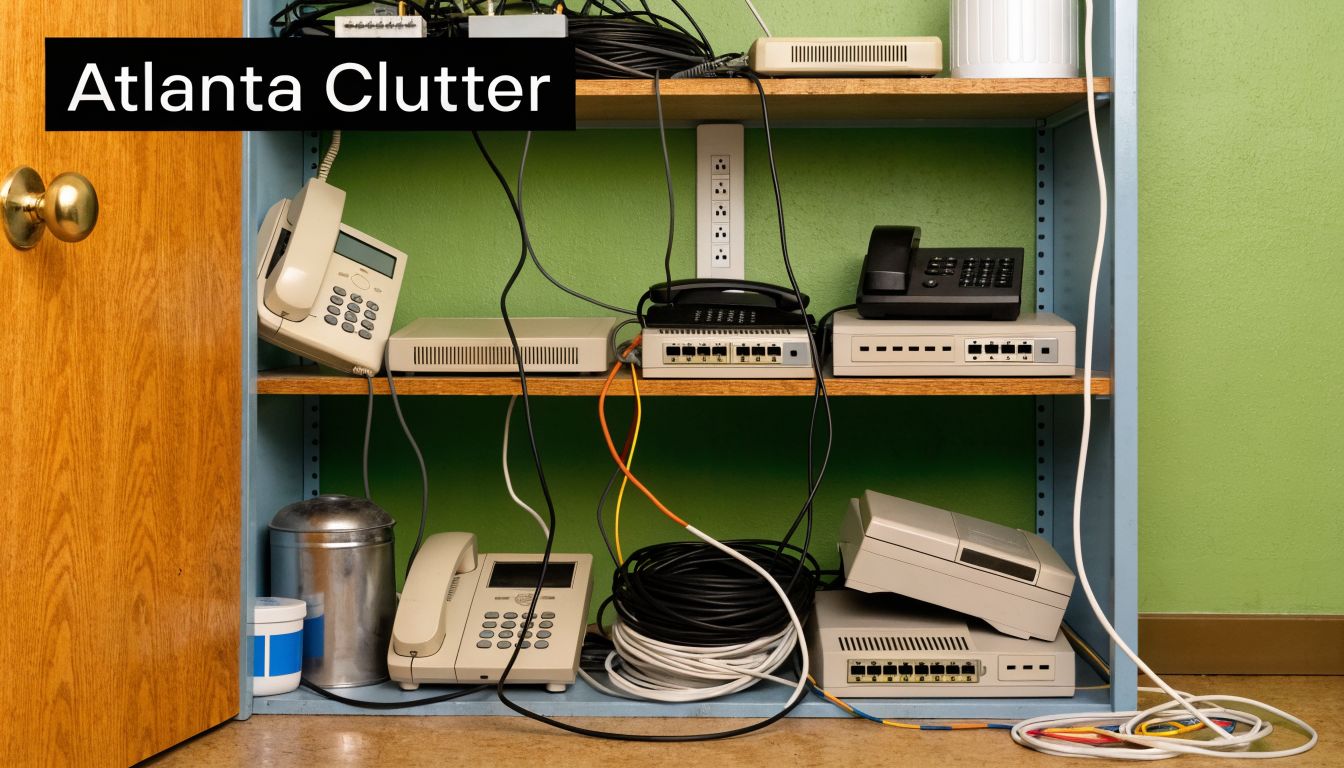
That delay creates risk. Old telecom gear often holds more than people think. Switches, firewalls, PBX systems, and VoIP appliances can retain configuration data, credentials, call records, or stored system settings. If a business hands that equipment to an unvetted hauler or drops it into a general recycling stream, the problem isn't just clutter anymore.
The bigger issue is that disposal has become part of a much larger waste and compliance problem. The world generated a record 62 million tonnes of electronic waste in 2022, and that volume is rising at nearly five times faster than documented recycling efforts, according to the Global E-waste Monitor 2024. That matters locally because every Atlanta business contributes to the same downstream system.
Practical rule: If your telecom gear was important enough to install with care, it's important enough to remove with documentation.
Businesses searching for telecom solutions in Atlanta usually don't need a map pin. They need a process. They need to know who inventories the gear, who disconnects it, how data gets destroyed, what paperwork they'll receive, and whether the recycler can manage a real office environment instead of treating the job like a household drop-off.
That's the gap this guide addresses. It's for companies dealing with rack gear, handsets, patching, cabinets, demarc hardware, and retired telecom systems that can't just be tossed in a bin and forgotten.
Identifying Telecom Assets You Need to Dispose Of
A lot of businesses underestimate the scope of their telecom disposal project because they only count desk phones. In practice, the phones are usually the easy part. The harder part is everything behind them.
What counts as telecom equipment
Start with anything that carried voice traffic, network traffic, or communications management inside your office, building, or campus.
- Desk phones and VoIP handsets. These are the visible pieces everyone notices first. They may be simple endpoints, but in larger deployments they're tied to licensing, call routing, and user assignments that should be documented before removal.
- PBX systems and phone controllers. Think of these as the central switching layer for office communications. Legacy PBX cabinets, VoIP controllers, and call management appliances often sit forgotten in telecom closets long after migration.
- Network switches. These are part of the office's central nervous system. Rack-mounted switches, stackable switches, and managed edge switches may contain saved configurations and network details.
- Routers and firewalls. These devices often hold WAN settings, credentials, VPN information, and policy configurations. They should never be treated like scrap metal.
- Wireless access points and controllers. These may look small, but they're still part of the managed network environment.
- Modems, gateways, and demarcation equipment. Carrier handoff devices and related edge hardware are easy to overlook during decommissions.
- Patch panels and structured cabling hardware. These don't usually create the same data risk, but they matter for removal planning and labor.
- Server racks, wall-mounted cabinets, and network enclosures. The cabinet itself may have no data value, but it changes the pickup logistics completely.
- UPS units and related support gear. Backup power equipment may be part of the same closet or rack footprint and often gets bundled into the same removal project.
What businesses miss most often
The biggest misses are usually mixed-use assets. A device may look like simple telecom hardware but still store system data or user information. That's why a quick visual sweep isn't enough.
If the device was configured, managed, licensed, or connected to your production network, treat it like an IT asset until proven otherwise.
Before scheduling pickup, make a rough list by room or closet. If you need a framework for broader IT asset disposal planning, use the same discipline you'd use for retired servers or workstations. Count the obvious items, then inspect the rack, cabinet, shelf, and floor space around them. That's usually where the forgotten hardware is.
The Compliant Telecom Disposal Process from Start to Finish
A proper business telecom disposal job follows a sequence. When vendors skip steps, that's where problems start. Equipment gets removed without records, data-bearing devices leave the site without sanitization, or a cleanout crew takes the visible items and leaves the complicated ones mounted in place.
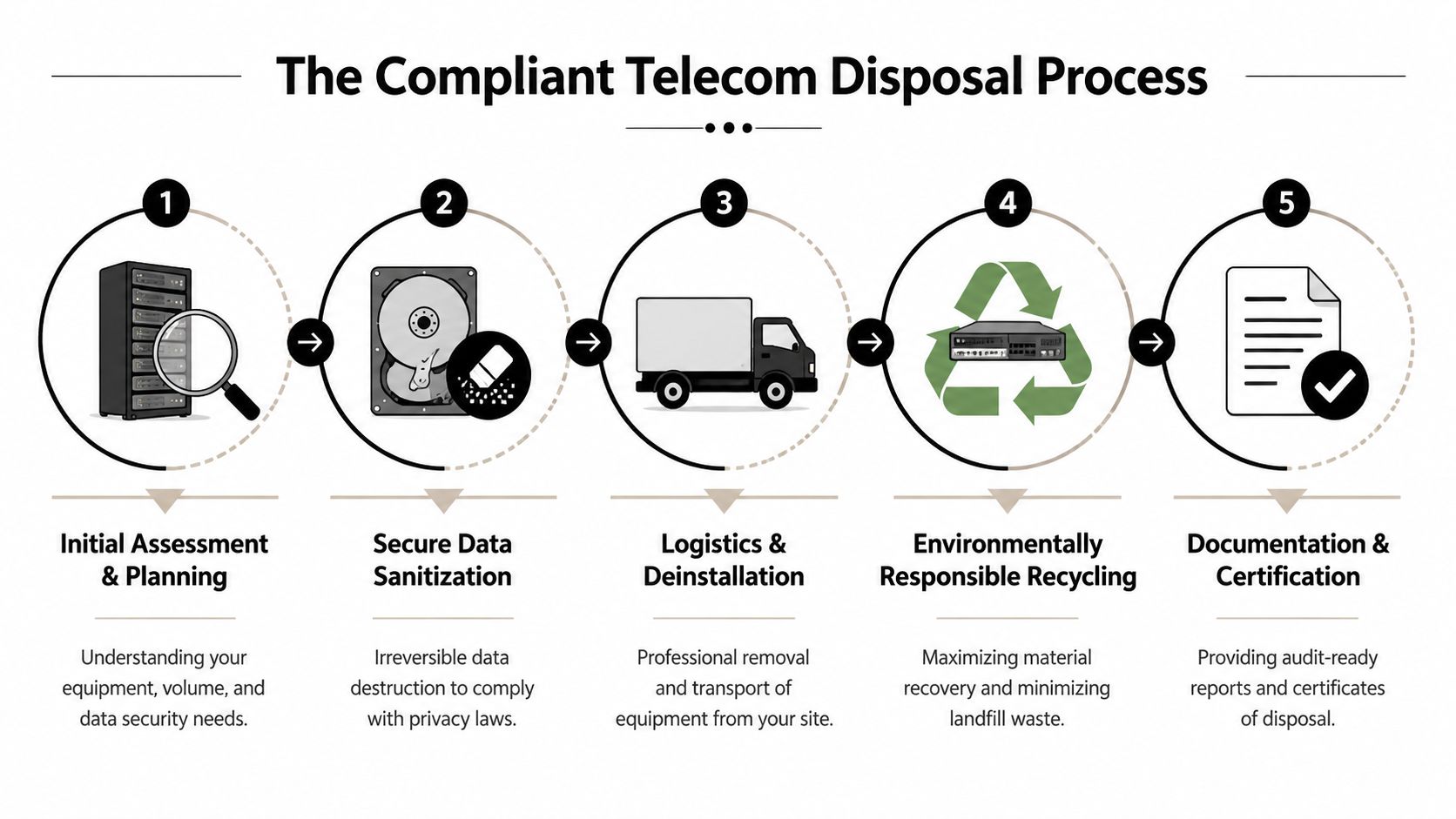
Initial assessment and logistics planning
The first step is a site-level review. A qualified recycler or ITAD provider needs to know what's being removed, where it sits, whether it's mounted, whether elevators or loading docks are involved, and whether the job must happen during a maintenance window.
This is also where the project gets separated into categories. Some items are simple bulk recycling. Some are resale candidates. Some require data destruction before they move. Some need on-site deinstallation by people who know how to work around active infrastructure.
A basic planning pass should answer questions like:
- What's loose and ready to go
- What's still mounted in racks or cabinets
- Which devices may store data
- Whether the client needs a serialized inventory
- Who signs chain-of-custody paperwork at pickup
If the disposal is part of a larger office shutdown, it helps to coordinate with facilities and furniture teams so the telecom work doesn't get trapped behind cubicles, locked rooms, or pending landlord access. In those situations, outside resources like these expert office cleanout solutions can help businesses think through sequencing before the telecom crew arrives.
Secure deinstallation and removal
Removal work isn't just hauling. In many offices, telecom gear is still mounted high in racks, attached to ladder trays, or bundled with power and patching that was installed years ago.
Good crews remove equipment in a way that preserves control. They label where needed, separate reusable assets from scrap-bound units, and keep data-bearing equipment from getting mixed into general loadout. That matters if you later need to match certificates to specific devices.
Some jobs need after-hours service because core switches, routers, or telecom controllers are still supporting branch systems until cutover is complete. Others are straightforward weekend pickups of already-disconnected hardware. The process should fit the environment, not the other way around.
A recycler that only offers curbside-style pickup usually isn't set up for enterprise telecom decommissions.
Certified data destruction
This is the step businesses care about most once they understand what telecom systems can retain. Not every telecom asset has a hard drive, but enough of them do, or contain non-volatile storage, that you should plan for sanitization from the beginning.
DoD 5220.22-M three-pass hard drive wiping is a military-grade data sanitization protocol that overwrites all data sectors across three sequential passes. This method is essential for meeting NIST SP 800-88 guidelines and satisfying HIPAA, PCI-DSS, and FISMA compliance requirements.
In practice, wiping and shredding serve different purposes. Wiping supports reuse when the media remains viable and policy allows it. Physical shredding is the answer when the device is damaged, highly sensitive, or your internal standard requires destruction over erasure.
For organizations that need a structured vendor workflow, IT asset disposal services typically combine pickup, chain-of-custody handling, wiping certificates, and optional on-site shredding into one documented process.
Environmentally responsible disposition and documentation
Once removal and data handling are complete, the remaining question is where the equipment goes. Certified downstream processing matters for this reason.
Some assets can be refurbished or remarketed if they still hold value. Others go to material recovery, where metals and components are separated through compliant recycling channels. What should not happen is untracked dumping, informal dismantling, or shipment into opaque downstream chains.
The business side of this is paperwork. A proper closeout usually includes some combination of asset reporting, certificates of data destruction, recycling documentation, and final disposition records. If your company faces audits, insurance reviews, or internal compliance checks, those documents matter as much as the truck that removed the gear.
Meeting Data Security and Environmental Regulations
The fastest way to create liability is to treat telecom equipment like ordinary office junk. Once a device has touched your network, call systems, or user environment, disposal becomes a security and environmental decision, not just a cleanup task.

Why certification matters
For Atlanta-area businesses, understanding whether a recycler holds R2 certification directly impacts organizational liability. Uncertified facilities may improperly handle hazardous substances, creating environmental contamination and exposing the generating organization to Superfund liability under CERCLA, as noted by York City's environmental resources page.
That's the part many businesses miss. Liability doesn't always end when the truck leaves your parking lot. If your vendor can't show audited processes and responsible downstream handling, your organization may still carry the risk.
A certified recycler is also easier to defend internally. Procurement teams, legal departments, and compliance officers all want the same thing. A documented process, clear chain of custody, and proof that sensitive equipment didn't disappear into an unknown channel.
What regulated industries should expect
Healthcare, finance, education, and government offices usually need more than a generic “recycled” receipt.
Here's what tends to matter most:
- Documented sanitization. If a device stored protected or confidential data, your records should show how that data was destroyed.
- Chain of custody. Someone should be able to show who handled the equipment from pickup through final disposition.
- Asset-level visibility. For many projects, especially mixed telecom and IT removals, broad category counts aren't enough.
- Downstream accountability. You should know whether the recycler uses vetted processors and compliant material recovery channels.
Compliance officers don't want a verbal assurance. They want records they can file.
If your organization needs a local provider for Georgia ITAD services, ask direct questions before pickup is scheduled. Do they provide wiping certificates. Do they offer physical shredding. Can they handle rack gear and mounted equipment. Will they issue documentation your auditors can use. Those answers tell you more than a marketing brochure will.
The environmental side isn't separate
Businesses sometimes split data security and environmental responsibility into two separate concerns. In real disposal work, they're connected. A vendor that cuts corners on one side often cuts corners on the other.
Telecom equipment contains boards, metals, batteries, and components that require proper handling. The right recycler doesn't just remove the problem from your office. They control the full path from collection through final processing, so your business isn't stuck explaining later why sensitive and hazardous equipment was handled informally.
Your Pre-Pickup Telecom Equipment Checklist
Most pickup delays come from simple things. Equipment is spread across three rooms, nobody knows which closet is in scope, and the employee with badge access is out that day. A short prep list solves most of that.
Before scheduling service, it also helps to confirm whether you need a business pickup or a small-quantity drop-off option like Atlanta electronics recycling pickup support.
Telecom Disposal Preparation Checklist
| Step | Action | Why It's Important |
|---|---|---|
| 1 | Gather equipment into one defined area when possible | Consolidation speeds loading and reduces the chance that small devices or accessories get missed |
| 2 | Make a basic inventory of major items | Even a simple list of switches, phones, racks, and controllers helps align pickup scope with documentation |
| 3 | Flag any data-bearing devices | This helps the recycler separate assets that need wiping or shredding from general recycling |
| 4 | Identify mounted or hard-to-access hardware | Wall cabinets, rack gear, and ceiling-adjacent equipment may require extra labor or scheduling |
| 5 | Remove anything still needed for operations | This prevents accidental pickup of live gear, spare units, or recently replaced hardware still in service |
| 6 | Confirm access details | Loading dock access, elevators, suite numbers, and after-hours entry all affect how smoothly the job goes |
| 7 | Assign one on-site contact | The recycler needs someone who can answer scope questions and approve any day-of decisions |
| 8 | Set aside related accessories if they should go too | Power supplies, handsets, patch cords, and mounting hardware often get left behind unless they're clearly included |
Small prep work on your side usually prevents big confusion on pickup day.
Why Atlanta Businesses Choose Montclair Crew
Local businesses usually want the same three things from a telecom disposal vendor. They want the equipment gone without disrupting work, they want data handled properly, and they want paperwork that stands up to internal review.

That's why Atlanta companies tend to favor providers that can do more than accept a few phones at a loading dock. They need on-site pickup, deinstallation support, asset audit and logistics help, secure data destruction, and environmentally compliant downstream processing. If there's reusable value in retired equipment, they also want to know that it won't be destroyed unnecessarily.
One Atlanta-area option is Montclair Crew Recycling. The company handles B2B IT equipment disposal and electronics recycling for organizations across Metro Atlanta, including Alpharetta, Marietta, Kennesaw, Norcross, Sandy Springs, Roswell, and nearby markets, with a drop-off center in Smyrna. Its services include on-site removal, DoD 5220.22-M three-pass hard drive wiping, optional on-site shredding, asset tracking, and disposition support for telecom gear and related IT assets.
What practical buyers usually look for
The local fit matters more than most vendor lists admit.
- Fast site access. A Metro Atlanta provider can usually coordinate around building schedules, office moves, and decommission windows more easily than an out-of-market hauler.
- Business-focused handling. Enterprise telecom gear isn't the same as residential e-waste, and the service model should reflect that.
- Flexible disposition paths. Some assets belong in recycling. Others may have reuse or resale potential.
- Straight documentation. Businesses want records that are easy to match against internal asset lists.
Discarded electronics represent approximately 70% of all heavy metals found in U.S. landfills, according to STS Electronic Recycling. That's a strong reason to keep telecom and network hardware in certified recycling channels instead of letting it drift into general waste handling.
The local advantage
A nearby provider also makes small follow-up jobs easier. Many companies don't finish telecom disposal in one round. They clear the main closet first, then find another stack of handsets, spare switches, or boxed accessories during the next cleanup pass.
That's where local service tends to work better. You're not rebuilding the process from scratch every time. You already know the pickup model, the documentation flow, and who to call when the next batch shows up.
Common Questions About Telecom Equipment Disposal
Can I just drop everything off at a public e-waste event
Usually not, at least not if you're disposing of business telecom infrastructure. Public electronics collection programs are typically designed for consumer devices. They rarely address deinstallation, chain of custody, data destruction, or serialized reporting for business equipment.
Do old phones and switches really contain sensitive data
Sometimes yes, and that's why they should be screened before disposal. Managed switches, firewalls, PBX systems, VoIP appliances, and some handsets can store configuration data, credentials, logs, or user information.
Why isn't there a flat price for telecom equipment disposal near me
Because scope changes everything. A few boxed handsets are one job. A rack-mounted switch stack with cabinets, UPS units, and access restrictions is another. Pricing usually depends on volume, access, labor, data destruction needs, and whether equipment has resale value.
If you're comparing residential pricing models for simpler junk hauling, this guide to junk removal pricing for homeowners gives useful context on why removal quotes vary by load size and labor. Business telecom disposal adds compliance and data security requirements on top of that.
What if I only have a small amount of gear
Small loads may be a fit for drop-off rather than a full truck call. That depends on the equipment type and whether any devices need documented data destruction.
Do you handle residential telecom waste
Some business recyclers focus on commercial jobs and refer residential or specialized categories to partner companies. That's common when the handling requirements differ from standard B2B telecom and IT asset work.
How fast can pickup happen
Turnaround depends on the project size, building access, and whether deinstallation is needed. Boxed equipment can move quickly. Multi-room cleanouts, mounted hardware, and after-hours projects usually need more planning.
If you need a compliant path for retired phones, switches, PBX hardware, racks, or mixed network equipment, contact Montclair Crew Recycling. They work with Metro Atlanta businesses that need pickup, data destruction, audit-ready documentation, and responsible telecom equipment disposal without treating an enterprise cleanout like a simple drop-off.
