

Most Houston businesses ask the wrong first question. They ask, “What speed can I get at this address?” when the better question is, “What connection will keep my phones, cloud apps, and staff productive when the day gets messy?”
That gap matters. A fast plan that drops VoIP calls, struggles with uploads, or takes too long to restore after an outage will cost you more than a slightly higher monthly bill ever will. In Houston, the choice isn't just between two national brands. You're weighing national carriers, cable incumbents, Texas-focused fiber networks, local metro fiber operators, and newer 5G fixed wireless options that can solve real problems in the right setting.
If you're comparing small business telecom providers Houston businesses use, look past headline speed. Look at support model, backup options, contract structure, and whether the provider fits your building and workflow. A law office, medical practice, field service company, and warehouse don't need the same network profile.
This guide gets to the point. It compares seven practical options for Houston SMBs, including wireline and wireless choices, with an emphasis on reliability, local support, and future-proofing. If your business also depends on voice systems, this outside guide on optimizing business telephony for UK SMBs is a useful parallel read because the underlying decision logic is similar even across different markets.
1. AT&T Business
AT&T is usually on the shortlist for one reason. It can cover a lot of scenarios without forcing you to switch providers later.
If you have one office today and expect to add locations, mobile lines, cloud phones, or a more formal internet circuit later, AT&T is one of the safer starting points. That breadth matters more than flashy promo language. A provider that fits now but breaks when you add a second site becomes expensive fast.
Where AT&T fits best
AT&T Business works well when you want fiber, business phone options, and the ability to bundle mobility under one umbrella. For some Houston businesses, that simplifies billing and support enough to justify paying a bit more than the cheapest local option.
Its business portfolio also makes sense if you expect your needs to change. You can start with standard business fiber and later move into more structured business internet or unified communications without rebuilding your vendor list. If you're sorting through telecom services in Houston, that's one of AT&T's strongest practical advantages.
Practical rule: If your business depends on cloud storage, large file uploads, remote staff, or VoIP-heavy call volume, symmetric fiber matters more than marketing around “up to” download speed.
What to watch before you sign
AT&T's trade-off is simple. Availability and final pricing are address-dependent, and the most attractive pricing often assumes you also carry eligible wireless services. That's not unusual, but it does mean the online number may not reflect your true stand-alone cost.
A few practical notes matter:
- Fiber first: If fiber isn't available at your suite, don't assume the alternative performs the same way.
- Backup isn't the same as full continuity: Built-in wireless backup can help, but you still need to ask how your specific setup behaves during failover.
- Bundle logic cuts both ways: Bundles can lower cost, but they also make future vendor changes more annoying.
AT&T is rarely the most interesting option on paper. It is, however, one of the most practical choices for SMBs that want a mainstream provider with room to grow. If you value flexibility across internet, voice, and mobility more than highly localized support, it's a strong baseline.
Find the platform at AT&T Business.
2. Comcast Business
Comcast Business is the provider I see most often in “we need something available now” conversations. That isn't a criticism. Broad availability is a real operational advantage.
For many Houston offices, Comcast is easier to install than niche fiber, easier to quote than custom metro fiber, and easier to bundle with voice and mobile than dealing with separate vendors. If your priority is getting a business online with a mainstream provider and predictable service packaging, Comcast earns its place.
Why Comcast wins many small office decisions
Comcast Business is a practical fit for standard office use, especially where coax service is already in the building and fiber alternatives are limited or expensive. It gives you internet, voice, Wi-Fi, and security features under one account, which is often enough for small teams that don't want network complexity.
Houston's telecom market rewards uptime and response expectations. Established providers in the area commonly target uptime guarantees above 99.9 percent as a standard benchmark, and providers competing in Houston also emphasize fast on-site response and fiber-rich infrastructure in business settings, according to Houston telecom provider landscape analysis. Comcast fits that broader “business continuity first” pattern better than many buyers assume.
If you're comparing mainstream options and need a nearby benchmark, this page on finding business telecom services near me is useful for framing what support expectations should look like.
The trade-offs are predictable
Comcast's biggest weakness isn't that it's cable. It's that buyers sometimes choose it for the wrong workload.
- Good fit: Browsing-heavy offices, general cloud app use, basic VoIP, and teams that value simple bundling.
- Less ideal fit: Environments with heavy upstream traffic, strict latency sensitivity, or specialized networking needs.
- Contract caution: The cleanest pricing often comes with a term choice or price-lock structure, so read the commitment details.
A stable, widely available provider often beats a theoretically better option that can't serve your exact suite or won't install on your timeline.
Comcast Business is often the right “practical over perfect” choice. If your building supports stronger fiber alternatives, compare them. If not, Comcast can still be a solid answer when uptime features, support scale, and bundled services matter more than bespoke engineering.
Visit Comcast Business.
3. LOGIX Fiber Networks
Need more than a basic internet pipe for one office?
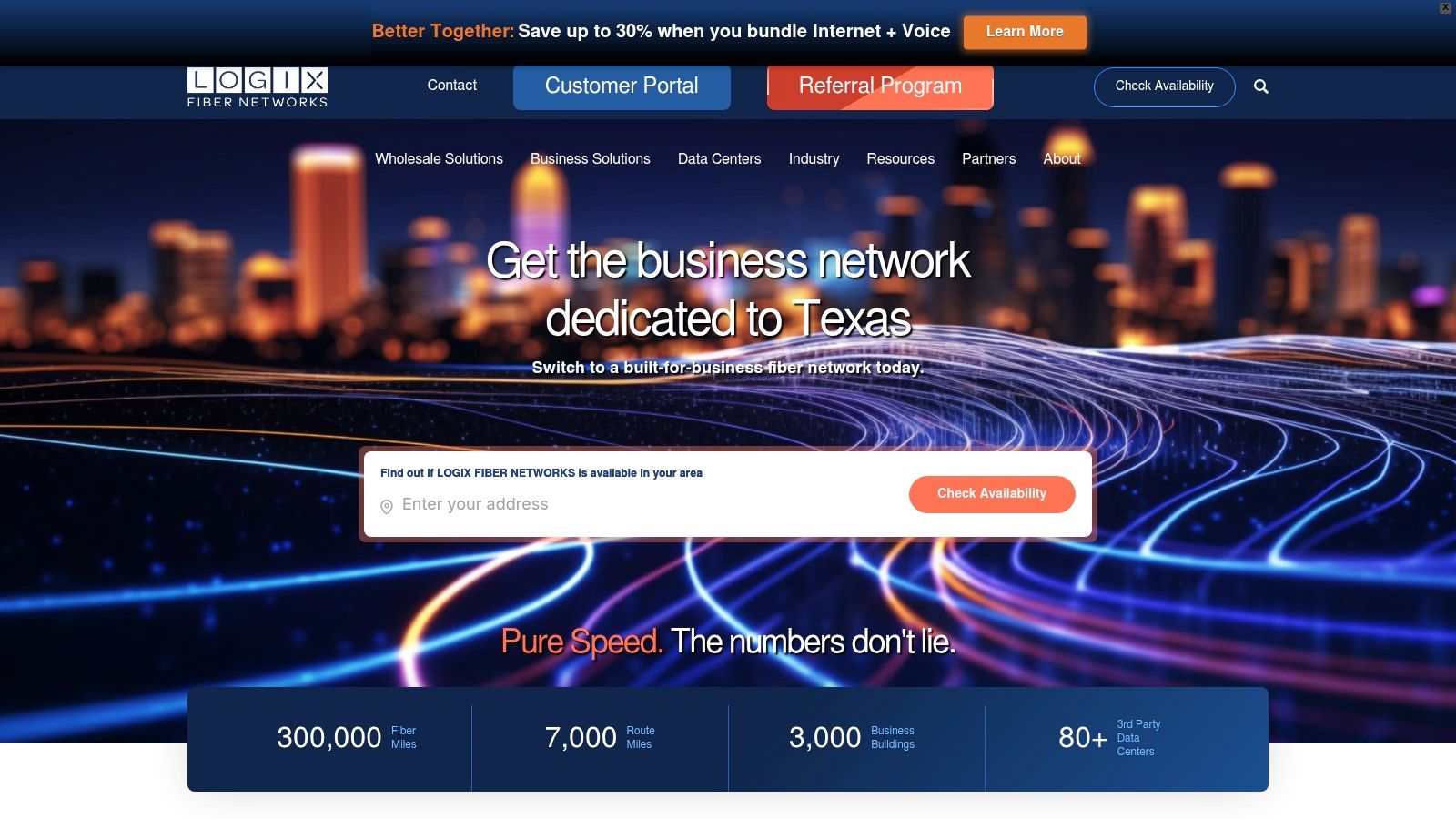
LOGIX usually enters the conversation when your business has higher stakes than simple web browsing and email. If you run multiple sites across Texas, depend on VoIP, connect to cloud platforms with private networking, or keep systems in colocation space, LOGIX is often a better fit than a mass-market package built for broad coverage first.
Its value in Houston comes from focus. LOGIX is built around business fiber in Texas, not around selling the same service to apartments, home offices, and enterprise buyers under one umbrella. That changes the buying experience and the support model.
Why Texas-focused fiber matters
Houston companies often compare providers on download speed and monthly price, then find out later that install complexity, upstream performance, and support responsiveness matter more. LOGIX tends to make more sense for firms that treat connectivity as operating infrastructure.
LOGIX also stands out for businesses with infrastructure beyond a single office. It offers dedicated internet, Ethernet, voice, and multi-location connectivity on a Texas-focused fiber network, with interconnections into more than 80 third-party data centers across Texas. If your applications live in regional colocation or hybrid environments, that can matter more than a flashy speed claim on a promo sheet.
I usually tell clients to ask a harder question before they ask for quotes. How well will this provider support the way your business is likely to grow over the next three to five years? That is the point where regional fiber providers start to separate themselves from cheaper short-term options, including some cable circuits and certain fixed wireless plans.
If you are comparing specialist providers across Texas markets, this guide to telecom consulting services in Dallas for multi-location businesses is a useful reference for evaluating support depth and network fit, not just headline pricing.
Where LOGIX fits best
LOGIX is usually strongest in on-net and near-net buildings where the provider can install without major construction work. In those cases, you are more likely to get the benefits you are paying for. Better service design, more business-aligned support, and cleaner options for site-to-site connectivity.
The trade-off is straightforward. Coverage is more selective than AT&T or Comcast, and pricing will not always win the lowest-bill comparison for a very small office. That does not make LOGIX expensive by default. It means you need to evaluate total fit, especially if downtime, packet loss, or clunky support would cost your business more than the monthly rate difference.
- Best fit: Multi-site Texas businesses, healthcare and professional services firms, offices with private networking needs, and companies that may outgrow basic broadband.
- Less ideal: Tiny teams shopping only on monthly price, short-term leases, or buildings outside practical LOGIX reach.
- Ask before you compare quotes: Is the building on-net, near-net, or dependent on new construction, and what does that do to install time and total cost?
For Houston businesses choosing between national providers, Texas fiber specialists like LOGIX, and newer 5G fixed wireless options, LOGIX is often the choice for buyers who want reliability, local relevance, and room to grow without rebuilding the network later.
4. Phonoscope Fiber
Phonoscope is the Houston-native option that many local businesses overlook until they need something more customized than a standard business internet package. Once private connectivity, dark fiber, or local engineering support enters the conversation, it becomes much more relevant.
That local specialization matters in a city where coverage, building access, and last-mile design can make or break the service experience. If your operation needs more than “internet and a phone line,” Phonoscope becomes interesting fast.
The local engineering advantage
In the Houston small telecom market, Phonoscope Services Inc. is the largest company by employee count, with 51 to 200 employees. That doesn't automatically make it the best fit for every SMB, but it does suggest meaningful local operational depth in a fragmented market of approximately 452 active telecom companies in Houston, where the top provider remains under $47M in annual revenue according to the same market view.
For a buyer, the practical takeaway is simple. Houston doesn't have a single dominant small-business telecom winner. It has lots of specialists. Phonoscope's value is that it's local, established, and capable of customized network work inside the metro.
If your review includes more strategic planning around telecom lifecycle decisions, this page on telecom consulting services Dallas is still useful because the consulting principles apply well beyond one city.
Houston businesses with custom connectivity needs often do better with a metro-focused provider that can speak directly to building access, fiber routes, and local network design.
Best use cases for Phonoscope
Phonoscope is usually strongest when your business wants a custom fit instead of a prebuilt package.
- Private networking: Good for point-to-point links and more controlled local connectivity.
- Higher-touch support: Better fit if you want Houston-based teams involved in engineering and service discussions.
- Specialized environments: More relevant for multi-building campuses, media workflows, larger offices, and firms with unusual routing or bandwidth needs.
The drawback is the same one that affects many specialized providers. Public pricing isn't the draw, and footprint outside Greater Houston isn't the story. If you need broad national standardization, look elsewhere. If you need a Houston operator that can build around your environment, Phonoscope belongs on your shortlist.
Visit Phonoscope Fiber.
5. Astound Business Solutions
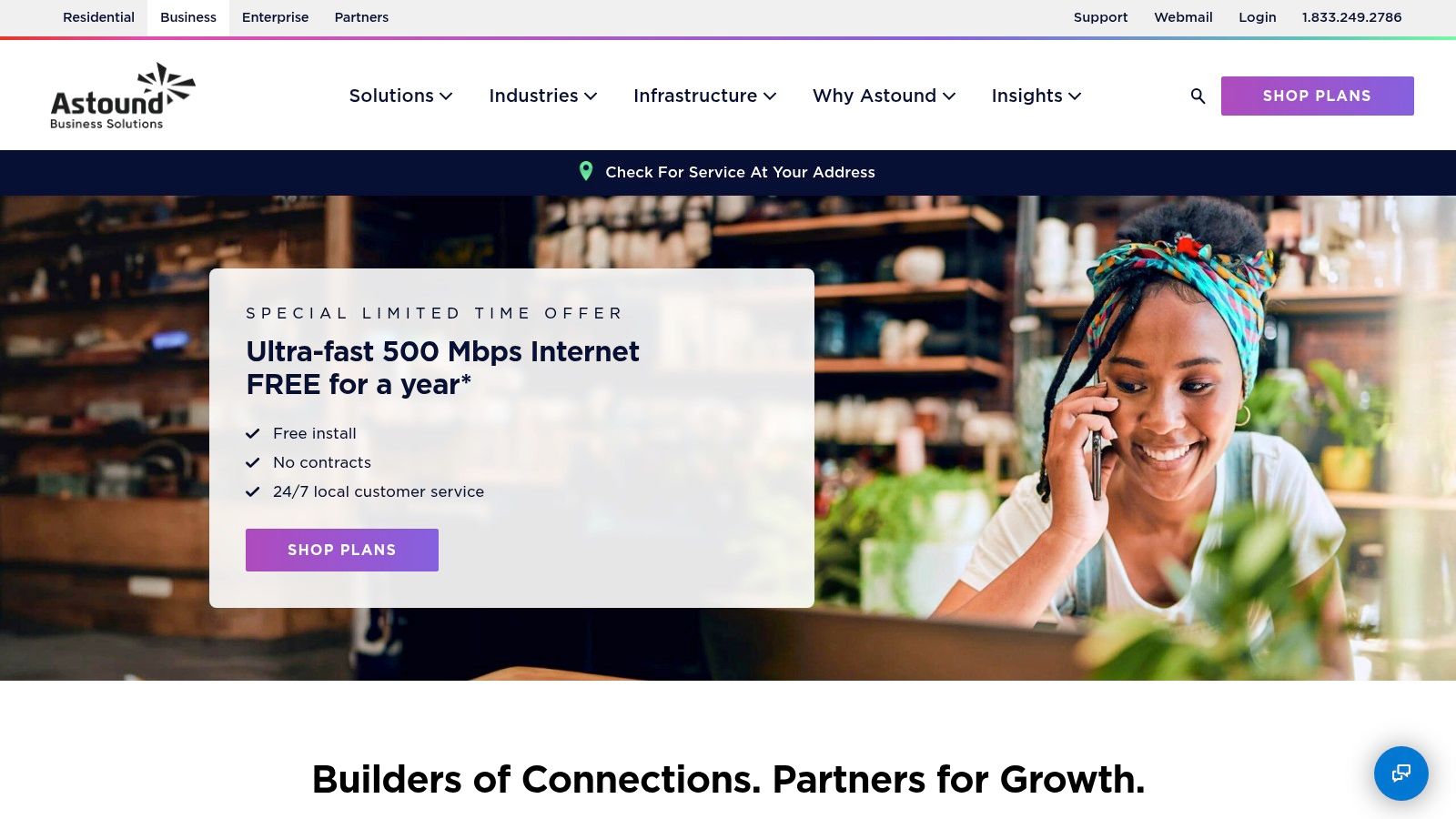
Astound Business Solutions is the value play that can make a lot of sense if your office sits in the right served area. Because of its Houston enTouch heritage, it can feel more local than many national alternatives, even though buyers still need to treat coverage as highly address-specific.
This isn't the provider I'd start with if you need citywide consistency across multiple unknown future locations. It is one I'd absolutely price-check for a small office, clinic, storefront, or branch that needs business internet and voice without overspending.
Where Astound makes sense
Astound works best when your need is straightforward and the local plant is already there. In those situations, the provider can be a practical one-stop option for internet and voice, with enough local familiarity to appeal to Houston-area businesses that don't want a giant-carrier feel.
This option is also relevant for businesses that are replacing older telecom setups and trying to simplify. In Houston's SMB market, managed providers and telecom integrators increasingly bundle voice, broadband, security, and cloud services under one relationship, as shown by Cytel's Houston business communications model. That trend matters because many smaller companies don't want to coordinate separate voice, internet, and IT vendors anymore.
If your organization is modernizing locations while planning for equipment retirement, these broader enterprise telecom solutions in Atlanta offer a useful lens on how telecom transitions affect hardware disposal and support models.
Where buyers get tripped up
Astound's weakness is not quality so much as reach. You have to verify the exact service reality at your address.
- Don't assume continuity across moves: A provider that works well in one building may not be available in your next lease.
- Check the actual access type: Coax and fiber are not the same buying decision.
- Price with the full bundle: If voice matters, compare the total package, not internet in isolation.
Astound can be a very sensible choice for a smaller Houston office in the right footprint. Just don't mistake a neighborhood-strength option for a universal citywide answer.
See Astound Business Solutions.
6. Verizon Business
Verizon Business earns attention for a different reason than the wireline providers. Speed isn't the main story. Deployment speed is.
If you need connectivity for a new suite, temporary location, pop-up operation, field office, or a backup path that doesn't require waiting on construction, Verizon's fixed wireless offering can solve a real business problem. That's where 5G fixed wireless belongs in the conversation around small business telecom providers Houston companies should compare.
When 5G fixed wireless is the smart move
Verizon is strongest when time-to-service matters more than perfect symmetry. Fiber remains the better long-term primary connection for upload-heavy offices, but a fast-turn wireless option is often the right answer for transitional spaces or continuity planning.
This also matters in Houston's operating environment. Local telecom competition places a premium on responsiveness and redundancy, and businesses increasingly want flexible service models that support hybrid work and cloud-heavy operations, as noted earlier in the Houston provider sector.
Use fixed wireless when you need coverage quickly, need a secondary path, or need to avoid construction delays. Don't choose it blindly for a video-heavy office that pushes large files upstream all day.
The real limitations
5G business internet works best when you accept what it is. It isn't metro fiber. It isn't dedicated internet. It is a fast, flexible access option with location-dependent performance.
That means you should ask practical questions:
- Test the exact suite: Signal and congestion can differ within the same building.
- Map the workload: Browsing, SaaS, and backup access are different from media uploads or large offsite sync jobs.
- Know your failover plan: If Verizon is your backup, decide what traffic should ride it during an outage.
For many SMBs, Verizon is not the forever primary circuit. It is the fast, useful, low-friction connection that keeps business moving when fiber isn't ready or doesn't make sense.
Review Verizon Business.
7. T-Mobile for Business
T-Mobile for Business is the simplest 5G option for many small teams. That's the appeal. Fewer installation headaches, less waiting, and less contract friction.
For startups, small offices, temporary workspaces, and businesses that need backup internet without another full construction cycle, T-Mobile can be a practical fit. It also works well when the buying team values speed of setup and pricing simplicity more than network customization.
Where T-Mobile shines
T-Mobile is best for businesses that want usable internet fast and don't want to overcomplicate the decision. Self-install hardware and straightforward plan design lower the barrier for small teams that just need to get online and stay productive.
That simplicity also makes it a useful stopgap during transitions. If you're moving off older voice or network gear, one gap many providers leave unaddressed is total cost of ownership. Houston telecom content often highlights features but rarely breaks down contract transparency, equipment costs, lock-in, or what old telecom assets are still worth during a transition, as discussed in Frontier's Houston business telecom context. That's relevant because a quick-turn wireless service can bridge the gap while you decommission older systems and recover value from retired equipment.
What T-Mobile won't do well
T-Mobile is not the right answer for every office.
- Not ideal for heavy upstream use: If your team sends large files all day, fiber is still the stronger primary choice.
- Not equally strong everywhere: Building construction, neighborhood capacity, and indoor signal all matter.
- Not a substitute for network design: If uptime is mission-critical, pair wireless with a primary wireline service instead of treating it as magic.
The best use of T-Mobile is often pragmatic. Use it as a primary connection for a small, mobile, or temporary operation. Use it as interim service while waiting on wireline. Or use it as a secondary path so one provider outage doesn't take your whole office down.
Go to T-Mobile for Business.
Houston Small Business Telecom: 7-Provider Comparison
Which provider fits how your Houston business operates once installation timelines, outage risk, and support quality enter the picture?
A simple speed chart will not answer that. Houston businesses often need to compare three different service models at once: large national carriers with broad availability, Texas fiber providers with stronger local engineering, and 5G fixed-wireless options that solve timing or backup problems fast. The right choice depends on whether you need day-one availability, lower-latency fiber, better local escalation, or a second path that keeps your office online when a wired circuit fails.
| Provider | Implementation complexity | Resource requirements | Expected outcomes | Ideal use cases | Key advantages |
|---|---|---|---|---|---|
| AT&T Business | Moderate. Fiber installs, building access, and multi-site setup can add coordination time. | Fiber availability matters. Bundled wireless can improve overall value. | Symmetrical fiber where available, plus stronger options for dedicated internet and mobile integration. | Growing offices, multi-location firms, and teams that want one national provider across internet and wireless. | Broad product mix, business fiber options, and wireless backup paths on some plans. |
| Comcast Business | Low to moderate. Coax is often faster to install than fiber, but business fiber still requires a site review. | Best pricing often comes with a term agreement. Availability is usually strong in many Houston commercial areas. | Reliable day-to-day broadband, with fiber available for businesses that need more than coax can deliver. | Small and midsize offices that want wide availability and a simpler buying process. | Broad reach, familiar bundles, and a practical fit for many standard office environments. |
| LOGIX Fiber Networks | Moderate. Quote-based installs, but the process is built for business circuits rather than consumer-style orders. | Best fit where LOGIX is already on net or close to the building. Local support can shorten problem resolution. | Lower-latency dedicated connectivity, Ethernet services, and better alignment for companies that depend on uptime. | Professional services, healthcare, finance, and multi-site firms that need business-grade fiber in Texas. | Texas-focused support, dedicated network options, and strong fit for businesses that have outgrown mass-market internet. Visit LOGIX Fiber Networks. |
| Phonoscope Fiber | Higher. Custom builds, private links, and darker-fiber-style projects take more planning. | Engineering review is often part of the sale. This is usually a custom quote, not a click-to-buy service. | High-capacity fiber, private network options, and strong local design support for Houston-area deployments. | Companies with heavier uptime demands, campus connectivity needs, or custom network requirements inside Houston. | Local backbone, Houston roots, and hands-on support for tailored connectivity projects. |
| Astound Business Solutions | Low. Straightforward where service is already in the area. | Coverage can be address-specific, so serviceability checks matter. | Cost-conscious internet and voice options for businesses inside its footprint. | Small offices that want a simpler bundle and are already in a served building or neighborhood. | Competitive pricing in covered areas and a relatively easy path to activation. |
| Verizon Business | Low. Fixed wireless can be turned up faster than most wired services. | Strong signal quality and building conditions matter. Professional install may help in tougher spaces. | Fast deployment, useful continuity coverage, and a practical option where wired service is delayed or limited. | Temporary offices, new suites, retail sites, and businesses that want a backup connection. | Quick installs, flexible use cases, and a strong role as a secondary circuit. |
| T-Mobile for Business | Low. Simple hardware and easy setup reduce deployment friction. | Performance depends on local 5G conditions and indoor reception. | Good short-term or small-office connectivity in the right location, plus practical failover use. | Small teams, pop-up locations, temporary spaces, and businesses waiting on fiber. | Predictable pricing, easy setup, and a useful option for backup or interim service. |
The practical split is straightforward. AT&T and Comcast cover a lot of mainstream small business needs. LOGIX and Phonoscope deserve a closer look if your business depends on dedicated fiber, lower latency, or local support that can work through Houston-specific building and routing issues. Verizon and T-Mobile matter for a different reason. They give you fast deployment and a realistic backup strategy when waiting months for wireline is not acceptable.
Connecting Your Houston Business for What's Next
Houston offers more telecom options than many business owners realize. This variety is beneficial, yet it often leads to a frequent error. Buyers compare only advertised speed and monthly price, then end up with a service model that does not match how the business operates.
The better approach is to separate providers by role. AT&T and Comcast are broad, mainstream options that can cover a lot of SMB use cases. LOGIX and Phonoscope are stronger when business-grade support, local fiber footprint, or custom connectivity matter more than mass-market simplicity. Verizon and T-Mobile add a different kind of value. Fast deployment, backup connectivity, and flexibility when wireline isn't practical.
If you're narrowing the field, focus on a few questions. Can the provider serve your exact suite well, not just your ZIP code? Is the support model built for business interruption, not just routine billing? Will the connection still fit when you add more staff, more cloud apps, more voice traffic, or another location?
For Houston businesses, reliability should sit near the top of the list. Local conditions, building access, and operational urgency make support responsiveness and redundancy more important than a headline speed tier. A provider that offers a clean install, stable service, and a realistic backup plan is usually worth more than the cheapest quote on a comparison spreadsheet.
You should also think beyond activation day. Telecom decisions trigger hardware decisions. New circuits, UC platforms, managed firewalls, SD-WAN appliances, and retired PBX or networking gear all create lifecycle work. If you're replacing older equipment, don't ignore contract transparency, equipment ownership, and what happens to decommissioned telecom assets. Those hidden details often shape the true cost more than the advertised monthly rate.
That broader operational view is one reason local visibility still matters. A business that's easier to find, verify, and trust tends to close faster, and this guide on Improve local SEO through citations is useful if you're thinking about how telecom reliability and local discoverability both support growth.
There isn't one universal best choice among small business telecom providers Houston companies can buy from. There is only the provider that best fits your building, workload, growth plan, and tolerance for downtime. If you treat telecom as business infrastructure instead of a commodity utility, you'll make a better decision and avoid a costly re-do later.
If your telecom upgrade leaves you with old phones, servers, switches, storage, or other retired IT gear, Montclair Crew Recycling can help you handle the exit side properly. They support secure, compliant IT asset disposition with data destruction, logistics, recycling, and resale support where applicable, which is especially useful when a network refresh or office move turns into a larger decommissioning project.
