

Your team is in the middle of a client call. Someone is screen-sharing a contract, a payment approval is waiting, and the circuit drops. In Los Angeles, that kind of failure hits fast. Sales stall, editors lose sync, phones fall back to mobile, and IT ends up troubleshooting instead of working the queue.
Choosing telecom services in Los Angeles is an operations decision with local constraints. Provider quality can change by building, suite, and street frontage. One office may have multiple fiber options. Another may be limited to cable plus a wireless backup. That is why a straight feature comparison usually fails LA buyers.
The better way to evaluate this market is by provider type and primary strength. Major carriers are often the first call for bundled service and broad regional coverage. Fixed wireless providers make sense when install speed or backup matters more than perfect symmetry. Enterprise fiber specialists fit sites that move large files, support latency-sensitive workflows, or need cleaner handoffs into data centers and multi-site networks. That framework helps a retail shop in Highland Park, a warehouse near Vernon, and a post-production team in Burbank avoid the same mistake. Buying a service tier that does not match the actual business risk.
I usually advise teams to start with three questions. What happens if this site goes down for two hours? How much upload capacity does the business really need during peak use? Do you want one vendor for internet, voice, wireless, and failover, or do you have the staff to manage separate providers well?
Those trade-offs matter more than brand familiarity. A smaller office may be fine with business cable and LTE backup. A production studio sending large media files probably needs fiber, tighter SLA terms, and a provider that can speak clearly about routing, repair windows, and install dependencies. If you want a second market example of how provider categories shape the shortlist, this breakdown of telecommunications services in Chicago is a useful comparison.
If resilience is part of the brief, design for failure from the start. Primary access, backup connectivity, router failover behavior, voice continuity, and internal network design all affect the outcome. This guide compares seven Los Angeles providers by the jobs they do best, so you can match the provider to the site instead of forcing every office into the same template.
1. AT&T Business
A common LA scenario is a company opening a second site and deciding whether to keep stitching vendors together or put one carrier in charge of internet, voice, wireless, and backup. AT&T Business usually makes the shortlist for that job. It is the broad-coverage incumbent option in this comparison, and that matters when the business cares as much about procurement and support structure as raw bandwidth.
AT&T has a wide footprint across Los Angeles, as noted earlier, but that should never be confused with guaranteed fiber at a specific suite. I tell teams to treat AT&T as an address-check provider first, not an assumed yes. In older multi-tenant buildings, the difference between "in the area" and "ready to install" can mean extra construction, longer lead times, or a fall back to a different access method.
Best fit for bundled business connectivity
AT&T is strongest for businesses that want one provider category to cover several jobs. A small office can start with Business Fiber. A more sensitive site can move to Dedicated Internet Access. A company with field staff, backup connectivity requirements, and voice needs can keep those pieces under one contract instead of managing a carrier stack.
That model works well for:
- Single-vendor operations: One account team and one billing relationship can reduce admin overhead.
- Businesses with room to grow: It is easier to move from a standard business circuit to DIA than to replace the provider entirely.
- Multi-site companies: SD-WAN, managed security, mobility, and primary access are easier to coordinate when they sit with the same carrier.
The trade-off is straightforward. AT&T is broad, not always simple.
A few watchouts matter in real deployments:
- Address qualification can change the deal: Sales may start with a clean fiber conversation, then the serviceability check comes back with different install terms or timing.
- Bundle math needs scrutiny: Pricing can look better when wireless lines or other services are attached, so compare the actual contract cost, not the headline rate.
- Enterprise products add process: DIA, managed firewall, and multi-site designs can be the right fit, but they usually involve more paperwork and longer implementation cycles than SMB cable.
My rule of thumb is simple. If the site supports normal office work and the business wants fewer vendor relationships, AT&T is a strong first call. If the site is a production floor, media workflow, or anything else with serious upload demand and hard downtime costs, ask for exact access type, SLA terms, install dependencies, and time to repair before you sign.
For businesses comparing provider categories across cities, the major-carrier role AT&T plays here lines up with what buyers often evaluate in this guide to telecommunications services in Chicago for multi-service business connectivity.
If the goal is operational simplicity with a credible upgrade path, AT&T Business fits. Start with Business Fiber for standard offices. Use DIA when the circuit is tied to revenue, production deadlines, or customer-facing systems.
Visit AT&T Business.
2. Spectrum Business
Spectrum Business is the practical SMB default in a lot of LA buildings. Not because it’s glamorous, but because it’s often available fast, easy to order, and familiar to property managers. If you need internet for a storefront, clinic, agency office, or restaurant and you need it this month, Spectrum usually makes the conversation easy.
That convenience comes with the trade-off you’d expect. For many small business tiers, the last mile is HFC rather than true dedicated fiber. That means it can be perfectly serviceable for everyday operations, but it’s usually not the first choice for upload-heavy workflows.
Where Spectrum makes sense
Spectrum is strongest when speed to install matters more than architecture purity. Retail, hospitality, and service businesses often care more about “can I get connected quickly without a long contract fight?” than about whether the transport is coax-backed.
A few reasons businesses keep buying it:
- Fast turn-up: Good fit for moves, new leases, and urgent cutovers.
- Bundle options: Phone, mobile, and TV packages are useful for front-of-house operations.
- Switching incentives: Helpful if you’re leaving a current contract and want less friction.
And the catches:
- Upload limitations: If your team pushes large media files, cloud backups, or surveillance footage all day, Spectrum can feel tight.
- Promo math: First-year pricing can look attractive, but renewal pricing needs to be reviewed in writing.
Spectrum is often the right answer for “good enough, available now, low procurement friction.” It’s usually the wrong answer for “our upload path is the business.”
The built-in backup angle also deserves attention. If you’re a smaller business without an IT staff, wireless backup bundled into the package is more useful than it sounds. It won’t replace a carefully designed redundant network, but it can keep card terminals, VoIP, and cloud apps alive during a wired outage.
If you’re comparing SMB-oriented providers across major metros, the buying pattern looks a lot like what businesses often review in telecom services in Houston.
Spectrum is worth checking first for basic business internet, especially if your site doesn’t justify enterprise fiber pricing.
Visit Spectrum Business in Los Angeles.
3. Frontier Business
Frontier Business is the value play when your address is on-net for Frontier Fiber. That’s the key condition. When Frontier is available in the building, the mix of symmetrical speeds, published business pricing, and a price-lock approach can be very attractive for small and midsize companies that don’t want to negotiate every line item.
This is the provider I’d put in front of a design firm, accounting office, or growing agency that wants better upload performance than cable but doesn’t need a full enterprise carrier relationship.
Why Frontier stands out
Frontier’s appeal is less about breadth and more about clarity. Businesses that hate quote games usually respond well to transparent SMB packaging. The symmetrical multi-gig options also make sense for teams that live in cloud storage, remote collaboration, and large file movement.
Where it works:
- Predictable operating cost: Clearer monthly planning than some promo-heavy offers.
- Strong fit for cloud-heavy SMBs: Symmetrical service matters if your team uploads as much as it downloads.
- Good middle ground: More serious than entry cable, less complex than carrier-grade DIA procurement.
Where you need to be careful:
- Coverage is selective: Frontier can be excellent on one corridor and absent a few blocks away.
- Bundle conditions still matter: Always verify eligibility details instead of assuming the advertised package applies cleanly.
A lot of businesses overbuy here. If you’re a normal office using SaaS apps, VoIP, and video meetings, you may not need the biggest multi-gig tier just because it’s available. Buy for your real workload, not for bragging rights.
The right Frontier sale is usually an office that’s outgrown cable but isn’t ready to pay enterprise-fiber construction costs.
For buyers looking at similar fiber-first business options in other cities, this selection process mirrors the evaluation many teams make around telecommunications services in Dallas.
Frontier Business is one of the better telecom services in Los Angeles for companies that want real fiber economics without immediately jumping into a custom enterprise contract.
Visit Frontier Business Fiber Internet.
4. Verizon Business

Verizon Business belongs in a different category from the wired incumbents. This is the fast-deployment answer. If your site is temporary, in transition, under construction, or waiting on a fiber build, Verizon 5G Business Internet can solve a problem quickly.
That speed is the product. Not theoretical peak performance. Not network architecture purity. Speed to service.
Best for temporary sites and backup
A lot of LA businesses need connectivity before the landlord, construction team, or building riser situation is ready. That includes pop-ups, event spaces, temporary offices, field sites, and recently leased suites. Verizon is useful in those moments because fixed wireless can go live without a trenching project.
Use cases where it tends to fit:
- Short timeline openings: You need internet now, not after a construction interval.
- Backup connectivity: A separate access technology gives you real redundancy against local wired failures.
- Mobility alignment: Good option if your business already standardizes on Verizon phones and support.
Trade-offs are straightforward:
- Performance varies by address: Signal conditions and local congestion matter.
- Not ideal for every production workload: It’s best judged as a practical business pipe, not as a replacement for every fiber use case.
If your internet plan depends on a landlord, a riser permit, or a construction schedule, put fixed wireless into the design from day one.
This is also one of the cleaner options for business continuity. LA sites dealing with outages, delayed installs, or building access issues often benefit from a wireless layer even when fiber is the long-term primary circuit.
Organizations comparing wireless-first business connectivity in multiple urban markets often evaluate it the same way they do telecom services in Atlanta. It’s about deployment speed, failover value, and operational flexibility.
Verizon Business is a strong fit when your biggest risk isn’t monthly cost. It’s waiting too long to get online.
Visit Verizon 5G Business Internet.
5. T-Mobile for Business
A common LA scenario is opening a small second site fast. The lease is signed, staff is ready, but the building contact is slow and the wired install date keeps slipping. T-Mobile for Business fits that kind of job well, especially for companies that need a connection in place without turning every location into a carrier project.
Its place in this list is clear. T-Mobile is the fixed wireless option that makes the most sense for distributed, lighter-duty sites where rollout speed and simple deployment matter more than strict performance consistency. That is a different buying decision from enterprise fiber, and it is a different use case from a flagship office that runs large file transfers all day.
Best fit for smaller sites and rollout speed
T-Mobile usually works best when the business problem is operational, not architectural. You need a site online quickly, you need to test a location before committing to a long-term circuit, or you need a practical connection for a branch with modest traffic.
Good fits include:
- Retail shops and small offices: Fast turn-up and straightforward setup matter more than custom network design.
- Temporary or flexible space: Useful for project offices, pop-up operations, and short-term leased suites.
- Distributed locations: Easier to standardize across many smaller sites than managing a separate wired install process for each one.
There is also a budgeting advantage. For businesses opening multiple smaller locations across Los Angeles, predictable pricing and low install friction can be more valuable than squeezing out the last bit of performance.
The trade-off is consistency
This is still wireless. In LA, that means results can change by block, by building, and sometimes by time of day. A site with clean signal and moderate usage may run perfectly well. Another site in a denser corridor may be fine for cloud apps and VoIP but struggle once the team starts pushing large uploads, constant video traffic, or sustained high-volume transfers.
That is the definitive evaluation standard. Test the service at the exact address, during the hours your staff works, with the applications the business relies on.
My advice is simple. Use T-Mobile where flexibility, speed, and easy replication across sites are the priority. Do not assign it to roles that require guaranteed high-capacity behavior every hour of the day. For a small retail location, sales office, or temporary production support space, that trade can make perfect sense. For a studio moving heavy media files, it usually does not.
Visit T-Mobile Business Internet.
6. Zayo
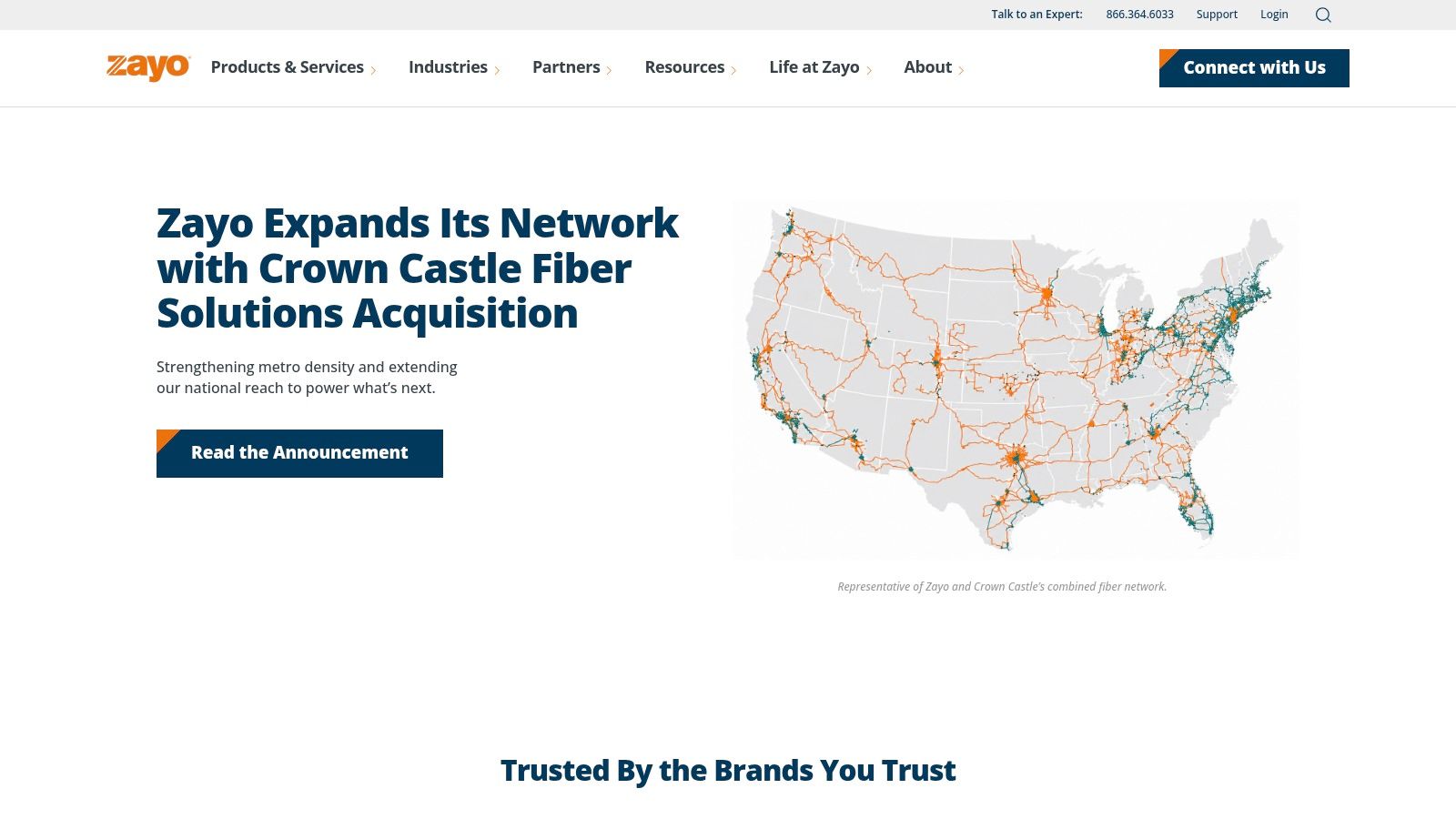
A post house in Burbank, a production office in Culver City, and gear in a downtown colo create a different telecom problem than a standard office. At that point, the question is no longer "Who sells business internet?" The question is which provider can handle fiber design, interconnection, and capacity planning without treating your network like a commodity circuit. That is where Zayo usually enters the conversation.
Zayo fits the enterprise fiber specialist category in this Los Angeles provider lineup. It is strongest where connectivity supports revenue directly, such as media workflows, multi-site operations, data center connectivity, and environments that need route diversity or high-capacity transport between facilities. Businesses comparing provider types can use that distinction quickly. Small offices often need a carrier with simpler packaging. Teams moving large files between sites or extending into colocation usually need a provider built for network engineering first.
Built for custom fiber and interconnection work
Zayo's value is not a bundle. It is the ability to deliver DIA, Ethernet, wavelength services, dark fiber, and private transport in designs that match the site, the building, and the traffic pattern. In Los Angeles, that matters for companies spread across studio lots, office towers, and carrier-dense facilities where a generic internet handoff does not solve the actual problem.
This is usually a good fit for:
- Media and entertainment teams: Large file movement, tight production deadlines, and facility-to-facility transport.
- Data center and hybrid cloud deployments: Private connectivity, cross-connect-heavy environments, and higher-capacity links.
- Multi-site enterprises: Especially where route diversity, failover planning, and custom builds matter.
The trade-off is time and complexity. Zayo is often quote-driven, address-specific, and dependent on what can be built at the property. That can be the right trade if the circuit supports editing workflows, replication, or private traffic between sites. It is usually the wrong trade for a single office that just needs stable access to cloud apps and video meetings.
If you are still sorting through provider types before getting into quotes, this guide to choosing a telecommunications company for your business location is a useful starting point.
When to put Zayo on the shortlist
Bring Zayo into the bid process if your team is discussing diverse fiber paths, carrier hotels, private transport, or dark fiber options. Leave it off the list if the project is really a standard office internet purchase dressed up with enterprise language.
That is the practical dividing line. Zayo makes sense when the network needs to be designed, not just installed.
Visit Zayo.
7. Cogent Communications
A downtown LA firm moves its servers into a colo, orders a big-name carrier, and then spends half the sales cycle batting away voice, mobility, and security bundle pitches. If the actual requirement is dedicated internet access and IP transit, that process wastes time. Cogent usually gets attention from IT teams because the conversation stays centered on bandwidth, handoff, building access, and price per Mbps.
That focus is the reason Cogent belongs in this list under bandwidth-first providers, not all-purpose telecom vendors. In Los Angeles, it tends to make the most sense in commercial buildings, carrier hotels, and colocation facilities where on-net availability is already strong and the buyer knows exactly what the circuit needs to do.
Best for buyers who already know they need dedicated internet
Cogent's narrower product set can be an advantage. The buying process is often simpler because you are evaluating committed bandwidth, port speed, contract terms, and installation conditions instead of sorting through a long bundle menu. For IT teams supporting cloud-heavy offices, public-facing infrastructure, or colo racks, that clarity helps.
A good fit for Cogent usually looks like this:
- Colocation and carrier hotel deployments: A practical option when your equipment already sits in a building with multiple carriers and cross-connect options.
- Bandwidth-first offices: Better for teams that care more about committed throughput and predictable performance than bundled phones or wireless lines.
- Secondary enterprise circuits: Useful when you want another carrier in the mix for failover or route diversity.
The trade-off is coverage at the building level. Cogent can price well where it is already established, but off-net locations can bring construction delays, added cost, or both. That matters in Los Angeles because provider choice still varies a lot by property, as noted earlier in the article. The right question is not which provider has the broadest ad campaign. It is which provider is already in, or close to, your building.
That same filtering approach helps when comparing any telecommunications company for your business location. Start with provider type, then confirm on-net status, install interval, SLA terms, and who owns the last mile.
Cogent is worth a shortlist spot when the job is straightforward. Buy a serious internet pipe, keep the design simple, and skip the extras you do not need.
Visit Cogent Communications.
Los Angeles Telecom Services: 7-Provider Comparison
| Provider | Implementation Complexity 🔄 | Resource & Cost Requirements ⚡ | Expected Performance & SLAs ⭐📊 | Ideal Use Cases 📊 | Key Advantages 💡 | Notable Limitations |
|---|---|---|---|---|---|---|
| AT&T Business | Moderate, address-specific fiber qualification and optional managed services setup | Medium–High, bundle discounts can lower entry cost but best pricing often requires wireless lines | Strong, symmetrical Business Fiber and DIA with SLA options; managed security/SD‑WAN available | Offices wanting single vendor for access, voice and mobility; sites needing managed security/SD‑WAN | Broad portfolio (access + voice + mobility); promotional pricing when bundled | Fiber availability is address‑dependent; best rates often tied to maintaining wireless service |
| Spectrum Business (Charter) | Low, quick turn‑ups, minimal construction for HFC installs | Low, promotional first‑year pricing, no annual contract options; renewal rates may be higher | Moderate, HFC (“fiber‑powered”) delivers good download speeds but lower upload than true fiber; 30‑day money‑back | SMBs needing fast installs and predictable first‑year pricing; retail/hospitality bundles (TV/phone) | Fast installation, address‑specific promos, contract buyout offers | Coax/HFC last‑mile limits upload and symmetric performance; promos expire and standard rates apply |
| Frontier Business (Frontier Fiber) | Moderate, address‑qualified fiber on‑net; simple provisioning when available | Medium, published pricing with 2‑year price lock improves OPEX predictability | Strong, symmetrical fiber from 500 Mbps to 7 Gbps with published tiers and price lock | SMBs on‑net seeking multi‑gig symmetrical service and predictable pricing | Clear published pricing and 2‑year price lock; modern router hardware on some plans | Coverage is neighborhood/building specific; promos may have eligibility conditions |
| Verizon Business (5G Business Internet) | Low, rapid deployment; self‑install or pro install for higher tiers | Low–Medium, predictable published plans; may require professional install for some tiers | Variable, good downlink but performance depends on local 5G signal and congestion; select plans offer long price guarantees | Rapid deployments, pop‑ups, temporary sites, or as fast failover/redundancy | Very fast turn‑up vs fiber builds; integrates with Verizon mobility and managed services | Throughput and upload depend on local 5G coverage and network load; availability is address‑dependent |
| T‑Mobile for Business (Business Internet) | Low, self‑install option and low‑touch deployment | Low, predictable entry pricing and cost‑effective for backup or primary in some locations | Variable, works on 5G/LTE; performance depends on signal strength and cell loading; possible de‑prioritization | Distributed locations, temporary sites, or as economical failover for wired circuits | Quick deployment, Cisco Meraki integration, simple predictable entry pricing | Performance varies by local coverage; terms may allow de‑prioritization at high use |
| Zayo | High, enterprise provisioning, possible construction for off‑net builds; complex routing options | High, quote‑based pricing; on‑net is easier but off‑net can incur build costs | Very strong, carrier‑grade fiber, multi‑100G support, enterprise SLAs and data‑center presence | Large enterprises, data centers, media/entertainment, multi‑site high‑capacity needs | Deep metro/long‑haul footprint; private optical transport, wavelengths and dark fiber options | Typically targeted at mid‑market/enterprise; pricing and lead times can be significant |
| Cogent Communications | Moderate, quick provisioning on‑net; off‑net builds may add time/cost | Medium, competitive DIA pricing for on‑net locations; simple product set reduces complexity | Strong, committed DIA/IP transit with SLAs and presence in major carrier hotels | Offices or colocation customers needing committed bandwidth and easy interconnects | Straightforward, value‑focused DIA with good PoP presence for interconnects | Focused primarily on DIA/IP transit, fewer voice/mobility bundle options; off‑net builds can add cost |
Making the Final Call Your LA Telecom Checklist
Your lease is signed, the move date is close, and the carrier quote that looked fine last week suddenly changes because the suite is off-net and the landlord wants a separate access review. That is a normal Los Angeles telecom decision. The best provider is rarely the one with the best marketing. It is the one that fits your building, your traffic profile, and your tolerance for outages.
This is also where the provider categories matter. Major cable and telco options can work well for straightforward offices and retail locations. Fixed wireless is useful for fast turn-ups, temporary sites, and failover. Enterprise fiber specialists make more sense for production teams, multi-site firms, and any operation that moves large files or needs tighter service terms. Match the provider type to the job first, then compare vendors inside that category.
Start with the workload, not the advertised speed. A small storefront running cloud POS, security cameras, and guest Wi-Fi may be fine with a business cable plan or a wireless-first setup if uptime expectations are realistic. A post-production studio, architecture firm, or design team pushing large uploads all day should treat symmetrical fiber or dedicated internet as the starting point, even if the monthly cost is higher.
Then verify the site details. Ask for serviceability at the exact street address, suite, floor, and demarc. Check whether the building is already on-net, whether riser space is available, and whether the landlord or property manager slows access. I have seen good quotes fall apart because the carrier qualified the building but not the suite.
The four checks that matter
- Define the actual workload: Separate routine office traffic from upload-heavy, latency-sensitive, or always-on operations.
- Check true availability: Use the provider qualification tool and get written confirmation of what can be installed at your exact address and suite.
- Price the full contract: Review install charges, equipment fees, renewal pricing, term length, and any off-net construction costs.
- Design redundancy on purpose: If an outage stops revenue, order a second connection and, ideally, use a different access type.
Statewide speed averages are a poor buying target. As noted earlier, broad coverage or speed benchmarks do not tell you whether your users will get stable uploads, clean voice quality, or predictable performance during peak hours. Buy for the application. Not for the headline number.
There is also a longer-term infrastructure factor in Los Angeles. Los Angeles County announced a broadband partnership to expand high-speed access in underserved areas through new fiber and wireless deployment, according to the county’s May 2024 announcement. That does not change today’s install reality at your address, but it does mean more businesses will deal with circuit upgrades, edge replacements, and old telecom hardware coming out of service over time.
Get formal quotes from two or three providers that fit your use case. Compare install conditions, SLA language, support escalation, failover options, and what happens at renewal. In LA, the right call is the provider that works in your building under real operating conditions.
If your Los Angeles telecom project also involves retiring old network gear, branch equipment, servers, or storage, Montclair Crew Recycling can help you handle the back end properly. Montclair Crew supports businesses, data centers, schools, healthcare groups, and public sector organizations with IT asset disposition, secure data destruction, on-site removal, and responsible electronics recycling, including telecom hardware and decommissioned infrastructure.
