

Your phone system still works, but tickets keep coming in about call quality. One office has a clean fiber circuit, another relies on a messy handoff from an older carrier contract, and your remote staff has outgrown the setup you approved three years ago. Meanwhile, finance wants lower monthly spend, security wants tighter control, and operations wants the migration done without disrupting customer service.
That's the reality behind most searches for enterprise telecom solutions Atlanta. The hard part usually isn't finding vendors. It's choosing an architecture that fits how your business operates across headquarters, branch sites, contact centers, cloud apps, and compliance requirements.
The market pressure behind these decisions is real. The global enterprise telecom services market was valued at approximately USD 848.2 billion in 2022 and is projected to exceed USD 1.2 trillion by 2032, growing at a 3.5% CAGR, according to TechSci Research's enterprise telecom services market analysis. In practice, that growth means faster refresh cycles, more service options, and more retired hardware sitting in closets, racks, and storage rooms after each upgrade.
Most guides stop at procurement and deployment. That's where expensive mistakes start. A sound telecom strategy has to cover selection, rollout, contract control, and the final step many teams mishandle: secure, compliant, value-conscious retirement of the old gear. If you're evaluating local options, it helps to start with a practical view of telecom solutions near Atlanta businesses and then work through the lifecycle with clear priorities.
Navigating Your Next Telecom Upgrade in Atlanta
Atlanta companies usually reach a telecom refresh for one of three reasons. Growth outpaced the original design. A merger, move, or cloud migration exposed weaknesses. Or the business is tired of paying enterprise rates for a network that behaves like a patchwork.
What tends to break first
The first failure usually isn't total outage. It's friction.
Voice quality degrades during peak usage. Branch offices get inconsistent application performance. Vendor invoices become harder to reconcile because circuits, voice services, and support contracts were bought at different times by different teams. Legacy PBX equipment keeps running, but no one wants to bet next year's operations on it.
Practical rule: If your telecom environment can't be diagrammed clearly on one page, it's already too complex for a painless refresh.
A good upgrade starts by separating symptoms from root causes. Slow application response may be a bandwidth problem. It may also be poor traffic prioritization, old edge hardware, or a contract that locked you into the wrong access type for that site.
Why timing matters now
Telecom decisions aren't isolated anymore. They affect cloud performance, security posture, hybrid work, customer experience, and how cleanly you can shut down old systems after cutover.
That's especially true in Atlanta, where organizations often operate across multiple property types. A downtown office tower has different carrier realities than a warehouse in the outer metro, a school campus, or a healthcare facility with uptime-sensitive workflows. The right answer isn't “buy the biggest pipe.” It's matching each location and workload to the right design, support model, and retirement plan for legacy assets.
Decoding Enterprise Telecom Solution Types
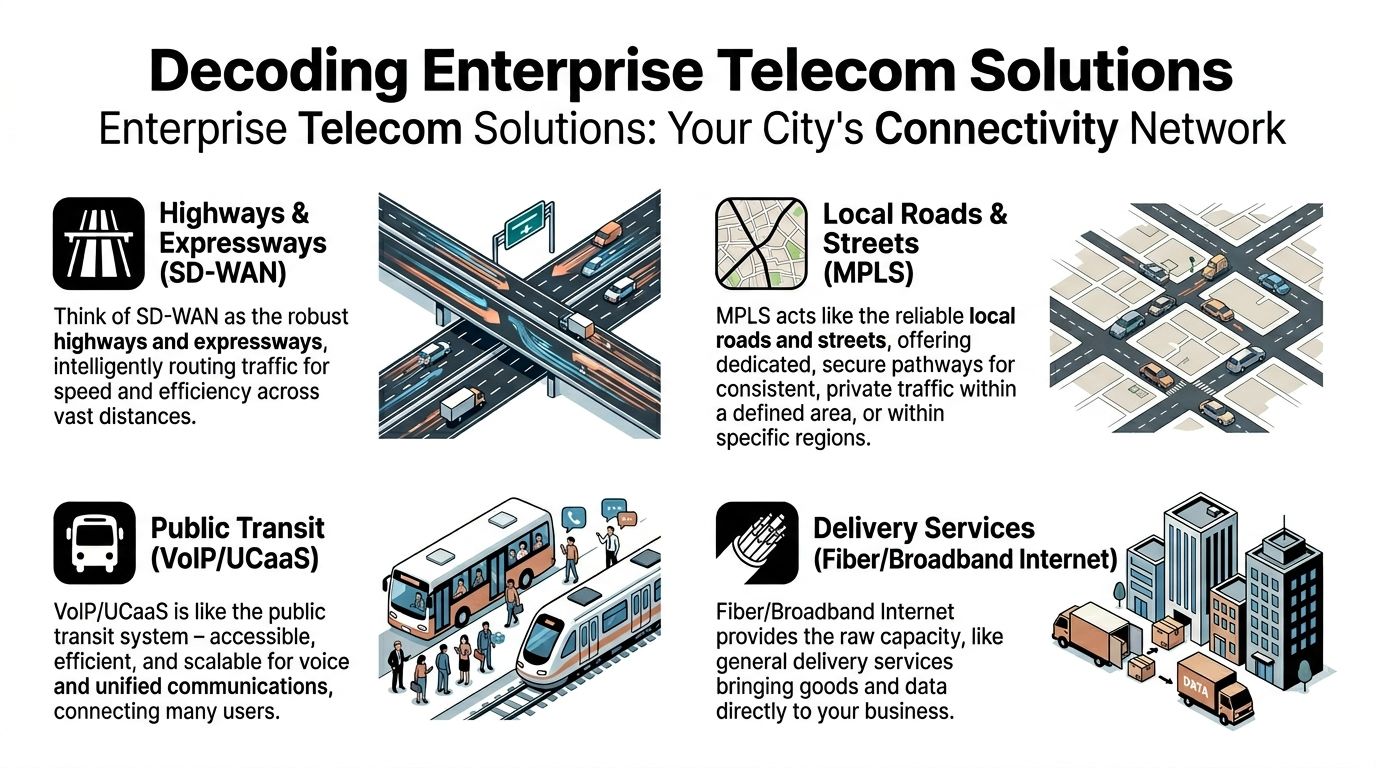
Most enterprise telecom solutions make more sense if you think of them like a city's transportation system. Some routes are built for speed. Some are built for predictability. Some move people. Some move freight. Your network needs the same kind of design logic.
SD-WAN, MPLS, VoIP, and internet access in plain terms
SD-WAN is your traffic control layer. It steers application traffic across available links based on policy, performance, and business priority. If you run multiple locations and depend heavily on cloud platforms, SD-WAN often gives better operational flexibility than a rigid single-network design.
MPLS is closer to a private road network. It's still useful when you need predictable routing, stable performance, and tightly controlled internal traffic between sites. It's less attractive when agility matters more than private path consistency.
VoIP and UCaaS are your communications transit system. They bring calling, messaging, meetings, and presence into one platform. For many businesses, that's the fastest way to retire aging PBX hardware and simplify user management. If you're comparing calling options, a practical primer on internet phone service can help clarify how hosted voice differs from older premises-based telephony.
Dedicated Internet Access, broadband, and fiber are the roads themselves. They determine the quality of the ride. Even the best SD-WAN policy won't save a site whose access circuit is wrong for its workload.
What each option does well, and where it falls short
| Solution Type | Primary Use Case | Pros | Cons |
|---|---|---|---|
| SD-WAN | Multi-site connectivity and cloud application performance | Flexible path selection, strong visibility, policy-based routing | Adds design complexity, depends on good underlying circuits |
| MPLS | Private site-to-site traffic with predictable behavior | Stable, controlled, familiar for many enterprise teams | Less agile, often slower to modify, can be costly for changing environments |
| VoIP or UCaaS | Business calling and unified communications | Easier scaling, supports remote users, reduces reliance on PBX hardware | Call quality depends on network readiness and QoS discipline |
| Broadband or Fiber Internet | Site connectivity and application access | Broad availability, supports modern cloud usage, simple to understand | Shared service tiers may not fit critical locations or sensitive workloads |
Match the tool to the workload
A lot of failed telecom projects come from buying by category instead of by use case.
- Call-heavy offices: Prioritize voice quality, failover behavior, handset strategy, and number porting discipline.
- Cloud-first teams: Focus on application path selection, SaaS performance, and branch visibility.
- Regulated environments: Keep a tighter eye on segmentation, logging, contract language, and hardware chain of custody.
- Mixed real estate portfolios: Design each site class separately instead of forcing one template onto offices, clinics, warehouses, and contact centers.
Buy telecom the way you buy facilities. A headquarters, a branch office, and a warehouse shouldn't be engineered as if they have the same traffic pattern.
For local buyers comparing architectures and providers, it helps to review telecom services available in Atlanta business environments with a site-by-site lens rather than a generic package mindset.
Your Practical Selection Checklist for Atlanta Businesses
Choosing enterprise telecom solutions Atlanta companies can live with for years starts with a disciplined checklist. Not a demo. Not a pricing sheet. A checklist.
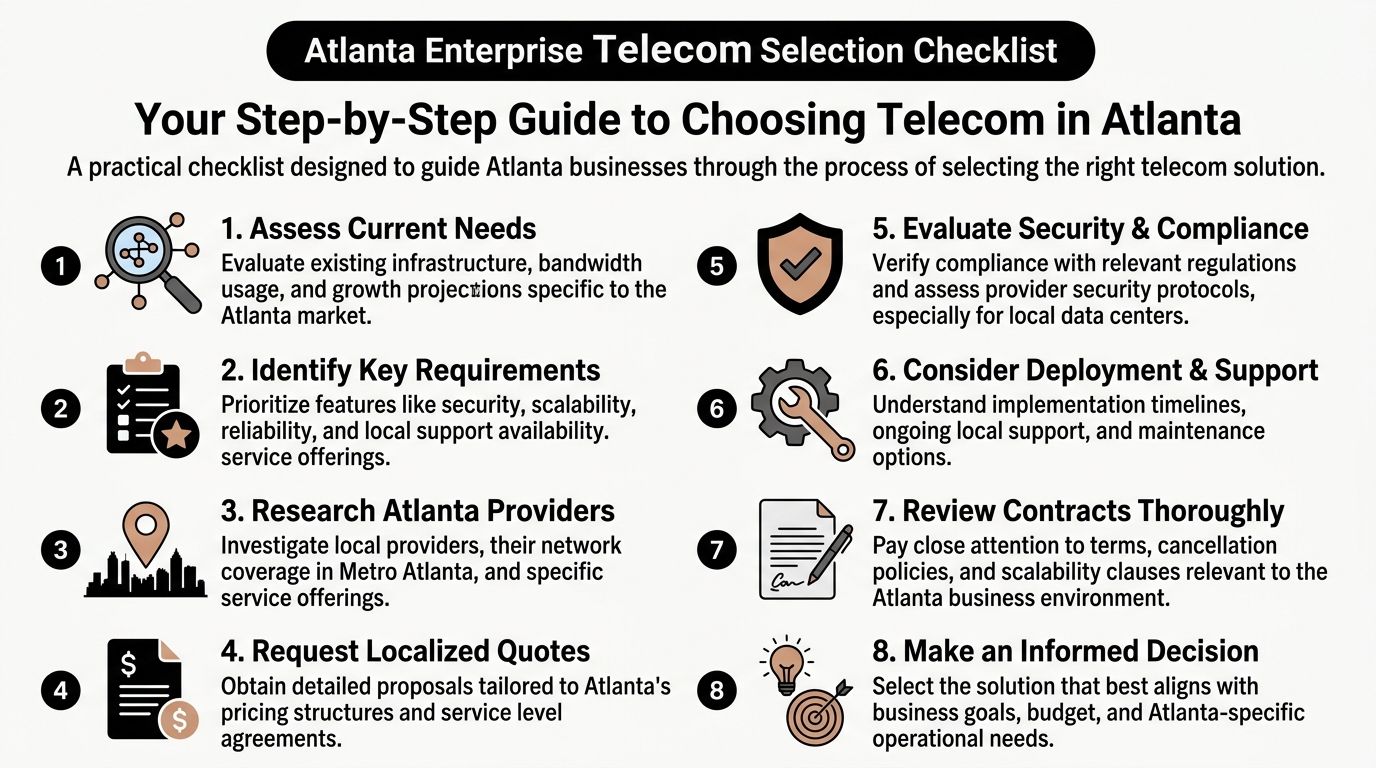
Start with internal discovery
Before you ask carriers or resellers for proposals, get your own house in order.
Map critical workflows
List what the network must support without fail. Voice, video, ERP access, CRM sessions, contact center traffic, remote access, file transfers, guest Wi-Fi, and machine connectivity all behave differently.Separate must-haves from preferences
“Need local support” means something different from “want a named account team.” Be precise. The more vague your requirements are, the easier it is for vendors to sell around them.Document what you're retiring
Include PBX equipment, routers, switches, handsets, edge devices, firewalls, conference phones, structured cabling remnants, and any branch gear no one remembers owning.
Vet providers like an operator, not a shopper
Once you know your requirements, push vendors on execution details.
- Ask about local serviceability: Who handles turn-up, escalation, and troubleshooting in Metro Atlanta?
- Inspect the SLA language: Don't stop at uptime promises. Review credits, exclusions, response windows, maintenance notifications, and how trouble is opened.
- Confirm integration fit: Your telecom stack has to coexist with Microsoft Teams, contact center tools, identity systems, CRM workflows, and security monitoring.
- Check migration ownership: Find out who owns number porting, circuit turn-downs, cutover planning, and rollback decisions.
Operator note: If a provider can't explain the cutover sequence clearly, they probably haven't done enough of them.
Use this final shortlist test
A proposal is stronger when it answers these questions cleanly:
| Question | Why it matters |
|---|---|
| Can this design handle growth without a major redesign? | You don't want to rebuy the core architecture after one acquisition or office move. |
| Are the support paths clear? | Ambiguous support creates long outages and finger-pointing. |
| Does the contract let you adapt? | Flexible terms matter when headcount, locations, and cloud usage shift. |
| Is there a retirement plan for replaced hardware? | Old telecom gear can create security, storage, and compliance problems after migration. |
Buyers doing early research often compare business telecom service options near Atlanta to understand what combinations of carrier access, voice platforms, and support models are realistic locally. That's useful, as long as the final decision stays tied to business operations, not brochure features.
Navigating Atlanta's Unique Connectivity Landscape
Atlanta is a strong telecom market because you're not dealing with a one-carrier town. Competition gives buyers an advantage, but only if they understand local density, building access, and the difference between “available nearby” and “deliverable at your suite.”

Why local network depth changes the buying conversation
Providers with deeper metro infrastructure can often support cleaner installs, better redundancy options, and more credible service commitments. One concrete example is that Spectrum Enterprise in Atlanta offers dedicated fiber-optic bandwidth up to 100 Gbps with 100% uptime SLAs, leveraging over 245,000 fiber-route miles, which supports low-latency performance below 10ms for local connectivity needs, according to Spectrum Enterprise Atlanta internet service details.
That matters if you run latency-sensitive cloud workloads, a busy contact center, large data transfers, or site-to-cloud voice traffic. It also matters during migrations, where stable throughput helps teams move services in stages instead of all at once.
How to think about metro Atlanta by site class
Atlanta isn't one environment. It's several.
- Downtown and major commercial corridors: More carrier choice, but also more complexity around building entry, landlord rules, and demarc coordination.
- Alpharetta, Norcross, and similar business hubs: Strong options for tech-heavy offices, multi-tenant properties, and distributed operations.
- Industrial or outer-ring sites: Coverage may exist, but timelines, construction variables, and backup design become more important.
- Data-center-adjacent operations: Proximity to dense interconnection areas can improve design flexibility for high-throughput and hybrid environments.
Use competition without overengineering
Plenty of Atlanta businesses overspend because they pursue perfect redundancy at every site. Not every branch needs the same dual-carrier architecture as a revenue-critical headquarters or healthcare location.
A better approach is to tier sites by business impact:
| Site type | Recommended mindset |
|---|---|
| Headquarters or primary operations center | Engineer for resilience, clear failover, and contract accountability |
| Revenue-generating branch | Balance uptime with cost discipline |
| Small administrative office | Keep design simple and easy to support |
| Specialized technical site | Prioritize application fit over standardization |
When you're assessing provider claims, compare them against local install realities, support reach, and building-specific constraints. Broad overviews of local telecom companies serving Atlanta can help frame the vendor environment, but the final answer still comes down to exact addresses, exact workloads, and exact accountability.
Managing Deployment Integration and Contracts
A signed order form doesn't solve anything by itself. Most telecom projects go wrong after purchase, during the weeks when circuits are being installed, numbers are being ported, routers are being staged, and everyone assumes someone else is running the timeline.

Run deployment like a real program
Treat implementation as a cross-functional project, not a vendor task. IT, security, procurement, facilities, and business unit leaders should all know the cutover sequence, dependencies, and fallback plan.
Use a short milestone structure:
- Design signoff: Network topology, voice flows, failover logic, and inventory confirmed
- Provisioning control: Circuits, licenses, numbers, and hardware tracked in one place
- Testing window: Validate voice quality, application behavior, QoS, and failover before user migration
- Cutover and validation: Move users in waves, collect exceptions, and resolve before decommissioning old systems
Integration work is where hidden complexity lives
The telecom platform rarely stands alone. It touches directory services, identity tools, call recording, CRM workflows, Teams or similar collaboration platforms, mobile device policy, and ticketing systems.
The migration isn't complete when dial tone works. It's complete when your users, admins, auditors, and support desk can all work normally on the new platform.
This is also where old assumptions cause trouble. A branch that looked simple on paper may have fax dependencies, alarm lines, elevator phones, analog adapters, or legacy conferencing devices. Surface those before cutover, not after.
Contracts need active management
Too many enterprises read the MSA once and then rediscover it during an outage or renewal dispute. Track the parts that affect operations:
- Service levels: What's promised, what's excluded, and what credit process applies
- Escalation path: Named contacts, response expectations, and after-hours procedure
- Renewal terms: Notice windows, auto-renew language, and pricing changes
- Termination dependencies: Circuit disconnect process, equipment return obligations, and number port coordination
For teams trying to tighten internal governance during rollouts, these IT vendor management best practices are a useful operational reference. The main objective is simple. Don't let a good telecom design fail because nobody owned implementation discipline.
The Full Lifecycle Security Compliance and Secure Decommissioning
Most telecom advice falls short because it treats success as “new system live.” That's incomplete. The old PBX, routers, switches, handsets, servers, SBCs, and storage devices don't stop mattering once the replacement is online.

Why retirement planning belongs in the original project scope
Telecom infrastructure turns over more often than many procurement teams expect. Consolidations, cloud migrations, UCaaS moves, branch closures, data center changes, and hardware refreshes all produce retired gear. If that gear contains storage, configuration data, call records, credentials, or customer information, leaving it in a closet is not harmless.
The strategic backdrop matters here. Between Q1 2020 and Q2 2024, acquirers deployed $56 billion across 424 M&A transactions in the global enterprise telecom communication services and solutions sector, with an average transaction value of $132 million, according to Jahani & Associates' telecom services M&A transaction analysis. In practical terms, active consolidation means more systems are being replaced, merged, or decommissioned. That creates more end-of-life equipment and more chances for chain-of-custody mistakes.
What good decommissioning actually looks like
A proper end-of-life process includes more than disposal. It should cover:
- Asset identification: Know exactly what is leaving service
- Data handling: Apply approved wiping or physical destruction based on device type and risk
- Audit trail: Record serials, locations, disposition path, and handoff details
- Environmental compliance: Keep equipment out of improper waste channels
- Value recovery review: Resell or remarket reusable assets when it makes business sense
Security reality: Unplugged equipment can still be a data problem, a compliance problem, and a finance problem.
For sensitive environments, data destruction standards and formal controls matter. Teams working through broader regulatory obligations may also benefit from guidance on Mastering 2026 PCI DSS compliance, especially when telecom systems intersect with payment workflows, call recordings, or network segments that support cardholder data environments.
What doesn't work
Three common bad habits show up repeatedly in enterprise telecom cleanouts.
First, companies move fast on deployment and postpone old equipment handling “until later.” Later often becomes months.
Second, they assume telecom gear has no meaningful data risk because it isn't a laptop fleet. That's wrong. Voice systems, edge appliances, and infrastructure devices can retain sensitive information or usable configurations.
Third, they treat all retired equipment as trash. Some devices belong in certified destruction streams. Some can be remarketed responsibly. The decision should be based on risk, condition, and business value, not convenience.
The business case is stronger than most teams think
Secure decommissioning protects more than compliance. It protects operational clarity. When old assets are audited, wiped, removed, and processed correctly, teams free up rack space, reclaim storage areas, eliminate forgotten maintenance exposure, and close the loop on capital equipment.
That's the missing piece in many enterprise telecom solutions Atlanta firms evaluate. The deployment gets budget. The teardown gets ignored. The better approach is to treat end-of-life handling as part of the original business case, with ownership assigned before the first new circuit is even installed.
Conclusion Building a Future-Proof Telecom Strategy
A strong telecom strategy isn't just a buying decision. It's an operating model.
The right plan fits your workflows, site types, support expectations, and compliance needs. It chooses the right mix of access, voice, and network control tools. It accounts for deployment discipline, integration details, and contract accountability. Then it finishes the job by retiring replaced equipment with the same seriousness used to approve the new environment.
That last part is becoming more important, not less. Atlanta's 5G coverage has reached 92%, fueling a 28% surge in enterprise hardware swaps, and that raises the stakes around secure handling of retired routers, edge devices, and related infrastructure, as noted by Empire Telecom's discussion of 5G-related business telecom changes. Faster upgrade cycles mean more frequent decommissioning events. If your process for retiring equipment is vague, your telecom strategy isn't future-proof.
The practical takeaway is simple. Build the lifecycle plan upfront. Define what you're buying, how you'll deploy it, how you'll govern the provider, and exactly what happens to every asset that leaves service. That's how enterprises avoid messy migrations, hidden security exposure, and warehouses full of forgotten hardware.
If your organization is replacing PBX systems, network gear, servers, handsets, or other retired telecom assets, Montclair Crew Recycling provides Atlanta-area businesses with a practical path for secure IT asset disposition, certified data destruction, compliant recycling, and value recovery where appropriate. For enterprises, schools, healthcare providers, data centers, and government teams, that makes the final step of a telecom refresh easier to control and easier to document.
