

Your current connection probably works just well enough to stay off the priority list. Then uploads drag during backups, Teams calls get choppy when the office fills up, and support turns into a ticket maze when you need a real answer. That’s usually when Atlanta business owners start searching for telecom providers near me, but the crucial decision isn’t just speed. It’s whether the provider fits how your company runs.
In Metro Atlanta, that answer changes fast by building, business park, and corridor. A law office in Buckhead, a warehouse in Smyrna, a clinic in Alpharetta, and a multi-tenant office in Sandy Springs can all see very different options at the same address count, even when the map says coverage looks solid. For business use, I care less about the marketing headline and more about what you’re buying: shared cable, shared fiber, dedicated fiber, fixed wireless, or a backup circuit that keeps phones and cloud apps alive when the main line drops.
If you’re relocating, opening a second office, or replacing aging network gear as part of the project, it helps to line up internet decisions with the physical move too. That’s why teams often coordinate telecom upgrades alongside other office logistics such as hiring commercial moving companies.
Below are the seven providers I’d shortlist most often for Metro Atlanta B2B work, from straightforward SMB installs to enterprise-grade carrier circuits.
1. AT&T Business
AT&T is the default first check for a lot of Atlanta businesses because it spans simple business fiber all the way to serious enterprise connectivity. If you’re running cloud-heavy workflows, pushing large design files, backing up to offsite storage, or connecting multiple offices, AT&T usually deserves a hard look before you sign with anyone else.
What I like most is the ladder of options. A smaller office can start on business fiber with symmetrical tiers, while a larger operation can move into dedicated internet and more formal service commitments without changing carriers. That matters for schools, healthcare groups, accounting firms, and any company that doesn’t want to re-platform its network every time it grows.
Where AT&T fits best
- Symmetrical fiber first: Business Fiber gives Atlanta offices a cleaner fit for uploads, VPN use, and cloud backups than typical cable plans.
- Enterprise path: Dedicated Internet and Ethernet options make sense when you need guaranteed bandwidth, formal SLAs, or multi-site design.
- Consolidated stack: Wireless, voice, and security options can reduce vendor sprawl if your team prefers one primary telecom relationship.
AT&T also benefits from the broader fiber benchmark seen in major business markets. In Dallas-Fort Worth, AT&T fiber is listed with speeds up to 5 Gbps and broad availability on BroadbandMap’s Dallas provider overview. I wouldn’t treat Dallas and Atlanta as identical, but the product positioning is similar enough to show where AT&T aims its business portfolio.
Trade-offs to watch
Availability is still building-specific. One suite may qualify for fiber while the building next door gets a very different answer. Higher-capacity dedicated circuits also move through a sales process, so if you need custom construction or route diversity, expect a quote and a longer lead time.
Practical rule: If your business depends on fast uploads, don’t compare AT&T fiber to cable on download speed alone. Compare upload performance, failover options, and escalation quality.
If you’re replacing legacy routers, firewall appliances, or old telecom handsets during the switch, plan the retirement path at the same time. A local Atlanta telecom services recycling option can keep that cleanup from becoming a pile of dead gear in the server room.
For direct plan and service details, go to AT&T Business.
2. Comcast Business
Comcast Business is often the practical answer when a Metro Atlanta company needs service quickly and doesn’t want a complex procurement process. In a lot of business districts, Comcast is available where fiber from other carriers is hit or miss. For many SMBs, that alone keeps it in the top tier.
I’ve seen Comcast work well for general office use, VoIP, web-based line-of-business apps, guest Wi-Fi, and retail locations that need one provider for internet, wireless backup options, and managed add-ons. The appeal is convenience. You can usually get from quote to install faster than with a custom enterprise circuit.
What Comcast does well
- Broad metro serviceability: Comcast tends to show up in a lot of Atlanta commercial addresses, especially standard office and mixed-use locations.
- Bundle-friendly setup: Internet, Wi-Fi, mobile, and security can land on one bill, which some owners value more than shaving every last dollar.
- Predictable planning options: Introductory pricing and price-lock structures can help with budgeting if you read the terms carefully.
The main catch is technical, not marketing. If the service delivered to your suite is cable-based, upload speed is usually the limiting factor. That’s fine for many offices. It’s less fine for architecture firms, video teams, large document imaging projects, or anyone constantly syncing data back to cloud platforms.
Where Comcast falls short
A lot of businesses shop by the biggest download number and stop there. That’s usually where Comcast gets over-selected for workloads better suited to fiber. If your staff spends all day inside Microsoft 365, Google Workspace, cloud backups, VoIP, and video meetings, upload consistency matters.
Don’t buy Comcast as if it’s dedicated fiber. Buy it as a strong business cable option, or ask specifically whether a fiber or dedicated internet variant is available at your address.
Comcast also becomes easier to manage when you treat carrier decisions as part of your overall vendor process, not a one-off utility purchase. In doing so, a tighter IT vendor management approach saves headaches, especially when internet, voice, security, and mobile all sit under one account.
For companies that want a large-provider business stack without a fully custom carrier build, Comcast Business is usually worth quoting.
3. Google Fiber (GFiber Business)
GFiber Business is the provider I’d call the cleanest option when it’s available at your Atlanta address. The pitch is simple, and that simplicity is the point. You get symmetrical business internet, straightforward equipment inclusion, and less of the pricing gymnastics that often come with traditional telecom sales.
For a lot of small and midsize firms, GFiber hits the sweet spot. It supports cloud collaboration, video calls, fast backups, and normal office traffic without pushing you into a custom enterprise contract before you need one. If you’re a design firm, agency, software shop, medical office, or professional services team with heavy upload needs, symmetrical service matters every day.
Why businesses like GFiber
- Simple plan structure: Fewer tiers means less time decoding packages and upsells.
- Strong upload performance: That’s the practical win over many cable competitors.
- Included equipment: For smaller offices, included Wi-Fi gear can reduce setup friction.
I also like GFiber for secondary offices that don’t have a full-time IT person on site. There’s less complexity in the handoff. You still need your own firewall and network design if you care about segmentation and security, but the provider side tends to be easier to explain to operations staff.
The main limitation
Coverage is the issue. In Atlanta, GFiber is still an address-by-address conversation. When it’s there, it can be one of the most business-friendly options in its class. When it’s not, there’s no partial workaround.
The other limit is plan depth. Some businesses love having only a couple of business tiers. Others outgrow that simplicity once they need dedicated circuits, custom redundancy, or larger site-to-site architecture.
“If GFiber is available and your office mostly lives in the cloud, it’s one of the easiest yes decisions you’ll make.”
If your upgrade also includes retiring switches, patch panels, old rack gear, or discontinued edge devices, fold disposal into the project scope early. That matters even more during a Georgia data center decommissioning project, where network cutovers and hardware removal need to happen in the right order.
You can review current business offerings at Google Fiber for Business.
4. Verizon 5G Business Internet
Verizon 5G Business Internet solves a different problem than wired fiber or cable. It’s about speed of deployment and flexibility. If you’re opening a temporary office, waiting on construction, adding a backup line, or need connectivity in a space where trenching won’t happen on your timeline, Verizon deserves consideration.
For many Atlanta businesses, I don’t position Verizon 5G as the automatic primary line unless the address situation forces it. I position it as a fast-turn backup circuit or a bridge service that keeps operations moving while the permanent wired install catches up. In that role, it can be very useful.
Best uses for Verizon 5G
- New site launch: Good for getting a location online quickly.
- Backup internet: Useful for failover behind a firewall or SD-WAN setup.
- Hard-to-wire locations: Handy in sites where construction is expensive or delayed.
Fixed wireless has become a real business option, not just a consumer workaround. In a major benchmark market, HighSpeedInternet’s Dallas provider overview describes T-Mobile, AT&T, and Spectrum as large providers and notes broad availability ranges, with 5G fixed wireless showing strong reach in that market. The Atlanta lesson is similar. Wireless business internet is now part of the shortlist, especially for backup and rapid deployment.
What doesn’t work well
Radio conditions still rule the experience. Nearby building materials, line-of-sight constraints, indoor placement, and local congestion all affect performance. That’s why I’m careful about putting fixed wireless in front of latency-sensitive or upload-heavy production workloads without testing.
One more point gets missed during telecom replacements. The old gateway, firewall, or storage media from the previous setup may still hold configuration data, user records, or call logs. If you’re cutting over to Verizon and retiring old edge hardware, schedule secure hard drive destruction in Georgia before that equipment disappears into a closet.
For current business internet options, check Verizon Business Internet.
5. T-Mobile for Business 5G Business Internet
T-Mobile for Business is the lowest-friction option on this list for many smaller Atlanta sites. If you need internet fast, don’t want construction, and can tolerate performance that varies more than wired service, T-Mobile is often the easiest path to a working connection.
I especially like it for temporary offices, project trailers, newly leased suites, field operations, and backup connectivity. It also works for multi-site businesses that want a standardized secondary circuit across multiple locations without negotiating a custom carrier deal at each address.
Where T-Mobile makes sense
- Temporary or rapid deployment sites: Plug-and-play setup is the main advantage.
- Secondary resilience path: Works well alongside cable or fiber for failover.
- Basic branch offices: Fine for lighter cloud use and general productivity.
In another major metro benchmark, T-Mobile led satisfaction categories in Dallas, and the market showed mobile and fixed broadband metrics plus broad 5G and provider availability data. That source also highlights how telecom expansion creates downstream equipment retirement issues, which is the part most provider comparisons ignore.
Where it can frustrate you
T-Mobile isn’t what I’d choose for a site that needs guaranteed, highly stable performance hour after hour under heavier business loads. Signal conditions change. Congestion changes. And if your team’s workday depends on large uploads, always-on VPN, or strict uptime requirements, wired service still wins.
That said, I’ve seen companies waste months waiting for a perfect primary circuit when a good-enough wireless line could have gotten the office open and generating revenue. Used that way, T-Mobile is a practical business tool.
Field note: For a startup branch, temporary location, or backup line, speed of turn-up often matters more than theoretical top-end performance.
If the deployment is part of a broader hardware refresh, don’t leave the disposal piece until the end. A provider swap usually creates a stack of retired access points, edge routers, handsets, and cabling. A local Georgia ITAD service can handle that handoff so old gear doesn’t become a security loose end.
For plan details and current offers, visit T-Mobile for Business Internet.
6. Lumen Technologies

Lumen sits in a different category from the retail-style business internet providers. This is enterprise telecom. If your company operates data-heavy sites, multiple facilities, public sector environments, or complex WAN designs, Lumen belongs in the conversation because it sells infrastructure-grade connectivity, not just office internet.
For the right customer, that distinction matters. You’re looking at dedicated internet, backbone reach, interconnection options, and commercial models built for larger networking requirements. If your business is in a data center, on a major campus, or supporting critical applications across sites, Lumen is often a more natural fit than a mainstream SMB ISP.
Why enterprises buy Lumen
- DIA and backbone depth: Better fit for mission-critical connectivity than ordinary shared broadband.
- Network reach: Helpful when your Atlanta site is only one node in a larger footprint.
- Flexible enterprise models: On-demand and usage-based structures can matter for changing workloads.
This isn’t a click, buy, and install product. It’s a design and procurement process. That’s fine if you need it. It’s overkill if you’re a 15-person office mostly using cloud apps and Wi-Fi.
Real-world trade-offs
Expect quote-based pricing, engineering review, and potentially longer lead times. If the building isn’t already in a favorable position for service delivery, that can shape both timeline and cost. Lumen is strongest when the business case supports enterprise-grade connectivity and the internal team knows how to use it.
A good rule is simple. If downtime has a real operational or contractual cost for your company, start talking to providers like Lumen earlier than you think. If downtime is annoying but survivable, a less complex provider may be enough.
For enterprise networking options and carrier services, visit Lumen Technologies.
7. Zayo Group
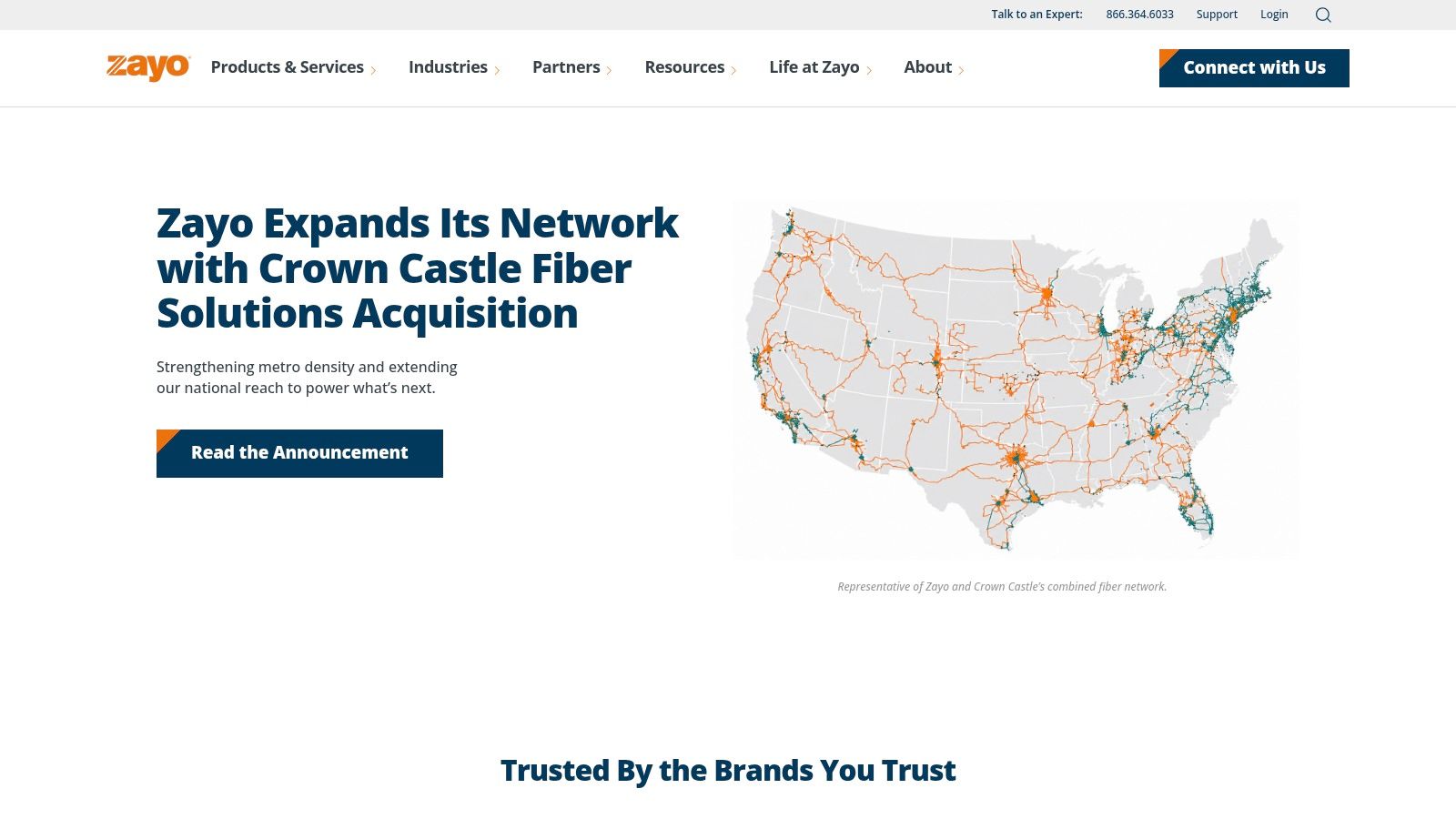
Zayo is for businesses that have moved beyond “internet provider” thinking and into transport, route diversity, private fiber, and data-center-grade connectivity. In Metro Atlanta, that usually means larger enterprises, campuses, cloud-heavy operations, colocation users, and organizations that need serious network architecture between facilities.
This is the provider I bring in when a client says one of three things. They need true path diversity. They need high-capacity connectivity between sites. Or they need a carrier with dense presence around major interconnection and data center environments.
What Zayo is good at
- Dark fiber and custom builds: Useful when standard business internet products won’t solve the problem.
- Wavelength and transport services: Better for inter-facility traffic than general SMB broadband.
- Carrier hotel and data center orientation: Strong fit for businesses with infrastructure in those environments.
Zayo isn’t the right answer for a typical small office searching telecom providers near me. It’s usually not a click-to-buy service, and it won’t feel simple if all you need is ordinary office connectivity. But if your Atlanta business needs low-latency transport, route separation, or higher-capacity private infrastructure, few categories of provider matter more.
Who should skip it
Most SMBs should. A standard office with email, VoIP, line-of-business apps, and cloud storage will usually spend too much time and money chasing capabilities it won’t use. Zayo makes sense when networking itself is a strategic function, not just a utility.
For private network infrastructure, fiber transport, and enterprise connectivity, see Zayo Group.
Head-to-Head: 7 Business Telecom Providers
| Provider | Implementation Complexity 🔄 | Resource Requirements ⚡ | Expected Outcomes 📊 | Ideal Use Cases 💡 | Key Advantages ⭐ |
|---|---|---|---|---|---|
| AT&T Business | Moderate, standard Business Fiber installs; DIA/hyper‑gig require quotes and engineering | Fiber ONT/CPE; possible construction for DIA; 5G backup hardware on 1Gb+ tiers | High symmetric bandwidth (300Mb–5Gb shared; DIA to 100Gb) with SLAs where quoted 📊 ⭐ | Offices, multi‑site networks, schools, healthcare, data‑heavy workloads | Extensive metro fiber footprint, diverse product portfolio, bundling options |
| Comcast Business | Low–Moderate, plug‑and‑play HFC; custom for on‑net fiber/DIA | Cable modem/gateway or ONT for fiber; optional managed Wi‑Fi/security and mobile bundles | High downstream shared speeds up to 2Gb; upload lower on HFC; intro promos common 📊 | SMBs wanting bundled services and price predictability | Very broad availability, simple bundling, multi‑year price‑lock option |
| Google Fiber (GFiber Business) | Low, FTTP with straightforward installs and included equipment | Fiber ONT and included Wi‑Fi 6/6E gear; optional mesh extenders | Symmetric 1–2 Gbps, 99.9% uptime guarantee on 2Gb; flat pricing 📊 ⭐ | Offices needing strong upload for cloud, file transfer and conferencing | Simple pricing, included equipment, strong upload performance |
| Verizon 5G Business Internet | Very Low, rapid FWA deployment; self‑install or pro setup | Gateway/router and good 5G/LTE signal; no trenching or fiber construction | Posted 100/200/400 Mbps plans; performance variable with radio conditions 📊 | Temporary sites, locations without wired access, backup/failover circuits | Fast turn‑up, long price guarantees on select tiers, cost‑effective backup |
| T‑Mobile for Business – 5G Business Internet | Very Low, plug‑and‑play gateway and fast activation | Self‑install gateway; depends on T‑Mobile 5G/LTE coverage; centralized management for multi‑site | Best‑effort speeds suitable for SMBs; variable by signal and congestion 📊 | Temporary/new offices, multi‑site deployments, SD‑WAN failover | Low friction onboarding, predictable pricing, nationwide 5G footprint |
| Lumen Technologies | High, quote‑based DIA/Wavelengths with longer lead times and engineering | On‑net fiber, cross‑connects, possible colocation; procurement/partner options for off‑net | Enterprise DIA up to 100Gb with SLAs, strong backbone and peering 📊 ⭐ | Enterprises, data centers, public sector needing guaranteed bandwidth and diversity | Deep backbone reach, flexible NaaS/on‑demand models, enterprise SLAs |
| Zayo Group | High, custom design/engineering for dark fiber, wavelengths and metro builds | Dark fiber leases or custom builds, colocation cross‑connects, significant engineering | Very high capacity and low‑latency private transport (400G+ options) 📊 ⭐ | Data centers, carrier hotels, enterprise campuses, AI/ML workloads | Dense data‑center presence, high capacity, true path diversity and private transport |
Upgraded Your Network? Now, What About the Old Gear?
A telecom upgrade isn’t finished when the new circuit goes live. It’s finished when the old equipment is out of service, data is handled properly, and the retired hardware leaves your office through a documented process. That’s the part many Atlanta businesses overlook, especially when the install team is focused on activation dates, downtime windows, and getting users back online.
Old routers, switches, VoIP phones, access points, firewalls, and decommissioned servers can hold sensitive information or business configuration data. They also create clutter fast. I’ve seen offices complete a clean provider cutover, then leave dead telecom gear stacked in an IT closet for months because nobody owned the disposal step.
There’s also a broader lifecycle issue. One underserved angle in telecom buying content is what happens to the equipment after a provider switch. The available research specifically notes a gap in guidance around securely disposing of outdated telecom gear such as routers, switches, servers, and cabling when businesses change providers, while also stating that a 2023 Gartner report found 70% of organizations fail to securely wipe data from retired IT assets and that FCC data shows only 25% of e-waste is recycled properly in the U.S., as summarized in this analysis of the disposal gap in telecom upgrade decisions. The source also notes a rise in IT asset disposition demand tied to ongoing 5G and fiber upgrades.
For Metro Atlanta businesses, that means the network decision and the retirement decision should happen together. Build a short closeout scope into the project: what hardware is being replaced, what data needs destruction, what can be remarketed, what gets recycled, and who signs off. That process matters for SMBs, but it matters even more for healthcare, education, finance, manufacturing, and public sector teams with compliance obligations.
Montclair Crew Recycling is one Atlanta-area option for B2B IT equipment disposal tied directly to telecom upgrades. The company handles on-site removal, asset audit and logistics, certified data destruction, environmentally compliant disposition, and resale or profit-sharing when applicable for certain equipment. For local organizations in Alpharetta, Marietta, Smyrna, and across the metro, that creates a practical final step after a provider swap: the old infrastructure gets removed securely instead of becoming a forgotten risk.
If you’re changing carriers, opening a new location, or replacing aging telecom hardware as part of a network refresh, include the decommissioning plan in the same timeline as the installation. That’s how you turn a provider upgrade into a complete lifecycle project instead of half a project.
If your Atlanta business is replacing routers, switches, VoIP phones, servers, or other retired telecom gear during a provider change, Montclair Crew Recycling can help close out the project with B2B pickup, data destruction, and compliant electronics recycling across Metro Atlanta.
