
Got a stack of old hard drives and not sure what to do with them? If you think simply deleting the files is enough to protect your Georgia business, you're leaving the door wide open for a data breach. Hitting 'delete' is like tearing the cover off a sensitive document—all the critical information is still there for anyone with the right tools to find.
Why Secure Hard Drive Destruction Is a Must for Georgia Businesses

When IT equipment gets retired, it can become your biggest liability. Every single server, laptop, and desktop PC you've ever used has a hard drive packed with years of data. We're not just talking about old memos; it's a treasure trove for criminals and corporate spies.
Even drives that are dead, damaged, or won't turn on are a huge risk. It's a common mistake to assume that a failed drive means the data is gone for good. The truth is, specialized forensic tools can pull information from drives that have been dropped, fried, or suffered mechanical failure.
The Real Risks of Neglecting Data Disposal
For any business in Metro Atlanta, whether you're a financial firm in Sandy Springs or a healthcare clinic in Marietta, the consequences of a data leak are enormous. Drives that aren't properly destroyed can expose:
- Customer and Patient Information: Social Security numbers, addresses, names, and private medical records.
- Employee Records: Payroll information, personal details, and performance reviews.
- Financial Data: Corporate bank accounts, client credit card numbers, and financial statements.
- Intellectual Property: Confidential business plans, product designs, and valuable trade secrets.
Just one data breach can trigger massive regulatory fines, expensive legal fights, and completely shatter the trust you've built with your customers. Physical destruction is the only way to be 100% certain that data can never be recovered.
Building a Foundation of Security
Protecting your business means being proactive. Data security doesn't just stop when you unplug a device. A smart approach integrates hard drive destruction into your company's overall data governance best practices.
This means having a formal IT asset disposition (ITAD) policy that tracks every device and verifies its data has been completely destroyed. For businesses that need a total, compliant solution, it helps to see what the pros offer. Find out more about how Montclair Crew Recycling provides secure data destruction to keep your company's information locked down for good. This isn't just an IT task—it's a critical part of your business's security strategy.
Here's the rewritten section, crafted to match the specified human-written style and tone:
The Hidden Dangers of Improper Data Disposal
Many business owners think that hitting "delete" or formatting a hard drive gets rid of their old data for good. This is a huge, and potentially very expensive, mistake.
Think of it like this: you wouldn't just paint over a confidential blueprint left on a wall. The design is still there, right under the surface, for anyone with the right tools to find. That leftover data is called data remanence, and it turns your old computers into ticking time bombs for thieves.
Every old server, laptop, and desktop in your storage closet has a hard drive. It's not just holding old projects; it's packed with your company's most valuable secrets. Even a drive that’s broken, fried, or won't even power on is a massive risk. Don't be fooled—specialized labs can pull data off devices you might think are completely useless.
Your Business Data Is More Vulnerable Than You Think
This isn't some far-off threat. It's a daily reality for businesses right here in Georgia. As of 2023, the average data breach costs a U.S. company a staggering $9.44 million.
For Georgia's booming ecosystem of banks, manufacturers, and schools, the risk is everywhere. These businesses create mountains of old hard drives filled with everything from customer PII to your next big product design. Proper destruction isn't just a good idea; it's what stands between you and a massive fine. Find out more about how the local data security landscape impacts Georgia businesses.
A single misplaced hard drive can cost you more than your entire IT budget for the year. In fact, over 70% of data breaches start with a lost or stolen device. Every single drive you haven't physically destroyed is a liability waiting to happen.
Why Software Wipes Are Not Enough
Just running a software "wipe" on a drive? It’s often not good enough for total security. These programs try to overwrite your data, but they can easily fail or skip over bad sectors and hidden partitions where sensitive files are still hiding.
For businesses in healthcare, finance, or legal services around Atlanta, that’s a gamble you just can't afford to take.
- Healthcare Providers: One old drive could hold thousands of patient records. A single HIPAA breach can lead to fines up to $50,000 per violation.
- Financial and Legal Firms: You’re handling client accounts, sensitive case files, and trade secrets. A data leak can lead to career-ending lawsuits and destroy your reputation overnight.
This is exactly why professional, physical destruction is a core security function, not just an IT cleanup task. It's the only way to be 100% certain that your data is gone forever and can never be recovered.
For any company in Kennesaw, Norcross, or anywhere in the Atlanta metro, using a professional hard drive destruction service in Georgia isn't a choice; it's essential armor. The peace of mind you get, knowing your data is truly gone for good, is priceless.
Choosing The Right Data Destruction Method
When it comes to getting rid of old hard drives, not all methods are created equal. The approach you choose is what stands between your Georgia business and a potentially devastating data breach. Let's walk through the three main ways to handle data destruction, cutting through the jargon.
Software-Based Wiping
Think of software wiping as scribbling over a sensitive document with a pen until the original words are covered up. This method uses specialized programs to overwrite every part of a hard drive with random ones and zeros. It's a decent first step, but it’s not perfect. If a drive has damaged spots, tiny fragments of the original data can get missed and remain recoverable.
Degaussing
Degaussing is a bit like taking a massive, powerful magnet to an old cassette tape. It uses an intense magnetic field to completely scramble the magnetic platters inside a traditional Hard Disk Drive (HDD), instantly wiping out all the information. It’s highly effective for those older HDDs, but here’s the catch: it’s totally useless on modern Solid State Drives (SSDs), which don’t store data magnetically.
The Gold Standard: Physical Shredding
This is the only way to be absolutely certain your data is gone for good. Physical shredding is the digital equivalent of feeding a top-secret file into an industrial shredder and turning it into confetti. A specialized machine literally grinds the hard drive—platters, circuit boards, and all—into tiny, mangled pieces of metal that can never be put back together.
For any business where a data leak is not an option, physical destruction is the only method that guarantees your data is 100% gone, forever. Crucially, it's the only technique that works just as well on old-school HDDs as it does on modern SSDs.
This chart can help you decide how to approach your old equipment.
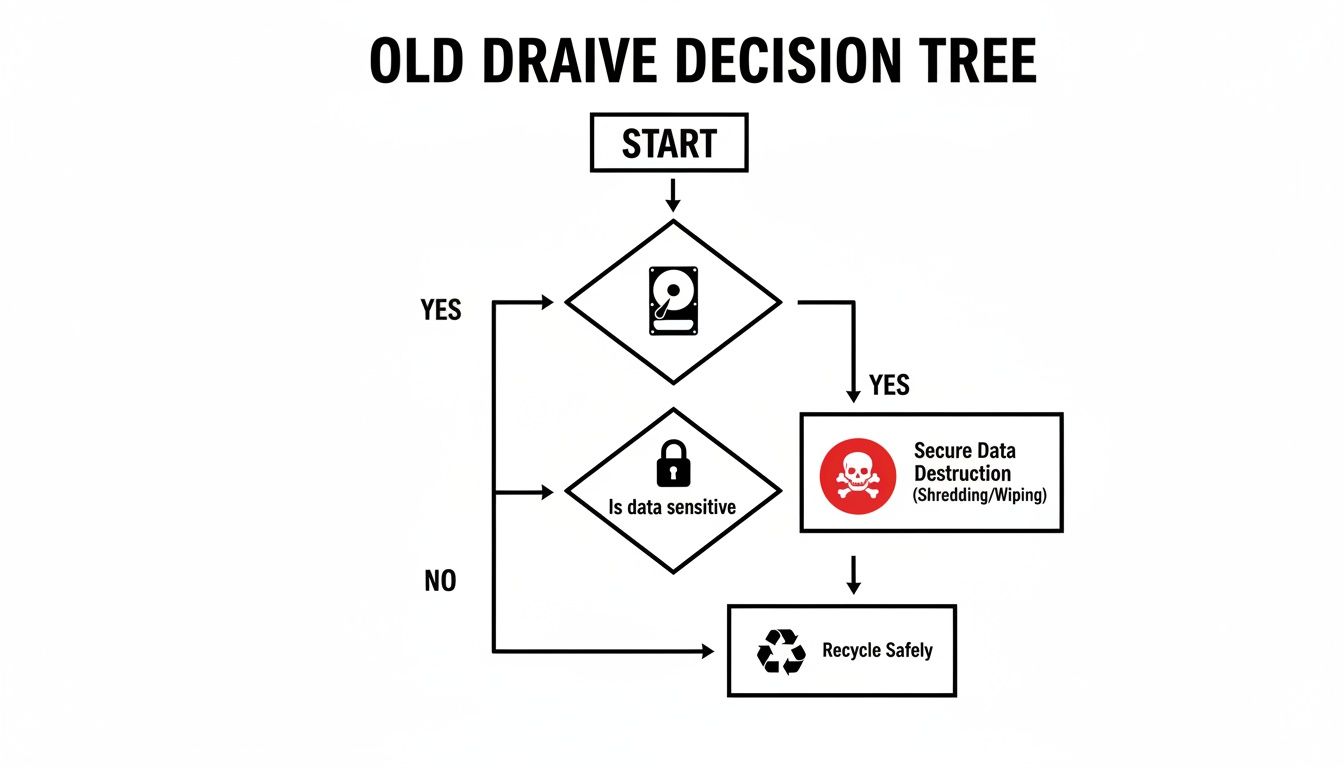
The message is clear: if that old hardware held any sensitive information, secure destruction isn't a "nice-to-have"—it's a must.
The need for this level of security is growing fast. The global hard drive destruction market was valued at a massive USD 1.65 billion in 2026, and it’s expected to climb to USD 5.05 billion by 2035. This huge jump is driven by the rising threat of data breaches and strict rules like HIPAA, GLBA, and NIST 800-88.
For small and medium-sized businesses in places like Alpharetta, Marietta, or Roswell, this is non-negotiable. That's why firms like Montclair Crew Recycling provide NAID AAA certified on-site shredding. We bring the shredder right to your office, and you can watch as your drives are pulverized into worthless scraps.
Comparing Data Destruction Methods
To make the choice even clearer, here’s a breakdown of the three main techniques. Each has its place, but only one offers total peace of mind.
| Method | How It Works | Security Level | Best For | Montclair Crew's Service |
|---|---|---|---|---|
| Software Wiping | Overwrites the drive with random data using specialized software. | Medium | Low-sensitivity drives you plan to reuse or donate. | Available upon request, but not recommended for sensitive data. |
| Degaussing | A powerful magnetic field erases data on magnetic platters. | High (for HDDs) | Bulk erasure of older, traditional hard disk drives (HDDs). | Not offered. It's ineffective on SSDs and doesn't provide visual proof of destruction. |
| Physical Shredding | An industrial shredder grinds the entire drive into small metal fragments. | Maximum / Absolute | All sensitive data, compliant with HIPAA, GLBA, etc. Works on both HDDs & SSDs. | Our Gold Standard. We offer NAID AAA Certified on-site and off-site shredding. |
In the end, it all comes down to your company's risk tolerance and what regulations you need to follow. For most businesses, the potential cost of a data breach makes physical shredding the only sensible choice.
For a more detailed look at the pros and cons, check out our guide on the best ways to destroy a hard drive and make sure your data truly disappears.
On-Site vs. Off-Site Shredding: What to Know in Metro Atlanta
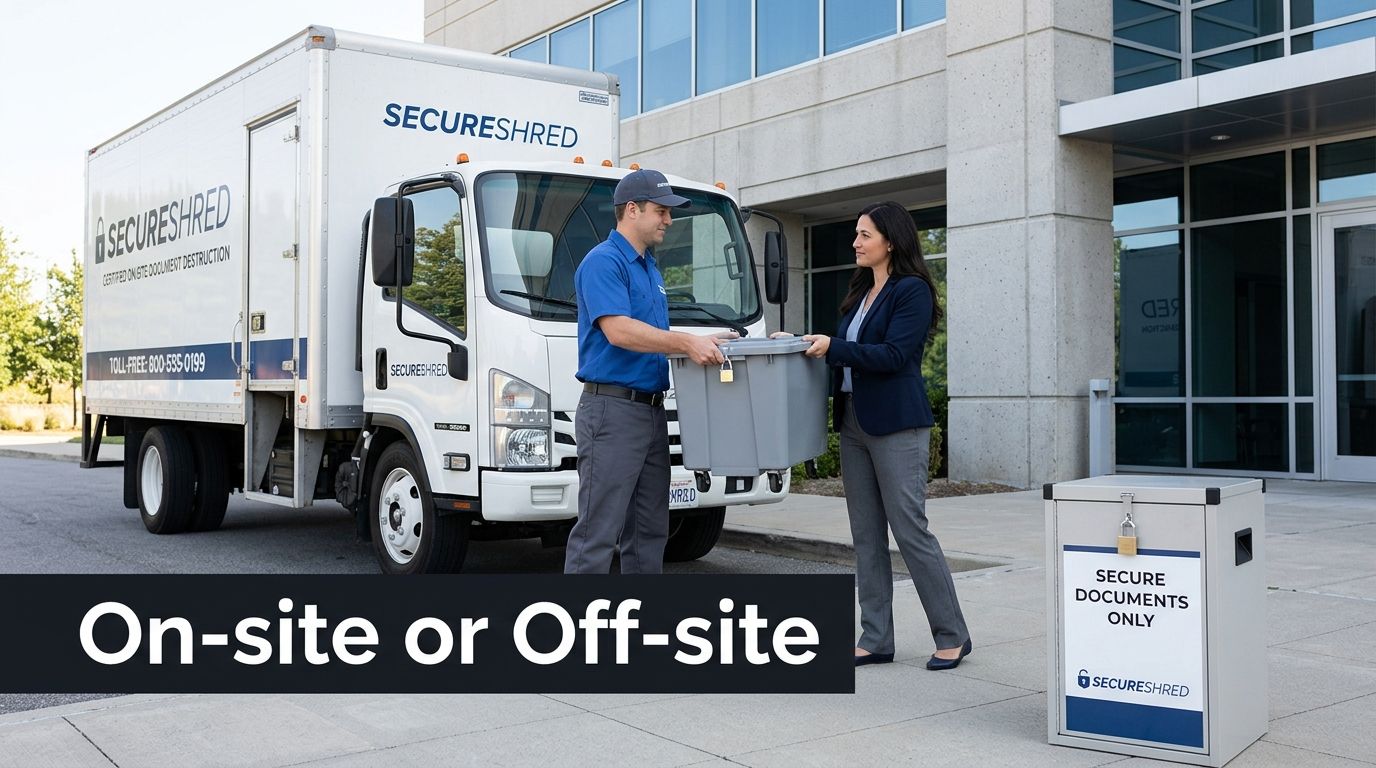
When your business needs hard drive destruction services in Georgia, one of the first questions you'll face is where the destruction should happen. Do you need a shredding truck to come to you, or can your old drives be taken away to a secure facility? Let's walk through the two main service models available right here in Metro Atlanta so you can decide what works for your organization.
The Ultimate Security of On-Site Shredding
On-site shredding delivers what many consider the highest level of security and peace of mind. A specialized mobile shredding truck comes directly to your office, whether you're in Alpharetta, Downtown Atlanta, or Kennesaw. The biggest advantage? You can witness the entire destruction process yourself.
The process is straightforward and built around security:
- Our certified technicians arrive at your location and gather all the hard drives slated for destruction.
- We scan the serial number of every single drive, creating an airtight chain of custody.
- You can then watch as each drive is fed into the industrial shredder and physically pulverized into tiny, useless fragments.
This method completely removes the risks that come with transporting intact data off your property. It's the gold standard for transparency. For an even closer look, check out our guide on how on-site hard drive shredding works.
The Cost-Effective Choice of Off-Site Shredding
Off-site shredding provides the same certified destruction but is often a more budget-friendly option. It's a great fit for businesses with large volumes of drives or those without a strict requirement to witness the shredding firsthand.
Here, we provide you with secure, locked containers to collect all your old hard drives. Once they're full, our GPS-tracked vehicle transports the sealed bins to our secure destruction facility. The drives are then destroyed under constant video surveillance, following the exact same rigorous protocols as our on-site service.
You don’t watch it happen in person, but you still get a formal Certificate of Destruction that verifies every drive on the manifest has been completely destroyed.
In Georgia's competitive hard drive destruction scene, efficiency is key. Mobile on-site units can shred up to 500 hard drives per hour, destroying everything from SATA drives and SSDs to USB sticks right before your eyes. This premium service typically costs $7 to $20 per drive, while off-site services for bulk disposals can bring the price down to $5 to $10 per drive, making it a great option for large enterprises in Sandy Springs or school systems in Marietta.
Ultimately, choosing between on-site and off-site shredding boils down to your company's security policies, compliance demands, and budget. For organizations dealing with highly sensitive data, the absolute assurance of on-site shredding is often worth the investment. For others, the proven security and cost efficiency of off-site destruction is the perfect solution.
How to Vet Your Georgia Data Destruction Partner

Picking the right partner for your hard drive destruction services in Georgia is the most critical decision you'll make when getting rid of old equipment. Think about it: this company is your last line of defense against a potentially devastating data breach. A cheap, uncertified operator might look like a bargain, but they could be putting your entire business on the line.
When you're ready to choose a company, you need to do more than just compare prices. It's time to perform thorough due diligence for vendors and ask the kinds of questions that separate the real security professionals from the simple junk haulers.
The Non-Negotiable NAID AAA Certification
Your vetting process can really start and end with one thing: NAID AAA Certification. This isn't just some logo they can slap on a website; it's a tough, third-party certification that proves a company meets the absolute highest security standards in our industry.
A NAID AAA Certified company has to deal with unannounced, surprise audits. These audits check everything from employee background screenings and insurance levels to the physical security of their facility and trucks. It's your concrete proof that a vendor is held accountable for protecting your data from the second it leaves your office.
This certification is your guarantee that the provider follows strict rules designed to stop data breaches before they happen. Honestly, working with anyone who isn't certified is a gamble you just can't afford to take.
Your Vendor Vetting Checklist
Don't ever feel shy about asking potential partners for the nitty-gritty details of their process. Any trustworthy provider will have clear, confident answers ready to go. Use this checklist to steer the conversation:
- Proof of Destruction: Ask them if they provide an official Certificate of Destruction. This isn't just a receipt; it's your legal paperwork proving compliance, and it should list the serial numbers of every single drive they destroyed.
- Chain of Custody: Can they walk you through their chain-of-custody procedures? You want to hear about secure, locked containers, GPS-tracked vehicles, and a clear, documented handoff process.
- Compliance Knowledge: Do they actually know about regulations like HIPAA, FACTA, and GLBA? A partner who gets it will understand exactly what's at stake for your particular industry.
- Responsible Recycling: What do they do with the shredded bits and pieces? Make sure they work with certified e-waste recyclers to handle the leftover metal and electronics the right way.
By digging in with these key questions, you can confidently find a partner that genuinely has your back. To see what a provider who checks all these boxes looks like, learn more about Montclair Crew's certified hard drive destruction services for businesses across Metro Atlanta.
Your Guide to Data Destruction Regulations in Georgia
For any business in Georgia, handling data protection laws isn't just about good practice—it's a legal minefield. While Georgia doesn't have a single, massive digital privacy law like some other states, it has a web of strict rules. These rules put the responsibility squarely on your shoulders to protect sensitive information.
Getting a handle on these obligations is your first line of defense against some serious financial and legal headaches.
The main state law you absolutely need to be aware of is the Georgia Personal Identity Protection Act (GPIPA). Now, this law won't give you a step-by-step on how to destroy a hard drive. What it does do is make you liable for what happens if you get it wrong. If a data breach happens because you carelessly tossed out drives with customer or employee data, the buck stops with you.
Key Federal Laws That Impact Georgia Businesses
On top of Georgia's own laws, several major federal regulations are in play, especially for certain industries. These aren't suggestions; they come with hefty fines for companies that don't comply, making professional data destruction a must-have service.
- HIPAA (Health Insurance Portability and Accountability Act): If you're in healthcare, from a major Atlanta hospital to a small clinic out in Roswell, HIPAA demands the secure and permanent disposal of all patient health information. No exceptions.
- GLBA (Gramm-Leach-Bliley Act): This one is for financial institutions. Banks, credit unions, and investment firms have to follow GLBA to protect consumer financial data, and that includes getting rid of it securely.
- FACTA (Fair and Accurate Credit Transactions Act): Any business that works with consumer credit reports is covered by FACTA. It requires you to completely destroy that information before you throw it out, all to prevent identity theft.
Cutting corners here can wreck a business. A single violation under HIPAA, for instance, can lead to fines as high as $50,000. Using a professional hard drive destruction service in Georgia is your best safeguard against these kinds of risks.
The Certificate of Destruction: Your Proof of Compliance
This is exactly why you bring in a professional data destruction partner. When a certified vendor like Montclair Crew destroys your old hard drives, you don't just get peace of mind—you get a Certificate of Destruction.
Think of this document as your legal shield. It’s official proof that you followed the rules and did your due diligence.
The certificate lists every single drive by its unique serial number and confirms that it has been physically destroyed. If you ever face an audit or a legal challenge, this piece of paper is your concrete evidence. It protects your business from liability and shows everyone you take data security seriously.
Your Hard Drive Destruction Questions, Answered
When Georgia businesses start looking into professional hard drive destruction, a few key questions always come up. Getting straight answers on the process, the proof, and what happens after is crucial for making a decision you can stand behind.
Why Is a Certificate of Destruction So Important?
Think of a Certificate of Destruction as more than just a piece of paper. It’s the official, legal proof that you followed through on protecting your sensitive data. This is your defense in case of an audit or legal question.
The certificate lists every single hard drive by serial number, confirming it was destroyed and transferring the liability from your company to us. To really understand its importance, learn more about why a Certificate of Destruction for hard drives is non-negotiable for secure data disposal.
Can You Shred Solid State Drives (SSDs)?
Yes, absolutely. While older methods like degaussing (using powerful magnets) are completely ineffective on SSDs, our industrial-grade shredders are built to handle them.
These machines don't just bend the metal; they grind the entire drive—casing, memory chips, and all—into tiny fragments. The data is physically obliterated, making recovery impossible.
It's a common myth that SSDs are tough to destroy. Their technology is different from old-school spinning hard drives (HDDs), but a NAID AAA Certified shredding process ensures they are completely annihilated to the highest security standards.
What Happens to the Shredded Material?
After your drives are turned into a pile of metal and plastic fragments, the job still isn't done. That material is securely transported to a certified e-waste recycling partner.
From there, the fragments are responsibly sorted, refined, and processed. This keeps hazardous materials out of landfills and puts valuable resources back into the supply chain. Nothing goes to waste.
Ready to protect your business with a secure, compliant, and environmentally responsible solution? Montclair Crew Recycling provides certified hard drive destruction services across Metro Atlanta, giving you the peace of mind that your data is gone forever. Contact us today to schedule your service at https://www.montclaircrew.com.
