

A lot of Houston teams hit the same point at the end of a network refresh. The new stack is installed, the cutover is done, and now there's a room full of old Cisco routers, Juniper switches, VoIP phones, gateways, and rack gear nobody wants to touch because nobody wants to own the risk.
That's where telecom equipment liquidation usually goes wrong. Facilities sees a removal job. Finance sees leftover value. IT sees a security issue. Compliance sees exposure if the wrong device leaves the building with configs, credentials, logs, or asset tags still intact.
If you're dealing with telecom equipment liquidation Houston, treat it like a controlled IT asset disposition project, not a junk haul. That shift changes everything. It affects how you inventory gear, how you separate resale candidates from scrap, how you document custody, and how you choose a buyer or processor.
Your Guide to Smart Telecom Equipment Liquidation in Houston
A Houston office closes a floor. A hospital upgrades voice infrastructure. A manufacturer retires branch networking gear after a WAN redesign. The scene is usually the same. Equipment that once mattered is now sitting in racks, closets, shelves, and telecom rooms waiting for somebody to “come get it.”
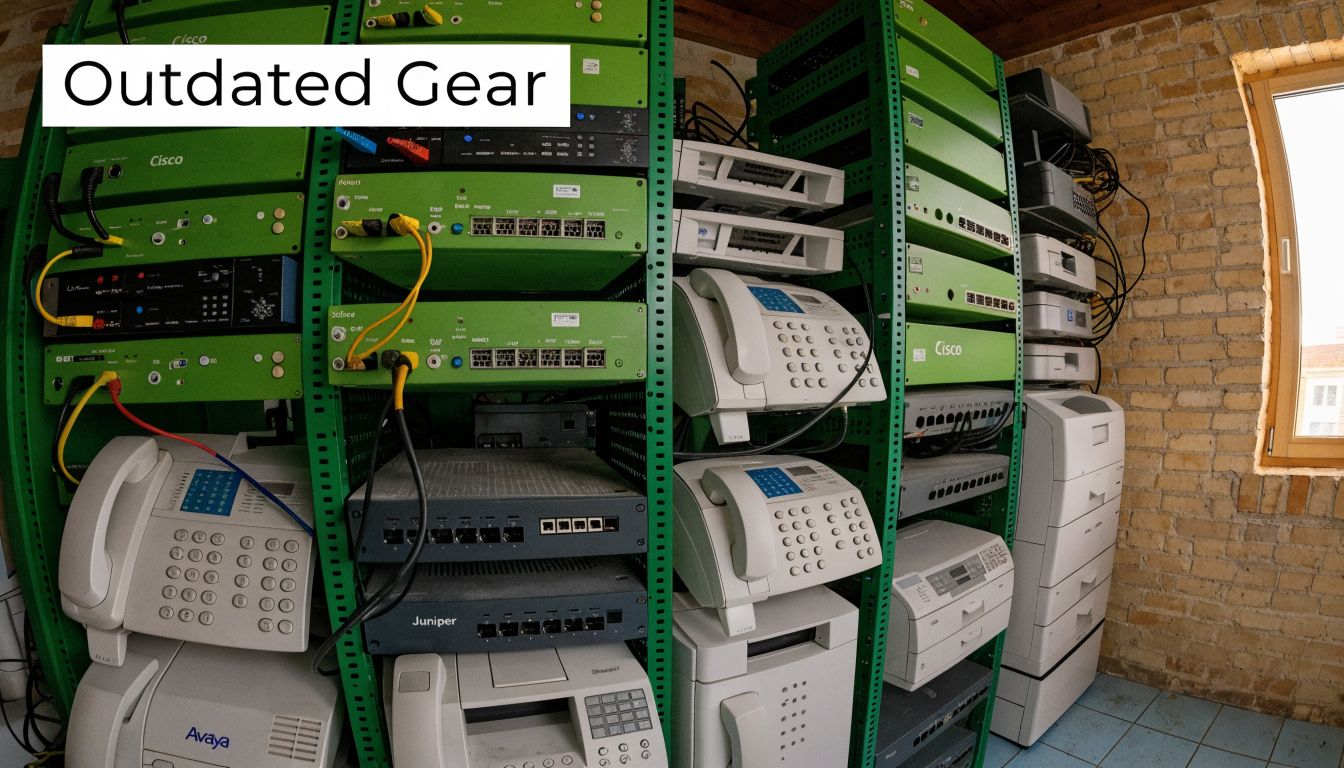
That approach is expensive in all the wrong ways. If a buyer picks through the obvious resale items and leaves the low-value material behind, you still have a disposal problem. If they remove everything without a defensible data process, you may have created a security problem. If nobody audits what left the site, finance can't verify value recovery and compliance can't verify control.
Houston has a deep secondary market for this category of equipment for a reason. After the Telecommunications Act of 1996 drove more than $500 billion in investment, the 2001 telecom crash left the industry with massive surplus inventory. FCC Chairman Michael Powell testified in 2002 that the industry owed about $1 trillion, which helped establish a durable resale market for used switches and routers in major hubs like Houston, as noted in the telecom crash history. That long history is why you'll still find local firms eager to buy, remarket, strip, recycle, or broker telecom gear today.
What a smart liquidation project looks like
The best projects start before the first quote request. Someone inside the business defines scope, separates data-bearing assets from ordinary electronics, and sets ground rules for sanitization and reporting.
Here's what usually works:
- IT owns asset identification: Routers, firewalls, PBX hardware, voice gateways, and switches get reviewed by someone who knows what stores configuration data.
- Facilities owns site logistics: Access windows, elevator use, loading dock rules, and staging areas get sorted before pickup day.
- Finance owns reconciliation: Final manifests, resale reports, and destruction records get matched back to the original asset list.
- Compliance sets the evidence standard: If your business handles regulated data, paperwork requirements need to be defined up front.
Practical rule: If the plan starts with “find somebody who pays cash for used equipment,” it's incomplete.
A lot of Houston managers also need to coordinate liquidation with broader carrier, network, or office transition work. If you're aligning decommissioning with an infrastructure change, it helps to understand the local service environment around telecom services in Houston, because removal timing often depends on circuit cutovers, cabling shutdowns, and site access constraints.
The real objective
The objective isn't just to get old gear out of the building. It's to get it out securely, with traceability, and with the highest defensible value recovery available for each asset class.
That means some gear should be resold. Some should be harvested for parts. Some should be recycled immediately. The mistake is treating all of it the same.
Preparing Your Telecom Assets for Liquidation
Most liquidation losses happen before the vendor arrives. Teams guess at quantities, skip serial numbers, and send a few blurry rack photos to three buyers. Then they wonder why quotes are all over the place.
Start with your own inventory. Not the buyer's. Yours.

Build an asset list buyers can actually use
A useful liquidation inventory should include enough detail for triage, pricing, and handling. “Networking gear from old phone system” is not an inventory. It's a problem statement.
Include these fields where possible:
- Manufacturer and model: Cisco ISR, Catalyst, Meraki hardware, Avaya handsets, Juniper EX, Palo Alto appliances, and similar identifiers matter.
- Serial number: This is the anchor for custody, destruction records, and dispute resolution.
- Physical condition: Note cracked bezels, bent ears, missing faceplates, fan errors, broken ports, rust, or heavy cosmetic wear.
- Working status: Pulled working, unknown, failed, powers on only, or not tested.
- Completeness: Include rails, power supplies, optics, cards, antennas, handsets, licenses, and rack kits where relevant.
- Location: Closet, MDF, IDF, branch site, warehouse shelf, or storage room.
If the project includes legacy phone gear, adapters, or analog transitions, technical teams sometimes need to identify what can still be used in a stopgap setup before it's retired. A practical reference is this SnapDial guide on connecting legacy phones, which helps distinguish equipment that still has operational bridging value from equipment that's only taking up shelf space.
Photograph everything before movement
Photos aren't optional when you expect fair pricing. They prevent arguments later about missing modules, damaged chassis, and whether the equipment was intact when it left your site.
Take photos that show:
- Front and rear views of each device or grouped set
- Close-ups of labels with model and serial information
- Installed cards or modules in open or visible bays
- Damage points like broken ports, dents, or missing components
- Rack context before unracking, especially if disputes might arise about what was removed
A buyer can price from a complete inventory and clear photos. Without both, they're guessing, padding risk, or planning to reprice later.
Gather the paperwork that supports value
Old purchase orders won't turn obsolete gear into premium inventory, but documentation can still affect buyer confidence and resale pathways. If you have them, attach maintenance records, decommission notes, warranty status, support history, and any proof that the device was recently in service.
Licensing is a separate issue. Some hardware is physically usable but commercially limited if software entitlements or service relationships don't transfer. Don't assume every appliance or communications platform has the same resale path just because it powers on.
A quick way to organize this is to create three folders:
| Folder | What goes in it | Why it matters |
|---|---|---|
| Inventory folder | asset list, serial lists, rack maps | supports pricing and chain of custody |
| Condition folder | photos, failure notes, missing part notes | reduces repricing disputes |
| Documentation folder | purchase records, service history, licenses, support notes | helps buyers assess resale potential |
Audit before you contact the market
Internal discipline pays off in these situations. When your team controls the inventory, you control the conversation. You can ask buyers specific questions about specific lots instead of accepting generic offers.
For larger refreshes or multi-site retirements, this kind of discipline fits into broader enterprise IT asset management practices. The companies that keep cleaner records during the life of the asset usually get cleaner outcomes at end of life too.
A few common mistakes to avoid:
- Don't mix active and retired gear: Staff grab the wrong switch when old and new hardware sit in the same room.
- Don't let branches self-box without instructions: Small sites often omit cords, power supplies, or label information.
- Don't wait until move-out week: Once the office is in chaos, inventory quality drops fast.
- Don't rely on memory for storage risk: Treat uncertain devices as sensitive until reviewed.
Separate assets into handling groups
Before any quote request goes out, sort everything into practical categories:
- Remarketing candidates such as newer enterprise switches, routers, servers, and complete phone lots
- Parts candidates where the chassis may be weak but modules, optics, or accessories may still have value
- Recycle-only material such as damaged, incomplete, unsupported, or physically compromised equipment
- Data-sensitive equipment that must be sanitized or destroyed before any resale decision
That pre-work does two things. It improves the quote quality you'll receive, and it prevents the vendor from defining your inventory for you.
Ensuring Bulletproof Data Security and Compliance
Telecom gear gets underestimated because it doesn't always look like a traditional data device. A switch looks like infrastructure. A VoIP phone looks like a handset. A firewall looks like network plumbing. In practice, these devices can hold configuration files, credentials, call data, access records, IP schemes, and management details your security team would never knowingly release.
That's why telecom equipment liquidation Houston has to be run as a security process first.

Factory reset is not the control
A factory reset is useful for operations. It is not the same thing as documented sanitization. Plenty of devices can be reset for redeployment while still leaving questions about what was stored, whether all media was addressed, and whether the wipe was verified.
The guidance on Houston telecom liquidation is clear on the sequence. A common liquidation failure is mismanaging data-bearing network gear. The recommended order is to audit assets first, classify each by storage risk, sanitize or destroy media before release, and only then grade for resale. For regulated sectors, documented chain-of-custody and destruction evidence are key requirements, not optional extras according to Houston-focused telecom liquidation guidance.
That sequence matters because once gear leaves your building, your options narrow. If you haven't identified storage-bearing devices before pickup, you're trusting someone else to find them later.
Sort gear by storage risk
Not every asset needs the same treatment. The right control depends on what the device stores, how it stores it, and what your internal policy allows.
A simple classification model works well:
| Device class | Typical risk | Preferred control question |
|---|---|---|
| Routers and firewalls | configs, credentials, logs, management data | can this be verifiably sanitized before resale? |
| Switches and controllers | startup configs, cached settings, possible removable media | has every storage point been identified? |
| VoIP systems and handsets | call records, user assignments, directory data | does policy allow reuse after wipe? |
| Servers and appliances in telecom racks | direct data storage | should this be wiped or physically destroyed? |
What to require from a vendor
A serious vendor should be able to explain, in writing, how sanitization works for each category of asset. If they can only say “we wipe drives,” they're not ready for telecom gear.
Ask these questions before pickup:
- Which devices do you classify as data-bearing?
- Do you sanitize on site, off site, or both?
- What method do you use for wipe verification?
- When do you choose physical destruction instead of wiping?
- How do you document chain of custody from rack to processing?
- What does the destruction certificate identify?
- Can you tie the certificate back to my asset manifest by serial number or unique lot reference?
Never accept “we'll wipe it after it gets to our warehouse” unless the custody path, verification method, and reporting format are already documented in the statement of work.
Compliance teams need evidence, not assurances
Healthcare, finance, legal, energy, and government-adjacent organizations in Houston don't need vague comfort. They need records that stand up in an audit, an internal review, or a post-incident investigation.
That means keeping:
- Pre-removal inventory records
- Device risk classifications
- Pickup manifests
- Handoff signatures
- Certificates of destruction or sanitization
- Exception logs for missing, damaged, or substituted equipment
If your team wants a non-telecom reminder of why repair and disposal privacy basics matter, this short set of Fixo privacy tips for phone fixing is useful because it reinforces the same operational truth. Devices leave your hands before your risk leaves with them.
Certified destruction should match policy
Some organizations allow verified wiping for remarketable equipment. Others require physical destruction for any storage-bearing device leaving a regulated environment. Neither approach is automatically correct for every business.
What matters is consistency. Your policy should decide first. The vendor should execute second.
If your internal standard requires formal sanitization records or destruction support, your team should review secure disposition expectations before release. A detailed reference point is secure data destruction process guidance, especially if different departments currently use different disposal rules.
Where projects usually fail
Most failures are boring. That's what makes them dangerous.
- A branch office ships phones back loose with no manifest.
- A facilities team lets a buyer remove mixed pallets without device-level review.
- A network admin factory-resets a firewall and assumes that closes the issue.
- A certificate arrives later with generic language that can't be reconciled to the original inventory.
All four failures come from the same mistake. The company treated liquidation like surplus removal instead of controlled disposition.
Valuation and Finding the Right Houston Partner
This is the part everyone asks about first and should ask about second. Value matters, but value without process usually collapses during grading, repricing, deductions, or security exceptions.
The right question isn't “Who pays the most for used telecom gear?” It's “Which partner can recover legitimate value while handling security, logistics, and reporting without creating new risk?”
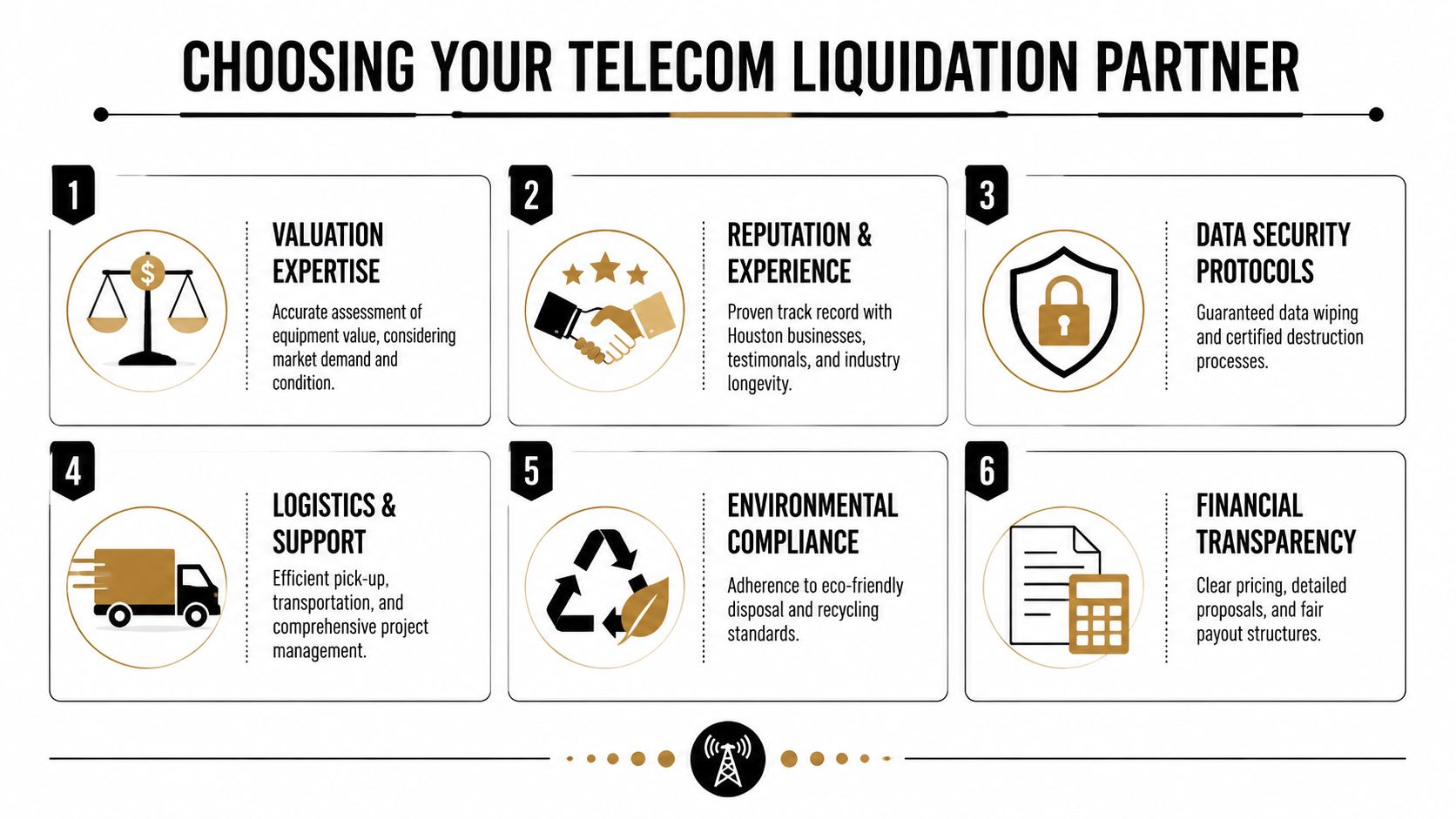
What actually drives telecom value
In this market, value usually comes down to a few practical factors:
- Age and support status: Equipment closer to end-of-support generally gets harder to remarket.
- Brand and model demand: Cisco, Juniper, and certain enterprise voice or edge devices often get more buyer attention than obscure or heavily customized platforms.
- Condition: Clean, complete, unrushed decommissions do better than dented, incomplete pull-outs.
- Completeness: Missing power supplies, optics, faceplates, rack ears, or licensing context can cut appeal fast.
- Timing: The longer retired gear sits in a closet, the more likely demand softens or paperwork disappears.
That timing issue matters. According to telecom asset recovery guidance, organizations without a structured disposition program often recover only 10-20% of potential asset value, while professional services that include certified data wiping can retain 40-60% of resale value. The same source notes that 40-60% of potential value is lost when decommissioning is delayed. In plain terms, waiting hurts.
The three partner types you'll see in Houston
Houston businesses usually end up choosing among three provider models. Each one has a place. The mistake is using the wrong one for the job.
Specialized resellers
These firms care most about remarketable inventory. If you have cleaner, newer, marketable lots, they may produce the best raw resale outcome.
The downside is scope. Some won't want low-value material, mixed-condition lots, or heavy compliance reporting. Others will outsource the less attractive parts of the job.
Certified e-waste recyclers
These providers are often the best fit when the majority of equipment is obsolete, damaged, incomplete, or not worth remarketing. They can move material compliantly and clear space fast.
The trade-off is obvious. If the lot contains meaningful resale candidates, a recycle-first vendor may not optimize value recovery.
Full-service ITAD firms
These firms sit in the middle of the value-security-compliance triangle. They usually handle inventory support, logistics, sanitization, destruction records, resale triage, and downstream processing under one workflow.
They're often the strongest fit for regulated industries, multi-site projects, telecom rooms mixed with server gear, and office closures where you need one accountable party.
Choosing Your Houston Liquidation Partner
| Partner Type | Best For | Value Return | Data Security | Compliance & Reporting |
|---|---|---|---|---|
| Specialized reseller | cleaner lots with obvious resale demand | potentially strong on select equipment | varies by provider | often lighter unless requested |
| Certified e-waste recycler | obsolete or damaged equipment | usually limited | can be solid for destruction workflows | often solid on recycling documentation |
| Full-service ITAD firm | mixed inventories, regulated sectors, site closures | balanced, with triage across resale and recycle paths | typically strongest end-to-end | usually strongest for manifests, custody, and final reporting |
If your inventory includes both resale candidates and sensitive data-bearing hardware, the cheapest pickup model is rarely the best business decision.
Questions that separate serious partners from opportunists
A strong Houston partner should answer these without hesitation:
- How do you decide resale versus parts harvesting versus recycling?
- Can you show sample manifests and destruction certificates?
- Will you take the low-value material too, or only the premium items?
- How is condition grading handled after pickup?
- What happens if actual inventory differs from the quote set?
- Who owns the process for chain-of-custody reporting?
If the provider gets vague once paperwork comes up, keep looking.
For teams comparing providers more broadly, a useful benchmark is how mature IT asset disposition companies explain custody, valuation, and downstream handling before they ever talk payout.
A realistic way to think about payout
Don't judge bids only on the top-line recovery number. Judge them on whether the path to that number is believable.
A believable proposal usually includes:
- a defined asset scope
- clear assumptions about condition
- a statement on how nonmarketable equipment is handled
- data destruction terms
- logistics responsibilities
- reporting deliverables
- timing for reconciliation and payment
A weak proposal usually sounds exciting and reads like fog.
Managing Logistics and Finalizing the Deal
Once you've chosen a partner, execution becomes the next source of risk. Good planning can still fail on pickup day if the site isn't staged, the crew isn't verified, or the statement of work leaves too much open to interpretation.
In Texas, this work is often sold as a full-service model. Vendors commonly advertise on-site evaluation, fast removal for office closures, and compliance-driven data destruction aligned with EPA and DoD-style standards, covering projects from single units to complete data centers, as described by a Texas ITAD service overview. That sounds good on paper. Your job is to turn the marketing language into actual operating controls.
Run pickup day like a controlled handoff
The cleanest removals happen when equipment is staged before the truck arrives. That doesn't mean piling sensitive devices in the hallway. It means separating lots, labeling what belongs to each manifest group, and making sure site contacts know exactly what should leave.
A solid pickup-day checklist includes:
- Staging plan: define where packed, unracked, and still-installed assets are located
- Access control: confirm loading dock access, elevator reservations, badging rules, and escort requirements
- Crew verification: record names, company identity, and any required insurance or work-order documentation
- Asset confirmation: match what leaves against the approved list before the vehicle departs
For larger projects with pallets, branch consolidations, or regional movement, logistics can get more complicated than most IT teams expect. If you need a framework for evaluating transport partners, this guide on how to compare freight forwarder pricing and capabilities is useful because many of the same issues apply. Handling capability, documentation quality, and accountability matter more than a low transport line item.
Keep active operations protected
Telecom rooms are rarely isolated from business operations. You may have active circuits in the next rack, temporary cutover equipment still in place, or branch teams sharing cramped IDF spaces with retired gear.
Use controls that reduce disruption:
- Schedule after critical changes are complete: don't overlap liquidation with unresolved cutovers
- Mark active gear clearly: use visual labels that the pickup crew can't misread
- Assign one escort from IT or facilities: somebody must know what's going and what stays
- Document rack condition before and after: this helps if questions come up later about missing devices or cable disturbance
The safest removal is the one where the vendor never has to guess.
What the statement of work must say
Too many teams get lazy at this stage. They accept a one-page pickup authorization and assume the details will be handled in the background.
They won't.
Your statement of work should cover, at minimum:
| SOW item | What it should define |
|---|---|
| Asset scope | which sites, rooms, racks, and device classes are included |
| Data handling | wipe, destruction, verification method, and any on-site requirements |
| Chain of custody | how assets are logged, transferred, and reconciled |
| Financial terms | buyback structure, service charges, shared revenue, or disposal fees |
| Reporting | manifests, certificates, settlement timing, and exception handling |
| Liability transfer | when responsibility shifts and under what documented conditions |
If the SOW says “data will be handled appropriately,” that isn't a control. If it says “items to be inventoried as needed,” that isn't a control either.
Red flags during contract review
Some warning signs should stop the deal before pickup gets scheduled.
- Vague destruction language: no method, no verification, no certificate format
- Loose inventory terms: the vendor reserves the right to define the lot after removal
- No exception process: missing, extra, or damaged assets have no formal resolution path
- Pressure to move quickly without audit: this usually benefits the buyer, not you
- Unclear fee mechanics: transportation, labor, recycling, and testing charges appear only after the fact
If you want a broader internal readiness tool before signatures are final, a server decommissioning checklist is a useful cross-check because many of the same handoff, inventory, and destruction requirements apply to telecom environments too.
Final verification after the truck leaves
The deal isn't done at pickup. It's done when you can reconcile the paperwork.
That means confirming:
- pickup manifest matches approved scope
- received inventory matches pickup manifest
- wiped or destroyed assets have corresponding records
- resale and recycle outcomes tie back to the original lot
- payment or disposal invoicing matches the agreed model
If any of those pieces are missing, the project is still open.
A Final Checklist for Your Houston Telecom Liquidation
The businesses that handle telecom liquidation well don't treat it as cleanup. They treat it like a controlled retirement project with security, financial, environmental, and operational consequences.
That approach matters more now because the downside of loose process is high. IBM's 2025 data breach reporting put the average cost of a data breach at $4.44 million, which is why telecom liquidation has to be managed as a security function, not a scrap transaction, as referenced in this Houston liquidation discussion.
Use this checklist before anything leaves the building
Inventory and audit
- Create a defensible asset list: include make, model, serial number, condition, completeness, and location.
- Photograph the equipment: capture labels, rack position, and visible damage before movement.
- Separate by handling path: identify resale candidates, recycle-only assets, and data-sensitive devices.
- Gather supporting records: pull service history, purchase details, and any useful licensing context.
Secure and sanitize
- Classify storage risk: routers, switches, firewalls, VoIP systems, and appliances all need review.
- Set the data policy first: decide what gets wiped, what gets destroyed, and what needs on-site handling.
- Require chain of custody: every handoff should be documented from release through processing.
- Demand auditable evidence: destruction and sanitization records need to match the inventory.
A trustworthy vendor should be able to prove what happened to each sensitive asset, not just describe the process in broad terms.
Value and partner selection
- Ask how triage works: resale, parts harvesting, and recycling should follow written logic.
- Compare partner types thoroughly: reseller, recycler, and ITAD firms solve different problems.
- Read the proposal for assumptions: especially condition, completeness, and fee treatment.
- Watch timing: old gear usually becomes less attractive as support ends and documentation disappears.
Execute and verify
- Stage the site before pickup: reduce confusion, protect active equipment, and speed removal.
- Verify the crew and paperwork: don't let assets leave on trust.
- Lock down the statement of work: asset scope, data handling, reporting, and financial terms all need plain language.
- Reconcile after processing: pickup manifest, destruction records, and final settlement should tell one consistent story.
The standard to hold
If a provider can't explain custody, sanitization, grading, and reporting in writing, they're not ready for a serious telecom liquidation project. That's true whether you're clearing one telecom closet or decommissioning multiple Houston sites at once.
The best outcome is simple. Your team clears the space, protects the data, documents the process, and captures whatever value the assets still hold. No guessing. No vague promises. No missing paperwork after the truck is gone.
If your organization needs a secure, documented path for retiring telecom gear, servers, computers, or other business electronics, Montclair Crew Recycling can help with compliant IT asset disposition, certified data destruction, logistics support, and responsible recycling for B2B environments.
