
That pile of old computers stacked in your storage room? It’s not just collecting dust—it’s a ticking time bomb of data liabilities. For any business in Georgia, proper IT equipment disposal isn’t just a cleanup chore. It's a critical security measure that protects your reputation, your finances, and your legal standing from some very real digital dangers.
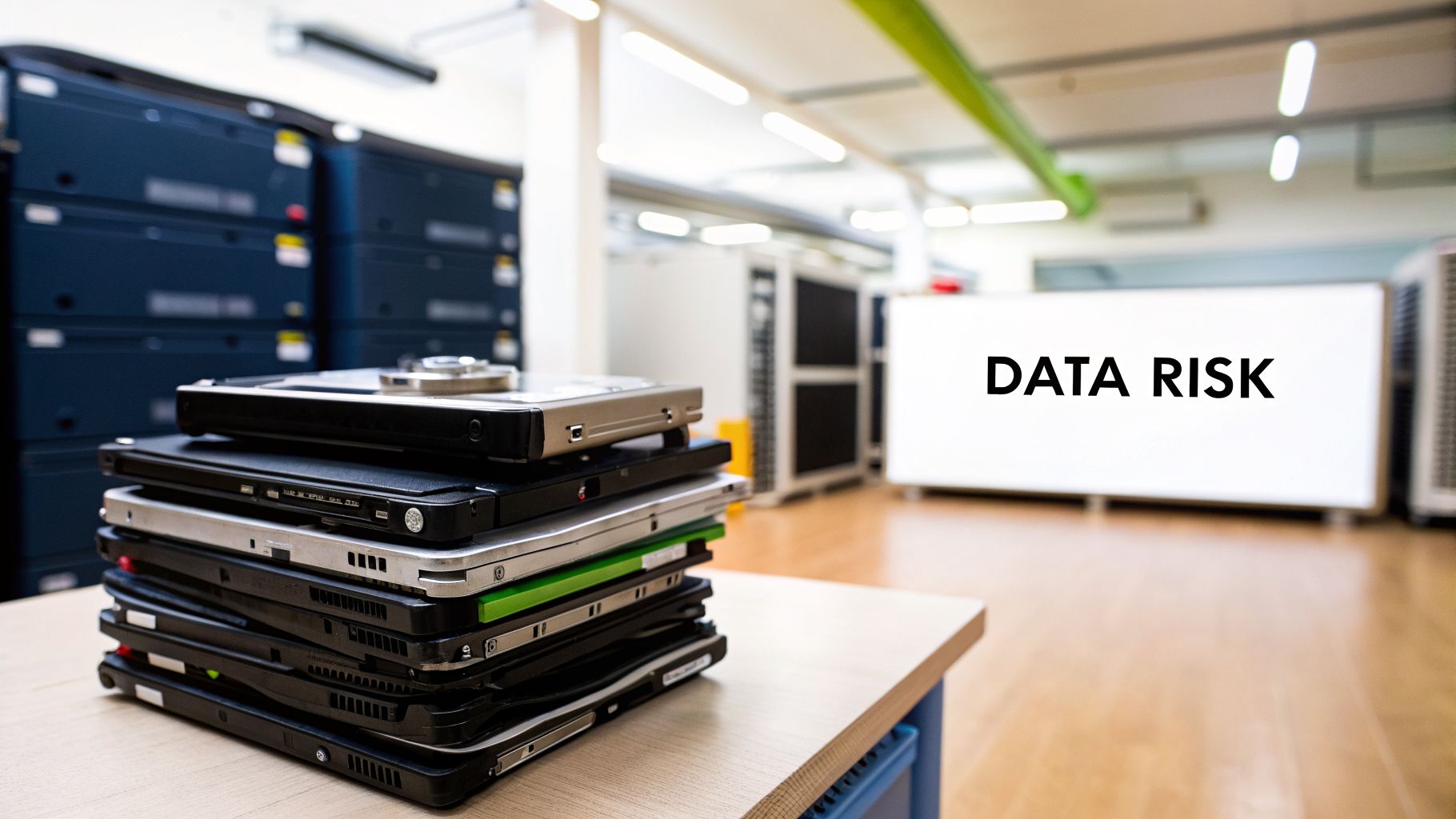
Why Your Old Tech Is a Major Business Risk
Let me paint a picture for you. An Atlanta-based marketing firm just finished a big office upgrade. They stacked all the old laptops and servers in a closet, planning to drop them off at a local e-waste event. An employee did what most people would do—they "deleted" the files and formatted the drives, thinking the data was gone for good.
That one simple mistake left the company completely exposed.
A few months later, a competitor somehow got their hands on client lists, private marketing plans, and financial numbers. The source? An old server hard drive they bought for next to nothing on the secondary market. The "deleted" information was recovered in minutes, leading to a devastating data breach, lost clients, and a mountain of legal trouble. This isn't a scare tactic; we see variations of this story play out more often than you'd think.
The Illusion of Deletion
Here’s the thing: formatting a hard drive doesn’t actually erase the data. It’s like tearing the table of contents out of a book—all the pages and the information on them are still there, waiting for anyone who knows how to look.
A standard deletion just removes the pointers your operating system uses to find the files. The data itself stays put until new data happens to be written over it.
This leftover data, known as data remanence, is a massive threat. Those old hard drives are a potential gold mine of sensitive information, including:
- Personally Identifiable Information (PII): Things like employee Social Security numbers, customer addresses, and phone numbers.
- Protected Health Information (PHI): For healthcare providers, this means patient records and medical histories.
- Financial Data: Credit card numbers, bank records, and internal accounting files.
- Intellectual Property: Your company's trade secrets, proprietary designs, and strategic plans.
To really get a handle on the risk, it helps in understanding what PII means for modern data security and the strict legal duties that come with protecting it.
The Real Cost of Negligence
The fallout from a data breach is staggering. You’re not just looking at potential fines and the immediate cost of fixing the mess. The long-term damage to your brand’s reputation can be impossible to repair. Customers trust you with their data, and a single breach can destroy that trust in an instant.
For Georgia businesses, the equation is simple: The potential cost of a data breach from improperly disposed IT equipment far exceeds the investment in professional, secure data destruction services.
Professional disposal is your only real defense. It takes the whole process from a risky guessing game to a certified, compliant security procedure. Our team offers a range of services, and you can learn more about our rigorous secure data destruction methods that guarantee your information is gone forever. This isn't just about clearing out old hardware; it's about closing a dangerous security loophole for good.
Navigating Georgia's Data Compliance Maze
For Georgia businesses, getting rid of old IT gear isn’t just a matter of clearing out a storage closet. It’s a serious legal responsibility. Get it wrong, and you’re looking at huge fines, potential lawsuits, and a damaged reputation that’s hard to fix. These aren't just vague threats; they are real-world rules with expensive consequences.
Think about it this way: a medical office in Sandy Springs can’t just toss an old server in a dumpster. If that server still has patient data on it, they could be on the hook for a HIPAA violation costing millions. The same goes for a law firm in Alpharetta that gets rid of old computers without wiping client files, leaving them wide open to a FACTA violation.
These regulations demand more than just crossing your fingers and hoping for the best. You need a documented, professional process that proves you handled that sensitive data correctly from the moment it left your building to its final destruction.
Key Regulations Georgia Businesses Must Know
A few major federal laws dictate how you handle data, and they apply to almost every business in Georgia, from a small startup to a Fortune 500 company.
- HIPAA (Health Insurance Portability and Accountability Act): This is the big one for anyone in healthcare. It requires strict, provable security measures for all patient health information (PHI), whether it’s on a live server or an old hard drive you're getting rid of.
- GLBA (Gramm-Leach-Bliley Act): If you're in the financial world—banks, investment firms, even tax prep services—GLBA applies to you. It mandates that you protect customers' financial information and ensure it's securely destroyed.
- FACTA (Fair and Accurate Credit Transactions Act): This law affects nearly everyone. If your business has ever run a background check on an employee or handled any kind of consumer credit report, you are legally required to destroy that data before disposing of the device it was on.
These laws turn old hard drives into legal liabilities. Just handing them off to a standard e-waste recycler isn't enough and puts your entire organization at risk.
The Importance of a Chain of Custody
So, how do you actually prove you did everything right? The answer is a solid chain of custody. Think of it as a legal paper trail that tracks your equipment every step of the way. It’s the documented proof that shows your assets were handled securely from start to finish.
A documented chain of custody is your best defense against claims of negligence. It provides a transparent, auditable record showing who handled your assets, when they were transported, and how the data was ultimately destroyed.
This documentation is a non-negotiable part of any professional secure IT equipment disposal service in Georgia. If a vendor can’t provide a clear and unbroken chain of custody, that’s a major red flag. The job isn’t done until every single piece of equipment is accounted for.
Your Ultimate Proof of Compliance
The final document that closes the loop is the Certificate of Destruction. This isn't a simple receipt. It's a legally recognized document confirming that your data has been permanently destroyed according to strict federal standards.
A legitimate certificate should always include these key details:
- A list of the serial numbers for every hard drive that was destroyed.
- The destruction method used (e.g., DoD 5220.22-M wiping, physical shredding).
- The date and location where the destruction took place.
- An authorized signature from the disposal company.
This certificate is your official proof that you've met your legal obligations. It gives you the peace of mind that the data is gone for good and your business is protected. As you look at your disposal options, it’s smart to understand the full range of local services. You can learn more about compliant Georgia electronics recycling to make sure every part of your old hardware is handled responsibly.
The Real Meaning of Secure Data Destruction
So, what does it actually mean to "securely" destroy data? It's a phrase you hear all the time, but for any business in Georgia, knowing what happens behind the curtain is non-negotiable. When you bring in a professional, you're not just paying them to haul junk away. You're investing in the complete, permanent, and irreversible destruction of your sensitive information.
Just hitting 'delete' or formatting a hard drive is a dangerously false sense of security.
Think of it like this: deleting a file is like crumpling up a confidential document and tossing it in the trash. Anyone can pull it out, smooth it over, and read it. Formatting a drive is a bit better—maybe like ripping that paper in half. A determined person could still tape it back together.
Secure data destruction is the equivalent of feeding that document into a cross-cut shredder, turning it into confetti. There’s no coming back from that. The information is gone for good. That's the level of certainty your business needs.
Method 1: Data Wiping for Total Digital Erasure
The first gold standard is multi-pass data wiping, also known as data sanitization. This isn't a simple delete; it's a software-based process that overwrites every single bit of a hard drive with random data, not just once, but over and over again.
Imagine your hard drive's data is writing carved into a wooden board. A simple format just puts a layer of paint over it. Data wiping is like taking a power sander to that board, grinding the surface down to nothing, then doing it two more times just to be sure.
The industry benchmark for this is the DoD 5220.22-M standard, first set by the U.S. Department of Defense. This process involves a three-pass overwrite:
- Pass One: Overwrites the entire drive with zeros.
- Pass Two: Overwrites it again with ones.
- Pass Three: Overwrites it a final time with random characters and verifies the wipe was successful.
This method is so thorough that even advanced forensic labs can't recover what was there before. To get a better handle on the specifics, check out our guide on what data sanitization is and why it's a critical part of any IT disposal plan.
Method 2: Physical Shredding for Ultimate Assurance
While wiping is extremely effective, some data is so sensitive that you need absolute physical proof of destruction. This is where on-site hard drive shredding comes in. It's the most final way to guarantee data is gone forever because the device itself is physically annihilated.
Picture a specialized, industrial-grade shredding truck pulling up to your office in Atlanta or Roswell. Your old hard drives are scanned one by one, their serial numbers recorded, and then you get to watch as they're dropped into a shredder that tears them into tiny, mangled pieces of metal.
On-site shredding offers total peace of mind. You get to witness the destruction yourself, giving you undeniable proof that your data was destroyed before the equipment ever left your property.
This is the go-to method for organizations with the tightest compliance rules, like hospitals, banks, and government offices. It completely removes any risk during transit.
This focus on security is a huge deal now. With data privacy laws getting stricter and cyber threats growing, proper disposal isn't just an IT task—it's a boardroom-level concern. The IT asset disposition (ITAD) market is expected to reach $36.4 billion by 2034, proving just how critical these certified services have become for modern businesses.
Your Step-by-Step IT Disposal Journey
So, you've decided it's time to retire your old IT gear. What happens next? The whole process can feel like a headache waiting to happen, but working with a professional IT Asset Disposition (ITAD) partner turns it into a straightforward, manageable project.
This isn't about just winging it. A professional service follows a clear, structured path to make sure your data is secure, your business stays compliant, and the old hardware is handled responsibly from start to finish.
Let’s walk through exactly what you can expect when you bring in a pro for your secure IT equipment disposal services in Georgia.
Step 1: The Initial Audit and Logistics Planning
It all starts with a simple conversation and an inventory list—not a moving truck. Before anything happens, a professional provider needs to know exactly what you have, from servers and laptops to networking gear and piles of old hard drives. This first step is all about creating a solid game plan.
You'll provide a list of all the assets you need gone, including what they are, how many you have, and where they are in your building.
This is also when you'll decide on the key services you need. Do you require on-site hard drive shredding for maximum peace of mind, or are you good with certified data wiping at a secure facility?
Once the plan is set, a pickup date is scheduled. All the logistics are buttoned up to make sure our team shows up prepared and the removal process is quick, efficient, and doesn't disrupt your business. This planning phase gets rid of all the guesswork.
Step 2: Secure On-Site Removal and Transport
On pickup day, a trained and insured logistics team will arrive at your Georgia facility. This isn't your average moving crew; these are professionals who get how important it is to handle sensitive IT assets with care.
Every single piece of equipment is carefully checked against the inventory list as it's packed and loaded.
The serial numbers of all devices that hold data are scanned and recorded, which officially kicks off the chain of custody. This documented trail is your proof that every asset is accounted for from the moment it leaves your hands. The equipment is then securely transported to a controlled processing facility.
Step 3: Certified Data Destruction
This is the most critical part of the process for your security. Once your old equipment arrives at the secure facility, every device that holds data is immediately separated for destruction. Based on the service level you picked, your data is permanently destroyed using one of two gold-standard methods.
This simple visual breaks down the difference between just deleting a file and truly destroying the data.
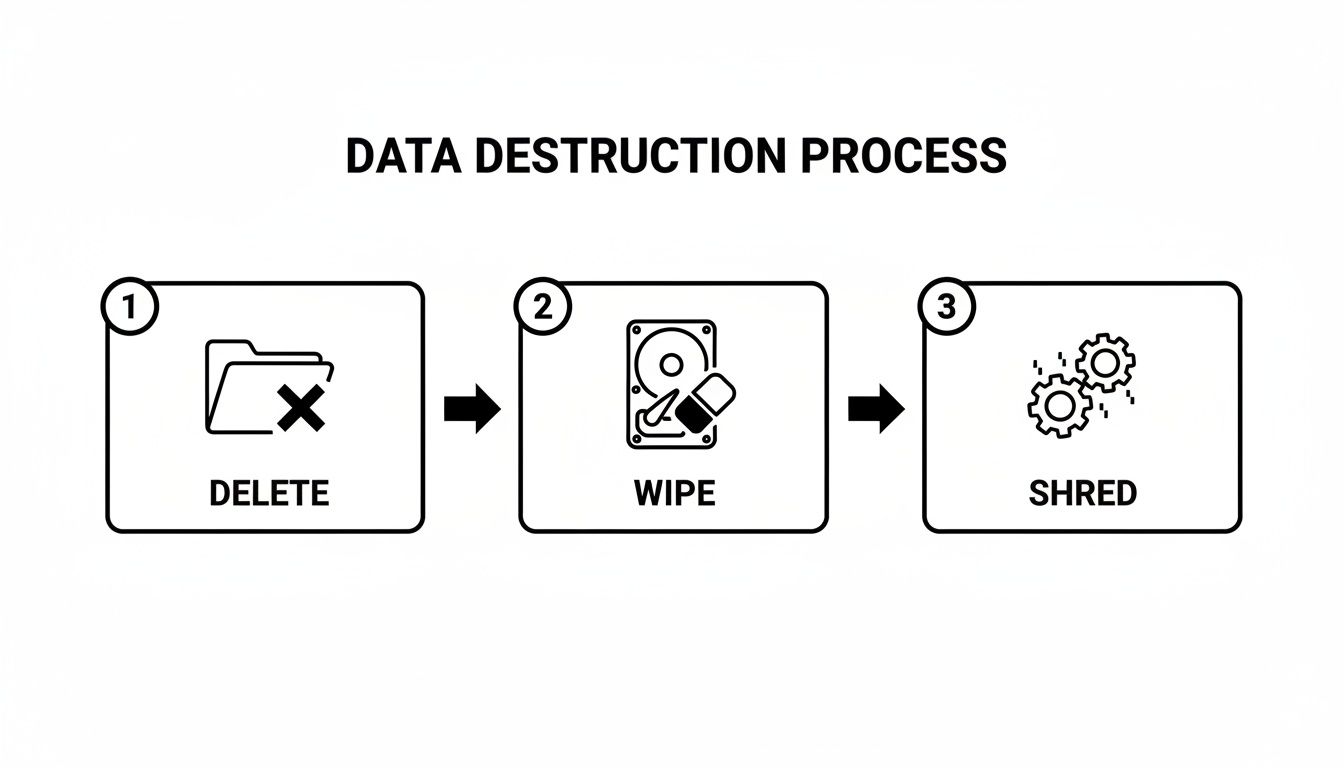
As you can see, hitting "delete" offers no real security. For compliance and true peace of mind, you need certified wiping or physical shredding to ensure your data is gone for good.
Step 4: Responsible Recycling and Asset Disposition
Once your data has been completely destroyed, the focus shifts to the physical hardware itself. The goal here is simple: be as environmentally responsible as possible by following a strict "reuse, recover, recycle" approach.
- Testing and Refurbishment: Any equipment that still has market value is tested, cleaned up, and refurbished for resale. This asset recovery process can often put money back in your company's pocket.
- Component Harvesting: For older or non-working units, we salvage usable parts like RAM, processors, and power supplies to be used as spare parts.
- Materials Recycling: Everything else gets de-manufactured. Materials like steel, aluminum, plastic, and precious metals are separated and sent to certified recycling partners to be turned back into raw commodities.
A core promise of any professional ITAD service is ensuring that zero e-waste ends up in a landfill. This isn't just about following environmental regulations; it’s about supporting your company's own sustainability goals.
Step 5: Final Reporting and Certification
The process wraps up when you receive the final documentation. This paperwork is your proof that the job was done right.
You'll get a comprehensive report that includes:
- A final, detailed inventory list of every asset that was processed.
- A Certificate of Destruction that lists the serial numbers of the destroyed hard drives and confirms the method used.
- A Certificate of Recycling to verify the equipment was handled in an environmentally compliant way.
This final report closes the chain-of-custody loop and serves as your official record for any internal or external audits.
If you want to dig deeper into the logistics and benefits of a structured approach, you can learn more about the complete process for the disposal of IT assets. This step-by-step method gives Georgia businesses total confidence that their old tech is handled securely, responsibly, and professionally.
Turning Old Tech into New Opportunities
Most businesses see old IT equipment as a headache—a necessary cost to keep data safe and stay compliant. But what if it was actually a hidden source of cash for your company? That’s where professional IT Asset Disposition (ITAD) comes in, turning a simple expense into a real financial plus.
The goal isn't just to destroy and recycle everything. It's about looking at your retired hardware strategically to see what still has value. This is what we call asset recovery.
Unlocking Hidden Value in Your Old Hardware
Believe it or not, not all your old tech is ready for the shredder. Newer gear, like servers that are only a few years old, enterprise laptops, or high-end networking equipment, often has plenty of life left in it. These items can be professionally refurbished, wiped completely clean of your data, and sold again on the secondary market.
It's just like trading in a used car. You wouldn't junk a three-year-old vehicle; you'd sell it to get some of your money back. The same exact logic applies to your IT assets. This process puts revenue right back into your business, often enough to cover—or even exceed—the cost of the entire disposal job.
Secure ITAD is more than just a defensive security move. It's a proactive financial strategy. By recovering cash from reusable assets, Georgia businesses can turn a potential liability into a real revenue stream.
This whole model is a huge part of the modern circular economy. The IT disposal market has shifted big time, with North America leading the way thanks to tough regulations and solid recycling programs. The focus now is all about the "refurbish-resell-recycle" approach. By giving hardware a second life, we unlock financial value and boost the ESG scores that investors and customers care about today.
Building Your Brand with Responsible Recycling
Beyond the money you can make back, responsible IT disposal says a lot about your company's values. When you make sure your e-waste is handled the right way, you're not just following environmental laws—you're actively hitting your corporate sustainability goals.
Every single piece of equipment that gets recycled or resold is one less thing taking up space in a landfill. The impact is real and measurable:
- Conserving Resources: Recycling pulls out valuable materials like gold, copper, and aluminum, which means less need for destructive mining.
- Preventing Pollution: It keeps toxic stuff like lead and mercury, common in electronics, from seeping into our soil and water.
- Boosting Your ESG Profile: A well-documented, green disposal program makes your Environmental, Social, and Governance (ESG) report look great. This is a big deal for investors, partners, and customers.
When you work with a certified provider for secure IT equipment disposal services in Georgia, you get the paperwork to prove your commitment. That Certificate of Recycling is a powerful tool you can feature in annual reports and marketing materials to show everyone you're a responsible corporate citizen. If you're wondering what to do with specific items like older PCs, you might want to check out our guide on how to sell an old computer safely and for a good return. It’s a true win-win, creating value for both your business and the planet.
How to Choose the Right Disposal Partner in Georgia
Picking a partner to handle your old IT gear is a huge deal. It’s a decision that directly ties into your company’s data security and legal footing. The fact is, not all providers are created equal, so you’ve got to do your homework. Think of it like hiring a security guard for your data—you wouldn't just hire the first person who showed up without checking their background, right?
The right partner turns what could be a massive liability into a secure, managed, and worry-free process. The wrong one? They could leave you wide open to data breaches and hefty fines, long after the equipment is out of your sight.
Vetting Your Potential ITAD Partner
To feel confident in your choice, you need to look at a few key things that separate the real pros from the basic recyclers. A little due diligence now protects your Georgia business from major headaches down the road and ensures your sensitive information gets the serious treatment it deserves.
When you're sizing up potential partners, knowing how to use a good vendor security assessment questionnaire is a game-changer. This is how you get past the sales pitch and see if their security practices really hold up.
Here’s a simple checklist to guide you:
-
Verify Industry Certifications: Don't just glance at logos on a website. Look for serious credentials like R2 (Responsible Recycling) or e-Stewards. These aren't just for show; they're proof that a vendor meets the highest industry standards for data security, environmental practices, and worker safety.
-
Confirm Data Destruction Methods: Get specific. Ask them exactly how they destroy data. Do they offer DoD 5220.22-M compliant data wiping? Can they bring a shredder to your office for on-site physical destruction? A reputable company will be totally transparent about their methods and help you pick the right one for your compliance needs.
-
Demand Detailed Documentation: A professional service runs on paperwork. You should insist on seeing examples of their chain-of-custody forms and Certificates of Destruction. These documents need to be detailed, listing individual serial numbers to give you a clear, auditable trail for every single asset.
A provider that can’t show you clear, professional paperwork for every step is a massive red flag. Your Certificate of Destruction is your legal proof that you did things right—it needs to be ironclad.
The Value of a Local Georgia Presence
Finally, don't overlook the benefit of a solid local presence. When you choose a provider based right here in the Metro Atlanta area, you're getting a partner who understands the local business environment.
This usually means more responsive, flexible service. A local partner can schedule faster pickups and is much more accessible for on-site services, like having you witness the hard drive shredding yourself.
Making the right choice really just comes down to being thorough. By checking their certifications, digging into their processes, and demanding proof of compliance, you can find a partner that truly protects your business and gives you complete peace of mind.
Frequently Asked Questions
Got a few last questions before you get started? We hear these all the time from Georgia businesses, so we've put together some quick answers to clear things up.
What Kinds of IT Equipment Do You Handle?
We handle just about any IT asset you'd find in a corporate, government, or educational setting. Our team is equipped for the heavy-duty stuff.
Think of things like:
- Servers and entire racks of data center hardware
- Fleets of desktop computers and laptops
- Networking gear like switches, firewalls, and routers
- Office phones, monitors, and other peripherals
If you have highly specialized medical equipment or just a few items from a home office, we have trusted partners we can connect you with. This way, you can be sure every single piece of equipment is handled responsibly and by the right people.
Is On-Site Hard Drive Shredding Really Worth It?
That's a great question. While our certified DoD-level data wiping is incredibly secure and meets most compliance needs, on-site shredding is about absolute certainty. It's the ultimate proof that your data is gone for good.
On-site shredding gives you witnessed, undeniable proof that your hard drives were physically destroyed before they ever left your facility. For industries like healthcare, finance, or government, it’s the gold standard.
There's simply no chain-of-custody risk during transport. You see it happen with your own eyes, giving your organization rock-solid proof of compliance and total peace of mind.
What Does IT Equipment Disposal in Atlanta Cost?
This is where our process really shines. The cost can vary depending on how much gear you have and if you need special services like on-site shredding. But for many of our clients, the project doesn't just cost nothing—it actually makes them money.
Here's how: We provide complimentary DoD-level data wiping for every drive we handle. On top of that, our asset recovery program is designed to find any equipment that still has resale value. The money we make from selling those reusable assets often covers all the service fees, and sometimes, it even puts cash back into your budget.
The best way to know for sure is to get a custom quote based on what you have.
Ready to clear out your old IT assets the right way? The team at Montclair Crew Recycling makes the whole process simple, secure, and smart for your Georgia business. Contact us today for a free quote!
