
For any business operating in Macon, handling electronics recycling is a critical task for both security and environmental stewardship. When you partner with a certified IT Asset Disposition (ITAD) expert, you get a clear path for managing old tech, from the initial pickup all the way to final destruction. It’s how you meet compliance standards without the headaches.
Why Smart Businesses in Macon Recycle Electronics
That storage closet full of old office equipment might seem out of sight, out of mind, but it’s a ticking time bomb of risk. Every single retired server, laptop, and desktop is a goldmine of sensitive information—think client records, financial data, and your own proprietary secrets. Just tossing these devices into a dumpster isn't just a bad idea; it's a direct threat to your business's reputation and security.
Improperly disposing of IT assets can have some serious blowback. Can you imagine the chaos if a discarded hard drive loaded with customer PII (Personally Identifiable Information) fell into the wrong hands? A data breach like that could easily trigger massive regulatory fines, spark costly legal fights, and do permanent damage to your brand's credibility. For most companies, the hit to their reputation hurts far more than any financial penalty.
The Environmental Imperative
Beyond just protecting your data, there’s a powerful environmental reason for proper electronics recycling here in Macon. Old electronics are one of the fastest-growing sources of hazardous waste. In the U.S. alone, around 500 million computers are expected to become obsolete soon, yet only about 15% to 20% of all e-waste gets properly recycled.
The rest? It often gets dumped in landfills, where toxic materials like lead, mercury, and cadmium can seep into our soil and water. For more on local green initiatives, you can always check out the Macon-Bibb County website.
The real cost of ignoring e-waste isn't just a potential fine. It's the long-term environmental damage and the permanent loss of customer trust that follows a preventable data breach.
From Risk Management to Strategic Advantage
It’s time to stop thinking of electronics recycling as just another expense. The modern, strategic way to view it is as a core business function. For a healthcare clinic in Macon, it’s about protecting patient data to stay HIPAA compliant. For a local manufacturing plant, it’s about responsibly decommissioning old control systems during an essential upgrade. Proper ITAD is an investment in solid risk management and corporate social responsibility.
This approach also plugs right into your larger corporate sustainability goals in Georgia, turning what feels like a chore into a positive part of your company's story.
When you work with a certified recycling partner, here’s what you get:
- Auditable Security: You'll receive a Certificate of Data Destruction for every single hard drive, giving you a clear paper trail.
- Environmental Compliance: All materials are processed according to a strict zero-landfill policy, guaranteed.
- Streamlined Logistics: We simplify the entire process with professional pickup and detailed inventory management.
Choosing a certified partner for your electronics recycling is the single most effective way for Macon businesses to protect their data, stay compliant, and show a real commitment to the environment.
How To Prepare Your IT Assets For Secure Recycling
Before any of your old IT gear leaves your Macon office, the real work begins. Simply unplugging a server and shoving it in a storage closet isn't a strategy—it's a risk. Getting your equipment prepped the right way not only makes the recycling process smoother but also builds an ironclad chain of custody.
It all starts with a detailed inventory. Think of it as a final roll call for your outdated tech. This isn't just busywork; it's a critical security step that's surprisingly easy once you have a system down.
Building Your Asset Disposition Inventory
Your main goal here is to log every single piece of equipment you plan on recycling. And I mean everything. Don't just count the big stuff like servers and desktops. What about the peripherals and individual components? A local Macon law firm we worked with had to track not just their old workstations but every single hard drive that ever touched a sensitive client file.
A solid inventory list needs to capture:
- Asset Type: Is it a server, laptop, desktop, smartphone, or maybe a network switch?
- Brand and Model: Get specific. Note the manufacturer and model number (e.g., Dell Latitude 7420).
- Serial Number: This is your golden ticket for tracking. It's the unique ID that follows the device from your door to its final destination.
- Physical Condition: Make a quick note. Is it working, damaged, or are parts missing? This detail can affect its resale or refurbishment value.
- Data-Bearing Status: This is crucial. Mark any device that contains a hard drive or other storage. This flags it for mandatory, certified data destruction.
A simple spreadsheet is all you need to manage this. This document becomes the single source of truth for both your team and your recycling partner, ensuring total transparency from start to finish.
A great way to speed this up, especially with a ton of equipment, is to use a barcode scanner app on a smartphone. It cuts down on manual entry errors and makes capturing serial numbers a breeze.
Segregating and Staging Your Equipment
Inventory complete? Awesome. Now it's time to get physical and separate those assets. This simple step prevents a lot of headaches, like an active laptop getting accidentally mixed in with the pile for recycling. Find a secure, low-traffic spot in your office—a spare room or a taped-off section of your warehouse is perfect.
Try to group similar items together. Stack the laptops, palletize the desktops and servers, and most importantly, put any loose hard drives in a locked, secure container. This level of organization makes a world of difference when the logistics team arrives for pickup.
Macon businesses are feeling the pressure from growing piles of e-waste, and it's a reflection of a national issue. Projections show a staggering 500 million old computers are set to hit the U.S. waste stream, putting an incredible strain on our landfills. But there's a flip side. Many services now offer free or low-cost recycling by recovering value from assets like PCs and servers. For businesses in regulated fields like healthcare or finance, getting free DoD 5220.22-M data wiping is a huge win for compliance.
This infographic breaks down the simple path from identifying your e-waste risks to implementing a secure, effective solution.
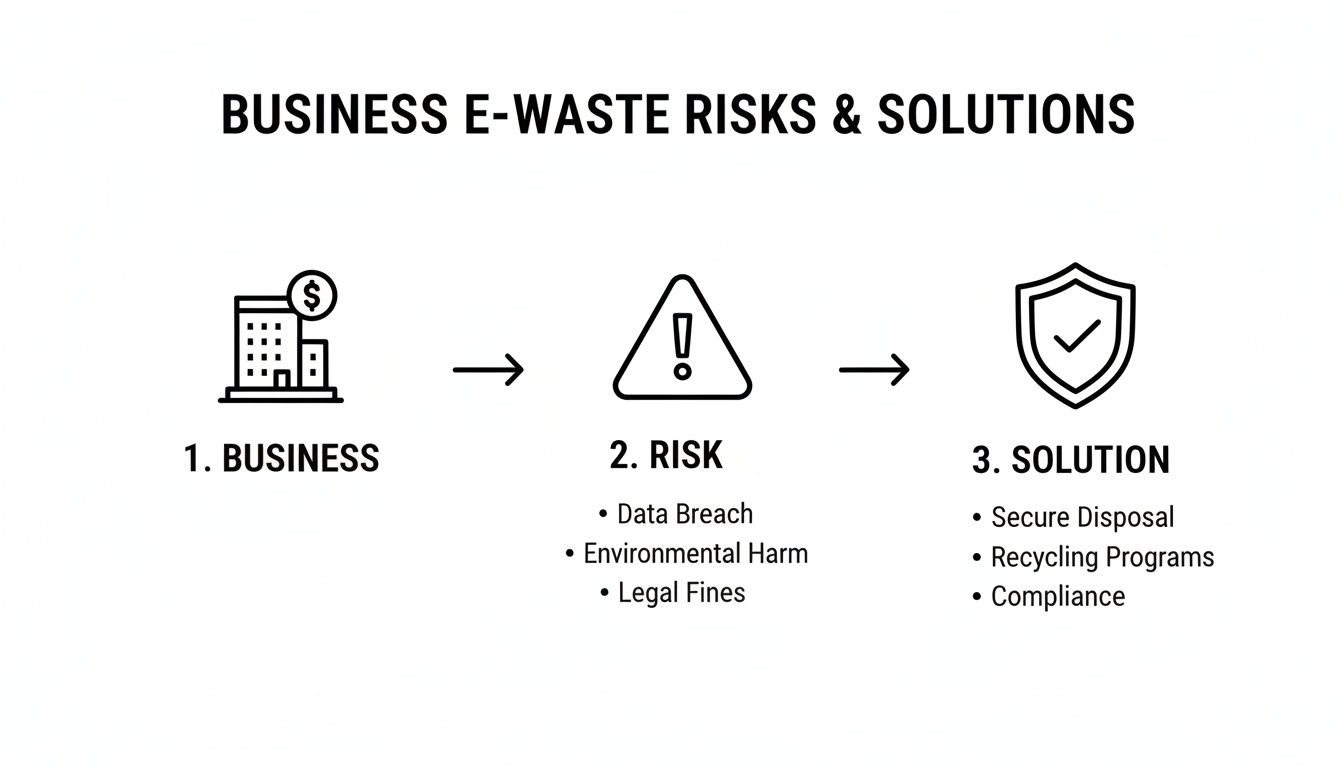
As you can see, being proactive and partnering with a certified recycler is the most effective way to neutralize the data and environmental risks that come with old technology.
Data Security Starts Before Pickup
While any reputable recycler will handle certified data destruction, taking a few extra steps on your end adds another powerful layer of security. It’s not a substitute for professional, certified wiping, but performing a factory reset on devices like tablets and phones is a smart first move.
If you want to dig deeper into this, we have a whole guide on how to wipe a computer before recycling. Think of it as building a multi-layered defense for your data—and it all begins with your team's careful preparation right there on-site.
Understanding Data Destruction and Compliance in Georgia
Once your IT inventory is sorted and ready for disposal, you’ve reached the most important part of the job: making sure the sensitive data on those old assets is gone for good. For any Macon business handling client information, financial records, or internal secrets, secure data destruction isn't a "nice-to-have." It’s an absolute must for responsible electronics recycling in Macon GA.
Don't be fooled into thinking a simple delete or a quick drive reformat will do the trick. Those actions just hide the data, leaving it wide open for anyone with basic recovery software to find. Real data security means using professional, certified methods that make your information completely and permanently unrecoverable.
DoD 5220.22-M: The Gold Standard for Wiping Data
When you work with a certified IT asset disposition (ITAD) partner, they'll likely talk about DoD 5220.22-M three-pass wiping. This software-based sanitization process comes straight from the U.S. Department of Defense and works by overwriting every bit of a hard drive multiple times.
Here’s how it works in a nutshell:
- Pass 1: Writes a pattern of zeros over the entire drive.
- Pass 2: Follows up by writing a pattern of ones.
- Pass 3: Writes a random character and then verifies the overwrite, confirming no original data is left.
This process is incredibly thorough, making data recovery virtually impossible. For most organizations in Macon, from healthcare clinics to financial firms, this method is the benchmark for meeting strict data privacy laws.
Physical Destruction: On-Site Shredding
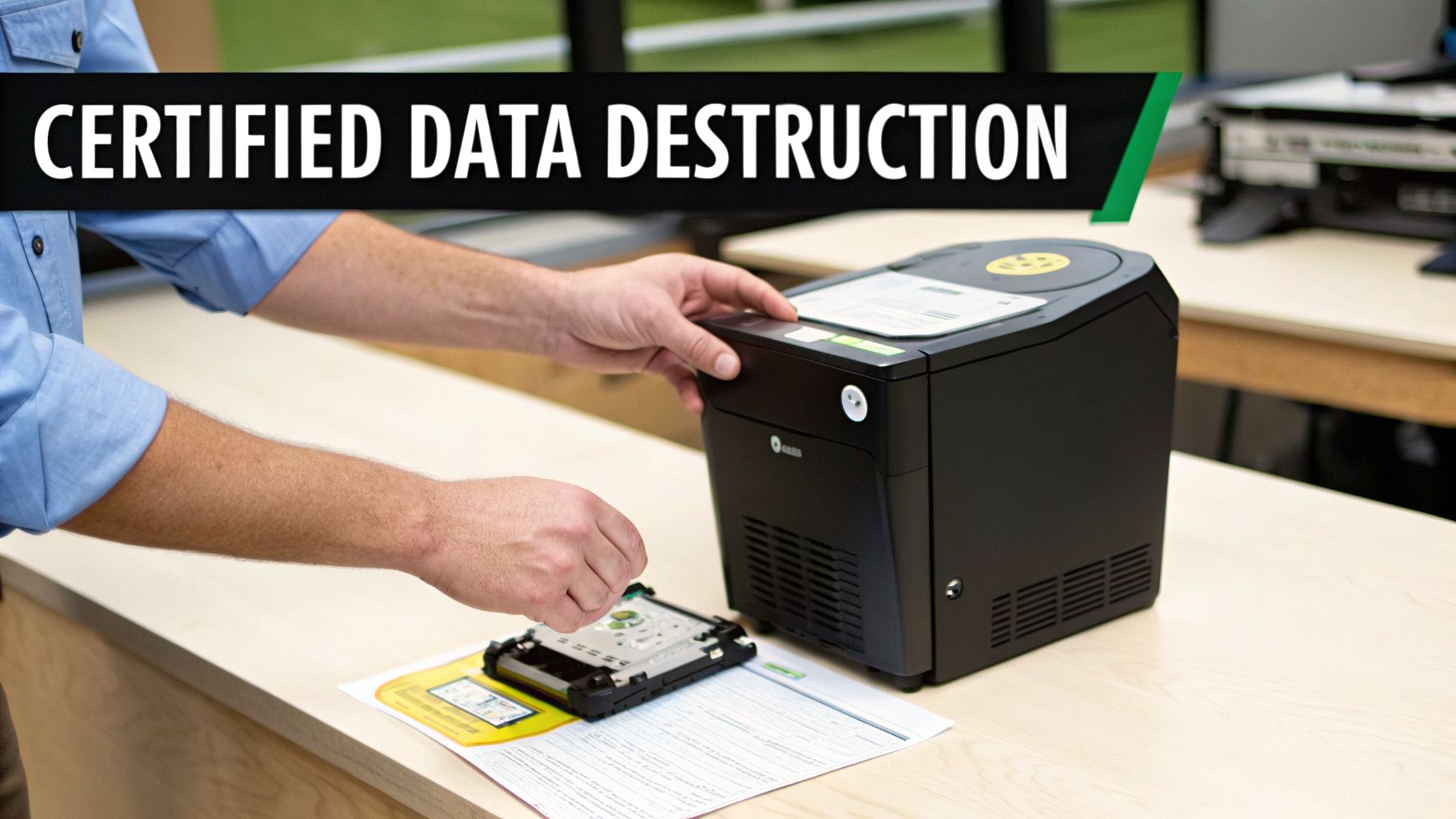
While data wiping is extremely effective, some scenarios call for something even more final: physical destruction. It’s exactly what it sounds like. A powerful machine physically shreds hard drives, SSDs, and other storage devices into small, mangled pieces of metal.
For companies with the highest security clearance, like a defense contractor or a bank managing sensitive wealth data, on-site hard drive shredding is the go-to solution. A mobile shredding truck comes right to your Macon office, and you can watch the destruction happen with your own eyes.
This gives you an immediate and undeniable audit trail. You see the assets destroyed, leaving zero doubt that your data is secure. The shredded fragments are then responsibly recycled.
Navigating E-Waste Compliance in Georgia
Georgia’s e-waste regulations are a bit different from states with heavy-handed mandates. The state encourages voluntary programs and partnerships, which means communities like Macon emphasize education and collaboration between businesses and licensed recyclers. This approach actually makes professional recycling very accessible and predictable for businesses. You can learn more about the statewide framework in our guide to electronics recycling in Georgia.
For most of our business clients, the costs are straightforward. You might see pickup fees in the $20-$45 range, and secure data wiping services usually run between $10 and $25 per drive. Services like on-site shredding give businesses a way to completely eliminate cyber risks, as the drives are rendered useless on the spot. You can get a better sense of local service costs by reading these insights on Macon GA electronics recycling.
The Certificate of Destruction: Your Proof of Compliance
Whether you choose software wiping or physical shredding, the process isn't truly over until you have one critical document in hand: the Certificate of Data Destruction. This is your legally binding record, proving your company’s data was destroyed according to auditable, certified standards.
A proper certificate will always include:
- Unique serial numbers of the destroyed hard drives.
- The destruction method used (e.g., DoD 5220.22-M wipe, physical shred).
- The date and location where the destruction took place.
- A signature from the certified recycling partner.
This certificate is your ultimate proof of due diligence. It's what you'll present during an audit to show compliance with regulations like HIPAA, FACTA, or PCI DSS. Any reputable ITAD partner will provide this documentation without question. Without it, you're leaving your business exposed and have no way to prove you handled your data responsibly.
So, you’ve sorted and inventoried your old IT gear. Now what? The next big question is a logistical one: how do you get all that equipment from your Macon office to a recycling facility? Your answer will really come down to how much stuff you have, what kind of equipment it is, and what your team can handle.
You're looking at two main options: arranging a full-service pickup or managing a drop-off yourself. Let's dig into the real-world pros and cons of each so you can figure out what makes sense for your business.
When to Schedule an On-Site Pickup
For most businesses we work with, a scheduled, on-site pickup is by far the most secure and hassle-free way to handle electronics recycling in Macon GA. This is especially true when you're dealing with a large volume of equipment or anything heavy and awkward. Think of a local medical center finally upgrading a few hundred PCs or a manufacturer clearing out an old server room.
With a pickup service, our logistics crew comes right to you. They do all the heavy lifting, palletizing, and loading. This keeps your own staff from having to do it—which means no strained backs or accidental damage to your building.
A pickup is the obvious choice in these situations:
- Large Volume: You're recycling more than just a few things, like 10+ computers, several servers, or entire pallets of mixed e-waste.
- Heavy or Bulky Gear: Your inventory includes things like enterprise servers, big network racks, or other equipment that's a pain to move.
- Security and Chain of Custody: You need a documented, seamless handoff. The recycling team will sign off on your inventory list right there on-site, officially taking over custody and liability.
- Limited Resources: Your team simply doesn't have the time, people, or a truck big enough to transport everything safely.
We recently helped a Macon law firm recycle dozens of old workstations. Our crew went on-site and verified the serial number of every single machine against the firm's inventory list before anything left the office. That's how you guarantee a perfect chain of custody.
Considering a Drop-Off Solution
While pickups are convenient, a drop-off can work if you're a smaller business with just a handful of items. If you only have a couple of laptops, a single desktop, and maybe a box of cables, organizing a full truck pickup might be overkill. Many Atlanta-area recyclers, including our own Smyrna facility, accept drop-offs from businesses all over Georgia.
This route makes sense if:
- You have a very small amount of lightweight equipment.
- You've got a company vehicle that can safely transport the gear.
- You're already planning a trip to the Atlanta metro area for other business.
Just remember, if you choose the drop-off route, you're responsible for the equipment until it’s physically in the recycler's hands. You'll still need to bring that detailed inventory list with you to make sure every item is checked in and accounted for. Honestly, for many companies, the time and effort saved by a professional pickup more than makes up for any perceived savings from a DIY drop-off. For businesses exploring their options, we have more details about arranging a free business electronics pickup in Georgia for qualifying assets.
Don't Forget the Paperwork at Handoff
Whether you go with a pickup or a drop-off, solid documentation is non-negotiable. At the moment of transfer, your recycling partner absolutely must provide a Bill of Lading or a field receipt that clearly references your own inventory list.
This document is your official record of the handoff. It’s your proof that the recycler has taken possession of the specific assets you listed. Never, ever let your equipment leave your facility without this critical piece of initial paperwork. It’s the first link in the chain that leads directly to your final Certificate of Data Destruction.
Finding the Right Recycling Partner for Your Macon Business
Choosing an IT Asset Disposition (ITAD) partner is hands-down the most critical decision you'll make in this process. This isn't just about hauling away old junk. Your recycler is a direct reflection of your company's commitment to data security and environmental ethics.
Picking the wrong vendor can open you up to staggering risks. But the right one? They become an invaluable ally, protecting your brand and ensuring you stay compliant. For any business thinking about electronics recycling in Macon GA, this isn't about finding the cheapest quote—it's about finding the most trustworthy partner.

Look for Leading Industry Certifications
Certifications are your first line of defense. They aren't just logos for a website; they are hard-earned proof that a recycler meets strict, internationally recognized standards. Earning them requires intense, ongoing audits by third-party experts.
There are two main certifications you absolutely need to see:
- R2v3 (Responsible Recycling): This is the gold standard, covering everything from data security and testing to reuse and final material recovery. An R2v3-certified recycler gives you a transparent and secure chain of custody.
- e-Stewards: Developed by the Basel Action Network, this certification is laser-focused on preventing the illegal export of hazardous e-waste. It's known for having some of the toughest environmental and social criteria in the business.
If a vendor has one or both, they've proven they do things by the book. Don't just take their word for it—ask to see their current certificate.
Verify Their Data Destruction Methods
Your next questions should be all about data security. How, exactly, will they guarantee your information is gone for good? If you get a fuzzy answer, that's a huge red flag.
A professional partner will have clear, verifiable methods for destroying data.
They should offer services like:
- Certified Data Wiping: Using professional software that meets standards like the DoD 5220.22-M three-pass overwrite makes data physically impossible to recover.
- On-Site Physical Destruction: For ultimate peace of mind, ask if they can bring a mobile shredding truck to your Macon facility. You can literally watch your hard drives get turned into tiny pieces.
- Serialized Reporting: The entire process must be documented. A good vendor tracks the unique serial number of every single drive they destroy and lists it on your final certificate.
The most important document you will get is the Certificate of Data Destruction. It's not just a receipt; it's your legal proof of compliance. It details what was destroyed, when, and how, protecting you in case of an audit.
Evaluate Their Downstream Transparency and Environmental Policy
So, where does all your old gear really end up? Every business should be asking this. A responsible partner operates with a strict zero-landfill policy for all electronics they handle. Their first priority is always reuse, followed by breaking down what's left into basic materials like plastic, metal, and glass.
Ask to see their downstream vendor map. This document shows exactly where different materials are sent for final processing. A transparent partner can prove that all hazardous materials go to certified, domestic facilities and are never shipped illegally overseas.
Our guide on certified electronics recycling companies in Georgia offers more detail on what sets the best providers apart. It’s a great resource for building a list of tough questions for potential vendors.
Comparing ITAD Vendor Features
To make a smart, clear-headed decision, use this checklist when you're interviewing potential electronics recycling partners for your Macon business.
| Feature | Why It's Important | What to Look For |
|---|---|---|
| Certifications | Provides independent proof of high standards for security, environment, and safety. | Current R2v3 or e-Stewards certification. Ask to see the certificate. |
| Data Destruction | Ensures your sensitive business and customer data is permanently unrecoverable. | Offers both certified wiping (e.g., DoD 5220.22-M) and on-site physical shredding. |
| Audit Trail | Creates an unbroken paper trail for compliance and internal governance. | Provides serialized reporting, chain-of-custody forms, and a final Certificate of Destruction. |
| Logistics | Determines the convenience and security of getting assets from your site to theirs. | Offers insured, professional on-site pickup with their own logistics team and vehicles. |
| Environmental Policy | Guarantees your e-waste won't end up in a landfill or be illegally exported. | A strict zero-landfill policy and transparent downstream reporting for all materials. |
| Value Recovery | Can offset recycling costs by remarketing newer, functional equipment. | A clear process for testing, grading, and reselling assets, with options for profit sharing. |
At the end of the day, choosing an electronics recycling partner is an investment in your company's security and reputation. By asking these questions and demanding proof, you can confidently pick a vendor that truly has your back.
Common Questions About Macon Electronics Recycling
Even with a solid plan, you probably still have a few questions before you pull the trigger on an electronics recycling service. We get it. Getting straight answers is the only way to move forward with confidence.
Here are the questions we hear most often from Macon businesses just like yours, along with the no-nonsense answers you need.
What Kinds of Electronics Can My Macon Business Actually Recycle?
This is usually the first thing people ask, and the answer is simple: we take almost all business-grade IT equipment. We’re focused on the hardware and technology that runs your office, data center, or professional workspace.
We're talking about the gear that powers your daily operations. This typically includes:
- Computers and Laptops: Any and all desktops, workstations, and notebooks.
- Servers and Data Center Gear: Rack-mount and blade servers, storage arrays (SANs), and other data center infrastructure.
- Networking Equipment: Your old switches, firewalls, routers, and modems.
- Telecom Systems: VoIP phones, office phone systems, and related communication hardware.
- Peripherals: We’ll take the LCD monitors, keyboards, mice, and docking stations, too.
It’s just as important to know what we can’t take in a standard business pickup. This usually means consumer appliances like microwaves or refrigerators, ancient CRT monitors, or anything with hazardous materials outside of normal electronics. Just give your recycling partner a quick heads-up on your inventory to make sure everything goes off without a hitch.
How Much Is This Going to Cost?
The cost of electronics recycling in Macon GA is more flexible than you might think. It really boils down to the value of the equipment you have. There's no one-size-fits-all price.
If your business has a lot of newer, valuable equipment—like enterprise servers from the last few years or a large batch of working laptops—the service might be very low-cost or even free. Why? Because the money recovered from reselling that functional gear helps cover the pickup and recycling costs.
The biggest cost factor is often data destruction. While basic data wiping might be included, services like on-site hard drive shredding come with a per-drive fee. Always ask for a detailed quote that breaks down every single cost.
For projects with older, less valuable, or broken items, you should expect to pay some nominal fees. These charges cover the logistics, labor, and the certified processes needed to securely destroy your data and recycle the materials.
How Do I Get Proof Our Data Was Wiped?
This is absolutely non-negotiable, and any reputable partner will provide it. You will receive a formal Certificate of Data Destruction once every single one of your data-bearing devices has been sanitized or physically destroyed. This is your official audit trail.
Think of it as the final, legally-binding receipt for your data security. It proves that every hard drive you handed over was processed to a specific standard, like DoD 5220.22-M. A proper certificate will list the serial numbers of the drives, the destruction method used, and the date it was all completed. This is the exact documentation you need to prove compliance with regulations like HIPAA or FACTA.
Do Atlanta Recyclers Come Down to Macon?
Absolutely. Many of the top Atlanta-based ITAD companies, including us, provide full-service logistics and on-site pickups for businesses all over Middle Georgia, including Macon. This is especially true if you have a decent volume of B2B equipment.
The best way to find out is to just call and tell us what you have. A quick conversation—something as simple as, "we have 30 desktops and 5 servers"—is usually all it takes to confirm we can service your location, schedule a pickup, and give you a quote. Professional, certified recycling isn't just for businesses inside the Atlanta perimeter.
Ready to create a secure and compliant electronics recycling plan for your Macon organization? Montclair Crew Recycling provides certified, end-to-end IT asset disposition services, from on-site pickups to guaranteed data destruction. Contact us today to get started.
