
For any Georgia organization, hard drive shredding isn't just a line item for IT disposal—it's an absolute necessity for security. Thinking that deleting files or reformatting a drive is enough is a dangerous mistake. That sensitive data is almost always recoverable, leaving your business wide open to risk. The only way to be 100% certain that your company, client, and employee information is gone for good is through professional physical destruction.
Why Physical Hard Drive Destruction Is a Must for Georgia Businesses
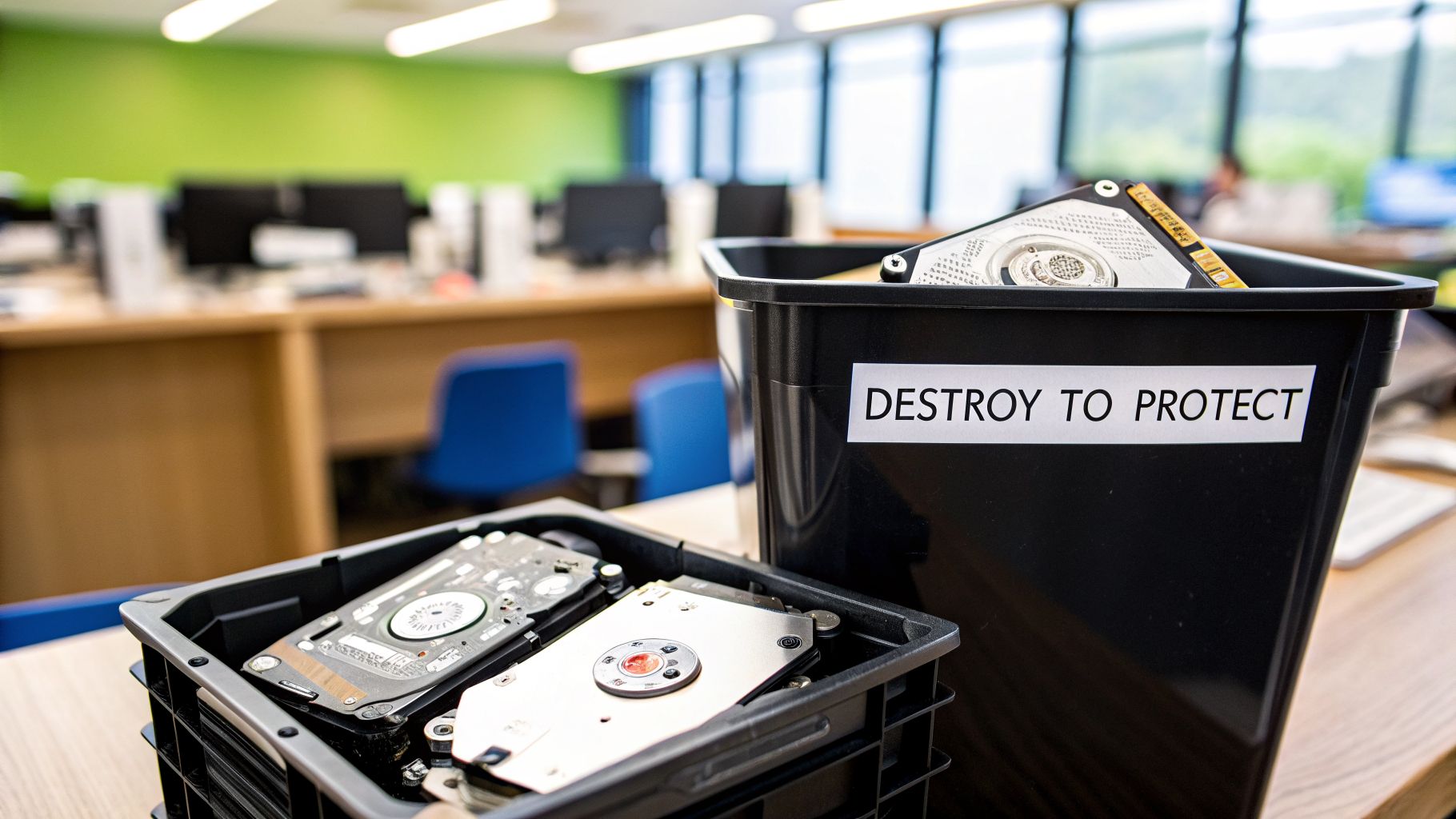
It’s a common myth that hitting "delete" makes a file disappear forever. The truth is, all you've done is remove the signpost pointing to the data. The actual information stays right where it is, just waiting for someone with basic recovery software to pull it back up. It’s alarmingly simple to do.
Think about a healthcare provider in Marietta upgrading its workstations. Those old hard drives are packed with patient records, billing details, and insurance data—all protected by HIPAA. If those drives are just tossed into an e-waste pile without being physically destroyed, that clinic could face crippling fines and a reputation that’s damaged beyond repair.
The True Cost of Inadequate Data Disposal
The fallout from a data breach caused by an improperly discarded hard drive can be catastrophic. For a law firm in Sandy Springs, one old drive could expose confidential case files, private client emails, and sensitive financial strategies. The consequences go far beyond just regulatory penalties.
- Financial Penalties: Fines for not complying with laws like HIPAA or FACTA can easily run into the millions.
- Reputational Damage: Losing the trust of your customers is often a much bigger blow than any fine. A data breach can tarnish your brand for years to come.
- Legal Liability: You could be facing lawsuits from clients or employees whose personal information was compromised.
This is exactly why certified hard drive shredding services in Georgia are so crucial. Physical destruction turns the drive platters into tiny, shredded pieces, making it completely impossible to recover any data. It’s more than a service; it’s an insurance policy for your business.
Georgia's Growing Commitment to Secure E-Waste Management
The push for secure data destruction is really picking up steam across the state. Georgia has become a frontrunner in secure e-waste practices, with the public sector's use of secure destruction methods jumping by 35% since 2020. This shows a much wider understanding among Georgia organizations about just how important compliant data destruction and responsible e-waste disposal are.
The only way to guarantee that sensitive information is permanently gone is to use verified hard drive destruction methods that make recovery impossible. Relying on software wipes or DIY methods leaves your organization exposed.
Data Wiping vs. Physical Shredding: A Critical Comparison
When getting rid of old drives, you have two main options: wiping the data with software or physically shredding the drive. While wiping has its place, it’s essential to understand the differences to see why shredding provides absolute security.
| Feature | DoD 5220.22-M Data Wiping | Physical Hard Drive Shredding |
|---|---|---|
| Method | Software overwrites data with random 0s and 1s. | A machine grinds the drive into small metal fragments. |
| Security Level | High, but not foolproof. Can be vulnerable to advanced recovery techniques. | Absolute. Data recovery is physically impossible. |
| Verification | Generates a software report. Can be difficult to verify 100% success. | Provides a Certificate of Destruction. Visual proof of destruction. |
| Time Required | Can take several hours per drive, depending on size and condition. | Seconds per drive. Very efficient for large quantities. |
| Best For | Reusing drives internally where security is less critical. | Total data security, compliance, and end-of-life disposal. |
Ultimately, for any Georgia business looking to prevent data loss and eliminate risk from old equipment, shredding is the superior choice.
While you need strong digital security for your active systems, physical destruction provides the final, undeniable proof that retired data can never be breached. This definitive approach offers something software wiping can't always promise: total peace of mind. When you partner with a certified provider, you get a Certificate of Destruction, which is your legal proof of compliance.
To get a better handle on this vital last step, check out our full guide to the secure hard disk disposal process. This documented, physical destruction is the bedrock of any modern data security plan.
Meeting Data Destruction Compliance Rules in Georgia

If you're running a business in Georgia, understanding your legal duties for data disposal isn't just a good idea—it's mandatory. It’s a huge piece of your risk management puzzle. Even though Georgia doesn't have one giant privacy law, a mix of state and federal rules makes one thing crystal clear: you are on the hook for the sensitive data you manage, from the moment you get it to the moment you destroy it.
Messing up the destruction of data on old hard drives isn't just sloppy work; it can easily become a reportable data breach under Georgia law. That single mistake can open your business up to investigations, big fines, and a black eye on your reputation. The goal is to get past the legal jargon and understand what these rules actually demand from you.
Key Regulations Georgia Businesses Must Follow
A few key laws dictate how Georgia companies need to protect sensitive information. They might not all scream "hard drive shredding," but they all establish a legal requirement to secure data. Improper disposal is a direct violation of that requirement.
HIPAA (Health Insurance Portability and Accountability Act): This is the big one for any healthcare provider, insurer, or related business in Georgia. HIPAA is non-negotiable. It requires ironclad protection of Protected Health Information (PHI). Just tossing a hard drive with PHI on it is a textbook violation that can result in crippling fines.
FACTA (Fair and Accurate Credit Transactions Act): This federal law applies to any business that handles consumer reports—and that's a much wider net than just banks. The "Disposal Rule" in FACTA is very specific, requiring you to "destroy or erase" documents and media so they can't be read or pieced back together.
GPIPA (Georgia Personal Identity Protection Act): This is our state's main data breach notification law. If unencrypted personal information gets compromised, you're required to notify the affected Georgia residents. A lost or stolen hard drive that wasn't properly destroyed is a classic example of a breach that would activate your duties under GPIPA.
These regulations create a legal environment where professional hard drive shredding services in Georgia are no longer a luxury, but a core compliance tool. It’s the clearest path to proving you've done your due diligence.
The Power of a Certificate of Destruction
So, how do you prove to an auditor or a regulator that you actually followed the law? You need a Certificate of Destruction. This single piece of paper is your get-out-of-jail-free card.
When you work with a NAID AAA Certified shredding company, you get a serialized Certificate of Destruction. This document is your legal proof that your data was permanently destroyed, meeting the standards of all relevant privacy laws.
A legitimate certificate includes the destruction date, the method used, and a detailed inventory of the shredded hard drives, often with their serial numbers. This gives you a solid chain of custody and a perfect audit trail. If you ever face a legal challenge or an audit, this certificate is your best defense. You can learn more about how a hard drive destruction certificate protects your business in our in-depth guide.
Aligning with NIST 800-88 Standards
While laws like HIPAA and FACTA tell you what to protect, they often get vague on the how. That’s where the NIST 800-88 Guidelines for Media Sanitization step in. This is the gold standard for data destruction that government agencies and smart, compliance-focused businesses rely on.
NIST 800-88 lays out three sanitization methods: Clear, Purge, and Destroy. Physical destruction—shredding—is the only method that falls under the "Destroy" category. It provides the absolute highest level of security by making data recovery physically impossible. Following this standard is a clear sign that you take your responsibilities seriously.
Choosing Between On-Site and Off-Site Shredding
So you've decided to professionally shred your company's old hard drives. That's the first smart move. The next big question is a logistical one: should the shredding happen at your place or ours?
You have two incredibly secure options when you work with a certified vendor: on-site (we come to you) and off-site (we pick up your drives). Both get you to the same place—total data destruction and a formal Certificate of Destruction. The right call really just depends on your organization's specific needs for security, convenience, and budget.
Let's break down how they're different.
On-Site Shredding: The Ultimate in Transparency
On-site shredding, sometimes called mobile shredding, brings the entire destruction show right to your front door. A specialized truck pulls up to your Georgia facility, whether it's a corporate campus in Alpharetta or a medical clinic in Kennesaw, with a powerful industrial shredder bolted inside.
The process is refreshingly simple and offers complete peace of mind. We collect your hard drives, scan every single serial number to create an inventory, and then you get to physically watch as they are fed into the shredder and turned into metal confetti.
This is the go-to option for organizations with iron-clad security policies or anyone who needs undeniable, firsthand proof of destruction.
- Data Centers: A data center in Norcross managing thousands of drives can't afford any weak links in their chain of custody. Witnessing the shredding on-site is often a non-negotiable compliance requirement.
- Government Agencies: It's common for public sector organizations to mandate on-site destruction to satisfy their own strict security protocols.
- Healthcare Providers: To maintain absolute HIPAA compliance, many hospitals and clinics prefer having a staff member witness the final moments of media containing patient records.
The biggest win here is the unbroken chain of custody. Your assets never leave your sight until they're destroyed. For high-security environments, that level of transparency is priceless.
On-site shredding completely eliminates any "what if?" questions about the destruction process. Watching your hard drives get destroyed provides the highest level of assurance you can get, which is a powerful tool for satisfying internal stakeholders and auditors.
Off-Site Shredding: Secure and Cost-Effective
Off-site shredding provides the exact same level of security but follows a different workflow. A certified, uniformed technician arrives at your office to securely collect your hard drives. The drives are placed into locked, tamper-evident containers right in front of you, and their serial numbers are meticulously logged.
From there, the secure containers are transported in a GPS-tracked vehicle to a specialized shredding facility with controlled access. Under constant video surveillance, the drives are destroyed. You get the same serialized Certificate of Destruction you would with an on-site job.
This route is often more budget-friendly, especially if you only have a smaller batch of drives to get rid of.
- Small Businesses: A small business in Roswell with a dozen old office computers can take advantage of the affordability of a scheduled off-site pickup without sacrificing an ounce of security.
- Routine IT Refresh Cycles: Companies that upgrade equipment on a regular schedule find it incredibly efficient to arrange for periodic pickups. It just becomes part of the process.
For many Georgia businesses, off-site shredding hits that sweet spot between security, convenience, and cost. The most important thing is partnering with a NAID AAA Certified provider. That certification is your guarantee that every single step—from pickup and transport to the final shred—is handled with the highest level of security. It means the facility is secure, the employees are vetted, and the chain of custody is rock-solid.
Making the Right Choice for Your Georgia Business
To help you decide, here’s a quick breakdown. Remember, both on-site and off-site services from a certified partner are fully compliant and 100% secure.
| Feature | On-Site (Mobile) Shredding | Off-Site (Plant-Based) Shredding |
|---|---|---|
| Security | Maximum. You witness the destruction. The chain of custody is unbroken. | Very High. Secure transport and destruction in a monitored facility. |
| Cost | Typically higher, accounting for the specialized truck and time on-site. | More economical, especially for smaller volumes and routine pickups. |
| Convenience | Extremely convenient. Destruction is immediate and happens at your location. | Very convenient. Pickups are scheduled to fit your business operations. |
| Best For | High-security needs, strict compliance mandates, and large quantities. | Budget-conscious needs, smaller volumes, and regular, scheduled disposals. |
At the end of the day, the shredding partner you choose is more important than the method. For businesses wanting the highest degree of transparency, our guide to on-site hard drive shredding takes a closer look at the mobile destruction process. A truly reliable provider will offer both options and work with you to figure out which service best fits your company's risk profile and budget.
A Look Inside the Hard Drive Shredding Process
Handing over your old IT gear can feel a bit unnerving, especially if you're not sure what happens once it leaves your sight. But a professional shredding service isn't a black box. The entire process is built on transparency and security, giving you a clear view of how your data is protected every step of the way.
It’s a much more buttoned-up and documented affair than most people think. Let's pull back the curtain on what really goes on.
Creating a Detailed Asset Inventory
The process kicks off long before a single hard drive meets the shredder. It starts with a clear, accurate count of every single asset slated for destruction. This isn't just about tallying up boxes; it's about building a detailed inventory.
A reputable provider won't just take your word for it—they'll work right alongside you to create a serialized list. Every hard drive, SSD, and data-bearing device gets its serial number scanned and logged.
This isn't just busywork. This log is the bedrock of a secure chain of custody. It creates a specific, trackable record for every item, ensuring nothing gets lost from the moment it leaves your office until it's reduced to a pile of tiny metal fragments.
Secure Logistics and Chain of Custody
The second your hard drives are collected, a strict chain of custody protocol begins. Think of it as a documented, chronological paper trail showing exactly who handled your assets, when they did it, and where it all happened. It’s a non-negotiable part of any compliant hard drive shredding service in Georgia.
Here’s what that looks like in the real world:
- Secure Collection: Background-checked, uniformed technicians arrive to pick up the inventoried drives.
- Locked Containers: Your drives go straight into locked, tamper-evident bins before they're moved an inch.
- GPS-Tracked Transport: Every truck used for transport has GPS tracking, creating a digital breadcrumb trail from your facility to the shredding site.
This flowchart shows the two main paths your drives can take—on-site shredding at your location or off-site at a secure plant.
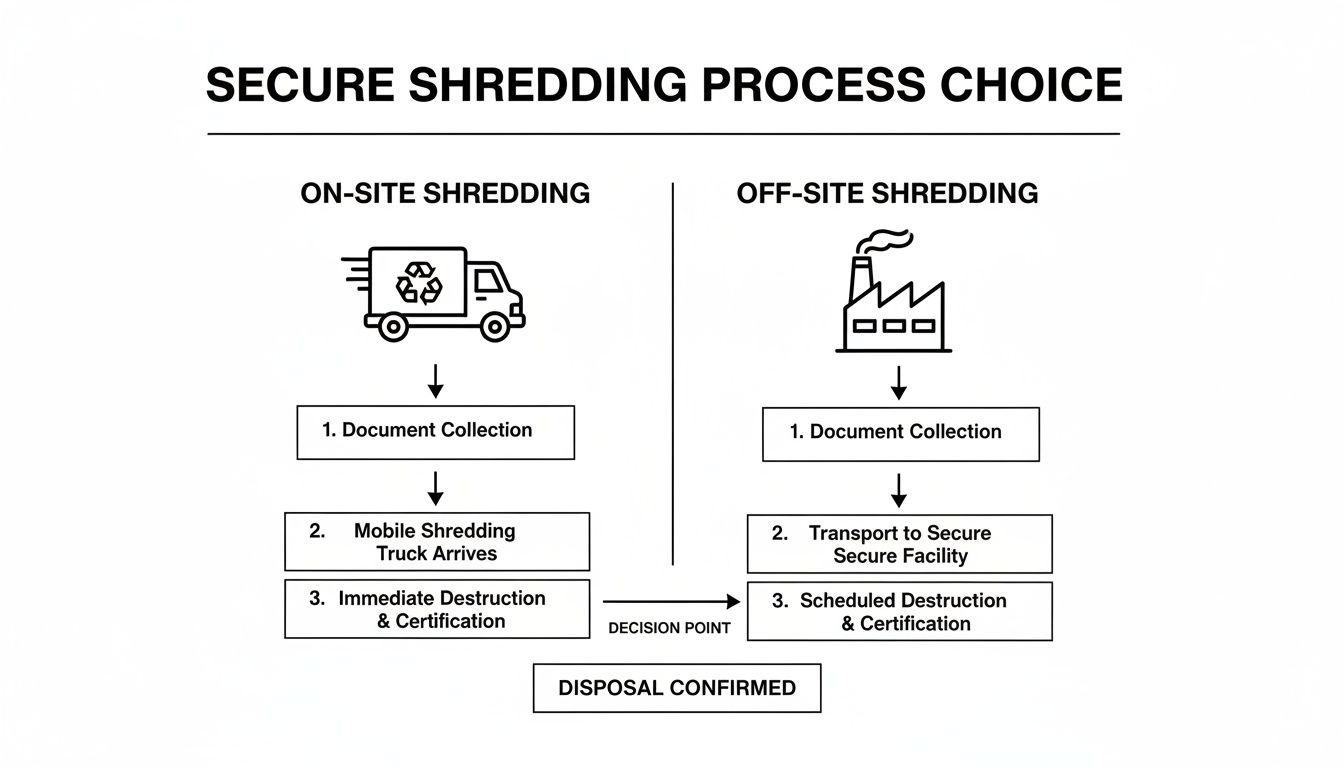
This meticulous process leaves no room for error. It’s a system of checks and balances designed to give you total peace of mind. For a deeper look into the specifics, you can learn more about how secure hard drive shredding works from start to finish.
The Physical Destruction and Final Verification
Now for the main event. Once the drives arrive—either inside the mobile shred truck at your curb or at the secure plant—the destruction is immediate. The inventoried drives are fed into a powerful industrial shredder that uses pure force to grind them into small, mangled pieces.
The goal isn't just to bend or break the drive; it's to completely obliterate the magnetic platters where data is stored. Once shredded to the correct particle size, data recovery becomes physically impossible.
But the job isn't done yet. The final piece of the puzzle is the documentation, which is arguably the most important step for your compliance records.
Your provider will issue a formal Certificate of Destruction. This is more than a receipt; it’s a legal document confirming the secure and permanent destruction of your data. It will always include:
- A unique serial number for the certificate itself.
- The date and location where the shredding took place.
- An itemized list of the destroyed drives, cross-referenced with that initial inventory log.
- A statement of compliance confirming the process meets data protection regulations.
This certificate is your official proof of due diligence. It's the document you'll show an auditor or regulator to prove you took every necessary step to protect sensitive information, closing the loop on your data's lifecycle once and for all.
How to Select the Right Hard Drive Shredding Partner in Georgia
Let's be clear: picking a partner for your data destruction isn't like ordering more paper clips from your office supply vendor. The stakes are infinitely higher. We've seen firsthand how the wrong choice can spiral into a full-blown compliance nightmare, while the right partner makes the entire process secure, seamless, and—most importantly—fully documented.
You're not just looking for a vendor; you're looking for an extension of your company's security team. This means you have to look past a slick website or a rock-bottom price. You need to get into the weeds of their certifications, their day-to-day procedures, and how transparent they really are. A true professional will welcome your toughest questions and have solid answers ready.
The NAID AAA Certification Litmus Test
Before you go any further in a conversation with a potential vendor, ask them one simple question: "Are you NAID AAA Certified?" If they hesitate, give you a fuzzy answer, or flat-out say no, it's probably best to end the call right there. The National Association for Information Destruction (NAID) is the gold standard for secure data destruction, period.
NAID AAA Certification isn't just some plaque they hang on the wall. It’s a grueling, continuous audit that puts their entire operation under a microscope. This includes:
- Employee Screening: Every single person who might come near your sensitive data has undergone serious background checks.
- Secure Facilities: Their plant is under 24/7 surveillance with strict access controls and video monitoring.
- Documented Processes: A third-party auditor has verified every step of their process, from chain of custody to the final destruction.
This certification is your single best assurance that a vendor is serious about security. Think of it as the absolute baseline, not a nice-to-have bonus.
A vendor that isn't NAID AAA Certified is essentially telling you to trust them on their word alone. In data security, trust has to be verified. That certification is the verification.
Scrutinizing the Chain of Custody
A secure chain of custody is the unbroken, documented trail that proves your hard drives were secure from the second they left your office to the moment they were turned into metal fragments. This is exactly where unqualified vendors tend to cut corners, leaving you exposed.
You need to ask specific, pointed questions about how they manage this process:
- Who is picking up our assets? Are they uniformed, background-checked employees?
- Will our drives be put into locked, tamper-evident containers right here at our site?
- Are your trucks GPS-tracked and secured?
- How do you document the handoff at every single stage?
A real pro will have a clear, documented answer for every one of these questions. They should be able to walk you through their entire playbook, showing you precisely how they create an auditable paper trail for every asset.
Verifying Final Documentation and Downstream Recycling
The job isn't done just because the shredder is quiet. The final paperwork is what gives you legal proof that you met your compliance obligations. You also need to know what happens to all that shredded metal afterward.
Before you sign any contract, use this simple checklist to vet any potential shredding partner in Georgia.
Vendor Vetting Checklist for Georgia Businesses
| Evaluation Criteria | What to Look For | Why It Matters |
|---|---|---|
| NAID AAA Certification | Active, verifiable certification on the official NAID directory. | This is the non-negotiable industry standard for secure destruction processes and personnel. |
| Serialized Reporting | A sample Certificate of Destruction with individual serial numbers for each drive. | This provides an auditable, one-to-one match between your inventory and the destroyed assets. |
| Transparent Recycling Policy | A clear statement on their R2 or e-Stewards certified downstream recycling partners. | Ensures shredded materials are managed responsibly and don't end up in landfills, creating environmental liabilities. |
| Insurance Coverage | Proof of professional liability and data breach insurance specific to their services. | Protects your organization in the unlikely event of an error or security incident during the process. |
One of the biggest red flags is a vendor who gets cagey about their recycling process. After your drives are shredded, the aluminum, steel, and circuit board fragments are commodities. A responsible shredding company will be completely transparent about their downstream partners, proving they work with R2 or e-Stewards certified recyclers. This is your guarantee that your e-waste is handled in an environmentally compliant way and won't come back to haunt you as a liability.
For businesses looking to work with a trusted provider, it helps to see the bigger picture of what’s out there. To get a wider view, check out our guide on how to choose from the top IT asset disposition companies in the area, which covers a lot more than just shredding. Asking these tough questions upfront is the only way to confidently pick a partner who will protect your data, your reputation, and your compliance record.
Common Questions About Hard Drive Shredding in Georgia
When it's time to get rid of old IT gear, Georgia businesses usually have a few questions. We get it. You need straight answers to make sure you're doing things right, both for security and compliance. We hear these questions all the time, so let's clear things up.
Getting a handle on these details turns what seems like a complicated security chore into a simple, check-it-off-the-list task.
How Much Does Hard Drive Shredding Cost in Georgia?
Let's get right to it—the first thing everyone asks is about price. The cost for professional hard drive shredding services in Georgia really boils down to two things: how many drives you have and whether we come to you (on-site) or you come to us (off-site). Bringing a mobile shredding truck to your office is a bit more for the convenience, but not by much.
But here's the real way to think about it. The cost of shredding a stack of hard drives is pocket change compared to the fallout from a single data breach, which can easily run into the millions. A good partner will give you a clear, upfront quote with no surprises. No hidden fees, ever.
Do I Have to Pull the Hard Drives Out Myself?
This is a big one, especially for companies without a dedicated IT person or the right tools. The short answer? Absolutely not. You shouldn't have to lift a finger. A true IT asset disposition partner handles everything for you.
- Our technicians can come right to your office or data center, unplug everything, and haul away your old computers and servers.
- Back at our secure facility, we professionally remove the hard drives from every single machine.
This full-service approach saves your team a ton of time. More importantly, it keeps an employee from accidentally breaking a drive or messing with sensitive hardware. It just makes the whole process easy.
What Happens to the Shredded Bits and Pieces?
So your hard drives are now just a pile of chopped-up metal and plastic. What's next? They definitely don't go to a landfill. That's not the end of their journey.
A huge part of doing this right is making sure we're responsible with the environment. Those shredded particles aren't trash. They're valuable materials that get recycled and put right back into manufacturing.
Certified e-waste recyclers take it from there. The mix of aluminum, steel, and plastic gets carefully sorted and processed. This isn't just about following environmental rules; it's about creating a circular economy where we reuse resources instead of just throwing them away.
Is a Certificate of Destruction Really Enough for an Audit?
Yes, 100%. A Certificate of Destruction isn't just a receipt. It's your official legal proof that your company followed data protection laws like HIPAA, FACTA, and Georgia's own GPIPA. When an auditor comes knocking, this is the document you hand them.
A real certificate from a NAID AAA Certified company will be serialized and packed with details, including:
- The exact date and method of destruction.
- A list of what was destroyed, often down to the serial numbers.
- A formal statement confirming the destruction met industry standards.
This piece of paper officially transfers the liability from you to us and closes the chain-of-custody loop. It's your ultimate proof of due diligence and your best defense if you're ever questioned. Keeping these certificates on file is non-negotiable for smart information management.
Trying to figure out data security and IT disposal can feel like a lot, but you don't have to go it alone. Montclair Crew Recycling provides full-service, NAID AAA Certified hard drive shredding and IT asset disposition for businesses across Metro Atlanta. We make it simple, secure, and compliant.
Contact us today to schedule a pickup or get a free quote for your IT asset recycling needs.
