
Old, retired IT equipment is one of the biggest unmanaged risks your business is probably facing. Those dusty hard drives aren't just taking up closet space; they're ticking time bombs of liability. Proper secure hard disk disposal is more than hitting "delete"—it means certified data wiping or physical destruction to head off a devastating data breach and keep you on the right side of the law.
Why Secure Hard Drive Disposal Is Non-Negotiable
Failing to properly destroy data on old hard drives isn't a simple IT oversight. It's a massive failure in risk management.
Every single server, laptop, and desktop computer you retire is packed with sensitive information. Think about it: customer financial records, employee PII, proprietary company secrets. Leaving these devices sitting around—or worse, tossing them in a dumpster—is like leaving the front door to your company's data wide open.
The fallout from just one compromised drive can be catastrophic. A healthcare provider in Sandy Springs could get hit with millions in HIPAA fines for mishandling patient data. A financial firm in Buckhead could face SEC penalties and a total collapse of client trust. These aren't just scare tactics; they're the real-world consequences of dropping the ball on end-of-life data security.
The Real-World Impact on Atlanta Businesses
For any organization in Metro Atlanta, staying on top of the tangled web of data privacy laws is a full-time job. Compliance isn't a choice, and the rules are unforgiving.
- HIPAA (Health Insurance Portability and Accountability Act): This law demands that all protected health information (PHI) is made completely unreadable, unrecoverable, and indecipherable before you get rid of the device it's on.
- FACTA (Fair and Accurate Credit Transactions Act): Requires any business dealing with consumer information to destroy it properly to prevent identity theft.
- GLBA (Gramm-Leach-Bliley Act): Puts the responsibility on financial institutions to guard the security and confidentiality of every customer record.
The bottom line is simple: if your business handles sensitive data, you are legally obligated to destroy it securely. That obligation doesn't just disappear when a piece of hardware is unplugged. It follows that device all the way to its final disposal.
Shifting from a Cost Mindset to a Security Investment
Looking at secure hard disk disposal as just another line-item expense is a dangerous mistake. You need to see it for what it is: a critical investment in your company's security. This proactive mindset turns a potential disaster into a controlled, documented process that protects your revenue, your reputation, and your customers' trust. Getting this right starts with understanding some fundamental data security concepts.
By working with a certified local expert, Atlanta businesses can take this entire headache off their plate. A professional service gives you a clear, defensible path to compliance, complete with an audit-proof paper trail and some much-needed peace of mind. For a broader look at protecting your company, learning about secure e-waste destruction provides even more context on handling electronic threats.
Choosing Between Data Wiping and Physical Destruction
When it's time to retire old hard drives, you're standing at a critical fork in the road. Do you wipe the data clean and give the hardware a second life, or do you send it to the shredder to make absolutely sure that data can never be seen again? This choice is the heart of any real secure hard disk disposal plan, and the right call hinges on the sensitivity of your data, your compliance headaches, and whether that old hardware is worth anything.
This isn’t just a technical decision; it's a risk management strategy. You're trying to balance the potential cash you can get back from old IT assets against the non-negotiable need for total data security. Guess wrong, and you could be leaving money on the table or, far worse, leaving your company wide open to a breach.
This flowchart lays it out pretty clearly—the path you choose for disposal has dramatically different endings for your organization.
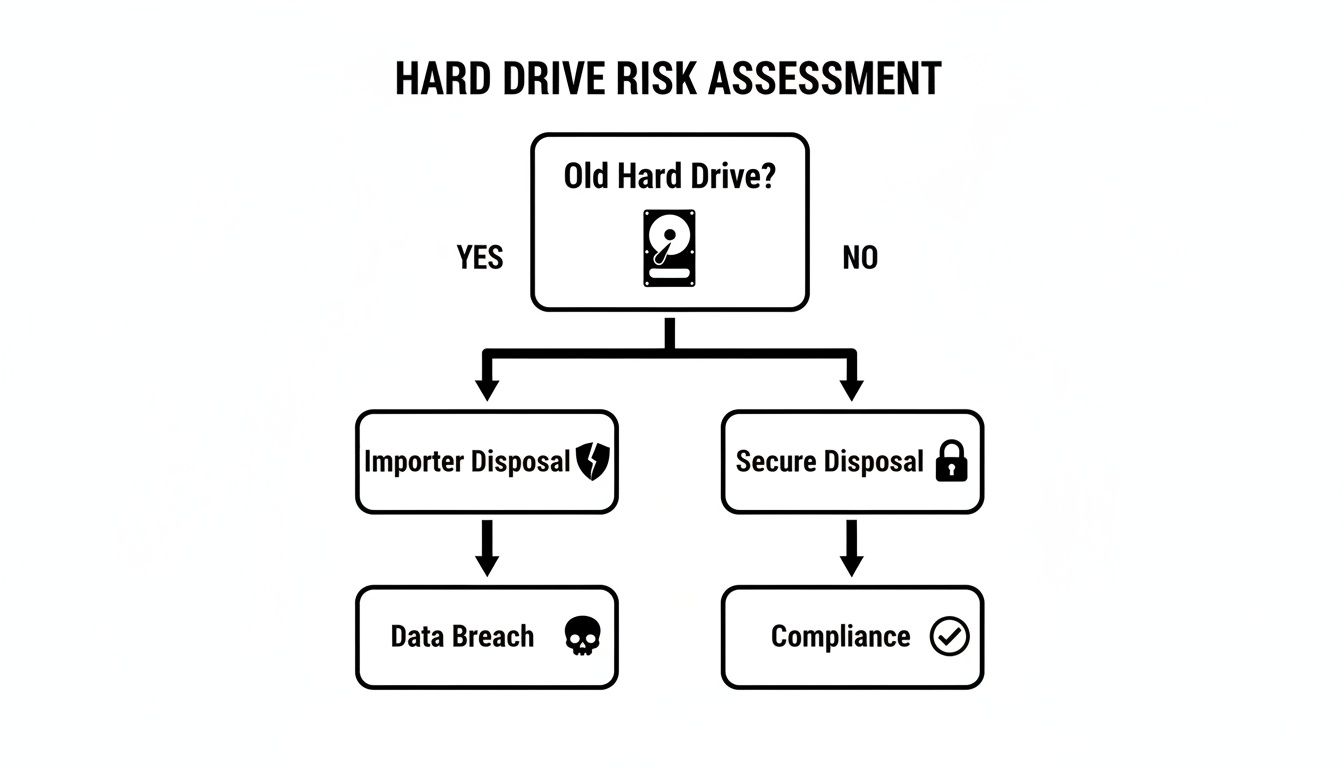
As you can see, proper, secure disposal is the only way to stay compliant and protected. Anything less is a direct invitation for a data breach.
When Data Wiping Makes Sense
Data wiping, or what we in the industry call data sanitization, is all about using software to systematically overwrite every bit of a hard drive with garbage data. Done right, it makes the original information practically impossible to get back. This is your go-to method when you want to reuse, donate, or sell the hardware.
There are a couple of heavy hitters when it comes to standards:
- DoD 5220.22-M: This is the old-school, tried-and-true method from the Department of Defense. It uses a three-pass overwrite and is rock-solid for traditional magnetic hard drives (HDDs).
- NIST 800-88: This is the modern gold standard from the National Institute of Standards and Technology. It’s a more sophisticated framework with methods like 'Clear' and 'Purge' that work well for all kinds of media, including today's Solid-State Drives (SSDs).
Opting for a software wipe is often a smart financial play. Think about a data center in Alpharetta decommissioning a rack of servers that are only three years old. Wiping those drives securely means they can be resold on the secondary market, turning a disposal cost into a revenue stream.
Why Physical Destruction Is Often Mandatory
Sometimes, though, the risk is just too high. When a drive holds sensitive R&D, patient health records, or critical financial data, there’s no room for error. In these cases, physical destruction is the only answer. It guarantees data is gone forever by turning the physical drive platters into a pile of tiny, shredded fragments.
For this, industrial shredding is the undisputed champion. It offers a final, verifiable end to the data's life, which is a must-have for anyone dealing with strict regulations like HIPAA or FACTA. There's no gray area, no "what ifs," and zero chance of a forensic recovery.
For organizations handling the most sensitive information, the peace of mind that comes with physical destruction is priceless. It provides absolute certainty and a clear, auditable paper trail with a Certificate of Destruction.
This need for total security is why the hard drive destruction service market is exploding, already valued at billions and projected to keep growing through 2033. This isn't surprising when you consider that 82% of breaches involve some kind of human element or lost hardware, and the average incident costs a staggering $4.45 million. Shredding simply removes the possibility of a lost or stolen drive causing a catastrophe.
Ultimately, it comes down to one question: can you afford even a remote possibility of that data being recovered? If the answer is no, physical destruction is your only real option.
Data Wiping vs. Physical Destruction: A Comparison
To make the decision clearer, it helps to see the two methods side-by-side. Each has its place, and the best fit depends entirely on your priorities for security, cost, and compliance.
| Attribute | Data Wiping (e.g., DoD 5220.22-M) | Physical Destruction (Shredding) |
|---|---|---|
| Data Security | High. Renders data unrecoverable by software means. | Absolute. Data is physically impossible to recover. |
| Hardware Reusability | Yes. The primary benefit. Allows for resale, donation, or redeployment. | No. The hardware is completely destroyed and unusable. |
| Cost | Lower initial cost, potential for revenue recovery from asset resale. | Higher service cost, no asset recovery value. |
| Compliance | Meets most standards (NIST 800-88, DoD 5220.22-M). | Meets the highest security standards (HIPAA, FACTA, NSA). |
| Verification | Verified through software logs and reports. | Verified with a Certificate of Destruction, often with video proof. |
| Best For | IT asset refreshes, leased equipment returns, employee laptop redeployment. | Highly sensitive data, regulated industries, end-of-life media. |
Choosing the right path isn't complicated once you've assessed your risk. If the drives have value and the data isn't top-secret, wiping is an efficient and profitable route. But for anything that absolutely cannot see the light of day again, shredding is the only way to sleep at night.
On-Site Versus Off-Site Hard Drive Destruction
Once you've decided physical destruction is the only way forward for your sensitive data, the next question is a practical one: where does the shredding actually happen? The choice between on-site and off-site services will shape your workflow, your security protocols, and your ability to prove an unbreakable chain of custody. Both routes lead to the same destination—total data obliteration—but they take very different paths to get there.
This isn't about which option is universally "better," but which one is the right strategic fit for your organization. A healthcare provider in Sandy Springs bound by strict HIPAA rules has a different set of priorities than a manufacturing firm in Kennesaw decommissioning a huge batch of non-sensitive drives. Your decision here defines the entire secure hard disk disposal process.
The Case for On-Site Destruction
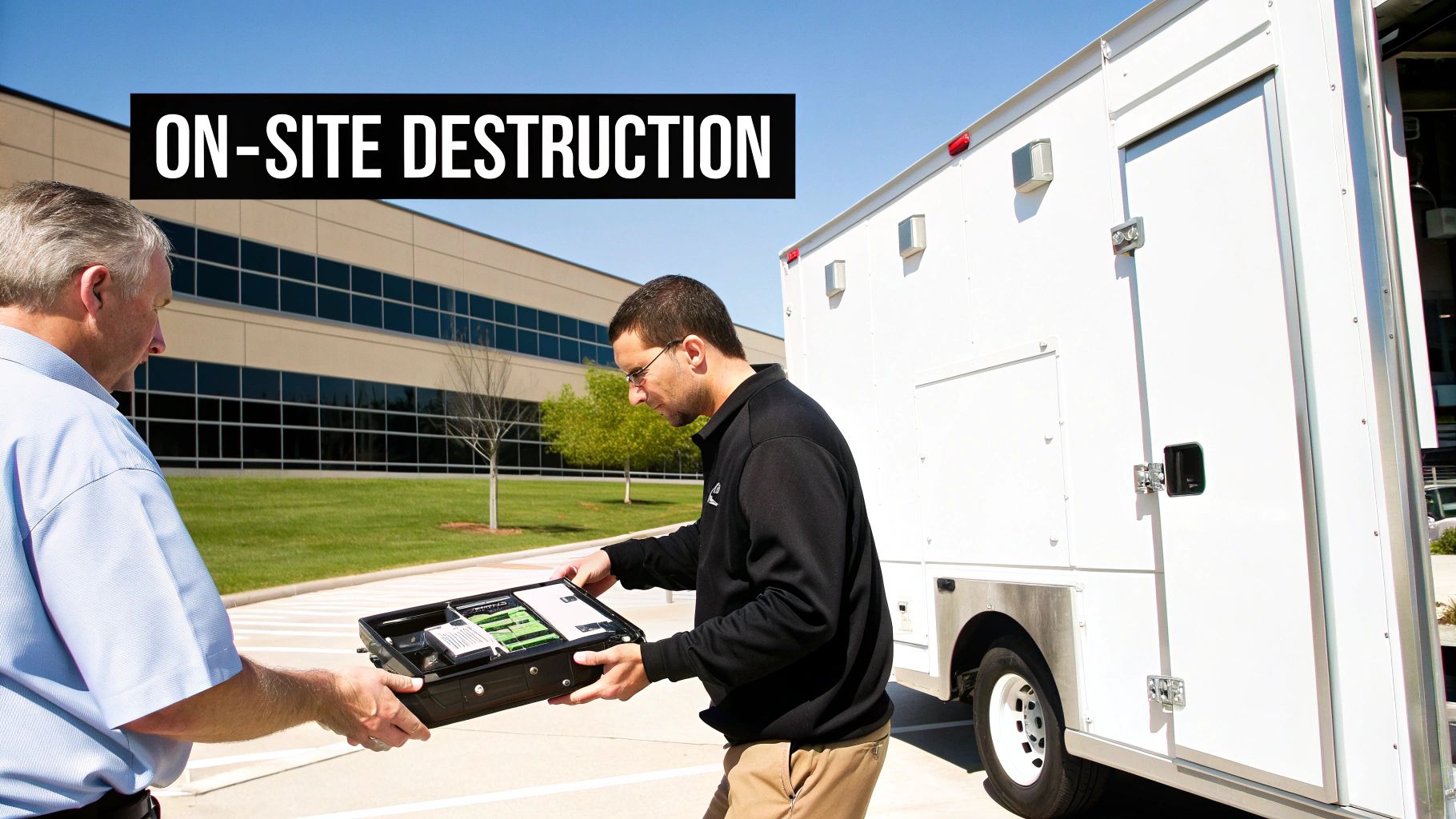
On-site destruction brings the solution right to your parking lot. Picture a specialized, industrial-grade shredding truck pulling up to your facility in Roswell. Your team brings out the hard drives, and you can watch the entire process unfold from start to finish. It’s the ultimate in transparency and control.
You can personally witness every single step:
- Asset Verification: Technicians scan each drive's serial number, matching it against your inventory list.
- Live Destruction: The drives get fed into the shredder, and you can usually watch it happen on a mounted camera.
- Immediate Certification: As soon as the last drive is turned into tiny metal fragments, you get the Certificate of Destruction right then and there.
This hands-on, witnessed process creates an absolutely airtight chain of custody. Since the drives never leave your physical control in a readable state, the risk of data being exposed during transport is zero. That’s why on-site shredding is often non-negotiable for organizations in finance, healthcare, and government.
The Logistics of Off-Site Destruction
Off-site destruction provides a more streamlined, and often more cost-effective, path, especially when you're dealing with a large volume of drives. The entire process is built on secure logistics and verified procedures to maintain a solid chain of custody from your door to the certified destruction facility. It's a highly controlled and documented workflow.
Here’s what the journey of an off-site disposal project usually looks like:
- Secure Collection: A trained technician shows up with locked, tamper-evident containers to collect your assets.
- Serialized Tagging: Every hard drive is scanned and inventoried before being sealed inside the containers.
- GPS-Tracked Transport: The locked containers are moved in a secure vehicle to a monitored, access-controlled facility.
- Verified Destruction: Once at the facility, the assets are destroyed under video surveillance, and a Certificate of Destruction is issued and sent to you.
While you don't get to see the shredding happen with your own eyes, every step is designed to be auditable and secure. For many businesses, the convenience of having a professional team manage the entire process—from pickup to certification—is a major plus. If you're exploring local options, our guide on finding a hard drive shredding service near you can point you to certified vendors in the area.
The decision really boils down to trust versus convenience. On-site gives you irrefutable, eyewitness proof. Off-site relies on a documented, trust-based process with a certified partner. Both are perfectly valid, but your specific compliance needs will almost certainly push you one way or the other.
The market is definitely leaning toward the transparency of on-site services. Projections show that on-site solutions are on track to grab nearly 64% of the market share in data destruction by 2035. This shift is all about the growing demand for real-time video proof and the desire to eliminate transport risks—a huge concern for HIPAA-regulated healthcare organizations all across Metro Atlanta. You can dig into these market dynamics and find out about the latest data destruction trends.
Mastering Your Chain of Custody and Documentation
The job of secure hard disk disposal isn’t over when the shredder stops spinning. Honestly, the most crucial part comes next: building an audit-proof paper trail. Without meticulous documentation and a clear chain of custody, you have zero legal proof your data was ever destroyed. That leaves your business wide open during a compliance audit.
This paperwork is your ultimate legal shield. It’s the difference between confidently sailing through an audit and staring down the barrel of steep non-compliance fines. Think of it as the official story of a hard drive's journey, from a retired piece of hardware to a pile of certified, recycled scrap.
The Anatomy of an Audit-Proof Certificate
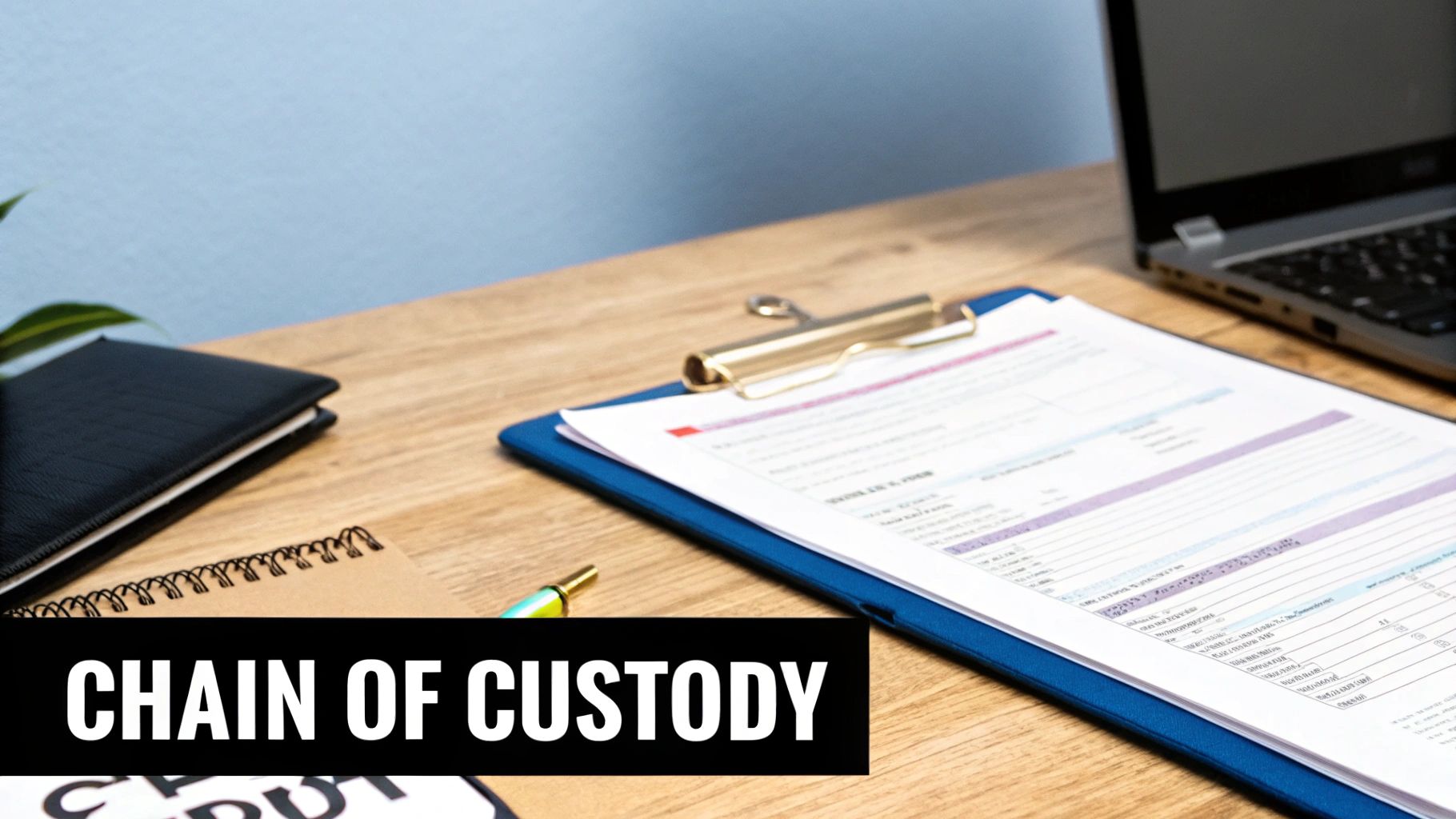
At the very heart of your documentation is the Certificate of Destruction. This isn't just a receipt from your vendor; it’s a legally binding document proving you followed due diligence. A legitimate certificate is your shield, but only if it contains all the right details.
A rock-solid certificate must include:
- Unique Serial Numbers: A complete manifest listing every single asset destroyed. This is non-negotiable.
- Destruction Method: It should clearly state how the drives were destroyed (e.g., shredding) and the standard that was followed.
- Date and Location of Destruction: This pinpoints exactly when and where the final destruction took place.
- Witness Signatures: Signatures from both your company representative (if you witnessed it) and an authorized official from the disposal vendor.
If these key elements are missing, your certificate might not hold up under scrutiny. For a deeper look at what makes this document so critical, you can explore our guide on the Certificate of Destruction.
A Real-World Atlanta Compliance Story
Let’s talk about a mid-sized financial firm right here in downtown Atlanta. During a routine regulatory audit, they were asked to prove how they had disposed of a specific server rack decommissioned two years prior. Because they had partnered with a certified vendor, their IT manager simply pulled up the Certificate of Destruction.
The document showed the exact serial numbers of the hard drives, the date of the on-site shredding, and the signature of the IT manager who personally witnessed the process. The auditor was satisfied, and the firm dodged what could have easily been a six-figure fine. That's the power of proper documentation in action.
Building Your Internal ITAD Log
Beyond the certificate your vendor gives you, maintaining your own internal IT Asset Disposition (ITAD) log is a smart move. This internal record connects all the dots and gives you a complete lifecycle history for every piece of equipment that leaves your building.
Your ITAD log should track:
- Asset Tag or Serial Number
- Device Type (e.g., Dell PowerEdge Server, HP EliteBook Laptop)
- Date of Decommissioning
- Assigned Disposal Method (Wipe vs. Destroy)
- Disposal Vendor Name
- Certificate of Destruction ID Number
This internal log gives you an extra layer of defense and makes it incredibly easy to pull records for any audit request quickly and accurately. For many businesses, working with a reliable IT service provider can take the headache out of this process, ensuring meticulous chain of custody and documentation every time.
The global market for hard disk destruction equipment, valued at USD 1,760 million in 2024, is surging for a reason. Driven by regulations like HIPAA and GDPR, the market is expected to hit USD 2,559 million by 2032 as more organizations realize that certified destruction logs aren’t just paperwork—they’re an essential business safeguard.
The Real ROI of Secure Hard Disk Disposal
It's a huge mistake to see secure hard disk disposal as just another line item in the IT budget. A much smarter way to look at it is as a strategic investment—one that pays you back in ways you might not expect. The most obvious return? Dodging the financial bullet of a data breach.
When just one old hard drive falls into the wrong hands, the fallout can be devastating. Today, the average cost of a data breach is over $4 million. For a small or medium-sized business, a hit like that is often a knockout punch. Professional disposal costs a tiny fraction of that amount, making it one of the most effective insurance policies you can buy.
Calculating the Hidden Financial Gains
But the ROI goes way beyond just avoiding disaster. A solid, transparent disposal strategy builds real value in areas critical to your company's long-term health.
- Deeper Client Trust: Think about it. When your clients—especially if you're in healthcare, finance, or law—know you have a certified process for destroying their data, their confidence in you skyrockets. That trust is a real competitive edge that keeps clients loyal and brings new ones in the door.
- A Protected Brand Reputation: A data breach can permanently stain a company's name. The cost of trying to rebuild that trust with PR campaigns, legal fights, and customer apologies can be far greater than the initial financial loss. Secure disposal protects your most important asset: your reputation.
- Fewer Headaches and Wasted Hours: Trying to handle disposal in-house chews up your team's valuable time and opens you up to unnecessary risk. Bringing in a certified expert streamlines everything, frees up your IT staff to focus on what they do best, and saves you a ton in operational overhead.
The secure data destruction market is exploding for a reason. It shot up from USD 6.50 billion in 2022 and is expected to hit USD 12.50 billion by 2030. That growth is being driven by the hard truth that lost or stolen hardware is a leading cause of breaches. It's why certified physical destruction has become the gold standard.
Turning Disposal Costs into Actual Revenue
Here’s where it gets really interesting: the chance to recover value from your old equipment. This is the point where a security necessity becomes a budget-neutral—or even profitable—part of your IT operations. For any Atlanta-area business sitting on aging IT infrastructure, this is a game-changer.
A good IT Asset Disposition (ITAD) partner does more than just shred drives. They look at all your retired gear and figure out what still has market value. Newer servers, networking equipment, or enterprise laptops can often be securely wiped, refurbished, and sold.
Through asset remarketing and profit-sharing agreements, the cash from selling those assets can offset or even completely cover your disposal costs. If your company is doing a big data center refresh or upgrading hundreds of computers, this can mean a serious financial return. This approach totally flips the script on IT lifecycle management. You can learn more about turning old equipment into value through our guide on the disposal of IT assets.
Common Questions About Hard Disk Disposal
Even with a solid plan, you're bound to have a few questions. It happens on every project. Here are the straight-up answers to the questions we get all the time from businesses here in Atlanta, so you can move forward with confidence.
What's the Real Difference Between DoD and NIST Standards?
This is a classic question. The DoD 5220.22-M standard is the old-school, three-pass wipe method that most people have heard of. It’s like painting over a wall three times—incredibly effective for traditional magnetic hard drives (HDDs) and gets the job done.
But technology moves on. The NIST 800-88 guidelines are the modern framework. NIST breaks it down into 'Clear' (like a standard overwrite), 'Purge' (think degaussing or cryptographic erasure), and 'Destroy' (physical demolition). Because new tech like Solid-State Drives (SSDs) store data differently, a simple overwrite doesn't always cut it.
For practical purposes, the DoD wipe is fantastic if you plan to reuse older drives. But for total data elimination, especially for SSDs or drives at their end of life, physical shredding aligns with NIST’s 'Destroy' method. It's the only way to be 100% certain the data is gone forever.
Do I Need to Wipe Drives Before You Shred Them?
Nope, it's not necessary from a security standpoint. If you've scheduled on-site shredding, our equipment will pulverize the drives into tiny fragments. There's simply nothing left to recover data from. Wiping them first is just extra work with no added security benefit.
That said, some companies have a strict internal policy: no drive leaves the building until it's been wiped. We completely respect that. It’s a good "belt and suspenders" approach. Just know that when we arrive, the end result is the same—total destruction.
Can't I Just Drill Holes in My Hard Drives or Smash Them?
It might feel satisfying, but drilling holes or going at a drive with a sledgehammer is a huge security risk. You'd be surprised what forensic experts can pull from just a piece of a damaged platter. It’s not a secure method by any professional standard.
The biggest problem with DIY destruction? You get no Certificate of Destruction. That certificate is your official, auditable proof that you complied with regulations like HIPAA or FACTA. Without it, you're exposed. Professional shredding delivers both guaranteed data destruction and the paperwork to prove it.
What's the Cost for Secure Hard Drive Disposal in Atlanta?
The price tag depends on a few things: how many drives you have, whether we come to you (on-site) or you bring them to us (off-site), and your exact location. But it's almost always more affordable than people think.
For businesses getting rid of newer equipment like servers, switches, or firewalls, our value recovery programs can make a huge difference. We can often remarket that gear and share the profits, which can significantly lower or even completely cover your data destruction costs. The best way to know for sure is to get a quick, custom quote based on what you have.
Ready to put a secure, compliant, and cost-effective disposal plan in place for your Atlanta-area business? Montclair Crew Recycling provides certified data destruction and IT asset disposition services built to protect your organization. Request your free quote today.
