
Secure hard drive shredding is the only way to be absolutely certain the data on your old devices is gone for good. Just deleting files or formatting a drive feels like you're clearing it out, but in reality, it leaves a shocking amount of sensitive information behind for anyone with the right tools to find.
Why Hitting 'Delete' Isn't Enough
Most people think that dragging a file to the trash or reformatting a drive wipes it clean. It’s a common mistake, but this false sense of security can put your entire business on the line. Thinking of it this way: deleting a file is like tearing out the table of contents from a book. The pages and all the information on them are still there; it’s just harder to find them without the guide.
When you delete something, your computer's operating system just marks that space as available. It removes the pointer telling it where to find your customer records or financial statements, but the actual ones and zeros making up that data remain on the drive platters. For a skilled person with easily accessible software, recovering those "deleted" files can take just a few minutes.
The Illusion of an Empty Drive
Formatting a drive might seem like a more permanent step, but it often just lays down a new, blank file system right on top of the old data. Your confidential information is still sitting there, completely untouched, until something new happens to be written over that exact spot. This creates a huge window of vulnerability where your data can be easily restored.
The risks of leaving this old data accessible are massive:
- Data Breaches: Recovered data can quickly turn into a full-blown breach, exposing employee records, customer lists, and your most valuable company secrets.
- Compliance Violations: Strict regulations like HIPAA and FACTA have clear rules about securely disposing of sensitive information. A slip-up here can lead to crippling fines and legal headaches.
- Reputation Damage: It only takes one data breach to destroy the trust you've built with your customers, sometimes permanently.
The Only Certain Solution
This is exactly why secure hard drive shredding has shifted from a simple IT task to a critical piece of any security plan. It’s a physical process that demolishes the drive, grinding the platters that hold your data into tiny, unreadable pieces of metal and plastic.
By physically destroying the media, shredding makes data recovery completely impossible. It’s the definitive final word in the data lifecycle, giving you absolute certainty that your information is gone forever.
Businesses are catching on. The global demand for hard drive destruction services is growing fast as more organizations make data security a top priority. The market is projected to skyrocket from around USD 1.65 billion to USD 5.05 billion by 2035, which tells you everything you need to know about how important this has become.
At the end of the day, shredding goes beyond what any software can do. It tackles the physical source of your data, offering a foolproof method of destruction. For businesses wanting to see how this fits into a larger security strategy, our guide on what data sanitization is offers some great context. This physical approach is the only way to truly close the security gap that simple deletion leaves wide open.
The Hard Drive Shredding Process Explained
So, what actually happens when you hire a professional for secure hard drive shredding? It’s not just about a guy showing up and smashing old equipment. This is a highly systematic, documented process designed to guarantee—without a shadow of a doubt—that your data is gone forever. The whole thing pivots on accountability and security, from the moment we arrive until the very end.
Think about how forensic evidence is handled. From the second an item is bagged at a crime scene, its every move is tracked through a "chain of custody." This unbroken paper trail ensures its integrity. We apply that same rigorous principle to your old hard drives because, frankly, they hold the sensitive data "DNA" of your organization.
Establishing an Unbroken Chain of Custody
The process kicks off the minute a certified data destruction specialist walks into your Metro-Atlanta office. Your hard drives aren’t just tossed into a random bin. Instead, they are carefully inventoried and then locked away in tamper-evident containers.
This is the critical first step in establishing the chain of custody. Every sealed container is scanned, creating a digital and physical log that tracks your assets from your hands to the point of destruction. For any business concerned with compliance, this meticulous documentation isn't just nice to have; it’s non-negotiable. It provides the auditable proof you need to show your data was handled securely at every single step.
This is why just deleting files isn't enough. As this infographic shows, the data is still there, just waiting to be recovered.
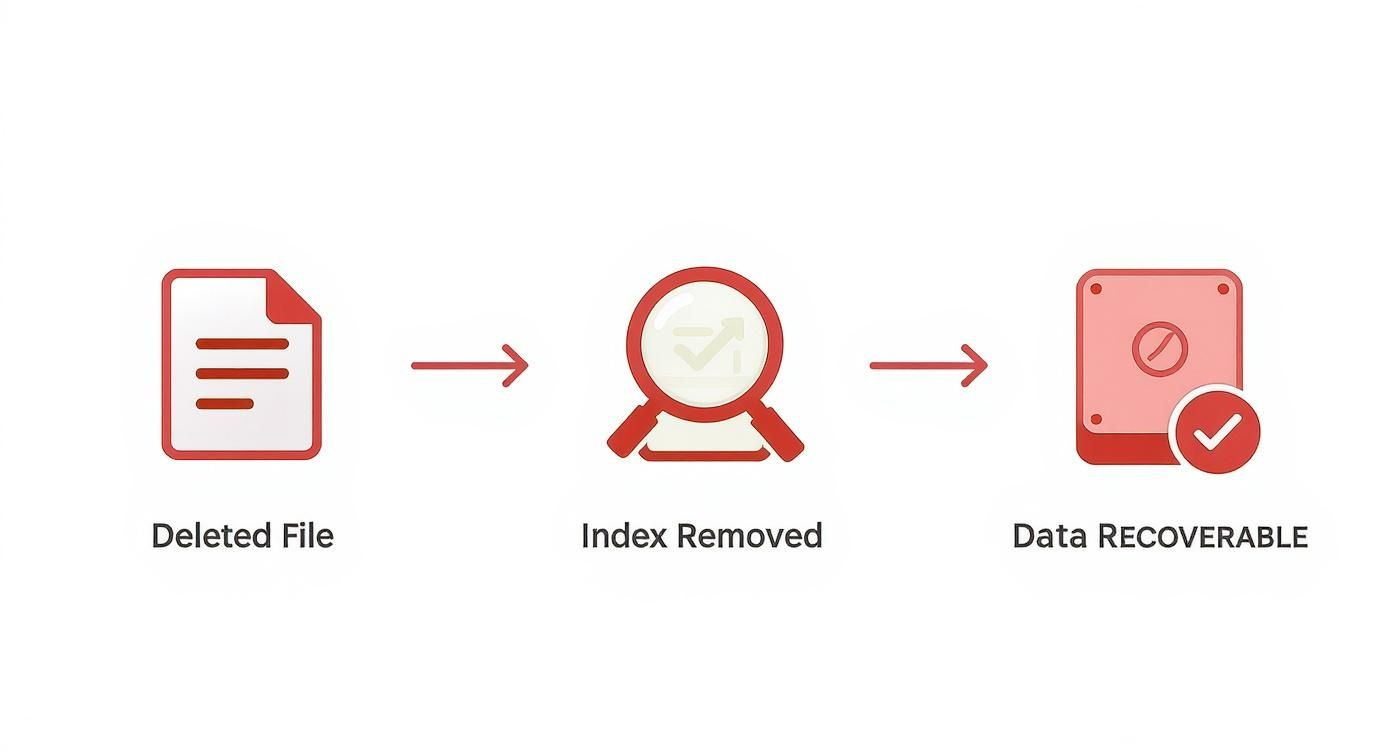
Without physically destroying the drive, your sensitive information is really just hiding in plain sight, easily restorable with basic recovery software.
On-Site Versus Off-Site Shredding Options
Once your drives are locked up and accounted for, you have two main options for how they meet their end. Both are certified and secure, but they cater to different needs.
- On-Site Shredding: This is exactly what it sounds like. A mobile shredding truck, basically a destruction plant on wheels, comes right to your location. You can literally stand there and watch your hard drives get fed into the industrial-grade shredder. It offers the ultimate transparency and peace of mind.
- Off-Site Shredding: With this option, your sealed and locked containers are transported in a GPS-tracked vehicle to a secure shredding facility. The entire process is filmed under strict security protocols.
Both methods keep that chain of custody intact. Your choice usually comes down to your company’s internal security policies, data sensitivity, or simple logistics. For businesses looking at the bigger picture, it's also useful to understand what IT asset disposition entails as a whole.
The Sheer Force of Industrial Shredders
Whether it happens at your curb or our facility, the heart of the operation is the machinery. These aren't the flimsy paper shredders you have by the copy machine. We’re talking about powerful industrial shredders with interlocking steel teeth designed to grab, bend, and tear apart entire hard drives.
The shredder reduces the entire drive—case, platters, electronics, and all—into a pile of small, mangled fragments of metal and plastic. The resulting pieces are typically no bigger than a quarter, making it physically impossible to put them back together or recover a single byte of data.
This is the ultimate guarantee. It’s not just erasing the data; it’s annihilating the very medium where the data lived. There’s simply nothing left for even the most sophisticated recovery lab to work with.
Finalizing with a Certificate of Destruction
The last and arguably most important step is receiving your Certificate of Destruction. This isn't just a simple receipt for the service. It’s a legal document that officially transfers liability for the destroyed data from your company to the shredding provider.
This certificate is your golden ticket for audits and proof of regulatory compliance. It will always include key details like:
- The date and location of destruction
- A unique serial number for the job
- A list or count of all media destroyed
- Confirmation that the process meets industry standards
- An authorized signature from the destruction company
From the secure collection at your office to the final certified proof, every step is built to eliminate risk and make sure your data is gone for good.
Navigating Data Protection and Compliance Laws
For businesses here in Metro Atlanta and across the country, secure hard drive shredding isn't just a smart security move—it's often the law. Failing to properly destroy sensitive data isn't just careless; it can bring on staggering financial penalties and leave your company's reputation in tatters. While the web of data protection laws can seem complex, the main idea is simple: if you collect sensitive data, you are on the hook for its secure disposal when it's no longer needed.
Think of it like handling hazardous materials. You wouldn't just toss old chemical containers into a dumpster. You'd follow strict disposal protocols to prevent any harm. Regulators view digital data, especially personal information, with that exact same level of seriousness.
Key Regulations Demanding Secure Disposal
Several major laws directly shape how your organization must handle data at the end of its life. The legal language can be thick, but their requirements for data destruction are crystal clear and unforgiving. Getting it wrong can lead to fines reaching into the millions, making compliance a mission-critical part of doing business.
Here’s a quick rundown of some of the heavy hitters:
- HIPAA (Health Insurance Portability and Accountability Act): This is the bedrock of patient data protection in healthcare. HIPAA requires that all Protected Health Information (PHI) be rendered completely unreadable and impossible to piece back together. Physical destruction, like shredding, is a recognized and approved method for meeting this standard.
- FACTA (Fair and Accurate Credit Transactions Act): This one impacts nearly every business that touches consumer information. FACTA's "Disposal Rule" is pretty direct, demanding the proper disposal of data from consumer reports. Again, physical destruction is listed as a primary way to comply.
- GDPR (General Data Protection Regulation): Even if your business is based in Georgia, if you handle the data of anyone in the EU, the GDPR applies to you. It champions the "right to erasure," which means you must be able to permanently delete an individual's data if they ask. Shredding is a definitive way to make that happen.
The growing demand for compliant destruction has fueled major growth in the data destruction industry. In fact, the global market for hard drive shredding services was valued at USD 0.72 billion and is expected to climb to around USD 1.2 billion by 2033. That jump is a loud and clear signal of just how crucial this service has become for modern businesses.
The following table breaks down how these key regulations apply across different sectors and what they specifically require for data disposal.
| Regulation | Affected Industries | Data Destruction Requirement |
|---|---|---|
| HIPAA | Healthcare Providers, Insurance Companies, Medical Billing | Render Protected Health Information (PHI) unreadable, indecipherable, and unable to be reconstructed. |
| FACTA | Financial Institutions, Retailers, Auto Dealers, Lenders | Proper disposal of consumer report information to prevent unauthorized access and misuse. |
| GDPR | Any organization processing the data of EU residents | Permanent erasure of personal data upon request (the "right to erasure"), ensuring it cannot be recovered. |
Understanding these mandates is the first step toward building a truly secure and compliant data end-of-life plan.
Shredding as a Cornerstone of Compliance
So, how do you prove to an auditor that you've followed the rules? Just saying you hit "delete" on a bunch of files won't cut it. This is where professional shredding services become a critical piece of your risk management strategy. The process gives you the concrete, auditable proof you need to show you did your due diligence.
When a hard drive is shredded by a certified provider, the process concludes with a Certificate of Destruction. This legally recognized document serves as your official proof of compliance, detailing what was destroyed, when, and how.
This certificate is your shield in an audit. It confirms that you took verifiable steps to protect sensitive data, effectively closing the loop on your data's lifecycle and shifting the liability. To see how this fits into a bigger picture, it helps to understand how shredding works alongside comprehensive cybersecurity compliance solutions.
At the end of the day, secure hard drive shredding turns a routine IT task into a powerful compliance tool. By physically destroying the media, you don't just eliminate the risk of a breach—you create an undeniable record that you handled your data responsibly. You can learn more about this crucial document in our guide on the role of a Certificate of Destruction. It’s the final, vital step in protecting your business, your customers, and your bottom line.
When it's time to retire old IT hardware, you'll find that not all data destruction methods are built the same. While secure hard drive shredding gives you a definitive, ironclad solution, other techniques like software wiping and degaussing are still out there. Knowing how they all stack up is critical to picking the right approach for your company’s security needs.
Think of it like getting rid of a sensitive paper document. You could try scribbling over the words with a thick black marker—that's basically software wiping. You could use a special chemical to dissolve the ink, which is similar to degaussing. Or, you could just feed it into a cross-cut shredder and turn it into confetti. Only one of those methods guarantees the information is gone for good.
Software-Based Wiping Explained
Software wiping, often called data erasure, uses a program to write over the information on a hard drive with random patterns of ones and zeros. This process gets repeated over and over—often following standards like the DoD 5220.22-M three-pass method—to make the original data incredibly difficult to recover.
The main selling point for wiping is that the drive is still in one piece and can be reused or resold, which helps with recovering asset value. But it comes with some serious drawbacks:
- It’s Slow: Wiping a single high-capacity drive can take hours. For a large batch of computers, that timeline just isn't practical.
- It Fails on Damaged Drives: If a hard drive won't power on or has physical damage, the software can't run. The data is left completely exposed.
- It's Dicey on SSDs: The way Solid-State Drives (SSDs) manage data can leave fragments behind in areas the software can't reach, even after a supposedly thorough wipe.
If you're still considering this route for functional devices, our guide on how to wipe a computer before recycling provides a step-by-step look at the process.
Understanding Degaussing
Degaussing is a less common but powerful method for traditional magnetic hard disk drives (HDDs). It works by hitting the drive with an extremely strong magnetic field, which instantly scrambles the magnetic charge on the platters where your data lives. The data is instantly rendered unreadable.
Degaussing is a fast and highly effective way to destroy data on magnetic media. However, its effectiveness is strictly limited to certain types of hardware, creating a major gap in modern IT environments.
Here’s the deal-breaker: degaussing has zero effect on Solid-State Drives (SSDs). Since SSDs use flash memory instead of magnetic platters, the powerful magnets are completely useless. This makes degaussing an incomplete solution for any organization that has a mix of old and new hardware.
Physical Shredding: The Gold Standard
This brings us back to secure hard drive shredding. Unlike wiping or degaussing, shredding is a pure brute-force approach. It doesn't care if the drive is new, old, working, or broken. The machine physically pulverizes the drive, its platters, and all its internal parts into tiny, unsortable metal fragments.
The advantages here are crystal clear:
- Universal Effectiveness: It works on everything. HDDs, SSDs, flash drives, backup tapes—even devices that are completely smashed or won't turn on.
- Absolute Certainty: There is a 0% chance of data recovery. Once a drive goes through a shredder, the data is physically annihilated.
- Efficiency at Scale: A powerful industrial shredder can tear through hundreds of drives an hour, making it the fastest and most efficient solution for bulk disposals.
To make an apples-to-apples comparison, let's lay it all out.
Comparison of Data Destruction Techniques
Choosing a method isn't just about security; it's about understanding the trade-offs in reusability, effectiveness, and what works for your specific hardware. This table breaks it down.
| Method | Security Level | Drive Reusable? | Effective on SSDs? | Best For |
|---|---|---|---|---|
| Shredding | Very High | No | Yes | Maximum security, compliance, bulk disposals, all drive types (including damaged) |
| Wiping | Medium-High | Yes | Partially | Asset reuse, functional drives, small quantities where time is not a factor |
| Degaussing | High | No | No | Legacy HDDs & magnetic tapes, environments with no SSDs |
While wiping has its place for asset recovery and degaussing works on old tech, only shredding provides the universal, guaranteed data destruction that modern security and compliance standards demand.
The market for this equipment shows just how critical this has become. The global hard disk destruction equipment market was valued at around USD 1.76 billion and is projected to hit approximately USD 2.56 billion by 2032. As organizations get more serious about data security, they're investing in the certified hardware that makes total data elimination possible.
Ultimately, shredding is the only method that eliminates every potential point of failure, securing its spot as the undisputed champion of data destruction.
How to Choose a Certified Shredding Provider

Picking the right partner for secure hard drive shredding is one of the most critical security decisions you'll make. You’re not just clearing out old IT gear; you're handing over the keys to your company's digital kingdom. Choosing a fly-by-night operator is like hiring a locksmith who leaves copies of your keys all over town.
The right provider becomes an extension of your own security team. They handle your data with meticulous care from the second it leaves your building until it’s verifiably destroyed. But with so many options out there, how do you spot the true professionals? It all comes down to asking the right questions and demanding proof.
Look for NAID AAA Certification
The single most important credential to look for is NAID AAA Certification. This isn't just some fancy sticker a company buys online—it's the absolute gold standard for data destruction. The National Association for Information Destruction (NAID) acts as a third-party watchdog, conducting tough, unannounced audits on its certified members.
Think of it like a restaurant's health department grade. A provider with NAID AAA Certification has voluntarily opened its doors to surprise inspections covering more than 20 different operational security points, including:
- Employee Screening: Are all employees who handle sensitive media put through rigorous, recurring background checks?
- Facility Security: Is the destruction facility monitored 24/7 with strict access controls and video surveillance?
- Process Integrity: Is there a documented, unbreakable chain of custody for every single asset?
- Secure Vehicles: Are the trucks locked, alarmed, and tracked from point A to point B?
Choosing a NAID AAA Certified provider means you are working with a company that has proven its commitment to the highest level of security. It’s a non-negotiable benchmark that verifies their processes, people, and facilities meet stringent industry standards.
This certification takes the guesswork out of the equation. It gives you immediate confidence that your partner operates with verified, best-in-class security protocols. It’s the fastest way to vet a provider’s legitimacy.
Essential Questions to Ask Any Potential Vendor
Beyond that all-important certification, a few direct questions can tell you a lot about a company's professionalism. Before you sign any contracts, make sure you get crystal-clear answers to these questions.
-
Can You Detail Your Chain of Custody Process?
A reputable provider should be able to walk you through their entire chain of custody without skipping a beat. Ask them how they log your assets, what kind of locked containers they use, and how every step is documented. A vague or rambling answer is a massive red flag. -
What Are Your E-Waste Recycling Policies?
Secure destruction and environmental responsibility should always go hand-in-hand. Once the drives are shredded, what happens to the pulverized bits of metal and plastic? A professional vendor will have established partnerships with certified recyclers to ensure all e-waste is processed responsibly and stays out of landfills. You can also review our guide on selecting e-waste disposal companies to learn more about what best practices look like. -
Can I Witness the Destruction Process?
Transparency is everything. The provider should offer you a way to verify the destruction, whether it's through on-site shredding where you can watch it happen or via secure video feeds for off-site services. A company that welcomes observation is one that is confident in its security. -
What Type of Insurance Coverage Do You Carry?
Don't be shy—ask about their professional liability and data breach insurance. A properly insured company is ready for worst-case scenarios, which ultimately protects your business, too. It’s a clear sign that they are a serious, professional operation that fully understands the risks involved.
Still Have Questions About Hard Drive Shredding?
Deciding to physically destroy your company's old hard drives is a smart move. But even after you understand the basics, a few practical questions usually pop up. It's a big step, and you want to be sure about the details.
Let's walk through the most common questions we hear from IT managers and business owners around Metro-Atlanta. We'll give you clear, straightforward answers to help you lock in your data destruction plan with total confidence.
What Happens to the Shredded Hard Drive Material?
This is a great question. You're left with a massive pile of metal and plastic bits, so where does it all go? Responsible disposal is about two things: total data security and being a good environmental steward.
Once a hard drive is pulverized into tiny fragments, the data is gone forever. But a certified shredding provider doesn't just haul the scraps to a landfill. Instead, that material enters a strict, environmentally-sound recycling process. The shredded mix of aluminum, steel, plastic, and circuit board components is securely taken to a specialized e-waste recycling partner.
At the recycling facility, machines sort and separate all these materials. The metals are melted down to be used again in making new products. It's a completely closed-loop system.
This process gives you two critical results:
- Your sensitive data is completely and permanently eliminated.
- Your old equipment stays out of landfills, helping you hit your company’s sustainability targets.
Always ask a potential shredding company about their e-waste policy. A true professional will have a transparent, certified process for responsibly handling everything they shred.
Is On-Site or Off-Site Shredding More Secure?
We get this one all the time. The short answer is that both are incredibly secure—as long as you’re working with a NAID AAA Certified provider. The right choice really boils down to your own company's security policies, budget, and how much oversight you want.
On-site shredding is exactly what it sounds like. A mobile destruction truck pulls up to your business, and you can literally watch your hard drives get fed into the shredder. It offers the highest level of transparency and gives you instant peace of mind. This is often the go-to for organizations with highly sensitive data or strict internal rules that require visual verification.
Off-site shredding involves securely transporting your locked and inventoried hard drives to a monitored destruction facility. The entire process is managed with a strict, documented chain of custody. Think GPS-tracked vehicles and locked, tamper-evident containers. The shredding is usually filmed, so you still get verification even though you aren't there in person. This option is often more cost-effective, especially if you have a huge number of drives.
The most important thing to remember is that security isn't about the location—it's about the process. A certified chain of custody protects your data from the second it leaves your hands, no matter where the final destruction happens.
Ultimately, you need to pick the option that gives your team the most confidence and checks all your compliance boxes.
Do I Need to Wipe My Hard Drives Before Shredding Them?
No. Absolutely not. Wiping, erasing, or degaussing drives before they are professionally shredded is completely unnecessary. It’s a common myth that wastes valuable time and money without adding any real security.
The physical destruction from an industrial shredder is the final word. These machines don't care if a drive is full of data or has been wiped clean; they rip right through the metal platters and internal parts where data lives. Trying to get data off those shredded fragments is like trying to put a shattered lightbulb back together. It’s impossible.
Think of it this way: spending hours wiping a drive that’s about to be shredded is like carefully redacting a document with a marker right before you toss it in a furnace. The final act of destruction makes the first step pointless. A certified provider's secure chain of custody is designed to protect the data on your drives from the moment of pickup until the moment of destruction.
What Is a Certificate of Destruction and Why Is It Important?
A Certificate of Destruction is much more than just a receipt. It's a formal, legal document that serves as your official proof that your media was destroyed according to industry standards and data protection laws. This document is a cornerstone of any solid risk management program.
This certificate is your tangible evidence that your organization did its due diligence to protect sensitive information. If you ever face an audit or legal question, it’s your definitive proof that you complied with regulations like HIPAA, FACTA, or GDPR.
A legitimate Certificate of Destruction will always include key details like:
- A unique serial number for tracking the job
- The exact date and location of destruction
- A detailed list or count of the items destroyed
- Confirmation of the destruction method (e.g., shredding)
- The name and signature of an authorized official from the shredding company
This document officially transfers the liability for the data from your company to the shredding vendor. It’s the final, essential step that closes the loop on your data's lifecycle and protects your business.
Ready to implement a secure and compliant data destruction plan for your Metro-Atlanta business? Montclair Crew Recycling offers certified on-site hard drive shredding services that provide absolute peace of mind. Contact us today to ensure your sensitive data is gone for good.
