
The asset-tracking market is no longer a back-office niche. It was valued at USD 24.14 billion in 2024 and is projected to reach USD 51.59 billion by 2030, with North America holding the dominant share, according to Grand View Research's asset tracking market report. For Atlanta companies, that matters because local IT estates don't stay small for long. A few laptops become a hybrid workforce. A modest server room becomes colocation space, cloud instances, edge gear, and retired devices waiting for disposition.
That shift changes what IT asset tracking is for. In practice, the strongest programs in Atlanta aren't just counting devices. They're proving who had them, where they went, what changed, and how they left service. That's a different discipline. It sits closer to compliance, security, and operational risk than to simple inventory control.
The New Baseline for Atlanta Business Operations
Atlanta companies used to treat asset tracking as an administrative task. A spreadsheet was often enough when a business had one office, a stable device count, and limited remote work. That model breaks once assets move between offices, homes, data centers, repair vendors, and disposal partners.
The local reality is more complex now. Businesses in healthcare, finance, logistics, professional services, education, and government contracting all manage devices that carry sensitive data or support regulated workflows. If a laptop disappears, or a retired server leaves the building without a documented chain of custody, the problem isn't only replacement cost. It's exposure.
Tracking now sits inside operations
A mature tracking program connects procurement, deployment, support, refresh planning, facilities, and disposition. That's one reason the topic increasingly overlaps with broader guidance on asset lifecycle management for facilities. Buildings, rooms, racks, storage areas, and loading docks all affect how well a company can maintain control over IT equipment.
Atlanta businesses also feel this pressure because growth creates fragmentation. New locations open. Teams move faster than documentation. Devices get reassigned informally. Temporary projects turn into permanent infrastructure. The result is familiar to most IT managers. The inventory list exists, but it no longer matches the current environment.
A lot of that strain shows up in day-to-day infrastructure work. The operational side is well illustrated in this look at Atlanta IT infrastructure challenges in rapid growth. The tracking issue usually isn't that companies have no records. It's that their records stop being trustworthy once change speeds up.
Practical rule: If your team can't show current owner, location, status, and disposition path for a device, you don't have control of that asset. You have a partial memory of it.
What no longer works
Older approaches fail in predictable ways:
- Spreadsheet-only logs: They depend on disciplined manual updates, which usually break during moves, terminations, loaners, and refresh cycles.
- Procurement records as inventory: A purchase order proves what was bought, not where the device is now or whether it still exists.
- Help desk notes as lifecycle history: Ticketing systems can support tracking, but scattered notes don't create an audit trail on their own.
- One-time annual audits: They catch drift after the fact. They don't prevent it.
The new baseline is straightforward. If a company manages more than a small handful of laptops, servers, storage devices, access points, switches, or mobile devices, formal asset tracking isn't optional anymore. In Atlanta, it has become basic operating discipline.
Forces Driving Asset Tracking Adoption in Georgia
Metro Atlanta's infrastructure growth is pushing asset control from “nice to have” into a hard operational requirement. In the first half of 2025, Metro Atlanta saw the world's largest year-over-year data-center inventory growth and became the second-largest market globally, with more than $40 billion in data-center investment in seven months, according to Georgia Trend's report on data-center dominance. That volume of investment means more servers, more storage, more network gear, more spare parts, and eventually more decommissioned hardware.

What matters for practitioners is the downstream effect. Hardware growth creates paperwork growth, custody growth, and risk growth. Every deployment adds ownership questions. Every relocation adds chain-of-custody risk. Every retirement event adds compliance obligations.
Local growth creates asset sprawl
Atlanta's business environment makes this sharper than in many markets. Companies here often operate across headquarters space, branch offices, colocation suites, warehouse locations, remote users, and cloud platforms at the same time. That mixed estate produces one of the most common tracking failures. The asset record starts in one system, while the final retirement evidence ends up in another.
That's why IT asset tracking trends in Atlanta companies increasingly revolve around governance, not just visibility. It's no longer enough to know that a device exists. Teams need to know who approved a move, who received it, whether it contains storage, and what retirement process applies when it leaves service.
Technology growth changes the tracking burden
The problem isn't just more assets. It's more asset types and more movement.
- Hybrid infrastructure: Companies split workloads across cloud, on-premises systems, and colocation. Physical and virtual dependencies don't stay neatly separated.
- IoT expansion: Sensors, smart building devices, mobile scanners, and field equipment create inventories that traditional desktop processes often miss.
- Distributed work: Laptops, monitors, docks, and mobile devices spend more time offsite, where manual updates fail fastest.
- Automation pressure: IT teams want less time spent reconciling records and more time spent acting on accurate data.
Many Atlanta firms are also pairing asset control with broader automation initiatives. That connection shows up in how businesses are evaluating AI adoption in Atlanta operations. The practical use case here isn't hype. It's exception handling. Teams need systems that flag missing scans, mismatched assignments, unreturned hardware, and incomplete retirement records before those become audit problems.
Good tracking systems don't remove work. They remove guesswork.
Why spreadsheet methods break first
Manual inventories usually fail at the same moments:
- Moves and office changes create location drift.
- Employee turnover creates ownership drift.
- Hardware refreshes create status drift.
- Disposal events create evidence gaps.
Those gaps matter more in Georgia now because the region's infrastructure density is rising. The businesses handling the most change aren't always large enterprises. Mid-sized firms feel this just as hard because they often have enterprise-grade risk with smaller admin teams.
Key Technologies Shaping Modern IT Asset Tracking
The biggest technology trend isn't flashy. It's automation replacing manual reconciliation. Atlanta companies are increasingly adopting automated, IoT-enabled tracking to replace spreadsheet-based methods because it reduces human-entry error, provides real-time visibility for offsite equipment, and improves theft deterrence and maintenance scheduling, as outlined in Tektelic's overview of automated asset tracking benefits.
That doesn't mean every company needs the same stack. The right setup depends on asset type, scale, mobility, and compliance pressure.
Where older methods still fit
Barcodes and QR labels still work well for controlled environments. If devices stay in fixed offices and your team has disciplined check-in and check-out procedures, they're inexpensive and easy to implement. The weakness appears when assets move often or when scan compliance is weak.
RFID and IoT-based tracking help when organizations need less friction. They're useful for higher-volume environments, shared device pools, offsite equipment, or storage rooms where manual scanning gets skipped.
UEM platforms, CMDB tools, and discovery platforms solve a different problem. They don't always prove physical location, but they're useful for connecting device identity, user assignment, configuration state, and lifecycle status.
Comparison of IT Asset Tracking Technologies
| Technology | Best For | Accuracy | Cost | Key Advantage |
|---|---|---|---|---|
| Barcode and QR labels | Small offices, static device fleets, controlled checkouts | Depends heavily on manual scanning | Low | Simple to deploy and easy to understand |
| RFID tagging | Larger offices, shared equipment, storage rooms, higher movement | Strong when readers and workflows are well placed | Moderate | Faster identification without line-of-sight scanning |
| IoT-enabled location tracking | Offsite assets, equipment in transit, distributed operations | Higher real-time visibility in moving environments | Moderate to high | Better visibility for assets outside traditional office control |
| UEM platforms | Laptops, desktops, mobile devices already under endpoint management | Strong for device identity and status, weaker for physical custody alone | Moderate | Ties asset records to users, policies, and device state |
| CMDB and SaaS asset systems | Organizations managing infrastructure relationships and audit workflows | Strong when fed by reliable operational data | Moderate | Builds lifecycle context, approvals, and reporting |
| Tagless network discovery | Servers, network devices, and infrastructure already connected to managed environments | Strong for discovery of active connected assets | Moderate | Finds assets teams forgot to record manually |
For companies evaluating platforms, this review of IT asset management software options is useful because the software decision usually matters more than the tag decision. Tags identify things. Systems create accountability.
What works in the field
A practical model for many Atlanta businesses looks like this:
- Laptops and user devices: UEM plus barcode or QR labeling.
- Server and network estates: CMDB plus discovery tools.
- Shared and mobile equipment: RFID or IoT-enabled location tracking.
- Disposition workflows: Asset system tied to serial-level retirement records.
The trade-off is simple. The more automated the environment becomes, the less your team depends on perfect human behavior. That's usually the difference between a usable inventory and a defensible one.
Meeting Compliance and Data Security Mandates
Many trend articles often miss the point. The fundamental value of modern tracking isn't that you can find a laptop faster. It's that you can prove what happened to it over time.
A recent Atlanta-focused security article identifies a common gap in ITAD programs. Teams often fail to link disposition evidence back to the original asset record, and a stronger model requires destruction or sanitization records tied directly to inventory so auditors can reconstruct the chain later. That's the core takeaway from this Atlanta analysis of IT infrastructure security trends.
Inventory is not an audit trail
An inventory list answers a narrow question. It tells you what should exist. Auditors, legal teams, and compliance reviewers often need different answers:
- Who owned the device at retirement?
- Did it contain storage media?
- Was there an approved decommissioning event?
- Was data sanitized or physically destroyed?
- Can the final certificate be tied back to the original serial record?
If those answers live in separate emails, spreadsheets, and vendor PDFs, the company may have performed the right action but still struggle to prove it.
Audit test: If you pull a retired server record from last quarter, you should be able to trace it from active use to final disposition without asking three departments to reconstruct the story.
Why Atlanta companies feel this pressure
Atlanta has a dense mix of healthcare organizations, financial firms, schools, public agencies, contractors, and multi-location service businesses. Those environments don't just require equipment control. They require evidence control.
That's why IT asset tracking trends in Atlanta companies are increasingly tied to policy and governance. The tracking system has to preserve status changes, custody transfers, and retirement outcomes in a way that survives personnel turnover and audit review.
For teams assessing their exposure, this summary of Atlanta tech regulations businesses should know is a useful reminder that compliance failures often begin with weak operational records, not dramatic security incidents.
The controls that actually matter
The strongest programs usually include these elements:
- Assigned ownership: Every server, laptop, storage device, or appliance has a person, team, or cost center attached.
- Change records: Moves, reassignments, and decommissions require documented approvals.
- Media awareness: Devices with storage are flagged differently from accessories and low-risk peripherals.
- Disposition linkage: Sanitization or destruction evidence is attached to the asset record itself.
What doesn't work is treating retirement as a separate cleanup exercise. Once that happens, evidence gets detached from the inventory, and the company loses the chain of custody that mattered most.
Operational Impacts for Atlanta Businesses
The practical effect of better tracking looks different depending on the business.
A mid-sized creative agency in Sandy Springs might not think of itself as an asset-heavy environment. But if it has a hybrid staff, frequent laptop swaps, freelancers, conference-room kits, and a growing stack of retired Macs and Windows devices, the same control issues show up. The common symptoms are familiar. New hires wait for equipment. Departed staff return incomplete kits. Spare devices disappear into closets. No one is sure which retired laptops are cleared for recycling and which still need data handling.
What changes for smaller firms
For SMBs, the shift toward cloud platforms matters because cloud-based software held a 63.15% share in 2025, which makes effective tracking more accessible through SaaS rather than on-premises tools, according to Mordor Intelligence's asset tracking market analysis. In plain terms, smaller Atlanta companies can now run disciplined asset programs without building heavy internal infrastructure.
That makes a real difference in operations:
- Onboarding improves: IT can issue from known stock instead of hunting through storage.
- Offboarding gets tighter: Teams know exactly what was assigned and what still needs to be returned.
- Refresh planning gets easier: Devices nearing retirement are visible before they become emergency replacements.
- Executive reporting improves: Finance and operations can see what's deployed, idle, or pending disposition.
What changes for larger environments
Now compare that to a colocation operator or enterprise facility in Norcross managing racks of active and retired infrastructure. The problem there isn't a missing laptop. It's volume, coordination, and proof. During a hardware refresh, teams have to track what's coming out of service, what still holds data, what can be remarketed, and what needs documented destruction.
In bigger environments, the error isn't usually losing a single asset record. It's losing confidence that the retirement batch matches the paperwork.
That's the operational divide. Small firms need order. Large environments need control at scale. Both need records that stay intact when hardware changes hands.
The companies that handle this well usually make one adjustment early. They stop treating asset tracking as an IT-only spreadsheet and start treating it as a shared business process across IT, security, finance, facilities, and disposition partners.
Integrating Tracking with a Secure ITAD Workflow
Asset tracking reaches its real value at end of life. That's where weak programs break apart. A device leaves active service, someone wipes it, someone else packs it, a vendor issues paperwork later, and none of it ties cleanly back to the original record.
That's also where there's upside. Effective tracking at end of life can yield financial benefits because businesses can identify equipment suitable for refurbishment or resale before it's wiped or recycled, as noted in Built In's coverage of Atlanta IT companies including Apto Solutions. If you don't know the exact model, configuration, condition, and ownership history, you can't make a good remarketing decision.
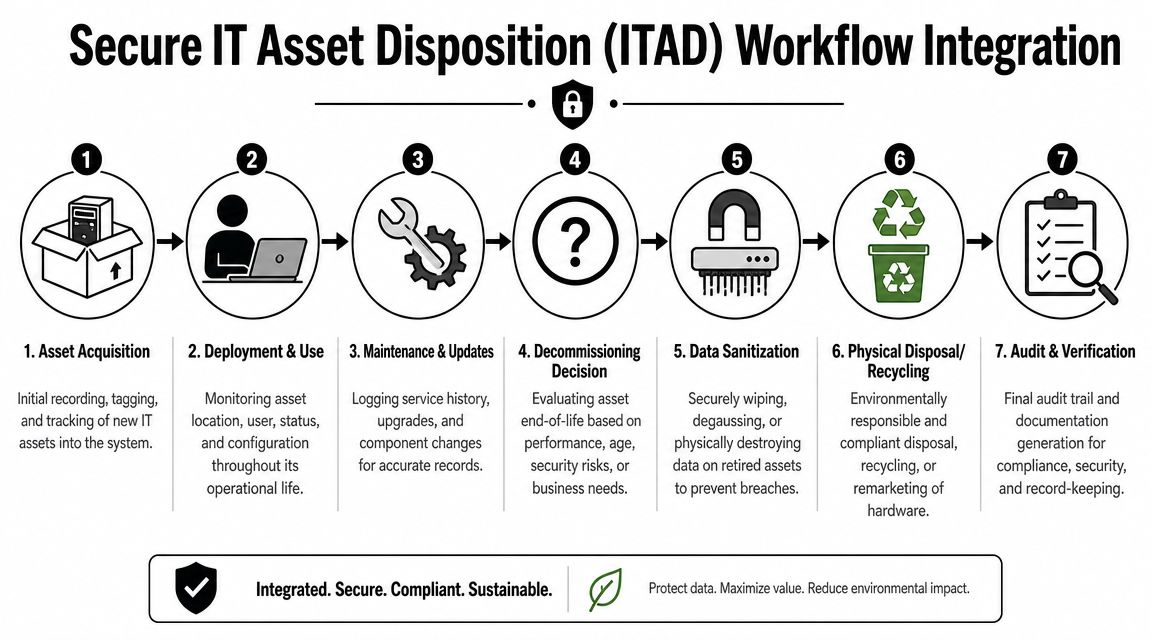
A workflow that holds up under scrutiny
The cleanest ITAD workflows tend to follow this sequence:
- Confirm the retirement decision. Mark the asset as pending decommission, not inactive.
- Verify the record. Check serial number, assigned owner, storage presence, and physical location before pickup.
- Choose the path. Reuse, refurbishment, resale, recycling, or destruction should be decided before the asset leaves control.
- Capture chain of custody. Record who released the asset, when it moved, and where it went.
- Tie evidence back. Sanitization or destruction documentation has to live with the original asset record.
- Close the asset formally. Status should change only when documentation is complete.
What companies should ask of their process
A useful test is whether the system can answer these questions without manual detective work:
- Can we identify storage-bearing assets before shipment?
- Can we separate remarketing candidates from destruction candidates early?
- Can we match every certificate or downstream record to a serial-level inventory entry?
- Can finance see whether retired assets had recoverable value?
When Atlanta businesses need outside execution for the final step, they typically look for providers that can support audit, logistics, data destruction, and downstream disposition in one process. For example, IT asset disposition services in Georgia often matter less as a hauling function and more as a documentation function. Montclair Crew Recycling is one local option that handles business IT equipment removal, asset audit, data destruction, and disposition workflows for Atlanta-area organizations.
Field advice: Don't let the asset leave your control before you've decided what evidence you'll need back.
The strongest IT asset tracking trends in Atlanta companies all point in the same direction. Better records at the front end make secure retirement possible at the back end. And when the record is complete, companies don't just reduce risk. They also preserve options.
If your organization needs a cleaner link between asset tracking, data destruction, and final disposition, Montclair Crew Recycling can help build that last mile into a documented process. For Atlanta businesses retiring laptops, servers, storage, network gear, or mixed office IT, the priority should be simple: maintain serial-level control, preserve the audit trail, and make sure every asset exits service with the right evidence attached.
