
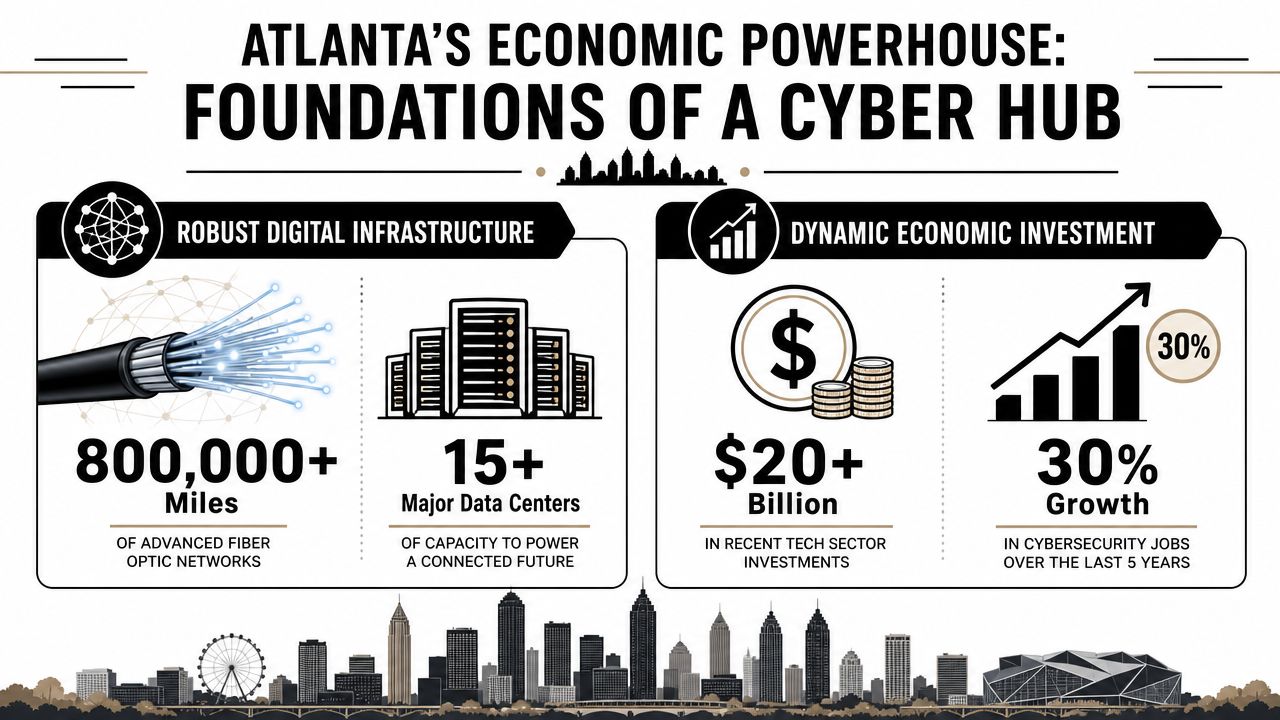
Atlanta moved from the 6th-largest U.S. data center hub to the 2nd, behind only Northern Virginia, while the market roughly doubled the amount of data center space under construction every six months since mid-2023, according to GovTech's coverage of CBRE's market findings. That single shift tells you more about Atlanta's cybersecurity trajectory than any generic “tech hub” label ever could.
Cybersecurity clusters form where valuable data, regulated industries, technical talent, and physical digital infrastructure stack on top of one another. Atlanta now has all four. The metro's rise isn't just about startup buzz or recruiting headlines. It's about banks, healthcare systems, cloud environments, colocation facilities, and enterprise networks operating at a level where security controls become operating requirements.
For local businesses, that changes the conversation. Cybersecurity in Atlanta isn't only about firewalls, endpoint tools, and compliance audits. It also reaches the end of the hardware lifecycle. Every server refresh, laptop replacement, storage retirement, and office relocation creates a second security problem. How do you dispose of the equipment without disposing of the data badly?
Why Atlanta Is the New Capital of Cybersecurity
Atlanta's broader tech labor base reached over 156,000 professionals and generated about $6 billion in annual tech economic output by 2025, while cybersecurity-specific hiring was growing at an estimated 11% annual rate and cloud-security job postings were up 40% year over year in the same market, based on this Atlanta tech market analysis. Those numbers matter because they show specialization, not just scale.
A city becomes a cybersecurity hub when security work stops being a support function and starts becoming part of core business operations. That's what happened in Atlanta. Finance and healthcare already demanded identity controls, encryption, auditability, and incident response. As cloud adoption and enterprise software spending expanded, those controls became embedded in daily workflows.
Why the shift happened here
Three forces lined up at the right time.
- Regulated demand: Atlanta's strongest sectors handle sensitive financial and health information, so security spending tends to be tied to business continuity and compliance, not optional experimentation.
- Enterprise depth: A large tech labor pool gives employers enough range to hire for security engineering, cloud defense, governance, and operational risk.
- Operational maturity: Companies don't just need strategy decks. They need real implementation, asset tracking, evidence, and documented handling of systems and data.
That last point often gets ignored. Secure operations don't start and end with software. They extend into procurement, decommissioning, and disposal. Teams trying to map this field can use SamSearch's cybersecurity industry guide as a practical way to understand how different security specialties fit together in a mature market like Atlanta.
Atlanta's rise as a cybersecurity hub wasn't accidental. It came from concentrated demand where failure carries legal, financial, and reputational consequences.
For metro-area businesses, the takeaway is simple. If you operate in Atlanta, customers, partners, and regulators are more likely to assume your security posture is documented, repeatable, and defensible.
The Infrastructure and Economic Engine Driving Growth
Atlanta's cybersecurity growth is tied to physical capacity, not just reputation. The metro's concentration of data centers, cloud connections, payment infrastructure, and enterprise back-office systems gives security spending a durable economic base. In practical terms, that means more organizations here are securing systems that process transactions, store regulated data, and eventually retire hardware that may still contain recoverable information.
Fintech set the operating standard
Atlanta's fintech base did more than create demand for security vendors. It set a high operating standard for the broader market. Companies tied to payments, banking, insurance, and healthcare have to document access, control sensitive data, and prove that systems were handled correctly across their full lifecycle.
That changes the local buying pattern. Businesses are not only purchasing detection tools or compliance support. They are also investing in the operational controls behind those tools, including asset inventory, chain-of-custody procedures, storage media handling, and retirement workflows for aging equipment.
The result is a cyber economy shaped by recurring operational requirements, not one-time projects.
Data center expansion raised the stakes
Earlier in the article, the data center figures showed how quickly Atlanta moved into the top tier of U.S. capacity markets. That buildout matters because every new facility adds more servers, storage systems, network gear, backup equipment, and tenant environments that require protection. It also adds a less visible burden. Over time, more infrastructure creates more equipment coming out of service.
For businesses in the metro area, that has direct implications. A rack refresh, office consolidation, cloud migration, or merger can leave behind drives, appliances, laptops, and retired servers that still hold regulated or commercially sensitive data. If those assets are poorly tracked, the security gap is not theoretical. It sits in a staging room, a closet, or a third-party warehouse.
Why this matters on the ground
The companies benefiting from Atlanta's growth are often the same companies feeling the strain of scaling infrastructure quickly. How Atlanta businesses are handling infrastructure pressure during rapid growth offers a useful local view of that problem. Expansion increases processing capacity and revenue opportunity, but it also increases the number of devices, vendors, locations, and handoffs that need to be controlled.
That is where the cyber hub story becomes operational. Security teams can harden cloud environments and tighten identity controls, but risk often accumulates around physical assets at the edges of the environment. Retired storage arrays waiting for pickup, employee laptops returned after offboarding, and networking equipment removed during upgrades all create exposure if disposition procedures are inconsistent or undocumented.
Operational reality: As Atlanta adds more digital infrastructure, cybersecurity spending increasingly follows the hardware lifecycle, from deployment and tracking to decommissioning and verified data destruction.
That is a major reason Atlanta's cybersecurity economy keeps expanding. The region is not only attracting security firms. It is generating a steady stream of real operational problems for them to solve.
Forging Talent at the Georgia Cyber Center and Universities
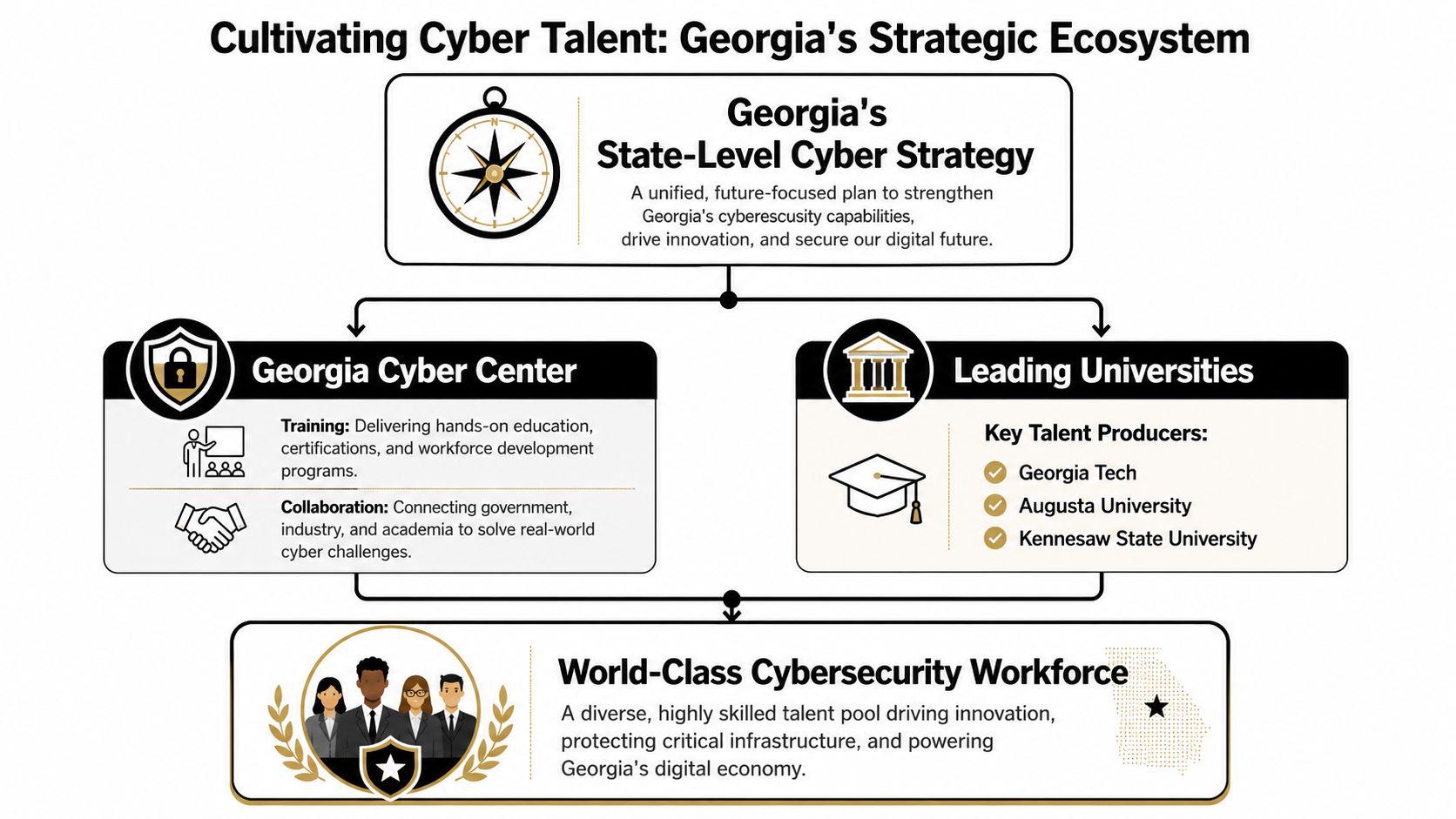
Strong cybersecurity markets don't rely on hiring alone. They build pipelines. Georgia took that route directly when it opened the Georgia Cyber Center in 2018 to train professionals and support cutting-edge tech companies, as outlined by the Georgia Technology Authority. That move matters because it shows intent. The state didn't wait for labor shortages to sort themselves out.
A pipeline built for real demand
Georgia's cyber talent strategy is more practical than many regional branding campaigns. The Georgia Cyber Center was designed around education, workforce development, and real-world practice. In a market shaped by fintech and health IT, that's important. Employers don't just need graduates who know theory. They need analysts, engineers, and operators who understand environments where controls must work in production.
Universities reinforce that pipeline in different ways.
| Institution type | Role in the pipeline | Business implication |
|---|---|---|
| Research universities | Produce advanced technical talent and applied security research | Employers gain access to deeper engineering and architecture skills |
| Regional universities | Expand the pool of operational and compliance-oriented talent | Local firms can hire for implementation, support, and governance roles |
| State-led training centers | Connect education with hands-on exercises and industry collaboration | Teams can recruit people with more job-ready exposure |
Georgia Tech often sits at the center of these conversations because of its technical influence, but the broader point is more strategic. Atlanta benefits when advanced research capacity, public-sector workforce planning, and enterprise demand all point in the same direction.
Why businesses should care
For local employers, a state-supported pipeline changes hiring strategy. You're not only competing with national firms for scarce talent. You're operating in a market where institutions are actively shaping a workforce around security needs tied to cloud, regulated data, and enterprise systems.
That doesn't eliminate hiring friction. It does mean the region can sustain more specialized security work than a generalist IT market can.
- For banks and fintech firms: local hiring can support identity, fraud-related controls, and enterprise risk work.
- For healthcare organizations: security staffing can align more closely with privacy, availability, and compliance demands.
- For mid-market companies: the local labor pool is more likely to understand why documentation and evidence matter.
Public investment changed the quality of Atlanta's cyber labor market. It made security talent part of economic development, not just recruiting.
That distinction helps explain why Atlanta's rise as a cybersecurity hub has staying power. The ecosystem is producing people, not just headlines.
Meet the Players Atlanta's Key Cybersecurity Employers
The clearest sign that a market has matured is specialization. Georgia now has over 120 cybersecurity firms in operation, according to SelectGeorgia's overview of the state's cyber boom. That density changes the local business environment because buyers no longer have to rely only on broad IT outsourcing shops for security work.
A market defined by categories, not one company type
Atlanta's cybersecurity employer base is diverse enough to break into functional groups. That matters for both hiring and vendor selection.
Identity and access firms tend to thrive in Atlanta because the city's business base includes sectors where user governance, privileged access, and authentication controls are central. In practical terms, these companies support the permission structure behind financial applications, enterprise software, and internal systems.
Threat detection and incident response providers fill another slice of the market. As the local environment grows more complex, businesses need teams that can monitor, investigate, and respond instead of installing tools and walking away.
Compliance and risk consultancies also have room to scale here. Atlanta's mix of regulated industries creates steady demand for policy translation, control mapping, audit preparation, and defensible evidence collection.
Data protection and secure disposition specialists are the less glamorous but highly necessary part of the ecosystem. Sensitive data often survives in drives, backup devices, retired servers, and network appliances long after production use ends.
What this means for metro Atlanta companies
A thicker vendor base gives local buyers more options, but it also raises the bar for evaluation. Businesses should choose providers based on operational fit, not category labels alone.
Ask questions such as:
- Can this provider handle regulated data environments?
- Do they document chain of custody and asset handling clearly?
- Can they support a narrow need, such as secure decommissioning, without forcing a full outsourcing model?
- Are they accessible enough to respond quickly in the metro area?
For firms based in North Fulton and nearby corridors, Alpharetta's business environment shows why this concentration matters. Local density shortens the path between problem and solution. You can find niche expertise without sending every project out of market.
The larger insight is that Atlanta's cybersecurity economy now behaves like a real cluster. Employers, service providers, and enterprise buyers are specialized enough to interact in modules. That's a major shift from a market where “cybersecurity” mostly meant an add-on sold by a general IT vendor.
What the Cyber Boom Means for Your Atlanta Business
Cyber hiring growth in Atlanta has been strong enough to reshape buyer expectations across the metro. For local companies, that shift shows up less as a branding opportunity and more as an operating requirement.
A larger security talent pool and a denser vendor market change the standard for doing business here. Customers expect tighter access control, clearer incident response, and better documentation around who can touch systems, data, and devices. That pressure is highest in healthcare, finance, education, logistics, and government contracting, but it increasingly reaches any firm that stores customer information or relies on outside IT providers.

Your operating standard is higher now
In practical terms, Atlanta businesses are being evaluated on security maturity even when security is not their core product. A manufacturer in Cobb, a medical practice in Sandy Springs, and a software firm in Midtown now face versions of the same question from customers and partners: can you show that your systems, vendors, and retired equipment are handled in a controlled way?
That affects three areas first.
Hiring
Security requirements now spill into roles that used to be defined more loosely. Cloud administrators, IT managers, compliance leads, and infrastructure staff are often expected to understand identity controls, logging, vendor risk, and basic incident procedures. For employers, that means job descriptions need to be more specific, compensation pressure can rise, and training gaps become more expensive to ignore.
Sales and partnerships
Enterprise buyers increasingly review controls before signing or renewing. For software teams, that can include evidence of policies, access management, and securing the software development lifecycle. For non-software businesses, the review often centers on how customer data is stored, who can access it, and how former employees and third parties are offboarded.
Vendor selection
A deeper local market gives buyers more choice, but not less diligence. Security tools, managed services, compliance support, and hardware retirement services all need clearly defined scopes, because category labels hide major differences in execution. Two vendors may both claim to handle device disposal, for example, while only one documents chain of custody, sanitization method, and downstream reporting well enough to satisfy an audit or customer questionnaire.
A practical checklist for metro Atlanta operators
Treat Atlanta's cyber growth as a change in baseline business conditions, not a niche tech trend.
- Review policy gaps: Focus on data retention, employee offboarding, device handling, vendor access, and incident reporting.
- Map assets by lifecycle stage: Track what is active, in storage, assigned to former staff, waiting for refresh, or pending disposal.
- Tighten contracts: Security responsibilities, notice periods, and evidence requirements should be written into partner and service agreements.
- Check applicable rules: Start with this guide to Atlanta tech regulations businesses should know.
- Include end-of-life hardware in security reviews: Retired laptops, servers, phones, and network gear still carry data risk if the disposition process is informal.
That last point gets missed often. Atlanta companies have spent years improving cloud security, endpoint protection, and vendor screening, yet many still treat aging hardware as a facilities issue or a resale decision. In a market that is becoming more security-literate, that is a costly blind spot. The practical consequence is simple: as the region gets better at spotting weak controls, businesses need stronger processes not only for active systems, but also for the devices leaving service.
The Hidden Risk Securely Managing Your IT Assets
Atlanta's cybersecurity economy produces a less discussed side effect. Every office expansion, cloud migration, branch upgrade, and data center refresh creates a stream of retired devices that still contain data, credentials, configuration details, or internal communications. For many metro Atlanta businesses, the exposure is not on the live network. It sits in a storage room, loading area, or surplus pile waiting for pickup.

The operating mistake is straightforward. Companies classify decommissioned hardware as excess property, even though the underlying issue is residual data and weak custody controls. In a city with dense concentrations of healthcare, finance, logistics, and enterprise back-office operations, that distinction matters.
Why disposal became a cybersecurity issue
Atlanta's cyber growth has improved awareness around active threats. It has also made gaps in the hardware lifecycle more expensive. Security leaders tend to focus first on cloud configuration, endpoint protection, identity controls, and vendor access. Those are rational priorities. But devices leaving service often move through a different process, involving IT, facilities, procurement, movers, recyclers, and sometimes no clear owner at all.
That handoff problem is what turns routine disposal into a security issue.
Retired laptops, phones, servers, storage arrays, and network gear can still hold customer records, internal email, saved credentials, application data, or intellectual property. If wiping is inconsistent, if serial numbers are not reconciled, or if custody records stop at the dock door, the business loses the ability to prove what happened to the data.
The most common blind spots
Risk rises when control gets diffuse.
| Risk area | What goes wrong | Why it matters |
|---|---|---|
| Storage media | Drives are removed without documentation or left inside old equipment | Data can remain recoverable |
| Chain of custody | Equipment sits in closets, loading docks, or storage rooms | No one can prove who handled it |
| Asset inventory | Teams retire devices informally during upgrades or moves | Security and finance records drift apart |
| Responsibility gaps | IT, facilities, and procurement each assume someone else owns disposal | Critical steps never happen |
Practical rule: If you cannot show where a retired device went, who handled it, and how its data was destroyed, your process will not hold up under audit, litigation, or a customer review.
What good practice looks like
Businesses in Atlanta should treat IT asset disposition, or ITAD, as part of security operations, not as an after-hours cleanup task. The logic is the same one used in securing the software development lifecycle. Weaknesses often appear at transitions, approvals, and handoffs rather than inside the core system itself.
A sound ITAD process usually includes four controls. First, confirm exactly which assets are being retired, by serial number and assigned owner, before anything leaves the site. Second, match sanitization methods to the media type and data sensitivity. Third, maintain chain-of-custody records from pickup through final disposition. Fourth, separate resale decisions from security decisions so value recovery happens only after data handling is complete.
For metro Atlanta companies that need outside support, local IT asset disposition services in Atlanta can combine on-site removal, inventory reconciliation, data destruction, and compliant downstream processing in one documented workflow. The business case is simple. Better process reduces legal exposure, shortens audit response time, and lowers the chance that a routine refresh turns into a reportable incident.
Why this issue carries extra weight in Atlanta
Atlanta's cyber hub status raises the standard for how businesses handle technology at end of life. The region has more regulated data, more distributed offices, more third-party IT support, and more hardware cycling through growth, consolidation, and refresh projects. That creates a volume problem, but also a governance problem. As companies add systems faster, informal retirement practices break sooner.
Old equipment is often the last unmanaged copy of sensitive business information. In Atlanta, that makes secure disposition part of operating discipline, not a cleanup detail.
Building a Resilient Business in a Cybersecurity Hub
Atlanta's rise as a cybersecurity hub comes from a specific combination of forces. Dense enterprise demand. Fast-moving digital infrastructure. Public investment in talent. A vendor base deep enough to support specialized security work. Those conditions create opportunity, but they also create a higher operating standard.
Resilient companies respond by tightening the full lifecycle of technology, not just the visible parts. They harden procurement, access, development, monitoring, and vendor management. Then they do the part many firms skip. They plan for retirement, removal, sanitization, and recycling with the same seriousness.
A short action plan
- Review device retirement policies. Make sure someone clearly owns decommissioning decisions.
- Match disposal practices to data sensitivity. A standard office refresh and a server retirement shouldn't be treated the same way.
- Require evidence. Keep records for wiping, destruction, pickup, transfer, and final disposition.
- Connect end-of-life controls to the rest of security. The same mindset used for enterprise network protection should carry through to the hardware leaving your environment.
- Train smaller teams on basics. Even simple internal guidance can reduce informal storage and ad hoc disposal. A local primer on cybersecurity tips for small businesses can help frame those conversations.
In Atlanta, secure growth means managing what enters your network and what leaves your building.
Businesses that understand that distinction will handle the next phase of Atlanta's tech economy more confidently. The companies that don't will keep investing in cybersecurity while leaving one of their most preventable risks sitting in a back room.
If your organization is retiring laptops, servers, telecom gear, or other IT equipment in Metro Atlanta, Montclair Crew Recycling provides B2B IT equipment disposal, electronics recycling, asset audit support, and data destruction services designed for businesses that need documented handling at end of life.
