

Atlanta companies are spending more time in executive meetings resolving data disputes than they should. In practice, that cost shows up in slower reporting, harder audits, security gaps, and expensive rework across teams that should be working from the same records.
The pressure is especially clear in Metro Atlanta because so many local firms operate in regulated, high-volume environments. Healthcare systems, banks, logistics operators, manufacturers, colleges, and enterprise service firms all rely on data that must be accurate, available to the right people, protected from the wrong ones, and retained or destroyed on schedule. In a city that continues to grow its role in security and technology, strong governance is increasingly tied to risk management and trust. That connection is even clearer as Atlanta strengthens its position as a cybersecurity hub for growing businesses and enterprises.
What works on the ground is rarely a policy-only approach. The firms making progress are treating governance as operating discipline. They assign clear ownership, tighten access controls, improve metadata, reduce duplicate copies, and build retention rules that match legal and business requirements.
They also address the last step many governance programs ignore. Data still creates liability after a laptop, server, or storage device leaves production. Secure data destruction and disciplined IT asset disposition close that gap, which is why mature governance programs in Atlanta now connect data quality, compliance, security, and end-of-life handling into one accountable process.
Why Data Governance Is Atlanta's New Competitive Edge
Sixty-five percent of organizations say better decision-making is the main reason they invest in data governance, while 39% still do not measure data quality across the enterprise, as noted earlier in the article. That gap is familiar in Atlanta. It shows up when finance, operations, compliance, and sales all bring different numbers into the same meeting.
Decision-making drives the investment
Atlanta companies used to treat governance as a cleanup exercise after a reporting issue, audit request, or system migration. The firms getting better results now treat it as a management control. They want faster decisions, fewer internal disputes over definitions, and less time lost reconciling records across ERP, CRM, security, and reporting systems.
That shift has direct business value.
A leadership team cannot act with confidence if every forecast review turns into a debate over which dataset is current. Governance reduces that friction by assigning ownership, standardizing definitions, and setting basic quality checks before bad data spreads into reporting, automation, or customer workflows.
Practical rule: If two departments use the same term but mean different things, you have a governance problem.
Atlanta has less room for error
Metro Atlanta has a concentration of businesses that handle regulated, high-volume, or operationally sensitive data every day. Logistics companies depend on accurate shipment, inventory, routing, and carrier data. Healthcare providers need controlled access, retention discipline, and clear handling of protected information. Financial institutions need consistency across risk, reporting, and audit processes. Universities, school systems, and public entities carry their own stewardship burden for student, employee, research, and vendor records.
That local mix raises the stakes for getting governance right. It also helps explain Atlanta's growth as a cybersecurity hub for growing businesses and enterprises. On the ground, security and governance are now tied together. Strong access controls, defensible retention rules, and clear data ownership support both compliance and incident response.
What the competitive edge actually looks like
The advantage usually starts with operational improvements, not abstract policy goals:
- Less reconciliation work: teams spend less time comparing exports and correcting mismatched records.
- More confidence in reporting: executives trust the numbers sooner and move faster.
- Cleaner compliance response: audit, legal, and security teams can show who owns data, how it is handled, and how long it is kept.
- Better support for growth: analytics, AI, and automation projects perform better when source data is consistent.
- Lower end-of-life risk: firms extend governance beyond active systems and address what happens when devices and storage media leave service.
That last point gets missed too often. A company can improve classification, retention, and access control, then create fresh exposure by retiring laptops, servers, or drives without a documented destruction process. In Atlanta, the stronger governance programs now connect data quality, security, compliance, and IT asset disposition into one accountable operating model.
The firms gaining ground are not waiting for a perfect enterprise rollout. They start with the data domains that affect revenue, reporting, customer service, and regulatory exposure first. Then they build control where it pays off.
The Core Pillars of Modern Data Governance
The easiest way to explain governance is city planning. A city doesn't work because it has one rule. It works because zoning, roads, inspections, permits, and utilities all operate together. Data governance works the same way.
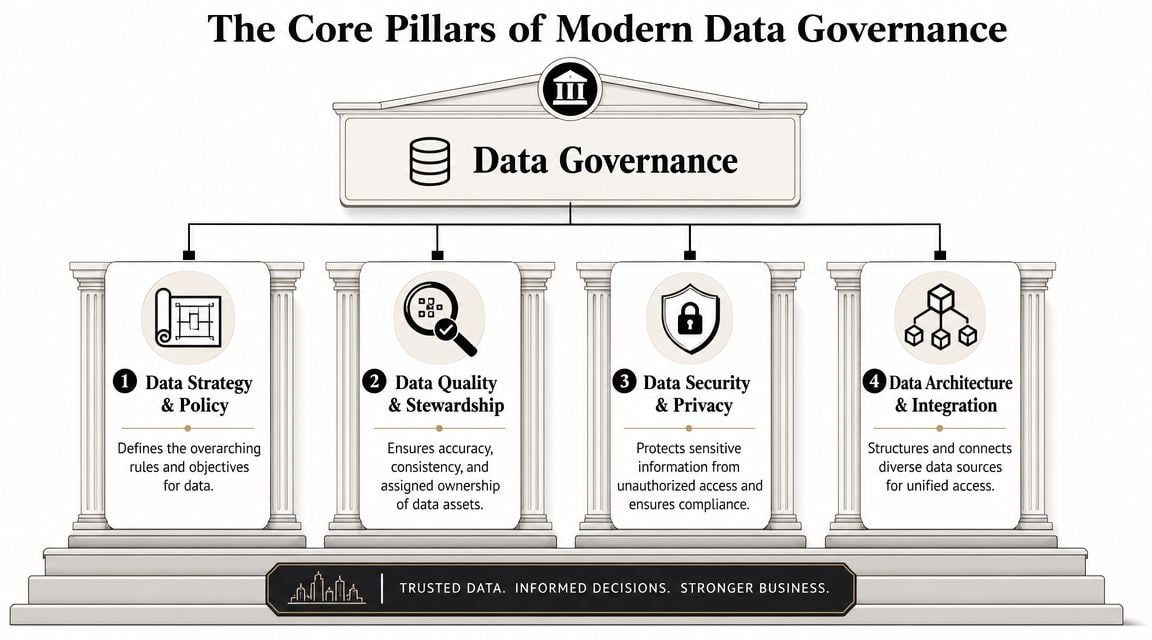
Strategy and policy set the rules
This is the zoning code of the data estate. It defines what data matters, who approves changes, what “customer” or “active supplier” means, and which policies apply to access, retention, and use.
Without this pillar, teams invent local rules. Sales exports one field set, finance uses another, and compliance keeps a separate version for audit. That isn't flexibility. It's policy drift.
A good strategy layer usually answers four questions:
- Which data domains matter most first
- Who has authority to define and approve them
- Which risks require controls
- How exceptions get escalated
For companies trying to connect governance with hardware lifecycle controls, that policy layer should also align with broader enterprise IT asset management practices, because data risk doesn't stop at the application layer.
Quality and stewardship keep the streets usable
Data quality is infrastructure maintenance. Stewardship is the team that notices the potholes, routes repairs, and prevents the same break from recurring.
A data owner makes business decisions about a domain. A data steward handles the ongoing discipline around definitions, quality rules, issue triage, and remediation coordination. In practice, stewards settle the arguments that waste time in real organizations. Which source is authoritative? Why does the customer count differ? Who signs off on a definition change?
A governance program becomes real when someone can answer, by name, who owns the field, who fixes the issue, and who approves the exception.
Security and privacy control who gets access
This pillar is where many firms start, but it can't stand alone. Access control works only when data is classified, ownership is clear, and retention rules are documented.
Security and privacy governance usually includes:
- Access policy enforcement: Who can view, edit, export, or share sensitive data
- Classification discipline: Which records are confidential, regulated, internal, or public
- Auditability: Evidence that access decisions and changes were controlled
Architecture and integration connect the city
This is the road network. It determines whether data moves through managed channels or through random side streets created by spreadsheets, manual extracts, and one-off integrations.
Modern governance depends on architecture that supports cataloging, metadata, lineage, and policy-aware integration. In cloud environments, that often means bringing order to platforms, pipelines, and duplicated datasets before complexity hardens into technical debt.
A short way to judge maturity is this:
| Pillar | Weak version | Strong version |
|---|---|---|
| Strategy | Policies nobody uses | Business rules tied to approvals and escalation |
| Quality | Cleanup after complaints | Ongoing ownership and monitored rules |
| Security | Generic restrictions | Access tied to classification and stewardship |
| Architecture | Siloed copies everywhere | Shared metadata, lineage, and controlled flows |
Key Governance Trends in Atlanta's Business Landscape
The Atlanta market has become more practical about governance. Leaders no longer ask whether governance matters. They ask whether it lowers spend, speeds decisions, and reduces compliance exposure in a way the business can feel.
ROI is now part of the conversation
That shift shows up in the numbers. Industry analysis reports that mature governance programs can cut annual data spend by 5% to 15% and improve decision-making speed by 30%, while 52% of organizations cite reduced compliance breaches as a direct benefit in this governance ROI analysis. In Atlanta, that lands well because local firms are balancing growth, cloud cost control, and security pressure at the same time.
A lot of executives used to hear “data governance” and think “committee overhead.” What changed is that the payoff became easier to connect to operating issues they already own. Redundant storage, overlapping tools, duplicate reporting pipelines, and recurring exception handling all cost money.
Hiring demand confirms the market shift
The same analysis notes 429 Atlanta-area job postings for data governance analyst roles on Indeed. That doesn't mean every company is building a giant governance office. It does mean employers across the region are willing to spend on people who can define controls, improve trust in data, and make those controls work across live systems.
That trend lines up with what many Atlanta IT leaders are also seeing in adjacent disciplines such as IT asset tracking trends in Atlanta companies. The common thread is accountability. Organizations want a cleaner map of what exists, who owns it, where it moves, and when it should be retired.
What's changing on the ground
The local pattern is straightforward. Governance is moving out of slide decks and into operating models.
What's working:
- Business-led prioritization: Teams start with customer, finance, supplier, or regulated records instead of trying to govern everything at once.
- Fewer uncontrolled copies: Organizations reduce shadow datasets and unmanaged extracts.
- KPI-driven oversight: Leaders ask for measurable signals such as policy exceptions, data defects, and remediation status.
What doesn't work:
- Policy-only programs: Writing standards without assigning ownership leaves the same issues unresolved.
- Centralized purity projects: Trying to redesign the whole data estate before fixing a few high-risk workflows usually stalls momentum.
- IT-only governance: If business leaders don't own definitions and usage rules, technical teams can't govern meaningfully.
Atlanta firms are investing in governance because they want lower operating friction, stronger security posture, and data they can use without argument.
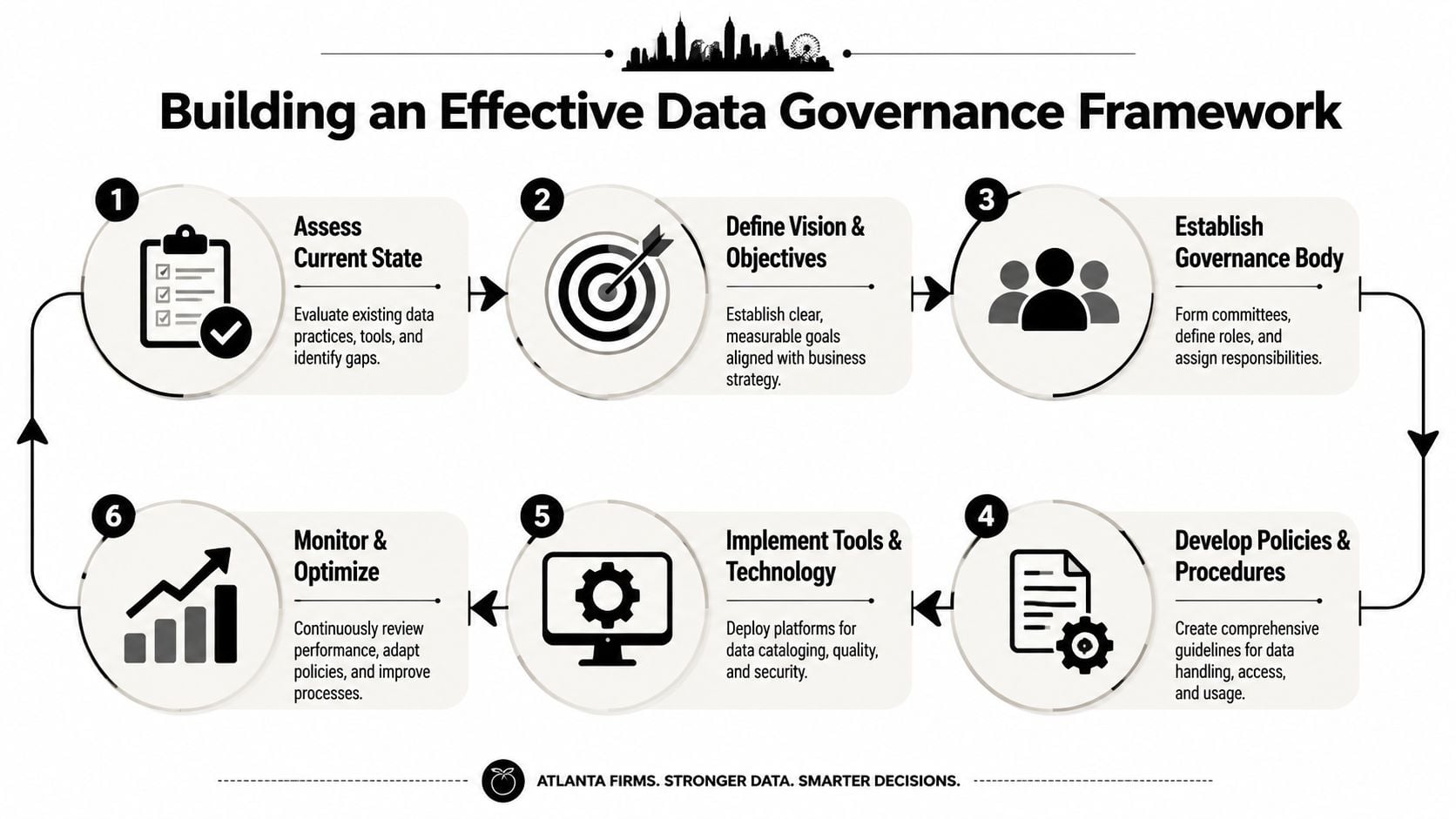
Building an Effective Data Governance Framework
The firms making real progress in Atlanta usually formalize governance the same way they'd formalize any other business control. They create a decision structure, assign named roles, and define what happens when something breaks.
What the framework looks like in practice
Atlanta firms are adopting operating models with formal councils and named stewards, shifting governance from ad hoc email chains to controlled workflow, with business, IT, and legal jointly defining and enforcing policies for quality, privacy, and retention, as described in this overview of enterprise data governance operating models. That's the structural difference between “we should fix this” and “here is who decides, approves, and verifies.”
A simple framework usually includes:
- A governance council: Senior representatives from business, IT, security, compliance, and operations
- Data owners: Leaders with authority over definitions, access expectations, and business use
- Data stewards: Practitioners who maintain metadata, coordinate issue resolution, and enforce day-to-day discipline
- Escalation paths: A documented route for exceptions, conflicts, and remediation deadlines
A realistic Atlanta example
Consider a mid-sized manufacturer in the northern suburbs. Sales calls a product “active” once it's in the catalog. Operations calls it “active” only when it's available to ship. Finance uses a third definition tied to billing eligibility. None of those teams are wrong. But together they create order mistakes, inventory confusion, and reporting noise.
The company forms a small governance council with operations, sales, finance, IT, and legal. The product master becomes the first governed domain. A business owner approves the official definition for active status. A steward maps source fields across ERP, CRM, and reporting extracts. IT adds lineage documentation so downstream reports can be traced. Legal reviews retention and access expectations for supplier and transaction records.
Within a few cycles, the arguments get shorter because the approval path is clear. That's how governance starts creating value.
What leaders should insist on
A framework becomes useful when it produces repeatable decisions, not just presentations. The most effective councils I've seen do three things well:
- They govern exceptions, not just standards. Edge cases expose whether the model works.
- They keep scope tight at the start. One critical domain beats a giant enterprise charter nobody can operationalize.
- They connect policy to execution. Data profiling, access review, remediation, and retention all need owners.
For companies that want a practical outside reference on data security and compliance for businesses, that resource is useful because it ties governance discipline to concrete handling and control expectations rather than abstract policy language.
A final point matters here. Frameworks should include end-of-life controls. If a policy defines retention and disposal, the governance body also needs to know how decommissioned laptops, servers, and storage media are tracked, wiped, destroyed, or recycled. Otherwise the lifecycle is only half governed.
Pragmatic Governance for Atlanta SMBs and Enterprises
Most companies don't fail at governance because they disagree with the idea. They fail because they copy a model built for someone with a larger budget, more staff, and more tooling than they have.

If you're a smaller Atlanta company
A Smyrna distributor, a Kennesaw medical office group, or a Roswell professional services firm doesn't need a large governance office to get started. It needs control over the few datasets that create the most risk or operational friction.
Start smaller than you think:
- Pick one domain: Customer, employee, vendor, financial, or patient-related data
- Create a simple inventory: Where does it live, who uses it, and who approves access
- Name one owner and one steward: Even if those roles are part-time
- Write short rules: What gets shared, retained, corrected, and destroyed
- Use tool support where possible: Basic cataloging, profiling, and access review beats informal spreadsheets
For smaller firms, good governance often overlaps with basic cyber hygiene. That's why practical cybersecurity tips for small businesses matter here too. If your access control, endpoint handling, and decommission process are loose, governance won't hold.
If you're a larger enterprise
Sandy Springs enterprises, regional healthcare systems, and larger logistics operators face a different problem. They already have committees, policies, and multiple cloud platforms. Their issue is scale and consistency.
Public Atlanta-market hiring signals show companies want people who can execute governance through data profiling, cleansing, SQL, cloud platforms, and cross-functional change management, which reflects the implementation gap described in this Atlanta hiring-based governance view. In other words, large organizations need operational governance, not just executive sponsorship.
For those firms, modern platforms matter. Cataloging, metadata management, lineage, and policy enforcement in cloud stacks like Snowflake, Databricks, AWS, Azure, or GCP help smaller teams cover more ground with less manual chasing.
A side-by-side view
| Organization type | Best starting move | Common mistake | Better approach |
|---|---|---|---|
| SMB | Govern one high-risk data set | Writing enterprise-grade policy for everything | Keep rules short and role-based |
| Mid-market | Assign owners and basic workflows | Depending on informal tribal knowledge | Add stewardship and issue routing |
| Enterprise | Standardize tooling and escalation | Letting each domain improvise its own model | Central standards with domain execution |
Governance doesn't need to start big. It needs to start where data errors, security exposure, or reporting disputes already cost the business time.
What works across both groups
Whether the company has fifty employees or thousands, the same principles hold:
- Ownership beats aspiration
- Metadata beats memory
- Workflow beats email
- Auditable disposal beats informal retirement
That last point is where many otherwise solid programs still have a hole.
The Critical Role of Secure Data Destruction
A governance program is incomplete if it stops at storage, access, and retention. Data lifecycle management doesn't end when a laptop leaves a desk or a server is powered down. It ends when the data is destroyed in a way the organization can prove.
Disposal is part of governance, not an afterthought
Many businesses create unnecessary risk. They govern active systems carefully, then treat retired hardware like a facilities problem. That separation doesn't hold up in healthcare, finance, education, legal, or public sector environments where devices may contain regulated, confidential, or business-critical data.
A sound governance model should define:
- When an asset is ready for retirement
- Who authorizes disposition
- How storage media is wiped or destroyed
- What documentation is retained for audit
- How chain of custody is maintained
If those answers are missing, the governance lifecycle has a blind spot.
The control point most firms forget
Secure destruction matters because data survives farther into the lifecycle than commonly realized. Old laptops, failed drives, network gear, backup devices, and decommissioned servers often leave behind recoverable records, credentials, logs, or configuration data. A policy that says “retain for X, dispose after Y” only works if the disposal step is controlled.
The practical fix is formal process. Businesses should route retired IT assets through an auditable secure data destruction process that matches their risk and compliance obligations. Depending on the asset and policy, that may include certified drive wiping, physical shredding, asset logging, and documented disposition.
What good end-of-life governance looks like
The strongest programs treat ITAD and data destruction as the final checkpoint in governance. That means governance teams, security leaders, and infrastructure teams agree on the same controls.
A workable checklist includes:
- Asset identification: Devices and media are logged before they leave service
- Custody control: Movement is documented from pickup through destruction or resale path
- Method selection: Wiping or shredding is chosen based on policy and risk
- Evidence retention: Certificates, audit logs, and disposition records are stored
- Environmental handling: Equipment is recycled or remarketed through compliant channels
For Atlanta organizations with distributed offices, branch locations, field devices, or periodic refresh cycles, this discipline matters even more. The more endpoints you retire, the more chances there are for policy to fail at the last step.
One practical example in the local market is Montclair Crew Recycling, which provides business IT equipment disposal, asset audit and logistics, certified data destruction, free DoD 5220.22-M three-pass hard drive wiping, and optional on-site shredding for Atlanta-area organizations. That kind of service isn't separate from governance. It's one way to execute the disposal control your policies already require.
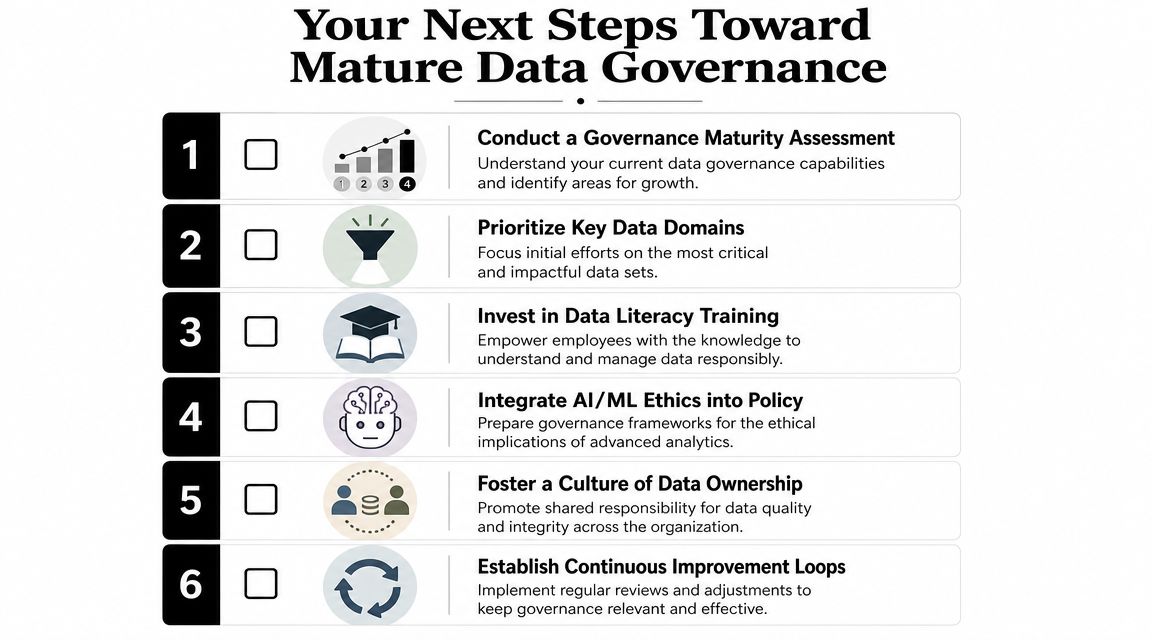
Your Next Steps Toward Mature Data Governance
The next stage for Atlanta firms isn't more policy for its own sake. It's governance that supports analytics, automation, and AI without losing control of security, privacy, or asset disposal.
The shift toward AI-ready governance
Atlanta-area job postings for governance leaders now emphasize support for future AI capabilities, showing that governance is becoming an enabling layer for advanced analytics, not just a back-office control, as seen in this Atlanta governance leadership role focused on future AI capabilities. That's the right question for executives to ask now. Not “How do we become more compliant?” but “How do we make our data usable with confidence?”
A practical self-check
Use this checklist to start the right internal conversation:
- Named ownership: Do we have a clear owner for our most critical data domains?
- Stewardship workflow: Does someone resolve data definition, quality, and access disputes?
- Policy execution: Can we show how retention, access, and remediation happen in practice?
- Tool visibility: Do we have usable metadata, cataloging, or lineage for important systems?
- End-of-life control: Is our device retirement and data destruction process auditable?
- AI readiness: Would we trust our current data foundation to support analytics or AI initiatives?
The firms that benefit most from governance don't chase maturity as a badge. They use governance to make data usable, secure, and defensible across the full lifecycle.
Start with one domain. Fix one recurring trust problem. Assign one owner. Define one disposal path. That's how Atlanta firms are improving data governance in a way that lasts.
If your organization is planning a refresh, consolidation, datacenter cleanup, or office decommission, Montclair Crew Recycling can help close the last mile of governance with business IT asset disposition, certified data destruction, and responsible electronics recycling across Metro Atlanta.
