
You are probably dealing with this right now.
There is a closet, back room, server nook, or storage cage in your Atlanta office full of dead laptops, old phones, monitors nobody wants, retired access points, maybe a few desktops from the last refresh, and at least one mystery box of cables. Someone on your team finally asks the obvious question: can’t we just take it to Best Buy?
For a homeowner clearing out a drawer, that question makes sense. For a business, it is usually the wrong move.
Electronics recycling Best Buy is a consumer convenience story. Business IT disposition is a risk management, compliance, and asset recovery job. Those are not the same thing. If your company handles customer records, patient data, employee files, financial documents, or proprietary information, treating disposal like a weekend errand is sloppy. You need a documented process, not a drop-off receipt.
Your Office E-Waste Problem Is Bigger Than a Trip to Best Buy
An office manager finds a stack of decommissioned laptops after a migration. The IT lead adds a few networking devices. Finance wants old workstations gone before quarter-end. Operations wants the storage space back. Best Buy comes up because everybody knows the brand and it feels easy.

That instinct is understandable. Best Buy has recycled over 2 billion pounds of electronics and appliances since 2009 and processes materials from approximately four million customers annually, which is why so many people default to it as the familiar option for disposal (Best Buy corporate).
For households, that scale is reassuring. For businesses, scale is not the same as suitability.
Why business disposal changes the stakes
When a company retires electronics, three questions matter immediately:
- What data is still on the device
- What proof do you have that it was destroyed or wiped
- Whether the asset still has resale value
A consumer program is built to take items in. A business process has to track items out, document what happened, and protect the organization if anyone asks questions later.
That is why a simple cleanup mindset causes problems. A pile of old electronics is not just junk. It is a mix of storage media, regulated records, fixed assets, and environmental liability.
If the device ever stored business data, disposal is no longer a convenience task. It is a governance task.
Teams that need help building an internal process should start with a practical framework for managing electronic waste. The same principle shows up in adjacent cleanup projects too. If you have ever worked through office clear-outs or warehouse cleanups, you already know why a generic hauling approach creates blind spots. Even a consumer-facing guide like junk removal in Durham region highlights the value of planning disposal by material type instead of treating everything as one pile.
The first mistake most companies make
They ask, “Where can we drop this off?”
The better question is, “What process protects us from data exposure, failed audits, and lost asset value?”
That is the line between consumer recycling and business IT asset disposition.
What Best Buy's Recycling Program Offers
Best Buy’s program is real, large, and useful. It just serves a different job than most businesses need.
The company makes money from recycling in part by charging manufacturers in 25 states with producer responsibility laws and by selling consumer services such as mail-in boxes priced at $22.99 and $29.99, which tells you exactly how the model is built. It is designed around individual transactions, not coordinated business asset disposal (Trellis on Best Buy’s recycling model).
What the program is built to do
Best Buy is strong at standardized intake.
It accepts a broad set of common electronics categories. Consumers can bring in many everyday devices, and some items can go through trade-in if they still hold consumer resale value. That makes the service easy to understand for households and small one-off drop-offs.
If you want a plain-language overview of downstream processing after collection, this explainer on what happens to recycled electronics is useful because it separates reuse, material recovery, and secure destruction. That distinction matters.
Where the consumer model shows up in practice
Here is what a typical Best Buy recycling transaction looks like for an individual:
Gather a few devices
A person rounds up a phone, cable box, tablet, or small office peripheral.Check whether the store accepts that item
Acceptance depends on category, condition, and in some cases location-specific restrictions.Transport the equipment personally
The customer handles packing, loading, and delivery.Pay a fee if the item falls into a paid service category
Mail-in boxes and some other services carry fees.
That is fine for a resident cleaning out a closet. It is weak for a business replacing a fleet, clearing a branch office, or decommissioning racks, telecom gear, and mixed IT hardware.
What business buyers should notice
The issue is not whether Best Buy recycles. It does.
The issue is how the program is structured:
- Transaction design favors one customer, one trip, one small batch
- Operational simplicity favors standardized items over mixed enterprise equipment
- Consumer economics focus on fees, trade-ins, and volume processing, not business reporting
Those are not flaws in a retail program. They are just the wrong priorities for commercial IT disposition.
Comparing Consumer Drop-Off with Professional IT Asset Disposition
If you are deciding between electronics recycling Best Buy and a professional ITAD provider, stop looking at convenience first. Look at controls.
Here is the comparison that matters.
| Feature | Best Buy (Consumer Program) | Professional ITAD (e.g., Montclair Crew) |
|---|---|---|
| Data security | Customer-oriented process, limited for business-grade destruction requirements | Documented data erasure or physical destruction with business controls |
| Chain of custody | Basic retail handoff | Itemized tracking from pickup through final disposition |
| Logistics | Best for small self-transported loads | Pickup, coordinated removals, and bulk handling |
| Compliance documentation | Not built around business audit packages | Certificates, audit support, and disposition records |
| Asset mix | Consumer-friendly categories and size limits | Better suited to mixed enterprise hardware inventories |
| Value recovery | Limited to consumer-style trade-in paths | Evaluation for resale, remarketing, or profit-sharing where applicable |
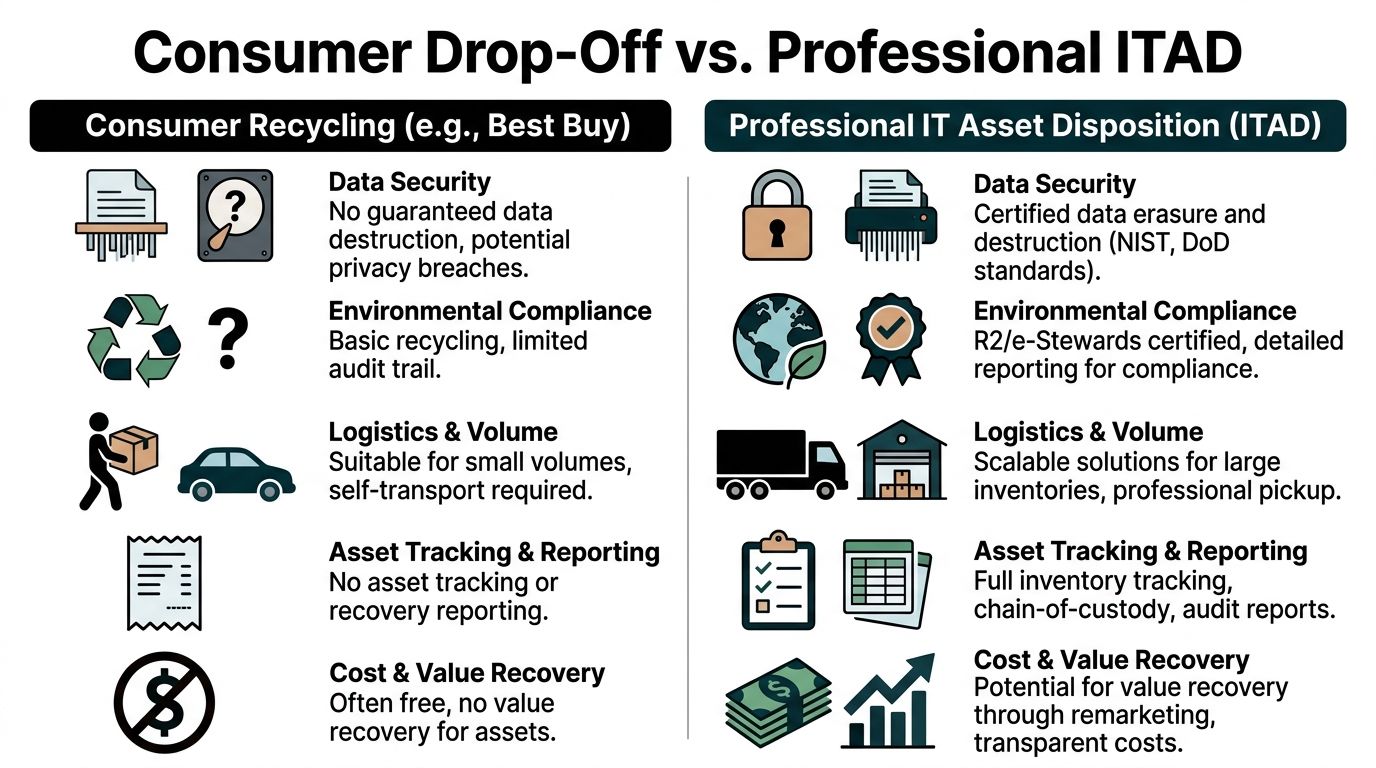
Best Buy processes a substantial amount of electronics and appliances, but its program offers no specialized data destruction certifications like DoD 5220.22-M three-pass wiping, which is a hard stop for businesses handling sensitive information (Best Buy recycling FAQs).
Data security is the primary dividing line
A consumer retailer can tell people to wipe devices before drop-off. That is not enough for a business.
A proper ITAD process creates evidence. It records asset intake, confirms serials when needed, applies a defined destruction or erasure method, and issues documentation the business can keep.
Best Buy’s model assumes the customer handles the risky part. A business cannot afford that assumption.
If your disposal process depends on an employee remembering to wipe every drive before a store run, your process is broken.
Logistics are not a side issue
Retail drop-off works when volume is small and item types are predictable.
Business cleanouts are neither. A project often includes desktops, docks, monitors, phones, drives, printers, UPS units, switches, access points, telecom equipment, and storage media from multiple departments. Someone has to pack it, move it, inventory it, and make sure nothing disappears in the process.
That is why pickup and chain-of-custody matter more than free drop-off.
Compliance needs paperwork, not assumptions
A business may need to show what happened to retired electronics during:
- Internal audits
- Insurance reviews
- Customer security questionnaires
- Regulatory reviews
- Board or legal inquiries after an incident
A retail program is not built around those documentation needs. ITAD is.
Value recovery separates disposal from asset management
Consumer recycling treats most old gear as material to process.
Business ITAD asks a better question first. Is any of this equipment still marketable, reusable, or worth harvesting for parts? Enterprise hardware often has a different value profile than consumer electronics. A generic retail intake model usually does not address that.
For a deeper business-specific breakdown of this mismatch, this page on recycling electronics best buy frames the issue from the standpoint of commercial asset disposition rather than household recycling.
The practical difference
Consumer drop-off solves one problem. It gets some electronics out of your space.
Professional ITAD solves the full problem:
- data protection
- documented disposition
- coordinated logistics
- environmental handling
- possible value recovery
That is why businesses should stop treating these services as interchangeable.
Data Security Risks in Electronics Recycling
Most disposal mistakes are not dramatic at the moment they happen. They look ordinary.
An employee loads old desktops into a car. A few laptops are missing chargers, so nobody checks whether they still boot. A closet gets cleared fast. The organization feels efficient for a day. Then nobody can prove what data was on those drives, who handled them, or whether destruction occurred.
That is the problem.

Best Buy’s acceptance rules are also limited by item type and size. The program excludes large appliances from in-store drop-off and sets limits on items such as TVs under 50 inches, which shows how a retail matrix can create immediate friction for organizations trying to move broad, mixed inventories of equipment (Best Buy recycling services page).
Why self-managed wiping is not enough
Businesses in healthcare, finance, legal services, education, and government do not get credit for good intentions.
They need records.
A Certificate of Destruction is the paper trail that shows the company followed a defined destruction process. It helps establish that the organization did not casually discard devices with live data. Without that record, leadership is left defending a disposal decision with memory, email threads, and store receipts. That is weak evidence.
The significant exposure
Risk shows up in several ways at once:
Privacy exposure
Hard drives, SSDs, phones, and multifunction devices may still contain sensitive information.Compliance exposure
Regulated organizations need documented handling, not informal assurances.Operational exposure
Mixed loads often include equipment a retail channel does not handle cleanly, which increases the odds of items being set aside, forgotten, or disposed of inconsistently.
That is why secure disposal should be treated like a controlled offboarding process for hardware.
A receipt proves you dropped something off. It does not prove what happened to the data.
Businesses that need a stricter process should require documented destruction from the start. This overview of secure data destruction is a useful benchmark for what to ask any provider before equipment leaves your site.
What a sound process looks like
A serious process usually includes:
Asset identification
Know what is leaving and where it came from.Controlled handling
Limit who touches devices and where they move.Certified destruction or verified erasure
Match the destruction method to the risk.Final reporting
Keep the records in case legal, compliance, or procurement asks later.
That is not overkill. That is normal governance for retired business hardware.
Finding Value in Your Retired IT Equipment
Most companies make a bad assumption about old hardware. They assume disposal is purely a cost.
That is not always true.
Best Buy’s model monetizes e-waste through manufacturer fees and consumer charges, but it offers no formal program for businesses to gain resale value or profit-sharing from enterprise assets like servers or telecom gear, which is exactly where specialized B2B recyclers operate differently (Best Buy trade-in and recycling overview).
Why enterprise gear is different
A retired business asset is not automatically worthless because your team is done using it.
Servers, networking equipment, telecom hardware, business-grade laptops, and components may still have reuse value depending on age, condition, configuration, and market demand. The right provider audits what you have before deciding whether it should be destroyed, recycled, or remarketed.
That changes the economics of the project.
What a business should ask before disposing of anything
Ask these questions first:
- Can any of these assets be resold as complete units
- Are there components worth harvesting
- Is a direct buyout available
- Is there a profit-sharing model
- Which items should be recycled only after value screening
Here, an expert IT asset management consultancy mindset is useful. Good IT asset decisions do not start at the recycling dock. They start with classification, lifecycle planning, and knowing which assets still carry value after production use ends.
The missed opportunity in consumer recycling
A retail model sees a public drop-off stream.
A business ITAD model sees a portfolio of assets with different outcomes:
- some should be wiped and redeployed
- some should be remarketed
- some should be broken down for parts
- some should be destroyed because the risk outweighs the resale case
That is a smarter way to handle retired equipment because it connects security, sustainability, and finance. Disposal should close risk, but it should also capture whatever value still exists.
The Local B2B Solution for Metro Atlanta
If your organization is in Alpharetta, Marietta, Kennesaw, Norcross, Roswell, Sandy Springs, Smyrna, or the broader metro area, the right answer is not another employee car trip to a retail store. The right answer is a business process built for pickup, documentation, and controlled data destruction.
That means asking providers very direct questions.
What to require from any Atlanta ITAD partner
Start with the essential requirements:
Pickup capability
Your team should not have to self-haul mixed IT loads across multiple trips.Asset audit support
You need a record of what was removed.Certified data destruction
The provider should explain the wiping or shredding method clearly.Compliance documentation
If they cannot issue records that support internal review, keep looking.Environmental disposition
They should be able to explain how assets move through reuse, recycling, and destruction.
Then ask about value recovery. If the provider never raises resale, remarketing, or profit-sharing for suitable enterprise equipment, they are probably treating all assets as scrap.
What a business-focused local process looks like
For Metro Atlanta companies, a practical B2B workflow should look like this:
Schedule on-site pickup
Equipment gets removed from your office, school, clinic, data room, or warehouse without relying on staff vehicles.Review the inventory
The provider separates reusable assets from end-of-life material.Apply secure data handling
Drives are wiped or physically destroyed based on your requirements.Receive documentation
You keep the records for compliance, internal controls, and procurement files.Recover value where possible
Equipment with remaining market value goes through a resale path instead of default scrap.
One Atlanta option built around that business workflow is Montclair Crew’s ITAD services in Atlanta, GA. The company handles on-site removal, asset audits, secure data destruction, environmentally compliant disposition, and value recovery where applicable for business IT equipment across Metro Atlanta.
My recommendation
Use Best Buy if you are a consumer with a few household electronics and no compliance burden.
Do not use a consumer drop-off program as your company’s ITAD strategy.
If your business has devices with storage, regulated information, mixed hardware categories, or any meaningful volume, you need a provider that treats the project as controlled disposition. That is the standard. Anything less shifts risk back onto your staff and leaves value on the table.
If your team needs a secure, documented path for retired IT equipment in Metro Atlanta, contact Montclair Crew Recycling. Ask for a pickup-based process, data destruction details, asset reporting, and value recovery options before anything leaves your site.
