
For any business in Augusta, hard drive destruction isn't just another item on an IT checklist—it's one of your most important security moves. When it comes to protecting sensitive data for good, nothing beats certified physical destruction. It offers complete security that simply wiping a drive can't match, making sure your data is gone forever.
Why Your Augusta Business Can't Afford to Ignore Secure Hard Drive Destruction
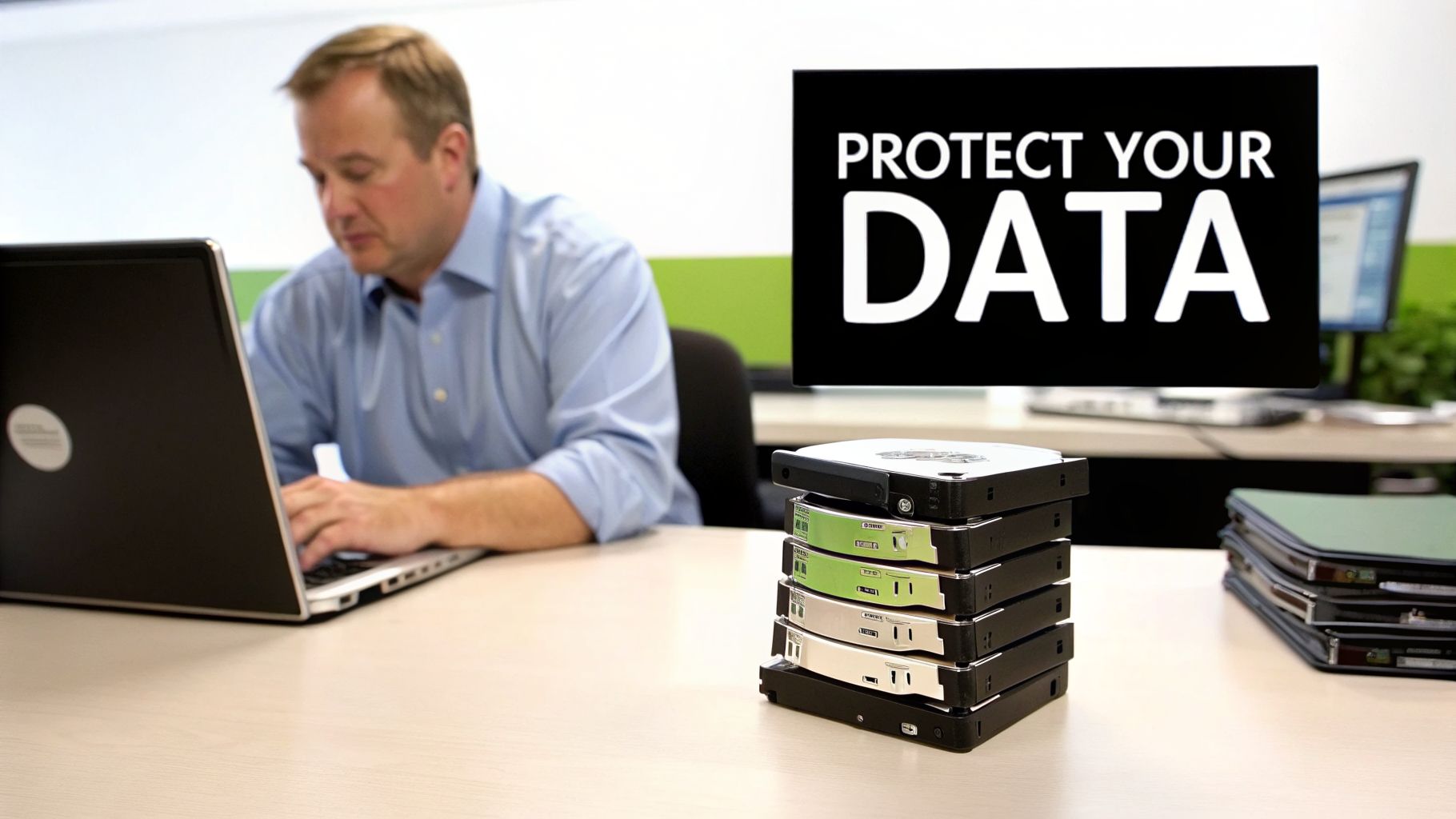
So, your Augusta office just upgraded its computers, servers, or copiers. What’s the plan for the old hard drives? If you're just stashing them in a storage closet or passing them to a standard recycler, you're taking a huge risk.
Those old devices are basically ticking time bombs packed with sensitive information. They hold everything from your client lists and financial records to employee PII and company trade secrets. Just hitting "delete" on a file does almost nothing—it only hides the file path, leaving the actual data behind for anyone with the right software to recover.
This isn't some made-up scare tactic. A major study by Blancco Technology Group showed just how real the danger is. They bought 200 used hard drives online and found that a shocking 36% of them still had leftover data.
Even worse, 67% of those drives contained personally identifiable information (PII) like Social Security numbers and bank accounts, and another 11% held sensitive corporate data. The evidence is clear: old drives are a goldmine for data thieves.
Protecting Your Company’s Reputation and Future
For any organization here in the Augusta area—whether you're a healthcare provider dealing with HIPAA or a financial firm following GLBA rules—improperly destroying data is a serious compliance failure. A single breach can spiral into a disaster.
You could be facing:
- Crippling Fines: Regulators don't mess around and can hit you with massive financial penalties.
- Reputational Damage: Once customer trust is gone, it's incredibly hard, and expensive, to win back.
- Legal Liability: You could be looking at lawsuits from clients, partners, or employees whose private data was exposed.
Just like the broader legal need for protecting trade secrets, making sure your digital information is destroyed beyond recovery is a must. This is where professional hard drive destruction in Augusta, GA, becomes your best defense.
The Only Real Solution for Local Businesses
Bringing in a professional service gives you a final, compliant answer to your data problem. Unlike software wiping, which can easily be done wrong or fail entirely, certified physical destruction guarantees your data can never be recovered.
For any business handling sensitive information, this is the only way to get true peace of mind. When you partner with a certified expert, you turn a major liability into a secure, documented, and closed process.
You can also explore our other guides on secure data destruction to learn more about different methods.
The Myth of the Delete Button: Data That Never Really Disappears
Most people think hitting "delete" or dragging a file to the trash bin gets rid of it for good. That’s a dangerous mistake, and for any Augusta business, it’s a misconception that can put everything you’ve built at risk.
When you delete a file, the data doesn't actually get erased.
Think of your hard drive like a massive library and its file system as the card catalog. Hitting "delete" doesn't burn the book. It just tears up the index card that tells you where to find it on the shelf.
That book—your sensitive client data or financial records—is still sitting right there. It might be invisible to a casual user, but it's an easy find for anyone who knows how to look. The space is just marked as "available" for new data to eventually be written over it.
The Ghost in the Machine: Data Remanence
This leftover information has a name: data remanence. It’s the ghost of your data that lingers on a drive even after you’ve tried standard deletion or a quick format. This is the exact vulnerability that data thieves look for.
Using widely available (and often free) data recovery software, a motivated person can pull "deleted" files off a discarded hard drive with terrifying ease. That could be anything, including:
- Complete client lists and private contact information
- Employee payroll data and confidential HR records
- Company bank account details and internal financial statements
- Your proprietary business plans and hard-earned trade secrets
For any organization in Augusta, whether you're a law firm on Broad Street or a medical clinic in the Hill District, trusting the delete button is like leaving your front door unlocked and wide open all night.
Your standard IT cleanup process is likely a major liability. The simple act of deleting files leaves client lists, financial records, and trade secrets dangerously exposed on drives you thought were clean.
This is exactly why professional hard drive destruction in Augusta GA isn’t some IT luxury; it's a fundamental security measure. Every time you retire an old computer or server without it, you're gambling with your company's reputation, your clients' trust, and your financial stability. The data doesn't just disappear; it waits.
Why Formatting Is Not Enough
"But what about reformatting the drive?" We get this question all the time. While a full format is a step up from just deleting files, it's still not a guaranteed solution.
Reformatting wipes the "card catalog" clean and gets the drive ready for a new operating system, but it doesn't always overwrite every single bit of old data.
Specialized forensic tools can cut right through a standard format and piece together fragments of old files. When you're dealing with sensitive information, that risk is simply too high. The only ways to truly neutralize the threat are through certified data wiping software or, for absolute certainty, complete physical destruction. This is where a professional service becomes essential, giving you proof that your data is gone forever.
Choosing Your Method: Software Wiping vs. Physical Shredding
Once you realize that just hitting "delete" on a file doesn't actually delete it, you're faced with a choice. For any Augusta organization, this boils down to two professional methods for destroying data for good: software wiping and physical shredding.
Each one has its place, and the right decision comes down to what you're trying to protect and whether the hardware itself still has any value.
The Art of Overwriting with Software Wiping
Think of software wiping like trying to cover up a message written in pencil. You could try erasing it, but a determined person with the right tools might still see the faint indentations. A much better approach is to scribble over the original message again and again with random gibberish until it’s completely unreadable.
That’s basically what professional data wiping does. It uses specialized software to write over every single part of a hard drive—not just once, but multiple times—with random 1s and 0s. A common industry protocol is the DoD 5220.22-M standard, which uses a three-pass overwrite process to make sure the original data is buried.
Pros and Cons of Software Wiping:
- Pro: Preserves the Asset. The biggest win here is that the hard drive is still usable. You can resell it, redeploy it in your office, or donate it, helping you get some value back from your old IT gear.
- Con: It's Not Foolproof. Wiping can fail on drives with bad sectors or physical damage, which could leave fragments of data behind. It also demands a careful verification process to be certain the job was done right.
Wiping is a solid choice for lower-risk data or when getting a return on your IT assets is a major priority. It just requires a high level of trust in the process and the vendor doing the work.
This flowchart shows the difference between simply "deleting" a file and making sure it's really gone.
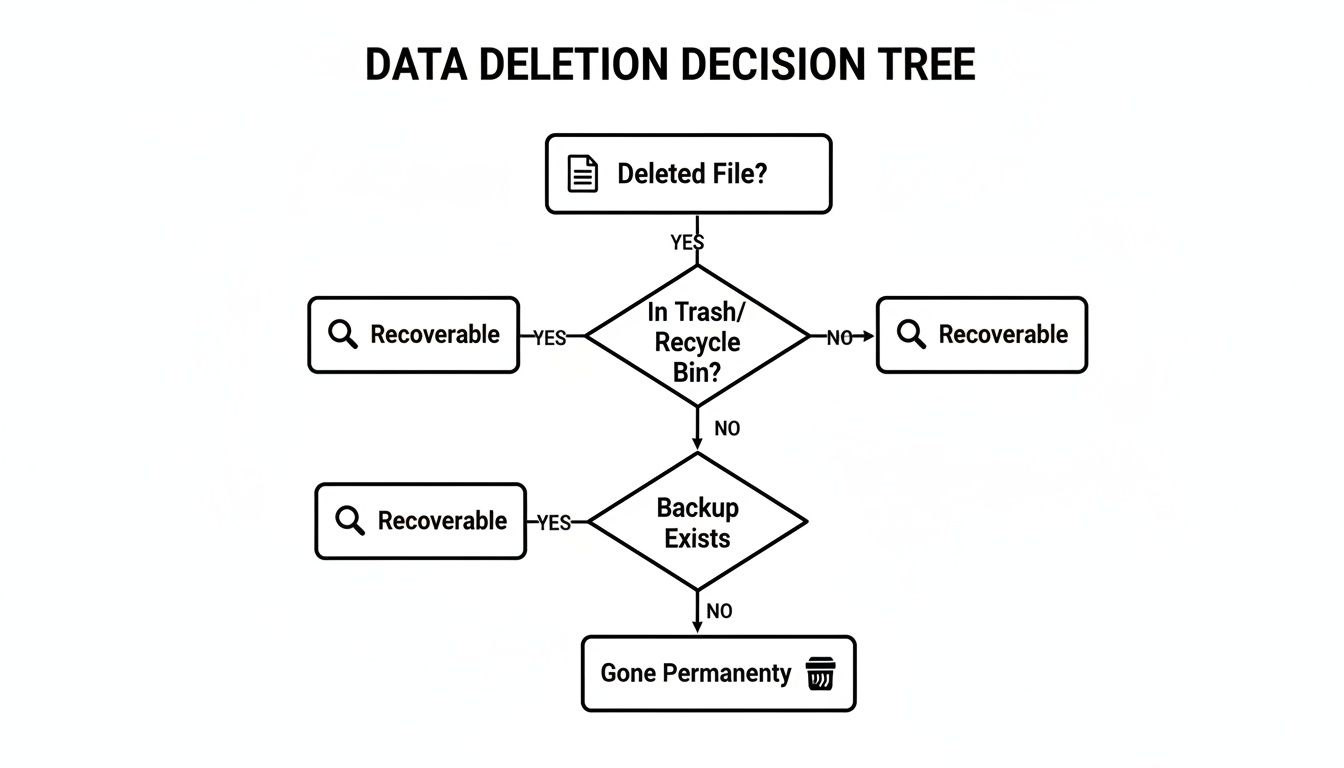
As you can see, hitting delete just tells the computer it's okay to write over the file eventually. Professional destruction makes sure that file is eliminated for good.
The Finality of Physical Shredding
Now, imagine taking a stack of confidential patient records or client contracts and feeding them into an industrial cross-cut shredder. What comes out is a pile of confetti. There's no amount of time or tape that could ever put those documents back together.
That’s the exact principle behind physical hard drive destruction. We use specialized, powerful shredders that grind hard drives, solid-state drives (SSDs), and backup tapes into small, mangled pieces of metal.
For the highest level of security, nothing beats physical destruction. It is the only method that provides absolute, verifiable proof that your data has been rendered completely and permanently irrecoverable.
This approach takes all the "what-ifs" out of the equation. You don't have to worry about whether a wipe was successful or if the drive had hidden bad sectors. The data is physically obliterated, and you can even watch it happen for total peace of mind. For an even deeper look, check out our guide on the best ways to destroy a hard drive.
With data breaches constantly in the news, physical shredding has become the gold standard for a reason. One analysis of 200 used drives found that an incredible 67% still held personal information like financial data and Social Security numbers. For Augusta businesses in healthcare or finance, where a HIPAA violation can lead to massive fines, shredding is often the only acceptable path.
Making the Right Choice for Your Augusta Business
So, which one is for you? This simple chart can help you decide.
| Factor to Consider | Choose Software Wiping If… | Choose Physical Shredding If… |
|---|---|---|
| Data Sensitivity | The data is non-critical or has a low-risk profile. | The data is highly sensitive (PII, PHI, trade secrets). |
| Compliance Needs | Your industry regulations allow for certified wiping. | Your compliance rules (like HIPAA or NSA) mandate destruction. |
| Asset Value | You need to recover value by reselling or reusing the drives. | Security is the absolute priority, regardless of asset value. |
| Risk Tolerance | You are comfortable with the small residual risk of wiping. | You require a zero-risk, 100% foolproof solution. |
For many businesses we work with in Augusta, the best strategy is a hybrid one. They wipe drives from standard office PCs to recover some cost, but any drives from the accounting department or servers with customer data go straight to the shredder.
A professional hard drive destruction Augusta GA provider can walk you through your inventory and help create a plan that perfectly balances security with your budget.
Navigating Data Destruction Laws and Compliance in Georgia
Destroying an old hard drive isn't just about clearing out old equipment. For any business in Augusta, it's a critical step in complying with a maze of laws designed to protect customer data. Getting this wrong isn't a simple mistake—it can trigger massive fines, legal headaches, and destroy the customer trust you've worked so hard to build.
It can feel like a lot to keep track of, but the idea is simple. If your business collects sensitive information, you are legally on the hook for making sure it's destroyed for good. It's not optional; it's the law.
The Key Regulations Affecting Augusta Businesses
Several major laws dictate how you handle data, and they get very specific about "media sanitization"—the official term for making data impossible to recover. Whether you're in healthcare, finance, or run a small retail shop, one of these almost certainly applies to you.
HIPAA (Health Insurance Portability and Accountability Act): If you're a medical practice, clinic, or any healthcare partner in the Augusta area, HIPAA is the big one. It requires that all Protected Health Information (PHI) be rendered completely unreadable and unusable before you get rid of the device it's on. This means having a documented process for destroying drives from patient check-in stations, office computers, and servers.
GLBA (Gramm-Leach-Bliley Act): This one's for the financial world—banks, credit unions, and investment firms. The law mandates a security plan to protect a consumer's private financial data. Securely disposing of customer information is a core part of that plan, making professional hard drive destruction a must-have.
FACTA (Fair and Accurate Credit Transactions Act): FACTA’s Disposal Rule hits just about every type of business. If you handle consumer reports for any business reason—think credit checks, background screenings, or even old job applications—you must take "reasonable measures" to destroy that info. Tossing a drive in the dumpster is a clear violation. Physically shredding it is a clear-cut reasonable measure.
These regulations don't just tell you to destroy data; they require you to prove it. This is exactly where professional services for hard drive destruction in Augusta GA become a business's best friend.
Georgia Data Privacy Regulations & Destruction Requirements
To stay on the right side of the law, Augusta businesses need to be aware of the specific rules that apply to their industry. The consequences for non-compliance are just too high to ignore.
| Regulation | Applicable Industries | Data Destruction Requirement | Consequence of Non-Compliance |
|---|---|---|---|
| HIPAA | Healthcare Providers, Insurers, Business Associates | Render PHI unreadable, indecipherable, and otherwise cannot be reconstructed. | Fines from $100 to $50,000+ per violation. |
| GLBA | Financial Institutions (Banks, Investment Firms, etc.) | Develop and implement a written information security plan that includes secure data disposal. | Fines up to $100,000 for each violation. |
| FACTA | Virtually All Businesses Handling Consumer Info | Take "reasonable measures" to protect against unauthorized access to information. | Civil liability, class-action lawsuits, and federal/state penalties. |
| Georgia Personal Identity Protection Act | Any Business Disposing of Records with Personal Info | Shred, erase, or otherwise modify the personal information to make it unreadable. | Subject to lawsuits for damages from affected individuals. |
This table makes it clear: proper destruction isn't a "nice-to-have," it's a mandatory part of doing business and protecting yourself from serious financial and legal risk.
NAID AAA Certification: The Gold Standard for Compliance
When an auditor asks how you got rid of old hard drives containing sensitive data, saying "we recycled them" won't cut it. You need documentation proving you used a secure and compliant process. That’s why NAID AAA Certification is the only standard that matters.
The National Association for Information Destruction (NAID) sets the bar for the entire secure destruction industry. To become NAID AAA Certified, a vendor has to pass intense, unannounced audits covering every single part of their operation, including:
- Thorough employee screening and background checks
- A secure, unbroken chain of custody for all media
- Strict facility security and access controls
- Verification of destruction equipment and processes
Think of a NAID AAA Certified partner as more than just a vendor—they are a key part of your legal defense. The certification is your concrete proof that you did everything right to protect sensitive data, which is invaluable during a compliance audit.
This level of verification is now the baseline expectation. In Georgia, government agencies and their contractors have to follow strict NIST and NSA guidelines, with NAID AAA certification required for over 70% of public sector contracts that involve data disposal.
Forgetting compliance can be costly. Improper disposal can lead to fines of up to $250,000 per violation under Georgia's electronics recycling laws alone. That's a risk no business can afford to take.
These laws and certifications give you a clear path forward. To stay compliant, you must have a documented process for data destruction. Partnering with a certified expert is the smartest and most reliable way to get there. You might be interested in our guide on what a Certificate of Destruction is and why it's so important for your records.
What to Expect During an On-Site Shredding Service
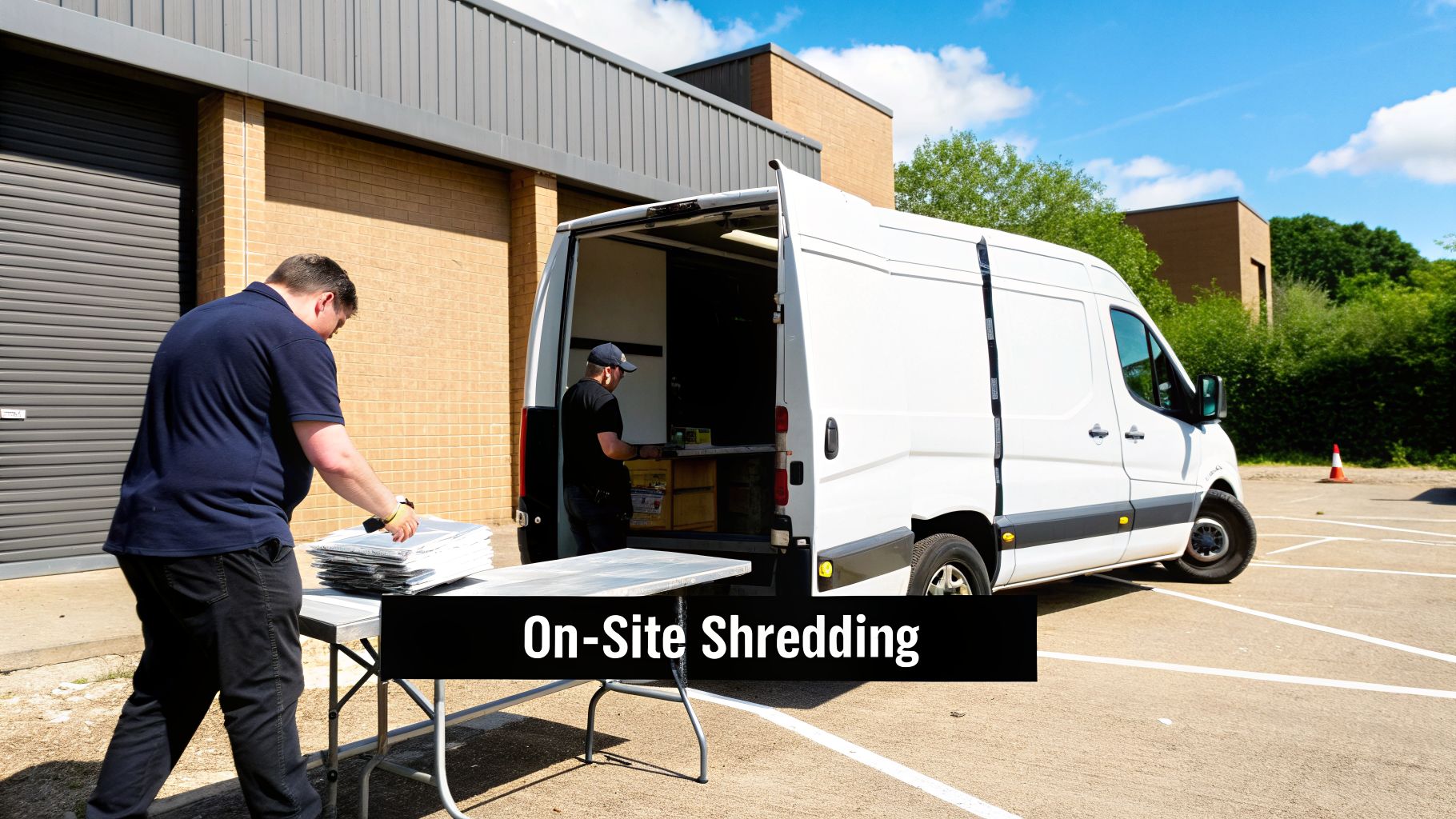
If you need to be absolutely certain your data is destroyed, on-site physical destruction is the only way to go. It completely removes the guesswork. For Augusta businesses that need a guarantee their data is gone for good, it's the gold standard for a reason—it’s transparent, secure, and surprisingly quick.
Let's walk through exactly what happens during a typical on-site shredding appointment. You'll see just how simple and secure the whole process really is.
Step 1: Scheduling and Logistics
It all starts with a simple consultation. Just tell us how many drives you have—whether they're standard hard drives, SSDs, or old backup tapes—and we'll schedule a time that works for you. Our team handles all the logistics, including finding a safe spot for our mobile shredding truck at your Augusta location.
And don't worry about pulling the hard drives out of old computers or servers yourself. Our technicians can handle all of that on-site. It’s one less headache for your IT team and ensures the whole process is seamless on the day of the appointment.
Step 2: On-Site Arrival and Secure Asset Verification
When our mobile shredding truck pulls up, our uniformed and badged technicians will greet you. They’ll collect all the devices you’ve marked for destruction—from your office, server room, or storage closet—and place them in locked, secure bins to be moved to the truck.
This is where the chain of custody begins, and it's a critical step. Before a single drive is touched, we scan and record the serial number of each device. This creates a detailed inventory that proves every asset was accounted for and destroyed, giving you a solid audit trail for compliance.
Step 3: Witnessing the Physical Destruction
Here’s the part that offers total peace of mind. Our shredding trucks are basically industrial-grade shredders on wheels, complete with an external camera system. You and your team are invited to watch the entire process.
You get to see your hard drives fed into the shredder one by one, where they are torn into tiny, mangled pieces of metal. There’s no ambiguity. No wondering if the job was done right. You see the proof with your own eyes, confirming your data is irretrievably gone.
Witnessing the destruction firsthand is the most powerful feature of an on-site service. It replaces uncertainty with absolute confidence, confirming that your confidential business, client, and employee data has been permanently eliminated.
Step 4: Receiving Your Certificate of Destruction
As soon as the last drive is shredded, our technicians will hand you a Certificate of Destruction. This isn't just a receipt—it's a formal legal document that serves as your official proof of compliant data destruction.
This certificate is your key to passing any audit. It includes:
- The date and location of the service.
- A complete list of the serialized assets that were destroyed.
- Confirmation that the destruction process meets all industry standards.
- The signature of the certified technician who did the work.
This document closes the loop on your data security responsibilities. It makes the hard drive destruction Augusta GA service a fully documented and defensible process. To dig deeper into this, you can learn more about on-site hard drive shredding from our in-depth guide.
How to Choose the Right Destruction Partner in Augusta
Picking a partner for your hard drive destruction in Augusta GA is a serious decision. It goes way beyond just clearing out old equipment. This choice directly protects your company's security, its compliance status, and even its reputation in the community. You absolutely need a vendor who treats your data with the same level of seriousness you do.
Don't just look at the price tag. The best partners in this business offer a mix of certified procedures, total transparency, and a genuine commitment to protecting you from the moment they arrive until the job is done. Think of it less like a disposal service and more like hiring a specialized security team for a critical mission.
Your Vendor Vetting Checklist
When you're talking to potential partners in the Augusta area, run them through this checklist. A truly professional service won't hesitate to give you straight answers on every single point.
NAID AAA Certification: Honestly, this is the most important thing to look for. It's the gold standard, proving the vendor meets the industry's toughest requirements for security, employee background checks, and documented procedures. If they aren't certified, they shouldn't be touching your sensitive data. Period.
Airtight Chain of Custody: Ask them to walk you through their process, step-by-step, from the second your drives leave your hands. A secure chain of custody means locked bins, serial number scanning for every single asset, and constant, documented control until the final destruction.
Environmentally Responsible Disposal: So, what happens after the shredding? A responsible partner will hold certifications like R2v3 (Responsible Recycling). This guarantees all the leftover e-waste is processed in an environmentally safe way and won't just be dumped in a landfill.
Core Offerings of a Top-Tier Provider
A quality destruction partner does more than just break things; they deliver a complete security solution built on security, flexibility, and real value.
A top-tier provider isn't just a vendor; they're a strategic partner in managing your IT assets. They should give you options that match your specific security policies and budget, whether that means recovering cash from retired gear or just getting you the audit-proof paperwork you need.
Make sure the company you choose delivers on these key promises:
Choice of Destruction Method: They should give you options, like both certified software wiping and on-site physical shredding. This flexibility is key. It lets you make smart financial decisions, like wiping drives that can be resold while shredding the ones that hold your most sensitive information.
Potential for Value Recovery: Don't assume every old piece of IT equipment is just junk. A great partner can spot assets that still have resale value. They might offer IT Asset Disposition (ITAD) services that can actually put some money back in your pocket. You can learn more by checking out options for ITAD services in Augusta, GA and see how old tech can become new revenue.
Unwavering Commitment to Compliance: Your partner must be an expert on regulations like HIPAA, GLBA, and FACTA. They need to provide a Certificate of Destruction as a standard part of their service, no questions asked. That certificate is your official proof that you did your due diligence and met your legal obligations.
By vetting your options against these criteria, you can find a partner in Augusta who will protect your business, keep you compliant, and give you complete peace of mind.
Frequently Asked Questions About Hard Drive Destruction
When it comes to hard drive destruction in Augusta GA, you've probably got questions. Most local businesses do—about the cost, the process, and what it all means for compliance. Getting those questions answered is the first real step in protecting your business from a data breach.
We've put together the answers to the most common questions we hear.
How Much Does Hard Drive Destruction Cost in Augusta?
Thankfully, pricing for professional hard drive destruction is usually pretty straightforward. Most services charge per drive, which makes it simple to budget for.
While prices can differ slightly from one company to the next, a good ballpark figure is around $10 per unit for a single hard drive. Just know that most companies have a minimum service fee to cover the cost of getting a truck and a certified technician out to your location. This is often around $50, so you'll get more bang for your buck by destroying several drives at once.
Do I Need to Remove the Hard Drives from the Computers Myself?
No, and you shouldn't have to. The whole point of hiring a professional service is to make your life easier and your data disposal process secure.
Our certified technicians handle everything for you. When we show up at your Augusta office, our team will:
- Locate all the desktops, laptops, or servers you've marked for disposal.
- Expertly remove every single hard drive from the equipment.
- Log each drive to ensure a perfect count before destruction begins.
This full-service approach frees up your IT staff and completely removes the risk of a drive getting overlooked. It’s a seamless process from start to finish.
The most important thing to remember is that you are not just paying for destruction; you are investing in a secure, documented process that protects you from liability.
What Happens to the Shredded Material?
After we turn your hard drives into tiny, unreadable pieces of metal, that material doesn't just end up in a landfill. Any reputable destruction partner takes their environmental responsibility seriously.
The shredded e-waste is securely transported to a certified recycling facility. There, all the metals, plastics, and other bits are properly sorted and processed following strict standards like R2v3. This guarantees your old equipment is handled sustainably, keeping hazardous materials out of our environment.
Can I Destroy Other Media Besides Hard Drives?
Absolutely. Your sensitive information isn't just on hard drives, and any comprehensive security plan needs to account for that. A professional destruction service can handle almost any device that stores data.
On top of your standard hard disk drives (HDDs) and solid-state drives (SSDs), we can also destroy:
- Backup Tapes (LTO, DLT)
- Flash Drives and USB Sticks
- CDs and DVDs
- Old Company Cell Phones
- Floppy Disks and Zip Disks
Bottom line: if it can hold data, it can be a liability. Making sure all these items are properly destroyed closes security gaps you might not have even known were there.
Ready to secure your retired IT assets and protect your business? Montclair Crew Recycling offers certified, on-site hard drive destruction services across the Augusta area. We provide the documentation, security, and peace of mind you need to stay compliant and safe. Get a quote today by visiting us at https://www.montclaircrew.com.
