
Old laptops in a cabinet. Retired phones in a desk drawer. A printer nobody wants to touch because it probably still has stored jobs on it. For many businesses, electronics recycling starts as a cleanup task and turns into a risk question fast.
The appeal of electronics recycling Staples offers is obvious. It’s nearby, familiar, and easy for small quantities of common devices. That convenience matters. But if you run a business in Metro Atlanta, convenience isn’t the only standard that matters. You also have to think about data exposure, chain of custody, audit requirements, and whether the equipment you need to dispose of even fits a retail program.
That’s where many companies make the wrong call. They treat business IT disposal like household decluttering. It isn’t.
The Hidden Risks in Your Office Storage Closet
Most business owners know the scene. Someone finally opens the back storage room and finds a stack of desktops, a few cracked monitors, old docking stations, cordless phones, and a banker’s box full of hard drives nobody labeled. The first instinct is usually practical: load it up and take it to a store.
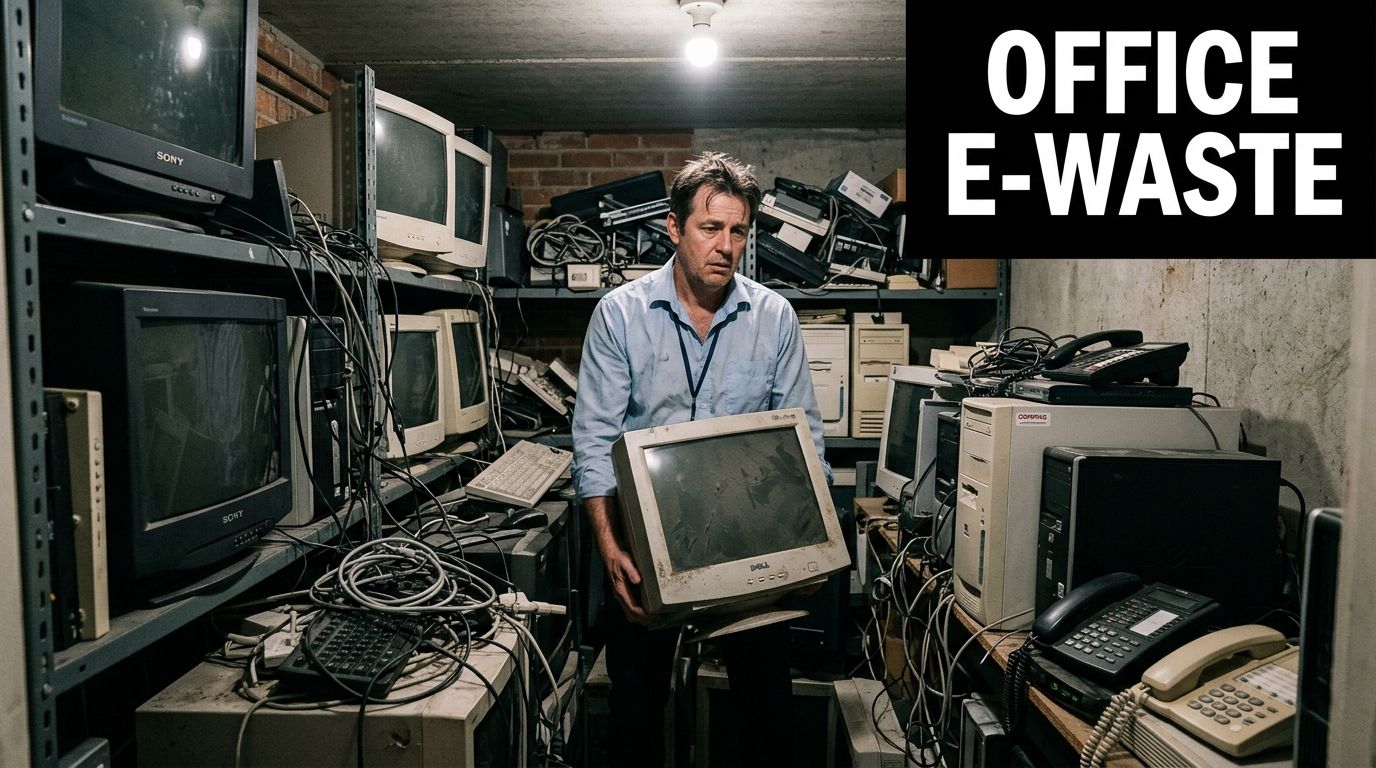
That instinct makes sense. Retail recycling feels like progress. The problem is that mixed office electronics aren’t just trash. They often contain client files, payroll records, saved passwords, network settings, email archives, and device histories that no one remembers are still there.
Why old devices become business liabilities
A lot of old hardware sits because no one wants to be the person who disposes of it incorrectly. That hesitation is understandable. Staples research found that only 4% of consumers recycle obsolete electronics, and among people who replaced gadgets in the past year, just 11% recycled their old equipment while 13% threw them away (Waste Dive coverage of the Staples research).
For a business, those numbers matter less as consumer behavior and more as a warning. If people already struggle to handle obsolete electronics correctly, office teams without a documented disposal process will usually default to delay, improvised drop-off, or storage.
Here’s what tends to pile up risk in that closet:
- Untracked data devices that may still hold regulated information
- Shared responsibility where no single employee owns the disposal decision
- Mixed asset types such as computers, peripherals, drives, and phones that need different handling
- Logistics friction because hauling and sorting equipment takes staff time
- Policy gaps where IT, operations, and compliance each assume someone else has it covered
Practical rule: If a device ever touched company email, files, customer data, financial systems, or internal networks, treat it like a compliance item, not office junk.
The environmental issue is real, but it’s not the only issue
Responsible recycling still matters. Devices shouldn’t sit indefinitely, and they shouldn’t be dumped with general waste. If you want a clearer picture of where processed equipment can go after collection, this overview of what happens to recycled electronics is useful background.
But for businesses, the bigger question is control. Who handled the device. When. Under what standard. With what record.
That’s why electronics recycling staples programs and business IT disposition services shouldn’t be treated as interchangeable. One solves a consumer convenience problem. The other is supposed to solve a business risk problem.
Understanding the Staples Recycling Program
Staples deserves credit for building a visible and widely used electronics recycling channel. For households, home offices, and very small businesses with a limited number of common items, it fills an important role.
The program is also substantial in scale. Staples says it has recycled 188,097,689 pounds of technology since launching its free office electronics recycling program in 2012 and has earned the EPA’s Gold Tier Award for Sustainable Materials Management seven times (Staples environmental program details).
What the program is designed to handle
At a practical level, Staples is built around store-based intake and a broad consumer-facing list of accepted electronics. It commonly accepts items such as:
- Small accessories like cables, keyboards, and similar peripherals, often without a fee
- Common office devices such as computers, printers, phones, and chargers
- Everyday consumer electronics including cameras and speakers
Larger electronics may cost around $10 per item to recycle, while smaller items like cables and keyboards are accepted free, according to Staples’ program page linked above.
If you want a direct look at how the retailer positions the service, this page on electronic recycling at Staples summarizes the customer-facing model in plain terms.
Where Staples is strongest
For the right use case, retail recycling works well because it offers:
Convenience
Employees can drop off common items during normal errands.
Brand familiarity
Decision-makers feel more comfortable using a known national retailer than searching for a recycler from scratch.
A legitimate recycling channel
The program isn’t casual disposal. Staples works with certified downstream partners and has a documented corporate sustainability program.
Staples plays a real role in keeping common electronics out of landfills. That’s worth acknowledging before talking about where the model stops working for business IT.
The operating assumption behind the program
The key thing to understand is this: the Staples program is built to make responsible drop-off simple. It is not built around the full operational needs of a business IT asset disposition workflow.
That distinction matters.
A retail model works best when the equipment is small in number, standard in type, easy to transport, and not tied to strict internal controls. If your situation matches that profile, Staples may be a practical answer. If your equipment includes managed drives, infrastructure gear, or anything tied to regulated data, you need to look past acceptance lists and ask harder questions.
Is Staples Recycling Right for Your Business
For a home user, the answer is often yes. For a business, the answer depends on what you’re trying to dispose of and what obligations attach to it.
That’s the first fork in the road. If you have a keyboard, an old webcam, and two dead cell phones, a retail drop-off option may be perfectly reasonable. If you’re retiring network closets, rolling out new laptops across departments, or clearing a server room, the decision changes.
When retail recycling fits
Staples makes the most sense when the job is small, simple, and low-risk.
A few examples:
- A solo office replacing one printer and a couple of accessories
- A small branch location with a handful of non-sensitive peripherals
- An employee cleanup effort involving clearly approved, low-value equipment
In those cases, the friction of scheduling a specialized service may not be worth it.
Where business needs outgrow the retail model
The problem starts when equipment volume, sensitivity, or complexity increases. According to Recycling Today, Staples’ program has limitations for B2B needs, often excluding heavier items like servers or specialized equipment like telecom gear, and the same source notes that U.S. e-waste from data centers surged 25% due to AI upgrades (Recycling Today on Staples program limitations).
That gap shows up in real operations quickly.
| Business need | Retail drop-off reality |
|---|---|
| Server decommissioning | Often outside the intended scope |
| Telecom and rack gear | May not fit accepted-item expectations |
| Bulk removals | Staff usually have to sort, pack, and transport |
| Asset audits | Not the core purpose of the program |
| Value recovery | Limited compared with ITAD resale workflows |
The real trade-off
Retail recycling optimizes for access. Business ITAD optimizes for control.
Those aren’t the same thing.
A business owner should ask four direct questions before choosing a path:
What exactly are we disposing of
Consumer-style electronics are one thing. Servers, storage, and telecom hardware are another.
Who is moving the equipment
If your staff is carrying drives and devices in personal vehicles, you’ve already introduced avoidable risk.
Do we need item-level records
Many businesses do, especially if assets came from multiple departments or contain data-bearing media.
Is there any recoverable value
Retail channels usually focus on disposal, not on auditing reusable equipment for resale or profit-sharing.
The phrase electronics recycling staples may rank well because it matches a common search. But from an operations standpoint, the better question is narrower: is a retail storefront the right endpoint for your company’s retired IT assets? In many business environments, it isn’t.
The Critical Data Security Gap in Retail Recycling
Data destruction is where casual recycling decisions become expensive mistakes.
A retail program can be environmentally responsible and still be the wrong fit for a company with compliance exposure. That’s because the standard for business disposal isn’t just “the device gets recycled.” The standard is “the organization can prove what happened to each data-bearing asset.”
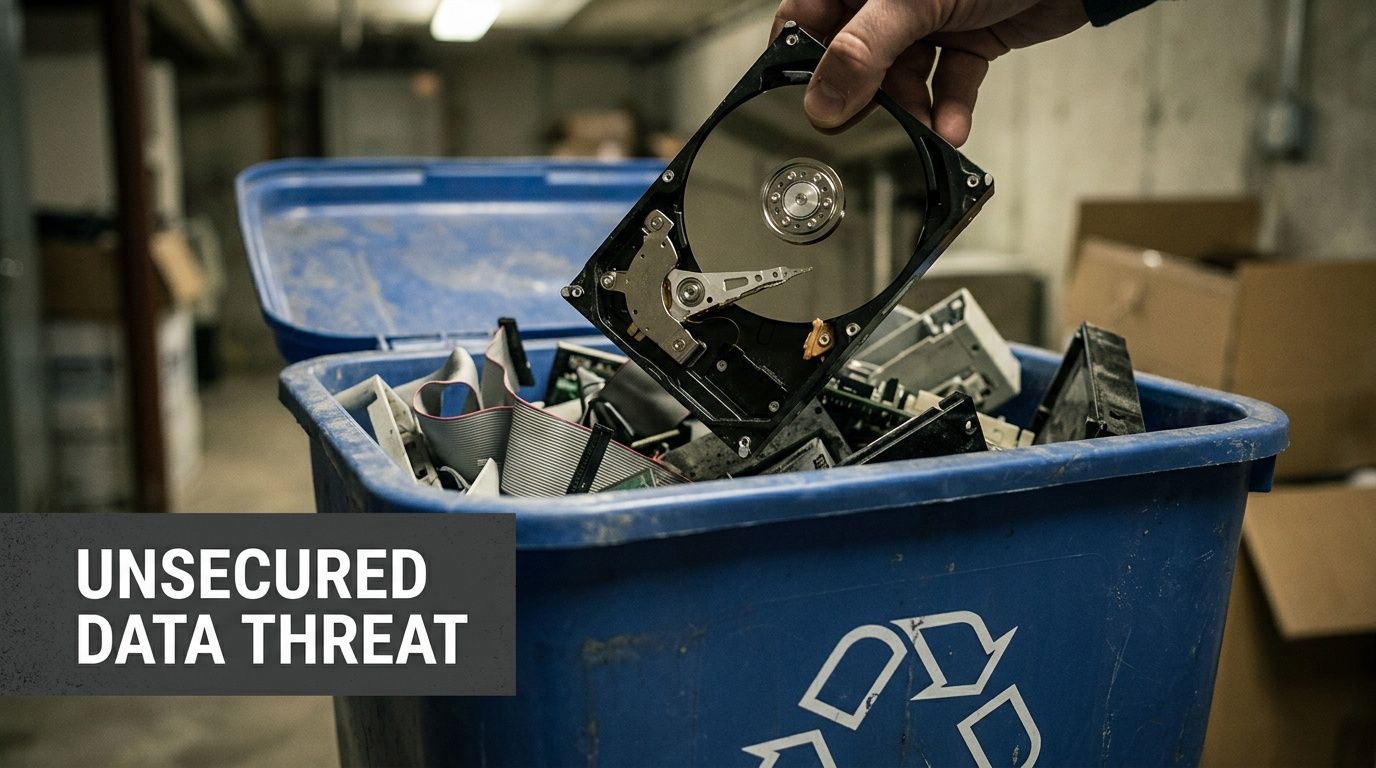
What Staples’ downstream destruction does well
Staples’ partners use advanced destruction methods. According to the company’s large-box recycling product details, solid-state devices are shredded into 2-millimeter particles to prevent data recovery, and the process aligns with standards such as DoD 5220.22-M (Staples large electronics recycling box details).
That’s meaningful. Physical destruction at that level is serious.
The issue for a business isn’t whether downstream destruction exists. The issue is whether your organization has direct, auditable proof tied to your specific assets. The same source makes the gap clear: the process occurs off-site, leaving businesses without the on-site verification or serialized reporting needed for stricter audits.
Why chain of custody matters
The risk window starts the moment an employee removes a drive from your office or hands over a device at a counter. After that, you may have limited visibility into:
- Asset identification before processing
- Who handled the device at each handoff
- Whether serial numbers were captured
- What destruction record maps back to your inventory
- How your compliance team would defend the process in an audit
That matters under frameworks that expect documented vendor oversight. If your company is working through governance and vendor controls, these SOC 2 vendor management requirements are a useful way to think about why informal handoff models create problems.
A recycler’s certification helps. It does not replace your company’s need to document custody, destruction, and accountability for each regulated asset.
Off-site destruction is not the same as verified destruction
For many organizations, off-site processing is acceptable only when it is paired with strong intake controls, serialized asset tracking, and destruction documentation that stands up to scrutiny.
Retail drop-off usually isn’t designed around that level of evidence. It’s designed around customer convenience.
That’s the core gap. Not bad intentions. Not bad recycling. Just the wrong process for systems that contain employee records, patient information, financial data, legal documents, or customer files.
If you’re weighing this specifically from the business side, this explanation of recycling electronics at Staples helps frame the difference between store drop-off and controlled disposition.
Montclair Crew A Compliant Alternative for Atlanta Businesses
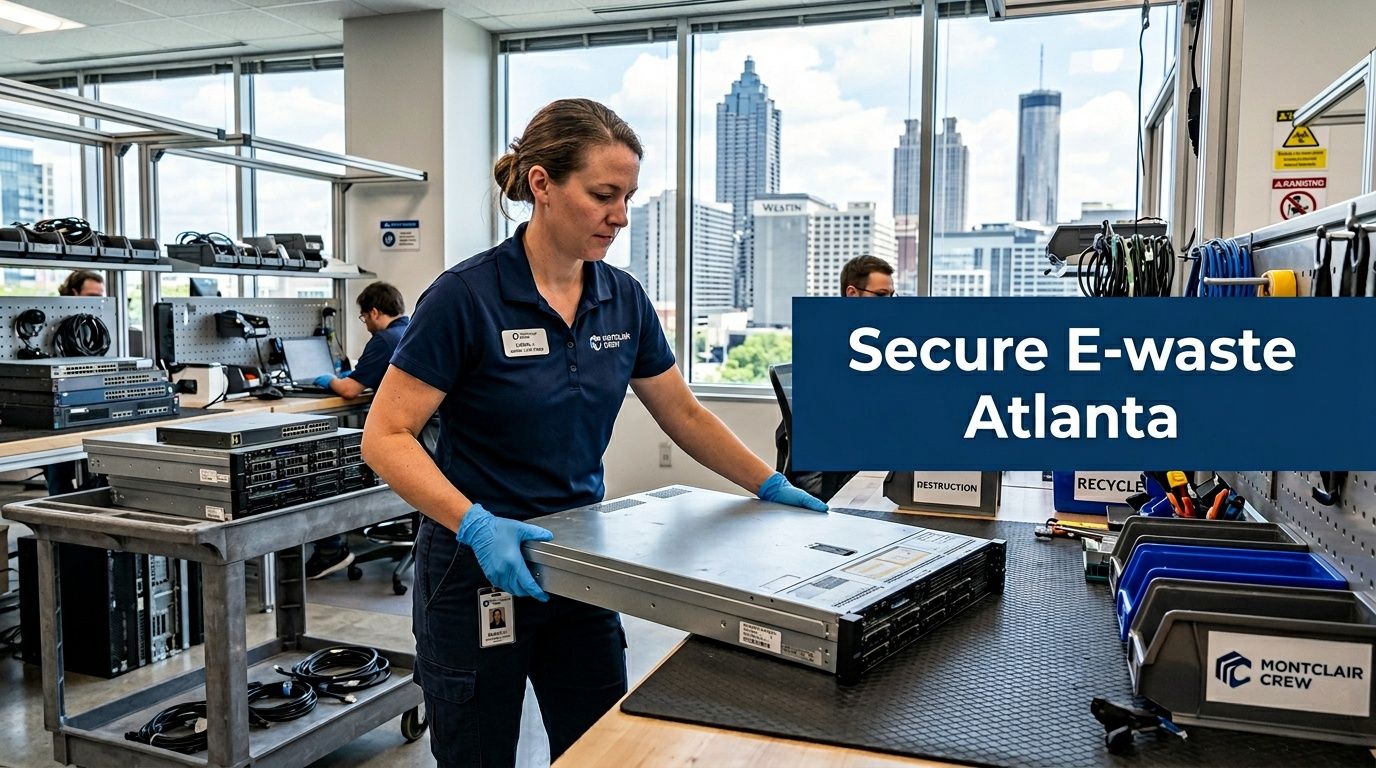
Atlanta businesses often need something retail programs weren’t built to provide: controlled pickup, documented handling, data destruction options, and records that satisfy internal security teams.
That need isn’t niche. Staples’ own recycling-solutions material identifies data security as the top issue for business recycling decisions, with 70% of businesses citing data security as the main barrier to e-waste recycling, and it notes that retail programs often lack specifics on B2B data verification for frameworks such as HIPAA or NIST (Staples recycling solutions overview).
What a business-grade alternative changes
A specialized ITAD provider changes the operating model in a few important ways.
Pickup replaces staff hauling
Equipment leaves your site through a planned removal process, not ad hoc employee transport.
Asset audit comes first
Devices can be inventoried before they disappear into a recycling stream.
Data handling is explicit
Wiping and shredding aren’t assumed. They’re scoped, documented, and matched to the media type.
Documentation supports compliance
Certificates and audit trails become part of the service, not an afterthought.
Why local execution matters in Metro Atlanta
For Atlanta-area organizations, local service matters because projects rarely involve just one box of old electronics. A healthcare office may need workstation pickup after hours. A school may need phased removal during a break. A data center may need decommissioning tied to a migration schedule.
Those jobs need coordination, not just acceptance.
A local option with business-focused workflows can also handle categories that don’t fit neatly into a retail bin, including servers, telecom gear, and mixed enterprise equipment. If you’re evaluating providers in Georgia, this overview of Georgia ITAD services is a practical starting point.
If your legal, IT, or compliance team would ask for a destruction record later, build that record into the process before the first device leaves the building.
The strongest argument for a B2B alternative isn’t marketing language. It’s simpler than that. Businesses need a disposal process that matches how they manage risk everywhere else.
Staples vs Montclair Crew A Side-by-Side Comparison
When business owners compare options, the easiest mistake is comparing them on convenience alone. A better comparison looks at the full workflow: intake, transport, data handling, documentation, equipment scope, and what happens if an auditor asks questions six months later.

Staples Recycling vs. Montclair Crew ITAD
| Feature | Staples (Retail Program) | Montclair Crew (B2B Service) |
|---|---|---|
| Service model | Store drop-off and mail-back style convenience | Business-focused pickup and managed disposition |
| Best fit | Households, small quantities, common electronics | Organizations with ongoing IT asset disposal needs |
| Data destruction visibility | Downstream processing, limited direct client visibility | Business-grade handling designed around proof and auditability |
| Chain of custody | Less formal from the client perspective | Structured handling from pickup through processing |
| Accepted equipment | Strong for common office and consumer devices | Broader fit for business IT and infrastructure equipment |
| Documentation | Basic transaction-style confirmation | Asset-level records and destruction documentation |
| Logistics | Customer often sorts and transports | Provider manages removal, transport, and workflow |
| Value recovery | Disposal-focused | May include resale or profit-sharing where applicable |
Where the difference shows up in practice
A retail customer mainly needs a convenient place to bring electronics. A business needs a repeatable process that still makes sense after legal review, internal audit, or a customer security questionnaire.
That’s why the comparison usually comes down to three points.
Control over data-bearing assets
If a company is disposing of hard drives, laptops, or storage appliances, it needs more than a general assurance that destruction happens somewhere downstream. It needs process integrity.
Operational burden on staff
Retail recycling can look inexpensive until your office manager spends hours sorting gear, confirming acceptance rules, coordinating employee drop-offs, and trying to reconstruct what was removed from inventory.
Business value beyond disposal
A true ITAD workflow can separate scrap from reusable assets. That matters when equipment still has residual value or when departments need records for depreciation, refresh cycles, or procurement planning.
For organizations working through formal destruction planning, IT asset destruction should be treated as part of security operations, not a side errand.
The right comparison is not “Which option takes electronics?” It’s “Which option lets my business dispose of electronics without creating a new security or compliance problem?”
Making the Right Choice for Your E-Waste
Staples serves a real purpose. For consumers and small, simple drop-offs, it’s a useful and responsible outlet. That shouldn’t be dismissed.
But businesses don’t operate under consumer assumptions. They hold regulated data, maintain internal controls, answer to customers, and sometimes need to explain exactly how retired equipment moved from office use to final destruction. That’s where retail convenience starts to lose to business process.
If your company only has a few low-risk accessories, a retail option may be enough. If you’re dealing with laptops, phones, drives, servers, or mixed IT equipment from a real operating environment, you need a tighter chain of custody and stronger documentation than a storefront model typically provides.
The environmental side matters too. Responsible disposition supports both compliance and corporate reputation. Teams thinking about that broader message may also find this guide to social responsibility marketing useful, especially if sustainability claims are part of how your business presents itself to clients and stakeholders.
The practical standard is simple. Use retail recycling for light-duty consumer-style disposal. Use a specialized ITAD process for business assets that carry data, compliance exposure, logistical complexity, or resale value.
That’s the safer choice. It’s also the more efficient one once you account for staff time, reporting needs, and downstream accountability.
If your Atlanta-area business needs a secure, documented way to dispose of computers, servers, telecom gear, or other IT assets, contact Montclair Crew Recycling. They help organizations manage pickup, data destruction, compliant recycling, and asset recovery without treating business equipment like household drop-off.
