
That back room tends to become the final stop for every retired device in the office. A few laptops from the last refresh. Old docking stations. A stack of monitors nobody wants to touch. Maybe a printer that “still works” and a box of hard drives with masking-tape labels from a project nobody remembers.
When that pile starts taking over a closet, most managers look for the fastest solution. They search for recycling electronics Staples, see a familiar brand, and think the problem is basically solved. For some situations, that instinct is reasonable. A consumer drop-off program is convenient, visible, and easy to understand.
But business equipment isn’t just clutter. It’s a mix of regulated data, depreciated assets, and environmental liability. A device can be worthless scrap, reusable hardware, or a compliance problem depending on what’s inside it, how it’s handled, and what documentation follows it out the door.
The Office Storage Closet and The E-Waste Dilemma
A common office scene looks like this. Facilities wants the closet cleared. IT wants to avoid a security mistake. Finance wants to know whether any of the equipment still has value. Nobody wants to spend half a day loading cars with monitors and desktops for multiple retail drop-offs.
That tension is why retail recycling stays attractive. It feels simple. Take the old gear to a nearby store, hand it over, and free up space by lunch.
The problem is that office electronics don’t behave like ordinary waste. A retired laptop may still hold client files. A printer may store scanned documents. A firewall appliance may contain configuration data that maps the network better than any attacker should ever see.
A small office problem is part of a much bigger one
The broader backdrop matters. Global e-waste generation reached 62 million tonnes in 2022, an 82% increase from 2010. That volume would fill about 1.55 million 40-tonne trucks, enough to form a bumper-to-bumper line around the equator, according to global e-waste statistics summarized here.
That’s not abstract. It explains why more organizations are replacing hardware faster, why storage closets fill up sooner, and why disposal decisions have gotten harder instead of easier.
A business can’t solve the global e-waste problem alone. It can control one thing, though. It can decide whether retired equipment leaves the building through a casual consumer process or through a documented business process.
What managers usually underestimate
Teams often focus on the visible problem first. The closet is full. The office is moving. The refresh is done. The merger closed. The old devices need to go.
The hidden issues show up later:
- Data exposure: Drives and embedded storage often stay in equipment longer than people expect.
- Missing records: A retail receipt rarely works as a full compliance record.
- Lost value: Functional hardware often gets treated like scrap.
- Broken chain of custody: Once devices leave the office in personal vehicles or mixed loads, accountability gets fuzzy.
Practical rule: If the equipment ever touched customer data, employee data, financial records, or internal systems, disposal is no longer just a recycling task.
If you want a plain-English overview of where retired devices go after collection, this explanation of what happens to recycled electronics is a useful starting point.
How Staples Electronics Recycling Works
Staples runs a good electronics recycling program. That’s important to say upfront. This isn’t a sham “green” bin by the front register. It uses recognized downstream recycling standards and a structured recovery process.
For businesses comparing options, the key is understanding what Staples is built to do well and what it isn’t built to do.
The core retail model
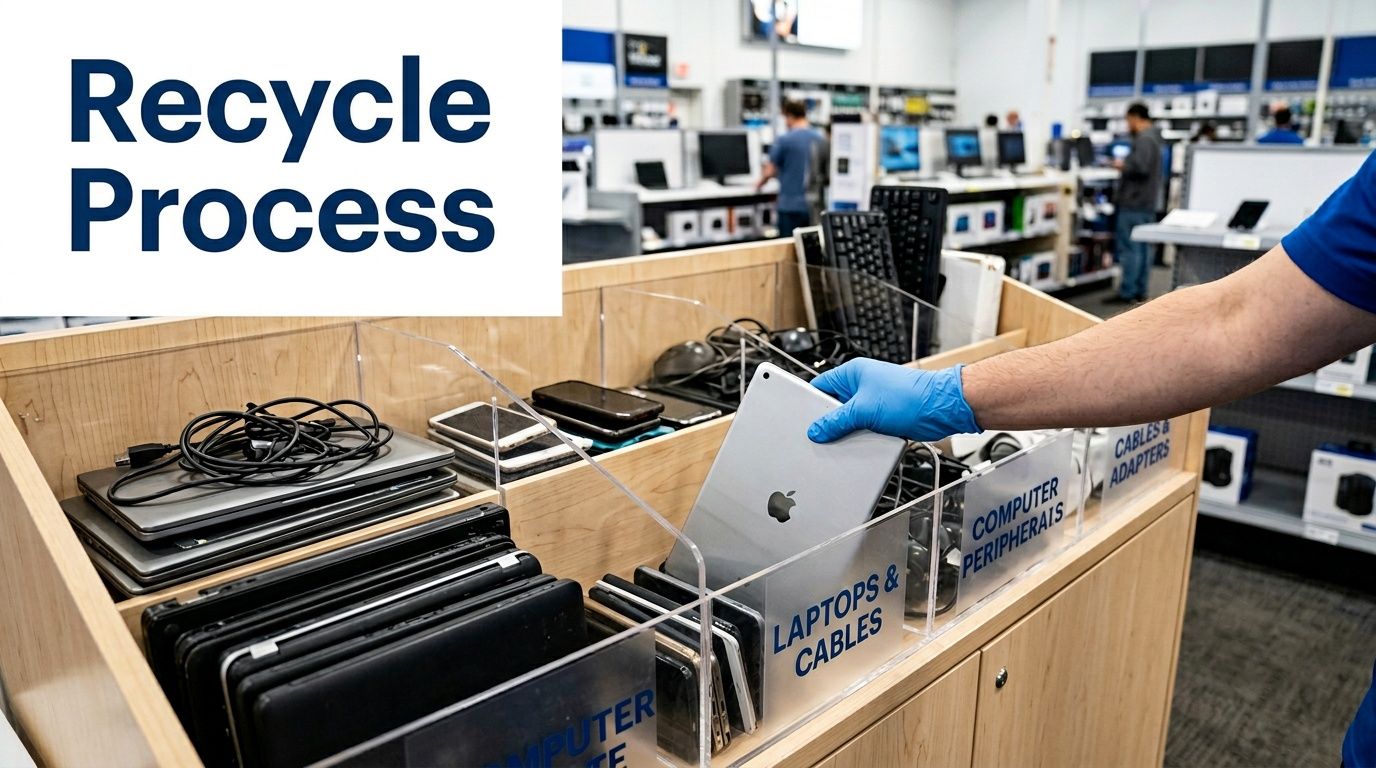
At the retail level, Staples is designed around convenience. A customer brings in accepted electronics, the store collects them, and certified recycling partners handle the downstream processing.
That model works best when the volume is small and the user’s priority is basic, responsible disposal rather than audit-ready asset disposition.
Retail programs are familiar because they reduce friction:
- Easy access: Staff already know where the store is.
- Low process burden: There’s no project kickoff, site walk, or logistics planning.
- Useful for small batches: A keyboard, router, or old desktop is manageable in a drop-off flow.
For many households and some micro-offices, that’s enough.
What happens after collection
The environmental side of the program is stronger than many people assume. According to reporting on the Staples electronics recycling program, Staples uses certified e-Stewards and R2 recyclers that disassemble devices, separate reusable components such as screens, batteries, and circuit boards, and recover materials including gold, copper, and aluminum. The same reporting notes that precious metal recovery from circuit boards can reach 95% to 98% efficiency when certified e-Stewards recyclers are used.
That matters because it distinguishes certified processing from a crude “shred everything and sort later” approach.
A proper disassembly flow typically includes:
- Sorting by device type so batteries, screens, boards, and housings move into the right stream.
- Component separation to isolate reusable parts and hazardous fractions.
- Material recovery so metals and other commodities can return to manufacturing channels.
- Certified downstream controls intended to prevent hazardous e-waste from being exported, landfilled, or incinerated improperly.
Good recycling and good IT asset disposition overlap, but they aren’t the same thing. Recycling focuses on environmental outcomes. ITAD adds data security, asset tracking, and business reporting.
The business mail-back option
Staples also has a B2B path. Instead of relying only on store drop-off, organizations can use a mail-back container workflow. The published format is a 20 inch by 20 inch by 20 inch box with a 70-pound limit, shipped flat, assembled by the customer, and returned with a prepaid label through the Staples program described on the large electronics recycling box product page.
That’s efficient for a certain use case. A small office with a manageable batch of mixed devices can box equipment, ship it, and move on.
It also reveals the program’s operating assumptions:
| Fit for the Staples model | Less ideal for the Staples model |
|---|---|
| Small batches of office electronics | Whole-room cleanouts |
| Standard devices that pack easily | Racks, servers, or heavy infrastructure |
| Teams with time to box and label items | Sites that need on-site labor |
| Low-sensitivity environments | Assets requiring witnessed destruction |
A business manager should read that as a design choice, not a flaw. Staples built a standardized collection system. Specialized ITAD firms build a service operation.
For another retail comparison from a business recycling perspective, this breakdown of recycling electronics at Best Buy helps show how large consumer programs tend to resemble each other operationally.
Hidden Risks When Businesses Use Retail Recycling
The mistake isn’t using a retail recycler. The mistake is using one for assets that need business-grade controls.
A retail program can be environmentally responsible and still be the wrong choice for a company laptop, a finance department printer, or a closet full of retired network gear.
The data destruction gap
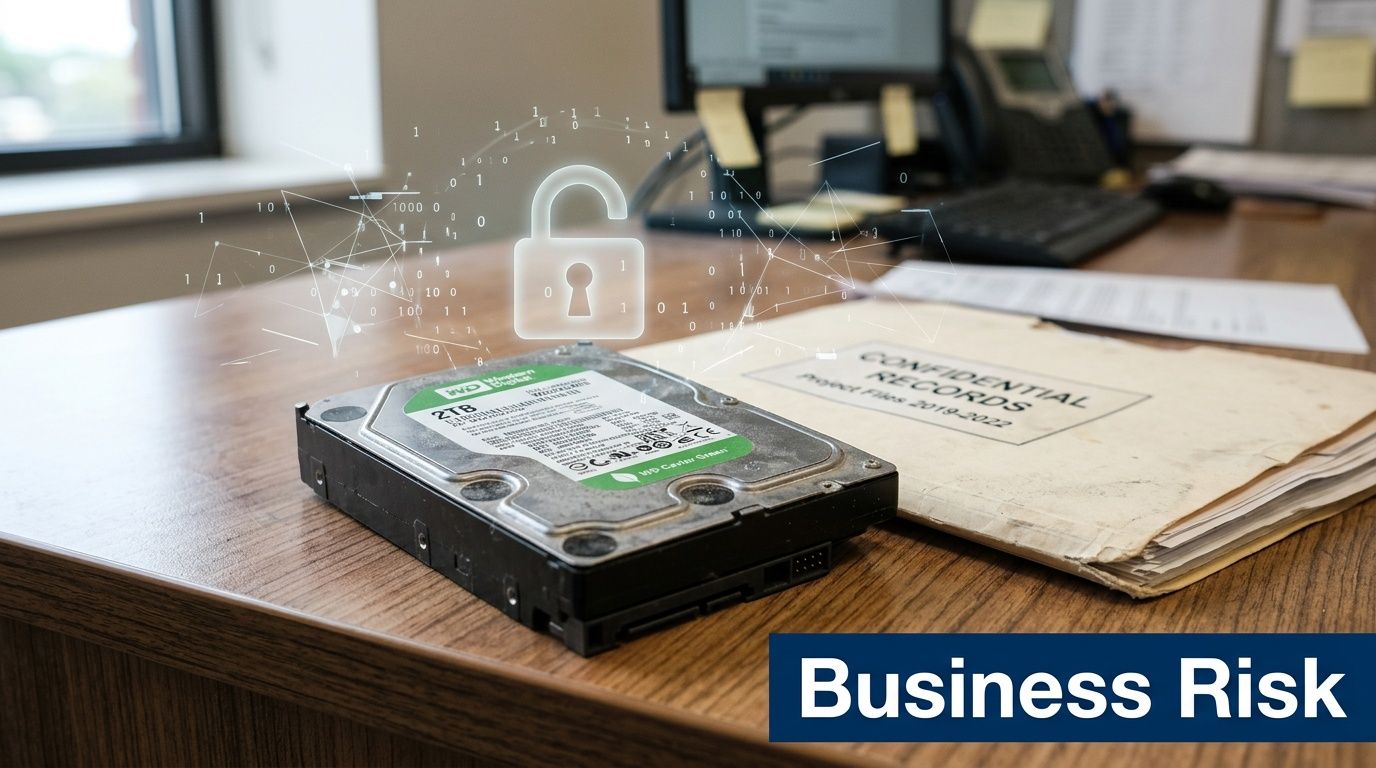
The biggest issue is simple. Businesses need verifiable destruction, not a general assurance that data is probably handled appropriately.
As noted in this review of Staples e-waste recycling and related data security gaps, a major weakness in many retail programs is the lack of specific, verifiable data destruction standards. They may state that data is erased, but they often don’t provide certificates confirming adherence to protocols like DoD 5220.22-M.
For a household, that may be an acceptable risk decision. For a medical office, law firm, accounting firm, bank, manufacturer, school, or government contractor, it usually isn’t.
Chain of custody breaks faster than people think
A common internal process looks harmless on paper. Someone from IT or operations loads old devices into a car, drives to a store, drops them off, and keeps the receipt.
That process creates several weak points:
- Who verified the inventory? If a device goes missing, many teams won’t know until much later.
- Who confirmed serial numbers? Without an asset-level log, the handoff is hard to reconstruct.
- Who documented drive sanitization? A drop-off receipt doesn’t answer that question.
- Who controlled the devices during transport? Personal vehicles and ad hoc handoffs complicate accountability.
This is why I compare retail recycling to paper disposal. Putting confidential records in a public paper recycling container isn’t the same as using a shredding vendor that provides locked bins, witnessed destruction, and a certificate afterward.
The same principle applies to electronics.
If your auditor asks, “Show me exactly what happened to this laptop and its drive,” convenience stops being the deciding factor.
Compliance needs records, not assumptions
Managers often ask whether a store receipt is enough. Usually, it isn’t. A business disposal record should connect the asset, the date, the transfer, the data destruction method, and the final disposition.
What a regulated organization usually wants is a package that includes:
| What the business needs | Why it matters |
|---|---|
| Asset inventory | Confirms what left the site |
| Chain-of-custody record | Shows who controlled the equipment |
| Data destruction record | Supports internal policy and audits |
| Final disposition reporting | Proves reuse, resale, or recycling path |
Retail programs don’t always fail on these points. They aren’t built around them.
The false comfort of “we wiped it ourselves”
Internal wiping can be appropriate when a company has the tooling, process discipline, and documentation to support it. Many don’t.
In practice, teams run into predictable problems. Drives fail before wipe completion. Devices won’t boot. Staff members skip verification. Equipment sits around after “wiping” and gets mixed back into active inventory or moved without records.
That’s why many Atlanta businesses eventually move away from ad hoc disposal and toward an ITAD process with documented controls. This review of Best Buy recycling from a business perspective highlights similar trade-offs that show up across consumer-facing programs.
Montclair Crew A Professional ITAD Partner for Atlanta Organizations
For organizations in Metro Atlanta, the better alternative to consumer-style disposal is a professional IT asset disposition workflow. That means the recycler doesn’t just accept devices. The recycler manages pickup, tracking, data destruction, reporting, and downstream disposition as part of one controlled process.
That distinction differentiates “recycling electronics” from handling retired business technology correctly.
What a business-grade process looks like
A professional ITAD partner serving Atlanta organizations typically starts at the client site, not at a retail counter.
That changes the entire risk profile.
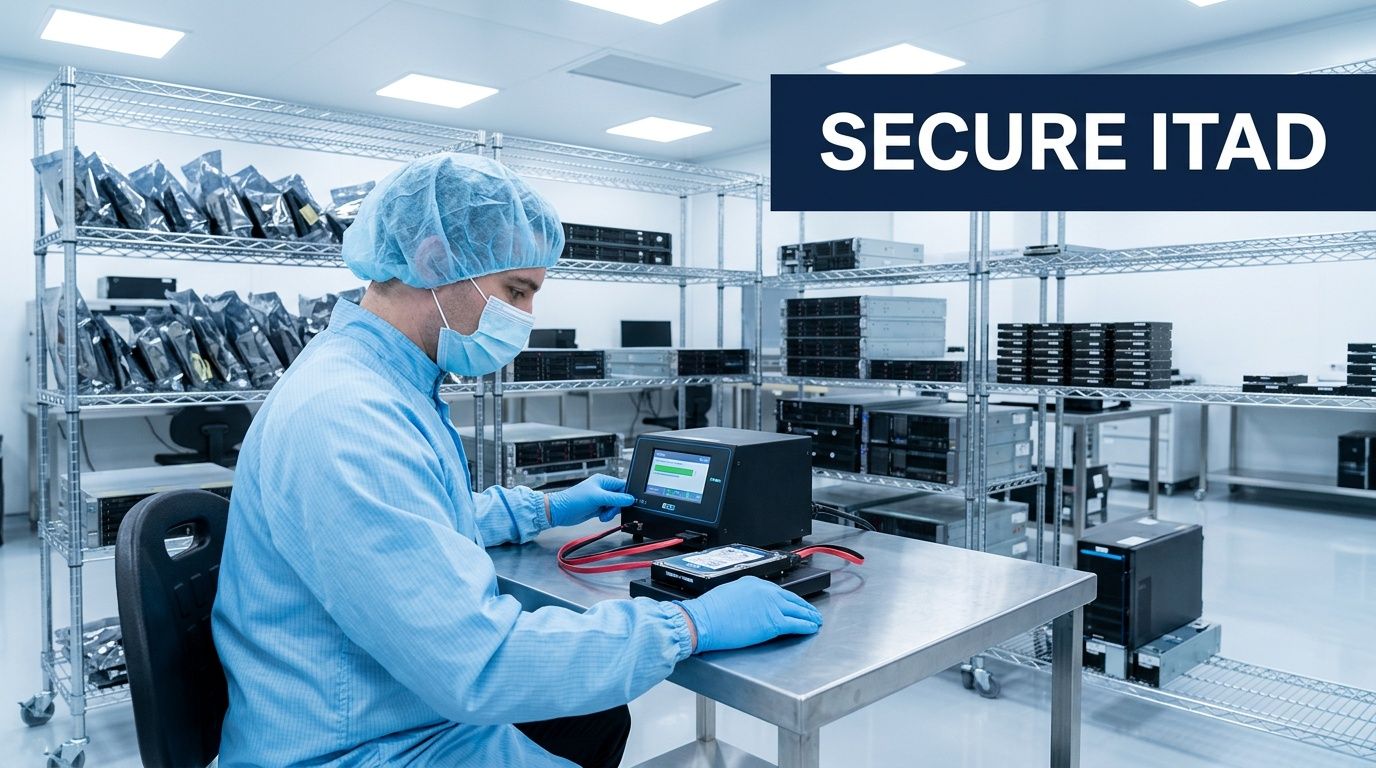
Instead of asking office staff to box hardware and figure it out, the service can include on-site removal from offices, server rooms, and data center spaces. Equipment is logged, staged, and moved through a more controlled handoff.
The practical upgrades usually include:
- On-site pickup and removal: Useful for offices, schools, healthcare sites, and rack environments.
- Asset audit and logistics: The outgoing inventory gets documented instead of guessed at.
- Certified data destruction: Drives can be wiped under a defined method, and physical shredding can be offered when needed.
- Environmental disposition: Reuse, resale, and recycling are handled through a business process rather than a consumer drop-off flow.
Why Atlanta businesses care about on-site control
On-site service solves problems retail programs can’t address well.
A facilities manager doesn’t want to move pallets of mixed electronics through public retail space. A healthcare office doesn’t want old workstations sitting in the lobby while staff take turns driving them to a store. A data center team needs technicians who understand servers, rails, switches, and decommissioning workflow.
Those are logistics issues first. Security issues second. Compliance issues throughout.
Field reality: The biggest disposal mistakes usually happen before the equipment reaches the recycler. They happen during internal handling, temporary storage, and informal transport.
A specialized local provider can reduce that exposure by taking custody where the equipment sits.
Data destruction that businesses can defend
For sensitive devices, generic assurances aren’t enough. A stronger process includes DoD 5220.22-M three-pass hard drive wiping, with optional on-site shredding for organizations that need physical destruction or a higher-assurance chain of custody.
That matters in sectors where the question isn’t “Was the data probably erased?” but “Can we document exactly how this was done?”
Examples where that difference matters:
- Healthcare practices retiring front-desk PCs and imaging workstations
- Banks and finance teams disposing of desktops, branch equipment, and storage media
- Schools and colleges handling student and staff records
- Government agencies and contractors operating under tighter policy requirements
The value recovery issue most companies miss
Not every retired asset is scrap. Some equipment still has resale or reuse value, especially in business environments where refresh cycles remove functioning hardware before the end of its practical market life.
That’s where retail programs leave money on the table. According to Staples’ own business recycling materials discussed on their corporate recycling solutions page, a major gap in retail-style programs is the lack of transparent asset valuation and value recovery. Specialized B2B recyclers, by contrast, may offer profit-sharing or resale for functional equipment such as servers and networking gear.
That changes the economics of disposition.
A business-grade ITAD process can sort assets into different lanes:
| Asset outcome | What it means for the business |
|---|---|
| Resale | Functional gear may generate recovery value |
| Redeployment | Useful hardware can stay in service internally or through approved channels |
| Parts harvesting | Some equipment has component value even when the full unit doesn’t |
| Recycling | End-of-life material still needs compliant handling |
A closet full of retired equipment often contains all four categories at once. Retail recycling treats most of it as one category. Professional ITAD does not.
Comparing Staples Recycling to a Specialized ITAD Service
A manager choosing between a retail program and a specialized ITAD provider doesn’t need marketing language. They need a side-by-side business decision.
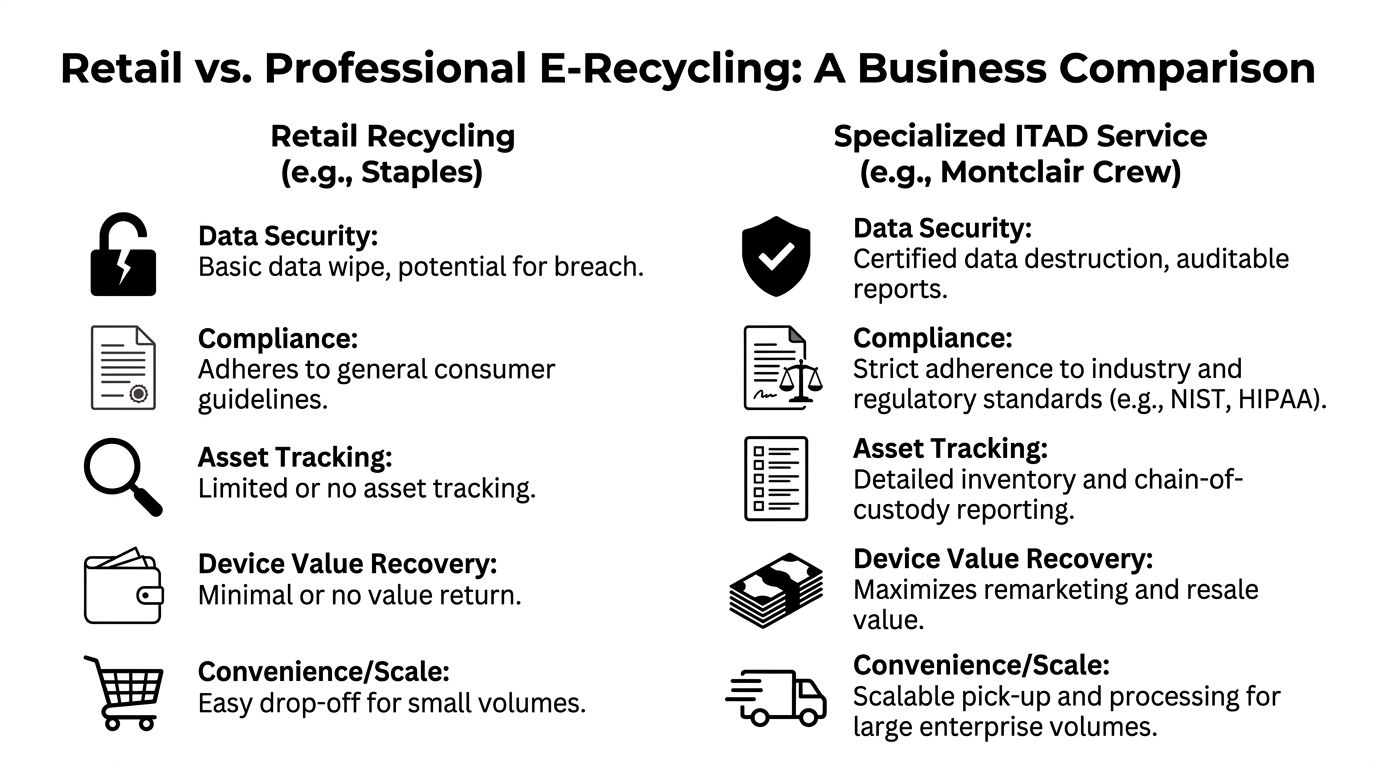
Data security
Retail recycling is usually built around collection first. Secure destruction may happen downstream, but the public-facing process often doesn’t give a business the level of detail it needs.
A specialized ITAD service is built around documented control. That can include serial-level tracking, formal wipe procedures, and optional on-site shredding for drives that shouldn’t leave the premises intact.
Compliance and reporting
A retail handoff usually produces a simple proof of drop-off. That may be enough for a household.
A business often needs more than a receipt. It needs a record set that supports internal policy, customer expectations, and external audits.
Logistics and scale
The operating model tells you a lot. Staples’ B2B option relies on customers filling and mailing 20x20x20 inch boxes with a 70-pound limit, as shown on the Staples business recycling box listing. That can work for small, shippable batches.
It doesn’t fit a branch closure, office move, floor-by-floor refresh, or server decommissioning project. Specialized ITAD providers handle on-site removal, bulk loads, and equipment that doesn’t belong in parcel boxes.
Asset value recovery
Regarding this, finance and IT often perceive the world differently.
Retail recycling is disposal-oriented. It may be responsible, but it usually doesn’t focus on extracting residual value from enterprise gear.
A specialized ITAD provider can identify equipment suitable for resale, refurbishment, or component recovery. That gives the organization a chance to offset part of the refresh cost instead of treating everything as waste.
A fast scan for decision-makers
| Decision point | Retail recycling | Specialized ITAD |
|---|---|---|
| Best use case | Small, simple batches | Business projects and regulated assets |
| Security posture | General process | Documented destruction options |
| Reporting depth | Limited | Audit-ready records |
| Logistics | Customer drop-off or mail-back | On-site pickup and removal |
| Value recovery | Usually minimal visibility | Resale and recovery options when applicable |
| Equipment scope | Standard office electronics | Office gear, servers, network hardware, mixed IT loads |
Retail is a convenience channel. ITAD is an accountability channel.
Businesses that are comparing providers in this category should understand the service model, not just the recycling claim. This overview of IT asset disposition companies is a useful benchmark for that evaluation.
Your Next Steps for Compliant Electronics Recycling in Atlanta
Once a business decides not to use a consumer drop-off route, the process usually gets easier, not harder. A professional ITAD engagement is straightforward when the scope is clear.
For Atlanta organizations, the main goal is to replace ad hoc disposal with a repeatable workflow.
Step one is to define the equipment
Start with a basic list. It doesn’t need to be perfect.
Include what you know:
- Device types: laptops, desktops, monitors, servers, switches, printers, phones
- Approximate volume: a few items, one room, multiple offices, or a rack environment
- Sensitivity: whether devices may contain regulated or confidential data
- Location details: office suite, clinic, school campus, warehouse, or data center
That short inventory is enough to begin a serious conversation.
Step two is to ask the right operational questions
Before scheduling anything, confirm the details that affect risk and cost:
- Will pickup happen on-site?
- Will the provider document the outgoing assets?
- What data destruction method will be used?
- Can the business receive a certificate of destruction or similar reporting?
- Will functional equipment be reviewed for resale or recovery value?
Those questions separate routine hauling from actual IT asset disposition.
Step three is to schedule around operations
Most businesses don’t want disposal projects disrupting workdays. Good planning usually means scheduling around staff access, elevator use, loading dock windows, medical operations, or branch hours.
For a local starting point, Atlanta organizations can review options for electronics recycling in Atlanta and use that to frame a project based on location, equipment type, and security needs.
Step four is to close the loop with documentation
The job isn’t finished when the truck leaves. It’s finished when the company has the records it needs.
That usually includes confirmation of pickup, disposition details, and data destruction documentation where applicable. Those records are what make future audits, internal reviews, and policy checks much easier.
Common Questions About Secure Business E-Waste Disposal
What if we only have a few computers
That depends on the provider and the sensitivity of the equipment. A small batch can still justify professional handling if the devices contain patient information, HR records, financial data, or internal credentials.
Volume matters less than risk. Three laptops from an executive team can deserve tighter controls than a larger batch of low-risk accessories.
Why can’t our IT team wipe the drives themselves
Sometimes they can. The primary question is whether they can do it consistently, verify it, and document it.
In many offices, internal wiping fails for ordinary reasons. Devices don’t boot, staff time gets pulled elsewhere, old hardware sits waiting for review, and nobody produces a final report tying the serial number to the sanitization result. The technical task is only part of the requirement. The recordkeeping matters just as much.
What happens to the equipment after pickup
A proper ITAD process sorts equipment by condition and business value. Some devices may be suitable for resale or refurbishment. Others may be harvested for parts. End-of-life material moves into certified recycling streams.
That distinction is important because “recycling” is often used as a catch-all term. In practice, the best outcome for a usable device is usually reuse, not destruction.
Do certificates of destruction really matter
Yes, when the organization has compliance obligations or wants a defensible audit trail.
A certificate doesn’t replace internal policy, but it helps prove that the business used a controlled process. Without documentation, companies often rely on memory, store receipts, or informal notes. That’s weak support if a customer, auditor, or regulator asks questions later.
Which organizations should avoid retail drop-off programs
Any organization handling sensitive information should pause before using a consumer workflow. That includes healthcare providers, banks, schools, manufacturers, government entities, legal offices, and companies with contractual security requirements.
Retail programs can still have a place for low-risk accessories or very small volumes. They’re just not the default best answer for professional IT assets.
If your team is clearing out old business electronics in Metro Atlanta, Montclair Crew Recycling can help with on-site pickup, asset audit and logistics, secure DoD 5220.22-M three-pass hard drive wiping, optional on-site shredding, compliant recycling, and value recovery when equipment is suitable for resale. It’s a practical way to move retired IT assets out of storage without creating new security or compliance problems.
