
When your Metro Atlanta business has old IT hardware to get rid of, you have two very different paths. The Best Buy recycling program is built for consumers dropping off an old TV or laptop. A specialized B2B IT Asset Disposition (ITAD) provider, on the other hand, is designed for the security, compliance, and scale that businesses require.
Your choice comes down to one simple question: do you need to toss a single, non-sensitive device, or do you need certified, documented disposal for corporate assets loaded with private data?
Choosing Your E-Waste Partner: Best Buy vs. B2B ITAD
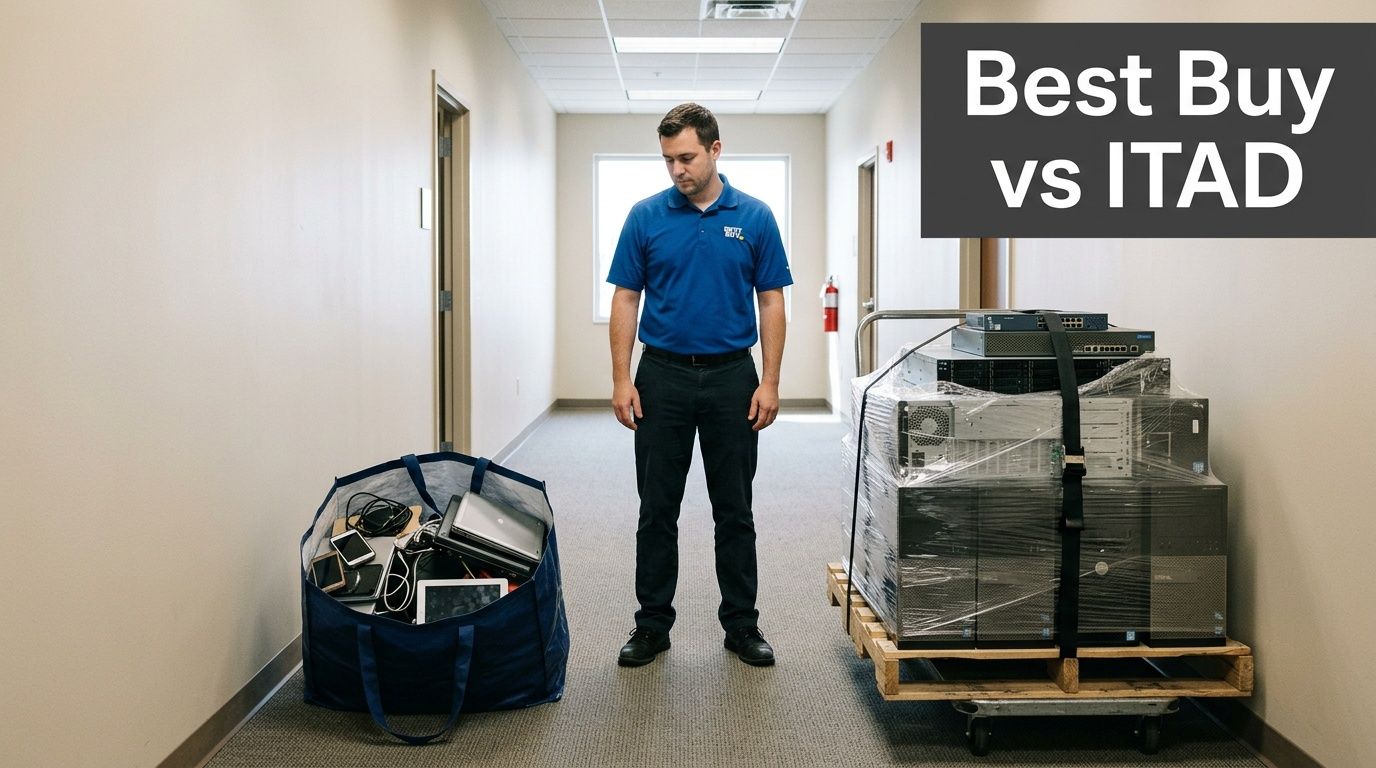
When a company’s technology reaches its end of life, the disposal choice you make has real consequences. For Atlanta businesses, it's often a decision between easy convenience and managing serious risk.
While it’s tempting to just use Best Buy’s free and accessible program, it simply wasn't built to meet the tough standards most companies need to follow.
This guide gives you a straight-up comparison of these two e-waste solutions. We're looking at them from the perspective of a business owner, IT manager, or compliance officer who has to worry about data security, regulations, and keeping operations smooth. The goal here isn't just to list what they take, but to get into the details that actually protect your business.
Uncovering the Critical Differences
The real gap between these services shows up when you look at what a business actually needs. A retail drop-off is worlds apart from a true disposition partnership. One is a public service for individuals; the other is a risk management strategy for businesses.
The real issue is accountability. With a retail program, you and your company are 100% responsible for data security and compliance. A professional ITAD service contractually takes on that responsibility, giving you a documented, auditable paper trail.
This isn't a small detail—it's the line between facing a potential lawsuit and having certified protection. Understanding this is the first step to making the right call for your company's old equipment.
To make it crystal clear, let's break down how each one handles what matters most to a business.
| Feature | Best Buy Recycling Program | B2B ITAD Provider (like Montclair Crew) |
|---|---|---|
| Primary Audience | Individuals and households | Businesses, schools, healthcare, government |
| Data Destruction | Your responsibility; no proof provided | Certified data wiping and physical shredding |
| Compliance Docs | None | Certificate of Destruction and Recycling |
| Logistics | You drop it off (limit 3 items/day) | Scheduled, secure on-site pickup for any volume |
| Value Recovery | Limited trade-in on certain consumer gadgets | Asset remarketing for potential profit-sharing |
| Liability | You assume all risk for a data breach | The provider assumes liability with a secure process |
This table shows the fundamental difference between a consumer convenience and a business-grade solution. Best Buy offers a fantastic environmental service for the public, but it doesn't have the security or compliance framework that companies need.
When your company's reputation and legal status are at stake, picking the right partner is everything. You can check out our guide to learn more about choosing from the top IT asset disposition companies that fit your specific needs.
How Best Buy's Consumer Program Works
Best Buy’s recycling program is, without a doubt, a massive success for consumer e-waste. It's built for convenience, letting anyone drop off a couple of old electronics at their local store anywhere in the country. For its target audience—households trying to get rid of a broken tablet or a box of old cables—it works beautifully.
The whole process is dead simple. You walk into a Best Buy, head to the customer service desk, and hand over your accepted items. No appointments, no complicated forms. It's a frictionless way for the average person to do the right thing and keep electronics out of the landfill.
But for a business, this simple model breaks down almost immediately. The very convenience that makes it great for a family recycling a VCR becomes a logistical nightmare and a security risk for a company.
The Limits for Business Use
The program's rules are designed around household-level recycling, not a corporate IT refresh. The biggest roadblock is the limit: three items per household, per day. If your company needs to decommission dozens of laptops, monitors, and servers, this is completely unworkable.
Imagine sending employees on daily trips to Best Buy for weeks on end. It's an insane waste of time and money. On top of that, the program isn't set up to take the kind of specialized gear businesses use, like network switches, rack servers, or other proprietary equipment.
The core issue is that the Best Buy recycling program is a disposal service, not a disposition solution. It helps consumers get rid of waste, but it doesn't provide the secure, documented process that protects a business from data liability and regulatory penalties.
For example, Best Buy is very clear that you are responsible for wiping your own data. They don't offer certified data destruction, and they certainly don't issue a Certificate of Data Destruction. For any organization dealing with HIPAA, FACTA, or GDPR, that certificate is non-negotiable. This lack of a documented chain of custody puts all the risk right back on your company's shoulders.
A Program Built for Consumers
Since it started in 2009, the program has collected over 1 billion pounds of electronics and appliances. In just one recent year, four million people dropped off nearly 86 million pounds of electronics. That's a testament to its incredible reach and impact on helping individuals avoid contributing to the 17 million tonnes of e-waste the U.S. generates annually.
This consumer-first approach is perfect for personal items. If you’re upgrading your own Mac, for instance, you might want to see what your options are for an Apple-specific recycle program. The Best Buy model is great for that one broken printer from your home office or an old gaming console.
But it’s no replacement for a professional IT Asset Disposition (ITAD) service. Not when you're dealing with devices that held sensitive corporate, client, or employee data. The potential cost of a data breach from a single improperly wiped hard drive is infinitely higher than the convenience of a retail drop-off.
The Specialized B2B ITAD Service Alternative
While the Best Buy recycling program works for everyday consumers, businesses play by a completely different set of rules and face much higher risks. That’s where a specialized B2B IT Asset Disposition (ITAD) provider comes in. They are built specifically to handle the volume, security, and complex needs of an organization.
Unlike a retail store with daily drop-off limits, an ITAD service is designed for bulk. We handle everything from a small office cleanout with a dozen devices to a full-scale data center decommissioning involving thousands of assets. The entire service is focused on one thing: secure, auditable, and compliant disposal of corporate electronics.
This isn't just about picking up old gear. It's a structured process centered on airtight security from start to finish.
Security and Compliance Are Front and Center
For a true ITAD specialist, data destruction isn't just a step in the process—it's the most critical part. We provide certified data destruction methods that meet the strict standards required by industries like healthcare, finance, and law.
This typically involves:
- Multi-pass data wiping: Using specialized software to overwrite data multiple times, making it impossible to recover. This process often follows the DoD 5220.22-M standard.
- Physical shredding: For hard drives that can't be wiped or when you need absolute certainty, the drives are physically shredded into tiny pieces. We can even bring a shredder to your location for you to witness the destruction firsthand.
This absolute focus on certified data destruction is what separates a real business solution from a consumer drop-off bin.
The single biggest value an ITAD provider offers is the transfer of liability. When you get a Certificate of Data Destruction, you have the legal proof needed to show your company's data was properly destroyed, shielding you from massive fines and lawsuits after a breach.
This paperwork is non-negotiable for proving compliance with regulations like HIPAA, FACTA, and GDPR. For any organization managing a fleet of devices, it's crucial to look at your options for corporate electronic asset recycling to guarantee this level of security.
End-to-End Logistical Management
Another key difference is total logistical control. A B2B provider doesn’t make you haul your equipment to them; we manage the entire process for you, starting with a secure, on-site pickup using locked trucks and trained staff.
From that point on, every single asset is tracked. Once at our secure facility, each device is inventoried and its serial number is recorded. This builds a complete chain-of-custody document, giving you a clear audit trail from your door to final disposal and ensuring no device ever goes missing.
Finally, what about equipment that isn't quite ready for the shredder? For gear that still has life in it, many ITAD partners offer remarketing and resale services. This isn't just about responsible recycling; it’s about recovering money from your retired assets. By refurbishing and selling working equipment, an ITAD provider can turn a disposal cost into a check written back to your company.
Service Comparison For Atlanta Businesses
When you’re trying to make a smart decision for your company, you have to look past the surface. The convenience of the Best Buy recycling program might seem appealing, but it often conceals major gaps in security, logistics, and compliance—the very things that are non-negotiable for any business.
Let’s put Best Buy head-to-head with a professional ITAD service like Montclair Crew. We’re going beyond the simple drop-off and looking at what really matters for an Atlanta business: protecting your data, proving you’re compliant, and keeping your operations running smoothly. This isn't just about getting rid of old gear; it’s about managing your risk and upholding your responsibilities.
Data Security And Destruction
This is where the two options couldn't be more different. For any business, a single hard drive filled with sensitive information—customer lists, employee records, financial data—is a ticking time bomb.
With Best Buy, the responsibility for wiping that data is 100% on you. Their policy is crystal clear: you must erase everything before you walk in the door. They don't offer data destruction services, and more importantly, they give you zero proof that your data was handled securely. For any company subject to data privacy laws, this "trust us" model is a complete non-starter.
A B2B ITAD specialist, on the other hand, builds their entire service around certified data destruction. A provider like Montclair Crew gives you multiple, auditable methods to make sure your data is gone for good. This can mean multi-pass data wiping that meets strict DoD 5220.22-M standards or even on-site physical shredding, where you can literally watch your hard drives get turned into a pile of metal fragments.
It all comes down to the difference between assumption and certification. With Best Buy, you just assume your data is gone. With an ITAD provider, you get a Certificate of Data Destruction—the legal proof you need to pass audits and protect your business from liability.
A true business solution goes far beyond a simple drop-off.
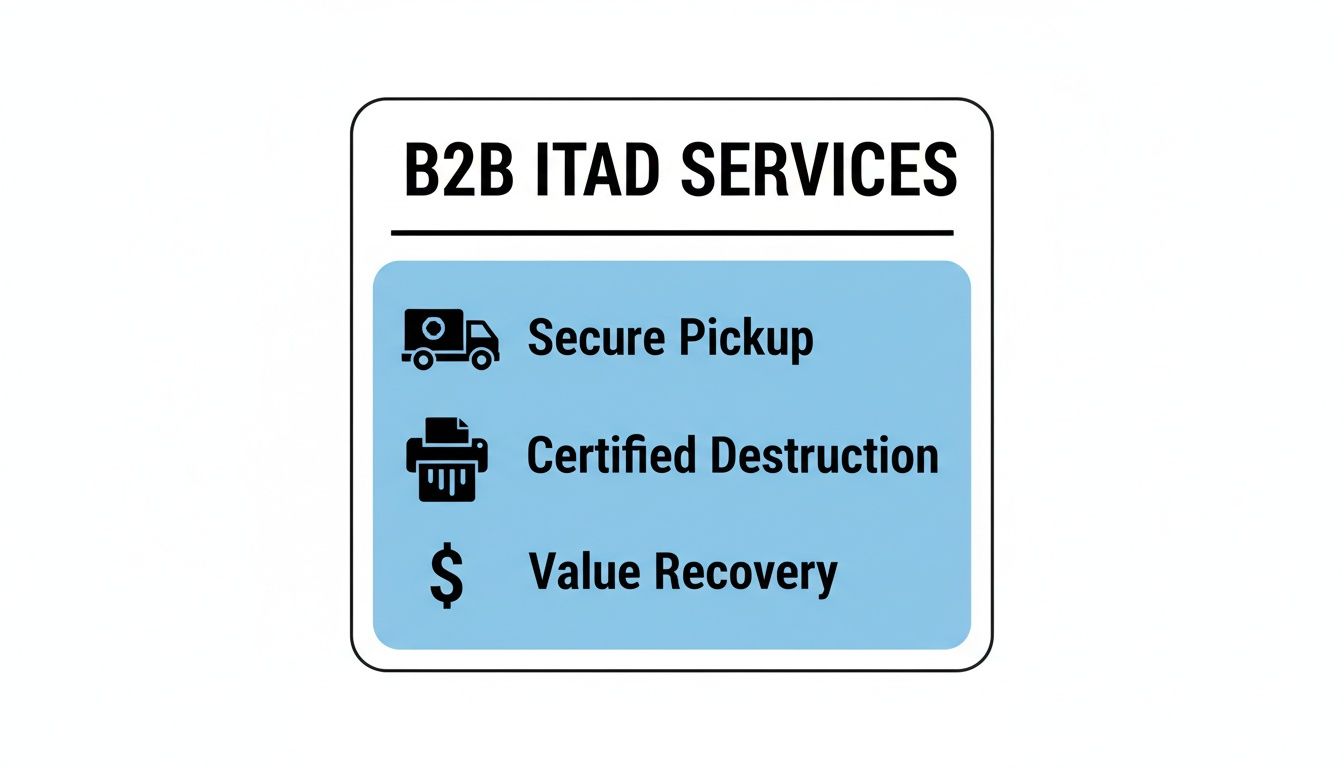
As you can see, a real partner integrates secure pickups, certified destruction, and even value recovery into one seamless process.
Logistics And Scale
How do you get your old equipment from your office to the recycling facility? The answer to that question reveals which service is actually built for business.
The Best Buy program has a hard limit: three items per household, per day. If your business is decommissioning a small office with just 20 laptops and monitors, you’d have to make seven separate trips. The hidden costs in employee time, gas, and sheer inefficiency make this completely impractical for any corporate environment. Plus, you’re on your own for all the transportation.
A B2B ITAD specialist handles all the logistics for you. They’ll schedule a single, secure pickup at your location, whether you have 10 assets or 1,000. Trained pros show up with the right equipment to safely pack and transport everything—from heavy servers and network racks to desktops and printers. It’s an end-to-end service designed for business reality.
Here's a quick look at how the services stack up side-by-side.
Service Comparison: Best Buy vs. B2B ITAD Specialist
For Atlanta-area businesses weighing their electronics recycling options, the differences are stark. This table breaks down the key features that matter most.
| Feature | Best Buy Recycling Program | B2B ITAD Specialist (e.g., Montclair Crew) |
|---|---|---|
| Data Destruction | Not offered. Customer is 100% responsible for wiping data. | Certified services, including DoD-compliant wiping and physical shredding. |
| Proof of Destruction | None provided. | Issues a legally-defensible Certificate of Data Destruction. |
| Logistics | Customer must transport items. Limited to 3 items/day. | Secure, scheduled pickups at your location for any volume of equipment. |
| Documentation | No formal paperwork. | Provides a full audit trail: Certificates of Recycling, asset reports, and Chain of Custody documents. |
| Compliance | No support for HIPAA, SOX, etc. | Process is designed to meet compliance standards for regulations like HIPAA, SOX, FACTA, and GDPR. |
| Value Recovery | Not available. | Offers remarketing and profit-sharing for assets that still have market value. |
| Best For | Individuals or households with a few personal items. | Any business, from small offices to large corporations, requiring secure, compliant, and scalable asset disposal. |
The choice becomes clear when you see the gaps. What might work for a personal laptop is simply not a viable risk management strategy for a business.
Compliance And Documentation
For a business, what happens after an item is recycled is just as critical as the act of recycling itself. You need proof of proper disposal for auditors and regulators.
Best Buy's program gives you no formal documentation. You won’t get a Certificate of Recycling or any other paperwork to prove your e-waste was handled in line with environmental laws. This leaves your company with a major compliance gap and no paper trail to defend your actions.
A B2B ITAD specialist makes comprehensive documentation a standard part of the package. You get a full suite of reports, including:
- Asset Reports: A detailed inventory of every single item collected, often down to the serial number.
- Certificates of Recycling: Proof that your equipment was recycled in an environmentally compliant way.
- Chain of Custody: Paperwork that tracks your assets from the moment they leave your office to their final disposition.
This documentation is your shield. It's what you need to satisfy regulations like HIPAA, FACTA, Sarbanes-Oxley (SOX), and GDPR. To see how these services are built specifically for business compliance, you can explore the details of professional Georgia ITAD services that put documentation first.
Cost And Value Recovery
Finally, let's talk money. The financial picture is more complex than just a "free" service versus a paid one, because hidden costs and missed opportunities can add up fast.
With Best Buy, the drop-off might be free, but the "hidden" costs are very real. You have to factor in your team's labor for wiping data and hauling equipment, not to mention the massive financial risk you carry from a potential data breach. On top of that, there's zero chance to recover any value from your old assets.
A B2B ITAD specialist has transparent service costs, but they also open the door to value recovery. If your retired laptops, servers, or other gear still have market value, an ITAD partner can refurbish and resell them through established channels. They often share the profits back with your company, which can turn a disposal expense into a new revenue stream, frequently offsetting or even exceeding the entire cost of the service.
Decision Guide: Which Path Protects Your Business?
Deciding between a quick retail drop-off and a professional disposal service isn't just about convenience—it's about risk. Making the right call protects your business from data breaches, fines, and logistical nightmares. The wrong one can open you up to all three.
Let's cut through the noise. This isn't a complex analysis; it's a practical checklist. Answering a few straightforward questions about your company's equipment will tell you exactly what you need to do.
Think of it as a simple diagnostic. Each question hits on a critical point—data, compliance, or logistics—and points you to the right solution for your specific situation.
What Kind Of Data Is On Your Devices?
We have to start here, because a data breach is the biggest and most expensive mistake you can make when getting rid of old electronics. The average cost of a breach is no joke, running into the millions.
Ask your team this one simple question: Did these devices ever touch sensitive customer, employee, or company financial data?
- If the answer is yes: You need a certified ITAD provider. Period. Company laptops, servers, and even old employee cell phones are full of confidential information. A real ITAD service gives you certified data destruction and a legal Certificate of Data Destruction. That’s your proof the data is gone for good.
- If the answer is no: For gear that never held data—like an old office printer, a conference room TV, or a box of spare cables—the Best Buy recycling program is a perfectly fine and responsible choice.
Never, ever assume a factory reset is good enough. Data recovery software can easily get past basic wipes, leaving your "erased" information out in the open. Professional data destruction uses multi-pass overwriting or physical shredding to make sure that data is 100% unrecoverable.
Honestly, this first question usually settles it. If there's any data involved, the conversation has to move away from retail options.
Do You Need To Prove Compliance?
Regulatory compliance isn't a "nice-to-have." For many industries, if you can't prove you securely destroyed your data, you're looking at serious fines and legal trouble. This is where your paperwork becomes your shield.
Ask yourself: Does my business need a Certificate of Data Destruction or a Certificate of Recycling to stay compliant with HIPAA, FACTA, SOX, GDPR, or other rules?
If you're in healthcare, finance, legal, or handle any kind of personally identifiable information (PII), the answer is a firm yes. A retail program like Best Buy’s simply does not provide this critical documentation. Only a B2B ITAD specialist can give you the auditable paper trail you need to satisfy regulators and cover your liability.
How Much Equipment Are You Recycling?
Logistics have a huge impact on the true cost and hassle of any disposal project. The amount and type of equipment you have will determine if a DIY approach is even possible.
Consider this: Are we just getting rid of a couple of items, or are we dealing with heavy or specialized hardware like servers and networking racks?
Best Buy’s program has a limit of three items per household per day. That just doesn't work for a business. Think about the hidden costs of sending an employee on multiple trips—their salary, fuel, and the work they aren't doing. It adds up fast.
If you have more than a handful of small things, a professional ITAD provider is way more efficient. They show up for a single, scheduled pickup with the right people and gear to handle everything at once, whether it's 10 laptops or 100. This turns a multi-day headache into a quick, secure event and lets your people get back to their real jobs.
The Bigger Picture: Your Company's Role in the E-Waste Problem
To make smart decisions about your company's old tech, you have to understand the scale of the e-waste crisis. It's a massive problem. In fact, electronic waste is the single fastest-growing type of trash produced in homes and businesses across the country, and the United States is one of the biggest contributors on the planet.
For any business, getting rid of old equipment the right way isn't just a "green" initiative—it's a core part of responsible corporate management. While a consumer-facing service like Best Buy recycling is fantastic for public awareness, a business's obligations are far more complex. You need a system that is structured, secure, and fully documented.
The Recycling "Say-Do Gap": Why Good Intentions Aren't Enough
We've all seen it. People say they want to recycle, but when it comes time to act, it doesn't always happen. This is the classic "say-do gap," and it’s precisely why you can’t just hope your employees will handle old company computers and phones correctly.
The numbers don't lie. While a whopping 77% of Americans claim they make an effort to recycle, only 32% of all recyclable materials are ever actually recovered. Even with a more eco-conscious group like Best Buy shoppers, where 22% say they recycle all their appliances versus 18% of the general population, a gap still exists.
This disconnect between what people intend to do and what they actually do is the number one reason businesses need a formal disposal policy. A mandatory, managed program is the only way to guarantee every corporate device is handled correctly, closing that 'say-do gap' at the company level.
This data really drives home the point: you can't afford to leave corporate asset disposal to chance. A business has to ensure its old equipment is properly managed, not just hope for it.
Why a Formal E-Waste Program is Non-Negotiable
Putting a structured e-waste program in place moves the burden of responsibility from individual employees to the organization as a whole. This is a critical shift for a few key reasons. First, it creates a repeatable, secure protocol for every single asset, from a massive data center server to the smallest company smartphone. No more guesswork.
Second, a professional program is far more effective at supporting the circular economy. Any recycling is better than dumping, but specialized ITAD providers are masters at maximizing the recovery of valuable materials. They are also experts at spotting opportunities for refurbishment and reuse, which keeps functional hardware in circulation and reduces the need to mine new resources.
Finally, structured programs are built to handle the sheer volume of business e-waste. The U.S. churns out around 17 million tonnes of e-waste every single year, second only to China's 20 million tonnes. Businesses are a huge part of that stream. Partnering with an ITAD specialist ensures your slice of that mountain is managed responsibly, keeping hazardous materials out of landfills and your sensitive data secure.
You can learn more about the environmental impact of electronic waste and see how your business can become part of the solution. By creating a formal policy, you’re not just dodging security risks—you’re stepping up to help solve a global environmental crisis.
Answering Your Top E-Waste Questions
When it comes to getting rid of old business electronics, you've got questions. And you should. The difference between dropping items at a retail store and working with a professional partner is huge, especially when your company's data and reputation are on the line.
Here are straight answers to the most common questions we hear from Atlanta businesses weighing the Best Buy recycling program against a dedicated ITAD provider like Montclair Crew.
Is Best Buy's Recycling Program Actually Free for My Business?
On the surface, yes, it's free to drop off a couple of items. But for a business, "free" is rarely the whole story. The real costs show up in other places:
- Wasted Payroll: Your team's time is money. Every minute they spend trying to wipe devices, inventory assets, and drive back and forth to a retail store is a direct hit to your bottom line.
- Logistics Headaches: Fuel, vehicle use, and the sheer hassle of being limited to three items per day add up. This just isn't built for business-level volume.
- The Biggest Cost: Risk. The financial and legal exposure from a single data breach is the most expensive "hidden cost" of all. Best Buy doesn't offer certified data destruction, meaning one missed hard drive could cost your company millions in fines and lost trust.
A professional ITAD service gives you a clear, upfront quote. Better yet, that cost is often reduced—or even completely covered—by the money you get back from reselling your newer equipment.
What Really Happens to My Data at Best Buy?
Best Buy is very clear about this: you are 100% responsible for removing all data before you drop anything off. They offer no data wiping services and provide no certificate of destruction.
This is a critical point. If any sensitive company files, customer information, or employee records are left on a device, they are out in the wild. A simple factory reset isn't enough—data is easily recovered with off-the-shelf software. That's a massive security risk and a compliance nightmare waiting to happen.
An ITAD partner like Montclair Crew considers data destruction a non-negotiable part of the process. We provide certified, auditable proof that your data is gone for good, completely eliminating that risk.
Can an ITAD Provider Take More Than Just Computers and Phones?
Absolutely. This is one of the biggest differences. A specialized ITAD provider is built to handle the full range of equipment that keeps your business running. Retail programs are just for common household gadgets.
We manage the entire spectrum of corporate IT assets, including things like:
- Servers and networking gear (switches, routers)
- Data center hardware
- Point-of-sale (POS) systems
- Medical and laboratory equipment
- Business phone and telecommunications systems
An ITAD service handles everything from secure pickup and certified data destruction to responsible recycling or remarketing. It's a comprehensive solution that a consumer drop-off program simply can't match.
Ready to make sure your company's e-waste is handled securely, compliantly, and efficiently? Montclair Crew Recycling provides certified, end-to-end IT asset disposition services for Metro Atlanta businesses. Contact us today to schedule your secure pickup.
