
If you're running a business in Atlanta, you know the scene: a storage room, closet, or corner of the warehouse is slowly being taken over by old servers, desktops, laptops, and monitors. What do you do with all of it? More importantly, how do you get rid of it without risking a data breach or running into trouble with environmental regulations?
To recycle electronics in Atlanta, your best bet is to team up with a certified, local recycler. This isn't just about clearing out space; it's about protecting your business from top to bottom.
Why Your Business Needs a Real Plan for Old IT Gear
That pile of outdated equipment is more than just clutter—it's a massive liability waiting to happen. Tossing an old company computer or a box of hard drives into the dumpster isn't just bad practice; it can lead to some serious fallout. A solid IT asset disposition (ITAD) strategy is non-negotiable for any modern business. It's how you protect your reputation and even turn those potential liabilities back into assets.
A good ITAD plan is all about creating a secure chain of custody for every single device, from the moment it leaves your office to its final destination. This means:
- Wiping the Data for Good: You need to be sure that every byte of client information, every financial record, and all your internal data is completely and permanently destroyed.
- Staying Compliant: Many industries have strict rules like HIPAA or PCI DSS that come with hefty fines for mismanaging data. A proper recycling plan keeps you on the right side of those regulations.
- Being Environmentally Responsible: Old electronics are full of toxic stuff like lead and mercury. Proper recycling ensures these materials don't end up poisoning local landfills and groundwater.
The Problem with Just Tossing It in the Bin
You can't rely on the city's regular waste services for business electronics. It's just not set up for it. A recent audit of Atlanta's recycling program revealed its curbside diversion rate was only 23%, with contamination levels hitting over 20%. These numbers show exactly why you need a specialized e-waste service. Without it, your equipment won't be handled correctly, and valuable materials will just end up lost in a landfill.
It's simple: your old server can't go in the same bin as your office paper. The data security and environmental risks are just too high. This gear needs expert handling.
As you set up your business's e-waste recycling service here in Atlanta, understanding effective local SEO strategies can make a huge difference in connecting with the right customers and showing your commitment to doing things the right way. A smart approach doesn't just solve a logistical headache—it gives you peace of mind about your data and your environmental impact.
For a complete breakdown of your options, check out our guide to how to recycle in Atlanta, which covers the process for both businesses and residents.
Choosing Your Logistics: On-Site Pickup vs. Drop-Off
So, how do you actually get your old equipment from your office to a recycling facility? When it comes to how you’ll recycle electronics in Atlanta, this is your first big decision. You basically have two paths: schedule a professional on-site pickup or handle the drop-off yourself.
There’s no single "best" answer here. The right choice really hinges on the amount of gear you have and how sensitive the data is.
A small marketing agency in Midtown with a dozen old workstations could probably manage a drop-off just fine. For smaller batches of non-sensitive equipment, loading up a vehicle and heading to a certified facility is straightforward. You control the timing, and it can be a simple, budget-friendly solution.
But what if you're a healthcare provider in Sandy Springs decommissioning an entire floor of computers? We’re talking massive volume and highly sensitive patient data. In that scenario, an on-site pickup service isn't just a convenience—it's a necessity.
Why On-Site Pickups Are Critical for Larger Projects
For any company with a significant amount of equipment or strict compliance needs, an on-site pickup is the gold standard for security and efficiency. It’s a completely different level of service.
Instead of your team doing the heavy lifting, professional technicians come directly to you. They securely pack and inventory everything, providing a clear chain-of-custody document before a single piece of equipment leaves your building. This process is built from the ground up to minimize risk—both for data exposure and for straining your internal resources.
This flowchart can help you visualize the decision.
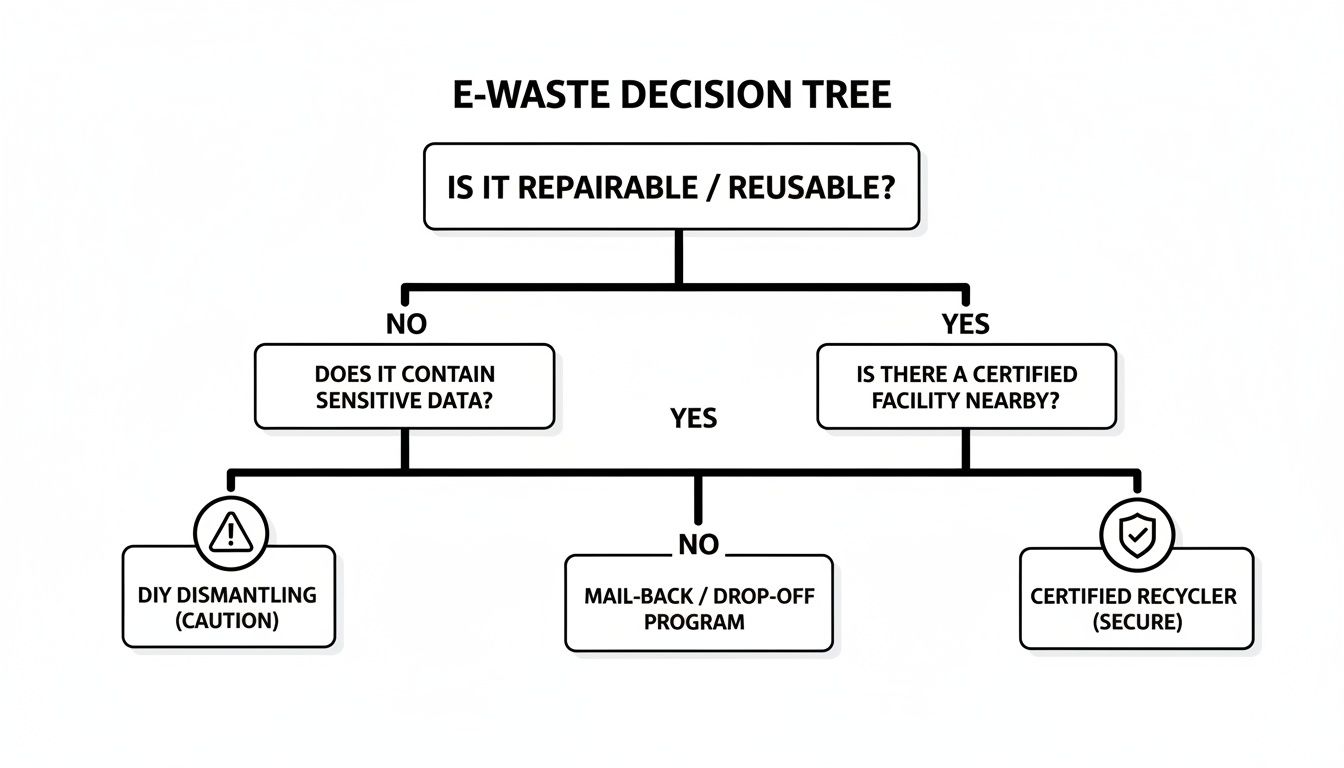
For business assets, the liability tied to data security and environmental rules almost always points toward partnering with a certified recycler. It's just smart business.
A Quick Comparison
Let's break down the practical differences between a professional pickup and a DIY drop-off.
On-Site Pickup vs. Drop-Off Logistics for Atlanta Businesses
| Feature | On-Site Pickup Service | Drop-Off Location |
|---|---|---|
| Best For | 10+ items, sensitive data, heavy equipment, large-scale cleanouts. | Fewer than 10 items, non-sensitive data, small businesses with transport. |
| Convenience | We handle all logistics, packing, and heavy lifting at your location. | You are responsible for inventory, packing, loading, and transportation. |
| Security | Secure chain of custody from the moment we arrive. Ideal for regulated industries. | You are liable for the equipment and data until it is checked in at the facility. |
| Cost | Often free for qualifying business pickups, saving you valuable staff time. | No direct service fee, but incurs costs in staff hours and transportation. |
| Time Investment | Minimal. You schedule a time, and our crew handles the rest. | Requires significant internal coordination and time away from core business tasks. |
While a drop-off seems simple enough, the hidden costs in employee time and transport can add up quickly.
Evaluating the Best Fit for Your Business
Think about the true cost of each approach. A drop-off might not have a line-item fee, but how many staff hours will it take to inventory, load, and transport everything? Is pulling your IT team away from their core duties really the best use of their time?
On the flip side, an on-site service is designed to take that entire burden off your shoulders.
The most important factor is often overlooked: risk. A professional pickup service transfers the liability for the equipment from your company to the recycling partner the moment it’s loaded onto their truck.
That transfer of liability is huge. For companies retiring hundreds of devices, managing that process internally is a massive operational headache and a significant risk.
Many businesses find that once they learn about the advantages of a free electronics recycling pickup service, the decision becomes much clearer. It combines professional handling with unmatched convenience, protecting your data, your employees' time, and your company's bottom line.
A smooth pickup in Atlanta doesn't just happen on the day the truck arrives. Honestly, the real work happens beforehand. Getting your IT assets prepped and ready is the single most important thing you can do to guarantee a secure, efficient handover and avoid any last-minute headaches.
First things first, you need a solid inventory list. Don't just jot down "50 desktops and 30 monitors." We need the details: asset tags, serial numbers, makes, and models for every single piece of equipment. Think of this list as more than just a packing slip—it's the start of your audit trail, a clear record of exactly what's leaving your control.
Once you have your list, get everything into one spot. A locked storage room, an empty office, even a designated corner of your warehouse will work perfectly. Having it all consolidated makes the actual pickup go incredibly fast and keeps our team from disrupting your day-to-day operations.
Don't Sweat the Big Stuff, It's the Small Details That Bite You
We've seen it all. The big picture stuff, like getting the computers together, is usually handled. It's the little things that end up causing delays and frustration. You really have to walk through the physical path the equipment will take from its current spot to our truck on the loading dock.
Here are a few common logistical tripwires we see all the time:
- Forgetting the Extras: Did you remember to detach and keep all your proprietary keyboards, mice, or special cables you plan on reusing?
- Access Roadblocks: Does the loading dock have specific hours? Is there a security check-in process our crew needs to follow? Does the freight elevator require a special key or badge access?
- Basic Data Hygiene: We handle the certified data destruction, but it’s always a good practice to do a basic wipe of non-critical devices beforehand. If you need a hand with that, our guide on how to wipe a computer before recycling walks you through it.
Just giving us a heads-up on these details makes a world of difference. A quick email letting us know about a narrow hallway or a tricky loading dock can save everyone an hour of trying to solve the problem on-site.
Prepping for More Complex Projects
Of course, not every job is a simple office cleanout. When you're dealing with extensive IT infrastructure, things get more complicated. Large-scale projects, especially those involving specialized data center services, often require a much more detailed chain-of-custody protocol and coordination across multiple departments.
Ultimately, all this prep work has one goal: making the actual handover a complete non-event. When you create that clear inventory, secure the assets, and communicate the logistics, you're setting us all up for success. This diligence is how you ensure that when you recycle electronics in Atlanta, the entire process is professional and secure from the moment we walk in the door.
Understanding Certified Data Destruction Methods
When your business is ready to recycle electronics in Atlanta, the physical hardware is honestly the least of your concerns. The real risk—the thing that should keep you up at night—is the sensitive data living on hard drives, servers, and all those company phones.
Certified data destruction isn't just a "nice-to-have." It's an absolute must to protect your company, your clients, and your hard-earned reputation from a data breach.
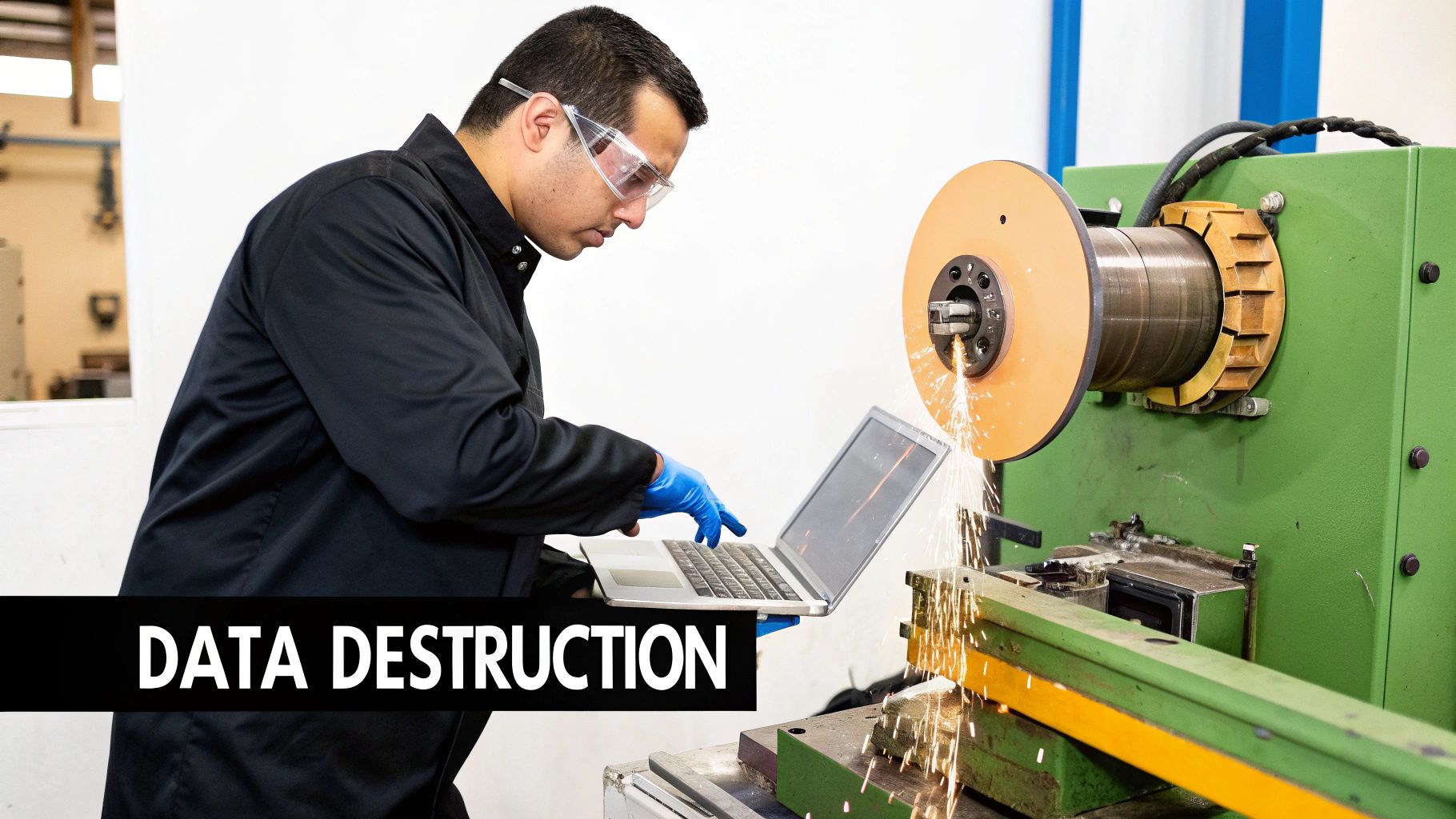
Simply handing over old equipment without a rock-solid guarantee that the data is gone forever is a massive gamble. This is exactly why professional, verifiable destruction methods are non-negotiable. You’ve really got two industry-standard routes to go: software-based wiping or old-fashioned physical destruction.
Software Wiping Versus Physical Shredding
Deciding between wiping and shredding usually comes down to your industry's compliance rules and your own internal security policies.
Software-Based Data Wiping is a process where we use specialized software to overwrite every single sector of a hard drive with random characters. Picture it like scribbling over a pencil drawing with a permanent marker, then doing it two more times just to be safe. The gold standard here is the DoD 5220.22-M three-pass wipe, which is designed to make the original data completely unrecoverable.
- Best For: Assets you think might have some resale value. Wiping lets the device be refurbished and find a new home.
- Key Advantage: It preserves the hardware for reuse. This is great for the environment and can even put some money back in your pocket.
Physical Hard Drive Shredding is as straightforward as it sounds. We can bring a mobile shredding truck right to your facility in Atlanta or handle it at our own secure site. The hard drives are fed into an industrial-grade shredder that pulverizes them into tiny, mangled pieces of metal.
- Best For: Drives with extremely sensitive information, especially for industries governed by HIPAA or PCI DSS that demand the highest level of security.
- Key Advantage: You get undeniable, visual proof that the drive is destroyed. There is zero chance of data recovery. It’s gone.
The goal here isn't just to delete files; it's to achieve irrefutable proof of destruction. Whether we're overwriting it digitally or shredding it into bits, the data has to be impossible to retrieve by any known method.
The Importance of Certification
No matter which path you take, the job isn't done until you have a Certificate of Data Destruction in your hands. This is a legal document, and it’s your official proof that you followed a secure and compliant process.
It will clearly list out the serial numbers of the destroyed drives, the method we used, the date it happened, and our credentials as the certified vendor.
Think of this certificate as your shield. If you ever face an audit, it’s your evidence of due diligence. It’s what lets you sleep at night, knowing you’ve properly protected your company's sensitive information. Taking the time to understand the full scope of professional IT asset destruction is how you build an e-waste program that's both secure and smart.
Navigating E-Waste Compliance and Financial Returns
Getting rid of your company's old IT gear isn't just a cleanup project—it's a serious business decision that ties directly into legal compliance and your bottom line. When you recycle electronics in Atlanta, the absolute first thing you need to do is partner with a certified recycler.
Certifications like R2 (Responsible Recycling) and e-Stewards are more than just fancy logos. They're your guarantee that a vendor meets the highest standards for both data security and environmental responsibility.
Choosing a certified partner is all about managing risk. An uncertified handler might cut corners, leading to environmental fines or, even worse, a data breach from a hard drive that gets traced right back to your office. These certifications prove your partner maintains a secure chain of custody, tracking every single asset from the moment it leaves your building.

Unlocking the Cash in Your Old IT Assets
Compliance is king, but a smart ITAD program can also put money back in your pocket. Not every piece of equipment is destined for the shredder. A surprising amount of hardware, especially recent-model enterprise gear, still has significant resale value.
We believe in a transparent valuation process. We look at every item, assessing its age, condition, and what it’s currently worth on the open market. This breakdown tells us what can be refurbished and sold.
- Enterprise Servers and Networking Gear: Equipment from brands like Cisco, Dell, and HPE often holds its value surprisingly well.
- Bulk Laptops and Desktops: Large batches of corporate laptops (less than five years old) are perfect candidates for refurbishment.
- Specialized Components: Things like high-capacity hard drives or powerful graphics cards can be sold off individually.
For the equipment that qualifies, we offer revenue-sharing programs. That means we split the proceeds from the resale, turning a closet full of retired equipment into a direct financial return for your business.
Thinking About the Real ROI of Your Recycling Program
The return on investment you get from a professional recycling program comes in a few different forms. Yes, there might be some costs for services like on-site hard drive shredding, but those are often covered by the value we recover from your reusable assets.
The biggest return, however, is the one you can’t always see: risk avoidance. The cost of a single data breach—in fines, legal fees, and damage to your reputation—is catastrophic. It far outweighs the cost of doing things the right way from the start.
In 2022, the global e-waste collection rate was a shockingly low 22.3%. That number represents a massive environmental problem and a huge security risk. For businesses here in Atlanta, working with a certified recycler means you're part of the solution, not the problem. You can dig deeper into these trends in the full e-waste monitor report.
Understanding the different ways IT asset disposition companies operate is key to finding a partner that protects you legally and maximizes your financial return.
Answering Your Atlanta Electronics Recycling Questions
When it's time to handle old IT gear, it's totally normal to have questions. The process can feel like a black box, especially when you're dealing with company assets and sensitive data. We've put together some straight answers to the questions we hear most from businesses right here in Atlanta to help you get started.
These are the practical, real-world details every IT director, operations manager, or business owner should know before scheduling a pickup.
What Kind of Electronics Do You Actually Take?
We handle just about any IT asset a business could generate. Don't think you're limited to just a pile of old office computers.
Our pickups cover the whole spectrum of corporate IT equipment. That includes things like:
- Data Center & Infrastructure: Servers, networking switches, routers, and other data center hardware.
- Workstations & Office Gear: Desktops, laptops, monitors, keyboards, mice, and printers.
- Phones & Telecom: Company cell phones, tablets, and old office phone systems.
Got something specialized or unusual? Just ask us. We can almost always point you in the right direction for proper disposal, even for proprietary or less common devices. Our goal is to be the only call you need to make for all your IT asset disposition needs.
How Much Is This Going to Cost?
That's the big one, and the honest answer is: it depends. The final price tag is shaped by a few key things.
The total volume of your equipment, the specific types of devices you have, and any extra services you need—like on-site hard drive shredding—all factor in. Logistics matter too, like whether our crew needs to navigate multiple floors or deal with tricky building access.
But here's the part most people miss: asset value recovery.
A lot of people think electronics recycling is just another expense line. But for many of our clients, valuable equipment like recent-model servers or a large batch of laptops can seriously reduce or even completely erase the service fees. Sometimes, it even puts money back in your pocket.
This turns what could be a cost into a smart financial move, making the decision to recycle good for both the planet and your budget.
What’s the Timeline for the Whole Process?
We get it. You need a clear, predictable timeline to keep your own operations running smoothly. The entire process, from the first call to getting your final paperwork, is built to be fast and straightforward.
Here’s what a typical timeline looks like for a business recycling electronics in the Atlanta area:
- Scheduling a Pickup: This is the easy part. Once you reach out, we can usually get a professional crew to your location within 2-5 business days.
- Processing & Data Destruction: After we securely transport the equipment to our facility, we jump into auditing, testing, and the certified data destruction process.
- Final Paperwork: You'll get your official Certificate of Data Destruction in your hands within 10-15 business days after the pickup. This document is your proof that you've met compliance standards and closes the loop on your chain of custody.
This timeline is designed to cause minimal disruption while giving you the secure, professional, and fully documented service your business requires.
Ready to clear out that old IT equipment with a partner you can trust? The team at Montclair Crew Recycling is here to make it simple, secure, and painless. Contact us today to schedule your electronics recycling pickup in the Atlanta area.
