

When an Atlanta-based data center reaches the end of its life, you’re not just clearing out old hardware. You’re handling a critical business function loaded with security, financial, and compliance risks. Smart data center equipment recycling isn’t about disposal; it’s a strategic process. It turns what could be a costly liability into a potential revenue stream, all while keeping your data secure and staying environmentally responsible.
Get this right, and you can prevent a catastrophic data breach and actually recover significant value from your retired assets.
Beyond Disposal: Strategic Data Center Equipment Recycling
Decommissioning a data center is a high-stakes project. We’ve seen firsthand how a single misstep can create massive headaches for Atlanta organizations. Picture a healthcare provider hit with staggering HIPAA fines because patient data was found on improperly sanitized drives someone bought online. Or a financial firm that lost thousands in resale value because their late-model servers were carelessly damaged during removal.
These aren't just hypotheticals. They are the real-world consequences of poor planning.
But if you look at this process strategically, the whole picture changes. Instead of being a pure cost center, a well-managed decommissioning project becomes a genuine opportunity. The trick is to shift your mindset from simply “getting rid of stuff” to strategic asset disposition.
The Problem of E-Waste and Missed Opportunities
The global e-waste problem is almost hard to comprehend. In 2022 alone, the world generated a mind-boggling 61.9 million metric tonnes of e-waste. Worse yet, only 22.3% of it was properly collected and recycled.
Here in the U.S., home to over 5,300 data centers, the problem is right on our doorstep. A shocking 12% of these facilities don't recycle any e-waste at all, and 43% don't even have an environmental policy for disposal. That’s a massive amount of hardware contributing to environmental fallout. If you want to dig deeper into the issue, you can explore the data on data center recycling practices.
This isn’t just about the environment; it’s a financial blunder. Every server rack collecting dust in a closet or pallet of networking gear sent to a landfill is lost revenue. It's a missed chance to be part of a circular economy. A proactive approach to IT asset recycling doesn't just prevent waste—it actively recovers value.
This visual flow shows how a little planning can turn risk into real, tangible value.
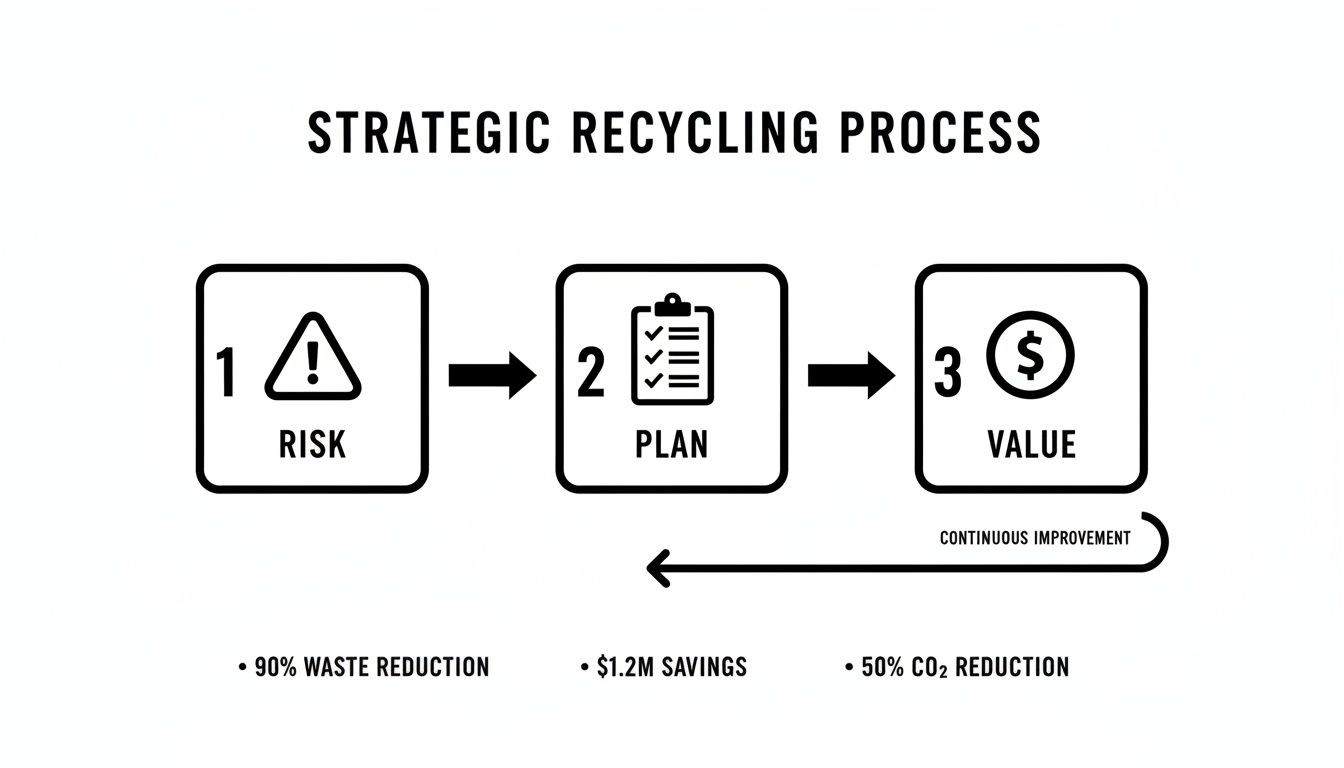
As the infographic shows, it’s a clear path from recognizing potential liabilities to putting a structured plan in place that generates a financial return.
What a Strategic Approach Looks Like
A strategic approach to decommissioning hardware pulls several critical tasks into one smooth process. This goes way beyond calling a scrapper to haul things away.
It’s about integrating key steps:
- Thorough Asset Audits: We're talking about a detailed inventory to figure out the real-world value of every single server, switch, and storage array.
- Ironclad Data Security: This means using certified, auditable data destruction methods that guarantee compliance and completely eliminate the risk of a breach.
- Value Recovery: This is where you identify the assets that still have resale potential and tap into remarketing channels to generate revenue.
- Compliant Disposition: For everything that can't be resold, you ensure it’s processed in an environmentally sound way, backed by complete documentation.
By treating decommissioning as a planned business initiative, organizations can protect their brand, secure their data, and often offset the entire cost of the project through asset resale. It transforms a logistical headache into a smart financial and operational decision.
The First Step to Profit: Your Asset Audit and Valuation
The success of your entire data center equipment recycling project comes down to one critical task: knowing exactly what you have. This isn't just about making a simple checklist; it's a deep dive into your hardware to find its real, often hidden, value. A solid asset audit is the foundation for everything that follows—secure data destruction, compliant recycling, and most importantly, getting the biggest possible check back in your hands.
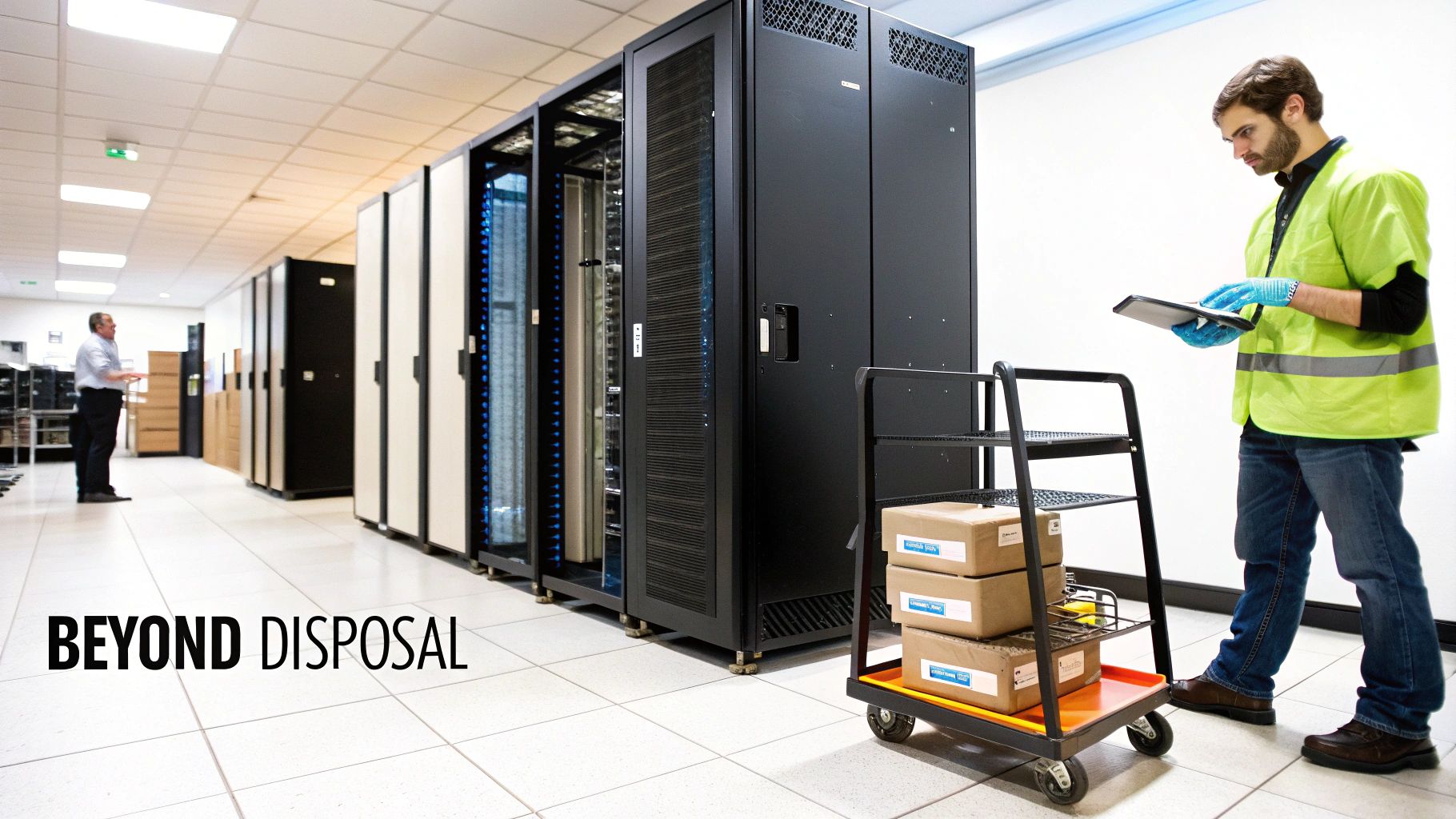
Without an accurate inventory, you’re flying blind. You can't guess what your equipment might be worth on the resale market, and you can't prove you've handled every single data-bearing device correctly. This first step changes your project from a hopeful guess into a smart, calculated business decision.
Beyond the Serial Number: What to Document
A truly useful audit goes way beyond just listing makes, models, and serial numbers. If you want to get resale partners interested and command top dollar, you have to capture the nitty-gritty details that determine an asset's worth. Think of it like selling a used car—the mileage, features, and condition are what set the price, not just the VIN.
For every server, storage array, and piece of networking gear, your inventory needs to include:
- Brand and Model: Be specific, like Dell PowerEdge R740 or Cisco Nexus 93180YC-EX.
- Unique Identifiers: Get both the manufacturer's serial number and any internal asset tags you use.
- Physical Condition: Make notes on any dings, missing parts, or heavy wear and tear. Is it "like new" or "seen better days"?
- Configuration Details: This is where the money is. Document the CPU type and speed, the amount and type of RAM, hard drive specs (SSD vs. HDD, capacity), and any special network or controller cards installed.
This level of detail means a potential buyer knows exactly what they're getting without having to see it in person. Getting this right from the start means adopting effective inventory management practices to track and assess every single piece of equipment you're retiring.
Real-World Example: We recently worked with an Atlanta-based software company shutting down a small server room. Their first list just said "20 servers." After our detailed audit, we found eight of those were late-model servers loaded with high-capacity RAM and enterprise SSDs. That discovery completely flipped the project's finances, turning a potential expense into a six-figure return.
Demystifying the Valuation Process
Once the audit is done, the valuation can begin. This isn’t a simple formula; it’s a fluid assessment based on what's happening in the market right now. Understanding these factors helps you have smarter conversations with your IT Asset Disposition (ITAD) partner and set realistic goals for your financial return.
The value of your data center hardware is really a mix of a few key things.
| Valuation Factor | How It Impacts Resale Value | Example |
|---|---|---|
| Age and Generation | Newer gear (usually under 3-4 years old) holds much more value because it can be put right back to work in another data center. | A 14th generation Dell server is worth a lot more than an 11th generation model. |
| Brand Reputation | Big names like Dell, HPE, Cisco, and EMC have a strong and predictable secondary market. | Buyers are usually willing to pay more for brands they know and trust for reliability. |
| Current Market Demand | The value of parts like RAM and SSDs goes up and down with global supply and demand. | A sudden shortage of a specific memory type can temporarily spike the value of servers that have it. |
| Condition and Completeness | Units that are fully functional with all their original parts will always bring in the highest prices. | A server missing its drive caddies or a power supply is going to be worth less than a complete one. |
Ultimately, a detailed audit gives you the raw data needed for an accurate valuation. This process is a key part of managing your IT hardware from purchase to retirement. You can learn more about the big picture by reading our guide on what is asset lifecycle management, which covers the entire journey. This knowledge gives you the power to negotiate effectively and make sure you squeeze every last dollar of value out of your retired IT assets.
Getting Data Security Right During Decommissioning
When it's time to retire old IT gear, data security is everything. It’s not just one step in the process; it's the foundation the whole project rests on. For any organization in Atlanta, one hard drive falling into the wrong hands can trigger a nightmare of financial penalties, lawsuits, and a damaged reputation that’s hard to rebuild. This is why you can't cut corners on data destruction when you're handling data center equipment recycling.
The first big decision is whether to have the data destroyed at your location (on-site) or at a specialized facility (off-site). This often comes down to your industry's rules and how much risk you're willing to take. To make the right call and keep your data safe, it helps to understand professional decommissioning practices from start to finish.
Think about a healthcare system over in Midtown Atlanta. They're dealing with HIPAA regulations, which are notoriously strict. For them, on-site physical destruction is the only real option. A mobile shred truck pulls up, and they can literally watch their old hard drives get chewed into tiny metal scraps. It completely removes any risk during transport and gives them concrete proof they met their compliance duties.
Now, picture a growing tech startup in Alpharetta. They might go with certified off-site wiping instead. A secure, GPS-tracked truck picks up their old servers. At a secure facility, the drives are professionally erased using NIST 800-88 standards. This approach wipes the data clean but keeps the drives intact, meaning they can be resold. It's a smart way to get some money back while still ensuring total what is data sanitization.
Choosing Your Data Destruction Method
Knowing the different ways to destroy data is key to picking the right service for your company. There are three main methods, and each offers a different level of security and affects whether you can resell the hardware.
These aren't interchangeable. The right choice depends entirely on how sensitive your data is and if you want to recover any value from the old assets.
- Data Wiping (Erasure): This is a software-based process that overwrites your data with junk information, usually multiple times. It’s perfect for equipment you plan to resell because it leaves the hardware in perfect working order but makes the original data impossible to get back.
- Degaussing: This method uses a super-powerful magnet to scramble the data on magnetic media like older hard disk drives (HDDs) and backup tapes. It’s quick and effective but also makes the drive totally useless afterward. A crucial point: degaussing does not work on Solid State Drives (SSDs), since SSDs store data electronically, not magnetically.
- Physical Destruction (Shredding): This is the ultimate in data security. A massive machine literally grinds hard drives, SSDs, tapes, and phones into small, confetti-like bits. It’s a 100% guarantee that the data is gone forever. This is often the required method for government agencies, banks, and healthcare organizations.
The single biggest mistake a company can make is thinking that just hitting "delete" or formatting a drive is enough. Forensic software can easily pull data off a formatted drive, leaving you wide open to a breach. Certified, verifiable destruction is the only way to be truly secure.
Let's break down the two main service models—having it done at your place versus sending it out.
Choosing Your Data Destruction Method On-Site vs Off-Site
| Feature | On-Site Destruction (at your facility) | Off-Site Destruction (at a secure facility) |
|---|---|---|
| Security | Highest level. You witness the destruction. No chain-of-custody risk. | High. Secure, GPS-tracked transport to a monitored facility. |
| Best For | Highly regulated industries (healthcare, finance), government contracts, top-secret data. | Most businesses, assets intended for resale, large quantities of mixed equipment. |
| Cost | Generally higher due to mobilizing specialized equipment and personnel to your site. | More cost-effective, especially for larger volumes, as work is centralized. |
| Asset Resale | Not possible for physically destroyed assets (shredded or degaussed). | Ideal. Wiping preserves the hardware's value for remarketing. |
| Convenience | Highly convenient. The process happens right there, and you sign off immediately. | Requires coordination for pickup but handles all processing off-site. |
| Verification | Instant visual confirmation, followed by a Certificate of Destruction. | Certificate of Destruction with serialized reporting provided after completion. |
Ultimately, both methods are secure when handled by a certified ITAD partner. The choice boils down to your organization’s specific compliance needs, budget, and asset recovery goals.
The Power of Verifiable Proof
At the end of the day, your security efforts are only as strong as the paperwork that backs them up. This is where serialized reporting and a solid chain of custody become your best legal defense. A good ITAD partner tracks every single asset meticulously from the moment it leaves your building.
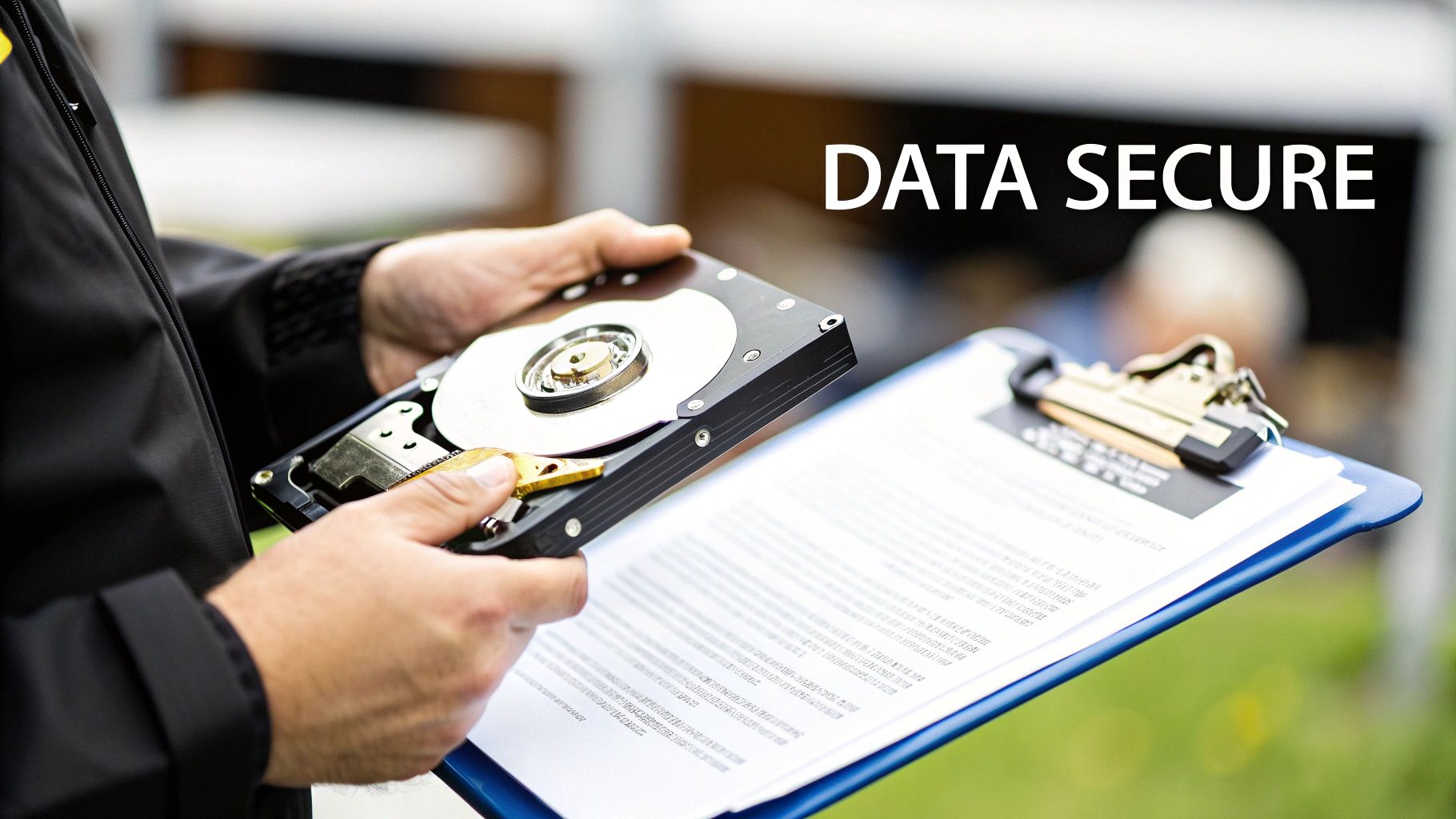
This whole process concludes with a Certificate of Destruction (CoD). This is much more than a simple receipt—it's a legally binding document that should detail:
- A unique serial number for every drive, server, or device that held data.
- The exact method of destruction used (e.g., DoD 5220.22-M wipe, physical shred).
- The date and location where the destruction took place.
- A signature from an authorized person at the vendor.
This certificate is your ironclad proof that you did your due diligence. If an auditor ever questions your disposal process, the CoD shows you took every required step to protect your data and shield your organization from liability. The demand for this level of security is a major reason why the entire IT Equipment Recycling Service Market is projected to hit $30.985 billion by 2025.
Getting the Equipment Out: The Logistics of Removal
Once your data is wiped clean, you're faced with the next challenge: physically getting all that heavy, cumbersome hardware out the door. This is where a lot of data center equipment recycling projects get bogged down. Moving IT assets isn't like calling regular movers; it’s a specialized process that affects safety, your building's integrity, and how much money you can get back from your old gear.
Successfully handling the logistics, especially in the tight commercial spaces around Metro Atlanta, is all about smart planning. It’s less about brute force and more about a methodical approach that protects the equipment and avoids expensive headaches.
The Pre-Removal Site Survey and Coordination
Before anyone even thinks about unplugging a server, a detailed site survey is a must. A seasoned logistics crew will walk the entire removal path, spotting any obstacles that could throw a wrench in the works or lead to damage.
This initial walkthrough is critical and covers a few key areas:
- Building Access: Are we dealing with freight elevators? We need to know their weight limits and dimensions. Do we have to work around specific loading dock hours?
- Path of Egress: The team maps out the safest, clearest route from your data center to the truck, looking for any tricky corners, stairs, or doorways that could be a problem.
- Floor Type: Is the data center on a raised floor? That changes everything. It means we need special lifts and a delicate touch to avoid cracking tiles or damaging the subfloor.
- Building Management: If you’re in a high-rise in Downtown or Buckhead, you have to get property management on board early. This means booking elevator time and making sure all the insurance paperwork is squared away.
Getting these details sorted out upfront means no last-minute panics that cause delays and drive up costs.
Mastering On-Site De-Racking and Packing
How the equipment is actually taken out of the racks and prepped for the truck makes all the difference in its final value. A sloppy job can turn a server worth thousands into a few bucks of scrap metal. Professional teams have a strict system for handling every single piece.
First, all power and network cables are carefully disconnected. Then, each server is systematically removed from the rack and placed onto special equipment carts. For the really heavy stuff like storage arrays or blade chassis, it takes multiple technicians—and sometimes lifting gear—to move them safely.
One of the most common mistakes we see is lazy packing. Tossing servers on a pallet with a bit of shrink wrap is just asking for trouble. Every asset needs to be individually wrapped or put in protective packaging before it's securely strapped down. This prevents things from shifting and getting banged up in transit.
This is the kind of detail that separates a professional IT asset removal from a couple of guys with a dolly. If you want to get the most money back, this careful handling isn't optional.
Navigating the Real-World Complexities of Removal
Let me paint a picture for you. We worked with a financial services firm in Sandy Springs that was closing a data center located on a raised floor inside a high-rise. They decided to have their own team handle the removal to try and save some money.
It didn't go well. They hit several roadblocks:
- They didn't have the right lifts for the heavy storage arrays and ended up cracking several expensive floor tiles.
- Their company's insurance didn't meet the strict liability requirements of the building, which halted the project for two full days.
- They palletized the servers incorrectly. During the truck ride, everything shifted, causing damage to the faceplates and internal parts on nearly 30% of their most valuable equipment.
This story is a perfect example of why cutting corners on logistics is a bad idea. Bringing in a professional service isn't just about getting the right tools and muscle; it's about getting the right insurance, project management, and expertise to do the job right. In the end, investing in skilled logistics protects your gear, your building, and your project's bottom line.
Turning Old Hardware Into New Revenue
After all the meticulous work of auditing assets, wiping data, and coordinating the removal, you finally get to the best part of data center equipment recycling: turning that old hardware into a fresh revenue stream. This is where your careful planning really pays off, transforming what was once a liability on your books into a tangible financial return. The trick is knowing the different financial models out there and picking the one that makes the most sense for your organization.
That asset inventory you painstakingly put together? It's now your most powerful negotiating tool. It gives you a clear, documented picture of your equipment's value, which is essential for a transparent and profitable deal. This report directly shapes which financial arrangement will get you the best results for your specific mix of assets.
Unpacking Your Financial Options
When you team up with an IT Asset Disposition (ITAD) company, they'll usually lay out a few different ways you can get paid. Each model has its own pros and cons, depending on whether your company needs cash now or is willing to wait for a potentially bigger payout later.
Here are the most common arrangements you'll see:
- Direct Buyout: This is the quickest and simplest route. Your ITAD partner assesses your equipment's value and cuts you a check for the whole lot. You get guaranteed money upfront and immediately transfer all the ownership and risk.
- Profit-Sharing Agreement: In this scenario, the ITAD partner takes on the entire remarketing process—testing, refurbishing, and selling your equipment. Once they cover their costs for logistics and processing, you split the remaining profits based on a pre-agreed percentage.
- Consignment Sale: This is a lot like profit-sharing, but you technically still own the equipment until it sells. The ITAD partner acts as your sales agent, moving the assets on your behalf and taking a commission from the sale price.
Getting a handle on these differences is key to making the right call. For a deeper look into picking the right partner, check out our guide on what to look for in IT asset disposition companies.
Choosing the Right Model for Your Business
There's no single "best" financial model—it all comes down to your organization’s unique situation and the gear you're retiring.
Let's look at a couple of real-world scenarios for Atlanta businesses:
Imagine a fast-growing startup in the Atlanta Tech Village decommissioning its first server rack to go all-in on the cloud. For them, immediate cash flow is everything. A direct buyout puts quick capital in their hands that they can pump right back into the business. It's the perfect move, even if the total return is a bit lower.
Now, think about a large, established corporation in Sandy Springs with a more flexible balance sheet. They can afford to play the long game. By opting for a profit-sharing agreement, they can let their ITAD partner work to get the absolute best price for their high-end servers and networking gear, leading to a much larger payout over a few months.
The most profitable route often ends up being a hybrid approach. A smart ITAD partner might offer an immediate buyout for lower-value, commodity items while putting your newer, high-demand equipment into a profit-sharing plan to maximize your overall return.
What Commands the Highest Prices?
Let's be clear: not all retired hardware is created equal. The secondary market has a huge appetite for specific kinds of equipment. Knowing what's hot helps you set realistic expectations for your revenue.
Generally, the most valuable stuff includes:
- Recent-Generation Servers: Servers less than four years old, especially from top brands like Dell and HPE, are always in high demand.
- High-Capacity Storage: Enterprise-grade SSDs and large HDDs hold their value surprisingly well.
- Networking Gear: Switches and routers from companies like Cisco and Juniper are consistently sought after.
- Components: Sometimes, individual parts like CPUs and high-density RAM can be sold for a great price, even if the server they came out of is ancient.
Being proactive is a massive factor in getting top dollar. In fact, recovery rates for retired IT assets can jump to 80-90% in the first year if the decommissioning is planned 6-12 months out. This strategy allows for proper refurbishment and reuse through global channels—a true circular economy approach that turns potential waste into real value. You can find more insights on this trend from industry experts discussing how data centers are embracing circular recycling.
Your Top Questions About Data Center Recycling in Atlanta
When it's time to decommission a data center, a lot of questions pop up. For any organization in Metro Atlanta, getting a handle on local rules, realistic timelines, and potential value is the first step toward making a smart decision. Let's clear up some of the most common things we get asked about the data center equipment recycling process.
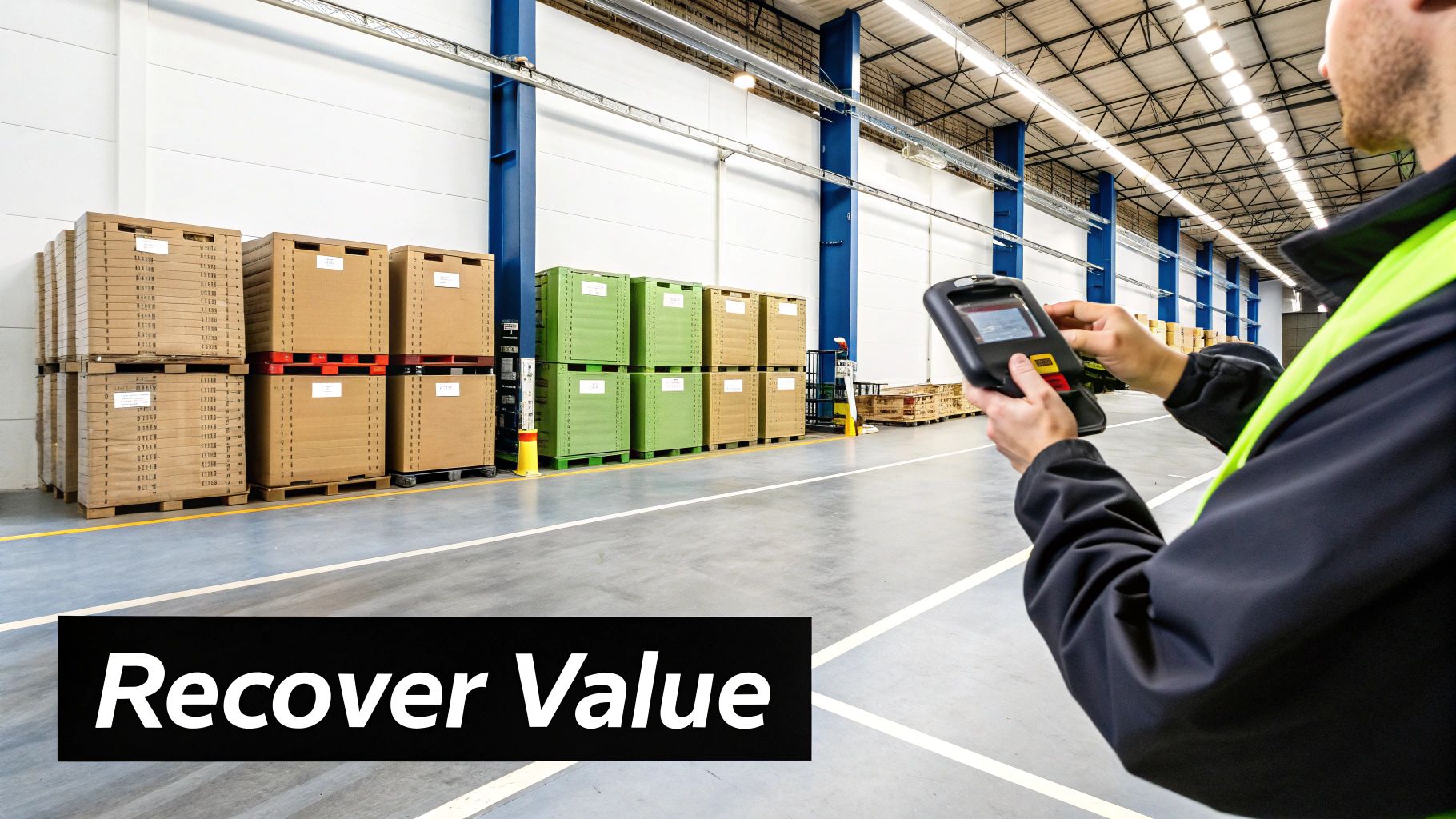
Here are the practical, no-nonsense answers you need.
What Specific Environmental Regulations in Georgia Do I Need to Worry About?
This is probably the most important question for any business in the Atlanta area. While Georgia doesn't have a state-wide ban on e-waste in landfills for businesses (unlike some other states), you are absolutely on the hook for federal laws.
The big one you need to know is the Resource Conservation and Recovery Act (RCRA). This is the federal law that deals with hazardous materials found in electronics—things like lead, mercury, and cadmium. If you dispose of equipment improperly and violate RCRA, you could be looking at serious federal fines.
On top of that, some Metro Atlanta counties have their own local rules. The easiest way to make sure you're compliant on every level? Work with a certified electronics recycler.
Partnering with an R2 or e-Stewards certified vendor is your best move. These companies are audited constantly to meet the highest standards for both environmental safety and data security. They give you the documentation to prove you’ve done everything right under federal, state, and local laws, which takes the compliance risk off your shoulders. For more background, our guide on how to recycle in Atlanta has some good general info.
How Long Does the Entire Decommissioning Process Take?
There's no single answer here—the timeline for a data center project really depends on the size and scope.
A small project, maybe cleaning out a server closet with a dozen or so machines, can be incredibly quick. From the first audit to getting the gear out the door and processed, you might be looking at just a week or two.
On the other hand, a huge data center with hundreds or thousands of servers, storage gear, and network switches is a much bigger deal. A project like that could easily take several months from the first conversation to the final reports.
Here's a rough breakdown of the phases:
- Asset Audit & Valuation: Usually takes 1-2 weeks, depending on how much gear there is.
- On-site Logistics & Removal: This can be anywhere from 1-5 days, based on the volume and complexity of the site.
- Off-site Processing: This is where data destruction, testing, and resale happens, which typically takes 2-4 weeks.
The absolute key to a smooth timeline is planning ahead. We always tell clients to bring an ITAD partner into the loop at least 3-6 months before your data center move is done or your lease is up. That buffer makes all the difference and avoids a last-minute fire drill.
Is My Old Equipment Even Worth Trying to Resell?
You'd be surprised what kind of value is hiding in that old hardware. A ten-year-old server might not be worth much as a complete unit, but it’s often full of components that are still in high demand on the secondary market.
A good ITAD partner doesn't just see an old server; they look at it piece by piece. They'll do a component-level audit to find and assess the value of individual parts that can be salvaged and sold.
These valuable components often include:
- CPUs
- RAM modules
- High-end controller cards
- Enterprise-grade hard drives and SSDs
Even if a piece of equipment has zero resale value, it's still made of commodity materials like steel, aluminum, and copper. A solid recycling program makes sure that scrap value is recovered for you.
Think of it this way: even if the resale and scrap value only covers the cost of the recycling and data destruction services, you've still won. You've handled a secure, compliant, and green disposal project at no net cost to your company.
What Is a Certificate of Destruction and Why Is It So Important?
The Certificate of Destruction (CoD) is one of the most critical documents you'll get during the data center equipment recycling process. It's a formal legal paper from your ITAD vendor that acts as your official audit trail.
This certificate is your concrete proof that every single one of your data-holding devices was securely and permanently destroyed according to industry standards. Legally, it's your best protection against any future liability.
A legitimate CoD will always include specific details:
- The unique serial number for every single hard drive or device that was destroyed.
- The exact method used for destruction (like NIST 800-88 wiping or physical shredding).
- The date the destruction took place.
- A signature from someone authorized at the vendor company.
This document is essential for proving due diligence and is a must-have for compliance with data privacy laws like HIPAA, SOX, and GDPR. If you ever face an audit or a data breach investigation, that CoD is your ironclad proof that you did everything right to protect your sensitive information.
Navigating a data center decommissioning is a big job that requires a partner you can trust. At Montclair Crew Recycling, we offer complete, secure, and compliant IT asset disposition services for businesses all over Metro Atlanta. From valuing your assets to certified data destruction and responsible recycling, we handle the entire process so you can stay focused on your business. Contact us today to see how we can help you get value back and eliminate your risk. https://www.montclaircrew.com
