

When your company's technology reaches the end of its road, what happens next? An IT recycling company is a specialized partner that securely handles this entire process. Think of them less like a trash service and more like a risk management team for your retired hardware.
They do more than just haul away old equipment; they protect your sensitive data, keep you compliant with environmental laws, and often find ways to recover cash value from your assets.
What Do IT Recycling Companies Actually Do
For any business in the Atlanta area, from a medical practice in Sandy Springs to a sprawling data center in Alpharetta, retiring old tech is a minefield of potential problems.
You can't just toss old computers, servers, or phones in a dumpster. That's a direct route to a potential disaster. Every single device could hold a treasure trove of sensitive information—client records, company secrets, financial data. A single lost hard drive can quickly spiral into a full-blown data breach, bringing with it massive fines and a damaged reputation that’s hard to rebuild.
More Than Just Disposal
This is where a real pro comes in. Their job goes way beyond just getting rid of stuff. They are your partners in managing risk, ensuring compliance, and recovering value. They control the entire journey of your old equipment, protecting your company every step of the way.
A certified IT recycling partner transforms a potential liability into a secure, compliant, and often profitable process. They provide an audited chain of custody that protects you from data breaches and environmental penalties.
This whole managed process has a name: IT Asset Disposition (ITAD). It’s a strategic game plan for the complete lifecycle of your technology. To get a better handle on the nuts and bolts, you can learn more about the specifics of IT asset recycling and how it locks down your business operations.
Core Functions of a Strategic ITAD Partner
For Metro Atlanta organizations, a good IT recycling partner zeros in on three main concerns: security, compliance, and financial return. Their services are built to put a protective bubble around your business when it’s most vulnerable—during the decommissioning phase.
Here’s a quick rundown of the essential services IT recycling companies provide to businesses.
| Service Category | How It Protects Your Business |
|---|---|
| Data Security | Uses military-grade methods like DoD 5220.22-M wiping and on-site shredding to make sure data is gone for good. |
| Compliance & Reporting | Provides detailed paperwork, like Certificates of Destruction, to prove you've met all legal and industry regulations. |
| Logistics & Auditing | Securely picks up, transports, and tracks every single asset, giving you a clear chain-of-custody from start to finish. |
| Value Recovery | Tests and refurbishes usable equipment for resale, sharing the profits back with your company. |
These core functions are what separate a simple recycler from a strategic ITAD partner.
Ultimately, picking the right IT recycling company is a serious business decision. It has a direct line to your data security, your legal standing, and your bottom line. They aren't just a vendor; they're an indispensable ally in today's tech-first world.
Key Services Your Business Can Expect
When you bring in a professional IT recycling company, you're not just hiring someone to haul away old gear. You're partnering with a team of specialists who follow a very specific, multi-step process designed to shield your business from every possible risk.
Let's walk through what that looks like. We'll use a fictional Atlanta tech company to make it real.
Imagine "PeachTech," a growing software firm in Alpharetta, is finally upgrading its entire server infrastructure. They're left with racks of old servers, networking switches, and storage arrays that have to go. Simply unplugging them and hoping for the best is a non-starter; every single device is loaded with sensitive client data and proprietary code.
IT Asset Auditing and Inventory Management
First thing's first: PeachTech needs to know exactly what they have. This is where a detailed IT asset audit kicks off the entire process. A good partner doesn't see a pile of electronics; they see individual assets, each with its own history and potential value.
A team shows up on-site to document every piece of equipment. They're scanning serial numbers, logging asset tags, and recording the make and model of each item. This creates an ironclad inventory list, which becomes the master document for the whole project. For PeachTech, this means they have a verified record of every single server and hard drive before it even leaves their building—a crucial first step for both compliance and security.
This careful inventory is the foundation for everything that follows: securing the assets, ensuring compliance, and ultimately, getting some money back.
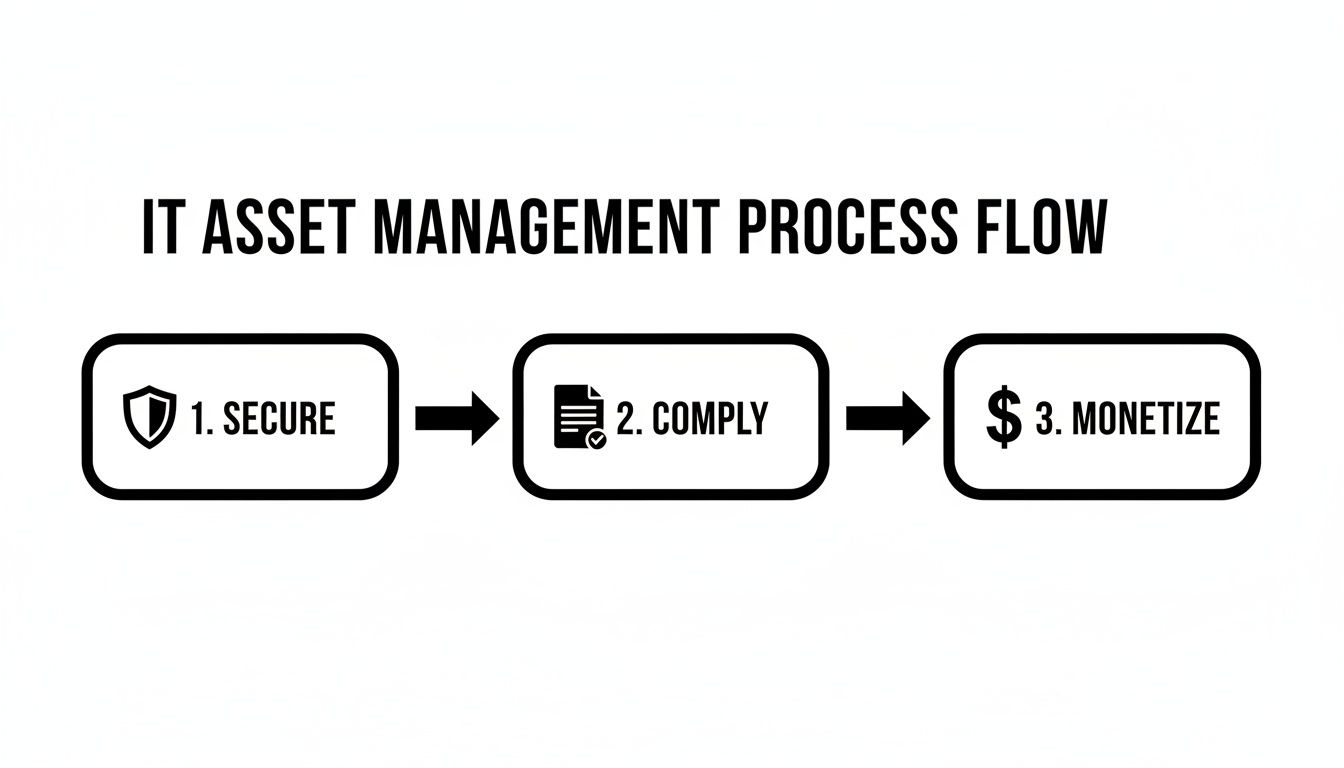
As you can see, the whole journey starts with securing your assets and checking all the compliance boxes. Only then can you move on to recovering value.
Secure Logistics and Chain of Custody
With the inventory locked down, it's time to move the equipment. Professional it recycling companies provide secure logistics, which is worlds away from a standard moving truck. We're talking about a documented, unbroken chain of custody.
For PeachTech’s servers, this involves a few critical layers of security:
- GPS-Tracked Vehicles: Every truck's movement is monitored in real-time.
- Sealed and Secured Containers: The gear is packed into locked containers, making tampering nearly impossible.
- Background-Checked Personnel: Only fully vetted and trained technicians are allowed to handle your sensitive assets.
From the second that equipment leaves PeachTech's Alpharetta data center until it arrives at the secure processing facility, there's an auditable trail. This documentation proves your assets were never lost, stolen, or accessed by anyone who shouldn't have been near them.
DoD-Level Data Wiping
Once the gear is at the secure facility, the number one priority is destroying the data. The industry-standard method is DoD 5220.22-M data wiping. This is a software-based process that overwrites the entire hard drive with random patterns of ones and zeros, usually in three separate passes.
Think of it like painting over a canvas. A simple file deletion is like taping a "sold" sign over the painting—the artwork is still right there underneath. Data wiping, on the other hand, is like applying three thick coats of black paint, completely and irreversibly destroying the original image.
Every single drive from PeachTech's servers goes through this wiping process. Afterward, the ITAD partner issues a Certificate of Data Destruction. This certificate lists the unique serial number of each wiped drive, giving PeachTech undeniable proof of data sanitization for their compliance and audit records.
On-Site Hard Drive Shredding
For the highest level of security, or for drives that are too old or damaged to be wiped, on-site hard drive shredding is the ultimate solution. A specialized shredding truck comes right to your location—in this case, PeachTech’s Alpharetta office.
You and your team can literally watch as your hard drives are fed into an industrial shredder and turned into tiny, mangled pieces of metal. Physical destruction makes data recovery absolutely impossible. It's the go-to method for organizations that can't take any chances, like those in healthcare, finance, or government.
Component Harvesting and Value Recovery
Here’s the part that often surprises people: not all old IT equipment is junk. A lot of devices, especially servers and networking gear that are less than five years old, are packed with valuable components. A huge part of what top-tier it recycling companies do is value recovery.
After all the data has been securely destroyed, technicians will test the components from PeachTech's servers. They might discover that the RAM modules, CPUs, and power supplies are still in high demand on the secondary market.
These working parts are carefully harvested, tested again, and resold. Through a profit-sharing agreement, PeachTech gets a cut of that revenue, turning what they thought was a disposal cost into a check. This is a core part of modern electronic waste recycling services, transforming IT retirement from a pure expense into a smart financial move.
Why Secure IT Recycling Is a Critical Business Defense
Let's shift gears from services to security. It's easy to think of IT asset disposition as just another operational task—something to check off a list. But that's a dangerous mistake. It's a core part of your business's defense strategy. One misplaced server or an improperly wiped laptop can become a ticking time bomb, capable of causing catastrophic damage to your organization.
The risks go way beyond just losing a piece of equipment. When a single device falls into the wrong hands, it can expose sensitive customer data, proprietary trade secrets, and employee information. The financial and reputational fallout from that kind of breach can be absolutely devastating.
The High Stakes of Non-Compliance
For any business in Metro Atlanta, neglecting secure disposal isn't just risky; it can be flat-out illegal. A number of federal regulations demand the secure handling of sensitive data. Failing to comply can bring on severe penalties, including fines that could easily cripple a small business.
Here are a few of the big ones that impact local organizations:
- HIPAA (Health Insurance Portability and Accountability Act): This is non-negotiable for any healthcare provider, from a small clinic in Marietta to a major hospital in Sandy Springs. HIPAA requires that all patient health information (PHI) is protected, and that includes the data lingering on old hard drives.
- GLBA (Gramm-Leach-Bliley Act): Financial institutions are on the hook here. Banks, investment firms, and even local tax preparers have to comply with GLBA, which mandates the protection of consumers' private financial information.
- FACTA (Fair and Accurate Credit Transactions Act): This act is all about preventing identity theft, requiring the proper, secure disposal of any consumer report information and records.
Getting on the wrong side of these rules can lead to audits, messy legal battles, and fines that climb into the six or seven figures. Working with professional it recycling companies is the best way to make sure your disposal process is compliant from beginning to end.
Decoding Certifications: The Proof of Security
So, how can you be sure a vendor is truly secure and not just making empty promises? The answer is third-party certifications. These aren't just fancy acronyms to put on a website; they are rigorous, audited standards that separate the real pros from the rest.
Certifications are your assurance that an IT recycling company follows documented, verifiable, and secure processes. They provide a third-party seal of approval, confirming that the vendor’s practices meet the highest industry standards for data security and environmental responsibility.
When you're vetting potential partners, keep an eye out for these key credentials:
- R2 (Responsible Recycling): This certification is a big one. It focuses on environmentally sound practices, worker safety, and data security all the way through the recycling chain.
- e-Stewards: Often considered one of the most stringent standards out there, e-Stewards has a zero-tolerance policy for exporting hazardous e-waste to developing countries.
- NAID AAA: This is the gold standard specifically for data destruction. A NAID AAA certified vendor has to go through surprise audits to verify their security protocols, employee screening, and destruction processes are completely airtight.
When a company holds these certifications, it means they've invested serious time and money to prove their commitment. That documented proof is critical, especially when you need a Certificate of Destruction to verify compliance for your own records. You can learn more about how a certificate of destruction provides an auditable trail and why it's so important.
Integrating IT Recycling Into Your Risk Strategy
Ultimately, you need to see secure IT recycling as an essential piece of your overall cybersecurity posture. It actively protects your business from data breaches that start with retired assets—a threat that far too many organizations overlook. Making secure IT recycling a formal part of your risk management is just as essential as other vital strategies like comprehensive disaster recovery planning.
The global e-waste management market is absolutely booming, with projections showing it could hit USD 326 billion by 2035. This growth is being driven by firms that are setting the industry standard for security and sustainability. For instance, a major player like Electronic Recyclers International (ERI) has recycled over 1 billion pounds of e-waste, securing data for Fortune 500 clients while sticking to zero-landfill and zero-export policies. By choosing a certified partner, you're not just getting rid of old equipment; you're actively defending your business against very real, modern threats.
The Hidden Value in Your Company's E-Waste
Beyond just security and compliance, there's a powerful story unfolding inside your company’s retired IT equipment. Every old server, laptop, and circuit board is part of a massive global challenge—and an even bigger opportunity. When you choose to partner with professional IT recycling companies, you're doing more than just protecting your business. You're connecting your company's actions to the larger narrative of environmental responsibility and economic innovation known as the circular economy.
The scale of the e-waste problem is truly staggering. When electronics are just tossed out, they often wind up in landfills. There, they can leach incredibly harmful toxins like lead, mercury, and cadmium straight into the soil and groundwater. The environmental damage has far-reaching consequences, hurting both ecosystems and public health. Your company's retired assets represent a small but significant piece of this global puzzle.
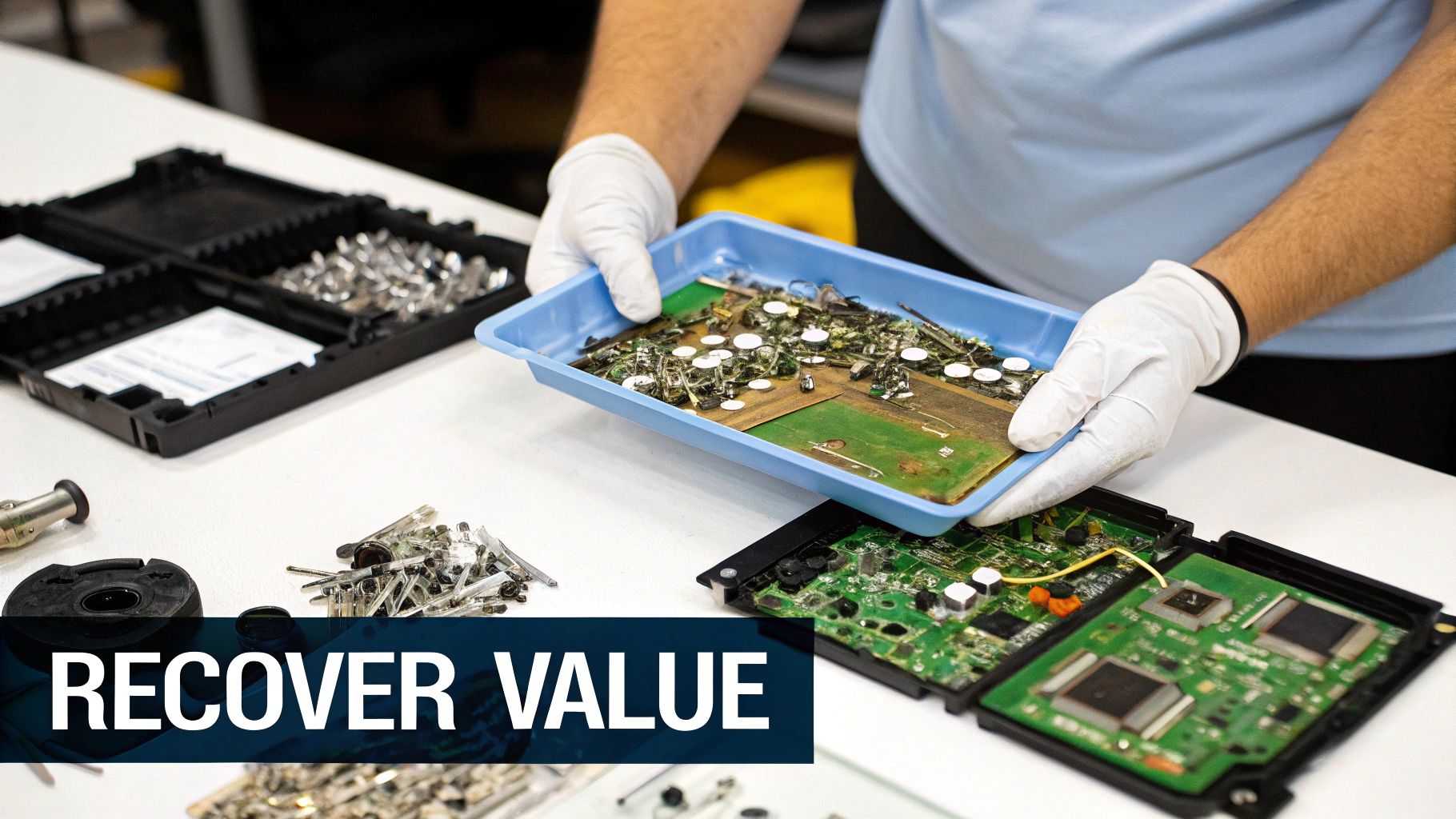
But this challenge also hides a remarkable economic upside. Responsible recycling isn’t just about preventing harm; it's about actively reclaiming value.
From Electronic Waste to Urban Mining
Think of your old IT assets not as trash, but as a rich source of valuable materials. This concept has a name: "urban mining." Instead of digging up the earth for new resources, we can harvest them from the millions of electronic devices already in circulation.
You’d be surprised at what's inside your old equipment. It’s a treasure trove of precious and base metals.
- Gold and Silver: Used in circuit boards and connectors for their excellent conductivity.
- Copper: Found everywhere from wiring and heat sinks to printed circuit boards.
- Palladium: A critical component in certain capacitors and connectors.
- Aluminum and Steel: Common materials used for frames and casings.
By recovering these materials, certified recyclers slash the immense environmental and financial costs tied to traditional mining. This process conserves natural resources, cuts energy consumption, and lowers greenhouse gas emissions. Managing your technology's retirement is a key part of what asset lifecycle management is all about, ensuring value is maximized and waste is minimized at every stage.
Boosting Your Brand with Corporate Social Responsibility
This is where your choice of an ITAD partner becomes a powerful tool for your brand. A solid commitment to responsible e-waste recycling is a tangible, real-world demonstration of your company's Corporate Social Responsibility (CSR). It’s a story you can proudly share with customers, investors, and employees.
Partnering with a certified e-recycler elevates your brand by transforming a routine operational task into a clear statement of your company's values. It shows you are committed to environmental stewardship and ethical business practices.
This isn't just about feeling good; it delivers real business benefits. Today’s consumers and employees are increasingly drawn to companies that put sustainability first. A strong CSR program can enhance your reputation, build customer loyalty, and help you attract and retain top talent who want to work for an organization making a positive impact.
The global electronic waste recycling market has seen incredible expansion, reaching an estimated USD 80,432.8 million thanks to a surge in e-waste and stricter regulations. North America holds a commanding 37% of this market, valued at USD 17,320.66 million, with steady growth fueled by corporate sustainability initiatives across the United States. By engaging in responsible recycling, your Atlanta business becomes an active participant in this vital and growing economic sector.
How Pricing and Value Recovery Actually Work
Let's get right to it. When you're looking at IT recycling companies, the first question on your mind is probably, "What's this going to cost me?" Most businesses automatically file IT asset disposition under "necessary expense," just another line item eating into the budget. But what if you could flip that script? A strategic partnership can turn that cost center into a real source of revenue.
The way these companies price their services isn't a one-size-fits-all deal. It all comes down to the type, age, and sheer volume of your equipment. Getting a handle on these models is the first step to unlocking the cash hiding in your old tech.
Breaking Down the Common Pricing Models
The cost structure really hinges on one simple question: does your old gear still have any market value? For the ancient, obsolete items with zero chance of being resold, you're going to be looking at service fees. It's just the reality of the business.
These fees cover the critical services that keep your business safe and compliant:
- Per-Pound Recycling Fees: For big cleanouts of miscellaneous electronics—think old printers, monitors, and keyboards—the standard is a fee based on weight. You can expect something in the $0.30 – $0.70 per pound range. This covers the labor and environmental costs of taking everything apart and recycling the materials responsibly.
- Flat-Rate Service Fees: For specific, high-security jobs, you’ll often see a flat fee. For example, you might pay a set price for a truck to come to your office for on-site hard drive shredding or for a technician to perform certified data wiping on a rack of servers.
- Logistics and Pickup Charges: This is simply the cost of getting your equipment from your building to their facility securely. The price tag can change based on how far they have to drive, how much stuff you have, and the level of security you need for the transport.
These costs are pretty straightforward. They ensure your business is doing the right thing, even when you're dealing with equipment that's past its prime. But for your newer assets, the financial picture looks a whole lot different.
The Power of Value Recovery and Profit Sharing
This is where things get interesting. Value recovery is the whole process of finding your functional IT assets, testing them, and reselling them (or their parts) on the secondary market. If you have equipment that's less than five years old—laptops, servers, networking gear—there's almost always a healthy demand for it.
A profit-sharing agreement is exactly what it sounds like: a partnership where the IT recycling company sells your valuable gear and splits the revenue with you. This model puts you both on the same team, giving them every reason to fight for the highest possible price for your equipment.
Instead of you paying them, they end up paying you. A good profit-sharing deal can easily generate enough cash to cover all the service costs (like data destruction and logistics), and in many cases, it leaves your company with a net profit. The secret is finding a partner who really knows the market and has the sales network to move the equipment effectively.
This economic engine is what drives the whole industry. In the electronics recycling world, PCs and laptops are the undisputed kings, commanding a massive 45% market share. This market is on a rocket ship, projected to explode from USD 43.2 billion to USD 147.9 billion by 2035. That growth is fueled by the simple economic fact that recovering materials from old tech is cheaper than mining for new ones. You can discover more insights about the electronics recycling market and see how your assets fit into this global circular economy.
Maximizing Your Financial Return
So, how do you make sure you squeeze every last dollar out of your retired IT assets? It starts long before a truck ever shows up at your loading dock. You absolutely must insist on a detailed, upfront audit.
An accurate inventory is the bedrock of any good value recovery program. We're talking every make, model, configuration, and serial number. This list allows your ITAD partner to research the real-time market value for each specific item. A server packed with a high-end processor and maxed-out RAM is going to sell for a lot more than a base model, and only a thorough audit will catch that kind of detail.
At the end of the day, understanding both the costs and the potential returns lets you make a smart decision. The right partner doesn't just haul away your e-waste; they work with you to maximize its value, turning what could have been a liability into a tangible financial asset for your organization.
A Practical Checklist for Vetting Atlanta Providers
Alright, you've got the lay of the land—you know the services, the risks, and what's at stake. Now it's time to actually pick a partner to handle your old IT gear here in Atlanta. This isn't something you can figure out with a quick Google search. Choosing the right company demands a real, structured vetting process to make sure they can actually protect your organization.
This checklist is designed to give you the exact questions to ask. Think of it as your script for moving from theory to a smart, defensible decision. As a general rule, it's always smart to apply standard IT vendor management best practices when you're hiring someone for a job this critical.

Key Questions for Your Potential Partner
Use these questions when you're on the phone or meeting with potential vendors. Don't just listen to what they say—pay close attention to how they answer. If you get vague, roundabout responses, that’s a huge red flag.
1. Can you provide proof of your certifications?
Any trustworthy company should be able to immediately send over documentation for their R2, e-Stewards, or NAID AAA certifications. A great answer is them emailing you their current, valid certificates without hesitation. A bad sign is if they just say they "follow the guidelines" but can't produce the actual paperwork.
2. How do you verify and document data destruction?
Listen for a detailed explanation of how they provide serialized Certificates of Destruction. The absolute best it recycling companies will tie every single wiped or shredded hard drive back to your original inventory list by its unique serial number. This creates a perfect, auditable paper trail from start to finish.
An ITAD partner’s value is measured by their ability to provide undeniable proof of security. A serialized Certificate of Destruction isn't just a piece of paper; it’s your legal and compliant defense in an audit.
3. Who are your downstream recycling partners?
This question is a gut check for their transparency. A reputable recycler will have a fully vetted network of partners they work with and should have no problem explaining how they audit those vendors. If they're secretive about where your old equipment eventually ends up, that's a major concern. This whole process is crucial, just like when you're evaluating different IT asset disposition companies and need to do your homework.
Final Verification Checks
Before you sign on the dotted line, there are a couple of last-minute checks you need to do. These final steps protect your business and confirm you’ve made a solid choice.
- Request a Certificate of Insurance: Ask for their COI to see proof of liability insurance. This is your safety net if a data breach or environmental problem ever traces back to their process. Look for a policy that specifically covers data breach liability and pollution.
- Ask for Local References: See if they can connect you with other Atlanta-area businesses they've worked with. A company with a solid local track record will be happy to put you in touch with satisfied clients who can vouch for their work and security practices.
Common Questions About IT Recycling Services
When you get down to the final details, a few questions always seem to pop up for Atlanta businesses. Getting straight answers helps you move forward with confidence and pick the right partner to protect your company's data and reputation.
Here are the most common concerns we hear and the practical, no-nonsense answers you need.
How Much Does It Cost to Use an IT Recycling Company in Atlanta?
This is a big one, and the answer isn't always a simple invoice. For older gear with little to no resale value, you can expect to see per-pound fees, which usually fall somewhere between $0.30 to $0.70 per pound. You might also see flat fees for specific jobs like bringing a shredder to your office.
But the story completely changes when you're dealing with newer equipment. For assets like servers and laptops that are less than five years old, most reputable it recycling companies work on a profit-share basis. In many cases, the money recovered from selling your usable assets will cover all the service fees, and you could even end up with a check coming back to your business.
Is a Certificate of Destruction Enough to Guarantee Data Security?
Think of a Certificate of Destruction as the receipt for a job well done. It's an absolutely essential document, but it’s only the final step in the process, not the whole security guarantee. You have to trust the process that produced the certificate in the first place.
A Certificate of Destruction is only as credible as the certified process behind it. True security comes from pairing this document with a vendor’s NAID AAA certification, which verifies their entire data destruction process through rigorous, unannounced audits.
For total peace of mind, always insist on serialized reports. This links your certificate directly to the specific serial numbers of your devices, creating an unbroken, auditable chain of custody that will hold up under any compliance check.
Can My Company Just Wipe Hard Drives and Donate Old Computers?
On the surface, this sounds like a great, charitable way to handle old tech. The problem is, it's riddled with hidden dangers. A basic DIY wipe or a factory reset is simply not enough to permanently erase data to a forensic standard. Professional ITAD firms use certified, multi-pass wiping software that guarantees 100% data elimination, and they give you the paperwork you need to prove it for compliance.
Worse yet, just donating equipment without a secure, documented chain of custody can expose your company to massive legal and data liabilities. If a device with sensitive client or company info falls into the wrong hands, your organization is still on the hook. A certified ITAD partner protects you from both angles by managing the data security and the responsible reuse of your old equipment.
Ready to turn your retired IT assets from a potential liability into a source of value? The team at Montclair Crew Recycling provides a full range of services for Metro Atlanta businesses, from certified data destruction to responsible recycling. Get a fast, transparent quote today.
