
When you hear the term corporate e-waste solutions, what comes to mind? It’s not just about hauling away old computers. Think of it as a complete service designed to help businesses get rid of outdated IT gear securely and responsibly. This covers everything from destroying sensitive data and recycling components to finding a new home for usable equipment, often turning a potential headache into a managed, and sometimes even profitable, process.
The Growing Challenge of Corporate Ewaste
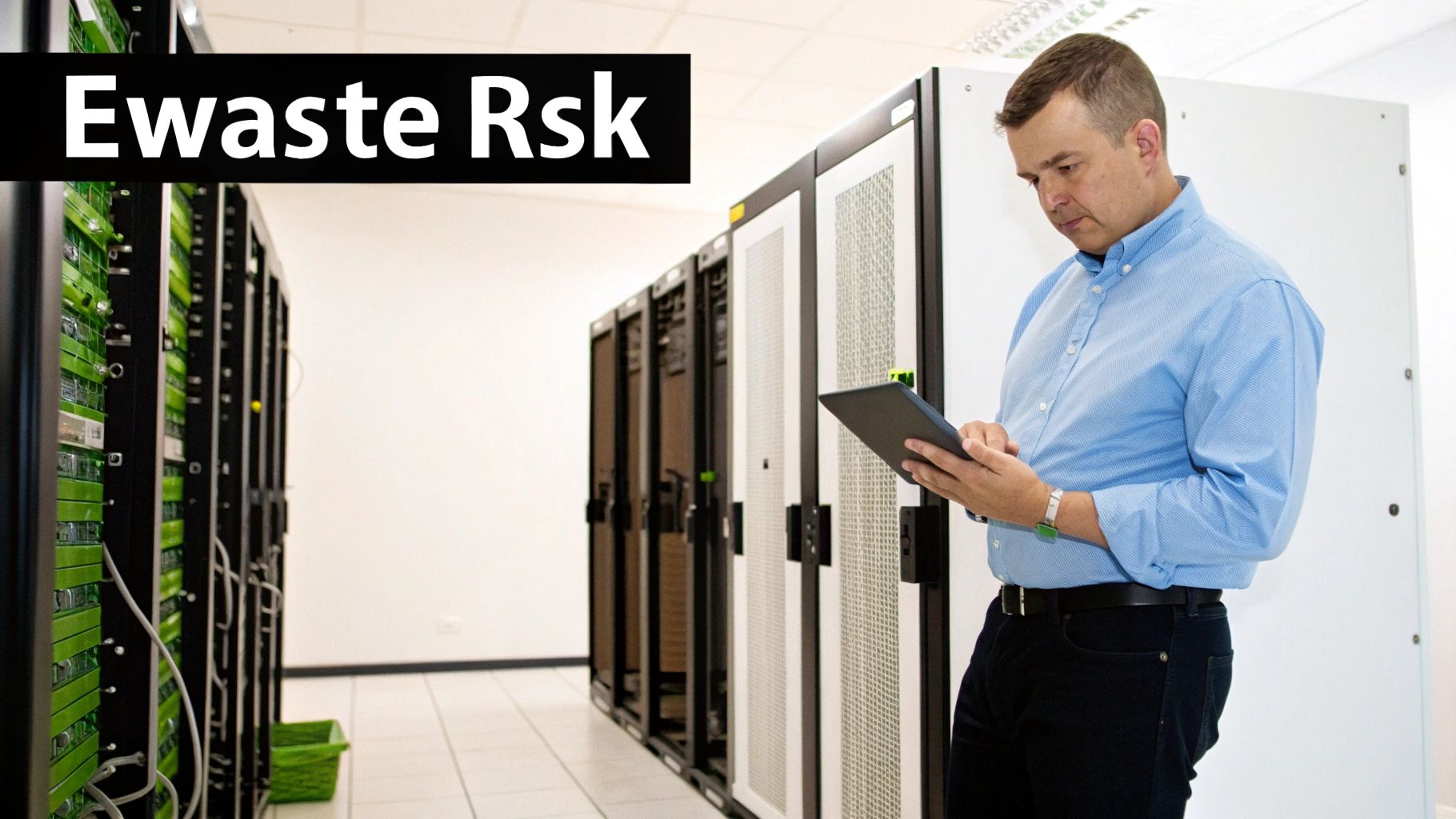
Every server room and storage closet in your building is holding a ticking clock. That old IT equipment isn't just taking up valuable space; it's a growing mountain of data risk and environmental liability that most companies just aren't equipped to handle. All that obsolete technology—servers, laptops, networking gear, company phones—is what we call corporate e-waste.
And this isn't just about clearing out a bit of clutter. The sheer scale of the problem is mind-boggling and it's getting worse fast. In 2022, the world generated a staggering 62 million tonnes of electronic waste, which is an 82% jump from 2010. The forecast shows we're on track to hit 82 million tonnes by 2030. That's an explosive trend, showing just how urgently businesses need a real plan for their old tech.
More Than Just Trash
For any modern business, e-waste is a double-edged sword that cuts deeper than just filling up a landfill. It’s a massive, and often ignored, weak spot in two absolutely critical areas:
- Data Security: Every single discarded hard drive, server, or smartphone is a potential goldmine of sensitive data—corporate secrets, customer lists, you name it. Tossing it out improperly is like leaving your company’s filing cabinet wide open on the curb for anyone to rifle through.
- Regulatory Compliance: There are rules—local, state, and federal laws—that spell out exactly how electronics must be disposed of. Mess this up, and you’re looking at hefty fines and a serious blow to your company's reputation.
The real problem for businesses isn’t just the amount of e-waste, but the hidden dangers locked inside it. A single forgotten hard drive can trigger a catastrophic data breach, turning a simple disposal job into a full-blown financial and legal nightmare.
Shifting From Liability to Strategy
Treating e-waste like a simple trash problem is a recipe for disaster. A smart, strategic approach, on the other hand, transforms this challenge into a controlled process that actually protects your organization. A formal e-waste program isn't just another expense; it’s a crucial form of risk management.
When you partner with a certified e-waste provider, you’re putting a safeguard in place for your most valuable asset: your data. You’re also making sure you meet your environmental duties, protecting both your brand and the planet. You can learn more about the environmental impact of electronic waste and see why this is so critical. A professional partner turns a complex mess into a simple, secure, and compliant solution.
Uncovering the Hidden Value in Your Old IT Assets
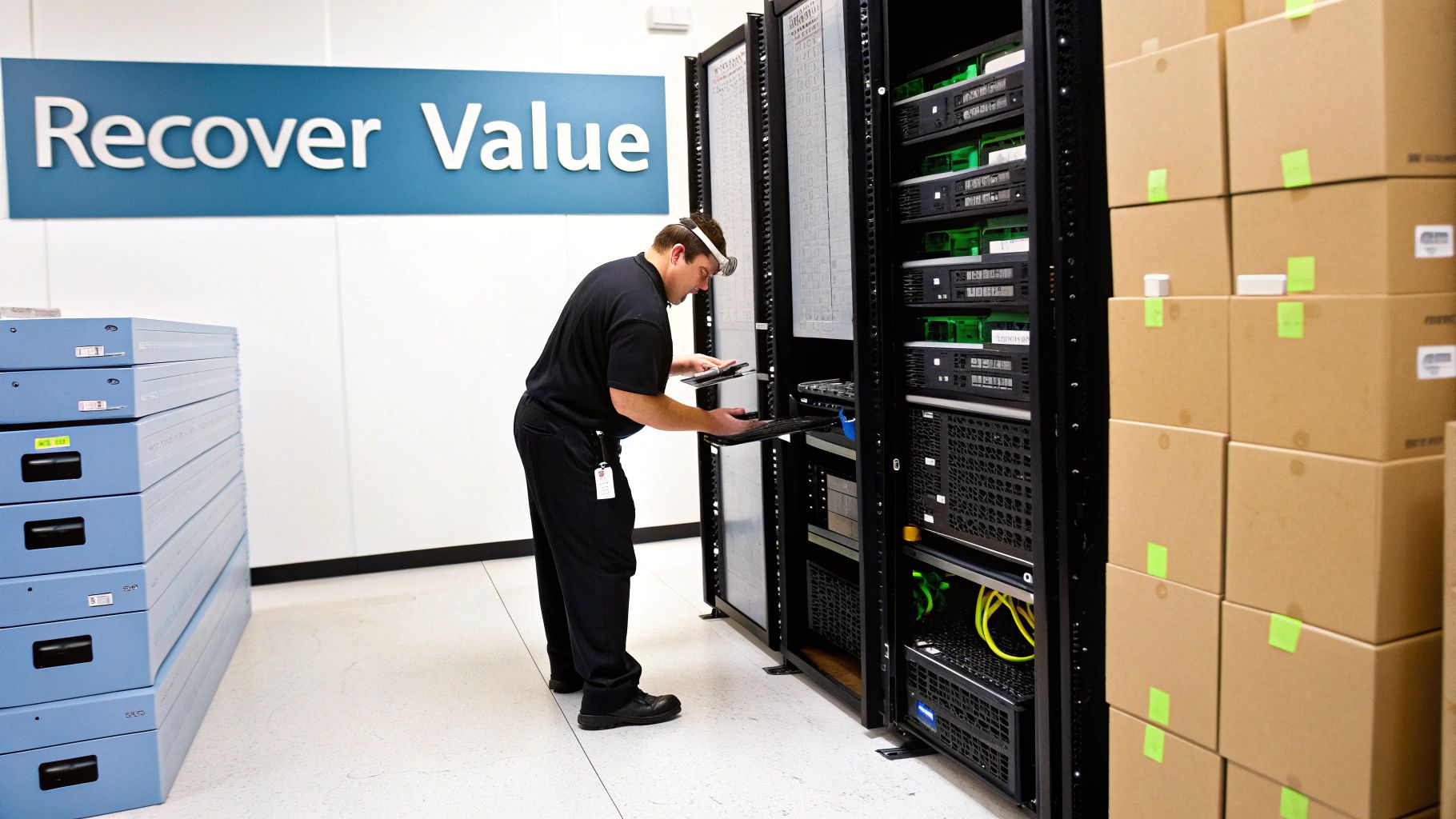
What if that storage closet full of outdated IT equipment wasn't just a headache, but a hidden revenue stream? Many businesses see old tech as a disposal cost, completely missing the financial opportunity locked inside. This is where we stop talking about expenses and start talking about earnings through value recovery.
Think of your retired equipment as a digital gold mine. Those enterprise-grade servers, networking gear, and even gently used laptops often hold on to a surprising amount of market value. A professional IT Asset Disposition (ITAD) program is the key that unlocks this potential, turning what looks like junk into a real financial asset.
Turning Old Tech into New Revenue
A true ITAD partner does a lot more than just haul away your electronics. They meticulously audit your entire inventory, pinpointing every single component that can be refurbished and resold. This whole process breathes new life into old hardware, not only extending its usefulness but also creating a return on your original investment.
The process usually breaks down like this:
- Detailed Auditing: Every item is inventoried and graded. We're looking at its condition, its age, and what the current market demand is.
- Secure Refurbishment: Our technicians get to work, repairing and upgrading the viable equipment to squeeze out every last drop of resale value.
- Strategic Resale: Finally, the refurbished assets are sold through established secondary markets to buyers who are actively looking for quality used hardware.
This structured approach is the backbone of a strong corporate e-waste solution. It ensures you capture the maximum possible value from every single piece of equipment. If you want to dive deeper into this, you might be interested in our guide on what asset lifecycle management is.
Understanding Profit-Sharing Models
So, how does this actually put money back into your business? Most leading ITAD providers, like us, work on a profit-sharing model. Once your assets are sold, the provider deducts their service fees from the proceeds and splits the remaining profit with you. It's a transparent partnership where our goals are perfectly aligned with yours.
This model can turn your IT department from a cost center into a potential revenue generator. The scale of this opportunity is massive. The precious metals buried in e-waste alone represented a $91 billion gold mine back in 2022. The shocking part? A staggering $62 billion of that value was left on the table due to improper recycling. This just goes to show the huge opportunity lost when companies don't pursue value recovery for everything from old servers to school laptops.
By partnering with the right ITAD specialist, you’re not just responsibly disposing of e-waste. You are actively participating in a circular economy that recovers value, reduces your environmental impact, and directly improves your company's bottom line.
Ensuring Data Security and Environmental Compliance
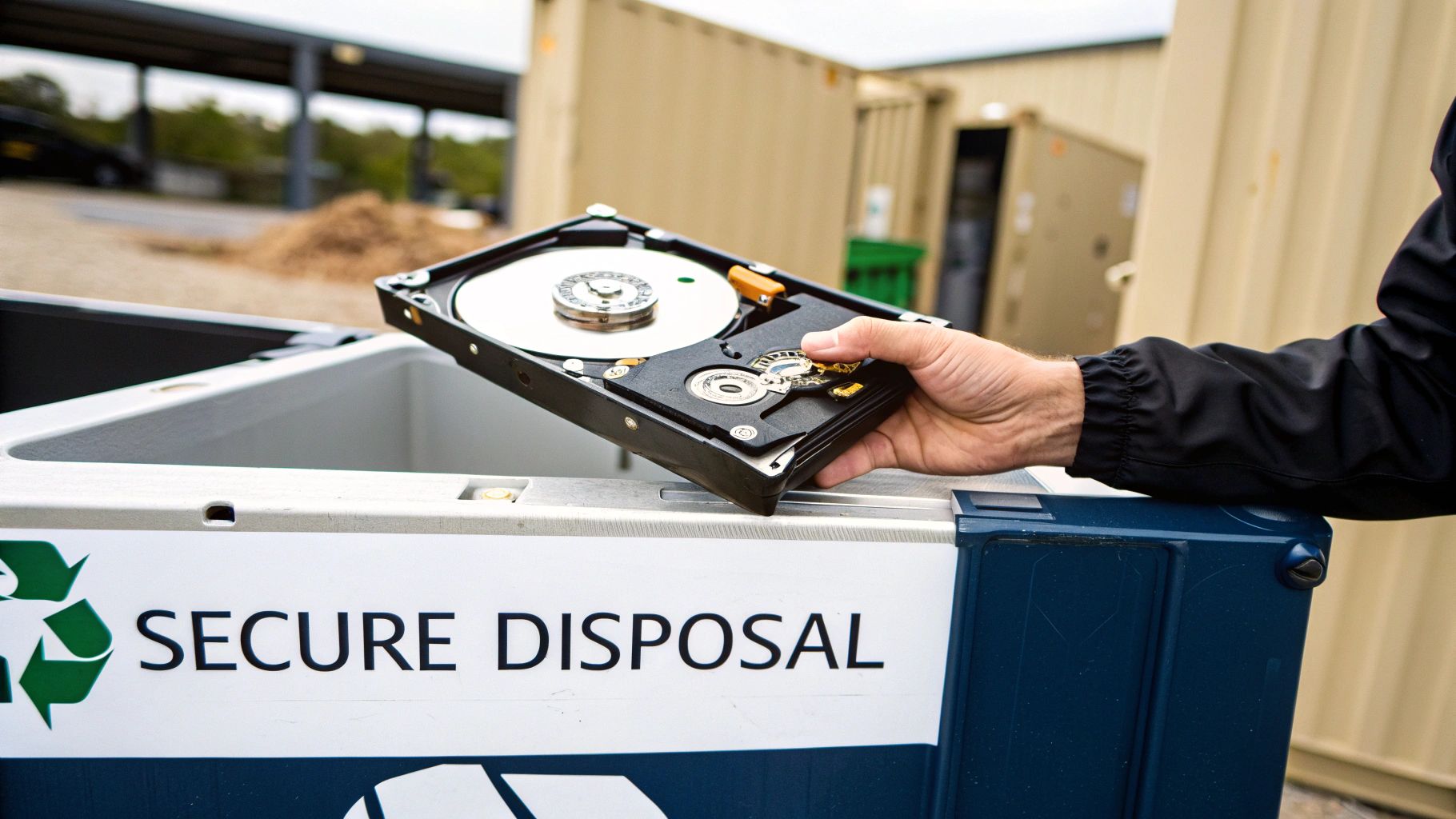
Let's be honest, for any organization, the two biggest headaches in IT disposal are data breaches and regulatory fines. The second a server or laptop is flagged for retirement, it goes from being a business asset to a potential liability. A proper corporate e-waste solution is designed to tackle these threats head-on before they can ever become a problem.
Getting rid of an old hard drive without wiping it properly is like leaving your company's most sensitive files in an unlocked box on the sidewalk. It's a huge risk. This is why certified data destruction isn't just a good idea; it’s an absolute must. It guarantees that every last bit of information—from financial records to customer data—is completely and permanently gone, protecting you from crippling data breaches.
The Gold Standard of Data Destruction
To really guarantee total data security, professional ITAD services follow strict, verifiable standards. The one you'll hear about most often is the DoD 5220.22-M protocol. This is a heavy-duty, three-pass data sanitization method cooked up by the Department of Defense. It works by overwriting your data multiple times with patterns of ones and zeros, making the original information completely unrecoverable.
Once the job is done, you should always get a Certificate of Data Destruction. Think of this as your official receipt—proof that your data was handled securely and in line with all privacy laws. For an extra layer of security, you can even opt for on-site hard drive shredding, where you can watch your media get physically destroyed. You can learn more about our secure approach to IT asset destruction services for that total peace of mind.
Navigating Environmental Regulations
Beyond just keeping your data safe, there's a whole maze of environmental rules to follow. Federal, state, and local laws are very specific about how electronic waste needs to be handled. The goal is to prevent nasty materials like lead and mercury from seeping into our soil and groundwater. Mess this up, and you could be looking at hefty fines and a serious blow to your company's reputation.
Partnering with a certified e-waste provider is your insurance policy against both data breaches and environmental non-compliance. It shifts the burden of risk and regulation from your team to a dedicated expert.
To stay on the right side of the law, look for partners with key industry certifications. These are the credentials that prove a vendor is committed to doing things the right way.
- R2 (Responsible Recycling): This certification is a big one. It ensures the vendor sticks to high standards for environmental safety, worker protection, and data security from start to finish.
- e-Stewards: Often seen as the toughest standard out there, e-Stewards certification is a guarantee that no hazardous e-waste gets shipped off to developing countries or dumped in a landfill.
Using effective risk management tools, like a simple risk register, is also a smart move to spot and handle potential issues with data and compliance. Ultimately, picking a certified partner is how you make sure your e-waste program protects your reputation, your bottom line, and the planet.
Core Services an E-waste Partner Must Provide
Picking the right partner for your company's e-waste goes way beyond finding someone to just haul away old gear. A real IT Asset Disposition (ITAD) expert offers a whole suite of services that work together to protect your data, squeeze every last drop of value out of your old tech, and keep you compliant. It's less of a transaction and more of a security protocol for your retired assets.
The whole thing kicks off with secure, professional logistics. Your partner should provide on-site asset removal, sending trained technicians to safely disconnect and pack up equipment right from your office. This isn't just for convenience; it's the very first link in a secure chain of custody, making sure your assets are accounted for from the second they leave your control.
Tracking and Data Destruction
Once your equipment is picked up, the next crucial step is a detailed inventory and audit report. Every single item—from servers down to the individual hard drives inside them—needs to be serialized and tracked. This creates the paper trail you need for compliance and gives you a crystal-clear record of what was disposed of, and when.
This obsessive tracking leads straight to the most important service of all: certified data destruction. Any partner worth their salt must offer data wiping methods that meet or exceed the DoD 5220.22-M standard, which makes data totally unrecoverable. For that extra layer of peace of mind, they should also offer on-site hard drive shredding, letting you literally watch your sensitive data get turned into metal confetti.
Every business must receive a Certificate of Data Destruction after the process is complete. This document is not just a formality; it is your legal proof that you have fulfilled your due diligence in protecting confidential information.
To help you decide what's best for your company, let's look at the options.
Comparing IT Asset Disposition Methods
| Disposition Method | Data Security Risk | Compliance Assurance | Potential for Value Recovery |
|---|---|---|---|
| In-House Disposal | High. Relies on internal staff who may lack specialized training, increasing the chance of data breaches from improperly wiped drives. | Low to Medium. Difficult to maintain a consistent, auditable process that meets all regulatory standards like HIPAA or GDPR. | Low. Limited access to resale markets and refurbishment capabilities means most equipment is simply scrapped. |
| Certified ITAD Partner | Very Low. Uses certified data destruction methods, provides certificates, and maintains a secure chain of custody from start to finish. | High. Experts are up-to-date on all regulations and provide the necessary documentation to prove compliance. | High. Established remarketing channels and refurbishment processes maximize the financial return on viable assets. |
Ultimately, while handling things in-house might seem cheaper upfront, the risks associated with data security and compliance are just too high for most businesses.
Value Recovery and Final Reporting
Finally, a top-tier partner knows how to find the money left in your old equipment. Through professional refurbishment and remarketing, usable gear is sold on secondary markets. This is often done through a profit-sharing agreement that puts a chunk of that cash right back in your company's pocket, which can seriously reduce or even cover the cost of the entire service. To get a better sense of how this fits into a larger strategy, you can explore how managed IT services for asset disposition integrate these practices.
The whole process should wrap up with transparent, end-to-end reporting that documents everything. From the initial pickup logs to the data destruction certificates and a summary of your financial returns, this final package closes the loop on your ITAD project. If you’re trying to choose between different vendors, our guide on how to evaluate IT asset disposition companies can give you some more helpful pointers.
How to Build Your Corporate Ewaste Program
Okay, so we've talked about the "what" and the "why." Now, let's get down to the "how." Moving from just an idea to a real, working plan is where the rubber meets the road. Creating a formal e-waste program isn’t just another task for the IT department; it's a smart business move that shields your company from risk, keeps you compliant, and can even put money back in your pocket.
The trick is to be methodical. You need to get buy-in from different departments, and the best way to do that is to show them what's in it for them.
Think of it like building a secure pipeline for all your old tech. The very first step? You have to know what you’re dealing with. This means doing a full audit of all the outdated or unused IT gear piling up. Don't just count laptops—document everything. Servers, networking equipment, monitors, keyboards, mice… get a complete inventory to understand the scale of your e-waste problem.
Your Step-by-Step Implementation Plan
Once you have that inventory, you can start putting together the actual program. A structured approach means you won't miss any crucial steps, turning what could be a chaotic mess into a smooth, secure process.
- Define Your Goals & Get Everyone on Board: Don't pitch this as a cost. Frame it as a solution. For the legal team, it's risk mitigation. For the C-suite, it's compliance assurance. For the finance department, it's a potential new revenue stream.
- Set Up Internal Rules: Create simple, clear guidelines for your employees. Who’s in charge of flagging old gear? What’s the official process for wiping a device and getting it ready for pickup?
- Find a Certified Partner: This is critical. Do your homework and find an ITAD vendor with the right certifications, like R2 or e-Stewards. Always ask for references and proof of their data destruction methods.
- Schedule a Secure Pickup: Work with your partner on the logistics. You need to ensure they provide a secure chain of custody from the second that equipment leaves your building.
- Review the Paperwork: Once the job is done, you'll get documents like a Certificate of Data Destruction and maybe even value recovery reports. File these carefully. This is your proof that you did everything by the book.
This simple flow chart shows exactly how a professional ITAD partner handles the process securely.
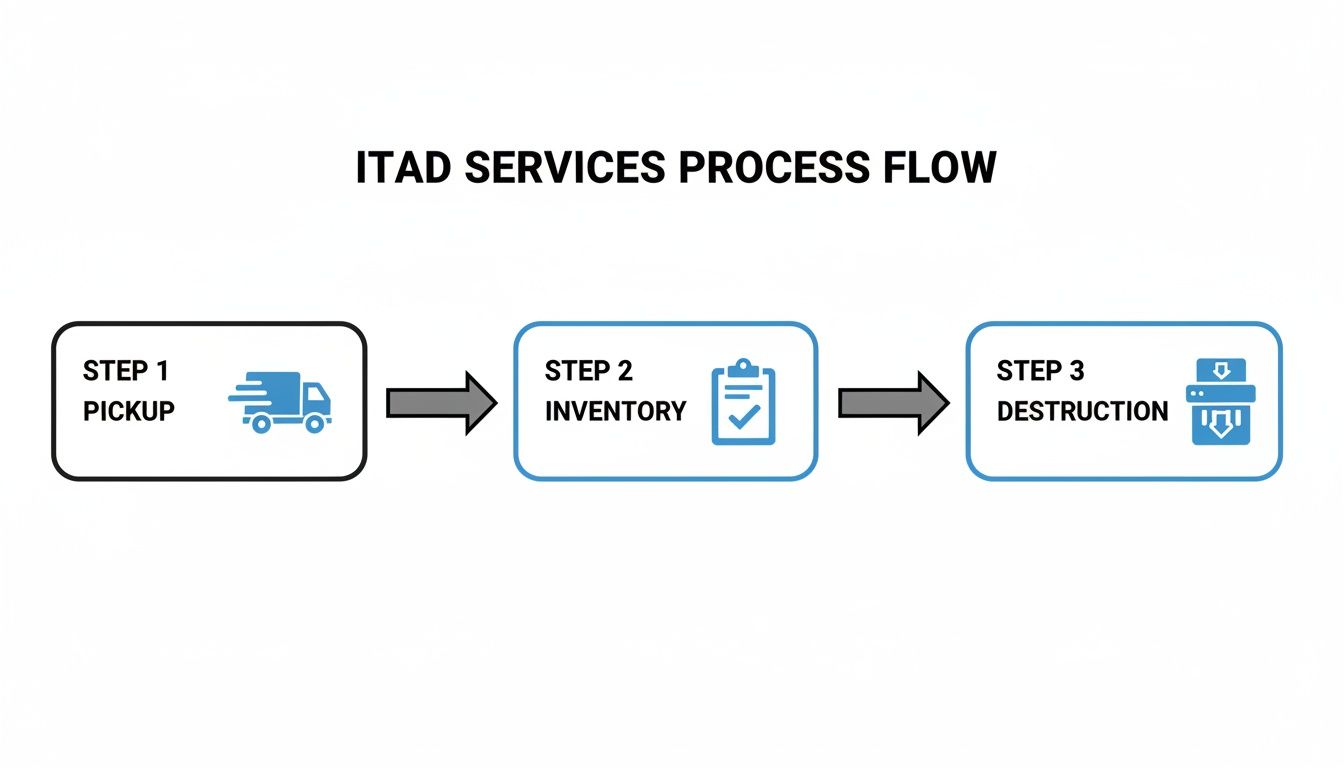
As you can see, a structured process is designed to move your assets from your location to their final, secure destination without a hitch.
Creating a Sustainable Ewaste Policy
A one-time cleanup is a great start, but a permanent policy is what really protects you. When you formalize your program, e-waste management becomes a normal part of doing business, not just a frantic reaction when the storage closet gets too full. Being proactive is key for long-term security and efficiency.
A successful e-waste program is built on clarity and consistency. By defining roles, setting procedures, and partnering with a trusted expert, you transform a potential liability into a well-managed asset lifecycle process.
This policy needs to be dead simple for everyone to understand and follow. The goal is to make responsible disposal the easy, default choice. By putting these systems in place, you give your team the tools to handle IT assets securely from the day they arrive to the day they leave.
For a deeper dive into this topic, check out our detailed guide on IT asset management best practices.
Choosing the Right E-waste Partner for Your Business
Picking a partner to handle your company's old electronics is one of the most important calls you'll make for your IT asset management. This decision isn't just about hauling away junk; it directly affects your data security, environmental compliance, and even your bottom line. Think of it less like hiring a moving company and more like bringing on a specialized security firm for your digital assets.
A quality partner does more than just show up with a truck. They provide a secure, verifiable chain of custody from the second a piece of equipment leaves your office. The first thing you absolutely must do when vetting a potential vendor is check their certifications. Are they R2 (Responsible Recycling) or e-Stewards certified? These aren't just fancy logos for a website; they are your guarantee that the provider meets the highest industry standards for both data security and responsible environmental practices.
Key Questions for Potential Partners
When you're talking to providers, your questions need to be sharp and focused on their process—and the proof they can offer. If you get vague, hand-wavy answers, that's a massive red flag. A transparent partner will have no problem walking you through their procedures and providing documentation for every single step.
Here are the non-negotiable questions you need to ask:
- Data Destruction: What exact methods do you use to sanitize data (e.g., DoD 5220.22-M)? Do you offer on-site hard drive shredding, and can my team witness the process?
- Logistics and Security: How do you guarantee a secure chain of custody while the equipment is in transit? Are your trucks GPS-tracked? What are your facility's security measures?
- Reporting and Documentation: What kind of paperwork will I receive? Can you provide a serialized Certificate of Data Destruction and a detailed report of all assets you've processed?
For companies in the Metro Atlanta area, choosing a local partner often comes with big perks. This can mean quicker pickups, lower transport fees, and working with someone who truly gets the local business scene and its specific compliance hurdles.
A partner who can confidently and clearly answer these questions is one who takes their responsibility—and your security—seriously. They should be able to map out their entire process for you, from the logistics of the initial pickup to the final value recovery report. Taking the time to choose wisely ensures your e-waste program isn't just a cost center but a strategic success that protects your business from every possible angle.
Frequently Asked Questions About Corporate Ewaste
Even with a solid plan in place, it's natural to have a few questions when you're dealing with corporate e-waste. We've put together answers to some of the most common concerns businesses in Metro Atlanta have before they partner with a professional ITAD service.
Is My Company Data Truly Secure?
Yes, but only if you work with a certified partner who takes data destruction seriously. Reputable vendors don't just delete files; they use data destruction methods that meet or even surpass government standards, like the DoD 5220.22-M wipe. This process makes your data completely unrecoverable.
For businesses that want absolute certainty, on-site hard drive shredding is the way to go. You can literally watch your sensitive data being physically destroyed. Always make sure you get a Certificate of Data Destruction afterward—this is your official legal proof that you've met your compliance obligations.
Are Ewaste Solutions Affordable For Small Businesses?
They absolutely are. Many ITAD services are designed with small businesses in mind, and some vendors even offer free data wiping for qualifying equipment. You might be surprised at how cost-effective it can be.
Better yet, if your old gear still has some life left in it (think newer servers, laptops, or networking hardware), a value recovery program can dramatically lower your costs. In many cases, it can turn what you thought was an expense into a new source of revenue for your business.
Many businesses are surprised to learn that a professional corporate ewaste solution can be cost-neutral or even profitable. The key is to partner with a provider who excels at maximizing the resale value of your retired assets.
What Types Of Electronics Can Be Recycled?
A good corporate e-waste partner can handle just about everything your business uses. We're talking about the full range of IT assets: desktops, laptops, servers, networking gear like switches and routers, old telecom systems, and all the other office peripherals that pile up over the years.
How Do We Get Started With An Ewaste Program?
The best way to start is by doing a quick inventory of the outdated electronics you need to get rid of. This gives you a rough idea of what you're dealing with. Once you have a general count, just contact a local e-waste solutions provider.
They'll walk you through the rest. A quality partner will help you figure out if your equipment has any resale value, explain how the pickup and logistics work, and detail their data destruction process. It should be a straightforward, hassle-free process from the very first phone call.
Ready to secure your data and recover value from your old IT assets? Montclair Crew Recycling offers certified, compliant, and convenient corporate ewaste solutions for businesses across Metro Atlanta. Contact us today for a free assessment at https://www.montclaircrew.com.
