
A lot of Atlanta businesses end up in the same spot. The storage room fills up first. Then the unused gear starts spilling into an empty office, a back hallway, or the corner of the server room. Old laptops from the last refresh. A stack of LCD monitors nobody wants to move. Retired firewalls. Maybe a few failed drives sitting in a drawer because nobody wants to guess what “safe disposal” means.
That is when a quick search for best buy/recycling starts to look attractive. It is familiar. It is visible. It feels easy.
For a household cable box or an old personal printer, that instinct is often fine. For business assets, it can create problems that do not show up until later. Data exposure, missing chain of custody, no pickup, no serialized reporting, and no practical way to move a large batch of equipment without turning your own staff into a hauling crew.
A key question is not whether Best Buy recycles electronics. It does. The more pertinent question is whether a consumer drop-off model matches the way Atlanta organizations retire IT equipment. In most business settings, the answer depends on four things: data sensitivity, volume, logistics, and value recovery.
The E-Waste Dilemma for Atlanta Businesses
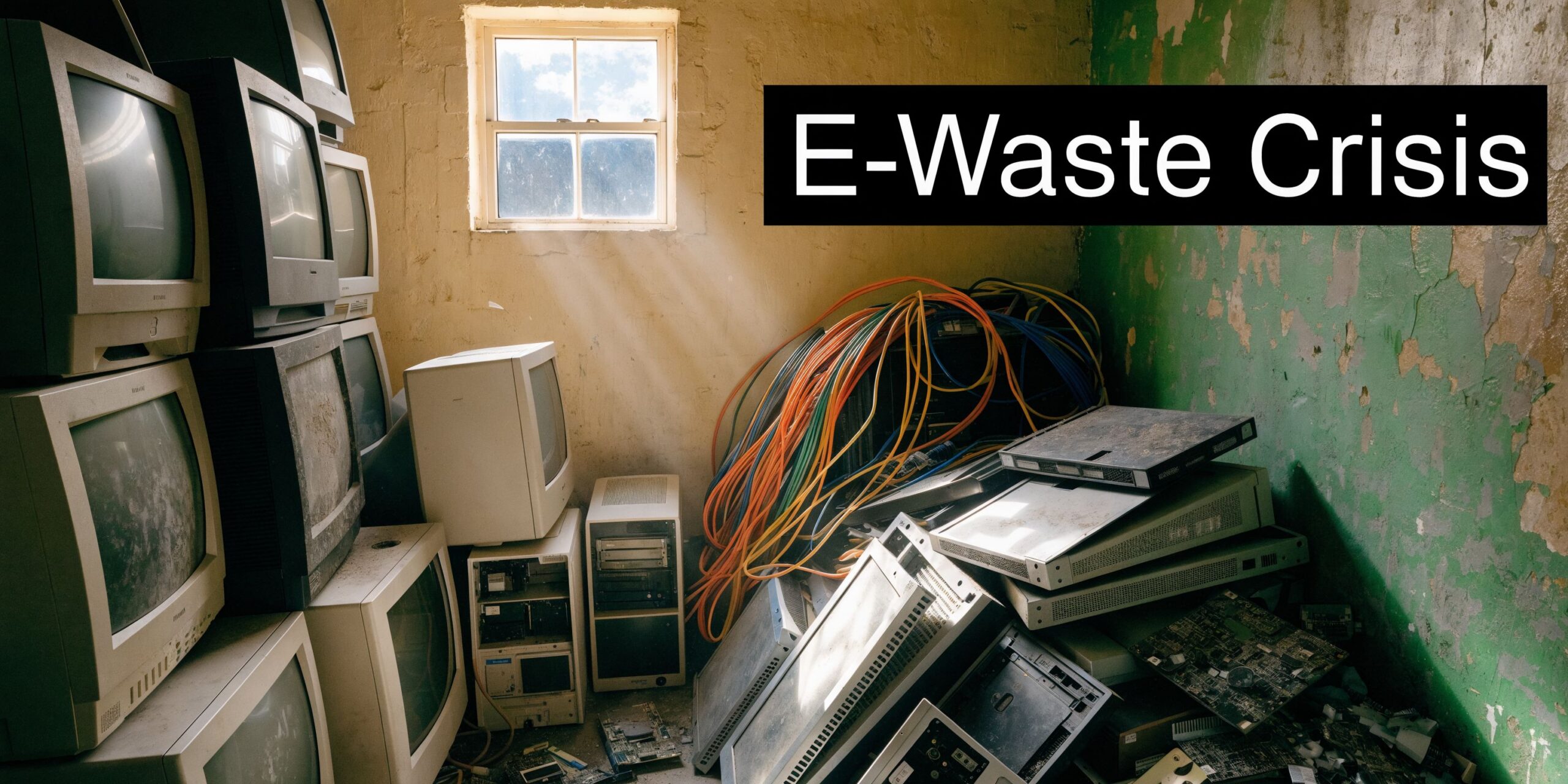
A typical office cleanout does not look like a consumer recycling errand. It looks like mixed inventory with mixed risk.
One corner has five-year-old desktops with employee records. Another has broken monitors and docking stations. The IT closet has access points, switches, and a box of hard drives from systems that were replaced months ago. Someone suggests loading it all into company vehicles and taking it to a store over a few trips. Someone else asks whether that creates a compliance problem. Both concerns are valid.
Why this choice gets harder for businesses
For consumers, convenience usually drives the decision. For businesses, disposal is tied to governance.
A medical office in Sandy Springs does not retire a patient-facing workstation the same way an employee recycles a broken headset. A school in Cobb County replacing a lab full of devices does not have the same needs as a homeowner dropping off a TV. The assets may all be “electronics,” but the risk profile is different.
Three realities usually shape the decision:
- Sensitive data stays on old devices: Laptops, desktops, servers, and drives often hold regulated or proprietary information.
- Bulk removal changes the job: Once you have carts, pallets, or multiple locations involved, a retail drop-off model starts to strain.
- Documentation matters after the pickup: If leadership, legal, or compliance asks what happened to specific assets, “we dropped them off” is rarely enough.
A practical disposal plan should answer who handled the devices, how data was destroyed, where the material went, and whether any reusable equipment still had value. Businesses that want a broader framework for this process usually benefit from thinking about managing electronic waste as an operational workflow, not just a sustainability task.
For an Atlanta business, e-waste disposal is rarely a trash problem. It is an asset control problem.
Two Recycling Models An Overview of Best Buy and Montclair Crew
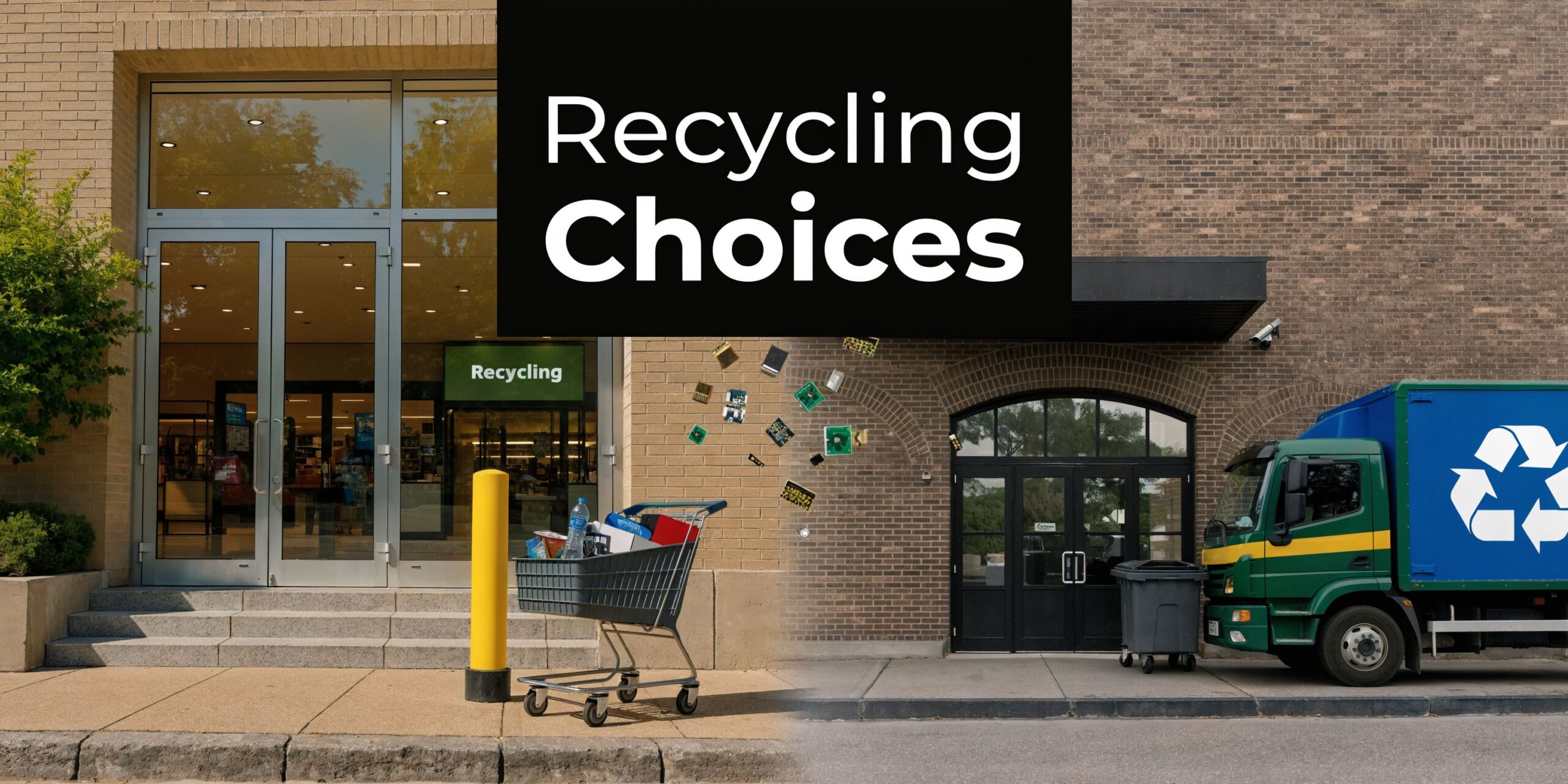
The easiest way to evaluate best buy/recycling for a business is to separate the two operating models. One is built for the public. The other is built for organizations.
| Criteria | Best Buy recycling | Professional B2B ITAD service |
|---|---|---|
| Primary audience | Consumers and low-volume drop-offs | Businesses, schools, healthcare, government, data centers |
| Service model | In-store drop-off | Scheduled pickup, audit, removal, disposition |
| Volume handling | Limited by household-style caps | Built for bulk and recurring projects |
| Data handling | Basic consumer-oriented process | Auditable destruction, reporting, chain of custody |
| Logistics | Customer transports items to store | Provider manages on-site collection and transport |
| Asset value recovery | Limited consumer trade-in focus | Business-grade resale and recovery options |
What Best Buy does well
Best Buy’s recycling program has real scale. It launched in 2009 and became the nation’s largest collector of e-waste. By 2019, it had collected 2 billion pounds of electronics and appliances, and collections in FY22 exceeded 189 million pounds, pushing the total beyond 2.5 billion pounds, according to Trellis reporting on Best Buy’s recycling program.
That matters. A retailer does not reach that scale without a functioning collection network, steady consumer participation, and significant processing infrastructure behind the scenes. For households, this is one of Best Buy’s strongest advantages. People know where the stores are. They understand the drop-off concept. Many common items can be recycled without a complicated process.
Best Buy also uses downstream partners with recognized certifications, and its public recycling materials emphasize responsible handling standards. That is important for environmental credibility.
Where the model changes for business use
A business asset retirement project asks for different capabilities.
The question is not just, “Will someone take this device?” The questions are tougher:
- Can they pick up from a downtown office tower or suburban campus?
- Can they process a full decommission with servers, storage, and network hardware?
- Can they document each drive or asset in a way your compliance team can defend?
- Can they separate reuse candidates from scrap so you do not destroy value unnecessarily?
Those needs fall into the IT asset disposition, or ITAD, category. That work combines logistics, data destruction, environmental handling, asset tracking, and sometimes resale.
The Atlanta business-oriented alternative
A local B2B provider operates differently because the job starts before the truck arrives. The provider may coordinate pickup windows, building access, loading dock rules, asset counts, and project sequencing across departments. If the equipment holds data, the destruction workflow becomes part of the service, not an afterthought.
In Metro Atlanta, one example is Best Buy recycling alternatives for business equipment, where the focus shifts from consumer convenience to business controls like pickup, secure data handling, and volume management.
That difference in mission is the part many quick online guides miss. Best Buy’s program is built to help people recycle electronics responsibly. A B2B ITAD provider is built to help organizations retire assets without creating security, compliance, or operational drag.
Best Buy solves a public access problem. A business ITAD partner solves a control problem.
Logistics Scope and Eligibility A Direct Comparison
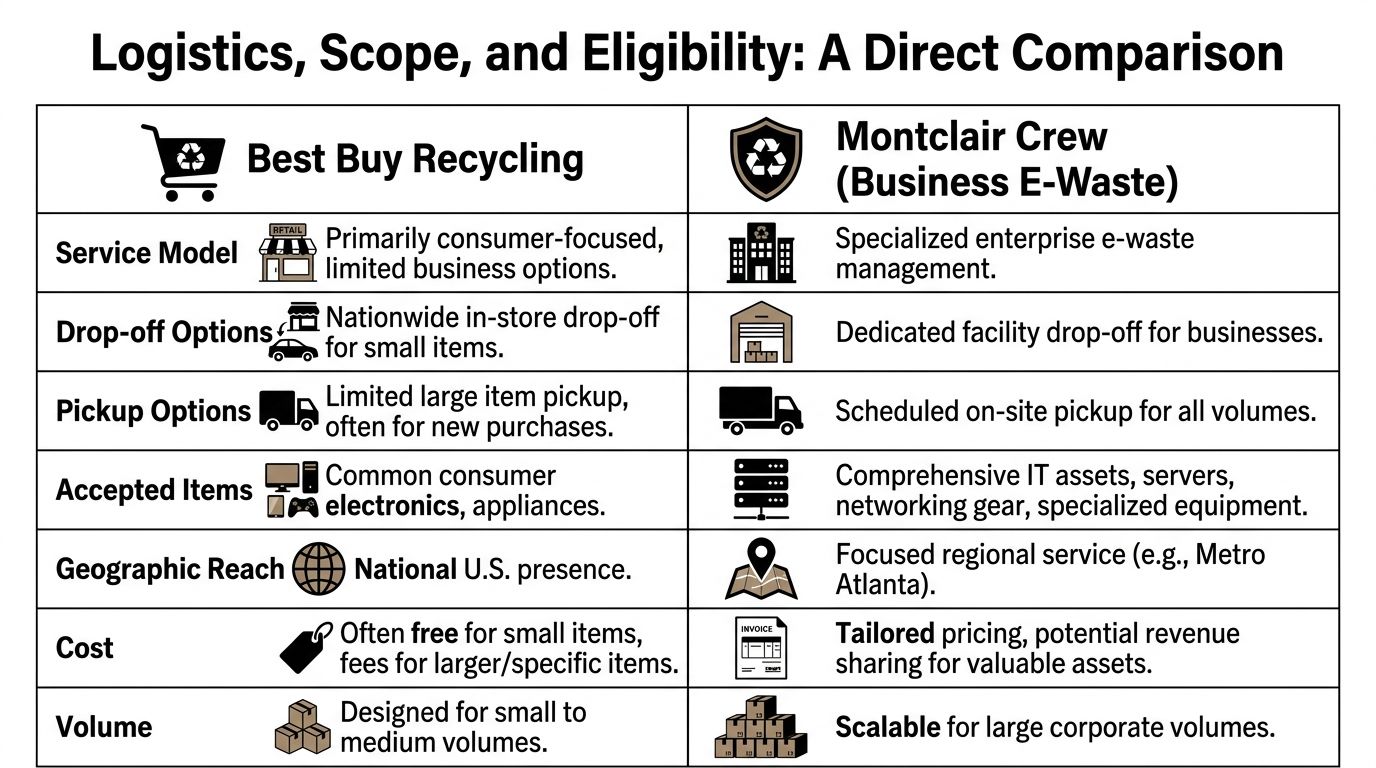
The fastest way to tell whether best buy/recycling fits your situation is to ignore marketing language and look at the physical workflow. Who moves the assets? What assets are in scope? How many devices are involved? What happens when the equipment is spread across floors, buildings, or departments?
Start with the transport question
Best Buy’s model requires the customer to bring material to the store. For a few personal devices, that is straightforward. For an office decommission, it becomes a labor and custody issue.
If your staff has to disconnect equipment, carry it downstairs, load it into personal or company vehicles, and make repeated trips, you have already created a chain-of-handling problem. You also pulled paid employees away from their actual work.
Professional ITAD services are built around the opposite assumption. The provider comes to the equipment. That matters in Atlanta offices where elevators, loading docks, parking, and access windows can complicate even a moderate pickup.
Scope of assets matters more than people expect
Best Buy is strongest when the asset list looks like household electronics. That is not the same thing as a business retirement inventory.
A business batch may include:
- User devices: laptops, desktops, tablets, thin clients
- Infrastructure gear: switches, firewalls, routers, patch panels
- Data center hardware: rack servers, storage arrays, telecom gear
- Peripheral overflow: docks, cables, keyboards, phones, UPS units
Consumer recycling programs can accept many common electronics, but enterprise environments generate a broader mix. The more specialized the equipment, the less practical a retail handoff becomes.
Eligibility becomes a hard stop
At this point, many organizations realize the consumer model is not designed for them.
Best Buy’s model has strict volume caps, including 3 items per household per day, requires self-transport, and keeps business liability with the drop-off party. A professional ITAD service, by contrast, can provide certified wiping, audit trails, and scheduled logistics for unlimited volumes, as outlined in this comparison of Best Buy recycling and professional ITAD services.
That one detail changes the whole job. A school replacing a lab, a bank closing a branch, or a company retiring 100+ laptops does not have a realistic path through a household-style drop-off rule.
What businesses should compare before choosing
Use this checklist before deciding:
- Pickup requirement: Do you need someone on-site, or can your team physically move every item?
- Asset mix: Are you disposing of only small user devices, or also servers and networking gear?
- Project size: Is this a handful of items, or a staged decommission across departments?
- Building constraints: Do you need dock appointments, COI paperwork, or after-hours service?
- Internal labor cost: Who on your team will sort, lift, inventory, and transport the equipment?
For companies that manage outbound inventory, returns, or multi-site equipment flow, it helps to understand how warehousing and reverse movement affect handling decisions. This explainer on a 3PL warehouse is useful context because it shows why collection, staging, and controlled movement matter once equipment starts moving at scale.
A practical Atlanta example
A five-person office in Roswell with a couple of dead monitors and an old personal printer can usually make do with consumer recycling. A law firm with old laptops, retired external drives, and conference room equipment should pause before doing the same thing.
The break point is not just volume. It is whether your disposal process still works when assets need tracking, pickup, and secure handling from room to truck.
Businesses that want that type of service usually look for free business electronics pickup in Georgia because pickup is not a luxury feature in commercial disposal. It is often the feature that makes the process workable.
If your plan depends on employees making multiple store runs with company assets, your disposal process is already working against you.
Data Security and Compliance The Critical Divide
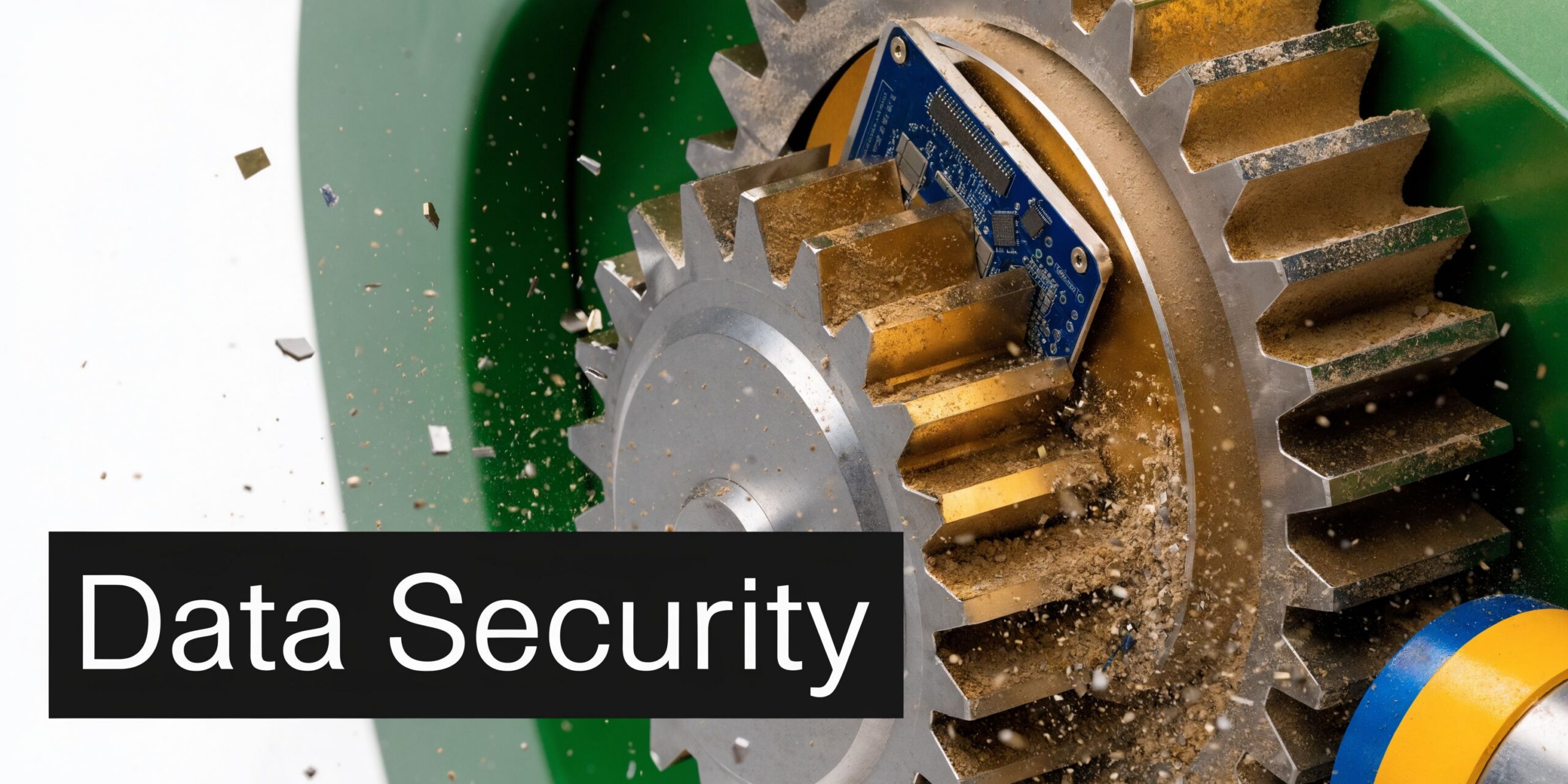
For business assets, recycling is not the first issue. Data destruction is the first issue.
That distinction gets blurred when people use best buy/recycling as shorthand for any electronics disposal option. But an old laptop is not just e-waste. It may hold payroll files, saved passwords, client communications, health information, contracts, browser credentials, VPN profiles, or cached exports from internal systems.
Recycled does not mean secure
Best Buy’s recycling program lacks specifics on certified data destruction standards such as DoD 5220.22-M or on-site shredding, according to Best Buy’s recycling service information as cited in this review of the service gap for business users: Best Buy recycling and the limits for business data protection.
That is the dividing line for business use.
A consumer drop-off workflow may be acceptable for low-risk household devices where the owner has already taken their own steps. A business needs a process that can be documented and defended. If a regulator, auditor, cyber insurer, or internal counsel asks how data-bearing assets were destroyed, the answer has to be stronger than “we dropped them off at retail.”
What business-grade security looks like
A proper B2B disposition process usually includes some combination of these controls:
- Serialized tracking: Each relevant asset or drive is tied to a record.
- Chain of custody: The business can show who handled the asset and when.
- Recognized wiping standard: The sanitation method aligns with an accepted destruction standard.
- Physical destruction option: Drives can be shredded when policy or condition requires it.
- Destruction reporting: The organization receives documentation for compliance files.
These controls matter because many organizations operate under legal or contractual obligations that go beyond general good practice. Healthcare, finance, education, legal services, and government contractors all face versions of this problem. The exact rule set may differ, but the operational need is the same. Prove what happened to the data.
Why chain of custody matters
Chain of custody is not paperwork for its own sake. It closes the gap between disposal intent and disposal proof.
If a former employee laptop goes missing in the handoff between office and recycler, the issue is no longer environmental compliance. It becomes a security incident. If ten hard drives leave a branch office and nobody can confirm which ten they were, the internal audit trail is broken before the material even reaches processing.
The legal risk usually does not come from the act of recycling. It comes from weak documentation around data-bearing equipment.
A professional ITAD provider can build disposal into your security controls. That means pickup logs, itemized reports, certificates, and destruction methods that fit corporate policy. For Atlanta companies with any material amount of regulated or confidential data, that is the standard to compare against.
The business question to ask first
Before asking whether a recycler will accept your equipment, ask this:
Would I be comfortable explaining this disposal method to my compliance officer after a breach investigation?
If the answer is no, the convenience of retail drop-off is not worth the exposure.
For companies that need a documented process, secure data destruction is the category to evaluate first. Recycling follows after that. The order matters.
If a device ever held patient records, customer data, financial records, legal files, or internal credentials, treat disposal as a security workflow. Do not treat it as general recycling.
Uncovering the True Value of Your IT Assets
A lot of organizations label everything “e-waste” too early.
That is understandable. Old hardware looks obsolete when it is piled in a corner. But disposal decisions improve when you separate scrap material from recoverable assets. Those are not the same thing.
Best Buy’s value model is consumer-oriented
Best Buy’s trade-in program kept over 650,000 devices in circulation for gift cards in 2021, but that program is oriented around consumer upgrades and does not address value recovery for major business IT such as servers or telecom gear, as summarized in this review of what Best Buy accepts for recycling and trade-in.
That is an important distinction.
A consumer trade-in program asks whether an individual device still has enough mainstream resale value to support a simple exchange. A business ITAD program asks a wider set of questions:
- Can this laptop fleet be refurbished and remarketed?
- Do these switches still have secondary market demand?
- Are these rack servers worth resale as complete units, parts, or components?
- Should this batch be redeployed internally instead of recycled?
Why finance and operations should care
When a company skips that evaluation, it often pays twice. First, it pays to get rid of equipment. Then it loses the residual value that a more thoughtful disposition process could have captured.
This is especially relevant when the devices are not fully depreciated, recently retired, or still useful in secondary channels. Finance teams that want a better lens on timing can benefit from understanding equipment depreciation life because depreciation schedules and market value do not always move in lockstep. A device can be near the end of its accounting life and still hold practical resale value.
Three buckets to use in real projects
A simple triage model works well in practice:
Reuse candidates
Equipment that still functions and fits a secondary use case.Resale candidates
Business-grade hardware with market demand, especially data center and network equipment.True recycling material
Broken, obsolete, or low-value gear that should be dismantled responsibly.
A specialized ITAD provider can outperform a basic recycling handoff here. The provider is not only a disposer. The provider can also act as an evaluator of what should be wiped and resold, what should be dismantled, and what should be destroyed.
The mindset shift that saves money
The old server in your rack may be waste. Or it may be an asset that aged out of your environment.
Those are different conclusions, and they lead to different outcomes. Businesses that sort for value before recycling usually make cleaner decisions on budget, sustainability, and auditability. Commodity recycling has its place. It just should not be the default for every retired asset.
Your Decision Framework Choosing the Right Atlanta Partner
Most businesses do not need a theory lesson when old equipment starts piling up. They need a decision rule.
Use this framework to decide whether best buy/recycling is good enough for the job, or whether you need a business-focused ITAD partner.
First screen the project by risk
Ask these four questions in order:
- Does any asset contain sensitive data?
- Is the quantity larger than a small personal drop-off?
- Do we need pickup, packing, or removal from the site?
- Could any of this equipment still hold resale value?
If you answer yes to even two of those questions, a retail drop-off model is usually the wrong fit.
Best Buy’s program uses partners that are R2 or e-Stewards certified, but the program itself is built for low-volume consumer drop-offs with 3 items per day and basic wiping. That makes it a poor match for enterprises that need NIST 800-88-aligned destruction expectations, serialized chain of custody, and liability transfer, as outlined in Best Buy’s recycling guidelines and business comparisons summarized here: Best Buy recycling guidelines for consumer drop-off use.
Scenario one with a very small office batch
You have five old laptops in a small office. No servers. No drives in storage. No regulated data beyond standard employee use.
This is the only situation where people are tempted to force a consumer solution. Even here, the right question is whether those laptops held company data and whether anyone needs proof of destruction later. If the answer is yes, use a business service. If the answer is no and the equipment is incidental, retail may be workable.
Scenario two with healthcare or legal data
A medical practice, dental office, accounting firm, or law office should not treat disposal like a simple recycling errand.
The devices may contain patient information, tax records, case files, payment information, or scanned identity documents. Those organizations need documented destruction and a clear chain of custody. Convenience is not the deciding factor. Defensibility is.
If your industry handles regulated records, choose the partner that can document the destruction process from pickup through final reporting.
Scenario three with a school or office refresh
A school district, college department, or corporate office refresh creates a quantity problem and a scheduling problem at the same time.
The project often involves classrooms, labs, or multiple departments. Equipment may need to be removed in phases. Building access, staff availability, and pickup windows all matter. Household-style drop-off caps make this model impractical fast.
Scenario four with a server room or data center
This is the easiest call.
If the asset list includes rack servers, storage, telecom gear, network infrastructure, or large batches of drives, use a professional ITAD provider. The logistics, resale potential, and data sensitivity all point in the same direction.
A short selection checklist for Atlanta organizations
When comparing providers, ask for direct answers to these items:
- Pickup and labor: Will they remove equipment from our site, or are we transporting it?
- Data destruction: What wiping or shredding standard do they use?
- Reporting: Do we receive serialized asset records and destruction documentation?
- Liability: At what point does custody transfer?
- Reuse and resale: Will they identify assets that still have market value?
- Service area: Can they support our Metro Atlanta locations consistently?
For businesses that want to compare local options side by side, this guide to electronic waste disposal companies is a useful starting point because it frames the decision around business requirements, not consumer convenience.
The practical rule
Use Best Buy for personal, low-risk, low-volume electronics when retail drop-off is all you need.
Use a business ITAD service when the equipment belongs to an organization, contains data, requires pickup, needs documentation, or may still hold value. That covers most real-world business projects in Atlanta.
A B2B provider such as Montclair Crew Recycling fits that second category by offering business pickup, asset auditing, DoD-compliant wiping, optional on-site shredding, and resale or profit-sharing for qualifying equipment. That is not a substitute for due diligence. It is the kind of service profile businesses should be looking for.
The mistake is not using Best Buy. The mistake is using a consumer recycling model for a business disposal problem and assuming the result will be equivalent.
If your Atlanta organization is retiring laptops, desktops, servers, telecom gear, or mixed IT inventory, contact Montclair Crew Recycling to discuss a business-grade disposal plan. A good partner should help you handle pickup, data destruction, compliance documentation, and asset recovery without turning your staff into a transport crew or leaving your audit trail full of gaps.
