
Georgia's tech economy generates an annual economic impact of $113 billion, and one industry roundup says Atlanta's SaaS sector revenue grew 18% in 2022. Those two figures matter on their own, but together they point to something larger: Atlanta is no longer just a promising regional tech market. It's operating as a serious software production and enterprise buying center, especially for business software sold into complex industries like payments, logistics, and compliance-heavy operations, according to WiFi Talents' Atlanta technology industry statistics.
Most discussions of Atlanta's SaaS rise stop at funding rounds, startup lists, or a few headline companies. That misses the more strategic story. Atlanta's role in SaaS industry growth isn't just about software founders and venture capital. It's also about physical systems: data centers, servers, networking gear, end-user devices, telecom hardware, and the operational burden of retiring those assets securely and responsibly.
That physical layer changes how local businesses should think about the boom. If your company operates in Metro Atlanta, you're not just participating in a software economy. You're participating in a full technology lifecycle economy, from cloud adoption and hardware deployment to decommissioning, resale, recycling, and data destruction.
The New Capital of Cloud Software in the South
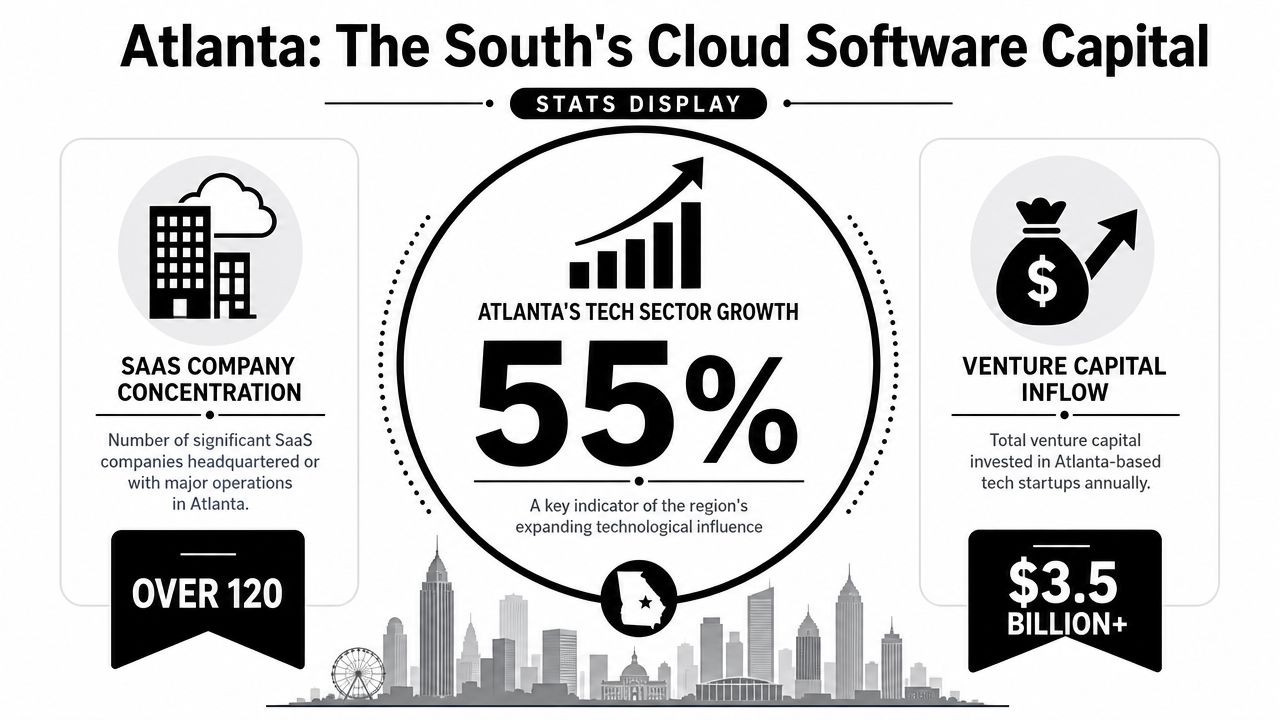
More than 40,000 people work in Atlanta fintech alone, and that concentration helps explain why the metro has become one of the South's strongest markets for B2B software. A SaaS hub is not built on founders and venture money by themselves. It forms when large local industries keep buying software, integrating it into daily operations, and demanding the infrastructure to support that usage.
Atlanta fits that pattern. The region combines enterprise buyers, technical labor, implementation capacity, and a large installed base of technology equipment across offices, colocation sites, and data environments. Software may be delivered through the cloud, but the business activity behind it still depends on physical systems.
Why the market signal is stronger than it looks
A large fintech workforce points to more than employment scale. It points to dense local demand for payments software, fraud tools, analytics platforms, compliance systems, customer onboarding products, and transaction monitoring. In practical terms, Atlanta has a customer base that already understands complex software and has budget authority to keep buying it.
That buyer maturity lowers go-to-market friction for SaaS firms serving regulated, process-heavy industries. It also helps explain why founders continue to connect with SaaS investors for fundraising around companies built for enterprise use cases rather than purely consumer adoption.
Atlanta's software growth makes more sense when fintech scale is treated as a standing source of enterprise demand.
What a SaaS ecosystem means for Atlanta operators
For businesses in Metro Atlanta, the opportunity is broader than selling or subscribing to software. Growth in SaaS increases demand for cloud migrations, security controls, device refreshes, server replacements, and retirement of aging equipment. Many local firms are already making those decisions through broader Atlanta cloud migration trends and modernization planning.
The business logic works across three layers:
- Buyer layer: Enterprise-heavy sectors such as fintech and logistics keep purchasing software, integrations, and compliance tooling.
- Builder layer: Engineers, cloud teams, and service partners can build, deploy, and maintain those systems locally.
- Infrastructure layer: Every cloud-heavy company still relies on networking gear, storage, end-user devices, and hardware that eventually has to be removed from service.
That final layer is easy to overlook and expensive to ignore. SaaS growth creates a downstream stream of retired laptops, failed drives, decommissioned servers, surplus networking equipment, and other assets that carry both data risk and disposal cost. For Atlanta companies, the cloud economy is also an asset lifecycle economy. That is where IT asset disposition, secure data destruction, resale recovery, and responsible recycling become operating requirements rather than back-office cleanup.
Atlanta's Ecosystem The Human and Financial Drivers
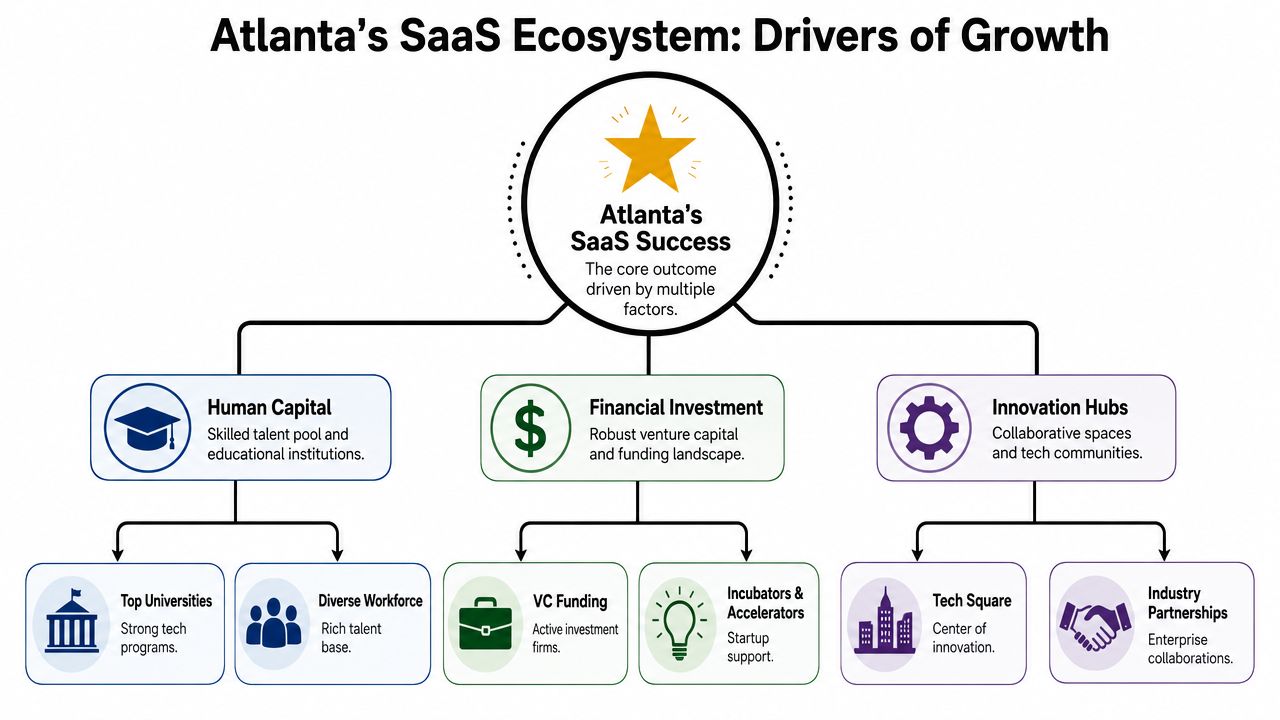
Atlanta's software momentum isn't accidental. It's the result of an ecosystem where capital and labor reinforce one another. Founders can raise money, hire specialized technical talent, test products in enterprise-heavy markets, and keep recruiting as products mature.
Independent reporting on the region says information technology, including SaaS, consistently attracts the most venture capital in Georgia, while software engineers are the most in-demand tech roles in Atlanta. The same reporting highlights strong demand for cloud architects, DevOps engineers, data scientists, security engineers, and full-stack developers in the metro, according to Capital Analytics Associates' review of Atlanta's tech growth.
Talent depth changes execution risk
That mix of roles matters because SaaS companies don't scale on software engineers alone. They need people who can build multi-tenant systems, automate deployment pipelines, secure cloud environments, manage uptime, and support enterprise integrations.
In thinner markets, companies often face a tradeoff. They can hire affordably, or they can hire specialized talent. Atlanta is more competitive because firms can recruit from a broader pool without relying entirely on remote hiring.
For local businesses buying software, that translates into a quieter advantage: vendors based in Atlanta often operate close to the industries they serve and close to the technical talent they need to keep shipping product.
Capital works better when local customers exist
Venture money matters most when founders can pair it with customer access and execution capacity. Atlanta's advantage is that capital doesn't enter a vacuum. It enters a market with corporate buyers, university commercialization activity, and operating talent that can move a product from prototype to production.
If founders want a current benchmark for how investors evaluate enterprise software categories, this list of SaaS investors for fundraising is a useful reference point. It helps frame what kinds of software businesses are getting attention and where local founders may need sharper positioning.
Practical rule: Ecosystems compound when talent shortens product cycles and capital arrives before that talent gets exhausted.
Why this matters beyond Midtown
The Atlanta SaaS story isn't confined to one neighborhood. The metro's business geography matters. Alpharetta, in particular, has become part of the wider operating footprint for technology, finance, and IT services, which is why local context around business growth in the City of Alpharetta matters for firms deciding where to build teams or support operations.
For operators, the takeaway is less glamorous than startup headlines, but more useful. Growth brings competition for engineers, security talent, and cloud specialists. Companies that don't plan for that competition early often end up with delayed implementation schedules, slower migrations, and higher vendor dependence.
A simple way to read Atlanta's human and financial drivers is this:
| Driver | Strategic effect on SaaS firms | Practical effect on local businesses |
|---|---|---|
| Talent demand in software and cloud roles | Makes product development and scaling more feasible | Raises hiring pressure for in-house IT teams |
| Venture concentration in IT and SaaS | Supports formation and expansion of software firms | Increases software vendor choice, but also noise |
| Research and commercialization activity | Helps turn technical ideas into businesses | Expands partnership and procurement options |
The Physical Foundation Atlanta's Data Center Boom
Cloud software feels intangible until you map where it runs. Every SaaS product depends on physical infrastructure somewhere: servers, storage systems, switches, routers, backup hardware, cooling, power distribution, and the facilities that keep those systems online.
Atlanta's role in SaaS industry growth becomes much more concrete when you look at data centers. The region's data center market is estimated at 1.82 GW of installed IT power in 2026, up from 0.92 GW in 2025, and projected to reach 7.68 GW by 2031 at a 26.95% CAGR, according to Mordor Intelligence's Atlanta data center market analysis. The same analysis says cloud and IT services represented 28.47% of leased capacity in 2025, equal to more than 250.5 MW, and are forecast to grow at 34.62% CAGR through 2031.
Software growth creates hardware consequences
Those figures don't just show local prestige. They show capacity. Atlanta is becoming a major Southern node for the infrastructure that hosts, scales, and delivers software products to enterprise users.
That has a direct operational consequence for businesses in the metro. As companies add cloud environments, hybrid infrastructure, edge systems, or private hosting environments, they also add a growing stream of physical assets that eventually need to be replaced or retired.
Software strategy and IT asset management finally meet. A company can migrate workloads to the cloud and still face a large cleanup problem in its server room, branch network closets, employee laptop fleet, telecom stack, or test lab.
The hidden work behind cloud adoption
The “move to cloud” narrative often skips the physical side of transition. But every migration leaves something behind:
- Legacy servers that still contain sensitive workloads or residual data
- Networking equipment that no longer fits the target architecture
- Storage media that requires secure destruction or certified wiping
- End-user devices redeployed during SaaS standardization projects
That's especially relevant for organizations dealing with Atlanta IT infrastructure challenges during rapid growth. Growth rarely arrives as a clean, one-time upgrade. It arrives as overlapping layers of old and new technology that must be managed at the same time.
If Atlanta keeps expanding as a cloud hub, the metro won't just need more developers and data centers. It will need stronger discipline around hardware retirement, asset tracking, and compliant disposal.
Meet the Innovators Notable Atlanta SaaS Companies
The best proof of ecosystem quality is the range of companies it produces. Atlanta has well-known SaaS names that serve very different business problems, which matters because it suggests the city supports more than one software niche.
Mailchimp helped define Atlanta's presence in marketing software. Calendly became a mainstream scheduling product with broad business adoption. Salesloft built its reputation in sales engagement. OneTrust is closely tied to privacy, governance, and enterprise risk management. Those examples point to a city that can support software businesses in workflow automation, revenue operations, trust and compliance, and customer communication.
This is a market, not a shortlist
The deeper point is scale. A May 2026 directory lists 321 Atlanta-based SaaS companies with $6.1B in combined revenues and $4.1B raised, according to GetLatka's Atlanta SaaS company directory. That's a meaningful sign of ecosystem density, because it suggests Atlanta's software economy isn't dependent on one breakout winner.
A dense market changes how businesses should evaluate opportunity. It means local buyers have more potential vendors. It means more founders can build niche products aimed at regional industry pain points. It also means service providers can build specialized practices around the needs of software firms and their customers.
What the local winners reveal
Instead of seeing Atlanta's SaaS names as isolated success stories, it's more useful to read them as signals.
- Mailchimp shows Atlanta can produce software with broad SMB and marketing relevance.
- Calendly shows that a product with a simple user experience can still scale from Atlanta into a global workflow category.
- Salesloft shows the city can support enterprise-facing software tied to revenue teams and operational process.
- OneTrust shows Atlanta can sustain software aimed at regulated, compliance-heavy enterprise environments.
That mix matters because it reveals a software city with range. Atlanta isn't locked into one narrow category.
A practical lesson for local operators
For businesses in the metro, this density creates two realities at once. First, there's more opportunity to find local or regional vendors who understand the operating environment. Second, there's more complexity in procurement because product categories are getting crowded, especially in AI, workflow tools, analytics, and governance.
That's one reason many firms are pairing software adoption with broader modernization efforts, including device refreshes and operational changes tied to how Atlanta businesses are adopting AI tools. New software often comes with new hardware assumptions, new security policies, and a backlog of retired equipment that no longer fits the stack.
From FinTech to Logistics Why B2B SaaS Thrives Here
Atlanta has a specific advantage that many software hubs don't. It supports B2B SaaS aimed at operationally complex industries, not just general-purpose software.
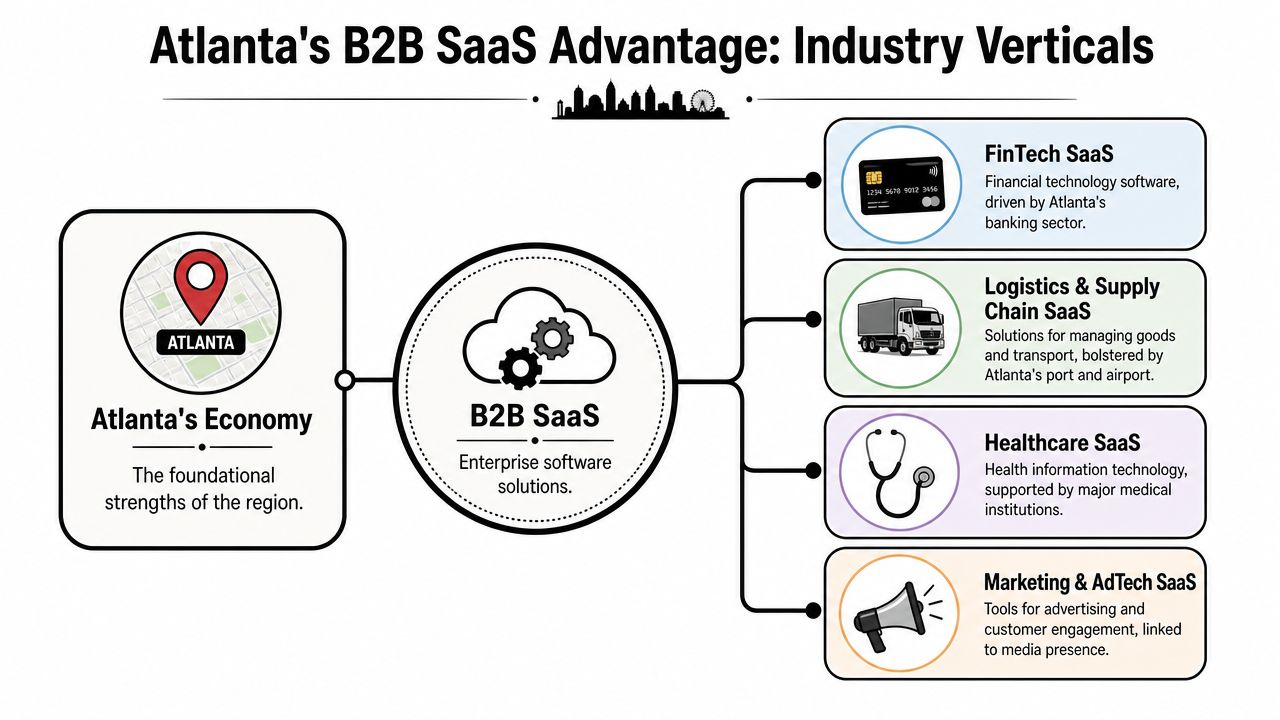
The Metro Atlanta Chamber describes the region as a global center for financial technology in payments, trade, and crypto, as detailed on the Metro Atlanta Chamber's growth overview. That matters because financial technology buyers usually need more than a polished interface. They need security, auditability, workflow controls, integration logic, and high reliability.
The city's best SaaS categories follow its real economy
This is why Atlanta's strongest software categories often overlap with the city's established industries. Financial infrastructure creates demand for payments software, fraud tools, governance software, merchant systems, and transaction analytics. Logistics activity supports software tied to routing, warehousing, supply chain visibility, and fulfillment operations.
Healthcare and marketing software also fit naturally into Atlanta's business environment, but the bigger pattern is structural. SaaS grows faster when founders can build near the industries they understand and sell into.
A useful comparison point for decision-makers is to study broader lists of enterprise software leaders. That context helps local buyers and founders distinguish between categories with durable enterprise demand and categories driven more by hype than by operational necessity.
Why this feedback loop is hard to copy
Atlanta's advantage isn't just “fintech exists here.” It's that fintech concentration shapes adjacent services and software behavior. Buyers ask harder implementation questions. Talent accumulates around regulated workflows. Vendors specialize earlier. Integrators and telecom partners gain vertical knowledge that generic software markets often lack.
For businesses operating in connectivity-heavy or distributed environments, that local specialization often intersects with practical service needs such as enterprise telecom support in Atlanta. Many B2B SaaS products don't stand alone. They sit on top of networks, branch equipment, communications systems, and endpoint fleets that still need disciplined management.
Atlanta is strongest when software solves transaction-heavy, compliance-sensitive, or operations-driven problems. That's a more durable niche than chasing every consumer app trend.
Navigating the Growth Strategic Next Steps for Your Business
Atlanta's SaaS expansion changes day-to-day operating requirements for local businesses. More cloud software usually means more endpoints, more identity dependencies, more network changes, and more retired equipment that has to be handled correctly. For firms in Metro Atlanta, software strategy and hardware disposition now sit in the same operating chain.
The split between SMBs and enterprises is real, but both face the same underlying problem. Growth adds tools. Tools add devices, access points, storage media, and infrastructure changes. If those assets are not tracked through retirement, the operational gains from new software can be offset by security gaps, audit problems, and avoidable disposal costs.
For SMBs, the immediate issue is software discipline tied to asset control. Before adding another SaaS product, review the hardware it touches, the user accounts it creates, the endpoint rules it requires, and the offboarding process it triggers. Otherwise, companies end up with idle laptops, unmanaged accessories, retired firewalls, and storage devices that no one clearly owns.
Large enterprises face a different version of the same issue. Cloud migration, office consolidation, M&A activity, security upgrades, and refresh cycles all create physical downstream work. Servers leave racks. Telecom equipment is replaced. Backup systems become redundant. Drives still need secure wiping or destruction, and records still need to stand up to internal review, customer requirements, or regulatory scrutiny.
What smart operators should do now
Strong execution starts with a documented process.
Map your hardware lifecycle
Identify where assets enter service, how they are tagged, who owns them, when they are redeployed, and how they exit the environment. Include laptops, desktops, servers, switches, phones, storage media, and lab or test equipment.
Tie software projects to decommissioning plans
A migration is not complete when the new platform is live. It is complete when the old hardware is removed, data-bearing devices are handled securely, and reuse, resale, or recycling decisions are documented.
Treat data destruction as a control, not a cleanup task
Retired drives, backup media, and decommissioned endpoints can create exposure long after users stop thinking about them. Secure wiping, physical destruction where appropriate, and chain-of-custody documentation should be part of standard operations.
Build end-of-life decisions into procurement
Ask what happens to equipment before you buy it. Some assets can be remarketed or redeployed. Others belong in compliant recycling streams. That distinction affects budget recovery, reporting, and environmental performance.
Where the risk actually shows up
Operational risk usually appears after the rollout.
| Business event | Immediate focus | Common overlooked issue |
|---|---|---|
| SaaS rollout | Adoption and user access | Old local infrastructure remains in place |
| Device refresh | Deployment speed | Retired devices pile up without clear disposition |
| Office move or closure | Continuity | Telecom and networking gear is left unmanaged |
| Data center change | Uptime | Decommissioned servers and drives create exposure |
In Atlanta, that pattern has become more important as the region adds software firms, cloud capacity, and supporting infrastructure. SaaS growth does not reduce the need for physical asset management. It increases the volume of equipment that must be inventoried, removed, wiped, recycled, resold, or destroyed safely. Businesses, schools, healthcare providers, banks, and public agencies all feel that pressure.
Companies that manage hardware exits with discipline usually execute digital transformation with the same discipline. The shared requirement is documented process, clear ownership, and accountability.
If your organization is decommissioning servers, retiring laptops, replacing telecom gear, or cleaning up after a cloud migration, Montclair Crew Recycling offers a local path for secure IT asset disposition and electronics recycling across Metro Atlanta. Their team helps businesses handle pickup, asset audit and logistics, certified data destruction, environmentally compliant recycling, and value recovery where remarketing makes sense. For companies operating inside Atlanta's expanding software and infrastructure economy, that support is part of responsible technology operations.
