

What happens to your recalled, defective, or outdated products after they leave your facility? If you just toss them, you're opening the door for them to pop up on a gray market, which can absolutely tank your brand's reputation. Product destruction services are your best line of defense against that nightmare scenario. Think of it as a strategic process for guarding your brand, protecting your intellectual property, and staying on the right side of the law.
Why Product Destruction Is a Critical Business Strategy
Too many businesses see disposal as just another line item expense. But secure product destruction is actually a powerful investment in managing your risk. When products are simply thrown in a dumpster, they can be easily retrieved, resold, or even reverse-engineered. This isn't just about getting rid of trash; it's about eliminating a potential liability waiting to happen.
Properly handling the end-of-life for your physical assets is a core part of protecting your brand. If you neglect it, you could face financial and reputational damage that costs far more than secure disposal ever would.
Protecting Your Brand and Reputation
Your brand's integrity is one of your most valuable assets. It's built on trust. When faulty or off-spec products sneak into the gray market, they chip away at that trust and dilute the quality your customers expect.
Just think about these common situations where professional destruction is a must:
- Defective Products: Items that failed quality control can cause real harm or just give a customer a terrible experience, leading to scathing reviews and potential lawsuits.
- Counterfeit Goods: When you seize counterfeit items, you have to destroy them. Otherwise, they'll find their way back to the market, cheapening your brand's value.
- Outdated Inventory: Expired goods or obsolete electronics can create massive liability issues if someone uses them past their effective date.
- Branded Uniforms: What happens to old uniforms? If they fall into the wrong hands, someone could impersonate an employee, creating a serious security risk for your business and your customers.
Securely destroying these items ensures they never see the light of day. You're not just getting rid of clutter—you're protecting the public and preserving the reputation you've worked so hard to build.
A Growing Market Driven by Necessity
Businesses are waking up to the need for secure disposal. The global Secure Product Destruction Service market is expected to balloon from USD 3.84 billion to USD 6.5 billion between 2025 and 2035. This isn't a fluke; it's driven by tougher regulations and growing concerns about data and brand security.
This whole process is the final, critical stage in a product's lifecycle. Managing this disposal phase is just as important as managing an asset's acquisition and use. You can learn more about how this fits into the bigger picture by reading our guide on asset lifecycle management.
By building product destruction services into your company's game plan, you're not just reacting to problems—you're proactively managing risk and securing your company's future.
Understanding Different Product Destruction Methods
Not all destruction is created equal. The right method always comes down to the material you’re dealing with, how sensitive it is, and what regulations you need to follow. Picking the correct approach is the critical first step to making sure your unwanted products are gone for good, not just tossed in a dumpster.
Think of it this way: you wouldn't use a sledgehammer to fix a watch. In the same way, the process for destroying a batch of defective t-shirts is worlds apart from what’s needed for a server packed with customer data. Every type of product needs its own specific solution.
Methods For Physical Goods
When you're dealing with hard goods—things like counterfeit apparel, recalled toys, or defective electronics casings—the goal is simple: make the product totally unusable and unrecognizable. The most common and effective tool for this job is industrial shredding.
This is nothing like your office paper shredder. We're talking about heavy-duty machines that chew through metal, plastic, and textiles, reducing everything to small, unsalvageable bits. This brute-force mechanical process guarantees that items can't be pieced back together or sold on the gray market, which is a direct defense of your brand’s reputation.
Another method, crushing, uses massive hydraulic force to flatten and compact items until they're completely inoperable. It's often used for bulkier products or as the first step before they head into the shredder. Both methods give you certainty that the product is truly destroyed.
Specialized Methods For Data And Electronics
The game completely changes when electronics are on the table. The focus instantly shifts from just wrecking the physical device to ensuring the permanent, irreversible erasure of the data inside. While shredding a hard drive is definitely effective, there are other specialized methods designed for data-bearing devices.
Data destruction isn't just about deleting files. Deleting a file is like tearing the table of contents out of a book—the pages are still there, they're just harder to find. Certified data wiping is like professionally bleaching the ink off every single page. The information is truly, permanently gone.
Here’s a quick look at the core techniques for digital media:
- Certified Data Wiping: This software-based approach overwrites every sector of a hard drive with random data, often in multiple passes to meet standards like the DoD 5220.22-M. It completely sanitizes the drive, making the original data impossible to recover while allowing the hardware to be safely reused.
- Degaussing: This technique blasts a hard drive or magnetic tape with a powerful magnetic field, instantly scrambling the data. The process makes the drive unusable, but it’s an incredibly fast and secure way to destroy the information it held.
- Physical Shredding: For the absolute highest level of security, nothing beats physically destroying the media. This is where a professional service shreds hard drives, SSDs, and backup tapes into tiny fragments. To see how this works, check out the details of a secure hard disk drive destruction service.
To give you a clearer picture, here's a quick comparison of the common methods.
Product Destruction Methods At A Glance
| Destruction Method | Best For | Key Benefit |
|---|---|---|
| Industrial Shredding | Apparel, counterfeit goods, plastics, packaging, non-data electronics | Renders products completely unusable and unrecognizable. |
| Crushing / Compacting | Bulkier items, scrap metal, large product batches | Reduces volume and makes items inoperable before final disposal. |
| Certified Data Wiping | Hard drives (HDDs), servers, laptops meant for reuse or resale | Securely erases all data while preserving the physical hardware. |
| Degaussing | Magnetic media like HDDs and backup tapes needing fast erasure | Instantly and permanently destroys data with a powerful magnetic field. |
| Physical Shredding (Media) | Hard drives (HDDs & SSDs), phones, backup tapes, USB drives | The highest security option; provides visual proof of destruction. |
Each of these methods offers a different level of security and serves a distinct purpose.
These product destruction services are typically performed either on-site at your facility or off-site at a secure destruction plant. That choice has a big impact on your logistics, cost, and peace of mind, which is exactly what we'll dig into next.
Navigating the Legal Side of Secure Disposal
Getting rid of old products and data isn't just about making room in the office. It's a serious legal matter. If you don't handle the disposal process correctly, you could be staring down the barrel of massive fines, lawsuits, and a hit to your brand's reputation that you might never recover from. These regulations aren't just suggestions—they are strict requirements, and the penalties for ignoring them are severe.
This is especially true when sensitive information is on the line. Think about federal laws like the Health Insurance Portability and Accountability Act (HIPAA) or the Fair and Accurate Credit Transactions Act (FACTA). These laws have very specific rules for how organizations must handle and destroy confidential data. A data breach isn't just an "oops" moment; it's a costly legal nightmare.
Key Regulations You Need To Know
Several major pieces of legislation require businesses to use secure product destruction services, especially for anything containing personal information. Getting a handle on these is the first step to making sure your disposal plan is compliant.
- HIPAA: This is a big one for anyone in healthcare. It requires providers and their partners to protect sensitive patient health information. That protection extends all the way to the end of life for old records, hard drives, and any other media storing patient data.
- FACTA: Designed to shield consumers from identity theft, this act mandates that businesses must completely destroy documents with consumer information before tossing them.
- CCPA/CPRA: California's privacy laws are setting the standard nationwide. They give consumers more power over their personal data, including the right to demand its deletion, which means businesses need a secure way to make that happen.
Getting this wrong can be financially crippling. For a deeper dive into managing these kinds of vulnerabilities and legal duties, this practical guide to risk and compliance is an excellent resource.
The growing teeth of these regulations are a huge reason the data destruction industry is booming. The global Data Destruction Service market was valued at around USD 12 billion in 2025 and is on track to hit nearly USD 39.3 billion by 2035. That's not just random growth; it shows just how seriously businesses are finally taking data privacy.
Why You Absolutely Need a Chain of Custody
So, how do you actually prove you followed the law? The answer is a rock-solid Chain of Custody. This is your detailed, chronological paper trail that documents every single step of the destruction journey, from the second an item leaves your hands to the moment it's completely destroyed.
Think of the Chain of Custody as a notarized diary for your sensitive materials. It tracks who handled your assets, when they were transported, and exactly how they were destroyed, providing an unbroken line of accountability.
This documentation is your shield. It's what protects you from liability if questions ever arise. Any professional destruction partner worth their salt will provide a detailed Chain of Custody report, which is finalized with a Certificate of Destruction. This is a legally recognized document that serves as your official proof that everything was handled securely and in full compliance with the law. You can learn more about what makes a Certificate of Destruction a valid legal document in our detailed guide.
On-Site vs Off-Site Destruction: Which Is Right for You?
When you’re looking at different types of product destruction, a big decision comes up pretty quickly: should we destroy everything here at our own facility, or send it off to a specialized plant? This choice between on-site (mobile) and off-site (plant-based) destruction is a major fork in the road, directly impacting your security, budget, and logistics.
There's no single right answer here. The best path depends entirely on your company’s specific needs, how much risk you're willing to accept, and exactly what you're getting rid of.
Think of it this way: it’s like deciding between hiring a personal chef to cook in your kitchen versus going out to a five-star restaurant. The personal chef (on-site) gives you total transparency and control—you see every single ingredient and watch every step of the process. The restaurant (off-site) handles everything for you efficiently, often at a better price, but you have to trust their process behind the scenes.
The Case for On-Site Mobile Destruction
For businesses that need the absolute highest level of security and proof, on-site destruction is the gold standard. A specialized mobile shredding truck comes right to your facility here in the Atlanta area. All your materials are destroyed right there in your parking lot before your eyes, which completely wipes out any chain of custody concerns during transport.
This is the go-to method for:
- Highly Sensitive Data: Perfect for destroying old hard drives, company prototypes, or documents packed with trade secrets.
- Strict Regulatory Needs: Essential for meeting compliance standards in industries like healthcare (HIPAA) or finance, where witnessing the destruction is often preferred or required.
- Maximum Peace of Mind: You get irrefutable, firsthand proof that your assets are gone for good.
While on-site services usually come at a premium because of the logistics involved, that extra investment buys you an unmatched level of security. It completely removes the "what if" from the equation.
When Off-Site Destruction Makes Sense
On the flip side, off-site destruction offers a great blend of convenience and cost-effectiveness, especially when you’re dealing with a large volume of items. In this model, your materials are securely collected from your location, loaded into a locked vehicle, and transported to a dedicated, monitored facility for destruction.
A solid chain of custody is maintained from the moment we pick it up until the final disposal, ensuring everything stays secure.
This approach is perfect for:
- Bulk Product Disposals: Ideal for clearing out huge quantities of recalled goods, expired inventory, or old company uniforms.
- Less Sensitive Materials: Great for destroying items where brand protection is the main goal, but physically witnessing the process isn't a must-have.
- Cost-Sensitive Projects: You get to benefit from the economies of scale that a large, centralized destruction facility can offer.
To help you visualize the differences, here's a quick breakdown of how the two services stack up against each other.
Comparing On-Site and Off-Site Destruction
| Feature | On-Site Destruction | Off-Site Destruction |
|---|---|---|
| Security | Highest level; witnessed destruction eliminates transport risk. | High level; relies on a secure chain of custody and facility controls. |
| Verification | Immediate, visual confirmation that items are destroyed. | Certificate of Destruction provided after the process is complete. |
| Cost | Typically higher due to dedicated vehicle and personnel time. | More cost-effective, especially for larger volumes. |
| Convenience | Highly convenient; the service comes directly to your location. | Convenient pickup, but requires trusting the vendor's transport process. |
| Best For | Hard drives, prototypes, legal documents, high-risk assets. | Bulk inventory, recalled products, uniforms, less sensitive materials. |
Ultimately, both paths lead to the secure destruction of your assets. The right choice simply depends on your specific priorities.
The decision really boils down to balancing risk versus cost. If the potential fallout from a data breach or product leak would be catastrophic for your business, the added security of on-site witnessed destruction is worth every penny. For more routine disposals, a certified off-site service provides a perfectly secure and efficient solution.
When it comes to things like old company computers and servers, it's critical to know your options. You can check out the benefits of a local hard drive shredding service near me to see how both on-site and off-site solutions can protect your digital assets in the Metro Atlanta area.
How to Choose the Right Product Destruction Partner
Picking a vendor for product destruction isn't like hiring a landscaper or ordering office supplies. This is a critical risk management decision. You're handing over your brand's reputation and your legal compliance to another company. That's a big deal.
Making the right call means looking way past the price tag. You need to scrutinize their security, their certifications, and their entire process with a fine-tooth comb. One wrong move here can be catastrophic—think sensitive prototypes hitting the grey market or a failed compliance audit that costs you thousands. Your partner has to be a rock-solid extension of your own security, giving you an unbroken chain of custody and undeniable proof that the job was done right.
Non-Negotiable Vendor Criteria
When you're vetting potential partners, some things are just not up for debate. These are the absolute essentials that separate the true professionals from the rest of the pack.
First up, look for NAID AAA Certification. This is the gold standard in our industry. It means a vendor isn't just saying they're secure; they've been independently audited and proven to meet the absolute strictest protocols for employee screening, operational security, and chain of custody. It’s your peace of mind in a single certification.
Next, talk about insurance—specifically, liability insurance. You need to know that if something goes wrong, they have the coverage to protect your business. Finally, ask them to be completely transparent about their environmental policies. A responsible partner won't just destroy your stuff; they'll have a clear, sustainable plan for recycling the materials afterward, keeping you compliant with environmental regulations.
This simple flowchart can help frame your initial decision based on what you're prioritizing.
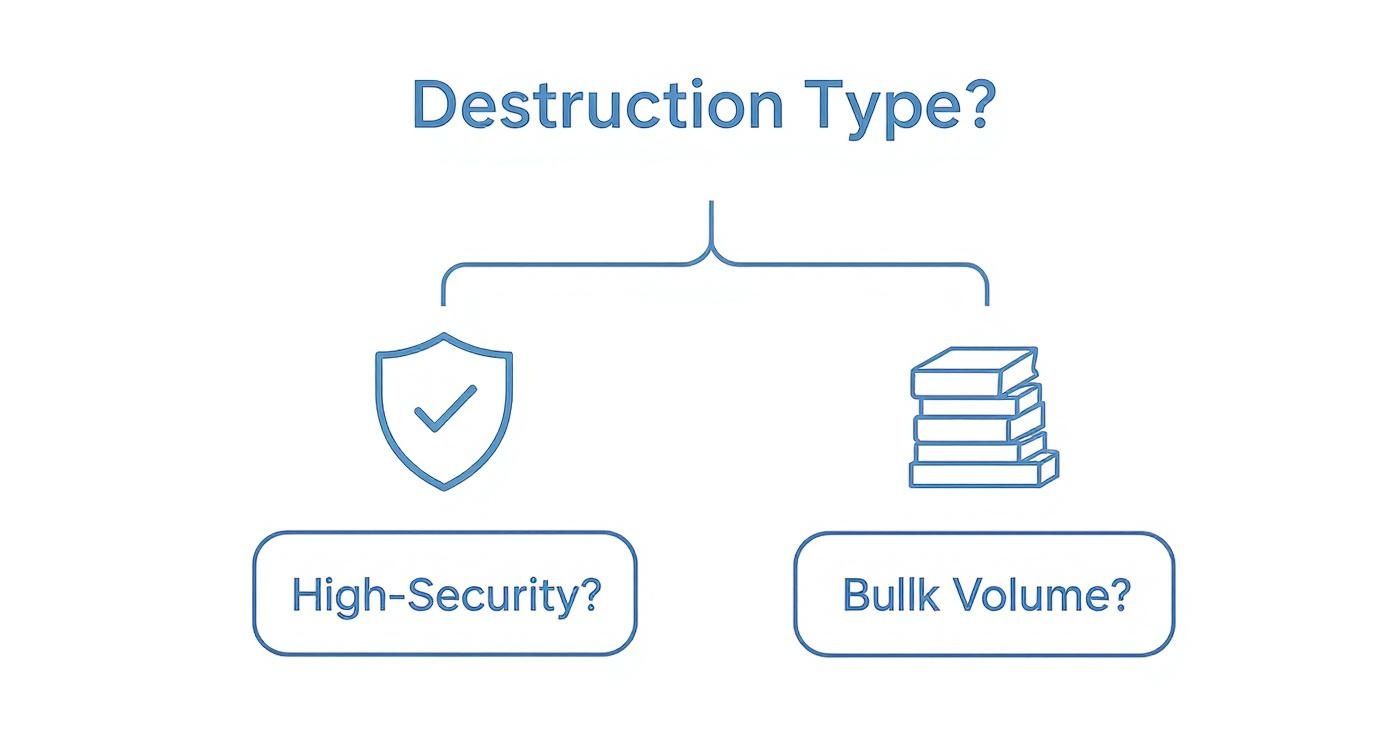
It really boils down to that fundamental choice: are you dealing with highly sensitive assets that demand maximum security, or are you focused on the logistics of getting rid of a massive volume of product?
Key Questions to Ask Potential Providers
Once you've covered the basics, it's time to dig deeper. Asking the right questions will quickly reveal who’s truly capable and who’s just paying lip service to security.
Here are four critical questions you should be asking every potential vendor:
- Can you show me a sample Certificate of Destruction? This is your legal proof. Make sure it’s not just a flimsy receipt. It needs to have a unique serial number, clear transfer of custody details, and an exact description of what was destroyed.
- What does security look like for your facility and your trucks? You want to hear about GPS tracking, locked and secured vehicles, and 24/7 surveillance at their processing plant. Anything less is a red flag.
- How do you screen your employees? Every single person who might come into contact with your materials must have undergone a thorough background check and receive ongoing security training. No exceptions.
- How do you handle different types of materials? A great partner can manage everything from electronics to textiles. For more specialized jobs, like complex IT gear, you might need to see how different e-waste disposal companies handle specific equipment.
At the end of the day, this is about building trust. Their answers will tell you everything you need to know about whether they have the infrastructure and the commitment to truly protect your business.
The Specialized Case of Hard Drive and Media Destruction
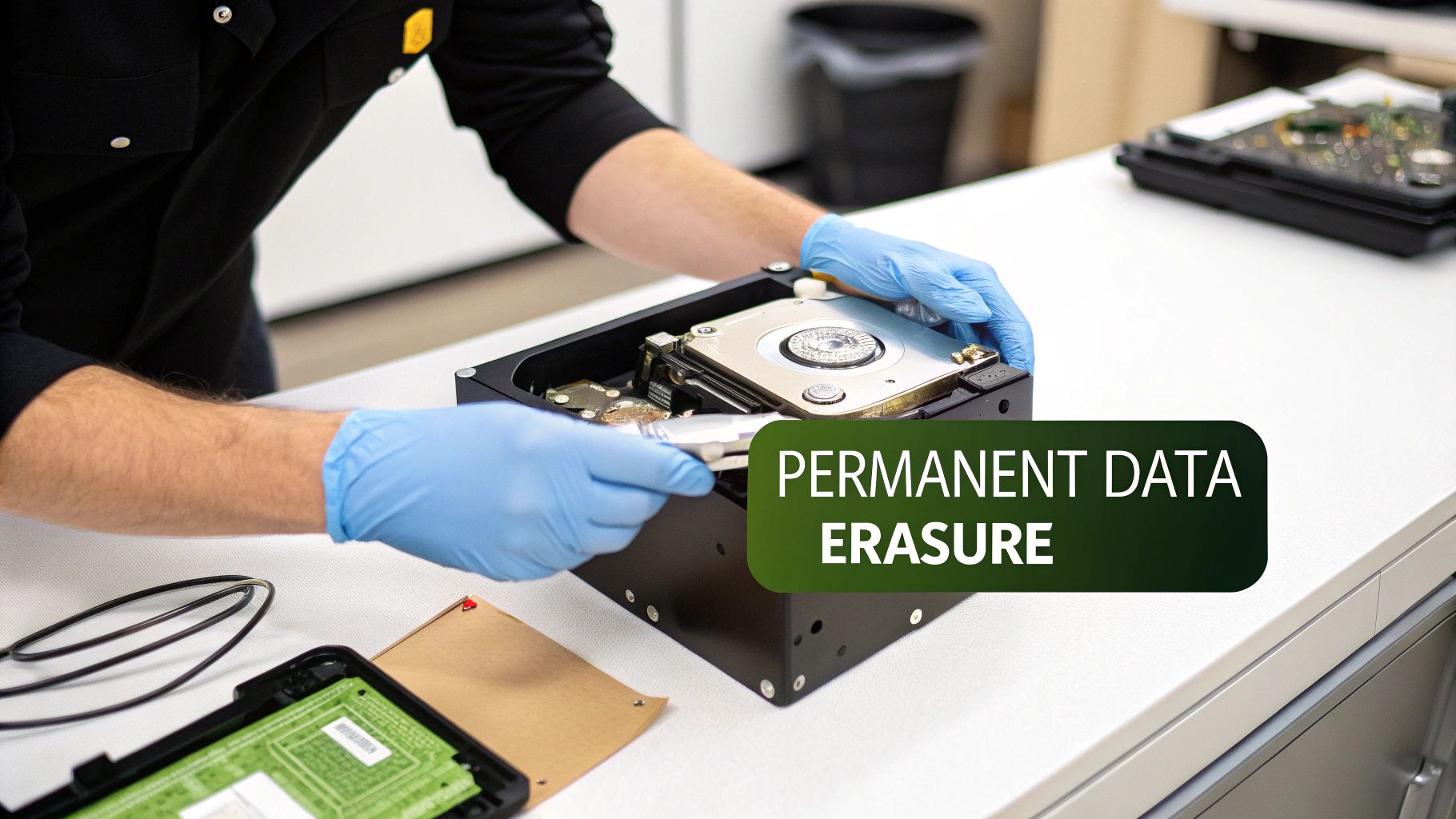
When the "product" you need to destroy is a hard drive, server, or even an old company smartphone, the game changes entirely. The stakes are exponentially higher, and the risks of getting it wrong are massive.
A lot of people think hitting "delete" or reformatting a drive gets the job done. It doesn't. Not even close. Doing that is like tearing the table of contents out of a book—sure, it's harder to find a specific chapter, but all the pages are still there for anyone who knows how to look. Basic data recovery software can pull that "deleted" information back in a snap.
That's why professional hard drive destruction isn't just an add-on; it's a non-negotiable part of any legitimate product destruction service today. One slip-up can lead to a catastrophic data breach, leaking everything from customer lists and financial records to your most valuable trade secrets. The legal fallout and damage to your reputation can cripple a business, making the cost of secure disposal look like pocket change.
Methods for Total Data Elimination
To make sure your digital data is gone for good, you need methods that make recovery physically impossible. We’re not just talking about deleting files; we’re talking about total annihilation.
- Physical Shredding: This is the most straightforward and visually satisfying method. We feed hard drives, SSDs, backup tapes, and other media into an industrial-grade shredder that pulverizes them into tiny, confetti-like metal fragments. There’s no coming back from that.
- Degaussing: Think of this as a magnetic apocalypse for a hard drive. A degausser hits the drive with an incredibly powerful magnetic field, instantly scrambling the magnetic platters where data is stored. The drive is rendered completely unreadable in seconds.
- Certified Wiping: Sometimes, you have drives that can be reused. In that case, we use certified software to overwrite every single sector of the drive with random data, not just once, but multiple times. This process effectively buries the original information so deep that it’s impossible to recover.
The demand for these specialized services is exploding. The Hard Drive Destruction Service market is currently valued at USD 1.65 billion and is on track to hit USD 5.05 billion by 2035. This growth is fueled by ever-stricter data security regulations and the constant threat of breaches. You can discover more insights about this growing market and its key drivers.
At the end of the day, bringing in a professional service like Montclair Crew is the only way to guarantee your digital footprint is erased permanently and securely.
Got Questions About Product Destruction? We've Got Answers.
Even after walking through the process, you might still have a few questions rolling around. That's completely normal. This is a big decision, and you need to have all the facts. Here are some of the most common questions we get from businesses just like yours.
How Much Do Product Destruction Services Cost?
There’s no simple, one-size-fits-all price tag for product destruction. The final cost really depends on what you need gone, how much of it there is, the exact method we need to use, and whether you want us to come to you or bring it to our facility.
For instance, on-site mobile shredding is often priced a bit higher. That's because you're paying for the convenience and the extra layer of security that comes with watching the whole thing happen right before your eyes. The only way to get a firm number is to request a detailed quote. A certified provider can look at what you have and give you a price tailored to your specific project.
What Exactly Is a Certificate of Destruction?
Think of a Certificate of Destruction as your official, legally-recognized proof that you did the right thing. It's a formal document we issue after the job is done, and it's a critical piece of the puzzle for your company's compliance and risk management.
This isn't just a simple receipt. The certificate details exactly what was destroyed, the date and location of the destruction, and the methods used. If you ever face an audit, this document is your ultimate proof that you took every necessary step to protect your brand, your data, and your customers.
What Kinds of Items Can Be Professionally Destroyed?
Professional product destruction services can handle way more than just paper documents or old hard drives. The whole point is to get rid of anything that could possibly come back to haunt you.
We can take care of a huge range of materials, including things like:
- Recalled or defective consumer products
- Counterfeit goods and knock-offs that hurt your brand
- Old branded uniforms and outdated marketing materials
- Electronic waste (e-waste), circuit boards, and prototypes
- Expired pharmaceuticals or other sensitive materials
Basically, if an item could damage your company's reputation or create a legal liability, it can and absolutely should be destroyed for good.
Ready to protect your brand and lock down your compliance with certified destruction services? The team at Montclair Crew Recycling is here to provide secure, transparent, and eco-friendly solutions for your Atlanta-based business. Contact us today to get a custom quote and secure your assets.
