
When your business needs to get rid of old laptops, what do you do? A professional laptop recycling company is more than just a disposal service—they're a security and logistics partner for your retired technology. Their job is to manage the entire end-of-life process, protecting your sensitive data, keeping you compliant with environmental laws, and even recovering some value from your old gear.
What Does a Laptop Recycling Company Actually Do?
Don't think of a laptop recycling company as a junk removal service. Think of them as managers for your technology's retirement plan. They handle the entire "reverse supply chain," a process designed from the ground up to protect your company's data and reputation long after a device is unplugged. They turn a potential compliance nightmare into a smooth, secure, and fully documented operation.
For businesses, schools, and healthcare providers in the Atlanta area, working with a local expert like Montclair Crew Recycling is essential. We handle all the complex risks that come with modern technology, making sure every single step is done right.
The Core Process: A Reverse Supply Chain
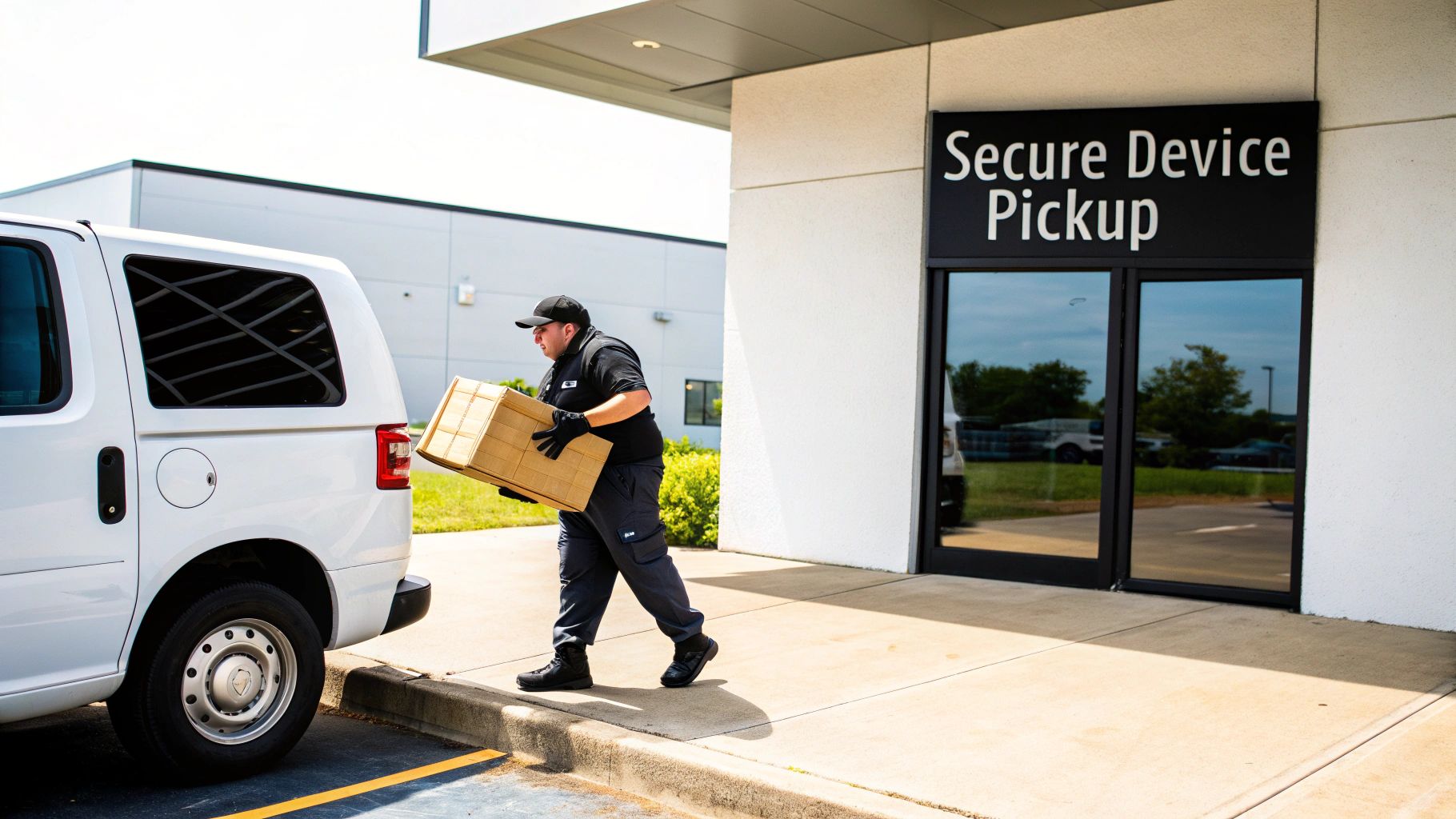
It all starts the moment you decide to retire a batch of laptops. Instead of letting them pile up in a storage closet—where they become a silent but serious data security risk—a professional partner kicks off a controlled workflow. This structured approach is critical for maintaining a clear chain of custody from your door to final disposition.
The graphic below breaks down the typical three-step flow, from secure pickup all the way through final processing.
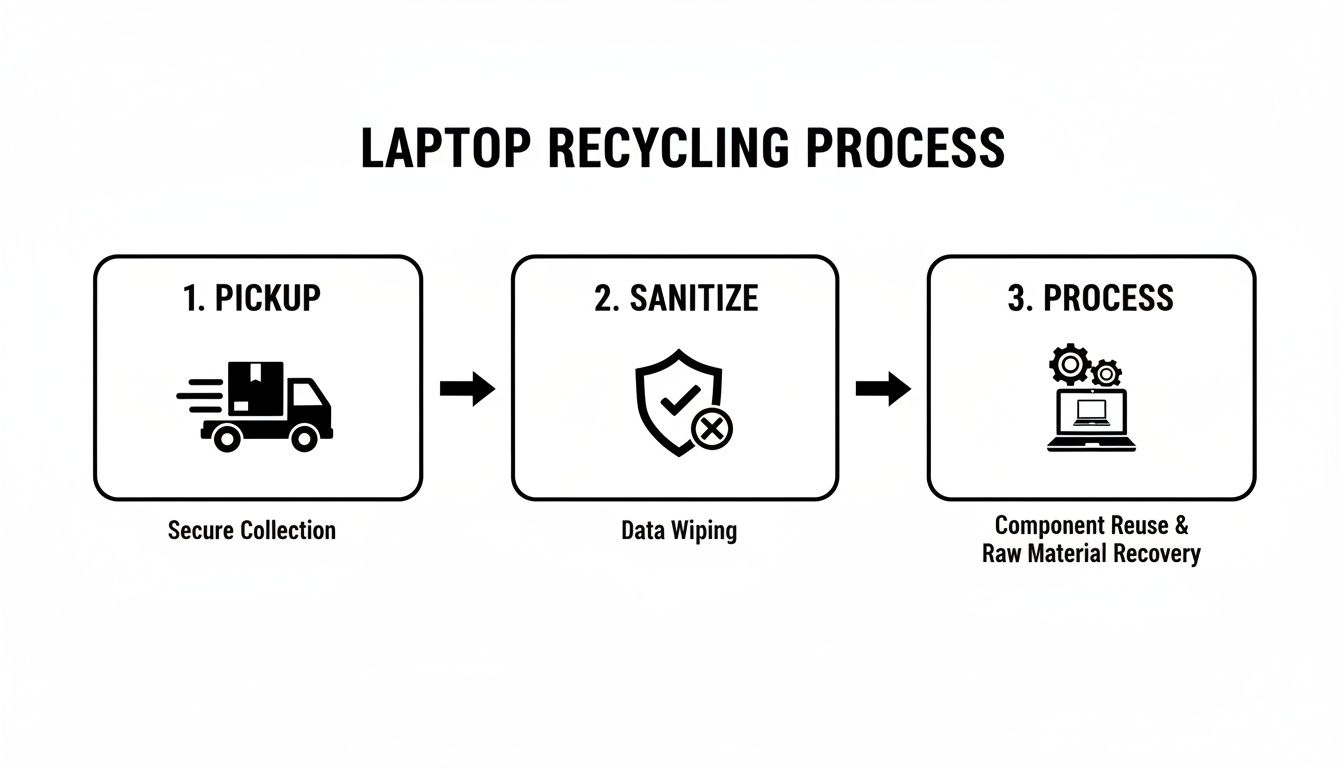
As you can see, this is much more than just hauling away old equipment. It’s a security protocol that starts with logistics, moves to data sanitization, and ends with responsible material handling.
More Than Disposal: A Security and Compliance Partner
The single most important job of a laptop recycling company is certified data destruction. Just deleting files or reformatting a hard drive isn't enough; it leaves your company wide open to a data breach. We use government-standard data wiping protocols, like DoD 5220.22-M, to permanently erase every bit of information.
For organizations with the strictest compliance needs, many providers also offer on-site hard drive shredding. This lets you physically watch your data-bearing devices get destroyed, giving you an ironclad audit trail.
Finally, the hardware itself is dismantled. Any components that can be reused are tested and refurbished. Raw materials like precious metals, plastics, and glass are separated out for recycling. This whole process keeps hazardous e-waste out of landfills.
To get the full picture, you can learn more about the complete journey of recycled electronics and see how it all feeds into a circular economy. This end-to-end service protects your data, handles your environmental responsibilities, and proves your organization is serious about corporate responsibility.
Here’s a quick breakdown of what you should expect from a true IT Asset Disposition (ITAD) partner.
Core Services of a Professional Laptop Recycling Partner
| Service Component | Key Business Benefit |
|---|---|
| Secure Logistics & Chain of Custody | Ensures your assets are tracked and accounted for from pickup to final disposition, minimizing risk. |
| Certified Data Destruction | Permanently erases all sensitive information, protecting you from data breaches and ensuring compliance. |
| Asset Value Recovery (AVR) | Identifies and resells usable equipment, turning old tech into a revenue stream for your business. |
| Responsible E-Waste Recycling | Prevents hazardous materials from ending up in landfills and meets environmental regulations (e.g., R2, e-Stewards). |
| Detailed Reporting & Certification | Provides a full audit trail with certificates of data destruction and recycling for your compliance records. |
Ultimately, a real partner doesn't just take your old laptops—they take the liability and complexity off your plate.
Why Responsible E-Waste Management Is a Business Imperative
In the business world, technology moves at breakneck speed. That powerful laptop that was mission-critical just a couple of years ago is now gathering dust in a supply closet, too slow to keep up. This constant upgrade cycle creates a problem that’s a lot bigger than just finding storage space—it generates a massive, growing wave of electronic waste, or e-waste.
This isn’t some minor issue. Electronic waste is officially the fastest-growing waste stream on the entire planet. The Global E-waste Monitor 2024 reported a staggering 62 million metric tons of e-waste was produced in 2022 alone. What’s worse? A measly 22.3% of it was actually collected and recycled properly.
For any business, especially those in a busy hub like Atlanta, pretending this isn't happening is no longer a viable strategy. It's a direct threat to your bottom line, your public image, and your data security.
The Tangible Risks of Improper Disposal
Let’s bring these global numbers down to what they mean for your business day-to-day. Think about just one of your old company laptops, maybe one that still has sensitive client lists or financial spreadsheets on it, ending up in an unlocked dumpster. The fallout from that simple mistake can be catastrophic.
- Data Breach Penalties: A single data breach can cost a company millions. That forgotten hard drive is a ticking time bomb, putting you at risk of violating data privacy laws like HIPAA or PCI-DSS and facing the crippling fines that come with them.
- Environmental Fines: You can't just toss electronics in the trash. Regulations like the Resource Conservation and Recovery Act (RCRA) have strict rules for handling the hazardous materials inside. Getting caught taking shortcuts can lead to serious financial penalties.
- Brand Damage: Today, customers and employees expect companies to be responsible. News of your business dumping e-waste improperly can permanently tarnish your reputation, making you look careless with both data and the environment.
These aren't just hypotheticals; they are real, concrete liabilities that can sink a business. A proper IT Asset Disposition (ITAD) plan, handled by a professional laptop recycling company, is the only sure way to defuse these risks.
From Afterthought to Core Business Function
It wasn't long ago that getting rid of old computers was a low-priority job pawned off on the IT department. Not anymore. Today, it’s a strategic issue that involves your legal, finance, and even marketing teams. Technology is advancing so quickly that companies are refreshing their hardware more often than ever.
This constant churn is exactly why a formal ITAD strategy has become essential. It’s not just about "disposal." It's about securely and responsibly managing the entire lifecycle of your tech assets. The right partner can turn this complicated headache into a simple, streamlined process.
By partnering with a certified recycling provider, a business creates a defensible, auditable process for managing retired assets. This proactive approach demonstrates due diligence and protects the organization from the "what ifs" of a data breach or compliance violation.
This structured approach is non-negotiable for any organization handling sensitive data, including:
- Healthcare Providers managing confidential patient records.
- Financial Institutions protecting customer bank accounts.
- Educational Institutions safeguarding student information.
- Law Firms securing privileged client files.
If you operate in one of these fields, working with a certified laptop recycling company is a fundamental part of modern risk management. It guarantees every single device is handled according to the highest security and environmental standards. When you need to recycle in Atlanta, choosing a local, certified expert gives you an extra layer of confidence and convenience, helping your business transform a major liability into a testament to your corporate responsibility.
Understanding Secure Data Destruction Methods
When you hand over your old business laptops, the most critical step isn't the recycling—it's making sure the data on them is gone for good. This is about more than just protecting your company; it’s about protecting your clients, employees, and your reputation. A lot of people think deleting files or formatting a hard drive is enough. It's not.
Imagine a formatted hard drive is like a book where someone just ripped out the table of contents. All the pages—your sensitive data—are still there. Anyone with basic data recovery software can find and piece them back together. For a professional laptop recycling company, that's a massive security risk we would never take.
Real data security comes from professional data sanitization, a process that makes your information permanently and completely irrecoverable. This is the absolute foundation of any trustworthy IT disposal partnership. Without it, you’re not securely recycling; you’re just handing over a potential data breach waiting to happen.
Software-Based Data Wiping
For hard drives that are still functional, the go-to method is using specialized software to overwrite every single sector of the drive with random data. This isn't just one "delete" command; it's a systematic, multi-layered process designed to obliterate information. The most recognized industry standard is the DoD 5220.22-M three-pass wipe.
To give you a clearer picture of how thorough this is, think of it like destroying a top-secret paper document:
- First Pass (Overwriting with Zeros): This is like running the document through a high-security shredder, turning it into tiny, unreadable strips.
- Second Pass (Overwriting with Ones): This is like taking all those tiny shreds and burning them to ash.
- Third Pass (Overwriting with Random Characters & Verification): This final step is like scattering those ashes in the middle of the ocean. There's no coming back from that.
This multi-pass method ensures that even advanced forensic tools can't recover the original data. A certified recycler will then give you a serialized Certificate of Data Destruction, which is your official, auditable record that the job was done right for every single device. This paperwork is your proof of due diligence.
Physical Hard Drive Destruction
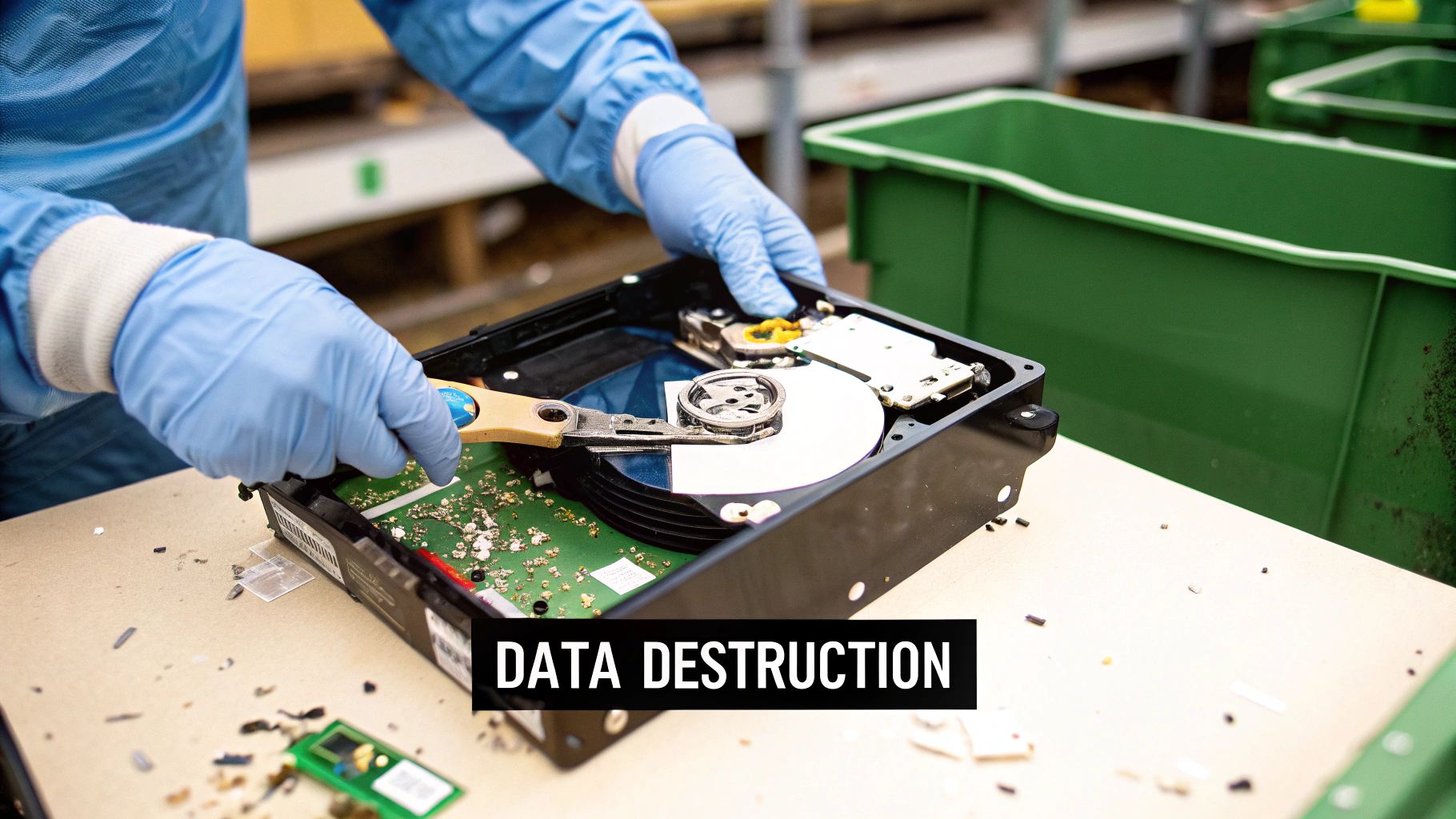
Sometimes, software wiping isn't the right tool for the job. If a hard drive is damaged, too old to sanitize properly, or if your organization operates under the strictest compliance rules, physical destruction is the only answer. It completely removes any doubt by rendering the drive physically useless.
Physical destruction is the ultimate failsafe. When compliance standards for industries like healthcare (HIPAA) or finance (PCI-DSS) demand irrefutable proof of data elimination, watching a hard drive turn into metal fragments provides that final peace of mind.
And we’re not talking about taking a hammer to it in the back room. A professional laptop recycling company uses industrial-grade machinery for this.
- Shredding: The most common and secure method. Hard drives are fed into a powerful shredder that grinds the platters into small, irregular pieces of metal confetti.
- Degaussing: A massive degausser blasts the drive with a powerful magnetic field, instantly scrambling the magnetic data on the platters.
- Punching: A machine physically punches a hole straight through the drive platters, shattering them and making data recovery impossible.
Many certified vendors, including Montclair Crew Recycling, even offer on-site shredding. This allows your team to witness the physical destruction of your hard drives before they ever leave your building, giving you the highest level of security and chain-of-custody control. To learn more about these processes, check out our complete guide to secure IT asset destruction.
Ultimately, whether we use multi-pass wiping or physical shredding, the goal is the same: to make your sensitive data vanish forever. A true partner doesn't just promise this; they prove it with certified processes and detailed documentation, turning a major security liability into a managed and verified solution.
Navigating Environmental Compliance and Liability
Beyond the obvious need for data security, getting rid of old company laptops opens up another major can of worms: environmental liability. Old electronics are often packed with materials like lead and mercury, and there's a tangled mess of federal and state laws that govern how they must be handled. For a business, pleading ignorance about these rules is simply not a defense.
The entire legal framework is built on a scary-sounding but critical concept: "cradle-to-grave" liability. This principle means your company is on the hook for its electronic waste forever—from the moment you buy it (the "cradle") until its final, proper disposal (the "grave"). That responsibility doesn't just vanish when you pay a guy with a truck to haul your old equipment away.
Think of it this way: imagine you sell an old car. A few years down the road, you get a call that the new owner illegally dumped it, and now the government is holding you financially responsible for the cleanup. It sounds completely unfair, but that's exactly how e-waste liability works under powerful regulations like the Resource Conservation and Recovery Act (RCRA).
The Chain of Responsibility
This never-ending liability means that if you give your retired laptops to a shady, uncertified vendor who then dumps them in a local landfill or ships them overseas, your company can be legally and financially blamed for the environmental damage. The fallout can be brutal, from massive fines to a public relations nightmare that tars your brand's reputation.
Your legal responsibility for e-waste never truly ends. The only way to mitigate this permanent risk is to formally and verifiably transfer that liability to a certified partner who assumes it on your behalf.
Working with a certified laptop recycling company is the only real way to break this chain of liability. A true professional doesn't just take your equipment; they take on the legal burden for you through a documented, transparent, and defensible process.
The Power of Proper Documentation
So, how does this liability transfer actually happen? It all comes down to the paperwork. A certified recycler gives you two essential documents that act as your legal shield, proving you did everything by the book.
- Certificate of Data Destruction: This paper is your proof that every single data-holding device was wiped clean or physically destroyed according to strict industry standards. It's your defense against any future data breach claims.
- Certificate of Recycling: This confirms that all the physical hardware was processed in an environmentally compliant way, officially clearing you of any downstream environmental liability.
These certificates create an ironclad audit trail. They are your official record, proving you handed your assets over to a responsible partner who handled them according to every applicable law. This documentation is your get-out-of-jail-free card against potential regulatory fines and legal battles down the line.
For any business trying to meet all local and federal rules, getting familiar with the specifics of Georgia electronics recycling regulations is a smart first move. A qualified partner won't just follow these rules—they'll provide the paperwork to prove it, giving your Atlanta-area business total peace of mind. Choosing the right laptop recycling company turns a forever risk into a managed, documented, and fully compliant business process.
Finding Financial Value in Your Retired IT Assets
For most businesses, getting rid of old laptops feels like another task on a long to-do list—a cost you have to eat for the sake of data security and compliance. But what if you could flip that script? What if that closet full of old tech wasn't a cost center, but a hidden source of revenue? A top-tier laptop recycling company does more than just dispose of old gear; they become an asset recovery partner, sniffing out the financial value in technology you've already written off.
This change in mindset is everything. Instead of seeing a pile of retired devices as a problem, you can start looking at it as a dormant asset waiting to be cashed in. Professional IT Asset Disposition (ITAD) isn't just about securely wiping and scrapping hardware. It's about intelligently giving that technology a second life, which is great for your budget and even better for the environment.
From E-Waste to Revenue Stream
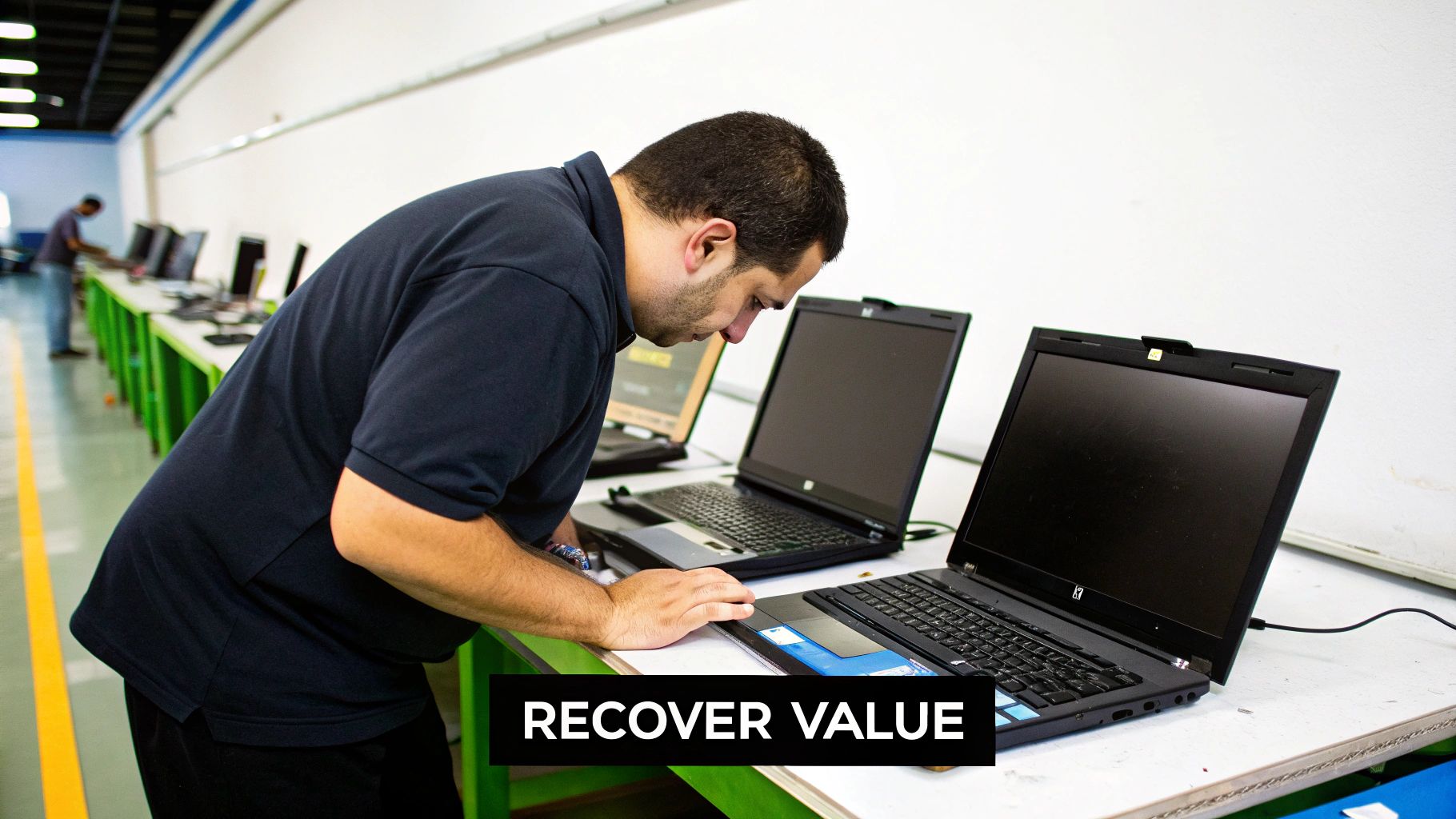
The secret sauce is a detailed assessment and remarketing process. Believe it or not, not every old laptop is headed for the shredder. Many enterprise-grade computers, servers, and networking components hold significant value on the secondary market long after you’ve pulled them from service. A good partner knows exactly how to spot these opportunities.
Here’s a peek at how it generally works:
- Initial Triage and Audit: First, technicians get their hands on each device to figure out its age, what shape it's in, and if it even powers on.
- Testing and Grading: Anything that works gets put through its paces. We test performance, check for cosmetic issues, and then assign it a grade for resale.
- Secure Refurbishment: This is the critical part. All your data gets professionally destroyed, and the device is cleaned up and restored to a market-ready condition.
- Strategic Resale: Finally, the refurbished equipment is sold through established channels to buyers who are hungry for reliable, business-class hardware at a good price.
Just like that, what was once considered scrap material is turned into a product with real value, creating a brand-new revenue stream for your company.
Understanding Profit-Sharing Models
The best part of this whole deal is usually the financial arrangement. The leading ITAD providers work on a profit-sharing or value recovery model. So, instead of billing you a flat fee to haul everything away, they give you a cut of the money they make from reselling your viable equipment. This puts you both on the same team—the more value they can squeeze out of your old assets, the more money everyone makes.
This model completely changes the game. It’s no longer just a transaction. It becomes a real partnership where your recycling vendor is motivated to get the absolute maximum return on every single piece of equipment they handle for you.
To get the most value and make sure everything is disposed of correctly, using a robust IT Asset Management Software can be a game-changer. It helps you keep a clean inventory, which is always the first step toward a successful asset recovery plan.
A Financially Smart and Sustainable Choice
Choosing to refurbish and resell your old IT assets isn't just a smart financial move; it's also a powerful statement about your company's commitment to the environment. The resources and energy that go into manufacturing new electronics are massive. Extending the life of devices that already exist is one of the most effective things you can do to shrink your organization's carbon footprint.
The environmental impact is staggering. Remanufactured laptops produce just 6.34% of the CO2 emissions compared to brand-new ones. For every single refurbished laptop that goes back into use, about 316 kilograms (that’s 700 pounds!) of CO2 emissions are prevented by not having to manufacture a new one. You can dig into the data on the sustainability impact of IT decisions and see for yourself how giving your assets a longer life helps the planet.
When you team up with a laptop recycling company that knows how to remarket assets, you score a triple win: your data is secure, you generate revenue you didn't expect, and you become an active player in the circular economy. This elevates your IT disposal plan from a simple compliance task to a smart, sustainable, and profitable business strategy.
How to Select the Right Recycling Partner in Atlanta
Choosing a vendor to handle your old IT equipment isn't like picking an office supply company. The stakes here are much, much higher. We're talking about data security, environmental liability, and strict legal compliance.
Picking the right partner protects your business from risk. The wrong one? That can expose you to staggering fines and serious damage to your brand's reputation. Finding a solid laptop recycling company in the Atlanta area means you need a sharp eye for detail. It’s about much more than just comparing prices. You need a partner whose security is as tight as yours and whose paperwork can stand up to any audit.
Verify Their Certifications
Your first filter should always be industry certifications. These aren't just fancy badges to put on a website; they are hard-earned proof that a vendor meets tough, third-party standards for both data security and environmental safety. Without them, you have zero verified assurance of what’s happening after your laptops leave your sight.
Keep an eye out for these two gold-standard certifications:
- R2v3 (Responsible Recycling): This one covers the entire lifecycle of the equipment. It ensures everything from environmental protection and worker safety to proper data sanitization is handled correctly.
- e-Stewards: Known for having incredibly strict environmental standards, e-Stewards enforces a zero-tolerance policy against exporting hazardous e-waste to developing countries.
If a potential vendor doesn't have at least one of these, you should walk away. A certified partner has already done the legwork to prove they follow best practices.
Scrutinize Data Destruction Protocols
The biggest liability you have is the sensitive data sitting on old hard drives. You absolutely must get a clear, detailed explanation of how a potential partner plans to make that data vanish for good. Don't settle for vague promises like "we wipe the drives." Get specific.
A trustworthy partner’s process should be an open book. They should be able to explain their data destruction methods clearly, provide sample documentation, and welcome questions about their chain of custody. Ambiguity is a major red flag.
Ask them these direct questions about their methods:
- What software do you use for data wiping? Their answer should mention standards like NIST 800-88 or DoD 5220.22-M.
- Can you provide on-site hard drive shredding? For ultimate peace of mind, watching the drives get physically destroyed is undeniable proof.
- What information is on your Certificate of Data Destruction? It needs to list the unique serial number of every single hard drive they handled.
This documentation is your only real legal defense if a data breach investigation ever comes your way.
Vendor Evaluation Checklist
Choosing the right partner requires asking the right questions. This checklist will help you drill down into what really matters and compare potential vendors effectively.
| Evaluation Category | Crucial Questions to Ask | What to Look For in the Answer |
|---|---|---|
| Certifications & Compliance | Are you R2v3 or e-Stewards certified? Can you provide your certificate number? | A "yes" and the ability to verify it. Any hesitation is a bad sign. |
| Data Security | What are your specific data destruction methods (wiping, shredding)? Do you follow NIST 800-88 standards? | Clear, specific answers. They should easily explain their process and provide documentation. |
| Chain of Custody | How do you track our assets from pickup to final disposition? What does your reporting look like? | Look for serialized tracking, secure transport, and detailed reports. Ask for a sample report. |
| Logistics & Operations | Do you offer on-site services like pickup and drive shredding? What is your service area in Atlanta? | They should have flexible options that match your needs and clear geographic coverage. |
| Value & Transparency | Do you offer any value recovery or resale options? Are all your fees explained upfront in the contract? | A good partner is transparent about costs and potential returns. No surprise fees. |
Using a structured approach like this ensures you're not just choosing a vendor, but a true security partner.
Evaluate Their Logistics and Reporting
Finally, a great laptop recycling company should make the whole process smooth and transparent. Check out their logistical capabilities to see if they can handle your needs, especially if you have multiple offices across Metro Atlanta.
Ask about their on-site pickups, how they handle asset tagging, and what their inventory tracking system is like. A professional partner will always provide a detailed, serialized report of every single asset they collect from you. This audit trail is critical for your internal asset management and for proving compliance. To make sure your partner delivers maximum value, you can explore these best practices for vendor management.
Choosing a recycler is a major decision. It pays to understand the different IT recycling companies and what they bring to the table. By focusing on certifications, data destruction, and logistics, you can confidently pick a partner who will truly protect your business.
Questions We Hear All The Time About Laptop Recycling
It's only natural to have a few questions when you're looking to dispose of old company laptops. Let's tackle some of the most common ones we hear from businesses just like yours.
Is Our Data Really Gone For Good?
Yes, but this is where choosing the right partner is everything. A professional, certified recycling company doesn't just "delete" files; they make your data completely unrecoverable. They'll use proven methods like the DoD 5220.22-M wipe to sanitize every drive.
For those who want absolute, undeniable proof, you can't beat on-site hard drive shredding. You can literally watch your old drives get turned into tiny pieces of metal. Always, always get a serialized Certificate of Data Destruction. This isn't just a piece of paper—it's your proof of compliance and your shield against liability down the road.
Think of it this way: a simple disposal service just takes away your trash. A true security partner gives you an ironclad, auditable paper trail proving every single device was properly handled. That's the difference that protects your business.
This documentation is non-negotiable for any company serious about protecting sensitive information.
What's This Going To Cost Us?
The price can swing from a fee to a payment to you. Some recyclers might charge you based on the weight of the equipment or a flat fee per laptop. But here's the inside scoop: top-tier ITAD partners can often do it for free or even cut you a check.
How? If your laptops are new enough to have a second life, they can be refurbished and sold. In that case, you can get a cut of the resale revenue through a value-sharing deal. The best move is always to get a custom quote based on what you actually have.
We're a Small Business. Can You Still Pick Up From Us?
Of course. Many local recyclers specialize in working with businesses of all shapes and sizes right here in Metro Atlanta. It doesn't matter if you have five laptops piled in a closet or five hundred stacked on pallets; a good partner will schedule a secure pickup that works for your team.
For even smaller batches, some also have drop-off spots, so there's a secure, professional option for every single business.
Ready to stop worrying about those old laptops and work with a local partner you can trust? Montclair Crew Recycling provides secure and compliant services for businesses across the Atlanta area. Schedule your free pickup today.
