
Got a closet full of old company servers, laptops, and networking gear? If you're like most Dunwoody businesses, that pile of outdated tech is a ticking time bomb of data risks, environmental fines, and missed opportunities. This is where a formal process for IT asset disposition, or ITAD, comes in.
It’s not just about hauling away junk—it’s a strategic plan for securely and responsibly retiring your technology.
What Is IT Asset Disposition and Why It Matters for Dunwoody Businesses
Think about what you do when a company car gets too old. You don't just abandon it on the side of Ashford Dunwoody Road, right? Of course not. You follow a process—transfer the title, clear out personal items, and make sure it's handled legally.
ITAD is the exact same idea, but for your company's electronics. It’s a formal plan for taking technology offline when it's no longer useful. For any organization in Dunwoody, this process is absolutely critical for managing risk and even recovering value.
The Three Pillars of Modern ITAD
A professional ITAD strategy is all about protecting your business from every possible angle. It moves way beyond simple disposal and becomes a complete management system for your retired assets.
- Data Security: Your old hard drives are a goldmine of sensitive info—customer lists, financial records, trade secrets. Hitting "delete" doesn't actually erase the data. Proper ITAD uses certified data destruction methods to wipe this information permanently, protecting you from a devastating breach.
- Environmental Compliance: You can't just toss electronics in the dumpster. It's illegal and incredibly irresponsible. E-waste is packed with hazardous materials that poison the environment. A certified ITAD partner makes sure every component is recycled or disposed of according to strict EPA and local regulations.
- Value Recovery: That old tech might not be junk. Enterprise-grade servers, newer laptops, and network switches often have plenty of life left in them. ITAD services include testing, refurbishing, and reselling these assets to put cash back into your budget, which can help pay for your next tech upgrade.
A proper ITAD process turns a pile of potential liabilities into a secure, compliant, and often profitable asset. It's the final—and most important—step in your technology's lifecycle.
To help you see how these pieces fit together, here’s a quick breakdown of the core stages and why they matter for your business.
ITAD at a Glance: Key Stages and Business Impacts
| ITAD Stage | Description | Business Impact |
|---|---|---|
| Secure Collection | Assets are logged and securely transported from your Dunwoody office to a certified facility. | Prevents asset theft or loss during transit, establishing the first link in the chain of custody. |
| Auditing & Reporting | Each device is tested, graded, and its serial number is recorded in a detailed inventory report. | Provides a full accounting of your retired assets for compliance and financial records. |
| Data Destruction | All data is permanently destroyed using certified wiping software or physical shredding methods. | Eliminates the risk of a data breach and ensures compliance with privacy laws like HIPAA or GDPR. |
| Value Recovery | Functional equipment is refurbished and sold through established resale channels. | Recovers capital from old technology, lowering the total cost of ownership for your IT infrastructure. |
| Responsible Recycling | Non-functional or valueless items are broken down, and materials are recycled responsibly. | Ensures environmental compliance, avoids landfill fines, and supports your company’s sustainability goals. |
| Certification | You receive a Certificate of Data Destruction and a Certificate of Recycling for your records. | Delivers auditable proof that you handled your end-of-life assets legally and securely. |
As you can see, each step is designed to protect your organization. The process transforms what could be a major headache into a streamlined, documented, and secure operation.
The U.S. IT asset disposition market is growing fast, largely driven by rising cybersecurity concerns and the astronomical cost of data breaches. It's no surprise that data destruction services are one of the most in-demand parts of the industry.
For any business handling sensitive information, a professional partner for IT asset disposition in Dunwoody GA is a must-have. It gives you a documented, secure chain of custody that protects your reputation and your bottom line. This isn't just another expense; it's a critical investment in risk management.
If you'd like to dive deeper into the fundamentals, check out our detailed guide on what IT asset disposition entails.
Navigating Data Security and Georgia Compliance Laws
For any business here in Dunwoody, the single biggest risk with old technology is the sensitive data left on it. Don't be fooled—simply dragging files to the trash or doing a factory reset is nowhere near enough. That's like leaving a ghost of the data behind, making it frighteningly easy for someone to recover customer lists, financial records, and company secrets.
Letting that happen isn't just a mistake; it can be a disaster. Fumbling your data security can lead to crippling financial penalties and a damaged reputation, especially with how strict federal and state laws have become. These regulations aren't just suggestions; they're legal requirements with real teeth.
Understanding Key Data Protection Laws
Several critical laws dictate how Georgia businesses must handle sensitive information, even on equipment you're ready to toss. Ignoring these can trigger audits, lawsuits, and fines that could easily put a small or medium-sized company out of business.
You need to be aware of a few big ones:
- HIPAA (Health Insurance Portability and Accountability Act): If you're a healthcare provider or a related business in Dunwoody, HIPAA is non-negotiable. It demands the secure, permanent destruction of all patient health information (PHI) on every single device, from servers down to the office printers.
- FACTA (Fair and Accurate Credit Transactions Act): This law is for any business that deals with consumer credit information. It requires you to completely destroy that data before getting rid of the device to protect people from identity theft.
- Georgia Personal Identity Protection Act (GPIPA): This is our state's own law. It requires businesses to notify Georgia residents if there's a data breach and to have reasonable security measures in place to protect personal information.
These laws create a clear line of responsibility. Your duty to protect data doesn't stop the moment a computer is unplugged. It follows that device all the way until the data is verifiably, permanently gone.
Methods of Certified Data Destruction
To meet these legal standards, a professional ITAD service uses certified methods to guarantee data is completely unrecoverable. Think of it like a sensitive paper document. You could tear it up, but a determined person might tape it back together. True security means using a professional-grade shredder that turns it into confetti.
The two main ways to do this are software-based wiping and physical destruction. Each has a specific role in a smart IT asset disposition Dunwoody GA plan.
Your legal proof of compliance is the Certificate of Data Destruction. This is the official document that shields your business from future liability. It lists the serial numbers of the drives that were destroyed and details the method used.
To build an even stronger data security wall and stay compliant in Georgia, looking into secure storage solutions to protect sensitive data for retired assets before their final send-off is a smart move.
Comparing Data Wiping and Physical Shredding
Knowing the difference between these two core methods helps you pick the right level of security for your equipment.
1. Software-Based Data Wiping
This process uses special software to write random characters over the entire hard drive, again and again. It’s like scrubbing a whiteboard so clean that you can’t even see the faint outline of what was written before.
- Standard Used: The most common industry benchmark is the DoD 5220.22-M standard, a three-pass overwrite process.
- Best For: Newer, working hard drives that still have life in them. Wiping allows them to be safely refurbished and resold, which helps you get some money back.
2. Physical Destruction (Shredding)
This is the most secure option, period. The hard drive is literally fed into an industrial shredder that grinds it into tiny metal pieces. This is the equivalent of smashing that whiteboard into dust—there is zero chance of putting it back together.
- Best For: Old, broken, or highly sensitive drives where you can't take any chances. When maximum security is the only thing that matters, this is the way to go.
Ultimately, picking the right partner who offers these certified services isn't just good business—it's a core part of managing your risk. You can learn more about compliant Georgia electronics recycling to make sure your old tech is handled the right way from start to finish.
The Complete ITAD Workflow With a Local Partner
So, what really happens when you call in a professional for IT asset disposition in Dunwoody? Let me tell you, it's a lot more involved than just a simple pickup. A certified ITAD process is a documented, secure, and transparent journey from start to finish, all designed to protect your organization at every single turn.
Think of it as a secure supply chain, but in reverse. We're tracking your assets from the moment they leave your office to their final, compliant destination. This is the critical difference between a real partner and some random junk hauler—one gives you a documented trail of security, while the other just leaves you with liability and a lot of unanswered questions.
This visual guide breaks down the core of the data security process, showing how we take your old tech and turn it into certified, worry-free proof that the job was done right.
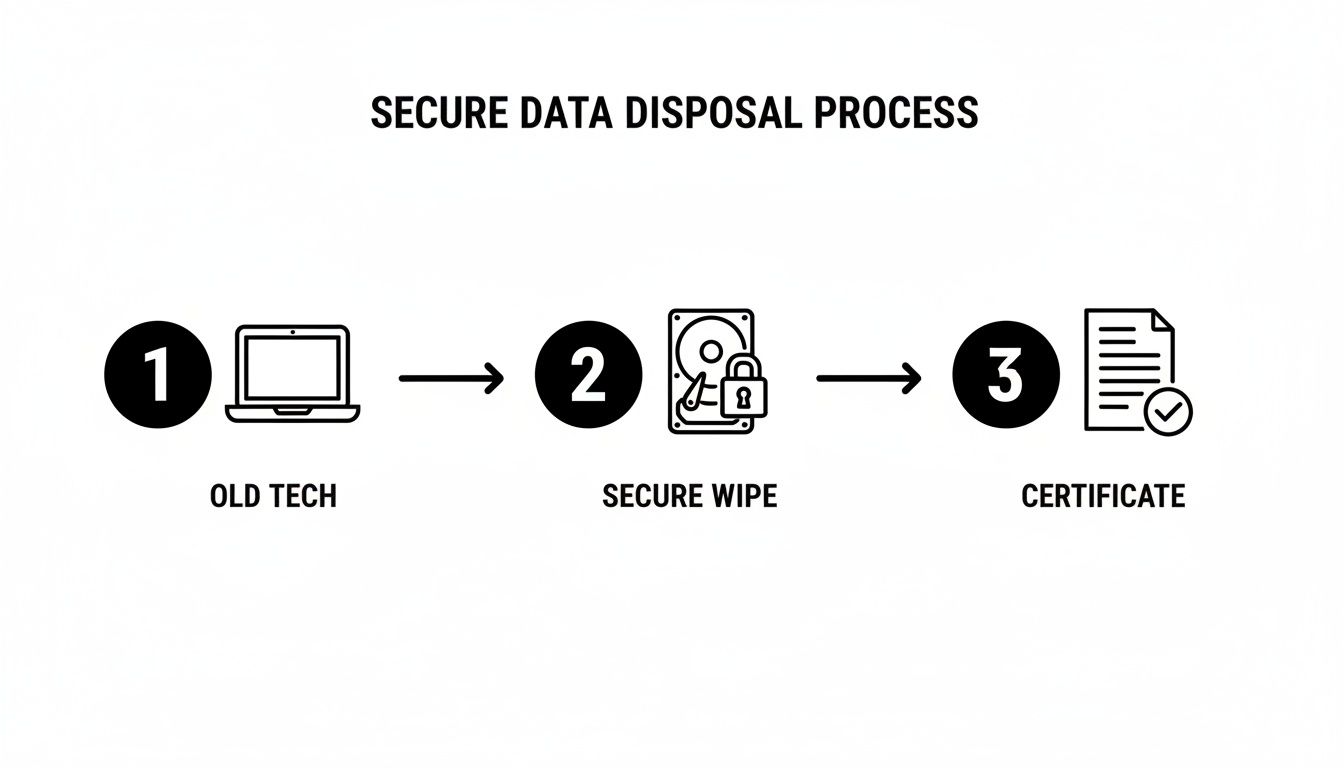
This simple flow nails the three non-negotiable stages for every device that ever held your data: secure handling, certified wiping or destruction, and the official paperwork to close the loop.
Stage 1: On-Site Collection and Secure Logistics
It all starts at your facility in Dunwoody. This first step is arguably one of the most critical: getting the assets out of your building securely. A professional ITAD team doesn't just show up with a dolly; they arrive with the right equipment to handle everything from a few dozen laptops to entire racks of servers.
Each and every asset is carefully logged as it’s prepped for transport. This initial inventory kicks off the chain of custody—a crucial document that tracks every device by its serial number from your door to its final disposition. From there, everything is loaded into a secure, GPS-tracked vehicle, ensuring it's protected from theft or loss the entire way to the processing facility.
Stage 2: Intake, Auditing, and Asset Tagging
Once your equipment arrives at the secure facility, the real detailed work begins. Every single item is unpacked and individually audited by technicians. They're recording the key details for each asset, including:
- Manufacturer and Model: Pinpointing the exact type of equipment.
- Serial Number: The unique identifier for all tracking and reporting.
- Asset Tag Number: Your company's internal tag, if you used one.
- Condition and Configuration: Noting specs like CPU, RAM, and storage, plus any cosmetic or functional issues.
This serialized inventory is the backbone of the entire operation. It provides you with a completely transparent accounting of everything we received, and it's what we use to build the final reports on data destruction and value recovery.
Stage 3: Certified Data Destruction
With a full inventory in hand, the next and most important priority is wiping out every last bit of your sensitive data. As we've covered, this is done in one of two ways. For devices that might have a second life, their drives undergo a certified software wipe using tough standards like DoD 5220.22-M. For older, broken, or non-functional drives, physical shredding offers absolute, foolproof destruction.
The most important thing you get from this stage is the Certificate of Data Destruction. This isn't just a piece of paper; it's a legally binding document that serves as your official proof that all data was destroyed compliantly. It protects your business from future liability and lists the serial numbers of every single drive that was processed.
Stage 4: Sorting for Resale or Responsible Recycling
After the data is gone, the equipment is triaged. Technicians test each piece to see if it's viable for the secondary market. Items with remaining value—like newer servers, networking switches, or enterprise-grade laptops—are set aside to be refurbished and resold. This is where value recovery happens, generating revenue that can offset or even exceed the cost of the service.
Assets that are too old, broken, or simply have no market value are ticketed for recycling. And no, that doesn't mean a trip to the landfill. These items are de-manufactured down to their core components—metals, plastics, circuit boards. These raw materials are then sent to certified downstream partners for processing, ensuring nothing ends up poisoning the environment. You can learn more about this careful handling in our overview of professional IT asset removal services.
To wrap it all up, you receive a comprehensive report detailing every step. This package includes the final serialized inventory, the Certificate of Data Destruction, a Certificate of Recycling, and a financial summary of any value we recovered for you. This full documentation closes the chain of custody, giving you a complete audit trail for your records and, more importantly, total peace of mind.
Unlocking Hidden Value in Your Retired IT Assets
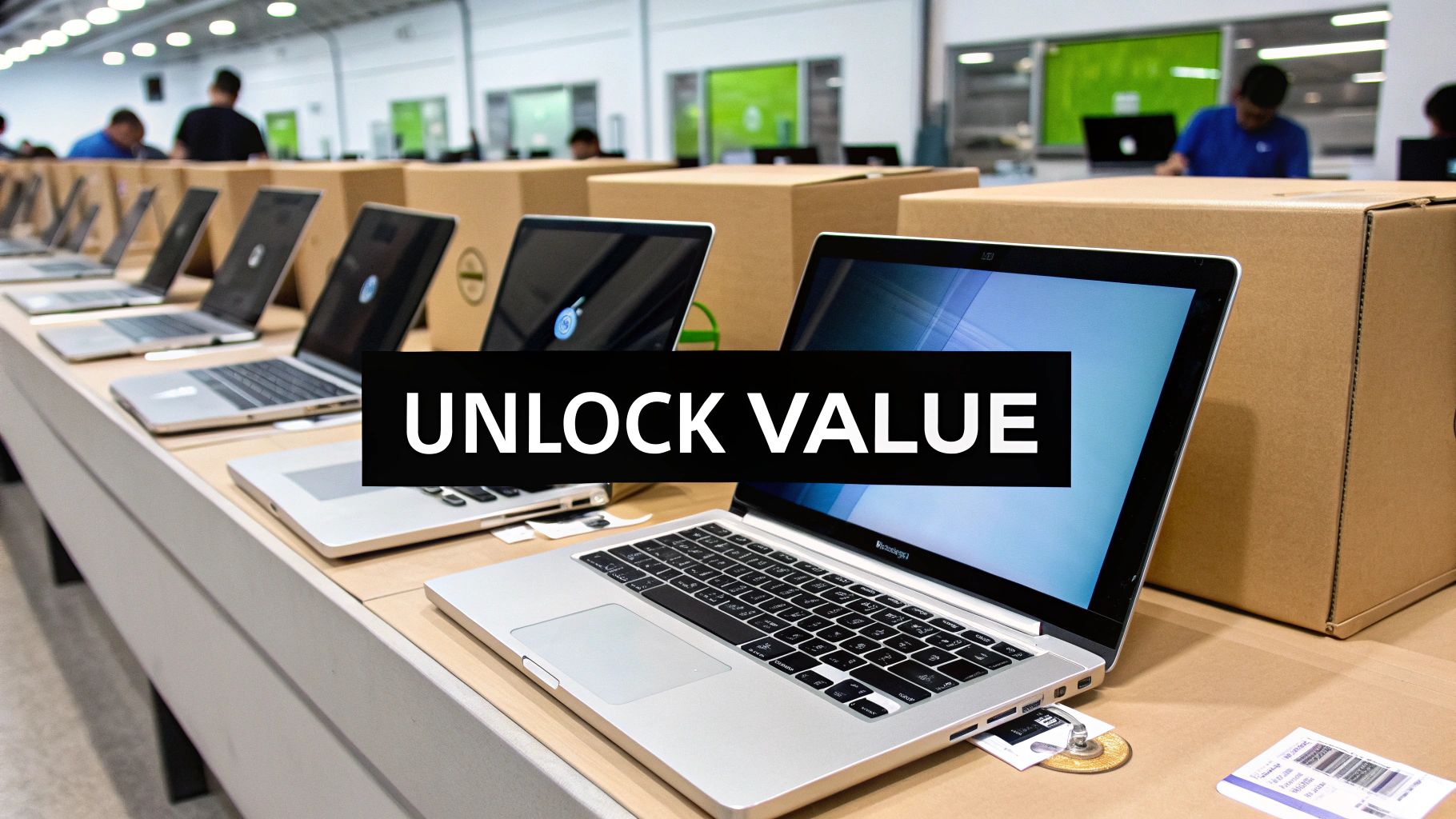
When Dunwoody businesses look at a room full of old tech, they often see one thing: a bill. It's easy to view retiring old equipment as just another operational cost for secure disposal and recycling. But that mindset misses a massive financial opportunity. Your outdated hardware isn't just a liability; it's a dormant asset, waiting to be turned back into working capital for your company.
A smart approach to IT asset disposition in Dunwoody GA flips the script, turning an expense into a program that can actually pay for itself. By identifying, refurbishing, and reselling the valuable equipment you no longer need, you can generate a surprising amount of revenue. This cash can directly offset your disposal costs and even help bankroll your next technology refresh.
Identifying Your Most Valuable Assets
Let's be clear: not all retired IT gear is created equal. That ten-year-old desktop computer collecting dust in the corner? It probably doesn't have much resale value. But enterprise-grade hardware often holds onto a good chunk of its worth on the secondary market. A professional ITAD partner can quickly size up your inventory and spot the high-value items immediately.
Generally, the equipment with the most resale potential includes:
- Enterprise-Grade Servers: Components like high-capacity RAM, powerful CPUs, and storage controllers from brands like Dell, HPE, and Cisco are always in demand.
- Networking Gear: Business-class switches, routers, and firewalls are built to last and are highly sought after by other companies looking to scale their infrastructure without breaking the bank.
- Recent Laptops and Desktops: Corporate models from the last three to four years, especially those in good cosmetic shape, can be refurbished and resold with ease.
- Data Storage Arrays: Even after you've securely wiped the hard drives, the chassis and controllers of enterprise storage systems hold significant value.
Think of your tech refresh less as a disposal project and more as a strategic asset recovery mission. The real goal is to maximize the financial return on every single piece of equipment walking out your door.
How Market Value Is Determined
So, what kind of return can you actually expect? Several factors play into the final dollar amount you can recover from your old assets. Knowing these variables helps set realistic expectations and shows why it’s crucial to act fast once equipment is decommissioned.
The main drivers of resale value are pretty straightforward:
- Age and Model: Tech depreciates, and it does so quickly. Assets under three years old will fetch the highest prices. Once you get past the five-year mark, the value drops off a cliff.
- Condition: This is a big one. Both functional and cosmetic conditions matter. A clean, complete unit that powers on will always be worth more than something that’s been banged up or is missing parts.
- Market Demand: Like any market, the value of specific components goes up and down with supply and demand. A certain model of network switch might be hot right now, driving its price up.
- Brand and Configuration: Well-known enterprise brands are trusted in the secondary market. It also helps if the gear has higher-spec configurations—more RAM, faster processors, and bigger storage capacity always add value.
For businesses looking to sell used computers and other equipment, a detailed audit is the essential first step to figuring out what your assets are really worth.
The Remarketing Process From Start to Finish
Unlocking this hidden value is a meticulous process that goes way beyond just throwing a few listings up on eBay. A professional ITAD provider uses a structured workflow to get you the best possible price for your assets while guaranteeing your data remains secure.
The journey starts with technicians testing and grading every component to see what works and what doesn't. Next, they perform any needed refurbishments, like cleaning the device or replacing minor parts. After certified data destruction is complete and documented, the assets are sold through established global remarketing channels to a network of vetted, trusted buyers. This professional approach almost always results in higher returns than trying to sell it all yourself, ensuring your Dunwoody business gets the most value back.
And remember, recovering value isn't limited to physical hardware. Many businesses find huge savings by implementing smart cloud cost management strategies. Digging into AWS cost optimization best practices is another great way to make sure all your IT resources, physical or virtual, are helping your bottom line.
How To Choose The Right ITAD Provider In The Dunwoody Area
Choosing a partner for your IT asset disposition in Dunwoody GA is a big deal. The wrong company can leave you wide open to data breaches, massive regulatory fines, and environmental trouble. But the right partner? They’re a shield, protecting your data, your reputation, and your wallet with a secure, fully documented process.
Think of it this way: picking an ITAD provider is like hiring a specialized security team for your data after it leaves your office. You wouldn't just hire anyone off the street without checking their background and credentials, right? The same level of scrutiny is essential here to keep your sensitive information and your company’s compliance in safe hands.
This guide will walk you through exactly what to ask and which credentials to check, so you can make a decision you feel good about.
Essential Industry Certifications To Demand
Certifications aren't just logos on a website; they are hard-earned proof that a provider meets strict, global standards for security, environmental practices, and quality control. These are independent, third-party audits that confirm a company actually does what it claims.
When you're talking to a potential vendor, be sure to ask about these key certifications:
- R2v3 (Responsible Recycling): This is the undisputed gold standard in our industry. An R2v3 certification means the provider has been thoroughly audited for environmental safety, data security, and the responsible handling of the entire recycling chain—including their partners down the line.
- e-Stewards: Another highly respected environmental certification, e-Stewards enforces a strict zero-landfill policy and flat-out prohibits exporting hazardous e-waste to developing nations. It’s a guarantee of the highest level of environmental and social responsibility.
- NAID AAA Certification: This one is all about data destruction. A provider with NAID AAA certification has passed tough, unannounced audits of their security, hiring practices, and destruction methods to ensure your data is completely and verifiably destroyed.
A provider that lacks these certifications might quote you a lower price, but that’s often because they’re cutting corners on the very things that protect you from risk. The cost of a single data breach or compliance penalty will dwarf any small savings you might have seen upfront.
Verifying Their Data Destruction and Security Protocols
Beyond the certs, you need to get into the nitty-gritty of their security procedures. This is where you can tell the real professionals from the rest. The answers they give to these questions will show you just how serious they are about protecting your information.
Ask them to get specific about their process:
- What data destruction methods do you offer? A top-tier provider should give you options, like certified software wiping (using standards like DoD 5220.22-M) and on-site physical destruction (shredding). This gives you the flexibility to get some money back from newer gear while guaranteeing total security for older drives.
- Can you provide a Certificate of Data Destruction? This is non-negotiable. This document is your legal proof that your data has been properly wiped or destroyed. It needs to be detailed, listing the serial number of every single drive they handled.
- What does your chain of custody look like? Ask to see a sample report. A secure chain of custody means they tag and serialize every asset at your location, use secure, GPS-tracked trucks for transport, and document every handoff until the equipment is finally processed. It creates a perfect, auditable trail.
If you get a vague answer to any of these questions, consider it a huge red flag. A trustworthy partner will be proud to show you their documentation and walk you through their security measures in detail. They’ve got nothing to hide.
To help you stay organized when comparing different vendors, we've put together a checklist of the most important criteria to evaluate.
Vendor Vetting Checklist Comparing Local ITAD Partners
Use this table as a scorecard when you're interviewing potential partners in the Dunwoody area. It covers the crucial points that separate a truly secure and compliant vendor from one that might leave you exposed.
| Criteria | What to Look For | Why It Matters |
|---|---|---|
| Industry Certifications | R2v3, e-Stewards, and/or NAID AAA. | These prove the vendor has passed rigorous third-party audits for security, environmental responsibility, and data destruction. |
| Data Destruction Methods | Both software wiping (e.g., DoD standard) and on-site physical shredding. | Gives you flexibility. Wiping allows for asset resale, while shredding provides maximum security for sensitive data. |
| Chain of Custody | Detailed, serialized reporting from pickup to final disposition. GPS-tracked, secure transport. | Creates an unbreakable, auditable trail for every asset, proving nothing was lost or stolen in transit. |
| Reporting & Documentation | Provides a sample Certificate of Data Destruction and detailed inventory reports. | This is your legal proof. The certificate should list serial numbers for every drive destroyed. |
| Insurance Coverage | Specific policies for data breach liability and environmental pollution. | Protects your business. If something goes wrong, their insurance policy should be the first line of defense, not yours. |
| Downstream Vendor Policy | A clear, documented process for auditing their recycling and refining partners. | Ensures your e-waste isn't illegally exported or dumped, protecting your company's ESG and brand reputation. |
| Local Presence & Logistics | A physical facility near Dunwoody; their own trucks and trained staff (not subcontractors). | A local team means faster response times, more control over security, and a better understanding of local business needs. |
By working through this checklist, you can confidently compare providers on the factors that truly matter for protecting your business.
Insurance and Downstream Vendor Management
Finally, a real professional ITAD partner has you covered even when things go wrong. Ask about their insurance, specifically policies covering data breaches and environmental liability. This is crucial—it means that in the rare case of an incident, their insurance policy, not yours, is on the hook.
Just as important is how they manage their downstream vendors—the partners who handle the final recycling of materials. Ask them how they vet these partners. A certified provider is required to audit their downstream network, ensuring that none of your equipment ends up illegally dumped overseas. This diligence is key to upholding your company's environmental and social governance (ESG) commitments. For a deeper dive into what separates the different service models, you can learn about the types of IT asset disposition companies and what to look for.
Common Questions About ITAD Services
When it comes to getting rid of old company tech, Dunwoody businesses usually have a lot of questions. That’s perfectly normal. Making a smart, confident decision starts with getting clear, honest answers. Here are some of the most common things we get asked about the process.
Our job is to cut through the jargon and give you the clarity you need to handle your retired equipment securely and profitably.
What Kinds of Equipment Do You Take?
We stick exclusively to commercial-grade IT equipment. This focus allows us to deliver the highest level of security and get the best value back for our business clients. Our services for IT asset disposition in Dunwoody GA are built to decommission a company's entire tech stack, from the server room to the desktop.
We handle a huge range of business hardware, including things like:
- Servers and data storage arrays from your data center or server closet.
- Networking gear like switches, enterprise routers, and firewalls.
- Business-class laptops and desktops from your latest employee refresh cycle.
- VoIP phones and telecom systems used in your offices.
Basically, if it powered your business operations, we can manage its retirement. We make sure nothing gets missed when you're decommissioning your infrastructure.
How Do I Know for Sure My Company's Data is Gone?
Data security isn't just a feature; it's the absolute foundation of our entire process. We treat it with the seriousness it deserves. Every single hard drive, server, or device with storage that enters our facility goes through a strict, certified data destruction protocol. This guarantees your sensitive information is permanently wiped out and 100% unrecoverable.
The ultimate proof and your peace of mind comes from the Certificate of Data Destruction we provide when the job is done. Think of this as your official legal record, confirming every single drive was properly sanitized or destroyed according to industry regulations.
We offer different layers of security to fit what you need. This could be DoD 5220.22-M standard data wiping for newer assets we can resell, or on-site physical hard drive shredding when you need absolute, undeniable destruction.
What Does ITAD Usually Cost?
The final cost really depends on a few things: the amount and type of equipment you have, the logistics of picking it all up, and—most importantly—the potential resale value of the gear itself. We always provide a transparent, itemized quote right from the start so you know exactly what to expect. No surprises.
Here's the best part: in many cases, the money we get from selling your newer, working equipment can seriously reduce or even completely cover our service fees. It can actually lead to a net profit for your company, turning an old expense into a new revenue stream.
Why is a Chain of Custody So Important?
A chain of custody is simply the documented paper trail that tracks your assets from the second they leave your office in Dunwoody to their final destination, whether that's resale or recycling. It's a chronological log, including serialized inventory lists and transfer receipts, that gets updated every time the assets change hands.
This paperwork is absolutely critical for proving you followed compliance rules and for limiting your company’s risk. It’s your evidence that you kept secure control over your assets—and the private data on them—through the whole process. Without that documented trail, you have no way to legally prove the job was done right.
Ready to put a secure, compliant, and profitable ITAD plan in place for your Dunwoody business? The team at Montclair Crew Recycling is here to make it happen. We manage the entire process to protect your data, ensure you meet all environmental rules, and get you the best possible return on your old IT gear. Contact us today for a free consultation.
