
For businesses in Dunwoody, figuring out what to do with old IT gear is about way more than just freeing up a closet. Having a real plan for electronics recycling in Dunwoody is a critical part of protecting sensitive data, staying on the right side of environmental laws, and frankly, safeguarding your company's reputation and finances.
It’s a smart business move that builds trust.
Why Smart E-Waste Management Is Crucial in Dunwoody
So, your company just upgraded the server room or refreshed the whole team with new laptops. Now what? You're left with a pile of old tech and a tricky problem to solve.
Simply tossing old computers in a dumpster is a massive no-go. It’s not just irresponsible; it can be illegal. Proper IT asset disposition (ITAD) isn't just about throwing things away correctly. It's a formal process that makes sure every single piece of equipment is handled securely and sustainably from start to finish.
This isn't just about ticking a compliance box—it's about smart business. A solid recycling program shields your company from the risk of staggering fines and the nightmare of a data breach. It also proves you're serious about corporate sustainability, something that clients, partners, and even your own employees care more about every year. For any organization in the area, from a major corporation in Perimeter Center to a local doctor's office, a clear ITAD strategy is no longer optional. It's a flat-out necessity.
The Growing Importance of Secure Recycling
The mountain of electronic waste is growing faster than ever, which makes professional recycling services absolutely essential. The global electronics recycling market is expected to explode from USD 43.2 billion in 2025 to a mind-boggling USD 147.9 billion by 2035.
And what’s driving that? A huge chunk of it is PCs and laptops, making up 45.0% of the market. This tells you that all those old office computers and servers from businesses right here in Dunwoody are a huge part of the problem—and the solution.
This trend points to a major shift in thinking. Companies are finally waking up to the fact that their retired tech holds two very important things: massive risk (in the form of data) and potential value (from resale).
A forward-thinking ITAD plan transforms an operational headache into a strategic advantage. It mitigates risk, ensures environmental stewardship, and can even generate unexpected revenue, turning a cost center into a value creator for your Dunwoody business.
Connecting E-Waste to Your Sustainability Goals
Making electronics recycling a core part of your company's green initiatives is a powerful statement. It's a real, tangible action that shrinks your environmental footprint and builds goodwill in a community that cares about sustainability. It shows you're not just talking the talk.
This is a key piece of the puzzle if you want to transform your small business to go green.
This commitment is about more than just checking a box. The damage from improperly handled e-waste is severe. You can get a clearer picture of the wider environmental impact of electronic waste. When you team up with a certified recycler, you're ensuring that toxic materials are managed safely and that valuable resources get funneled back into the supply chain, which is the whole point of a circular economy.
Before diving into a recycling program, it helps to step back and look at the big picture. For any Dunwoody business, a few key factors will shape your approach.
Key Factors for IT Asset Disposition in Dunwoody
| Consideration | Why It Matters for Your Business | Potential Risk of Neglect |
|---|---|---|
| Data Security | Your retired devices store sensitive company, client, or patient data. A breach could be catastrophic. | Fines, lawsuits, loss of customer trust, and severe reputational damage. |
| Environmental Compliance | Federal (RCRA) and state laws regulate the disposal of hazardous e-waste materials like lead and mercury. | Hefty fines for improper disposal and potential legal action from regulatory agencies. |
| Logistical Feasibility | You need a practical plan for packing, moving, and tracking dozens or hundreds of assets. | Wasted staff hours, potential for lost or stolen equipment, and an inefficient process. |
| Potential for Value Recovery | Newer or specialized equipment might have resale value that can offset disposal costs or even generate revenue. | Leaving money on the table. What could have been income becomes purely a cost. |
| Chain of Custody | You need documented proof of where your assets went and how they were processed, from pickup to final destruction. | Lack of auditable records leaves you vulnerable if questions about data security or compliance ever come up. |
Thinking through these points upfront will help you build a smarter, safer, and more cost-effective ITAD plan tailored for your Dunwoody operations.
Preparing Your IT Assets for Secure Disposal
When you're getting ready to recycle old electronics, it's about a lot more than just unplugging them and hauling them out the door. You need a solid game plan to protect your company's data and create a clear, auditable trail. Before you even think about scheduling an electronics recycling pickup in Dunwoody, your first move should always be a thorough inventory.
Seriously, you need to account for every single device you're getting rid of. That means logging all your servers, laptops, desktops, switches, phones, and even the smaller stuff like keyboards and mice. It's easy to overlook a forgotten hard drive in a storage closet, but that's exactly where sensitive data can hide.
Once your list is complete, it's time for asset tagging. Give each piece of equipment a unique tag that matches your inventory log. This is how you create an unbreakable chain of custody. You'll be able to track every asset from the moment it leaves your office until you get that final Certificate of Destruction. That piece of paper is your proof of a job done right.
Creating Your Internal Handling Checklist
Let me be clear: simply deleting files or reformatting a hard drive is not enough. Not even close. Data recovery software can easily bring back "deleted" files, exposing everything from your company's financial records to your client lists. You absolutely need a formal process for handling this internally.
Here's a practical checklist every IT manager should have taped to the wall:
- Go Offline: The first thing you should do is disconnect every single machine from your network. This closes any potential backdoors or lingering security risks.
- Set Up a Staging Area: Gather all your tagged equipment in one secure, designated spot. This makes life way easier for your recycling partner when they come for pickup and auditing.
- Document Everything: Keep a detailed log that connects your asset tags to the device's serial number and type. This meticulous record-keeping is non-negotiable for compliance.
And don't forget about safety. Old electronics can be full of things like lead and mercury. Make sure your staging area follows hazardous materials storage requirements to keep your team and the environment safe.
This process really boils down to three core ideas: safeguarding your data, staying compliant, and protecting any remaining value in your assets.
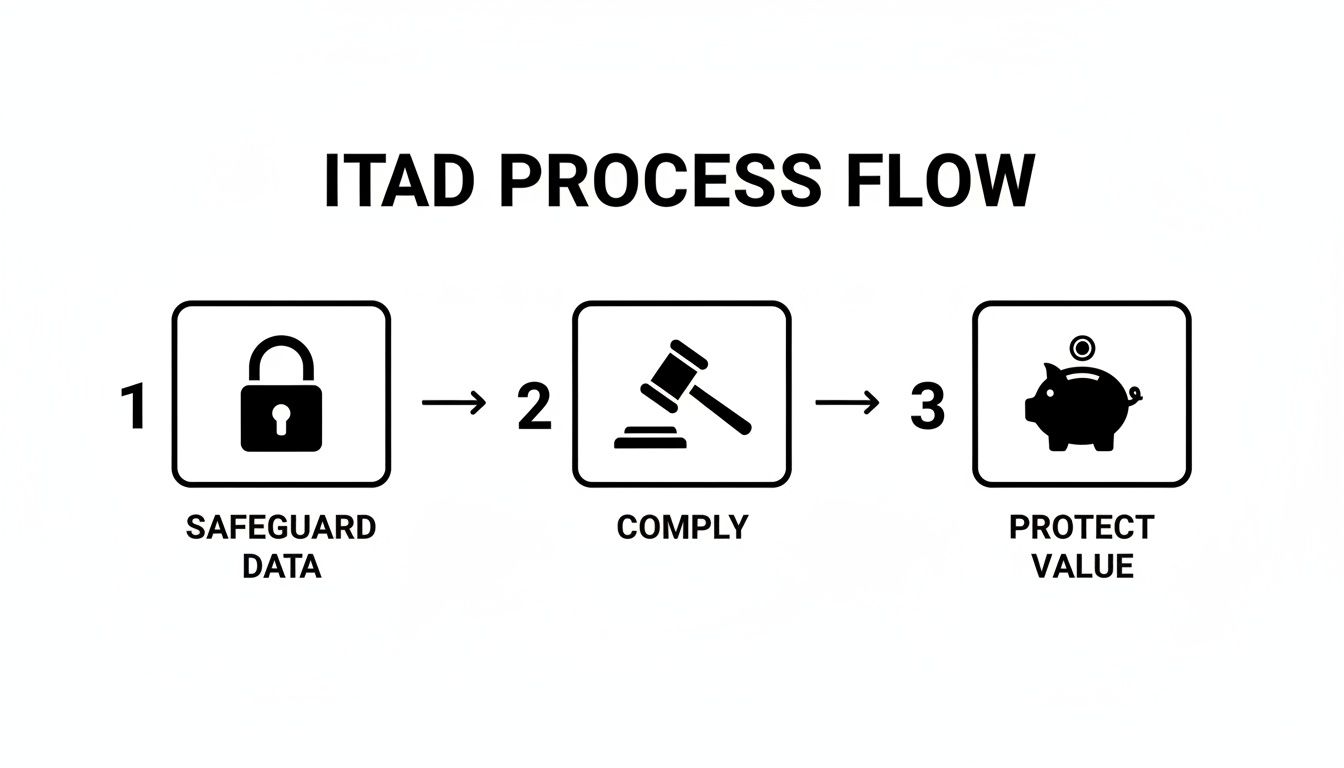
As you can see, secure disposal isn't just one action—it's a complete strategy.
Taking the time to properly inventory and prepare your assets is the most effective way to prevent logistical headaches and costly security oversights down the line. A little diligence upfront saves a lot of trouble later.
This prep work is the foundation of the entire disposition process. To see how it fits into the bigger picture, you can learn more about IT asset disposition in Dunwoody, GA and what it means for your business goals. By getting these internal protocols locked down, you pave the way for a smooth, secure partnership with your recycling vendor.
Mastering Secure Data Destruction
When it's time to retire old IT assets, data security isn't just one part of the process—it's the absolute center of gravity. After you've taken inventory, the next make-or-break step is guaranteeing every last bit of sensitive information is permanently gone. For any Dunwoody organization, this is where professional data destruction becomes completely non-negotiable.
Simply hitting 'delete' or formatting a drive is like leaving your front door wide open. With basic recovery software, that "deleted" data can be brought back in minutes, creating a massive liability for your business. Real data security means making that information impossible to recover, period.
What is Data Wiping, Really?
One of the most trusted methods in the industry is data wiping, also known as data sanitization. This isn't just deleting files. It's a process that uses specialized software to methodically overwrite every single sector of a hard drive with random, meaningless characters. It actively buries the old data, making it unreadable.
A benchmark standard you'll often hear about is the DoD 5220.22-M three-pass wipe. This protocol, originally from the U.S. Department of Defense, is incredibly thorough:
- First Pass: It overwrites the drive with a specific character, then its opposite (like zeros, then ones).
- Second Pass: It writes a new set of random characters across the drive.
- Third Pass: It verifies the entire process to confirm the original data is completely gone.
This layered approach is designed to defeat even sophisticated recovery attempts. It's the perfect solution for destroying data while keeping the physical drive intact, which is key if the computer or server still has resale value.
When You Absolutely Have to Shred It
Sometimes, software wiping isn't the right tool for the job. For drives that have already failed, devices holding exceptionally sensitive data, or situations where you need to meet the absolute strictest compliance rules, physical destruction is the only way to go. And no, we're not talking about taking a hammer to it in the parking lot. This is a precise, industrial-grade process.
On-site hard drive shredding is the gold standard here. A specialized mobile shredding truck comes right to your Dunwoody office, and you can watch your hard drives, SSDs, and backup tapes get turned into a pile of tiny metal fragments. It offers total peace of mind and an unbroken chain of custody from start to finish. You can dive deeper into the different methods in our complete guide to IT asset destruction.
Imagine a Dunwoody-based medical clinic retiring old patient check-in tablets. To stay compliant with HIPAA, they have to ensure that Protected Health Information (PHI) is 100% irretrievable. On-site shredding gives them a transparent, verifiable process that slams the door shut on any potential data breach and satisfies those tough legal requirements.
The Certificate of Destruction: Your Proof of a Job Well Done
No matter which method you go with, the job isn't finished until you have a Certificate of Data Destruction in your hands. This is more than just a receipt; it's a legal document proving your data was properly destroyed according to all relevant privacy laws.
Your certificate should list every single asset by its serial number, clearly state the destruction method used, and be signed by your ITAD partner. If a vendor can't or won't provide this, walk away. It's that important.
This certified process is more critical now than ever. With the e-waste management market expected to jump from $70 billion in 2024 to $81.27 billion in 2025, and ITAD services projected to hit $36.4 billion by 2034, the stakes are high. For any business handling electronics recycling in Dunwoody, choosing the right destruction method is a fundamental move to protect your reputation, your customers, and your bottom line.
Choosing Your Recycling Logistics: Onsite vs. Drop-Off
Alright, so you’ve got your old IT gear cataloged and ready to go. Now for the practical part: how do you get all of it from your Dunwoody office to a recycling facility? It really boils down to two main paths, and the best one for you depends entirely on your situation.
You can either schedule a professional on-site pickup or you can handle the move yourself and use a drop-off center. The right choice hinges on a few key things: the sheer amount of equipment you have, your company’s security protocols, and frankly, how much time your team can afford to spend on this project.
The Convenience of On-Site Pickup
For most businesses, especially if you have more than just a few desktops, scheduling an on-site pickup is the cleanest, most secure way to go. Think of it as a white-glove service designed to lift the entire logistical weight off your team. It’s a straightforward process built to cause as little disruption to your workday as possible.
It usually starts with a quick chat to go over your inventory. From there, we schedule a time, and a professional crew shows up at your Dunwoody location. They do all the heavy lifting—safely packing and loading everything from bulky servers to boxes of cables onto a secure truck. A crucial step here is the on-the-spot audit. The crew verifies your inventory list against the actual items, which kicks off a secure and accurate chain of custody right from your doorstep.
A scheduled pickup is more than just a convenience; it's a strategic move to maintain security and accountability. Having professionals manage the logistics from your door to their facility ensures that no asset is lost and the chain of custody remains unbroken.
When a Drop-Off Makes More Sense
On the flip side, the drop-off option can be a perfect fit for smaller businesses or any organization with just a handful of items to recycle. If you’re only getting rid of a couple of old laptops, a monitor, and a printer, arranging a full-scale pickup might be overkill.
Choosing to drop off your electronics gives you total flexibility. You can bring your items to a designated recycling center whenever it works for you. The catch? The responsibility for packing, hauling, and unloading all that equipment falls squarely on you and your team. Before you head out, it's absolutely critical to make sure your devices are prepped correctly—meaning all data has been professionally wiped or the hard drives have been physically removed for destruction.
You can find more details about our flexible options, including information on a free electronics recycling pick-up.
On-Site Pickup vs. Drop-Off Center: Which Is Right for You?
Making the call between an on-site pickup and a drop-off isn't always obvious. This quick comparison should help you figure out which logistical approach makes the most sense for your Dunwoody business.
| Factor | On-Site Pickup Service | Drop-Off Center |
|---|---|---|
| Best For | Medium to large businesses, data centers, schools, and healthcare facilities with significant volume. | Small businesses, startups, or companies with only a few items to recycle. |
| Convenience | High. The recycling partner handles all labor, loading, and transportation. | Low to Medium. Requires your team to pack, transport, and unload all equipment. |
| Security | Maximum. A secure, documented chain of custody begins at your facility. | Moderate. You are responsible for asset security during transit. |
| Time Investment | Minimal. Your team's involvement is limited to overseeing the pickup. | Significant. Requires staff time for logistics and transportation. |
Ultimately, the goal is to get your equipment recycled responsibly and securely. Whether that means having a team come to you or handling it yourself, the key is to choose the method that best aligns with your company's resources and security needs.
Finding Hidden Value in Your Old IT Equipment
Most businesses look at a closet full of old IT equipment and just see a liability—a pile of hardware that’s going to cost time and money to get rid of. But that’s not always the full picture. Your old tech isn't just waste; it might just be a hidden asset waiting to be found through a process called value recovery.
This process flips the script, turning a potential disposal cost into a revenue stream by finding and remarketing equipment that still has value. For any business managing their electronics recycling in Dunwoody, this can totally change the financial outcome of an IT refresh. You might actually get paid instead of paying a bill.
What Equipment Holds Resale Value?
Look, not every five-year-old desktop is going to be a goldmine, but you'd be surprised what still has life in the secondary market. The trick is knowing what's in demand, and that's where a professional ITAD partner's expertise really shines.
Generally, the gear that gets a second look includes:
- Enterprise-Grade Hardware: This is the big one. Things like blade servers, high-capacity storage arrays, and networking equipment from brands like Cisco or Dell often keep a good chunk of their value.
- Newer Laptops and Desktops: Computers that are only a few years old, especially the business-class models from major brands, are always in demand.
- Telecom Equipment: Don't forget about modern VoIP phone systems and other communications hardware. They can definitely be resold.
A good partner will evaluate every single asset based on its age, physical condition, configuration, and what the market is paying for it right now. This detailed audit is what separates the items destined for refurbishment and resale from those that need to be responsibly recycled. It’s the first step to see if you can sell an old computer or other gear for a real return.
Shifting your mindset from "disposal cost" to "asset recovery" is fundamental. An experienced partner can identify remarketing opportunities you might miss, transforming a financial burden into a benefit for your Dunwoody organization.
This usually works through a profit-sharing model. Your recycling partner takes on all the heavy lifting—secure data wiping, testing, and finding buyers—and then shares a percentage of the final sale price with your company. It’s a transparent setup that creates a real partnership, turning that pile of e-waste into a win for your bottom line.
Answering Your Dunwoody Electronics Recycling Questions
Even with a great plan in place, a few last-minute questions always pop up during an IT refresh. For Dunwoody businesses, getting straight answers can make the whole electronics recycling process feel a lot less daunting. These are a few of the most common questions we hear from local companies.
What Happens to My Equipment After It Leaves My Office?
Once your gear is securely loaded and leaves your Dunwoody facility, it doesn't just disappear. First, it goes through a meticulous receiving and auditing process. We check every single item against the inventory log we created on-site, ensuring a rock-solid chain of custody from start to finish.
Next comes the most critical step: data destruction. Every single device with a storage drive is wiped clean using multi-pass software or physically shredded into tiny pieces, depending on what you’ve requested. Nothing moves forward until we can verify all your data is gone for good.
From there, any equipment that still has some life left in it is tested, refurbished, and prepped for resale. For everything else, we carefully de-manufacture it, breaking it down to its core materials—metals, plastics, and glass. These raw commodities are then sorted and shipped to certified processors to be refined and used in new products.
Are There Specific Dunwoody or DeKalb County Regulations I Should Know About?
While Georgia doesn’t have a state-wide ban on businesses sending e-waste to landfills, you’re not totally off the hook. You still have to follow federal rules like the Resource Conservation and Recovery Act (RCRA). This is the big one that governs how you handle hazardous materials found in most electronics, like lead, mercury, and cadmium.
Working with a certified recycler is the easiest way to make sure you're compliant with RCRA and any local DeKalb County business waste guidelines. The paperwork you get back, like a Certificate of Destruction, is your proof that you handled everything by the book.
This isn't just about avoiding fines; it's about being a responsible local business. The world generated a mind-boggling 62 million tonnes of e-waste in 2022, which is an 82% jump from 2010. Shockingly, only 22.3% of it was actually recycled properly. You can learn more about these e-waste statistics and why it matters for every business in the Metro Atlanta area.
Can You Take Specialized Medical or Lab Equipment?
Yes, but it's a different ballgame. Your standard IT recycler is set up for computers, servers, and phones. Specialized gear like medical imaging machines, diagnostic equipment, or sensitive lab instruments is a whole other story. They might contain biohazards or unique materials that require special handling.
For these highly specialized assets, you need a vendor who knows the right people. Partnering with a recycler who has established connections with certified medical and lab equipment specialists is the key. They ensure every piece of your equipment is handled in full compliance with environmental rules and healthcare regulations like HIPAA.
This is the only way to guarantee that even your most complex and sensitive assets are processed safely, protecting both your data and public health.
If you’re ready to put a secure, compliant electronics recycling program in place for your Dunwoody business, Montclair Crew Recycling can help. We manage the entire process, from secure on-site pickup to certified data destruction and getting you money back for your old gear.
