
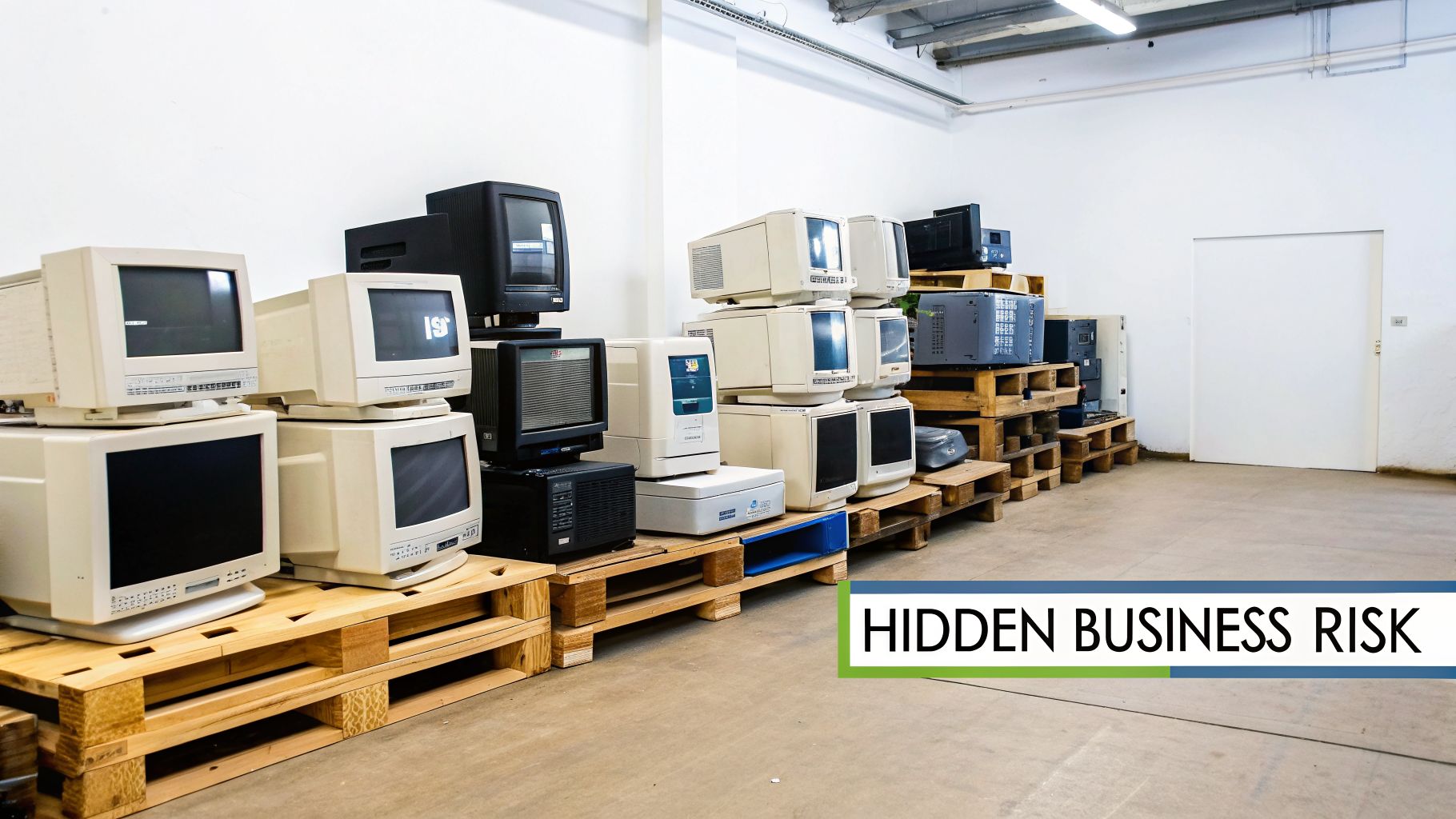
That pile of old office computers, servers, and phones in your storage closet isn't just taking up space—it's a real business risk. For any company in Georgia, knowing how to handle these devices is critical. If you don't have a plan for responsible e-waste recycling, you're exposing your business to some serious environmental and data security liabilities.
Why E-Waste Is Georgia's Hidden Business Risk
The amount of outdated electronics being tossed is growing faster than anyone can keep up with. Globally, we're on track to generate a staggering 82 million metric tons of e-waste by 2030. What's worse is that recycling efforts aren't even close to matching this pace, and an estimated US$62 billion in valuable, recoverable materials is lost every year when this equipment is just thrown away.
For Georgia businesses, this isn't some distant global issue. It's a local problem waiting to happen. Think of every old computer or company phone as a "digital landmine" in your back room. If you dispose of it the wrong way, it can blow up in two very different, but equally damaging, ways.
Environmental and Data-Related Dangers
First, there's the environmental hazard. When electronics sit in a landfill, they can leak toxic materials like lead, mercury, and cadmium straight into Georgia's soil and groundwater. This doesn't just damage the local ecosystem; it can create a legal nightmare for the company that threw them out. You can get a deeper look at the environmental impact of electronic waste in our detailed article.
The second risk is even more immediate: data security. Every hard drive you get rid of contains a ghost of its old life. We're talking customer lists, private financial records, and all sorts of sensitive company data. Just hitting "delete" doesn't actually erase it. This leaves you wide open to a data breach that could ruin your reputation and cost you a fortune in fines.
An improperly handled device is a ticking time bomb for your business. It represents a direct threat to your data security, legal compliance, and environmental responsibility.
You don't need to be an expert to solve this. You just need a solid game plan. Here’s a quick guide to help your business get started on the right foot.
Your Quick Guide to Responsible E-Waste Management in Georgia
This table breaks down the essential steps for Georgia businesses to turn a potential liability into a secure, compliant process.
| Key Principle | Why It Matters for Your Business | Your First Action Step |
|---|---|---|
| Understand Your Legal Duties | Federal and state regulations carry stiff penalties for non-compliance, putting your business at financial and legal risk. | Review EPA regulations and any industry-specific rules (like HIPAA for healthcare) that apply to your data. |
| Guarantee Total Data Destruction | Simply deleting files is not enough. Lingering data on old drives is a primary cause of costly data breaches. | Choose a recycler that provides certified data destruction with a Certificate of Destruction for your records. |
| Partner with a Certified Recycler | An uncertified vendor could illegally export your e-waste, leaving you liable for environmental damage and data exposure. | Ask for their R2 or e-Stewards certification and proof of a secure chain of custody from pickup to disposal. |
By following this roadmap, Georgia businesses can effectively disarm these digital landmines. You can stop worrying about the risks and start focusing on a process that is secure, sustainable, and good for your bottom line.
Understanding Georgia’s E-Waste Rules and Regulations
Trying to figure out the legal side of e-waste recycling in Georgia can feel like a headache. The good news? It’s a lot simpler than it looks once you get the basics down. Here's the most important thing for any business to know: Georgia does not have a specific statewide law that bans electronics from landfills or mandates recycling.
But don't mistake that for a free pass. Every single business in Georgia, whether it's a small shop in Alpharetta or a huge data center in Atlanta, falls under the umbrella of a powerful federal law: the Resource Conservation and Recovery Act (RCRA). This law dictates how hazardous waste is managed, and a surprising amount of the stuff inside your old electronics fits that description.
Think of it this way: while there isn't a state law stopping you from tossing old paint cans in your office dumpster, federal environmental rules definitely prohibit you from dumping hazardous chemicals. Your old IT gear is treated with the same level of seriousness.
Who Is an E-Waste Generator
Under RCRA, if your business creates or even just has e-waste, you're considered a "generator." This isn't some complex legal term; it just means your company is the source of the old equipment. As a generator, you are legally on the hook for that equipment from "cradle to grave."
That responsibility starts the second you decide a piece of tech is obsolete and doesn't end until it's been properly and completely disposed of. You can't just hand off that liability by giving your equipment to a guy with a truck. If that hauler illegally dumps your old computers, your company can still be held responsible for the cleanup and face massive fines.
A lot of people think this only applies to big corporations. The reality is, these rules apply to any business, no matter the size. The only thing that changes is your specific classification and reporting requirements based on the amount of waste you generate.
The Real-World Risks of Non-Compliance
Let's walk through a quick scenario. An Atlanta marketing agency decides to finally clean out a storage closet packed with old tech. They've got a dozen old CRT monitors, a box full of server batteries, and around 30 outdated desktops. To save a few bucks, they pay an uncertified hauler a small cash fee to make it all disappear.
A few months later, an environmental inspector finds the monitors and leaking batteries dumped in a wooded area in a neighboring county. By tracing serial numbers on the equipment, investigators link the illegal dump site directly back to the marketing agency.
The fallout is immediate and painful. The business is now looking at tens of thousands of dollars in federal fines under RCRA for improper disposal of hazardous waste. Worse, their brand takes a massive hit in the news, and they lose the trust of their eco-conscious clients.
This story highlights a crucial point: choosing your recycling partner isn't just another vendor decision. It’s a critical layer of legal and financial protection for your business. A certified recycler knows the ins and outs of RCRA and guarantees hazardous materials are handled by the book. You can get more information on our specific services by reviewing our guide on professional Georgia electronics recycling.
What Qualifies as Hazardous in Your E-Waste
Not all electronics are the same in the eyes of the law. RCRA regulations are mostly focused on specific materials that can leach into the soil and water, causing real environmental harm. Knowing what they are helps you understand why professional recycling isn't just an option—it's a necessity.
Here are some of the most common hazardous materials hiding in your office electronics:
- Lead: Found in the heavy glass of old CRT monitors and used in solder on circuit boards.
- Mercury: A key component in the backlights of flat-screen monitors and some types of batteries.
- Cadmium: Often used in rechargeable computer batteries and other older electronic parts.
- PCBs (Polychlorinated Biphenyls): Present in very old equipment with transformers and capacitors made before the 1979 ban.
Because these substances are federally regulated, you can't just toss items containing them into your regular trash. You need a responsible partner to correctly sort and process these materials, protecting your business from the very real—and very expensive—risks of getting it wrong.
Securing Your Data During Electronics Disposal
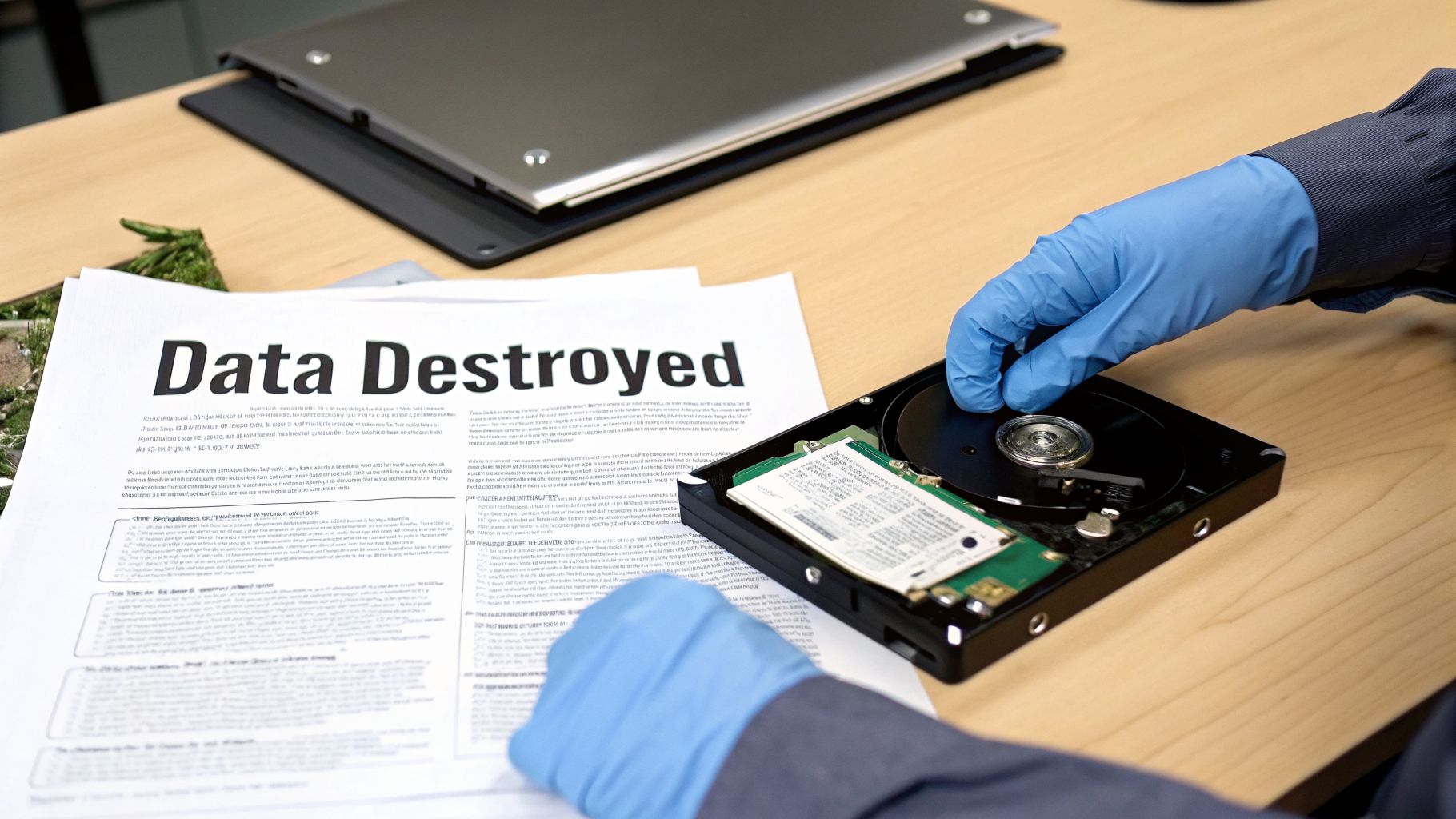
When it's time to retire old office equipment, protecting the data stored inside is your most important job. Simply hitting 'delete' or running a factory reset is dangerously insufficient.
It’s like tearing the index out of a library book—all the information is still on the pages, just a bit harder for a casual observer to find. A determined individual with the right tools, however, can easily recover that "deleted" data.
For Georgia businesses, this creates a massive liability. Every retired computer, server, and phone holds a digital footprint of sensitive information, from client lists and financial reports to employee records. Leaving that data accessible is an open invitation for a breach, with serious financial and reputational consequences.
With only 22.3% of global e-waste properly recycled, the rest is often landfilled or improperly handled. For Georgia organizations, this means every discarded device containing data is a potential breach waiting to happen. You can dive deeper into these e-waste trends and their implications for businesses.
Data Wiping for Asset Reuse
When an electronic asset still has value and can be refurbished or resold, the goal is to completely sanitize the data without damaging the hardware. This is where professional data wiping comes in.
This process goes far beyond simple deletion, using specialized software to overwrite every single sector of a hard drive with random characters. The gold standard for this is the DoD 5220.22-M wipe.
This method, originally specified by the Department of Defense, performs multiple passes of overwriting, making the original data forensically unrecoverable. Think of it like painting over a canvas—one coat might let the old image show through, but three thick coats will permanently obscure it.
Physical Destruction for Total Elimination
In some cases, wiping isn't enough. For highly regulated industries or when a drive is at the end of its life, the only acceptable risk is zero. This is where physical destruction becomes non-negotiable, especially for sectors governed by laws like HIPAA (healthcare) or GLBA (finance).
On-site hard drive shredding is the most secure method for complete data elimination. A mobile shredding truck comes directly to your location, and you can personally witness your hard drives, SSDs, and backup tapes being turned into tiny, irrecoverable pieces of metal.
Physical destruction isn't just about breaking something; it's about providing absolute, verifiable proof that your data has been permanently destroyed and can never be compromised.
This method completely removes any possibility of data recovery. For organizations with a low-risk tolerance or strict compliance mandates, it provides the ultimate peace of mind. Montclair Crew offers both on-site shredding and certified wiping, and you can learn more by exploring our approach to secure data destruction services.
The Certificate of Data Destruction
Whether you choose data wiping or physical shredding, the process isn't complete until you receive a Certificate of Data Destruction. This formal document is your legal proof that you took responsible steps to protect your sensitive information.
This certificate is a critical piece of your compliance and audit trail. It closes the loop on your IT asset disposition process, confirming that your data was handled securely from start to finish.
A proper certificate should always include key details like:
- Serial numbers of the destroyed or wiped devices
- The method of destruction used (e.g., DoD 5220.22-M wipe, physical shredding)
- The date and location of the destruction
- A statement of indemnification from the vendor
This document proves you met your legal obligations and serves as your first line of defense in the event of a regulatory audit or legal challenge.
How to Choose a Certified E-Waste Recycler in Atlanta
Picking a partner to handle your company's old electronics isn't like hiring any other vendor. The stakes are much, much higher. One wrong move can leave you facing huge fines, a public data breach, and environmental liabilities that can haunt your business for years.
Not all recyclers in the Atlanta area are created equal. Knowing what to look for is your company's best defense against disaster.
The single biggest factor is certification. Think of it this way: anyone can buy a wrench and call themselves a mechanic, but you trust the technician with an ASE certification because they’ve been audited and proven to follow industry standards. In our world, the gold standards are R2v3 (Sustainable Electronics Reuse & Recycling) and e-Stewards.
These aren't just logos for a website. They are your guarantee that a vendor is held to strict, third-party audited standards for data security, environmental safety, and even worker protection. A certified recycler is legally on the hook for their process; an uncertified hauler operates with virtually no oversight.
Key Questions to Ask Any Potential Recycler
Before you hand over a single server or laptop, you need to put any potential partner to the test. How they answer these questions will tell you everything you need to know.
- "Are you R2v3 or e-Stewards certified?" If they say no, or they hesitate, that's the end of the conversation. Always ask for a copy of their current certificate to prove it.
- "Can you provide a full chain-of-custody audit trail?" This is non-negotiable. You need a paper trail that shows exactly where your assets went from the second they left your building to their final recycling or destruction.
- "What is your downstream vendor management process?" No single recycler does everything in-house. They have to use downstream partners for specialized tasks like smelting. A certified recycler is required to audit these partners to make sure they're also compliant.
- "Do you offer on-site services and serialized reporting?" For maximum security, you might need hard drives shredded at your location before they even leave. No matter what, every single asset should be tracked by its serial number on the final report.
- "Will I receive a Certificate of Data Destruction and Recycling?" This document is your legal proof that you did the right thing. It should clearly list all the serial numbers of the devices that were processed.
Choosing an uncertified recycler is like giving your company’s most sensitive files to a stranger with a truck and hoping for the best. The initial cost savings are never worth the immense risk of a data breach or an environmental fine.
Certified Recycler vs Uncertified Hauler: What Businesses Need to Know
The difference in liability and security between a true certified partner and a standard scrap hauler is night and day. This breakdown shows why making the right choice is so critical for any Georgia business.
| Feature | Certified Recycler | Uncertified Hauler |
|---|---|---|
| Data Security | Audited data destruction processes (wiping/shredding) with a Certificate of Destruction. | No guaranteed process; data is often left intact, creating a massive breach risk. |
| Legal Liability | Assumes liability upon pickup with a clear chain of custody and indemnification. | You remain liable. If they dump your equipment illegally, your company faces the fines. |
| Environmental Compliance | Adheres to federal and international laws, preventing illegal exporting and landfilling. | Often exports hazardous materials to developing nations or dumps them in local landfills. |
| Transparency | Provides full, serialized reporting and downstream vendor audits. | No transparency. You have no idea where your equipment or data truly ends up. |
| Value Recovery | Can identify, test, and remarket reusable assets, often sharing profits with you. | Typically treats all items as scrap, offering only low commodity-based value. |
Ultimately, what a certified partner gives you is peace of mind. You get a secure, compliant, and fully documented process that protects your business from top to bottom.
As you look at your options, remember that a trustworthy and certified electronic waste company is more than just a vendor—they are an extension of your own risk management team.
Your Step-By-Step IT Asset Disposition Workflow
A solid IT Asset Disposition (ITAD) plan is what turns a messy, complicated job into a simple, repeatable process. It takes the guesswork out of the equation. You'll know exactly where every piece of equipment is, backed by a clear audit trail for compliance. Think of it as a GPS for your old tech—guiding each asset securely to its final stop, whether that's a new life through refurbishment or responsible recycling.
Without a structured workflow, you’re just guessing. Here’s how to do it right.
Step 1: Create an Initial Asset Inventory
Before you can get rid of anything, you need to know exactly what you have. The first move is to create a detailed inventory of all the equipment you're retiring. Don’t just count boxes—get the specifics.
Your inventory audit needs to capture the critical details for every single asset:
- Asset Type: (e.g., laptop, server, monitor)
- Brand and Model: (e.g., Dell Latitude 7420)
- Serial Number: This is absolutely crucial for tracking.
- Physical Location: (e.g., Storage Closet B, Desk #114)
- Data-Bearing Status: Does it have a hard drive or any other storage?
A simple spreadsheet works perfectly for this. This record is the foundation for your entire ITAD process, making sure no device ever gets lost in the shuffle.
Step 2: Segregate for Value and Security
Not all your old electronics are junk. Your next step is to sort your inventoried equipment into two main piles: assets that might have resale value and assets that are truly at the end of their life.
Things like newer laptops, servers, or networking gear can often be refurbished and sold. This puts money back into your pocket. On the other hand, broken devices, old monitors, and fried hard drives are headed for secure destruction and materials recovery. This sorting helps your recycling partner handle everything correctly, maximizing your return and keeping the process secure.
Step 3: Schedule a Secure Pickup
Once your assets are inventoried and sorted, it's time to get them out the door. A professional ITAD partner handles all the logistics, showing up for a secure, documented pickup right at your facility. This is not like calling a standard moving company. Your vendor should use trained techs and secure vehicles to protect your assets from the moment they leave your sight.
This infographic breaks down the key stages of choosing and working with a recycling partner.
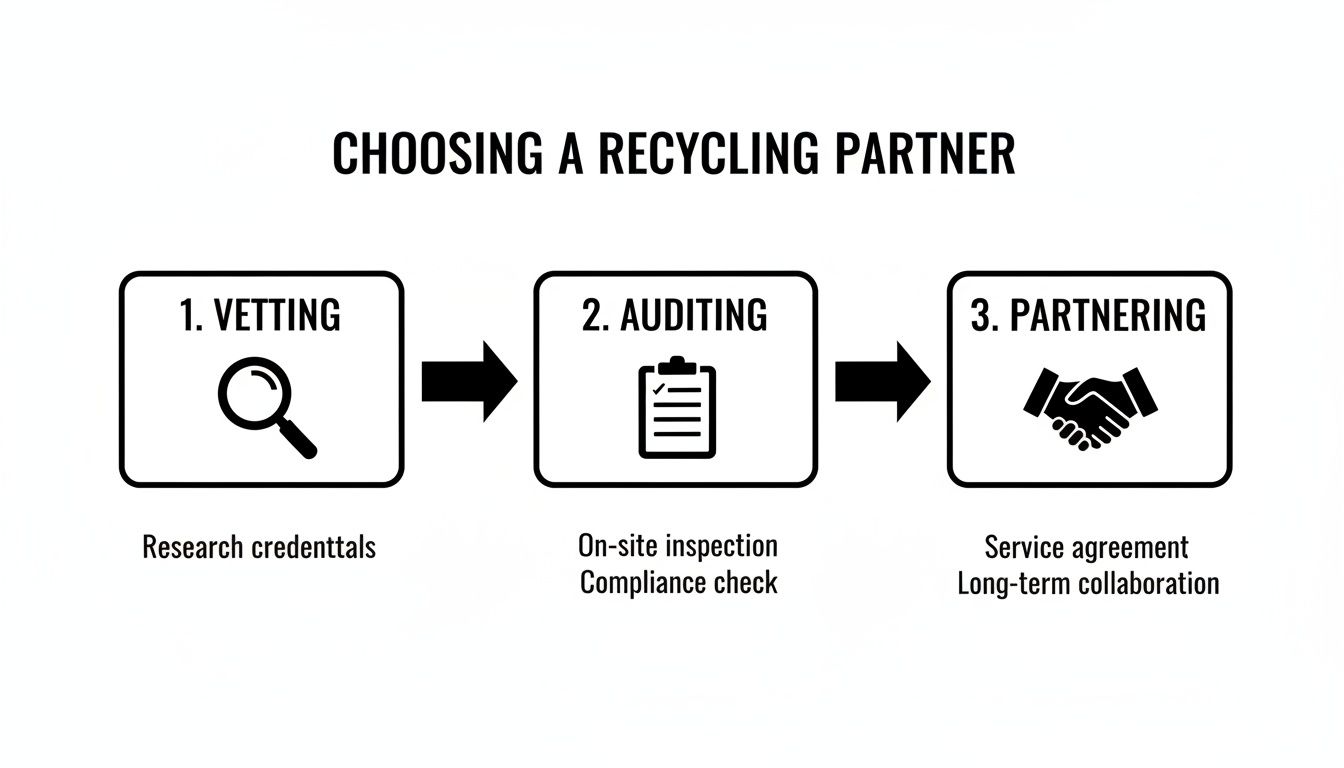
The process highlights just how important it is to properly vet, audit, and partner with a recycler you trust.
Step 4: Verify the Chain of Custody
The moment your equipment leaves your office, the chain of custody begins. This is the unbroken paper trail that follows your assets. When they're picked up, you must get a manifest that lists every single item being transported, which you can then check against your own inventory list.
Chain of custody is your proof of responsible transfer. It confirms that your vendor has taken legal possession and liability for your equipment. This protects your business from any downstream problems.
This paperwork is non-negotiable for your records. It proves you handed everything over to a certified and accountable facility. For a deeper dive into how this all works, check out our guide on the complete process for the professional disposal of IT assets.
Step 5: Receive Final Documentation
The job isn't done until you have the final paperwork from your recycler. These documents officially close the loop on your ITAD project and are what you'll need to pass any compliance audit.
You should always receive two key documents:
- A Certificate of Recycling: This confirms your e-waste was processed in an environmentally compliant way, following all federal and Georgia state regulations.
- A Certificate of Data Destruction: This document lists the serial numbers of every sanitized or destroyed hard drive, verifying that your sensitive data is gone for good.
These certificates are your ultimate proof of due diligence. File them away safely. They are your evidence of a secure and responsible ITAD program.
Your E-Waste Recycling Questions Answered
When you’re trying to responsibly handle old electronics, a lot of practical questions pop up. If you're running a business in Georgia, you need clear, direct answers to make sure you're doing things right. Here are some of the most common questions we hear from businesses just like yours.
What Kind of Electronics Can My Business Actually Recycle?
Good news—most of the standard equipment sitting in your office is easily recyclable. This covers all the usual suspects:
- Computers, desktops, and laptops
- Servers and all your networking gear
- Printers, keyboards, mice, and monitors
- Company cell phones and tablets
But some things are a different story. Specialized equipment, like heavy industrial machinery or certain medical devices that might have biohazard risks, often need a different disposal process. The best move is to always confirm with your recycling partner that they can handle everything you’ve got.
Do These Rules Apply to My Small Business, Too?
Yes, they absolutely do. The core responsibilities apply to everyone, regardless of size. While you might not have a warehouse full of old servers like a Fortune 500 company, your legal obligations under federal laws like the Resource Conservation and Recovery Act (RCRA) are exactly the same.
The risk of a data breach or an environmental fine doesn't shrink just because your company is smaller. Every business, no matter the headcount, is liable for its data and hazardous waste from "cradle-to-grave."
This is why working with a professional service is such a critical safeguard for small and mid-sized businesses. It protects you from mistakes that can get very expensive, very fast. A certified recycler guarantees your data is wiped clean and your equipment is processed in full compliance with the law.
What’s the Real Cost of Professional E-Waste Recycling?
The cost is almost always much lower than what business owners expect. In fact, many certified recyclers work on a value-based model. This means if your old equipment still has working parts or can be refurbished and sold, that resale value can seriously cut down—or even eliminate—your costs.
With services like free DoD-standard data wiping and profit-sharing from the sale of remarketed assets, you could end up paying nothing out-of-pocket. When you stack that up against the massive cost of a data breach or a fine for improper disposal, professional recycling is an incredibly smart and affordable investment in your company’s security.
Can't I Just Take Everything to a Local Drop-Off Spot?
Those local drop-off sites are a great option for residents or a business that's only getting rid of one or two old monitors. However, they simply aren't set up to handle the volume or the security needs of a business cleanout.
For any kind of office liquidation, a scheduled, on-site service is the only way to go. It gives you secure logistics, a clear chain-of-custody for every single asset, and ensures everything is removed efficiently without getting in the way of your day-to-day operations. A professional service is built to meet business needs, not just residential ones.
Ready to put a secure, compliant, and easy IT asset disposition plan in place for your Georgia business? Montclair Crew Recycling delivers certified, complete services, from on-site pickup and asset tracking to secure data destruction and value recovery. Visit us to see how we can protect your company and turn your old tech into a secure, sustainable asset.
Learn more at https://www.montclaircrew.com
